The opportunity cost of a new OKC Thunder arena

Paycom wide
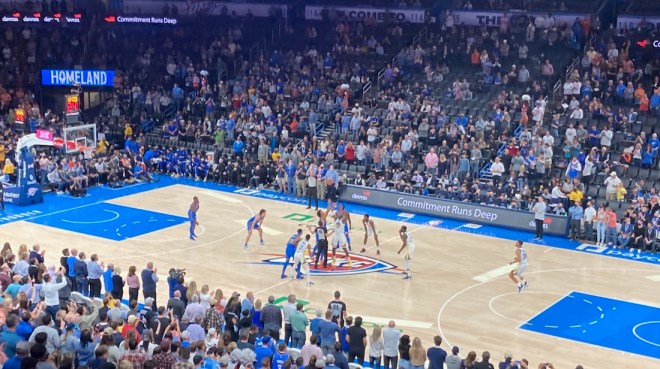
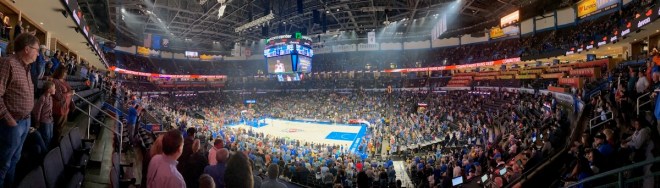
A wide shot of Paycom Center during a Thunder game early this past season.

I admit that I was caught off guard when Oklahoma City Mayor David Holt alerted us to impending negotiations with the NBA Thunder about a new arena.

I shouldn’t have been.

The NBA and its franchises can be incredibly demanding of hosts cities as far as facilities they use. Here’s a list of every NBA arena and the years they were built. 

In Holt’s book, “Big League City,” written in the afterglow of the Thunder franchise relocating to OKC, he talks about how critical a $120 million arena improvement special tax package was to that decision.

But that was 14 years ago, and there’s been a lot of Thunder games under the bridge, so to speak. I never gave the length of their lease agreement a second thought.

So, last week’s announcement came as both a surprise and a disappointment. Seems like Paycom Center was built only yesterday, but turns out it is already 20 years old.  Arenas must age in dog years.

After my initial anger subsided, I’ve come to accept the reality that OKC — and Thunder fans like me — find themselves in.

For all sorts of reasons — amenities, size, not built specifically for the NBA, perceived second-rateness — the city must build the Thunder a new arena within the next decade.

A new showcase arena will set us back at least a half billion dollars, if not much more.

Consider that American Airlines Arena in Dallas was built in 2001 at a cost of $420 million (and the Mavericks already are pushing for a new arena). How high will inflation drive the cost past that?

Holt’s job now becomes that of selling OKC residents on another special financing package, whether it’s part of a new MAPS deal or a special sales tax like that passed in 2008. I hope the city can negotiate a deal that requires the Thunder to share some of that cost.

But I’m not holding my breath.

paycom1
Paycom Center exterior (Oklahoman photo)

It’s not a scenario I’m rushing out to embrace, but I do see the reality of the OKC’s situation. Remember what happened to Seattle when that city refused to build a new arena to the Sonics’ specifications?

Thank you very much, Seattle.

And you know there are cities all over the nation that would jump at the chance to claim our franchise as their own and build it a billion dollar Taj Mahal.

Find out more about the perceived need for a new arena from this column by Berry Tramel published in Sunday’s Oklahoman.  Berry, like some other folks I know, speaks of Paycom Center as if it’s a tarpaper shack.

Anyway, I got a glimpse this morning of what Holt is up against in convincing voters to accept a new arena. I was at church chopping up the arena prospects with a friend when someone overheard us and wanted to know the topic.

We told him we were discussing the prospects of a new arena for the OKC Thunder.

“What?” he asked. “No way. Paycom is how many years old? No way will that happen.”

And this guy is the former CEO of an OKC-based company with two college-age kids. He’s not even in the demographic that I see as most opposed to a new arena.

So that brings me to the real purpose of this blog post. Who will be most opposed and who will support the new arena? I’m weighing in with my totally non-scientific observations.

I’ll start with those I see as most likely to oppose a new arena built by OKC for the Thunder:

First, it’s people in my demographic who are over the age of 65. Or what I call the get-off-my-lawn crowd. That includes many people who live in suburban areas of the city and have never attended a Thunder game. These folks poo-poo’d the whole MAPS initiative beginning back in the early ’90s and continue to disparage it today. Apparently, they were fine with our downtown the way it was in 1989 because they never went down there. And remember, statistics show that older citizens are far more likely to show up at the voting booth whenever a new arena hits the ballot.

Second, up-and-coming young people from the urban core who are focused on social issues. They are asking ‘why would we spend half a billion dollars or more on an arena for a professional sports team while we ignore the plight of hundreds of our citizens who are without shelter, food, sanitation and health care?’ That’s a legitimate and tough question to answer .

Third, people who recognize the opportunity costs of building a new arena. If we pour half a billion dollars (or more) into a new arena, we’re limiting the potential of other legitimate economic development drivers in our community. On Facebook, one pundit cited articles that show publicly built sports arenas don’t return the promised economic impact. Another example I saw: If we tear down the old Cox Center to build a new arena, our best facility as a set location for the film industry disappears. And that’s an industry just now gaining some real momentum in Oklahoma.

So, who supports a new arena?

The first group is pretty easy. They’re the 30-year-old Thunder fans who obsess over the team’s tanking philosophy, where the Thunder will end up in the draft lottery each year and over-analyze who will be the team’s next pick. Naturally, they will support a new arena because they are offended that our players have to play home games in an obvious shanty like Paycom Center. HAVE YOU NOT SEEN CHASE CENTER IN SAN FRANCISCO? But this is a pretty small voting block, all in all.

I see the second group as led by Oklahoma City business and community leaders who endured the OKC of the 1980s and enjoy what the city has become in 2022. They can point to both the MAPS projects and the arrival of the Thunder as critical elements to turning our city from eyesore into a showcase. If we refuse to build a new arena, there’s a risk that the team could be sold and relocated to one of dozens of cities salivating for the opportunity to become their own Big League City. And we turn back the clock on two decades of economic development. I believe this is a sizable, influential voting block.

Finally, I see the third group of supporters as being that large block of Thunder fans and season ticket holders. The NBA season has become as much a part of their lives as going to church on a Sunday or taking the kids to school. It’s what they do. They schedule their lives around the Thunder season, whether it’s watching the games on TV or driving down to Paycom Center 41 times a season. There’s a legion of loyal Thunder fans whom I believe will be a major source of support for a new arena.

Mayor David Holt and OKC civic leaders have a big job ahead to gain majority support of a new arena. I don’t envy you.

But as I told my friend Steve Buck last week, I’ll grit my teeth and support a new arena, because that’s our only real option.

Let’s not risk taking OKC back to the 1980s.

paycom2

The ‘first’ video game, Pong turns 50 this summer

Atari logo screenSomewhere in the early 1970s, I stumbled upon a video game called “Pong,” and was immediately infatuated. I couldn’t get enough, playing the game against my cousin on an old black and white television.

If you remember Pong, you know it was a simple game that featured two paddles and a sort of ball-like squarish blip that made a cool sound when it connected with the paddle. You connected Pong to your television and used simple controls to move the paddles to return the “ball” to your competitor in a crude table tennis simulation.

That’s all Pong could do, but the world had really never seen a game like this that could be played on your TV. Pong even kept score for you at the top of the screen.

Pong screenTurns out, Pong is hailed as the world’s first video game and it was released 50 years ago this summer. It was created by a young inventor and entrepreneur named Nolan Bushnell, who founded Atari to market Pong and other games.

I recently saw a Q&A published with Bushnell on the Daring Fireball website. The Q&A caught my eye because I had the opportunity to interview Bushnell during an appearance at the Oklahoma History Center in 2006.

Click here to read the story I wrote for The Oklahoman from that event. 

Anyway, Atari became a huge hit after it licensed Pong to Sears and the national retailer sold 150,000 units of the game. That led to other popular Atari games.

Bushnell eventually sold Atari in 1976 to Warner Communications for a reported $28 million.

Pong was such a ground-breaking innovation that today Bushnell is known as the “Father of the Video Game” and was named to Newsweek magazine’s list of “50 Men Who Changed America.”

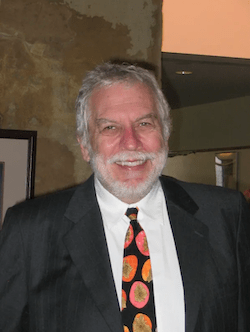
Bushnell
Nolan Bushnell in 2006 (Oklahoman photo)

In his Oklahoma City appearance back in 2006, Bushnell talked about how Pong was created and designed on the circuit board to do only one thing.

“What I did was create the video game out of digital building blocks,” Bushnell said. “But it was architected in such a way that this board was designed to play Pong and that was all that it would ever do.”

Atari released many other game titles, including Breakout and Combat, after its success with Pong and eventually produced a popular personal computer. The Atari 2600 game console is considered one of the most successful game platforms in history.

An aside: I’m also a Steve Jobs fan, and discovered a connection between Jobs and Bushnell from reading the Walter Isaacson biography of Jobs published in 2011. Bushnell hired a 19-year-old Steve Jobs to work at Atari to develop another game known as “Breakout.” Read more on the Bushnell-Jobs relationship here. 

So, Nolan Bushnell created Pong, founded Atari and single-handedly launched a multi-billion dollar industry. But I can’t forgive him for one thing.

He also founded the Chuck E. Cheese restaurant chain.

BONUS:  Read this fascinating Wired magazine story about the creation of Pong and how Bushnell scammed a young software engineer to come to work for him to make the game a reality. https://www.wired.com/story/inside-story-of-pong-excerpt/

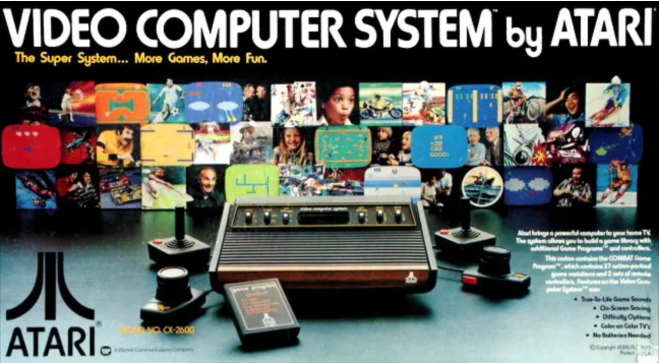
Atari system

When a line was drawn on the price of gas

gas prices
The sign shows gas prices at the OnCue at Western Ave. and Edmond Road on Tuesday morning.

As I fueled up my vehicle the other day with unleaded gas priced at the bargain price of $4.57.9 a gallon, it stirred a memory that I clearly recalled from 1973.

Gas prices were suddenly rising in the early ’70s when I heard an angry young man defiantly declare the line he was drawing in the sand.  It was in a time when Americans had been comfortable for years paying 30, 40, 50 cents a gallon.  

“I’ll never pay $1 for a gallon of gas,” he said.

So, how did that work out for you, fella?

I was living in Western Arkansas at the time, two years out of high school. A Sunday afternoon of what I will call sandlot football brought me into contact with a dozen or so local yahoos.

Somehow, the topic of the Arab oil embargo and gas prices became the focus of discussion among the group, when one guy defiantly declared what he would never pay for a gallon of gasoline.

Nearly 50 years later, I can still clearly hear his defiant tone and how I wondered at the time how a young man living in small town Arkansas could be so delusional. 

Would he beat the $1 gas price by purchasing fuel with a gun? Hunting down robber barons in the oil industry? Committing suicide just before the price crossed over the $1 rainbow from $.99.9?

Turns out, gas prices topped $1 a gallon not too many months after the bravado that I heard on that Sunday afternoon.

So, nearly half a century later, we find ourselves in another situation where gasoline prices are setting all-time highs. I’m not assigning blame like I read from so many who think President Biden should just pull a lever and prices will fall back to $1 and some change.

In today’s world, we’re at the mercy of Putin’s war, limited refining capacity, and, well, the robber barons who control the flow.

I will say this. Climbing fuel prices are a great incentive to get people to try public transportation.  Or electric vehicles.

Surely, in 2022 there’s no one foolish enough to declare that he will “never pay, uh, $6? $7?, for a gallon of gas.”

It could happen tomorrow.

Cattlemen’s: A birthday tradition like no other

cattlemens sidewalk
A sidewalk selfie outside of Cattlemen’s Steakhouse on the occasion of my birthday.

“Nobody goes there anymore. It’s too crowded.”

This quote is attributed to baseball Hall of Famer Yogi Berra after he was once asked about eating at a famous restaurant in New York City.

Yogi could have been speaking about Cattlemen’s Steakhouse in Oklahoma City in 2022.

Credited as being the oldest restaurant still operating in OKC and which once allegedly changed ownership at the roll of some dice, Cattlemen’s remains incredibly popular and busy.

Lunch at Cattlemen’s on my birthday with my wife has been a family tradition of ours for more than a decade.

So, today, on the occasion of my 69th trip around the sun, we made our pilgrimage to the mecca of OKC restaurants.

Located in the Stockyards City area adjacent to the Oklahoma National Stockyards, Cattlemen’s was playing to a full house this afternoon.

Of course.

And we didn’t arrive until 1:30.

But since there were only two of us, we were escorted to a table after a wait of only a couple minutes. Larger groups waited outside on the sidewalk.

The meal was awesome, as always, but what I really go for is the giant yeast roll that comes with the steak. It is my downfall. Oh, and the basket of melba toast that comes out with the salad.

Our waitress was so accommodating and took our photo as we sat at the table, then we followed up with a selfie on the crowded sidewalk outside.

cattlemens inside
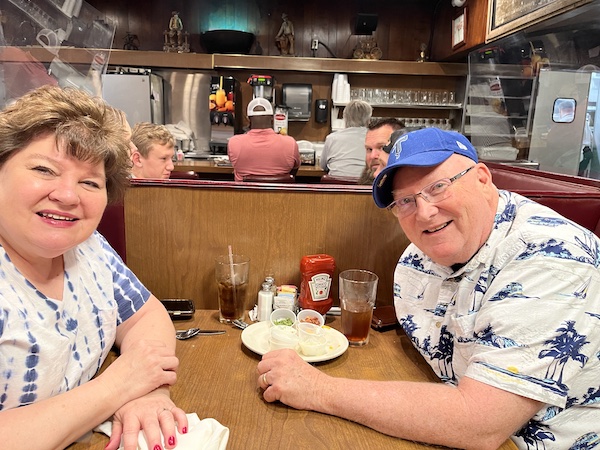
Paula and Jim inside Cattlemen’s Steakhouse

As we were pulling out of the lot behind the restaurant after enjoying the meal, we looked around at the many western-themed businesses in the Stockyards City area.

“There wouldn’t be all these businesses without Cattlemen’s,” Paula said as she looked acoss the intersection of Agnew and Exchange.

You’ve got that right. Cattlemen’s definitely is the engine that drives the Stockyards City economy.

It IS too crowded. But people (like us) keep coming year after year. And it’s worth the wait.

An infield fly and the ‘archaic’ rules of baseball

double shift
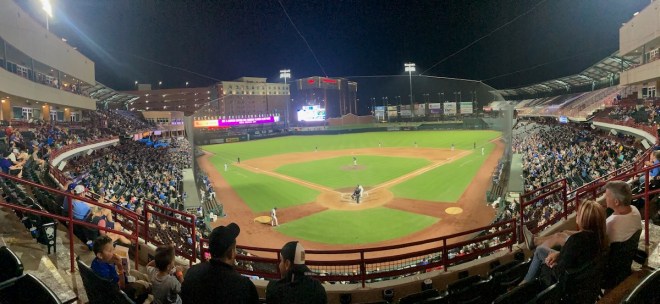
Albuquerque’s infielders are playing a radical shift during Saturday’s game with only one player between second and third base.

A fun thing about watching a baseball game is you can count on seeing an outstanding fielding play or an unusual circumstance during any given game.

It happened Saturday night in the bottom of the fourth inning at Chickasaw Bricktown Ballpark in the game between the Albuquerque Isotopes and our OKC Dodgers.

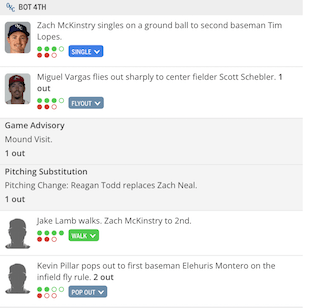
As I sat with my friend Casey Harness, the infield fly rule was called on a popup by OKC’s Kevin Pillar with runners on first and second base.

Albuquerque’s first baseman attempted to field the high popup, but it bounced off his glove. The umpire’s fist and thumb were already up signaling an out. The runners never moved.

play by playI’ve witnessed many similar situations at games throughout the years, but can’t recall when an infielder missed the ball with runners on base and the infield fly rule was invoked.

It’s not that I was unaware of the infield fly rule or knew that it was in effect on a popup with runners on base and less than two outs.  Read more about the infield fly rule here.

It’s that it is so rarely invoked because fielders at this level rarely misplay a popup in the infield like that.

Casey, who is a long-time Dodgers season ticket holder and has attended far more games in recent seasons than me, questioned the call. Why was the batter out before the ball even hit the ground? Why weren’t the runners running?

Well, if the fielder purposely dropped the ball and there was no infield fly rule, the Isotopes could have easily turned a double play. Maybe a triple play if things fell right.

Casey was not satisfied with that answer.

“This is archaic, unnecessary and downright confusing,” he said.

OK, but baseball was created in the 1800s and the rules were developed long ago. They (mostly) make sense to me.

casey
OKC Dodgers season ticket holder Casey Harness at the April 9 game between the Dodgers and the Isotopes.

Turns out, Casey has other ideas to make the game more interesting. He’s been watching a lot of women’s softball because the OU women’s team has been so dominant in recent years. Especially this year, when they are still undefeated and currently 36-0.

“Why not eliminate the pitching mound so pitchers don’t have the advantage of throwing downhill?” Casey opined at one point during the game.  “Softball pitchers don’t need that advantage.”

“Are you going to let them move up to 43 feet?” I asked?

“Sure, if they want to pitch underhand.” (Smirk).

OK, Casey, you’ve gone a bridge too far.

Instead of the infield fly rule or the pitching mound, we could be arguing over the dramatic infielder shift that has gained popularity in recent years. If you squint at the photo at the top of this post, you will see that there is only one infielder to the left of second base.

The shift is designed to take away hitting lanes for left handed batters and has a lot of detractors. Rules changes may be soon coming.

Meanwhile, let’s enjoy softball for what it is and let baseball continue to entertain us with its sometimes quirky rules like the one that results in an automatic out when the ball is put in play.

We can live with the infield fly rule.

OKC’s TokenEx draws $100 million investment

ALEX1
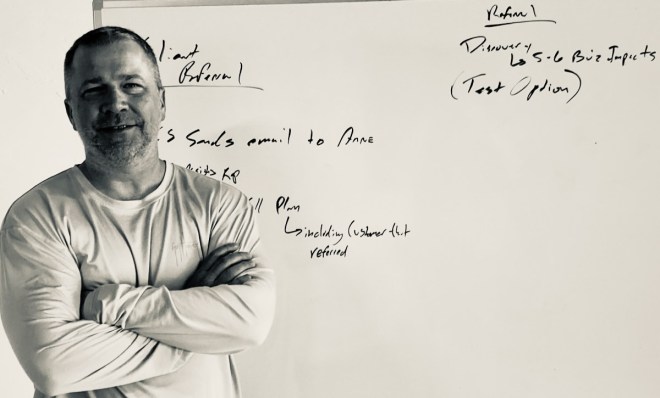
TokenEx co-founder Alex Pezold stands in front of a whiteboard in the company’s Oklahoma City offices

Something big for all Oklahomans recently flew under the radar locally, and I thought BlogOKC would be a great place to shine some light.

OKC’s TokenEx received a Series B investment round of $100 million.

$100,000,000. That’s a lot of zeros.

TokenEx logoIf you are unfamiliar with the company, TokenEx developed proprietary technology that “desensitizes” critical information by replacing it with tokenized placeholders that have no relation to the original inputs.

So, if a hacker breaks into a company’s server and steals sensitive data such as credit card or Social Security numbers, tokenization renders the information useless to the data thief.

Co-founded by Alex Pezold, CEO, and Jerald Dawkins in 2010, TokenEx is located in the Port164 office center in far northwest Oklahoma City. It employs 72 people who are constantly innovating improvements to the tokenization software.

I became acquainted with Pezold and Dawkins through past work with i2E, Inc., and the Oklahoma Center for the Advancement of Science and Technology (OCAST). TokenEx’s early development work was supported by funding from OCAST’s Oklahoma Applied Research Support program and the OCAST Technology Business Finance Program managed by i2E.

Read more on TokenEx in an article I wrote last year on behalf of OCAST.

The latest investment round was led by Manhattan Beach, Calif.-based K1 Investment Management, LLC, which led me to ask Pezold about location implications for TokenEx.

Pezold was adamant that TokenEx was, is and continues to be an Oklahoma-based venture.

“TokenEx always has been and always will be an Oklahoma-first business,” he said. “We continue hiring locally and actually relocating professionals into the state of Oklahoma! Of course, due to the pandemic, our hiring practices have adapted accordingly so our business can thrive. “

The latest investment round will allow TokenEx to expand its “go-to-market capabilities” while enabling it to continue to create new products and solutions, Alex told me.

Pezold and his team built this business amid an extremely competitive market, yet drew investor interest from more than 10 different potential equity partners before the K1 Investment Management deal.

“We selected K1 Investment Management because of their progressive practices around partnering with and growing their portfolio companies,” Alex said. “K1 has already been a great partner to TokenEx, and we expect our partnership to progress nicely as our cultures blend extremely well – and we are aligned as partners with our goals.”

Tokenization screenDemand for TokenEx’ tokenization solution continues to increase in urgency. There were 1,862 data breaches last year according to the International Association of Privacy Professionals.

Meanwhile, new legislation was proposed in Oklahoma designed to protect data privacy, and similar laws are being adopted around the nation and the world.

“As we’ve seen even here in Oklahoma recently, legislation around protecting privacy data for Oklahoma constituents is only increasing, which is the opportunity we will capitalize on in he next 2-5 years,” Alex said. “The good news, TokenEx is already protecting both payment and privacy data today, so it is only natural that we will continue growing in both addressable markets.”

I’m proud that TokenEx was created in Oklahoma and continues to be an Oklahoma-based company.

Click here to read an article from VentureBeat that details the investment.

A proposal: let’s destroy ‘The Process’ in the NBA

Thunder arena
Plenty of good seats available shortly before tipoff at a Thunder game in February this season.

Editor’s note: Although I attribute the concept described in this post to radio talk show host Dan Patrick, my friend Don alerted me to the fact that it was originally floated by sports guru Bill Simmons.  So, I want to give credit where it’s due, and a salute to Simmons for a worthy idea.

On the list of things in this world that make me crazy, you can put the concept of “tanking” by professional sports teams close to the top.

If you’re not a sports fan, you should know that tanking means a team is trying to maneuver for the best possible draft position. It does that by having as bad a record as possible at the end of the season.

Sometimes it’s called ‘The Process’ (wink, wink).

Teams tank not by asking their players to not play hard, but by manipulating the roster so their least experienced get most of the playing time. I offer the Oklahoma City Thunder’s mostly G-League lineup down the stretch this season as Exhibit A.

Oklahoman columnist Berry Tramel put it best last fall when he wrote “losing is the path to winning.” The idea is that if a team is horrible for two, three, four seasons it will eventually be able to draft the next ‘unicorn’ that will turn it all around.

Meanwhile, local fans lose incentive to follow their team and actually show up at games. The thousands of unused seats on a nightly basis at Paycom Center this season is a prime example.

I wrote about my opposition to tanking and the need to take a “win now” philosophy before the season began. You can read it here.

But today, I’m here to offer an alternative to the tanking strategy that will keep fans more engaged as the season concludes. I credit this idea to radio talk show host Dan Patrick,  who proposed something similar on his show earlier in the season.

Here’s how it would work as I envision it:

The NBA would create an in-season, six-week tournament for the bottom teams in the standings. The league would set an in-season cutoff date of February 28 with the six teams with the league’s worst records qualifying for the tournament.

Then for the remaining six weeks of the season, qualifying teams would play to win as many games as possible before the season ends. The team that has the best record in the season-closing “tournament” would be awarded the No. 1 pick in the draft.

Thunder actionTeams would have every incentive to put their best roster on the court. Fans would have a reason to show up and cheer their local team down the stretch.

The league could make a big deal out of the tournament, with separate nightly standings, maybe even a trophy for the winning team. The rest of the draft order for the bottom six would follow according to their finish in the tournament.

However, it needs a name. The Race to Save Face? Bottoms Up? Sprint to the Finish? I’ll let the marketers handle that.

My friend Steve poo-poos this concept because the league’s conferences are not balanced talent-wise. But he’s a tanking enthusiast and wears unicorn-colored glasses.

So, what does happen if the team with the seventh worst record on Feb. 28 loses so many games that it has the league’s worst record by season’s end?

That team is shut out of the tournament, so it only gets the seventh pick in the draft order. But it has no incentive keep losing, and that’s the point.

Thank you, DP, for sharing this idea.

So, what’s keeping the league from adopting The Race to Save Face and creating some excitement for bottom-feeding teams?

Nothing that I can see. Let’s destroy “The Process.”

Coffee shop discovery on the road to nowhere

Solomon sits at the bar at Kingfisher’s Strange Brew coffee shop as our barista, Trent, makes our drink in the background.

Our 2-year-old grandson suffered from a case of cabin fever this afternoon, which meant that toys were strewn across the living room and nothing pleased the frustrated boy.

We decided a road trip was in order.

As I gathered Solomon into my arms and carried him to the car, my wife asked me where we were going. I told her I didn’t know, but would let her know when we got there.

So, we pulled out of the driveway about 2 p.m. with no destination in mind, but thinking about discovering a cool coffee shop in a nearby small town.

I headed northwest out of Edmond and decided that Kingfisher might make a good destination. It’s only about 40 minutes from our house, and I love the Main Street look of its downtown.

I figured the town with a population of about 5,000 was bound to have a local coffee shop or two.

Sure enough, we passed a billboard advertising a coffee shop named Strange Brew Coffee House and Tea Room as we entered Kingfisher’s city limits. And that’s where we landed at 2:50 p.m., 10 minutes before its 3 p.m. closing.

The shop was empty except for “Trent,” our barista, as we stepped in. I apologized for barging in so near closing, but he welcomed us in. I ordered an iced mocha and looked around the place as Trent made the beverage.

Strange Brew — also the name of an Eric Clapton recording — has sort of a classic rock theme with posters and faux records on the tables. Trent wore a Led Zeppelin T-shirt that matched the decor of the small shop.

I placed Solomon on a chair at the bar and explored for a few minutes. Trent said the busiest times were early mornings on certain days and the 11 o’clock hour during the work week.

The iced drink arrived within a few minutes, and it was perfect for an 80-degree March afternoon. Trent also rewarded Solomon with some complementary whipped cream for the road.

We loaded back in our car and headed east out of Kingfisher precisely at the Strange Brew’s 3 p.m. closing time.

For a Saturday afternoon drive that began without a destination, Kingfisher and the Strange Brew made it an excellent road trip. And Solomon was a happy boy as we pulled back into our driveway.

Now I’m plotting future drives on the road to nowhere.

Perspective: Paul Whitmire & the urban ministry of Cross & Crown

The 9th and McKinley location of the Cross & Crown Mission

Paul and Suzanne Whitmire are “urban missionaries” who serve a vast underserved population in the heart of Oklahoma City at 9th and McKinley. Cross & Crown Mission was launched in 2001 by the Whitmires and others from their home church group. They immediately began rehabbing a dilapidated old church property, and for the last 20-plus years have remade the surrounding neighborhood and the lives of many of those they serve. Paul and Suzanne emerged from the church I attend when it was known as Quail Springs Church of Christ. Our congregation, now known as The Springs Church of Christ, still supports our urban missionaries two decades later.  Paul recently took the time to answer a few questions about his ministry for this BlogOKC feature. 

Question: Where were you raised and what did you do in previous life before Cross & Crown?

Answer: My father was a minister. While living at home, we lived in seven different towns, mostly Texas. I graduated high school in Houston, college from Abilene Christian University. I served as a youth minister in Fort Worth from 1979-1984, youth minister in Edmond from 1984-1992, operated an antique business from 1992-2001. Began Cross & Crown in March 2001.

Q: Tell me the story of how you came to launch this ministry in this part of the city?

A: We considered moving to Honduras. God moved us to 9th and McKinley. Most people said ‘don’t go to that area.’ God said ‘go to that area.’ (For more on the founding of Cross & Crown Mission, read this story by Bobby Ross published in The Oklahoman in 2001 ).

TheWhitmires
Paul and Suzanne Whitmire

Q: Who has worked with you and your wife, Suzanne, over the years to advance the ministry?

A: The work was originally shared by our house church with the ultimate plan to be primarily operated with people from the community. God keeps sending people. Some receive and leave, some receive and come back for more, some receive and come back to be a part of giving to others.

Q: What obstacles have you faced in this journey to provide ministry through the Cross & Crown Mission?

A: Big obstacles early. Most were because we said ‘but how?’ Finances, trust of the community, paying the bills, getting enough food. Someone asked early on if I knew how much it would cost to make the old building usable? I told him I know someone that has more money than we could ever need. He wanted to know the guy’s name. I gave him my Bible.

outside foodQ: What population are you serving, (and how have you gained their trust over the years?

A: We serve whoever shows up. About 65 percent are hispanic. The group with the most to fear. We try to meet their request; we ask to pray; we act humbly. It has worked. Many gave fake names early, then shared their real names later.

Q: How do you balance providing for physical needs and well being of those you serve and being a spiritual influence or leader for them?

A: We have discovered that graciously meeting physical needs eventually leads to them asking the question of ‘why?’ You get the rest.

Q: How would you describe the impact Cross & Crown has had on the neighborhood surrounding your location?

A: Early into the work, housing became an ongoing need. We followed Isaiah 61:1-4 and decided we would ‘restore the places long devastated and renew the ruined cities.’ It has significantly changed the landscape.

Inside clothingQ: What type of services do you provide?

A: The primary services provided: food, clothing, furniture, medical, legal aid, housing, education of youth, Bible study, worship, baby supplies, prayer.

Q: What’s a typical day look like at the mission?

A: Sunday morning worship; Monday-Wednesday: food pantry, clothing, furniture. Wednesday: legal aid; Thursday-Saturday: projects in the neighborhood. Primary focus: being in the neighborhood constantly to meet people’s needs, being Jesus to others.

Q: How often do you offer worship services?

A: Worship service: Sunday morning 10:30-12, English and Spanish.

Q: From where have you drawn your volunteers over the years?

A: Our volunteers come from around the city or live in the neighborhood or are in our housing programs. Our paid staff are all self-supported missionaries , such as myself.

prayer crosscrown (1)Q: How do you measure the success of your ministry?

A: I wish I knew how to measure success, but I trust God with that. I knew if they were hungry and we fed them; needed clothes and we provided them; they were thirsty and we gave them drink; homeless and we housed them; alone and we invited them in; were drunk for 40 years and we helped them to be sober for one day; never thought God loved them and we showed them love, led them to Jesus, became family when they had none; then it’s a good day to me.

Q: How has the ministry expanded, and its mission changed or evolved over the years?

Luke whitmire
Luke Whitmire & family

A: The ministry began with food from ours and your pantries, then relationship with the Regional Food Bank, relationship with Walmart, Dollar General, pastry shops. Taking people home with us — to 11 properties to house people; two attorneys to address legal needs to 150 partnering attorneys available. From after school with children in basement to new Youth Center, to Classical Arts school for neighborhood children. And on and on. In the midst of the pandemic we began a south side mission in Capitol Hill.  It’s known as the Christian Service Center, with Luke Whitmire as director and minister.

Q: How do you describe yourself to people you meet along the way?

A: When people ask what I do, (I say) ‘I’m the director of an inner-city non-profit.’ Then it’s up to them to be curious. An hour later they have a pretty good idea of what I do, and maybe wished they had been satisfied with my first answer. It’s normal that I will be in tears, and maybe them, as well. God is pretty amazing.

Q: How can local people contribute or participate as volunteers?

bikerA: Donate or volunteer. Donate almost anything if it works. Clothes, food, appliances, furniture, cars. Call Paul at (405) 232-7696. Volunteer — let’s get past COVID.

Q: What else would you want readers of this blog to know about you or the Cross & Crown mission?

A: This work is the Lord’s. He wants it to be the work of all of us. We need financial donors, we need prayer warriors, we need material donations.  

Q: What do you want to say to the people of The Springs church, where you were when you began the ministry?

A: The people of The Springs were there with us when we began in 2001. They have supported and prayed for us continually. They have never burdened us with expectations or demands. They have faithfully been family to us and blessed us richly. We are not alone because of you.

Follow the Cross & Crown Mission on Facebook

Facebook won’t let milestone pass unnoticed

FB screen
Facebook founder Mark Zuckerberg

Facebook has become somewhat of a boogeyman for millions of people worldwide, and the criticism is well earned. The social network collects data on subscribers. It tracks users across the web. And it’s a boiling concoction of crazy conspiracy theories and crazy uncles.

But sometimes Facebook surprises me in a good way.

Today, it showed past January 27 posts from my timeline, and one popped up that I had given no thought to until I saw it.

fb memoryOn this day in January 2019 I underwent double heart bypass surgery at Oklahoma Heart Hospital. It’s an anniversary of a life-saving medical procedure that is definitely worth noting personally.

So, I decided I should share it with you. The FB memory was actually posted by my wife when it was clear that I had survived the surgery and had a good prognosis.

I spent the next four nights in the hospital before making a very anxiety-filled trip home where the real recovery began.

Three years later I’m close to being my old self and moving on with my life pretty much as before. Maybe just a little slower.

Thank you, Dr. Randolph, the gifted surgeon who literally held my life in his hands for about six hours.

And thanks to Facebook, which made sure I remembered the milestone day in my life.