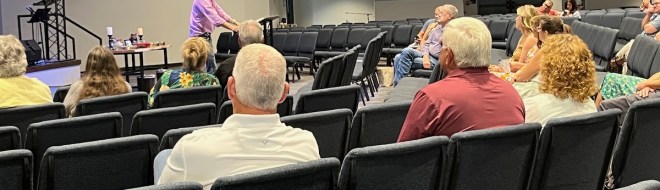
A Sunday morning adult class at The Springs Church of Christ in Edmond
First off, let me say up front that I am NOT wearing an aluminum helmet as I write this. And our windows are not covered with foil to keep mind-controlling radio waves out.
But sometimes weird coincidences happen, especially with our cell phones.
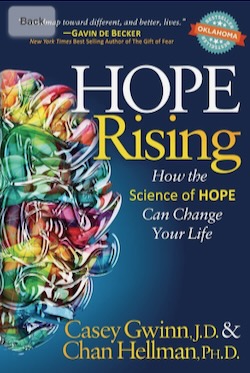
I was sitting in a Sunday morning class on the topic of ‘hope’ at our church a few weeks ago, listening to a lesson presented by Chad Hellman, Ph.D., a University of Oklahoma professor and co-author of the excellent book “Hope Rising: How the Science of Hope Can Change Your Life.”
Dr. Hellman discussed subjects like how childhood trauma impacts the future lives of children, and how pursuing “hope” as he defined it can help people — young and old — set goals and achieve them as they pursue a better life.
My wife, Paula, was seated next to me, and near the end of Dr. Hellman’s presentation she got a text alert from Apple news on her phone. It promoted an article on the order of “12 steps you can take for a happier life.”
Paula showed me the alert on her phone’s screen and whispered “they’re listening.”
We both smiled at the irony.
But it’s happened before. We’ve been in the car on trips having conversations on some topic when ads served up by Facebook on our phones eerily matched the subject.
Cue the Twilight Zone theme.
If you search “is my phone tracking my conversation” online, dozens of articles will pop up on the subject, including this one from the Washington Post that seeks to quell our fear.
Here’s the bottom line based on interviews with experts:
“It’s an old wives’ tale,” said Eric Seufert, who founded the marketing consultancy Heracles Media and runs a popular blog for app developers. “It’s this kind of mythical, horrific, but ultimately untrue, fear.’
‘The short answer is: No, your phone isn’t listening. But why is this rumor so hard to shake?’
Other articles take the possibility more seriously that conversations are being tracked by our phones, including this one from Fox News headlined: “You are not paranoid: your phone really is listening in.”
So, it’s a mixed bag of believers and skeptics. I only know from my own experience like the one during Dr. Hellman’s presentation on a Sunday morning.
‘The horse is here to stay, but the automobile is only a novelty — a fad.’ — American banker to potential investor in 1903
Even at the dawn of the 20th century, your crazy uncle was spouting off nonsense about things he didn’t know anything about.
I guess back in those days, social media rants took place at the local church, tavern or letter to the editor. New technologies have always brought out the doubters and naysayers, I guess.
One hundred years ago. Sarah T. Bushnell published a biography called “The Truth About Henry Ford” in which she told the story of the banker who advised the attorney that drew up incorporation papers in 1903 for Ford’s automotive company.
The attorney had been asked to invest in the Ford Motor Co., but was hesitant and sought out advice from his banker.
“My advice is not to buy the stock,” the banker said. “You might make money for a year or two, but in the end you would lose everything you put in. The horse is here to stay, but the automobile is only a novelty — a fad.”
We’re at the beginning of a revolutionary transition in which electric vehicles will replace gasoline and diesel powered vehicles. Auto manufacturers are building more EVs each year with commitments to make electric vehicles the vast majority of their production by the 2030s.
There seem to be an incredible number of Teslas already on Oklahoma roads.
Despite the upward trajectory and inevitable march of technology, I’m seeing rants against EVs every day on the social media platforms where I hang out. A lot of ‘crazy uncles’ are poo-pooing the potential of electric vehicles, along with alternative power generation from wind and solar energy.
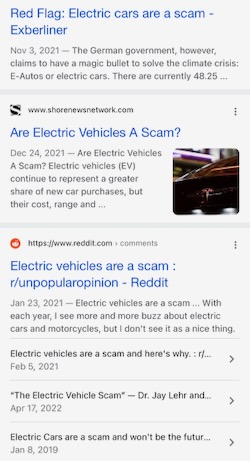
I’ve seen photos and graphs and charts that allege that electric energy is just as harmful to the environment as fossil fuels because of the mining for minerals and the ultimate disposal of batteries.
If you Google “electric vehicles” and “scam,” you get dozens of articles showing that the world is being played.
I’m no expert, but I choose to believe that scientists and innovators have taken all of that into consideration.
So, I assume a lot of folks — especially Oklahomans — are feeling threatened by alternative power and transportation because of our long-standing ties to the oil and gas industry.
It’s sort of ironic that oil and gas-dominated Oklahoma is home to one of the world’s first large scale electric vehicle battery remanufacturing and recycling ventures, Spiers New Technologies.
Founded less than a decade ago by Dirk Spiers, the company has shown phenomenal growth, quickly outgrowing its original 23,000 square feet of manufacturing space to now occupying its current 200,000 square feet in its operations center along SE 89th Street just east of I-35.
Spiers also operates a European location and provides battery lifecycle services to virtually every automaker with the exception of Tesla. The company showed such potential that it was acquired in 2021 by Cox Automotive.
But I want to share some of his perspective again in this post, because I think it’s both worthy and accurate.
“In the next five years, the cost of an electric vehicle will be cheaper than a combustion engine,” Spiers said. “So, we are only at the beginning of where we are going.
“The Devon tower — and I think it is a great building — is now more than 50 percent empty. That shows you how they (and Oklahoma City) misread the future. And now the Devon tower stands there as a symbol of Oklahoma City prosperity, but it is half empty. A relic of an industry in decline.
“The good thing is that you know eventually that everyone will drive an electric car. Those cards have been played. So, we are on the right side of history”
Although he added that the transition is not going to happen all at once, we’re watching Dirk’s predictions playing out every day.
Meanwhile, I’ll end this with the long-ago perspective of another futurist, former U.S. Supreme Court Justice H.B. Brown in a 1908 article entitled “The Horseless Carriage Means Trouble.”
“The automobile is doubtless a most useful vehicle, but one is not likely to lavish upon it the fond attention he bestows upon his horse or dog. A man may admire his own carriage, but his affections are reserved for the horse that draws it and the dog that follows it. Whatever the outcome may be, every true admirer of the horse will pray that it may not be the extinction or dethronement of the noblest of all domestic animals.”
In Holt’s book, “Big League City,” written in the afterglow of the Thunder franchise relocating to OKC, he talks about how critical a $120 million arena improvement special tax package was to that decision.
But that was 14 years ago, and there’s been a lot of Thunder games under the bridge, so to speak. I never gave the length of their lease agreement a second thought.
So, last week’s announcement came as both a surprise and a disappointment. Seems like Paycom Center was built only yesterday, but turns out it is already 20 years old. Arenas must age in dog years.
After my initial anger subsided, I’ve come to accept the reality that OKC — and Thunder fans like me — find themselves in.
For all sorts of reasons — amenities, size, not built specifically for the NBA, perceived second-rateness — the city must build the Thunder a new arena within the next decade.
A new showcase arena will set us back at least a half billion dollars, if not much more.
Consider that American Airlines Arena in Dallas was built in 2001 at a cost of $420 million (and the Mavericks already are pushing for a new arena). How high will inflation drive the cost past that?
Holt’s job now becomes that of selling OKC residents on another special financing package, whether it’s part of a new MAPS deal or a special sales tax like that passed in 2008. I hope the city can negotiate a deal that requires the Thunder to share some of that cost.
But I’m not holding my breath.
Paycom Center exterior (Oklahoman photo)
It’s not a scenario I’m rushing out to embrace, but I do see the reality of the OKC’s situation. Remember what happened to Seattle when that city refused to build a new arena to the Sonics’ specifications?
Thank you very much, Seattle.
And you know there are cities all over the nation that would jump at the chance to claim our franchise as their own and build it a billion dollar Taj Mahal.
Anyway, I got a glimpse this morning of what Holt is up against in convincing voters to accept a new arena. I was at church chopping up the arena prospects with a friend when someone overheard us and wanted to know the topic.
We told him we were discussing the prospects of a new arena for the OKC Thunder.
“What?” he asked. “No way. Paycom is how many years old? No way will that happen.”
And this guy is the former CEO of an OKC-based company with two college-age kids. He’s not even in the demographic that I see as most opposed to a new arena.
So that brings me to the real purpose of this blog post. Who will be most opposed and who will support the new arena? I’m weighing in with my totally non-scientific observations.
I’ll start with those I see as most likely to oppose a new arena built by OKC for the Thunder:
First, it’s people in my demographic who are over the age of 65. Or what I call the get-off-my-lawn crowd. That includes many people who live in suburban areas of the city and have never attended a Thunder game. These folks poo-poo’d the whole MAPS initiative beginning back in the early ’90s and continue to disparage it today. Apparently, they were fine with our downtown the way it was in 1989 because they never went down there. And remember, statistics show that older citizens are far more likely to show up at the voting booth whenever a new arena hits the ballot.
Second, up-and-coming young people from the urban core who are focused on social issues. They are asking ‘why would we spend half a billion dollars or more on an arena for a professional sports team while we ignore the plight of hundreds of our citizens who are without shelter, food, sanitation and health care?’ That’s a legitimate and tough question to answer .
Third, people who recognize the opportunity costs of building a new arena. If we pour half a billion dollars (or more) into a new arena, we’re limiting the potential of other legitimate economic development drivers in our community. On Facebook, one pundit cited articles that show publicly built sports arenas don’t return the promised economic impact. Another example I saw: If we tear down the old Cox Center to build a new arena, our best facility as a set location for the film industry disappears. And that’s an industry just now gaining some real momentum in Oklahoma.
So, who supports a new arena?
The first group is pretty easy. They’re the 30-year-old Thunder fans who obsess over the team’s tanking philosophy, where the Thunder will end up in the draft lottery each year and over-analyze who will be the team’s next pick. Naturally, they will support a new arena because they are offended that our players have to play home games in an obvious shanty like Paycom Center. HAVE YOU NOT SEEN CHASE CENTER IN SAN FRANCISCO? But this is a pretty small voting block, all in all.
I see the second group as led by Oklahoma City business and community leaders who endured the OKC of the 1980s and enjoy what the city has become in 2022. They can point to both the MAPS projects and the arrival of the Thunder as critical elements to turning our city from eyesore into a showcase. If we refuse to build a new arena, there’s a risk that the team could be sold and relocated to one of dozens of cities salivating for the opportunity to become their own Big League City. And we turn back the clock on two decades of economic development. I believe this is a sizable, influential voting block.
Finally, I see the third group of supporters as being that large block of Thunder fans and season ticket holders. The NBA season has become as much a part of their lives as going to church on a Sunday or taking the kids to school. It’s what they do. They schedule their lives around the Thunder season, whether it’s watching the games on TV or driving down to Paycom Center 41 times a season. There’s a legion of loyal Thunder fans whom I believe will be a major source of support for a new arena.
Mayor David Holt and OKC civic leaders have a big job ahead to gain majority support of a new arena. I don’t envy you.
But as I told my friend Steve Buck last week, I’ll grit my teeth and support a new arena, because that’s our only real option.
Somewhere in the early 1970s, I stumbled upon a video game called “Pong,” and was immediately infatuated. I couldn’t get enough, playing the game against my cousin on an old black and white television.
If you remember Pong, you know it was a simple game that featured two paddles and a sort of ball-like squarish blip that made a cool sound when it connected with the paddle. You connected Pong to your television and used simple controls to move the paddles to return the “ball” to your competitor in a crude table tennis simulation.
That’s all Pong could do, but the world had really never seen a game like this that could be played on your TV. Pong even kept score for you at the top of the screen.
Turns out, Pong is hailed as the world’s first video game and it was released 50 years ago this summer. It was created by a young inventor and entrepreneur named Nolan Bushnell, who founded Atari to market Pong and other games.
Anyway, Atari became a huge hit after it licensed Pong to Sears and the national retailer sold 150,000 units of the game. That led to other popular Atari games.
Bushnell eventually sold Atari in 1976 to Warner Communications for a reported $28 million.
Pong was such a ground-breaking innovation that today Bushnell is known as the “Father of the Video Game” and was named to Newsweek magazine’s list of “50 Men Who Changed America.”
Nolan Bushnell in 2006 (Oklahoman photo)
In his Oklahoma City appearance back in 2006, Bushnell talked about how Pong was created and designed on the circuit board to do only one thing.
“What I did was create the video game out of digital building blocks,” Bushnell said. “But it was architected in such a way that this board was designed to play Pong and that was all that it would ever do.”
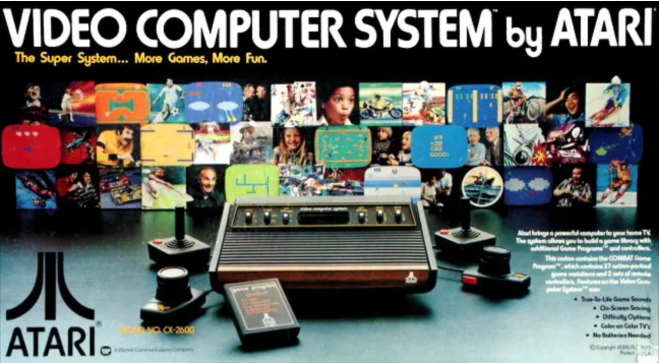
Atari released many other game titles, including Breakout and Combat, after its success with Pong and eventually produced a popular personal computer. The Atari 2600 game console is considered one of the most successful game platforms in history.
An aside: I’m also a Steve Jobs fan, and discovered a connection between Jobs and Bushnell from reading the Walter Isaacson biography of Jobs published in 2011. Bushnell hired a 19-year-old Steve Jobs to work at Atari to develop another game known as “Breakout.”Read more on the Bushnell-Jobs relationship here.
So, Nolan Bushnell created Pong, founded Atari and single-handedly launched a multi-billion dollar industry. But I can’t forgive him for one thing.
He also founded the Chuck E. Cheese restaurant chain.
BONUS: Read this fascinating Wired magazine story about the creation of Pong and how Bushnell scammed a young software engineer to come to work for him to make the game a reality. https://www.wired.com/story/inside-story-of-pong-excerpt/
The sign shows gas prices at the OnCue at Western Ave. and Edmond Road on Tuesday morning.
As I fueled up my vehicle the other day with unleaded gas priced at the bargain price of $4.57.9 a gallon, it stirred a memory that I clearly recalled from 1973.
Gas prices were suddenly rising in the early ’70s when I heard an angry young man defiantly declare the line he was drawing in the sand. It was in a time when Americans had been comfortable for years paying 30, 40, 50 cents a gallon.
“I’ll never pay $1 for a gallon of gas,” he said.
So, how did that work out for you, fella?
I was living in Western Arkansas at the time, two years out of high school. A Sunday afternoon of what I will call sandlot football brought me into contact with a dozen or so local yahoos.
Somehow, the topic of the Arab oil embargo and gas prices became the focus of discussion among the group, when one guy defiantly declared what he would never pay for a gallon of gasoline.
Nearly 50 years later, I can still clearly hear his defiant tone and how I wondered at the time how a young man living in small town Arkansas could be so delusional.
Would he beat the $1 gas price by purchasing fuel with a gun? Hunting down robber barons in the oil industry? Committing suicide just before the price crossed over the $1 rainbow from $.99.9?
Turns out, gas prices topped $1 a gallon not too many months after the bravado that I heard on that Sunday afternoon.
So, nearly half a century later, we find ourselves in another situation where gasoline prices are setting all-time highs. I’m not assigning blame like I read from so many who think President Biden should just pull a lever and prices will fall back to $1 and some change.
In today’s world, we’re at the mercy of Putin’s war, limited refining capacity, and, well, the robber barons who control the flow.
I will say this. Climbing fuel prices are a great incentive to get people to try public transportation. Or electric vehicles.
Surely, in 2022 there’s no one foolish enough to declare that he will “never pay, uh, $6? $7?, for a gallon of gas.”
Credited as being the oldest restaurant still operating in OKC and which once allegedly changed ownership at the roll of some dice, Cattlemen’s remains incredibly popular and busy.
Lunch at Cattlemen’s on my birthday with my wife has been a family tradition of ours for more than a decade.
So, today, on the occasion of my 69th trip around the sun, we made our pilgrimage to the mecca of OKC restaurants.
Located in the Stockyards City area adjacent to the Oklahoma National Stockyards, Cattlemen’s was playing to a full house this afternoon.
Of course.
And we didn’t arrive until 1:30.
But since there were only two of us, we were escorted to a table after a wait of only a couple minutes. Larger groups waited outside on the sidewalk.
The meal was awesome, as always, but what I really go for is the giant yeast roll that comes with the steak. It is my downfall. Oh, and the basket of melba toast that comes out with the salad.
Our waitress was so accommodating and took our photo as we sat at the table, then we followed up with a selfie on the crowded sidewalk outside.
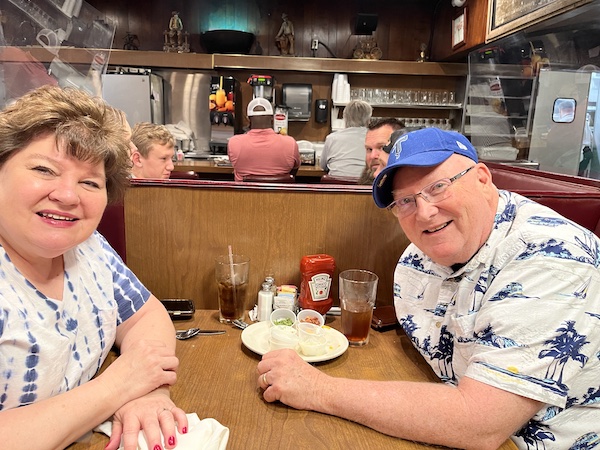
Paula and Jim inside Cattlemen’s Steakhouse
As we were pulling out of the lot behind the restaurant after enjoying the meal, we looked around at the many western-themed businesses in the Stockyards City area.
“There wouldn’t be all these businesses without Cattlemen’s,” Paula said as she looked acoss the intersection of Agnew and Exchange.
You’ve got that right. Cattlemen’s definitely is the engine that drives the Stockyards City economy.
It IS too crowded. But people (like us) keep coming year after year. And it’s worth the wait.
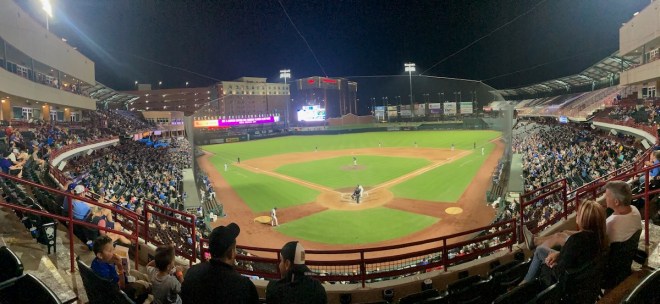
Albuquerque’s infielders are playing a radical shift during Saturday’s game with only one player between second and third base.
A fun thing about watching a baseball game is you can count on seeing an outstanding fielding play or an unusual circumstance during any given game.
It happened Saturday night in the bottom of the fourth inning at Chickasaw Bricktown Ballpark in the game between the Albuquerque Isotopes and our OKC Dodgers.
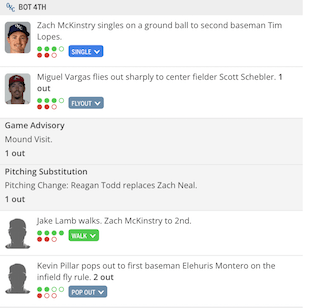
As I sat with my friend Casey Harness, the infield fly rule was called on a popup by OKC’s Kevin Pillar with runners on first and second base.
Albuquerque’s first baseman attempted to field the high popup, but it bounced off his glove. The umpire’s fist and thumb were already up signaling an out. The runners never moved.
I’ve witnessed many similar situations at games throughout the years, but can’t recall when an infielder missed the ball with runners on base and the infield fly rule was invoked.
It’s not that I was unaware of the infield fly rule or knew that it was in effect on a popup with runners on base and less than two outs. Read more about the infield fly rule here.
It’s that it is so rarely invoked because fielders at this level rarely misplay a popup in the infield like that.
Casey, who is a long-time Dodgers season ticket holder and has attended far more games in recent seasons than me, questioned the call. Why was the batter out before the ball even hit the ground? Why weren’t the runners running?
Well, if the fielder purposely dropped the ball and there was no infield fly rule, the Isotopes could have easily turned a double play. Maybe a triple play if things fell right.
Casey was not satisfied with that answer.
“This is archaic, unnecessary and downright confusing,” he said.
OK, but baseball was created in the 1800s and the rules were developed long ago. They (mostly) make sense to me.
OKC Dodgers season ticket holder Casey Harness at the April 9 game between the Dodgers and the Isotopes.
Turns out, Casey has other ideas to make the game more interesting. He’s been watching a lot of women’s softball because the OU women’s team has been so dominant in recent years. Especially this year, when they are still undefeated and currently 36-0.
“Why not eliminate the pitching mound so pitchers don’t have the advantage of throwing downhill?” Casey opined at one point during the game. “Softball pitchers don’t need that advantage.”
“Are you going to let them move up to 43 feet?” I asked?
“Sure, if they want to pitch underhand.” (Smirk).
OK, Casey, you’ve gone a bridge too far.
Instead of the infield fly rule or the pitching mound, we could be arguing over the dramatic infielder shift that has gained popularity in recent years. If you squint at the photo at the top of this post, you will see that there is only one infielder to the left of second base.
The shift is designed to take away hitting lanes for left handed batters and has a lot of detractors. Rules changes may be soon coming.
Meanwhile, let’s enjoy softball for what it is and let baseball continue to entertain us with its sometimes quirky rules like the one that results in an automatic out when the ball is put in play.
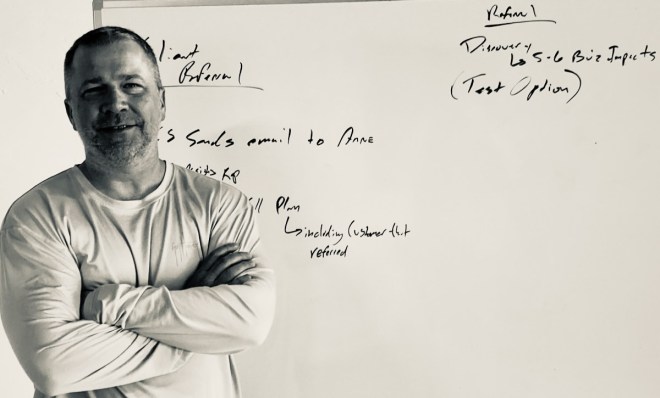
TokenEx co-founder Alex Pezold stands in front of a whiteboard in the company’s Oklahoma City offices
Something big for all Oklahomans recently flew under the radar locally, and I thought BlogOKC would be a great place to shine some light.
OKC’s TokenEx received a Series B investment round of $100 million.
$100,000,000. That’s a lot of zeros.
If you are unfamiliar with the company, TokenEx developed proprietary technology that “desensitizes” critical information by replacing it with tokenized placeholders that have no relation to the original inputs.
So, if a hacker breaks into a company’s server and steals sensitive data such as credit card or Social Security numbers, tokenization renders the information useless to the data thief.
Co-founded by Alex Pezold, CEO, and Jerald Dawkins in 2010, TokenEx is located in the Port164 office center in far northwest Oklahoma City. It employs 72 people who are constantly innovating improvements to the tokenization software.
I became acquainted with Pezold and Dawkins through past work with i2E, Inc., and the Oklahoma Center for the Advancement of Science and Technology (OCAST). TokenEx’s early development work was supported by funding from OCAST’s Oklahoma Applied Research Support program and the OCAST Technology Business Finance Program managed by i2E.
The latest investment round was led by Manhattan Beach, Calif.-based K1 Investment Management, LLC, which led me to ask Pezold about location implications for TokenEx.
Pezold was adamant that TokenEx was, is and continues to be an Oklahoma-based venture.
“TokenEx always has been and always will be an Oklahoma-first business,” he said. “We continue hiring locally and actually relocating professionals into the state of Oklahoma! Of course, due to the pandemic, our hiring practices have adapted accordingly so our business can thrive. “
The latest investment round will allow TokenEx to expand its “go-to-market capabilities” while enabling it to continue to create new products and solutions, Alex told me.
Pezold and his team built this business amid an extremely competitive market, yet drew investor interest from more than 10 different potential equity partners before the K1 Investment Management deal.
“We selected K1 Investment Management because of their progressive practices around partnering with and growing their portfolio companies,” Alex said. “K1 has already been a great partner to TokenEx, and we expect our partnership to progress nicely as our cultures blend extremely well – and we are aligned as partners with our goals.”
Demand for TokenEx’ tokenization solution continues to increase in urgency. There were 1,862 data breaches last year according to the International Association of Privacy Professionals.
Meanwhile, new legislation was proposed in Oklahoma designed to protect data privacy, and similar laws are being adopted around the nation and the world.
“As we’ve seen even here in Oklahoma recently, legislation around protecting privacy data for Oklahoma constituents is only increasing, which is the opportunity we will capitalize on in he next 2-5 years,” Alex said. “The good news, TokenEx is already protecting both payment and privacy data today, so it is only natural that we will continue growing in both addressable markets.”
I’m proud that TokenEx was created in Oklahoma and continues to be an Oklahoma-based company.
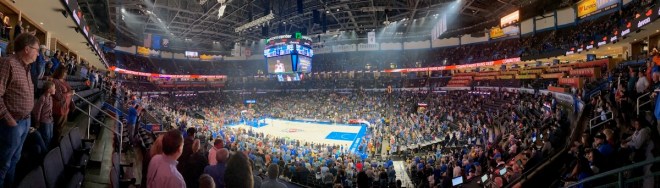
Plenty of good seats available shortly before tipoff at a Thunder game in February this season.
Editor’s note: Although I attribute the concept described in this post to radio talk show host Dan Patrick, my friend Don alerted me to the fact that it was originally floated by sports guru Bill Simmons. So, I want to give credit where it’s due, and a salute to Simmons for a worthy idea.
On the list of things in this world that make me crazy, you can put the concept of “tanking” by professional sports teams close to the top.
If you’re not a sports fan, you should know that tanking means a team is trying to maneuver for the best possible draft position. It does that by having as bad a record as possible at the end of the season.
Sometimes it’s called ‘The Process’ (wink, wink).
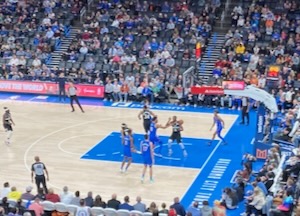
Teams tank not by asking their players to not play hard, but by manipulating the roster so their least experienced get most of the playing time. I offer the Oklahoma City Thunder’s mostly G-League lineup down the stretch this season as Exhibit A.
Oklahoman columnist Berry Tramel put it best last fall when he wrote “losing is the path to winning.” The idea is that if a team is horrible for two, three, four seasons it will eventually be able to draft the next ‘unicorn’ that will turn it all around.
Meanwhile, local fans lose incentive to follow their team and actually show up at games. The thousands of unused seats on a nightly basis at Paycom Center this season is a prime example.
I wrote about my opposition to tanking and the need to take a “win now” philosophy before the season began. You can read it here.
But today, I’m here to offer an alternative to the tanking strategy that will keep fans more engaged as the season concludes. I credit this idea to radio talk show host Dan Patrick, who proposed something similar on his show earlier in the season.
Here’s how it would work as I envision it:
The NBA would create an in-season, six-week tournament for the bottom teams in the standings. The league would set an in-season cutoff date of February 28 with the six teams with the league’s worst records qualifying for the tournament.
Then for the remaining six weeks of the season, qualifying teams would play to win as many games as possible before the season ends. The team that has the best record in the season-closing “tournament” would be awarded the No. 1 pick in the draft.
Teams would have every incentive to put their best roster on the court. Fans would have a reason to show up and cheer their local team down the stretch.
The league could make a big deal out of the tournament, with separate nightly standings, maybe even a trophy for the winning team. The rest of the draft order for the bottom six would follow according to their finish in the tournament.
However, it needs a name. The Race to Save Face? Bottoms Up? Sprint to the Finish? I’ll let the marketers handle that.
My friend Steve poo-poos this concept because the league’s conferences are not balanced talent-wise. But he’s a tanking enthusiast and wears unicorn-colored glasses.
So, what does happen if the team with the seventh worst record on Feb. 28 loses so many games that it has the league’s worst record by season’s end?
That team is shut out of the tournament, so it only gets the seventh pick in the draft order. But it has no incentive keep losing, and that’s the point.
Thank you, DP, for sharing this idea.
So, what’s keeping the league from adopting The Race to Save Face and creating some excitement for bottom-feeding teams?
Nothing that I can see. Let’s destroy “The Process.”
Solomon sits at the bar at Kingfisher’s Strange Brew coffee shop as our barista, Trent, makes our drink in the background.
Our 2-year-old grandson suffered from a case of cabin fever this afternoon, which meant that toys were strewn across the living room and nothing pleased the frustrated boy.
We decided a road trip was in order.
As I gathered Solomon into my arms and carried him to the car, my wife asked me where we were going. I told her I didn’t know, but would let her know when we got there.
So, we pulled out of the driveway about 2 p.m. with no destination in mind, but thinking about discovering a cool coffee shop in a nearby small town.
I headed northwest out of Edmond and decided that Kingfisher might make a good destination. It’s only about 40 minutes from our house, and I love the Main Street look of its downtown.
I figured the town with a population of about 5,000 was bound to have a local coffee shop or two.
Sure enough, we passed a billboard advertising a coffee shop named Strange Brew Coffee House and Tea Room as we entered Kingfisher’s city limits. And that’s where we landed at 2:50 p.m., 10 minutes before its 3 p.m. closing.
The shop was empty except for “Trent,” our barista, as we stepped in. I apologized for barging in so near closing, but he welcomed us in. I ordered an iced mocha and looked around the place as Trent made the beverage.
Strange Brew — also the name of an Eric Clapton recording — has sort of a classic rock theme with posters and faux records on the tables. Trent wore a Led Zeppelin T-shirt that matched the decor of the small shop.
I placed Solomon on a chair at the bar and explored for a few minutes. Trent said the busiest times were early mornings on certain days and the 11 o’clock hour during the work week.
The iced drink arrived within a few minutes, and it was perfect for an 80-degree March afternoon. Trent also rewarded Solomon with some complementary whipped cream for the road.
We loaded back in our car and headed east out of Kingfisher precisely at the Strange Brew’s 3 p.m. closing time.
For a Saturday afternoon drive that began without a destination, Kingfisher and the Strange Brew made it an excellent road trip. And Solomon was a happy boy as we pulled back into our driveway.
Now I’m plotting future drives on the road to nowhere.
 I was sitting in a Sunday morning class on the topic of ‘hope’ at our church a few weeks ago, listening to a lesson presented by Chad Hellman, Ph.D., a University of Oklahoma professor and co-author of the excellent book “Hope Rising: How the Science of Hope Can Change Your Life.”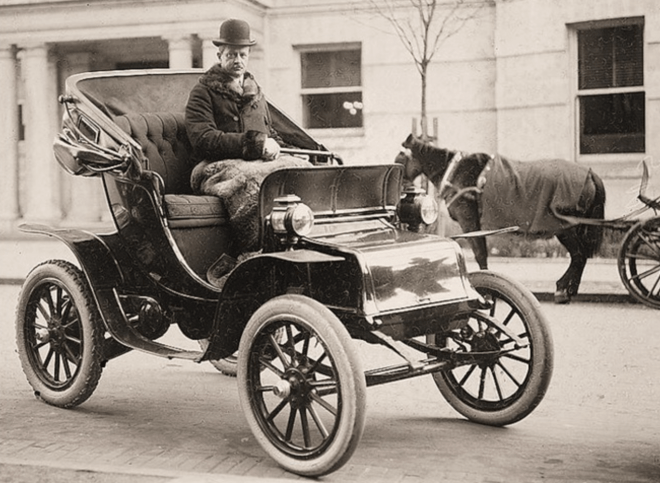
 I’ve seen photos and graphs and charts that allege that electric energy is just as harmful to the environment as fossil fuels because of the mining for minerals and the ultimate disposal of batteries.
![negative screen]](https://jim-stafford.com/wp-content/uploads/2022/08/negative-screen.png?w=660)






 I’ve witnessed many similar situations at games throughout the years, but can’t recall when an infielder missed the ball with runners on base and the infield fly rule was invoked.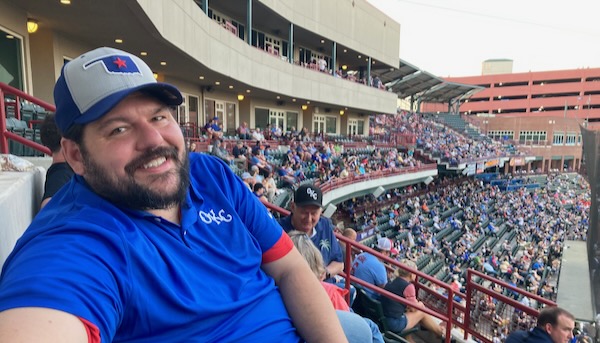
 If you are unfamiliar with the company, TokenEx developed proprietary technology that “desensitizes” critical information by replacing it with tokenized placeholders that have no relation to the original inputs.
 Demand for TokenEx’ tokenization solution continues to increase in urgency. There were 1,862 data breaches last year according to the International Association of Privacy Professionals.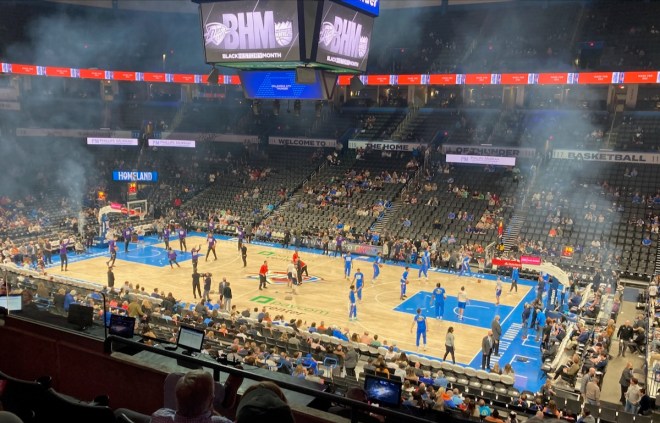
 Teams would have every incentive to put their best roster on the court. Fans would have a reason to show up and cheer their local team down the stretch.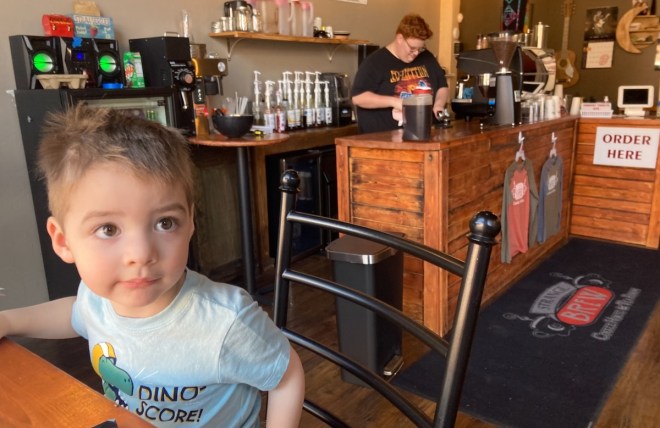

 Jim Stafford's BlogOKC