As a public service, I’m repeating a newspaper headline from this week that I’m sure a lot of people missed because it’s 2023 and there’s no longer a place for the daily paper in their lives.
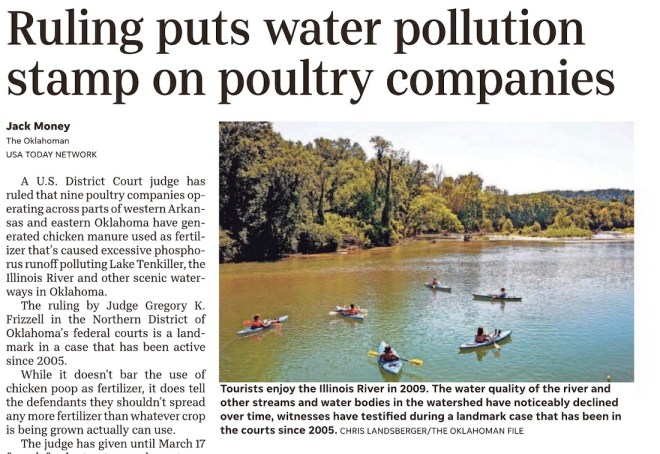
“Ruling puts water pollution stamp on poultry companies”
I had deja vu all over again when I stumbled across the story on page 4A of Friday’s edition of The Oklahoman.
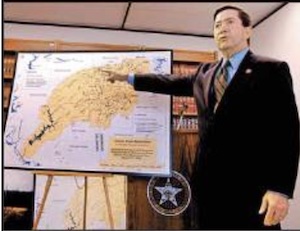
The case began in 2005 when then Oklahoma Attorney General Drew Edmondson filed a lawsuit on behalf of the state against 13 integrated poultry companies.
Edmondson alleged the poultry companies — most based in Western Arkansas — had polluted the Illinois River basin from the spread of chicken manure across pasture and cropland .
So, why is this important enough that I write a blog post about it?
Well, in 2008 I was a Business News reporter for The Oklahoman, with agriculture as one of my beats. When a hearing began in February 2008 in Federal Court in Tulsa on Edmondson’s bid for an injunction against spreading poultry manure in the Illinois River watershed, my job required I cover it for the paper.
Drew Edmondson at poultry hearing.
The hearing was held in Tulsa federal courthouse before Judge Gregory K. Frizzell.
Turns out, the injunction hearing turned into a long-haul of court dates. It ran through four February hearings before a week’s pause, and then picked up in March for another week.
There was testimony from “expert” witnesses and acrimony between attorneys for both sides.
Judge Frizzell was clearly frustrated over the slow pace of the hearing.
“Frankly, this is the longest preliminary injunction hearing I’ve ever conducted,” Frizzell was quoted as saying in one of my stories.
What do I remember of the hearing 15 years later? Seared into my memory is how vigorously attorneys from both sides of the case — plaintiff and defendants — attacked the credibility of every expert who testified.
In fact, attorneys worked so hard to destroy the credibility of the witnesses that the actual testimony seemed like an afterthought.
My friend Russ Florence also sat through each day of the hearing because his Tulsa-based public relations firm, Schnake Turnbo Frank, was working on behalf of the defendants. Today, Russ is President and CEO of Schnake Turnbo and is currently writing a book on the history of the firm, which includes a section on the trial.
Russ writes: “Like the Road Runner and Wile E. Coyote, each side tried to out-maneuver each — politically, legally, and publicly. They circled one another, trying to deliver a punch that would resonate …”
I was grateful when the hearing finally ended and I didn’t have to make a daily commute to Tulsa and back. Several months later Judge Frizzell denied the injunction request.
The actual trial over the pollution issue began the next year. I was no longer working at the paper, so someone else had the pleasure to cover it.
And now, almost 15 years later, we have our verdict. The poultry companies — 13 of them originally — are responsible for the poultry manure pollution of the Illinois Watershed.
“So much has happened since then,” Russ told me. “Some of the poultry companies have been acquired by others. Several of the key players have retired. And to think, I was single then, and am now married and have a fifth grader.”
And what of the punishment imposed on the responsible poultry companies?
“The parties are hereby directed to meet and attempt to reach an agreement with regard to remedies to be imposed in this action. In the event the parties are unable to reach an accord, the court shall enter judgment,” Judge Frizzell wrote in his ruling.
That’s it? It’s a ruling easily could have been imposed back in, say, 2009.
Seems like a joke that took way too long to get to the punchline.
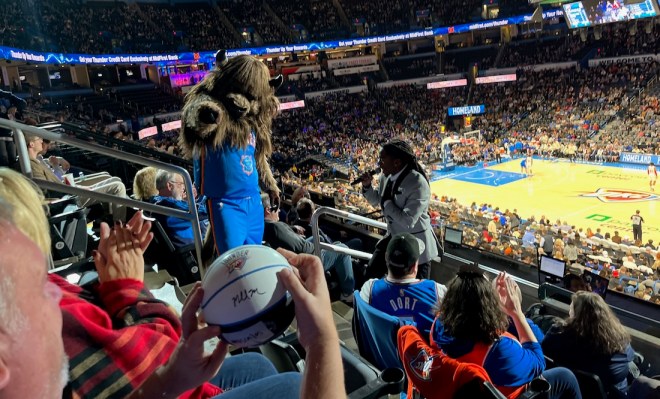
Thunder mascot Rumble makes an appearance in the stands at a recent OKC game.
I’ve heard a lot recently about this Artificial Intelligence app called ChatGPT, which allegedly will answer any question and write a report or an essay on any topic.
I figured that I owe BlogOKC readers an explanation of what ChatGPT is, so I went right to the source. Here’s what the Chatbot told me.
“ChatGPT is a large language model developed by OpenAI. It is trained on a dataset of internet text, which enables it to generate human-like responses to a wide range of text-based prompts. It can be used for tasks such as text completion, question answering, and conversation. It is based on the GPT (Generative Pre-training Transformer) architecture.”
A little long-winded, but there you have it.
So, I came up with a topic for my Chatbot to address to see how awesome it could be. Since much of my time seems to be focused on the Oklahoma City Thunder and my opposition to its tanking philosophy to rebuild for the future, I thought I would ask Chatbot for its take on the subject.
Here’s Chatbot’s take on why tanking is not the right philosophy for the Thunder:
“Tanking, or losing on purpose, is a controversial strategy that can have negative consequences for teams in the NBA. For the Oklahoma City Thunder, tanking may not be the best route to rebuild their team and become a contender in the league.
“One of the main reasons why tanking is a bad route for the Thunder is that it can have a negative impact on the team’s culture and morale. When a team is losing on purpose, it can be difficult for players and coaches to stay motivated and maintain a positive attitude. This can lead to a lack of effort and poor performance on the court, which can ultimately harm the team’s development. Additionally, it can also lead to a lack of fan support and engagement with the team, making it harder for the team to attract and retain fans.
“Another reason why tanking is a bad route for the Thunder is that it doesn’t guarantee success in the future. The NBA draft is not a sure thing and even the top draft picks do not always turn into star players. Therefore, tanking may not result in the Thunder getting the high-quality players they need to become a contender in the league. Additionally, even if they do get a high draft pick, it takes time for young players to develop and it’s not guaranteed that they will become the star player the team needs.
“Additionally, tanking can also lead to a lack of stability for the team. When a team is consistently losing, it can be difficult to keep coaches, players, and management in place. This can lead to frequent changes and a lack of continuity, which can make it difficult for the team to build a sustainable winning culture.
“Furthermore, tanking can also be detrimental to the league as a whole. When teams are not trying to win, it can lead to a lack of excitement and interest in the league, which can negatively impact the league’s reputation and overall revenue.
“In conclusion, while tanking may seem like a quick fix, it can have negative consequences for teams like the Oklahoma City Thunder. Tanking can lead to a negative team culture, lack of fan support, lack of stability, and lack of success, and it can also harm the league as a whole. Instead, the Thunder may be better served by taking a more gradual approach to rebuilding, focusing on player development and making strategic moves in the draft and free agency.”
Did you read that? “Detrimental to the league.” Chatbot went right to the heart of why tanking doesn’t fly for me, and I hope millions of other fans. If a lot of teams are playing to lose, the interest will wane everywhere.
I think Chatbot is dead on in its assessment of the impacts of tanking, including decrease in attendance and a loss of revenue.
All in all, I would grade this essay with an A+.
Chatbot, you’ve impressed me with this argument.
After I read this essay, I decided to have Chatbot argue the other side of the equation for balance. So I ask it to write 450 words on why tanking is good for the Thunder.
Here’s what it wrote in favor of tanking:
“Tanking, or losing on purpose, is a controversial strategy that teams in the NBA have used in order to rebuild their rosters and improve their chances of success in the long term. The Oklahoma City Thunder are currently in a position where tanking could be the best route to rebuild their team and become a contender in the league once again.
“One of the main reasons why tanking is the best route for the Thunder is that it would give them a better chance of getting a high draft pick. The NBA draft is the primary way for teams to acquire young, talented players who can help them improve in the future. The higher a team’s draft pick, the more likely they are to select a player who can make a significant impact on their team. By losing on purpose, the Thunder would increase their chances of getting a high draft pick and selecting a player who could be a cornerstone of their team for years to come.
“Another reason why tanking is the best route for the Thunder is that it would give them more financial flexibility. The NBA has a salary cap that limits how much teams can spend on player salaries. When a team is not competitive, they may not be able to attract top-tier free agents who can help them improve. By rebuilding through the draft and developing young players, the Thunder would have more financial flexibility to make moves in the future.
“In addition, tanking would give the Thunder a better chance of building a team that can contend for a championship in the future. Building a championship team is a difficult and time-consuming process that requires a combination of talented players, good coaching, and a solid organizational structure. By losing on purpose and getting high draft picks, the Thunder would be more likely to acquire the young, talented players they need to build a championship team.
“Furthermore, tanking would also give the Thunder a chance to give more playing time to their young players and prospects. This would be beneficial for their development and would also help the team to evaluate their potential.
“In conclusion, there are several reasons why tanking is the best route for the Oklahoma City Thunder to rebuild their team. The Thunder are currently not in a position to compete for a championship, and tanking would give them a better chance of getting a high draft pick, more financial flexibility, and a better chance of building a team that can contend for a championship in the future. Additionally, it would also give more playing time to the young players and prospects and help in their development. While tanking is a controversial strategy, it can be a necessary step for teams like the Thunder to rebuild and become a successful team again in the future.”
ChatBot presented some compelling arguments in favor of tanking for a rebuild. It hit on an argument that my friend, Steve Buck, often makes in favor of tanking: player development.
Chatbot wrote: “Furthermore, tanking would also give the Thunder a chance to give more playing time to their young players and prospects.”
Again, Chatbot wrote a compelling essay without an factual errors that I can detect. I give it an A+ on this assignment, as well.
However, I’ve still not moved an inch from anti-tanking stance.
Chatbot, when I finally found you at the OpenAI web page, you surprised me with some fine writing and compelling arguments.
Well done.
Editor’s note: My first attempt to have ChatGPT to write essays for and against tanking by the Oklahoma City Thunder was done via an app I downloaded to my iPhone from the Apple App Store. I’ve since discovered that app is ChatGPT filtered through a company hoping to make money by charging a weekly fee for the free, open-source app. So, I signed up on the OpenAI page and had the Chatbot write me new, much improved essays.
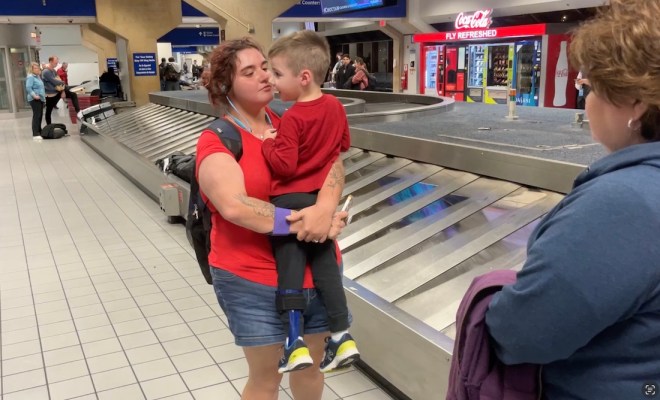
Our daughter, Sarah, is reunited with her son, Solomon, at DFW airport
I was sitting in an OKC coffee shop this past Wednesday, getting some work done and anticipating picking my daughter up at Will Rogers World Airport later that night.
Sarah was flying in from South Florida to celebrate a late Christmas with us and her 3 -year-old son, Solomon.
We had our evening planned for a big OKC airport reunion between mother-and-child before a short drive home.
Then my phone dinged with an alert.
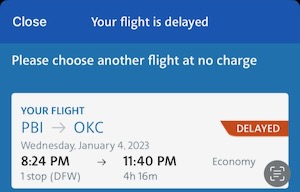
I looked down and saw that it was from American Airlines. It said ‘your flight is delayed.’
Oh great.
Sarah was scheduled for a 7:37 EST flight from West Palm Beach Airport to DFW. It was now scheduled for an 8:20 departure.
So that made for an incredibly short connection window at DFW.
American flight 2640 originally was scheduled to land about 9:30ish at DFW with only an hour to navigate the airport before catching a 10:40 flight to OKC. To add yet another layer of panic, a change of terminals was required to find the departure gate.
That appeared to be the Impossible Challenge now. So I called my wife, Paula, to see what she thought.
Sarah also received the text and had already called her mom.
We weighed our options and decided we needed to head to Dallas just in case. Sarah had WiFi on her plane, so she could update us on the odds of making her OKC connection.
I headed home so we could hit the highway.
Then we got another text. The flight was back to 7:37 departure.
Great, we could stand down. Back to the original plan of meeting Sarah at roughly 11:40 in OKC.
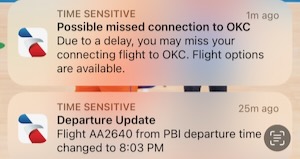
Meanwhile, Sarah was headed to the airport in Florida, but got yet another text alert that said departure time was now 8:03 pm. This one added a tag line: “Possible missed connection to OKC.”
We headed south.
Sarah arrived at the airport, but didn’t go directly to the security line because of the apparent delay.
Then the airline dropped the ultimate hammer. Yet another alert. The flight was back to a 7:37 departure.
Sarah and several of her fellow passengers had to hustle through security.
We drove on.
Sarah made the flight and it departed the gate, but sat another 30 minutes or so on the tarmac.
Meanwhile, the pilot made an announcement that the flight would take additional time because they would be forced to fly around thunderstorms looming to the west.
The flight took off, and we drove on to DFW, expecting to get there a full hour before it landed. We arrived about 10 pm and looked on the flight board. Flight 2640 from West Palm Beach was arriving at 10:25.
Whoa! As the flight pulled up to its gate in Terminal C, we got a text alert telling her she had 15 minutes to make the OKC flight at its gate in Terminal A.
Paula and I had gone back and forth as to whether we really needed to make this rushed trip to DFW. But the text confirmed the wisdom of our decision.
It was another 5 minutes or so before Sarah emerged from the plane and walked to the baggage area where we waited.
The lesson we learned: don’t rely on the airlines’ squishy updates. Get to your gate on time and be prepared.
We were tired and frazzled. But the mother-and-child reunion at DFW Airport made it all worthwhile.
We all piled into the car and headed north, back to OKC.
Editor’s note: I went back over a year’s worth of BlogOKC posts and picked out the 10 that meant the most to me. I hope you take the opportunity to browse among these and find something that pique’s your interest. Enjoy!
For all sorts of reasons — amenities, size, not built specifically for the NBA, perceived second-rateness — the city must build the Thunder a new arena within the next decade.
A new showcase arena will set us back at least a half billion dollars, if not much more.
Consider that American Airlines Arena in Dallas was built in 2001 at a cost of $420 million (and the Mavericks already are pushing for a new arena). How high will inflation drive the cost past that?
Holt’s job now becomes that of selling OKC residents on another special financing package, whether it’s part of a new MAPS deal or a special sales tax like that passed in 2008. I hope the city can negotiate a deal that requires the Thunder to share some of that cost.
It’s obvious that Presti pours a huge amount energy in learning all he can about the players, their personalities and their families, in addition to assessing their level of talent.
I loved the way he described watching the players in various settings months or years before the moment their names were announced.
And how he uses locations of historical significance to introduce new players to the community.
All of that’s probably the reason broadcaster Dan Patrick described Presti last year as “the best GM the NBA has seen in a long, long time.”
If you remember Pong, you know it was a simple game that featured two paddles and a sort of ball-like squarish blip that made a cool sound when it connected with the paddle. You connected Pong to your television and used simple controls to move the paddles to return the “ball” to your competitor in a crude table tennis simulation.
That’s all Pong could do, but the world had really never seen a game like this that could be played on your TV. Pong even kept score for you at the top of the screen.
Turns out, Pong is hailed as the world’s first video game and it was released 50 years ago this summer. It was created by a young inventor and entrepreneur named Nolan Bushnell, who founded Atari to market Pong and other games.
Portrait of Dr. Charlie Marler in his office/ACU photo
Turns out, Dr. Marler was traveling through the state that Sunday morning and randomly decided to attend the Quail service. Quail was a large church, but somehow he ended up sitting directly behind me.
I took it as divine coincidence.
I had only been attending at Quail for about a year and had begun dating the woman who would become my wife, Paula Bottom. She was sitting next to me at that service, so I introduced her to Dr. Marler.
“Oh, you need to stay away from this guy,” he said with a smile.
I was at Quail because of the influence of Dr. Charlie Marler. Not only did he help guide me and motivate me to stay the course to graduation at ACU, he also modeled a life of faith for me that led me to Quail Springs church decades later.
Mike Turpen before leading an educational session at a convention last week in Norman.
My friend Steve Buck asked me to serve as a room monitor in Norman at the spring convention of the organization he leads.
As I was stationed outside the door to my assigned room before the workshop began, I turned and found myself face to face to Mike Turpen.
If you’ve lived in Oklahoma any time at all, you know Turpen is long-time co-host of the Flashpoint issue/debate show on KFOR in OKC. He is also a former Oklahoma Attorney General and chairman of the Oklahoma Democratic Party.
“I’m the last Democrat in Oklahoma,” Turpen joked after we introduced ourselves.
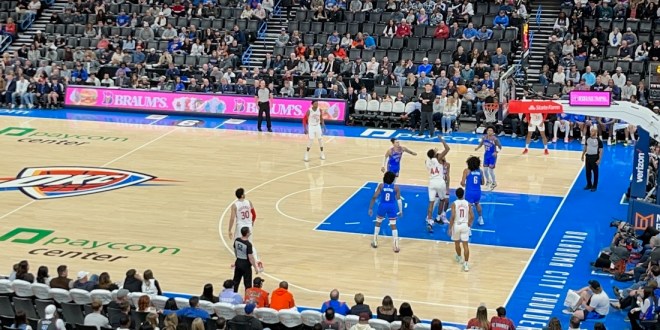
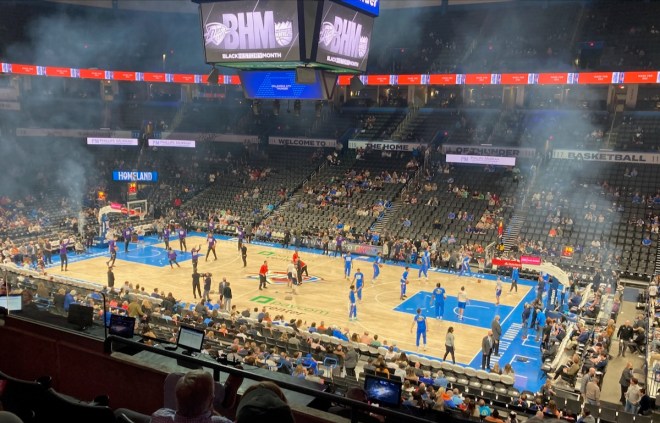
Plenty of good seats available shortly before tipoff at a Thunder game in February this season.
If you’re not a sports fan, you should know that tanking means a team is trying to maneuver for the best possible draft position. It does that by having as bad a record as possible at the end of the season.
Sometimes it’s called ‘The Process’ (wink, wink).
Teams tank not by asking their players to not play hard, but by manipulating the roster so their least experienced get most of the playing time. I offer the Oklahoma City Thunder’s mostly G-League lineup down the stretch this season as Exhibit A.
Oklahoman columnist Berry Tramel put it best last fall when he wrote “losing is the path to winning.” The idea is that if a team is horrible for two, three, four seasons it will eventually be able to draft the next ‘unicorn’ that will turn it all around.
Meanwhile, local fans lose incentive to follow their team and actually show up at games. The thousands of unused seats on a nightly basis at Paycom Center this season is a prime example.
Our professor, Dr. Charlie Marler, speculated about the future of the newspaper industry. He said that some day we could get our news on a TV -like screen and have the choice to print out the stories that we wanted to read.
No one laughed out loud, but I had a good laugh to myself. Yeah, right, I thought. Not sure where Dr. Marler came up with this kooky idea.
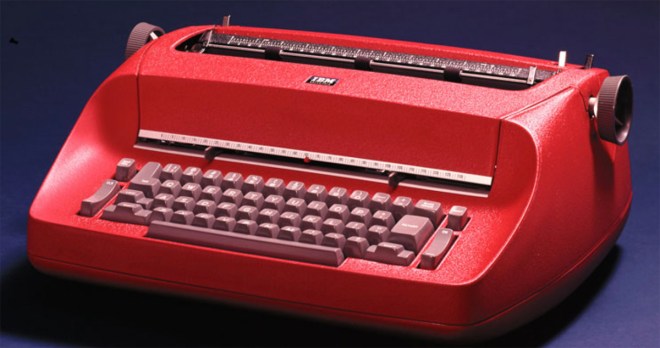
At the time, the IBM Selectric typewriter was cutting edge technology for journalists. We were privileged to be able to type our stories on one in the late 1970s for The Optimist, ACU’s student newspaper.
Fast forward four decades. We can now see how dead-on Dr. Marler’s prediction was in the 1970s.
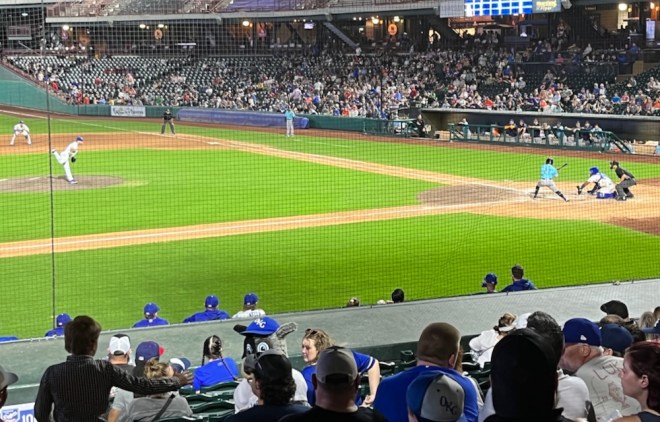
That’s Houston Astros star Jose´ Altuve batting for Sugar Land against the OKC Dodgers on Friday night.
I saw something Friday evening at an Oklahoma City Dodgers game at Chickasaw Bricktown Ballpark that I’ve never witnessed before: A 9-inning professional baseball game played in 2 hours and 14 minutes.
And it was a fun, action-filled game between the Dodgers and the Sugar Land Space Cowboys that was won by OKC 3-2.
Thanks to new rules that mandate no more than 14 seconds between pitches — 18 if runners are on base — the game moved incredibly fast.
There seemed to be no complaints by players or managers over the mandated fast pace. However, there appeared to be a Sugar Land player called out at one point because he wasn’t ready for the pitch in time.
I was able to witness the Dodgers game thanks for my friend Steve Buck and two of his children. Steve had an extra ticket and invited me at the last minute.
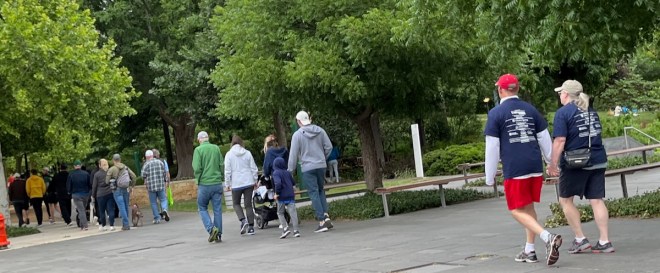
Walkers begin their trek around the Myriad Gardens this morning in the annual NAMI Walks event
Every family — mine included — likely has first hand experience with some form of mental illness. I long ago decided that it’s my job to support my loved ones who suffer from mental illness, try to get them professional help and not make rash judgments or punish them for what’s out of their control.
I say all of that because today was the annual NAMI Walks Your Way event down at the Myriad Gardens. It went off without a hitch amid unseasonably cool weather but with no rain to hamper the program or the walkers.
The important thing about the NAMI Walks event is that it is designed not only to raise money to support the efforts of NAMI Oklahoma — the National Alliance on Mental Illness — but to help end the stigma of mental illness.
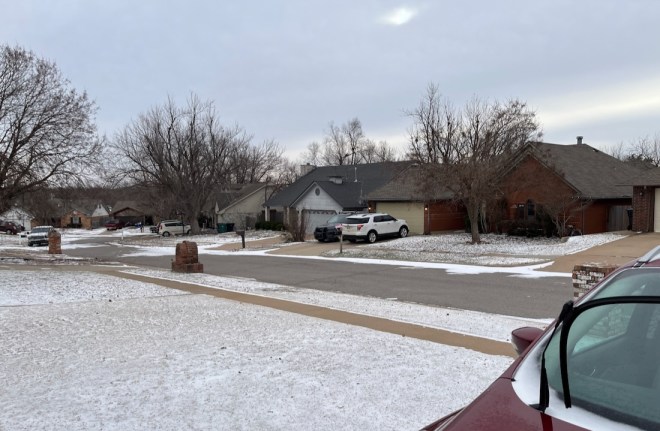
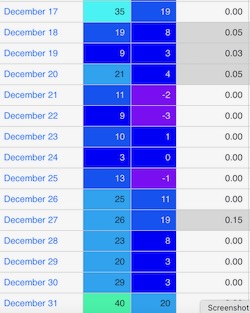
The weather in OKC was a frightful 5 degrees as I stepped out to take this photo.
As I looked out over the frozen tundra that was northwest OKC at 5 degrees this morning, I thought of another holiday season that was disrupted by bitter weather.
Back in 1983, I had just moved to Oklahoma City to work at The Daily Oklahoman newspaper. My folks lived in Fort Smith, Ark., roughly 200 miles to the east.
Anyway, as the newbie on the Sports staff at the paper, I would only get Christmas off if the holiday fell on my normal day off.
It did not, which meant that I had to drive over to Fort Smith a few days before the holiday to celebrate with my family, then drive back to work Christmas Eve and Christmas Day.
As I was preparing to leave town on roughly Dec. 18 or Dec. 19 (the dates are hazy now), a massive outbreak of Polar air settled over Oklahoma and brought sleet and snow with it.
It was apparent the roads were going to be awful, so I even checked the bus schedule to Fort Smith. I called the bus station and they told me that all bus departures were canceled.
So, I called my dad and asked him what he thought.
“Come on over,” he said. “It can’t be that bad.”
It was.
I managed to make it with no trouble to Henryetta, OK. But about 5 miles east of there, as I was climbing a fairly steep hill, my car began to fishtail and swung around 90 degrees. It went off I-40 backwards and into a snow-filled ditch.
Oh, great. These were days before we could even conceive of having a phone in our cars. How was I going to contact anyone?
As I walked up the steep shoulder to the road, a young man in a Camaro pulled over and asked if he could help. I asked him if he would call a wrecker in the next town.
He looked down at my car in the ditch and said, “I think you can drive out of this. The ditch flattens out at the bottom of the hill and you should be able to drive onto the highway. I’ll wait until I see if you can get out.”
I got back in my car, eased down the hill, made it to the flat part, and, like magic, drove right back onto the highway.
I never got to thank the Good Samaritan.
But the road was so ice covered that I drove no faster than 30 mph the remaining 85 miles to Fort Smith.
So, my trip took hours longer than expected. My parents were greatly relieved when I finally pulled up, but I was angry at my dad because he urged me to make the challenging drive.
A better mood took over, and we celebrated the holidays as a family.
There was still plenty of ice and snow to negotiate on the trip back to OKC, but I made sure I kept it on the road this time. I arrived safely back into town and made it to work my holiday shifts on time.
So, thank you, Mr. Good Samaritan, for saving Christmas in 1983.
The Little Engine That Could — Imagination Library version
We have a 3-year old in our house who knows his way around an iPad better than most of us who are 65+ in age. However, we’ve been challenged to get him interested in even the most simple of age-appropriate books.
Solomon will usually stick with a book — even those he brings to you to read with him — for maybe a page or three. Then he’s off to something — anything — else.
Until now.
Last week, we received the first book from Dolly Parton’s Imagination Library, which sends a free, age-appropriate book monthly to those who sign up.
It was The Little Engine That Could.
The book has great illustrations, and also includes some helpful tips on reading it to your child. There’s also a welcome page from Dolly.
My wife, Paula, broke it out as we were all settling down for the night. She put some real expression into it as she read the text to Solomon.
To my surprise, Solomon listened closely and stayed with it for the entire story. He neither tried to find something else to do nor have her hurry through the pages as his usual mode.
Here’s Paula’s take on the experience.
“When the first book came in the mail, I think we were more excited than Solomon,” she said. “But Solomon loved The Little Engine That Could. We will definitely read it again and look forward to the next one that comes.”
Paula learned about the Imagination Library from a news article, and then found the website to register. Not every geographic area qualified, but ours did (after a couple of registration attempts).
I don’t know if all of Dolly’s Imagination Library books will hold his attention like the Little Engine That Could, but so far the program is a huge hit with Solomon — and his grandparents.
Thank you, The Little Engine That Could. It could, and it did keep the interest of our restless grandson.
And thank you, Dolly for this creative reading program. You will make a reader out of Solomon yet.
And millions of aspiring young readers like him across the world.
Gaylord Perry pitching for the Seattle Mariners in 1982. (Associated Press photo)
Editor’s note: Major League Baseball and its fans lost Hall of Fame pitcher Gaylord Perry on Thursday, Dec. 1. Perry pitched in the first Texas Rangers game I ever witnessed in Arlington, so I wrote this post to commemorate that event and what I remembered from seeing the Hall of Famer pitch in the game.
Let me tell you the story of my introduction to the Texas Rangers.
In the spring of 1976, I moved to Abilene, Texas, to go to college at Abilene Christian University. I was transferring my credits from a community college and started at ACU in the second summer semester while working at a small retail store in Abilene..
Anyway, I drove back to Fort Smith to visit my folks the week of Independence Day, and then drove back to Abilene on Monday, July 5.
I had grown up a St. Louis Cardinals fan, but became acquainted with the Rangers through their radio broadcasts after moving to Abilene.
So, as I was driving down from Fort Smith that Monday, I tuned the radio to WBAP 820, the Rangers flagship station. I learned they would be playing a home game that evening.
Perfect timing.
I detoured into Arlington and got to the ballpark about an hour before game time. I had read about how sparsely attended Rangers games were at that time, so I was surprised to find the parking lots surrounding Arlington Stadium almost completely full.
I parked and walked to a ticket window, where I was told that the only tickets remaining for sale were general admission in the outfield. It was a July 4 sellout.
Good enough for me.
I bought a ticket and found a spot deep in left field bleachers next to a man and his son, who was approximately 6 years old. The guy had a transistor radio with him that was shaped like Mickey Mouse and had the volume and tuning dials in the ears.
The Mickey Mouse radio was tuned to WBAP, so we had radio play-by-play throughout the game while sitting in the stands. I guess that’s how we rolled in 1976.
Don’t remember much about the game except for the fact that the Rangers won and I got to see all-time great Gaylord Perry pitch for Texas (I was saddened to learn on Monday that Perry had passed away.)
My real adventure started after the game as I left the stadium. I did not know my way around Arlington and had no map to consult. So, as I left the ballpark I found myself on Randall Mill Road, which I thought would take me back to I-30 and then west to Abilene.
Instead, Randall Mill Road seemed to go on forever with no sign of the Interstate. Finally, after seemed what was about an hour on the road to nowhere, I pulled into a 7-11 to ask for directions.
“How do I get to I-30,” I asked the clerk behind the counter.
He pointed to the west. “It’s right there.”
Sure enough, I had come within a few yards of the Interstate without realizing it, although I was actually now in Fort Worth.
So, about 11:30 pm on Monday, July 5, 1976, I pulled onto I-30 West and headed for Abilene and the rest of my life.
But I drove into Abilene now a Texas Rangers fan and a memory of watching Gaylord Perry pitch in a Major League game.
Ben Langford delivers a message of “Hope” to The Springs CofC audience.
I hope you keep reading this blog post. See what I did there?
Well, you will.
The church I attend, The Springs Church of Christ in Edmond, launched a series of sermons on the season of Advent this past Sunday. Our preacher, Ben Langford, presented it as a season of hope found in the birth of Christ.
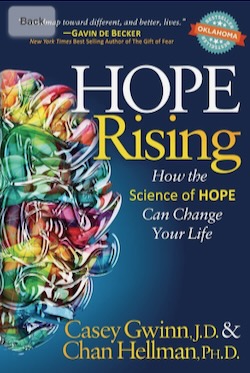
Ben defined hope in the way that University of Oklahoma professor and author Chan Hellman, Ph.D., describes it in his book “Hope Rising: How the Science of Hope Can Change Your Life.”
Dr. Hellman’s definition of hope is, “the belief that your future can be brighter and better than your past and that you actually have a role to play in making it better.”
I read Hope Rising a couple years ago and was caught off guard by the definition. I always thought hope was something far more nebulous and random.
Sort of like “I hope rain doesn’t wash out the baseball game tomorrow, or “Gee, I hope you get what you want for Christmas.”
See, I’ve always believed that hope was more of a wish than something you could actually turn into an action item.
But Hellman’s book explains how people can set a goal, find a path toward its completion and then take action to reach it.
That sounds a lot like a goal setting exercise I learned in college.
In Hope Rising, Hellman demonstrates how the science of hope actually helps people who have been afflicted by life’s circumstances find their way to a better life from things like childhood trauma.
It’s not random or nebulous, but it does require some action by the person who’s hoping for better. It took a while, but I finally saw Dr. Hellman’s point about the “science” of hope as I read the book.
So, anyway, back to Ben’s sermon (watch it here). He made the point that people find hope in Christ by seeing the path to God and taking action to achieve it.
It was the type of sermon that stayed with you beyond lunch at Earl’s BBQ afterward.
Shortly before 4 am at the Elk City Walmart store on ‘Black Friday’ 2008.
It was dark and cold on the Friday morning after Thanksgiving in 2008 as I left my mother-in-law’s farm outside of Hammon, OK.
At roughly 3:30 am on that Black Friday, I headed into Elk City to see what the crowd of shoppers was like at the Walmart store on the west side of town. The store was scheduled to open at 4 am.
My wife and mother-in-law thought I had gone off the deep end.
But it was all in the name of work, because I had been asked by Clytie Bunyan, then the Business Editor at The Oklahoman, to contribute some color from Elk City for the paper’s annual Black Friday shopping roundup.
I rolled into the Walmart parking lot about 10 minutes before 4. The only spot I could find was at the far fringes of the lot about 100 yards from the store. The rest of the spaces were filled with vehicles.
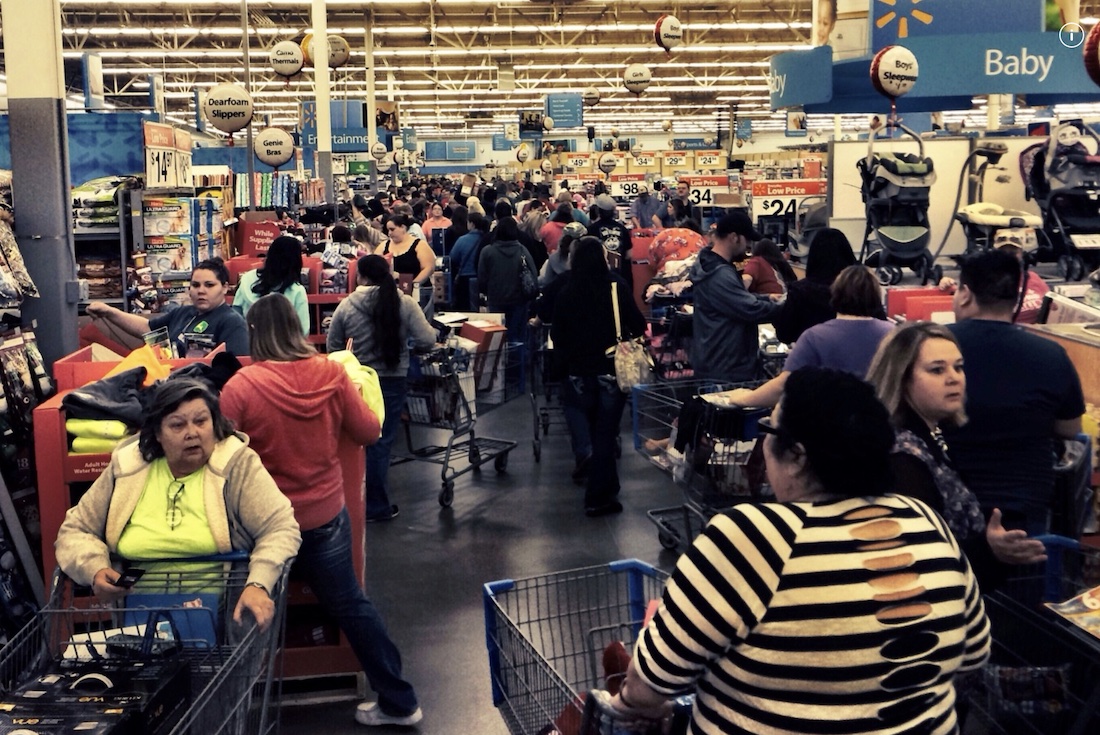
So, I walked toward the entrance, where hundreds of people sort of jumbled together in not so much of a line but what I would call a crush of shoppers. There was a genuine excitement in the air as they anticipated nabbing the ultimate Christmas bargains that had been advertised to go on sale on an hourly basis.
It reminded me of the incredible lines of folks that used to wait outside the Apple store when a new iPhone was released. A lot of camaraderie.
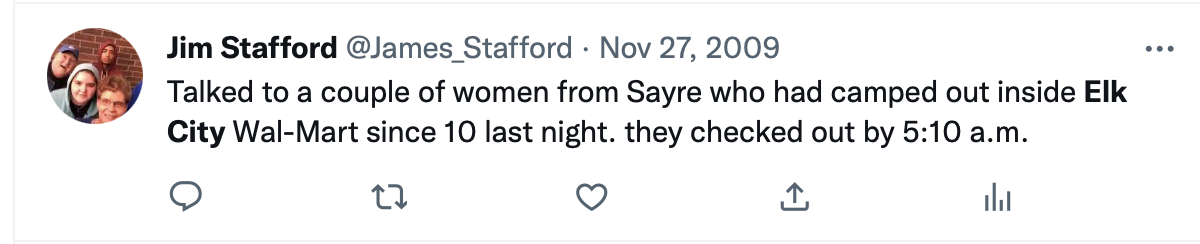
Folks patiently waited for the doors to open and chatted among themselves. I talked to a few people about what drew them to this store well before dawn on the day after Thanksgiving. They came not just from Elk City but from surrounding communities such as Sayre to the west, Mangum to the south and, yes, Hammon to the north.
In the darkness, I shot what was a poorly lighted photo — it’s at the top of this page — with whatever digital camera I had at the time (not an iPhone) and posted it to my Twitter account.
Shortly after 4 am, the doors opened and the crowd surged forward. I waited a few minutes until it cleared and walked in. There were already lines at the cash register as people claimed televisions, toys and whatever the hot electronic item of the day was.
I sipped free coffee the store offered as I wandered through the aisles and managed to get comments from shoppers and store personnel about the Black Friday shopping experience.
My Black Friday early morning routine remained the same for the next few years.
Looking back on this memory from a distance of 14 years, it now seems like the Good Ol’ Days of Black Friday shopping. Back in those days, grabbing a copy of the newspaper fat with holiday advertising on Thanksgiving Eve was the first stop for most shoppers.
In just a few years, stores started opening ON Thanksgiving Day, so there was no longer the urgency to head out in the pre-dawn darkness.
Now we’ve come full circle. Online shopping has made a big impact on how we approach Christmas buying, and most stores — including Walmart — will again be closed on Thanksgiving this year.
So, I guess early morning Black Friday shopping is back, although in what I assume to be a less frantic manner. A Google search showed Walmart stores are opening at 6 am.
But, check your local listings, as they say. Here’s a link to a story in The Oklahoman that lists opening hours for OKC stores both on Thanksgiving Day and Black Friday. (The Wednesday paper this year was still fat with holiday ads.)
Yes, I fondly recall the camaraderie of that crowd of Elk City shoppers in the pre-dawn hours of 2008.
But I’ll still be in bed when the doors swing open this year.
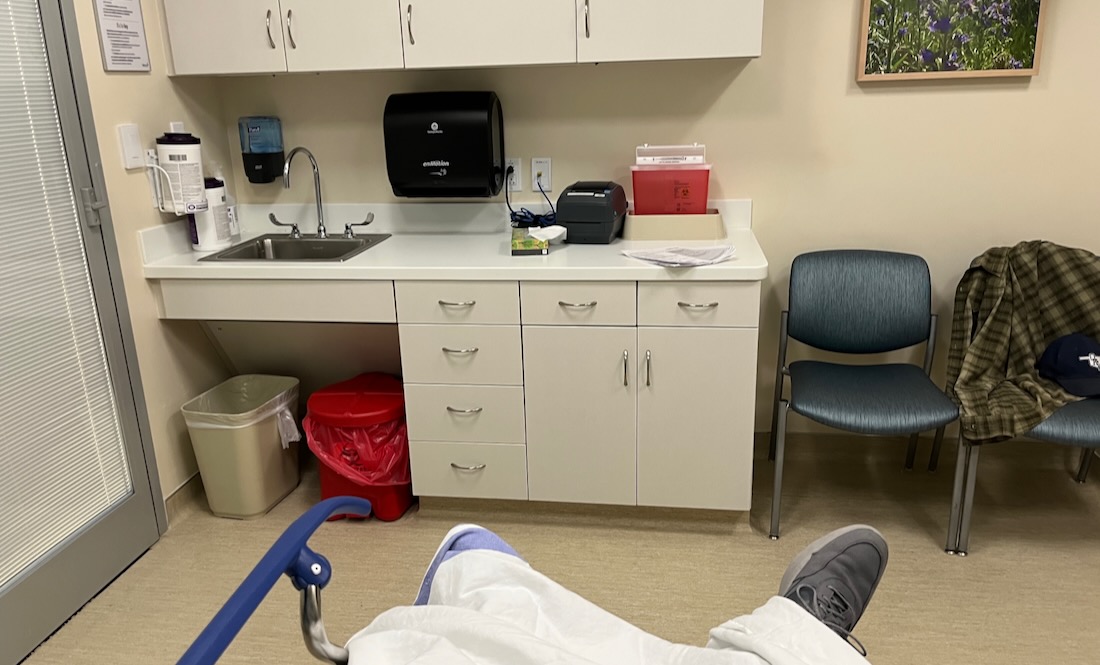
In the ER room at the Mercy Health Emergency Room along i-35 in Edmond.
I’ve read somewhere that COVID is eventually going to infect us all, but I had begun to doubt that it would catch me.
Until it did.
It’s been more than 2-1/2 years since our world was shook when the pandemic washed over us, beginning locally when the Utah Jazz-Oklahoma City Thunder game was cancelled on March 11, 2020.
That was a jarring, scary night, with both my wife and my mother in-law at that game.
Anyway, we masked up and stayed home much of 2020. Then just after Christmas of that year my wife had a mild COVID infection. She tested positive two weeks in a row.
I tested at the same time and was negative each time.
Also, I received the Pfizer vaccine in early January 2021 and declared myself bullet proof, even at my advanced age of 69. I’ve added two booster shots since then.
Then a little over a week ago I woke in the middle of the night with an unexpected, out-of-the-blue sore throat. No big deal.
But I lost energy and appetite throughout the next day, while adding a cough and tons of drainage.
By the third day, it moved into my chest and I had no taste or smell.
So, I went to a walk-in clinic. I was tested for STREP, Flu and COVID. The COVID test came back positive, which I was NOT expecting.
The doctor gave me some pills to take for the next five days, as well as a nasal spray. He said I should no longer be contagious after five days.
Things didn’t improve over the next four days, so by Sunday I walked into the Mercy Health ER along I-35 to see if I could find some relief. The health care professionals there were awesome and empathetic while giving me a steroid shot and hydrating IV.
By Monday, there was incredible improvement in my condition. I’m still improving and hope to be completely symptom free by the end of this week.
Meanwhile, what of my wife, who sleeps and eats with me? She had laryngitis while all of this was going on, and has been tested twice for COVID over the past week.
Negative, both times. So, it’s role reversal this time.
I’ve learned my lesson. I’m not bullet proof. I am thankful for the vaccines and boosters. Because of my age and medical history, there’s no telling how far down COVID could have taken me.
Now I’m up for the Bivalent booster in a couple weeks. I’m all in.
 So that made for an incredibly short connection window at DFW.
 Meanwhile, Sarah was headed to the airport in Florida, but got yet another text alert that said departure time was now 8:03 pm. This one added a tag line: “Possible missed connection to OKC.”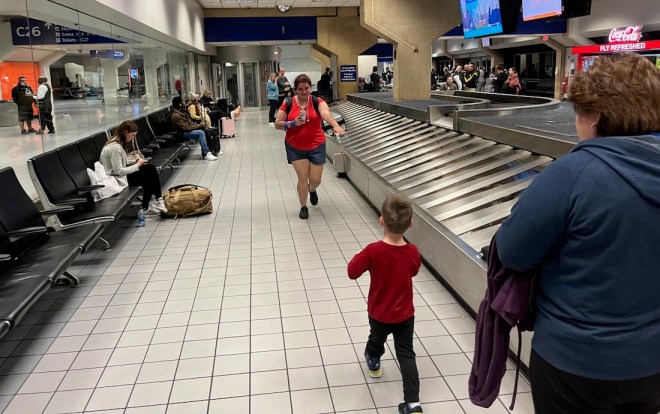


 So, I called my dad and asked him what he thought.


 The Mickey Mouse radio was tuned to WBAP, so we had radio play-by-play throughout the game while sitting in the stands. I guess that’s how we rolled in 1976.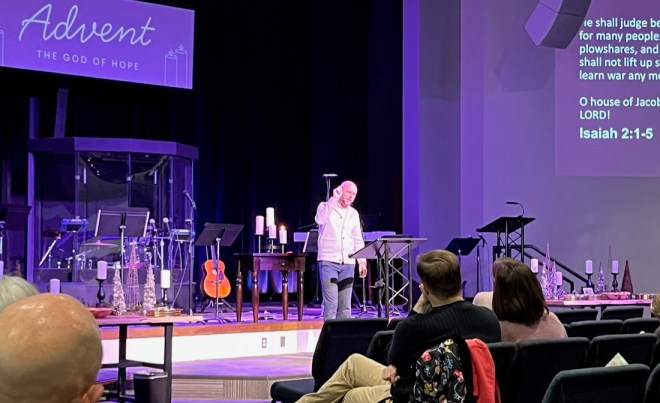
 In Hope Rising, Hellman demonstrates how the science of hope actually helps people who have been afflicted by life’s circumstances find their way to a better life from things like childhood trauma.
 Jim Stafford's BlogOKC