What is Blockchain for Business? OKC conference provides some context

Alan Dickman, IBM Blockchain Architect, delivers a primer on Blockchain for Business to an audience of OKC business leaders.

Editor’s note: I was invited by my friends at OCAST to attend the recent Blockchain for Business conference here in OKC. This is what I wrote about the experience and what I learned from the event about a subject that I know very little about.

By Jim Stafford

There is a huge gulf between the emerging blockchain-for-business technology and the cryptocurrency world, a group of 150 Oklahoma business leaders learned at the recent Blockchain for Business conference at the Baker Hughes/GE Energy Innovation Center.

The blockchain primer delivered to the Oklahoma audience by Alan Dickman, IBM Blockchain Architect, contrasted the two computing networks that are often confused for one another.

“Blockchain is really just a shared, distributed ledger that helps record transactions,” Dickman said in his keynote presentation. “Blockchain facilitates business processes that are shared among a network that is using the same ledger.”

What blockchain-for-business is not is a giant, worldwide computing network that requires every member of the network, or peer, to update their blockchain file with each transaction, Dickman said.

“That sounds like Bitcoin, where there are lots and lots of peers around the world, and what you are doing is updating each ledger,” he said. “Only a small number of blockchains have that infrastructure.”

Blockchain-for-business can limit the number of peers, and requires that each participant be identified and invited to the network. Transactions are recorded as an “immutable” record that can never be altered.

In contrast, Cryptocurrency networks are known as “permission-less,” which means that participation is unlimited. Participants can remain anonymous. The “permission-less” networks can grow unwieldy and consume large amounts of energy as each transaction is updated.

“You can have permission blockchains where you put up your own private networks,” Dickman said. “So, it depends on the use case and depends on the technology and whether you are using a permission or permission-less blockchain.”

The Blockchain for Business conference was presented by OG&E and IBM, with support from the Greater Oklahoma City Chamber; the Oklahoma Department of Commerce; the Oklahoma City Innovation District; the Oklahoma Center for the Advancement of Science and Technology (OCAST); the Tom Love Innovation Hub at the University of Oklahoma; Baker Hughes, a GE Company, the Oklahoma Manufacturing Alliance; Zilker Technology LLC.; and the Energy Web Foundation.

“From OG&E’s perspective, the business purpose of this conference was two-fold,” said Richard Cornelison, economic development manager for OG&E. “We wanted to bring a better understanding of technology, and ways to communicate to the communities we serve and into the companies we serve.”

The conference featured breakout sessions for energy industry users, government, health care and supply chain, and oil and gas.

“Blockchain is one of those emerging, potentially enabling technologies that has the capability of impacting our economy,” said Mark Ballard, programs officer with OCAST. “We’re interested in this technology because it can give businesses another opportunity to compete more effectively in the economy.”

Jim Stafford writes about Oklahoma innovation and research and development topics on behalf of the Oklahoma Center for the Advancement of Science & Technology (OCAST).

Plumbing the limits of home repair Sticker Shock

The Hi-Tech Plumbing & Leak Detect truck parked in front of my house is a familiar site.

We had Hi-Tech Plumbing & Leak Detect out at our house (again) today to replace our kitchen sink and faucet, as well as repair a leak in the drain beneath the sink.  I almost choked when they told me what the cost would be to do the work.  

But I told them to go ahead, because, well, what else are we going to do?

We’ve had Hi-Tech out many times over the years, in part because of the awful polybutylene piping used on this house when it was built in 1989.  We sprang so many leaks over the years that we finally had all the hot-water run through the attic, bypassing the polybutylene pipes beneath the foundation. 

We used Hi-Tech on that project, of course, and it cost several thousand dollars.  Same thing on a recent hot water heater install.

You might ask why I keep going back to Hi-Tech if they are so expensive.  The reason is that we know that they will do a thorough job with nothing left incomplete.  Not once have we had to call them back out to redo a job.   

But the price we pay is still so embarrassingly high. While I do have confidence in Hi-Tech, I feel as though I’m being ripped off in the process. 

I think it’s called buyer’s remorse.

My question for readers is what has been your experience with plumbers and what are my alternatives for future issues?  


OK-WISE panel: Internships provide entry into Aerospace industry for young women

Panelists in a Women Impacting Aerospace discussion are (from left): Heather McDowell, OCAST, Alexis Higgins, CEO of the Tulsa International Airport; Brenda Rolls, Ph.D., CEO of Frontier Electronic Systems; Sara Shmalo, material and process engineer at Spirit Aerosystems; and Haley Marie Keith, CEO of MITO Material Solutions


Editor’s note: I was invited by my friends at the Oklahoma Center for the Advancement of Science and Technology to attend the recent OK-WISE conference in Tulsa, where I sat in on a couple of panel discussions.  The topic of internships as a way to gain experience and an entry into the Aerospace industry (and others!) caught my attention.  So, I filed this report.

TULSA – Heather McDowell shared some bleak industry employment numbers as moderator during a panel discussion entitled Women Impacting Aerospace at the recent 2019 OK-WISE conference at the Hyatt Regency Tulsa.

The conference focused on helping women advance their careers in STEM fields such as cybersecurity, manufacturing, technology and economic empowerment.

“We see statistics all the time about STEM industry and how women are under represented in this field,” said McDowell, associate director of Programs at the Oklahoma Center for the Advancement of Science and Technology (OCAST).

“Overall, about 25 percent of our workforce are women, but particularly in aerospace only about 10 percent of the workforce are women,” she said. “How can we get more women involved in aerospace?”

The OK-WISE – Women Impacting STEM & Entrepreneurship – conference was produced by the Oklahoma Catalyst Programs that is headquartered at the Tom Love Innovation Hub at the University of Oklahoma. Organizers sought to inspire and encourage an audience of about 300 women aspiring to STEM careers in science, technology, engineering and mathematics, or entrepreneurship.

So, how did the panel of female aerospace professionals answer McDowell’s questions of bringing more women into the industry?  

Internships can be an important component to bringing more women into aerospace – and any STEM profession — panelists suggested.

And that can begin with high school, students, said Sara Shmalo, material and process engineer at Spirit Aerosystems in Tulsa.

“One of the things that Spirit does is we partner with high schools and started bringing in high school students who have a passion for aviation,” Shmalo said. “They can watch the processes in place, and some of them have come up with great ideas that have saved time, and they are offered jobs out of high school. We train them to work there.”

Seated next to Shmalo on the panel was Brenda Rolls, Ph.D., CEO of Stillwater’s Frontier Electronic Systems, a company that manufactures sophisticated electronic components for advanced military aircraft and for the U.S. space industry. Frontier employs more than 50 engineers among its workforce of about 120 people.

Potential interns are recruited and evaluated for the positions as if they were being hired for full-time Frontier Electronic positions, Rolls said.

“We try to give the interns real hands-on experience of what it would be like to work in an aerospace company like ours,” Rolls said. “We have had a number of female interns, and one of the great things that happens is there have been a number of interns who have stayed with us after they graduated. So, we have three women that have continued with us as full-time employees, and we have a number of men.”

OCAST manages a statewide cost-share Intern Partnership program that places college students in real world work environments like Frontier Electronic Systems across Oklahoma.

“I think Oklahoma is trying really, really hard to improve the hands-on learning opportunities for students at all levels,” Rolls said.

Jim Stafford writes about Oklahoma innovation and research and development topics on behalf of the Oklahoma Center for the Advancement of Science & Technology (OCAST).
Take me out to the ‘Botball’ game: Robotics competition fuels STEM interests

The KISS Institute for Practical Robotics (KIPR) unleashed hundreds of robots in Norman at the recent Global Conference on Educational Robotics.

The event brought 700 school aged software engineers to Oklahoma from around the world.

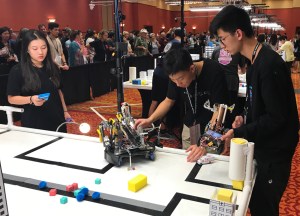
Students from elementary age to high school competed in an international robotics competition called “Botball,” in which autonomous robots they designed, built and programmed attempted to tackle the task of cleaning up a virtual “city” that had been ravaged by flooding.

I was there at the invitation of my friends at the Oklahoma Center for the Advancement of Science and Technology (OCAST) for the opportunity to see some student-built robots in action.

A student team makes last-second adjustments to their robot before the Botball tournament begins.

While students saw Botball as a fun and challenging competition, the KIPR Institute describes it as a “standards-based” STEM (science, technology, engineering and mathematics) education program.

“What is awesome about Botball, I have students that are writing code and doing all of this in the third grade,” said Steve Goodgame, executive director of the KIPR Institute. “I had a college student who came in earlier and said he was working with the elementary students and ‘my gosh, that’s what I was doing as a freshman in college and these third graders are doing it.’”

The KIPR Institute hosts STEM events throughout the year and regional Botball competitions from which top teams qualify for the International competition.

The Institute has a mission to improve the public’s understanding of STEM and “develop the skills, character and aspirations of students” while contributing to the enrichment of schools and the community.

Teams from Canada, Mexico, Qatar, Kuwait, China, Poland, Austria, Africa, Taiwan and across the United States came to Norman for this year’s event, which also included an aerial drone competition and international keynote speakers.

Of course, there’s a bottom line to all the Botball fun. And that’s the acquisition of STEM skills that help create a workforce prepared for the career demands of the future.

“We are teaching a bunch of skills they can put in their tool box that they can use when they start innovating new companies, new ideas and new technologies,” Goodgame said. “It’s imperative that we as a state prepare our younger students as they age up and get these skills so we have a talented workforce that understands computer science.”

For Gillian Melendez, a 16-year-old junior-to-be from Xavier College Prep in Coachella Valley, Calif., the International Botball experience provided the opportunity to meet like-minded students from around the world and pursue her interest in software coding.

“I started when I was in 6th grade and I fell in love with it,” Melendez said. “Most girls aren’t into robotics because it’s nerdy, but I fell in love.  I love to code.”

Melendez was one of two girls on the six-person “G-Force” team from Coachilla Valley.

Norman native Braden McDorman is Exhibit A that Botball is an effective strategy for building STEM skills.

Braden McDorman is an entrepreneur who learned coding from his Botball experience

McDorman began competing in Botball in middle school, and today is co-founder and chief technology officer of a robotics software startup called Semio.

“I started Botball in sixth grade at Whittier Middle School and did it all through high school,” McDorman said. “Then I got an internship at KIPR working on software in high school and continued while I was working on my undergraduate degree at OU.”

McDorman’s path took him to the Oklahoma School of Science and Mathematics in high school and then on to a computer science degree at the University of Oklahoma. He also serves as a KIPR instructor for regional Botball competitions in Southern California, and co-founded Los Angeles-based Semio with another Botball alumnus.

“I’m working on a startup all because of Botball, actually,” McDorman said. “It’s a game that teaches everything you need to know to do real science, real programming. It’s the perfect way to prepare for a career in STEM.”

(Full disclosure: I write about Oklahoma innovation and research and development topics on behalf of the Oklahoma Center for the Advancement of Science & Technology (OCAST).

A typo and a Confederacy of Dunces — 2019

We needed to change a single letter in a name. A typo. We wanted to change an “A” to an “O,” correcting the misspelling “Soloman” to “Solomon” on a birth certificate and Social Security card issued to my newborn grandson, Solomon James Stafford.

The bureaucracy conspired against our efforts to make it happen. We had to make five separate trips to state and federal offices to get it corrected.

Let me start at the beginning.

rejectedMy daughter gave birth to a baby on May 29, a boy who was born two months premature. The hospital sent a person around to inquire about the name shortly after he was born. Both my daughter and my wife told her that he was to be Solomon James Stafford and spelled it out.
S-O-L-O-M-O-N.

Somehow, Solomon became Soloman before it was turned into the state for an official birth certificate. That misspelling was picked up by the Social Security Administration, which promptly printed out a new SS card in the wrong name and mailed it to us.

The effort to correct the spelling turned into an odyssey that began with our initial trip to the records department at the Oklahoma Health Department and ended up with four trips to the Social Security office before the “a” could be corrected to an “o.”

Here’s how it happened.

At the state records office, my daughter filled out the form requesting a corrected birth certificate, and we paid our $30 for two copies and then went to the window to obtain the documents.

After a short wait of just a few minutes, the woman behind the glass gave the new birth certificates to my daughter and we were off! As we walked out, I told Sarah that she should check the spelling just to make sure that it was correct on the corrected version.

She opened the folder and then stopped dead in her tracks. I looked. It read “Soloman James Stafford.”

I looked back and no one was at the window yet, so I ran back and told the attendant that the new birth certificate we received had the same misspelling. When my daughter walked up, she was told to go pay the fee once again, then get back in line.

Sarah fought back tears and an urge to scream at someone, went back and paid a new fee for corrected birth certificates, then got back in line, which had grown considerably. Turns out, this time the wait was about 35 minutes, but we ended up with two birth certificates with the correct spelling of Solomon James Stafford.

Then we headed to the Social Security office. Bad news. Sarah was told that a birth certificate is not acceptable to change a name. We needed an official document from the hospital.

So, we drove back to Mercy Hospital and asked for an official document with a doctor’s signature as proof of birth. A nurse gave us a certificate that had the doctor’s signature, the seal of the hospital and included Solomon’s footprints.

Nailed it! Or so we thought. We were rejected for a second time at the Social Security office because the document the hospital gave us was a “souvenir,” as the attendant described it. “That’s not an acceptable federal document,” he told us.

Back to the hospital, where we went straight to the health records office and asked for something – anything – that the Social Security Administration would accept. I was given a couple of printouts that included the doctor’s notes from the birth and an immunization record. The doctor’s signature was electronic and the document did not have a name or hospital seal on it.

But that’s what we received. By now, I had gone out of town on a trip, so my wife took over and went with Sarah back to the Social Security office.

Of course, the documents were rejected again.

This time, Paula went straight to the hospital and requested to talk to an administrator. She told them about our plight and the need for a signature and an official hospital seal with Solomon’s name on it. The hospital had to create such a document and did.

Paula took that back to the Social Security office and it was finally accepted as official. I was still on my trip out of town when my daughter texted me the words “FIFTH TIME IS A CHARM!” I called her back and learned that baby Solomon (allegedly) would soon be receiving a new Social Security card with the correct spelling of his name.

I’ll call this lunacy a Confederacy of Dunces after my favorite novel, because the system set us up for failure time after time.  

Baby Solomon, it will be years before you realize the challenges that we faced to correct a random typo of a single letter in your name. But we got it done. You’re welcome.


When Oklahoma City invested in itself


I’ve been reading about the ongoing debate over the upcoming vote on a temporary, 1-cent sales tax that the citizens of my home town in Fort Smith, Ark., are considering imposing on themselves.

The tax, which as I understand it would be effective for only nine months, would be used to complete the U.S. Marshals Museum, which is under construction along the Arkansas River in Fort Smith.

To me, a “yes” vote on the tax would be a no-brainer. The community would be investing in itself for a facility that would enhance it as a go-to destination for visitors from around the nation and the world. 

But many don’t see the possibilities, and only see the extra penny tax they would have to pay. You can read about the debate here from the Talk Business and Politics website.

I would offer Oklahoma City’s experience in investing itself as a template for what is possible.

Since we voted “yes” to our MAPS projects in 1993, OKC has been transformed into one of the nation’s premier go-to destinations not only for visitors, but for new businesses and residents. We built a new ballpark, arenas, a canal, a library and transformed a neglected and almost empty river that runs just south of downtown.
Now we have one of the NBA’s premier franchises, a downtown streetcar system and are building a fantastic new “central park” and massive convention center. Our population is blossoming, and many of those are the young, educated “creative class,” who are choosing to stay here rather than take jobs out of state after graduating college.

All because of MAPS, a temporary, 1-cent sales tax.

Sure there were naysayers who could not or would not see the vision. I’m so glad that the majority of voters bought into the concept of MAPS in 1993 and in subsequent votes in the years to follow.  We’re so far removed from the city we were in 1993.

I’m hopeful that the folks in my hometown of Fort Smith can see the vision of what is possible for their community and vote “yes” for the temporary sales tax to fund the Marshals Museum.


Setting it straight; digital newspaper subscriber responds

I recently shared my thoughts in this blog on the current struggles of the newspaper industry and frustrations that I have little to offer as far as solutions to reverse the trend.

I used my friend Casey as an example of smart young potential readers who have found their news sources elsewhere.

After the blog post was published, I discovered that I did Casey a disservice.  

Turns out, even though he’s great with snarky one-liners about the newspaper industry (for my benefit as an old newspaper guy), he still reads the daily newspaper online.

Casey told me that he is a newsok.com “pro” subscriber to the online version of The Oklahoman.  And he comes from a family of longtime newspaper readers and subscribers.

So, I asked him to share his thoughts on what type of content the newspaper should offer readers.  Here is what he said:

“I go to the newspaper when I want a more in-depth, more trustworthy source. Instead of instant alerts, I think they need to slow their content even more; give me more detail and deeper journalism. Heavily researched.  Articles more like what you would find in a magazine, almost.”

Casey was responding to what I wrote about young people seeking only online news alerts and instant headlines instead of deeper newspaper coverage.  

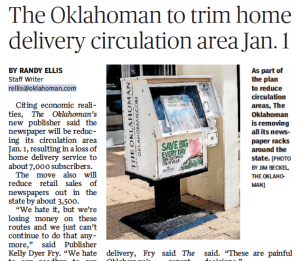
Of course, newspapers continue to struggle, despite the support of individuals like Casey.  The Oklahoman announced in its Dec. 27 editions that it was trimming its circulation area and eliminating street sales. 

Casey broke my stereotype of the typical young American who only learns what’s happening in the world (or their local community) through social media interactions.

And he likes the paper.  He really, really likes it.

“For my money, real reporters work for the newspaper,” he told me.

Wow. Casey, I salute you.  And I promise not to throw you under the bus again, even if you zing me with a snarky one-liner.  


I wish I had a magic potion to restore fading newspaper glory

My friend Casey recently told me that the newspaper is great for when you want to know what happened 24 hours ago. 

Ouch!

As a former newspaper guy who started his career on a manual typewriter back in 1978, Casey’s honest truth really hurt.  

No one is wanting the newspaper — all of them — to succeed more than me. But I see what’s happening all over the country (and world, I guess). People are seeking their news sources online with instant alerts for which they aren’t likely to pay a dime.

There’s nothing earthshaking in that news. It’s a reality that we all know. How many people under the age of 30, no, 40, no, 50 are newspaper subscribers? A handful; 5 percent? 1 percent? 

In fact, Pew Research recently released results of a survey that showed more people now get their news content via social media than the newspaper.

My friend Casey is roughly 30 years old. He prefers instant updates and free content.

Some of my former newspaper colleagues are discouraged because they are convinced that if the paper would just (insert remedy of choice), subscribers would come back. I’m afraid that ain’t happening.

Subscribing to a newspaper takes commitment, financially and in time.  It’s the model from, oh, 1990 and earlier. Young people aren’t buying it, literally. You know why? They were never newspaper subscribers in the first place.

I wish I had a magic potion.  

My ideas tend to run toward things like a cool app similar to that of Starbucks where I can put money on my account ahead of time and draw it down as I consume coffee (or, newspaper content). 

More analysis and less breaking news from 24 hours ago might help. But there’s always that obstacle of free content.

So what’s the answer?  The papers (all of them collectively) are going to have to figure out a way to make their online content so alluring that folks like Casey would be willing to make a small monthly investment. 

That’s the model that The Athletic sports site is pursuing, although I think it’s too early to call it a success. 

That still doesn’t keep the presses running.  

Meanwhile, I’ll just fetch the latest edition of the paper off my driveway for as long as it lasts. I don’t want the physical newspaper to disappear, even though I can access it online. 

I’m from Generation Past.

Once upon a time, virtually every house on my block had a paper out in the driveway before daylight.  Now it’s only on my driveway and one or two others.

Recently, I was at a local hospital waiting on my daughter’s appointment when a nurse came by. I was reading my paper.

“Ooh, we don’t see many of those around here these days,” she said. “Where did you get it?”

I had some breaking news for her.

“Off my driveway this morning,” I said.

Then there is my friend Casey, who assures me he loves the newspaper and always has. “Just not enough to subscribe to it,” he said.

Ouch.


Launching pad: Considering the potential of UCO’s Don Betz STEM Center

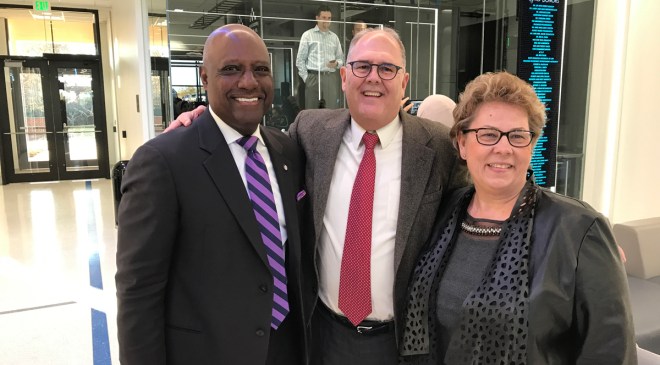
Michael Carolina, left, OCAST executive director, poses with Dr. Thomas and Carolyn Kupiec in the Don Betz STEM Research and Learning Center on the UCO campus.

I’ve always said that I would love to be involved in a STEM career, except for a few barriers – those being science, technology, engineering and math.

So, I’m content to write about those subjects on behalf of my friends at Oklahoma Center for the Advancement of Science and Technology (OCAST) and i2E, Inc.

But that doesn’t mean that I can’t admire an awesome new facility like the Don Betz STEM Research and Learning Center on the University of Central Oklahoma campus.

UCO officially opened the new 57,000-square-foot facility with a ribbon cutting ceremony this past Wednesday. I was among about 200 people fortunate to attend.

After the speeches and the ribbon cutting, we were invited inside to check it out.

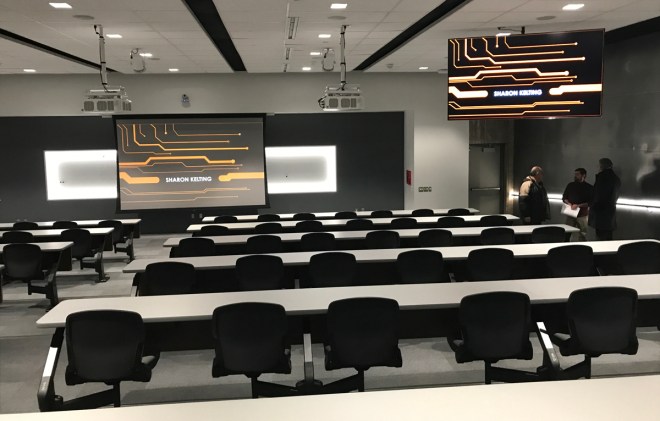
The Don Betz Center, named after the current UCO President, features state-of-the-art research and teaching labs for multiple academic disciplines and a striking lecture hall that can accommodate 80 students.
As I wandered the halls taking it all in, I encountered Dr. Thomas Kupiec, CEO of Oklahoma City’s ARL Biopharma and DNA Solutions. He and his wife, Carolyn, were visiting with Michael Carolina, OCAST executive director. I consider them all friends of mine and stopped to chat for a moment.

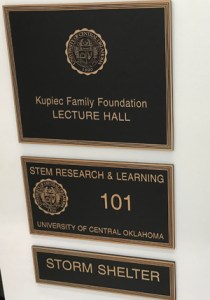
I knew that Dr. Kupiec was a UCO graduate, earning his undergraduate degrees there, but did not realize how involved he remains with the university. He is a member of the UCO Foundation Board of Trustees, and his Kupiec Family Foundation provided funding for the Betz Center’s lecture hall.

Dr. Kupiec pointed me to the lecture hall just across the corridor from where we were talking, so I walked over to check it out. A sign on the outside wall identified it as the Kupiec Family Foundation Lecture Hall, so I stepped inside.

The lecture hall is breathtaking, with theater style seating, sleek white tables and massive video screens scattered throughout.

The lecture hall also doubles as a storm shelter and is identified as such at the entrance.

The rest of the two-story Betz Center was equally impressive. I saw labs filled with microscopes and chemistry hoods. I toured a teaching facility for nurses that looked like an actual hospital room. I saw large racks of computer servers.

Hanging on the walls in the interior corridor were the original drawings of the building as envisioned by the architects at Elliot & Associates.

The Don Betz Center appears to be a perfect place to launch the next generation of chemists, health care professionals and research scientists for whom science, technology, engineering and math are no barriers.

Meanwhile, I’ll keep writing about it.

Inside the Kupiec Family Foundation Lecture Hall


Fondly recalling my first love in computing — an Apple //e

The original Apple //e, released in 1983


A few weeks ago I had the opportunity to tour the NextThought, LLC, offices on the University of Oklahoma’s South Research campus. The company  specializes in educational technology and “connected” online learning.

As founder and CEO Ken Parker escorted me through the open office, I spotted what appeared to be an original Macintosh computer on one of the desks. Ken asked me if that was my first computer.

I said that my first computer was actually an Apple //e.

Ken turned and gave me a high five.  Turns out that his first computer also was an Apple //e, which debuted in 1983.

Of course, Ken learned how to write software on his Apple //e and went on to build an incredible career developing financial services and now educational software.

My interest in the Apple //e was all the cool things I could do with software already available on it such as the original Visicalc spreadsheet, word processing and games. AppleWorks became my go-to software product.

For instance, I used AppleWorks to develop a spreadsheet with which I ran a fantasy baseball league for several years.  Of course, I had to spend several hours each week inputing data from the newspaper into the spreadsheet to make it work.

I did make a couple of unsuccessful stabs at learning to write software on the machine.  Maybe it was a lack of patience that held me back.

i recall writing a little program that printed “My name is Jim Stafford.”  The first time I inputed “run,” into the program, the screen filled with my name and wouldn’t stop. I had to do a hot reboot to get it to stop.  Only later did I realize that my little program needed a line to tell it how many times to print “My name is Jim Stafford” and then a line that said “end” to make it stop.

The Apple //e sat on my kitchen table for a half dozen years before I finally, reluctantly, retired it. It controlled my checking account. I tracked stocks on it. I wrote articles and even created a little newsletter. I added a modem and surfed local OKC online “bulletin boards.”

Finally, I gave it to my uncle to use in his business.  I moved on to the more modern Mac.

I still miss my original Apple.