I was recently asked to contribute a couple of stories to the special Oklahoma Inc. section published by The Oklahoman. It was an opportunity to write short profiles on a couple of the state’s leading public companies.
So I signed on.
If you’re not familiar with it, Oklahoma Inc. ranks all 28 public companies in our state based on three key categories: one-year return to shareholders, revenue growth and earnings per share growth.
I was fortunate to be able to select the companies I wanted to profile, so I chose Paycom and AAON, ranked Nos. 1 and 2 in the 2020 Oklahoma Inc. standings. Paycom’s stock is traded on the New York Stock Exchange, while AAON is traded on the NASDAQ market.
You can read the stories here (subscription required). Paycom AAON
Paycom is the shining star among Oklahoma public companies.
I first interviewed Paycom founder Chad Richison for The Oklahoman shortly after Paycom was founded in 1998, with no clue that it would some day employ more than 3,000 Oklahomans and build an awesome campus in far Northwest OKC.
Paycom moves fast, both with the innovative HR software it offers clients and in its philanthropic efforts across Oklahoma and in the cities in which it operates. I cited an example of Paycom’s philanthropy in my story, but have since been made aware of something even more recent.
The company most recently announced a donation of $30,000 to Folds of Honor to help provide scholarships to military families. That contribution closely follows the $10,000 it gave to Central Oklahoma Habitat for Humanity to support its Critical Home Repair program.
AAON, meanwhile, has a great story about how the pandemic is driving demand for its heating, air conditioning and ventilation technologies.
Congratulations to Paycom, AAON and all the companies that made the top 10 of this year’s Oklahoma Inc.
John Hodgman revives his take as the uncool “PC” at Apple’s One More Thing event
I’m a long-time Apple fanboytm, so when I see that a new Apple product event is about to drop, I wait for it with the same impatient anticipation that consumed fans of Game of Thrones or The Sopranos.
Apple held its latest event today, entitled “One More Thing,” plagiarizing the famous Steve Jobs line. The company introduced three Macs built around its own silicon architecture that it calls the M1 chip.
One More Thing did not disappoint, although the highlight of the event for me turned out to be a huge surprise.
Apple brought back John Hodgman as “PC,” and it was a drop-the-mic moment. If you’re not familiar with Apple’s “I’m a Mac and I’m a PC” ads from the early 2000s, I invite you to check out some on this YouTube channel. They are hilarious.
Anyway, Hodgman shows up at the very end after Apple CEO Tim Cook had already signed off.
It was sort of like how Matthew Broderick resurfaces at the end of Ferris Bueller’s Day Off to tell everyone to go home because the movie is over.
Apple CEO Tim Cook
Hodgman bursts on to the screen and says “Stop! Hang on! Wait! One more thing.” Then as the totally uncool PC, he demands to know why Apple is making all these advancements.
Oh, and one more thing (apologies). Apple’s new M1 computers, the MacBook Air, the Mac Mini and the 13-inch MacBook Pro, all look incredible. Can’t wait to get my hands on them.
I’ve worked on the periphery of Oklahoma City’s startup community for about two decades, first as a business news reporter at The Oklahoman newspaper, then as communications specialist for i2E, Inc., and now as a freelance writer.
It’s pretty exciting to see local companies announce a breakthrough discovery, a new product or investment that will carry their innovation into the commercial market.
Unfortunately, many worthy developments don’t always make it onto the pages or websites of local news media, whether it’s a newspaper, television or even digital news site.
There are hundreds of voices seeking media attention every day, so it can be pretty daunting to attract the attention of an editor or reporter.
So, I’ve decided that this blog can be a conduit for my entrepreneur friends to find an audience for their news. From time to time, I’ll publish news that comes my way that hasn’t found its way into any other media.
For example, today I want to share some exciting news from a Stillwater-based company called XploSafe. If you don’t know XploSafe, the company describes itself as a provider of “critical safety solutions for homeland security and chemical safety.”
XploSafe has its roots in the Oklahoma State University laboratories of co-founders Allen Apblett, Ph. D., and Nick Materer, Ph. D., both chemistry professors, along with former OSU graduate student Shoaib Shaikh, also a co-founder and now CEO.
I learned about XploSafe more than 10 years ago when Shoaib pitched the concept in the Donald W. Reynolds Governor’s Cup business plan competition (now known as the Love’s Entrepreneur’s Cup).
Since then, XploSafe has expanded its mission beyond explosive detection to chemical vapor sampling and other areas where detection of potentially dangerous materials is critical.
Recently, XploSafe was awarded a $125,000 Phase 1 Small Business Innovation Research (SBIR) contract from NASA to develop specialized air filtration units for the next-generation of American space suits.
XploSafe released the exciting SBIR news in mid-October, but received little media attention. I invite you to read their announcement from October 15 below.
Stillwater, OK – 15 October 2020 – XploSafe announced today that it has been awarded a Phase I SBIR contract from the National Aeronautics and Space Administration (NASA) to develop specialized air filtration units for the next-generation of American space suits.
The award amount is $125,000 over a six-month period.
These filtration units will help keep the space suit’s internal air-flow free of any toxic, trace contaminants, which naturally build-up while astronauts use their suits. XploSafe aims to capture these contaminants within their proprietary sorbent media, which could then be vacuum regenerated to enable longer spacewalks and substantially improve time in-suit over the duration of a mission. Such a capability will be required for NASA’s upcoming Artemis missions, in which the United States intends to return to the moon by 2024.
The design of XploSafe’s filtration units would provide astronauts with safer air to breathe, as well as lighter, easier to use suits. XploSafe’s filtration unit would be housed within the Exploration Portable Life Support System (xPLSS) backpack of the next-generation xEMU suits, alongside other critical life-support systems. The company holds multiple patents for vapor nanoconfinement technology that facilitates high-capacity absorption, stabilization, and consistent recovery (removal) of a wide range of volatile, semi-volatile, and even reactive organic compounds.
XploSafe’s Operations Manager, Michael Teicheira, had the following to say: “we are ecstatic about this opportunity to showcase the research and development efforts of XploSafe here on the national and even international stage. The prospect of our products enabling astronauts to spend more time in space is an enthralling one, and we are so grateful for this opportunity to show what a small Oklahoma research company can achieve.”
XploSafe based in Stillwater, Oklahoma, is a provider of critical safety solutions for homeland security and chemical safety. Their XploSens explosives detection, XPell peroxide safety products, and XCel+ chemical vapor sampling badges are used by first responders, industrial safety officers, threat assessment officials, and laboratory and chemical manufacturing personnel all over the world.
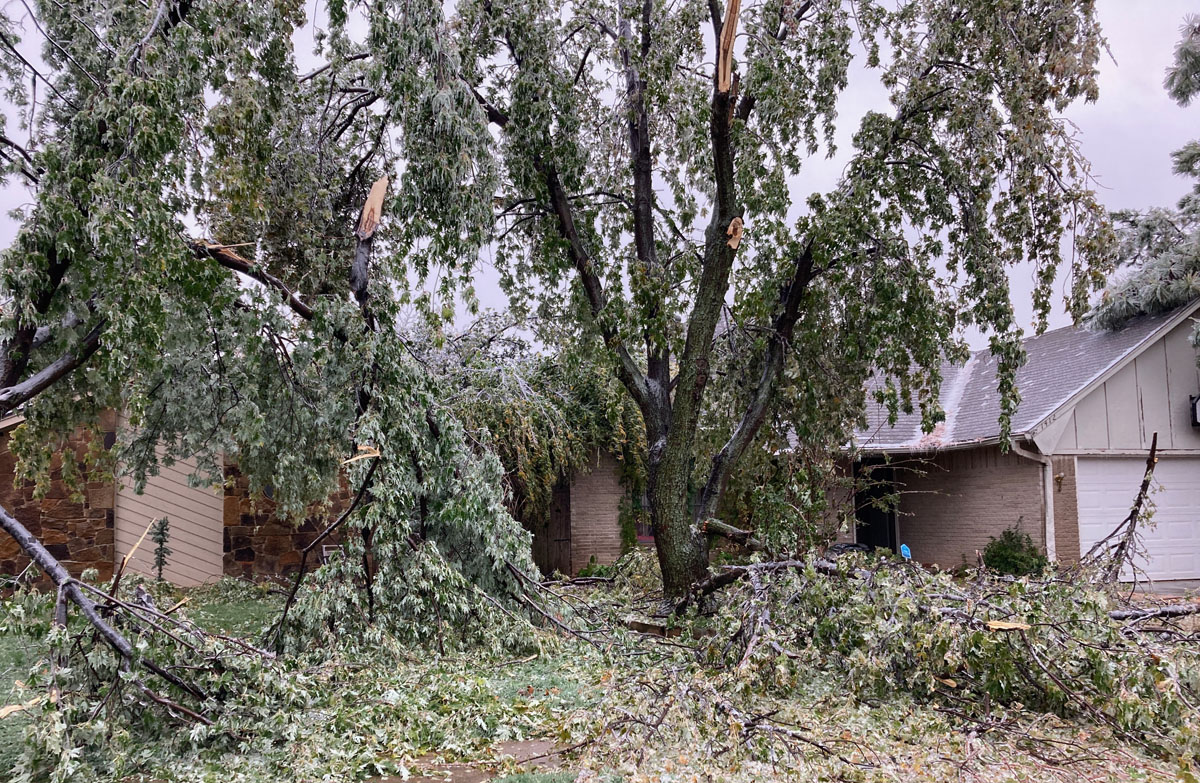
Typical of trees with limbs down in our neighborhood because of the October ice storm.
Our house went dark about 7:20 this morning. No big deal. Power went off yesterday and came back on about an hour later.
But by 3 p.m., we figured out this might be a long-term outage. We had driven out of our neighborhood a couple of times and were amazed by the number of trees that were down with limbs covering both the street and sometimes the roofs of homes.
Winter arrived extra early with an October ice storm that threatened to take out every tree and power line in Oklahoma County. Late this evening we saw that OG&E was reporting nearly 300,000 customers without power.
As I prepared for a night of “adventure sleeping” in our living room in front of the gas logs in the fireplace, my wife suggested it was time to seek a hotel room for the night.
Yeah, right. So, I reluctantly fired up the Priceline app on my phone and began to see what our choices were. We sought a hotel in Northwest OKC or Edmond.
But as I scrolled through the choices, every one had a note that said “no rooms available.”
I switched to Expedia, and got the same thing. I even tried to find an available Bricktown hotel, but there was no room at the Inn for us.
Adventure sleeping it would be. Our household consists of me, my wife, Paula, daughter, Sarah, and her 16-month old son, Solomon.
Paula did not want Solomon sleeping in a cold house.
So, I decided to stop by a few hotels in the Quail Springs Mall area to put my name on the list if there were any cancellations. First up was the Holiday Inn North, but the desk clerk told me they were 10 rooms “overbooked” and gave me the front desk number to call later to check.
A room at the Inn
Next stop was the Holiday Inn Express at the intersection of Memorial Road and the Lake Hefner Road. This place was Grand Central Station judging by the people going in and out, but I approached the desk anyway and ask about cancellations.
The clerk gave me some paper to write my name and phone number, but then the manager on duty walked in from out of the back and said they just might have a room for us. Turns out they did, and I whipped out my payment on the spot to secure it.
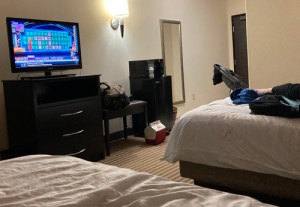
It was aChristmas an October miracle!
So, we’re lounging in the room tonight, making the most of our Ice Storm Staycation.
Breaking news on the COVID front. The COVID-19 test I took on Thursday came back negative today.
Huge exhale.
As a reminder, my daughter, Sarah, and I both had COVID tests done at the IMMY Labs free “Swab Pod” mobile testing site near UCO. Here is a blog post about our experience.
Sarah’s test came back negative, as well.
If you were wondering what type of test we took, the IMMY website describe it as a “PCR” test, whatever that means. I understand that it’s more accurate than the tests that return results in 15 minutes.
The negative result was important to me because I’m technically a “senior citizen” with underlying medical conditions.
For Sarah, it was important, because the negative result allows her to get back to her job immediately.
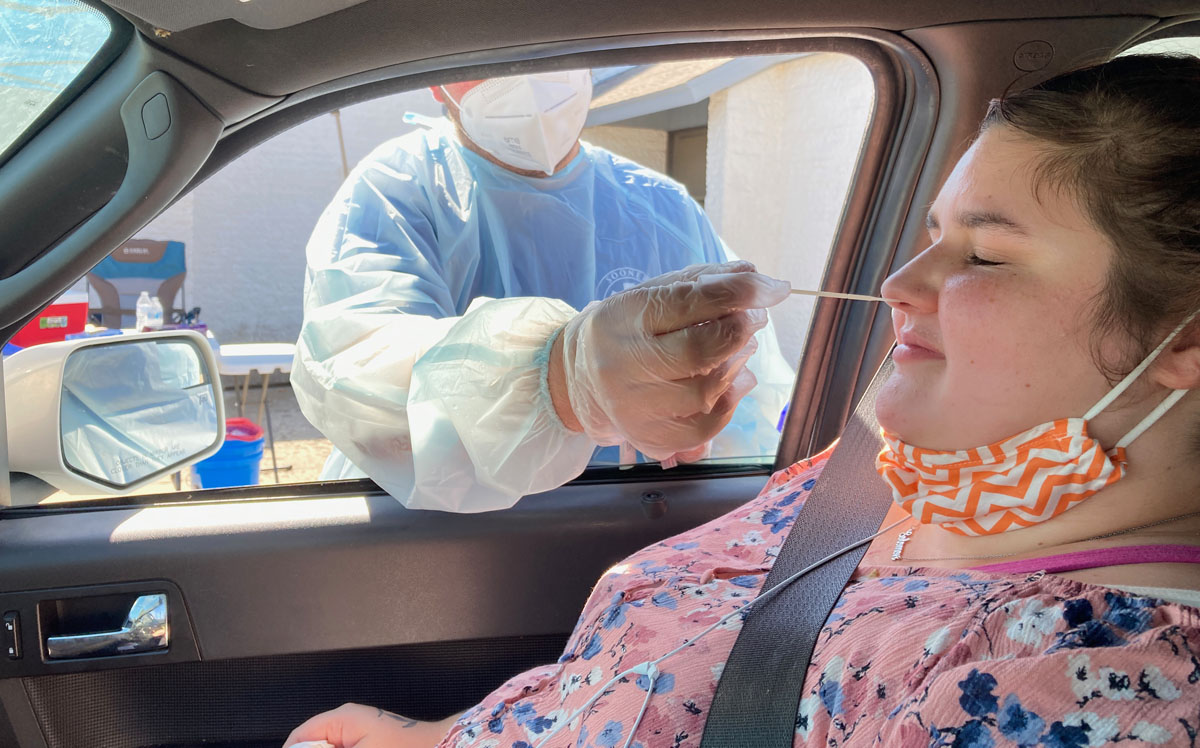
My daughter, Sarah, reacts as a nurse inserts a swab into her sinus cavity for a COVID test.
You’ve no doubt seen video clips of people being tested for COVID-19 where a health care professional inserts a long cotton swab into their nostril. I wince each time because it looks like they’re trying to make the brain squeaky clean instead of probing for virus.
So, wouldn’t you know it that my turn came today for a COVID test.
Both my daughter and I have been showing some symptoms, although she was originally diagnosed with an ear infection. And I have ongoing allergy challenges.
But Sarah also has a hacking cough and needed to have the test done for her work. I have been incredibly tired in recent days, so I decided to join her.
Our first decision was where to have the test done.
My friends at Norman-based IMMY, a developer and manufacturer of innovative lines of diagnostic tests and reagents for infectious diseases, have also developed an FDA approved COVID test. It set up a subsidiary company called IMMY Labs to conduct the testing.
IMMY conducts free, drive-by testing daily in the Edmond/Oklahoma City area and locations across the state that include Tulsa, Blanchard, Norman, Moore, Midwest City, Chickasha, Purcell and more. They call their testing sites the Swab Pod. Results are promised in two days or less.
So, Sarah and I chose the Swab Pod near the UCO campus and drove over for our tests this afternoon.
I have to admit that I was fairly apprehensive. Those news clips didn’t do me any favors.
We drove up about 5 minutes before our scheduled time and got in line behind about three other vehicles. There was a check-in table where they scanned a registration code on our phone and placed vials on our windshield beneath the wipers.
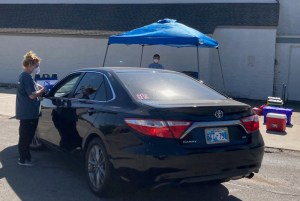
The vehicle in front of us pauses for a quick swab test.
We were told to fall in line and follow the vehicles to the nurse’s station. Less than two minutes later we were there.
The nurse approached Sarah’s side first, and I took photos as she was swabbed. It took only seconds, and she didn’t show any discomfort.
My time came. I closed my eyes, leaned back in the seat and anticipated the worst, which I’m not sure what that would have been. The swab scraping my brain? Hitting a nerve? Blinding me?
The nurse inserted the swab and counted down from five. Just like that it was over. I had a tickling sensation and almost sneezed. That was it.
We drove off the lot and were on our way in less than 30 seconds, slightly giddy at how painless and easy it was. We’ll know the results probably sometime tomorrow.
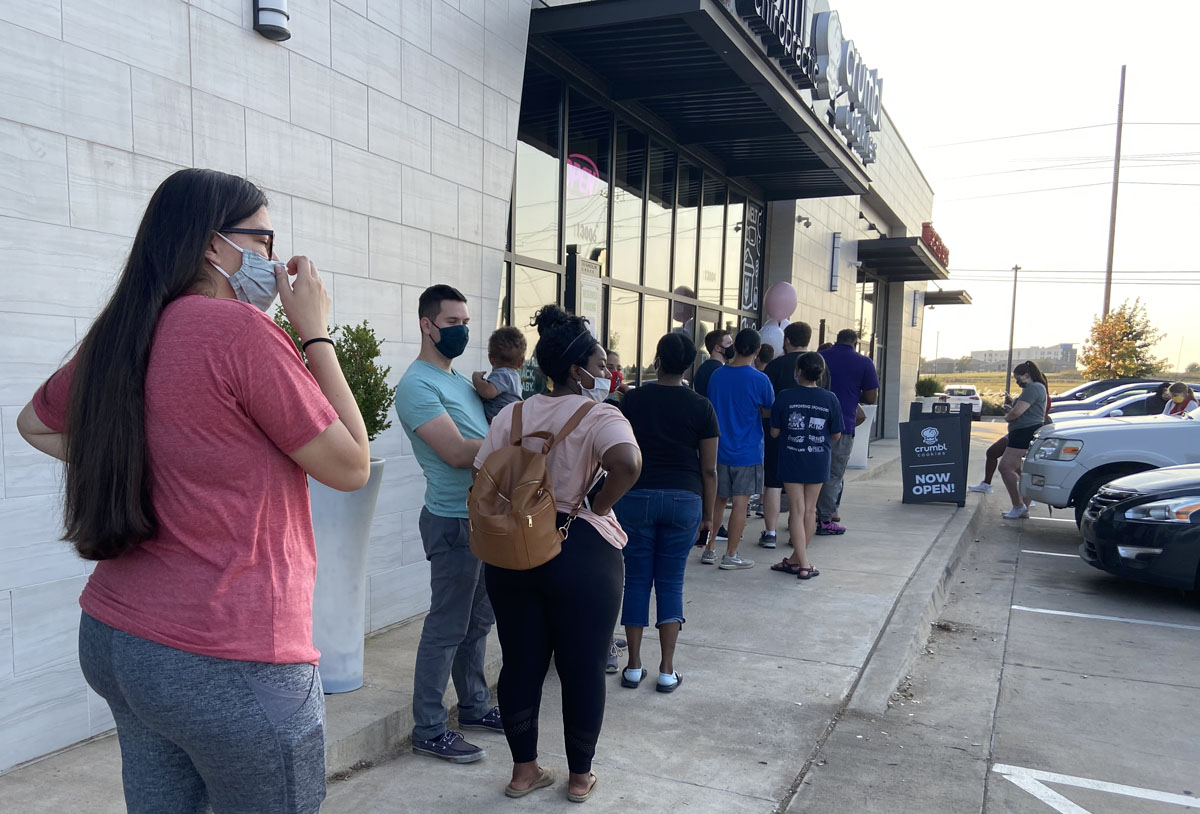
The crowd waits for cookies outside Crumbl Cookies on the recent Free Cookie Day
I have an admission to make. I am The Original Cookie Monster. No cookie is safe around me, which you can kind of tell by sizing up my physique.
Anyway, the recent entrance of Crumbl Cookies into the Oklahoma City market caught my attention because of a couple of reasons.
Reason No. 1: OK, my daughter got a job there before the store opened for its first day of business.
Reason No. 2: See the “Cookie Monster” comment in the first line.
When my wife and I showed up on Free Cookie Day during Crumbl’s grand opening week, there was a 20-minute wait in line down the sidewalk outside the door.
We waited it out, of course. The cookie was warm and delicious.
Crumbl is a franchised location of a chain launched less than three years ago in Logan, Utah, by founder Jason McGowan. The OKC store, opened by franchise owners C.J. Roundy and Jefferson Palmer, was store No. 115.
So you can see how quickly the concept has spread across the nation.
I spoke with Roundy the other day, and he told me the pair located their store in OKC’s Chisholm Creek shopping center because it fit all their criteria for launching a store: prime shopping location with high traffic count, demographics and a business-friendly community.
Here are a few other observations from the franchise co-owner:
“Our grand opening, compared to others in the Midwest and South region, was probably one of the better ones ever,” Roundy said. “We had 10,000 cookies go through our door in three days.”
Did you catch that? 10,000 COOKIES IN THREE DAYS.
“It was hectic,” he said. “We had lines out the door Friday and Saturday, almost all day long. We had really high sales. I would say our sales were about 15 to 30 percent higher than what we expected. It was really fantastic for us. “
Crumbl cookies are large, but not cheap. A single cookie will cost you $3.48. A box of 4 is $10.98.
“We are a premium product, but we use only the best quality ingredients,” Roundy said. “Everything is made fresh in our store. We really think the price that we charge is equivalent to the quality.”
Sarah Stafford outside Crumbl Cookies on opening day
One last thing. Since Crumbl is a franchise based in Utah, it doesn’t fit the “shop local” criteria that has become a theme for many residents across the city.
“All of our employees are from here; It’s only my business partner and I who moved here,” Roundy told me. “But we moved here in the hopes of being here a long time. We want to open six or seven more locations in the Oklahoma City area. We want this to feel local even though it started in another state.”
Crumbl employs cutting edge technology in its cookie marketing, offering catering, curbside pickup and home delivery. There’s an eye-catching Crumbl website, mobile app and a company-developed point-of-sale software system that gives customers the option of checking out at kiosks without actually having to go up to the sales counter.
Roundy said Crumbl’s cookie lineup rotates weekly with chocolate chip and sugar cookies being constants. He hopes the store, located on the N. Pennsylvania segment of Chisholm Creek shopping center, becomes a regular staple for the city’s cookie lovers.
So, what does that mean for me?
Well, I know that C is for Crumbl Cookie. That’s good enough for me. Apologies, Cookie Monster.
Colt Stadium in Houston was the locale for my first Major League baseball experience
The death of baseball Hall of Famer Joe Morgan this week took me back to the early 1960s and a rickety old stadium in Houston where I saw my first Major League Baseball game. I was there with my Little League team from Bryan/College Station.
We all wore our uniforms, as did about 5,000 other Little Leaguers that day. The outfield stands were a splash of rainbow colors from so many uniformed youngsters sitting together.
While I don’t remember anything about that game from 1963, I do remember that Joe Morgan was a member of the Houston Colt 45s, who were playing the St. Louis Cardinals. Jimmy Wynn, known as the Toy Cannon, also was a member of that team.
Bonus memory: We could see the Astrodome under construction right next door to Colt Stadium, so the baseball future held a lot of promise for a 10-year-old.
Of course, Morgan eventually was traded from Houston and built his Hall of Fame career as a key player with the 1970s Big Red Machine in Cincinnati. The Houston Chronicle published a story this week about how he was the one that got away. Read it here.
That 1963 Houston Colt 45s experience pretty much ensured I would be a lifelong baseball fan.
Like most kids of the time, I collected baseball cards and memorized the starting lineups of the teams. I even made up my own stats-based game that mimicked the APBA baseball board game but used a spinner instead of dice.
Joe Morgan as a Cincinnati Red
Fast forward more than half a century to the awful year of 2020. Morgan and Wynn both died this year. They are among a host of former Major League players who passed away in 2020, a list that includes all-time greats like Bob Gibson, Lou Brock, Tom Seaver, Al Kaline and Whitey Ford.
Baseball Reference publishes a running list of every former player who died this year. You can see the list here.
The deaths of Seaver, Ford, Brock, Gibson and Morgan came in rapid succession. It hurt. As a child of the ‘60s, it’s painful to watch my heroes pass into history.
Each death hammers home the passage of time, but I’m hanging on to the distant memories. It’s all we have left in the end.
Connor Cox, left, with OCAST, Tom Wavering with the Tom Love Innovation Hub at the University of Oklahoma, and James Eldridge with the Ada Jobs Foundation in a Zoom presentation during the Oka’ Water Conference
Editor’s note: For the past several years, I have attended the Oka’ Water Sustainability Conference in Ada at the invitation of the Oklahoma Center for the Advancement of Science and Technology (OCAST). This year, the conference was forced off the campus of East Central University by the pandemic and onto the World Wide Web as a virtual event. I sat in on the first day and wrote this report on behalf of OCAST:
By Jim Stafford
ADA – The Water Sustainability Conference presented by the Oka’ Institute at East Central University recently took critical topics such as water conservation, research and economics to the screens of participants across Oklahoma and around the world. No masks required.
The ongoing Coronavirus pandemic mandated a change for the 2020 conference. And that required brainstorming from conference planners to execute a virtual presentation on the Zoom video conferencing platform.
“Our attendance was strong,” said Susan Paddack, executive director of the Oka’ Institute. “We had 302 register this year, which was an increase of over 50 from last year. Participation averaged about 120 people per session throughout the two days of the conference.”
The Oka’ Institute sponsors the Water Sustainability Conference annually to tackle issues that impact not only the southeast Oklahoma region, but the rest of the state and nation.
Formally known as Oka’, The Water Institute at East Central University, the Institute was created in 2016 with support from the Chickasaw Nation, the Ada Jobs Foundation and the City of Ada with seed money from the Sciences and Natural Resources Foundation. “Oka’” is the Chickasaw word for water.
This year, speakers included regulatory and conservation agency officials, economic development professionals, entrepreneurs and Oklahoma farmers and ranchers honored for their water conservation efforts.
“We found that we were able to attract speakers from across the state and out of state because the virtual format saves travel time for them,” Paddack said.
Virtual participants came from across Oklahoma, as well as distant locales like California and Australia.
“We love the diversity of our audience,” Paddack said. “Our goal is to provide them with timely information on water research, policy education and the economics/value of water.”
Among the speakers was Ken Wagner, Oklahoma Secretary of Energy and Environment and a former administrator with the federal Environmental Protection Agency.
Water sustainability issues invoke passion among people like few other issues, Wagner said.
“People are willing to fight over that,” he said. “It is conferences like this that allow people of different viewpoints to be heard, to get their priorities and passions known so that policy makers like me and director Paddack and certainly Chickasaw Gov. Bill Anoatubby and the Chickasaw Nation can actually hear what is important to Oklahomans.”
Water continues to be an ongoing topic for Oklahoma regulators, he said.
“Our office is in the process of working on many water projects of sustainability and protection around the state,” Wagner said. “We see this as the highest priority.”
The state, along with the Chickasaw and Choctaw nations and the city of Oklahoma City signed an historic agreement in 2016 designed to ensure water abundance for decades into the future.
“The agreement provides a framework to ensure sustainable management of our water resources for rural areas and urban communities alike,” Gov. Anoatubby told conference participants in his address.
“Water availability is the greatest economic building block for all communities,” he said. “The Chickasaw Nation is committed to working with local communities to develop tangible solutions to protect the groundwater and surface water we all depend upon.”
Stillwater’s XploSafe presents in a discussion moderated by Dia Ghosh with the Ada Jobs Foundtion
The conference also featured a panel discussion that included three recent Oklahoma Leopold Conservation Award winners who have taken decisive steps such as no-till farming and controlled burning of unwanted vegetation to ensure the land they manage can hold moisture and fight erosion.
The Leopold Award recognizes landowners who inspire others with their dedication to land, water and wildlife habitat management on private, working land.
Oklahoma Leopold winners who described their conservation efforts included Jimmy Emmons (2017 winner) of Leedy in far western Oklahoma, Russ Jackson (2018 winner) from Kiowa County in southwestern Oklahoma and Chuck Coffey (2020 winner) from the Arbuckle Mountain region.
Also featured were economic development officers from the Oklahoma Center for the Advancement of Science and Technology (OCAST), the Tom Love Innovation Hub on the University of Oklahoma campus, as well as Oklahoma entrepreneurs, elected officials, representatives from the EPA, the Oklahoma Conservation Commission and other stakeholders.
“In these challenging times, our sponsors stepped up to make sure that this high quality, valuable information was still shared through our conference,” Paddack said. “Water is needed for life. Water is needed for economic growth. We must keep focused on our efforts to ensure water sustainability, and Oka’ is grateful and proud to be a part of this vital discussion.”
Jim Stafford writes about Oklahoma innovation and research and development topics on behalf of the Oklahoma Center for the Advancement of Science & Technology (OCAST).
Dr. Richard Kopke (left) with the Hough Ear Institute was the historic first guest on the Innovate That! podcast hosted by Oklahoma Lt. Gov. Matt Pinnell
Editor’s note: My friends at the Oklahoma Center for the Advancement of Science and Technology (OCAST) recently launched their first podcast, which highlights Oklahoma innovators and companies across the state. I listened to the first three podcasts hosted by Lt. Gov. Matt Pinnell and wrote this story about the podcast and the folks Pinnell interviewed:
“Thank you to all who are listening to the Innovate That! podcast.”
With those words, Oklahoma Lt. Gov. Matt Pinnell launched the initial podcast produced by the Oklahoma Center for the Advancement of Science and Technology (OCAST) and highlighting innovative Oklahoma companies and entrepreneurs.
OCAST is a legislatively funded state agency with a mission to expand and diversify Oklahoma’s economy by supporting research and development of new projects, processes and industries.
Pinnell serves as host of the Innovate That! podcast, interviewing Oklahoma innovators and highlighting the collaborative Oklahoma Innovation Model that provides assistance to small businesses and entrepreneurs.
“I’m really excited to start this podcast with OCAST,” Pinnell said. “They are all about innovation, all about helping companies create, helping companies grow their businesses in the state of Oklahoma. For us to build a top 10 state and build a state in the right way, we have to have OCAST and the Innovation Pipeline Model.”
The historic first Innovate That! podcast featured Dr. Richard Kopke, CEO of Oklahoma City’s Hough Ear Institute. The Institute developed a drug known as NHPN-1010 in cooperation with the Oklahoma Medical Research Foundation (OMRF) that can prevent and potentially restore hearing loss.
Hough Ear Institute is a not-for-profit research organization with a mission to restore hearing worldwide through research, education and humanitarian efforts.
Stillwater-based XploSafe was the second innovative company highlighted by the podcast, with Gas Tech Engineering of Sapulpa completing the trio of launch podcasts.
The positive influence of OCAST and its partners in the Oklahoma Innovation Model – i2E Inc., the Oklahoma Manufacturing Alliance, the New Product Development Center at Oklahoma State University and the Tom Love Innovation Hub at the University of Oklahoma – was a common theme in the first three podcasts.
“OCAST has been key to it all,” Kopke said of Hough Ear Institute’s success in both developing the drug and licensing it last year to Oblato Inc., which has indicated it plans to initiate Phase 2 clinical trials of NHPN-1010. “And through their granting process, OCAST has provided grants that were leveraged into several millions of dollars of Department of Defense funding.”
Kopke’s words were echoed by entrepreneurs in companies with different missions and in far different industries.
XploSafe is a provider of critical safety solutions for homeland security and chemical safety.
“OCAST programs have been instrumental in us being able to not only find funding to push out new products, but they’ve also helped us find the people that we hire,” said Michael Teicheira, operations manager for XploSafe. “The OCAST intern program funding in particular has been great for us.”
Gas Tech Engineering, which provides expertise in process engineering, design, fabrication and service, received OCAST funding to develop a new product for the oil and gas industry.
“Without the OCAST process, as a small, privately held company, I don’t think we could have done the project,” said Ron Key, chief technology officer at Gas Tech Engineering. “Now we are working with another Oklahoma agency, the OSU New Product Development Center.”
OCAST Executive Director Michael Carolina said the involvement of Pinnell and the Lt. Governor’s office shows the world of potential listeners that Oklahoma is all-in on developing new technologies and new companies.
“We’re so pleased Lt. Gov. Pinnell agreed to host our new podcast,” Carolina said. “He brings an enthusiasm for Oklahoma innovation that will make listeners across Oklahoma and the nation want to know more about innovation in our state.”
Oklahoma innovators have a great story to tell, and the Innovate That! podcast makes its accessible to potentially a worldwide audience, Pinnell said.
“That’s why Innovate That! is the name of this podcast,” he said. “To really bring amazing Oklahoma companies to the 4 million Oklahomans inside the state of Oklahoma, and, hopefully, to people around the country and around the world as well, who will be listening to this to see and to hear what an amazing state that Oklahoma is when it comes to innovation.”
Jim Stafford writes about Oklahoma innovation and research and development topics on behalf of the Oklahoma Center for the Advancement of Science & Technology (OCAST).
ABOUT OCAST: The Oklahoma Center for the Advancement of Science and Technology is a state agency tasked with leading Oklahoma’s technology-based economic development efforts, supporting the efforts of start-ups and entrepreneurs to transform promising innovations from concepts into commercial products. OCAST also is an active supporter of STEM education across Oklahoma and provides funding to support internships between local industries and two- and four-year colleges and universities. Visit ocast.ok.gov to learn more.