An NBA Don Quixote takes on tanking — again

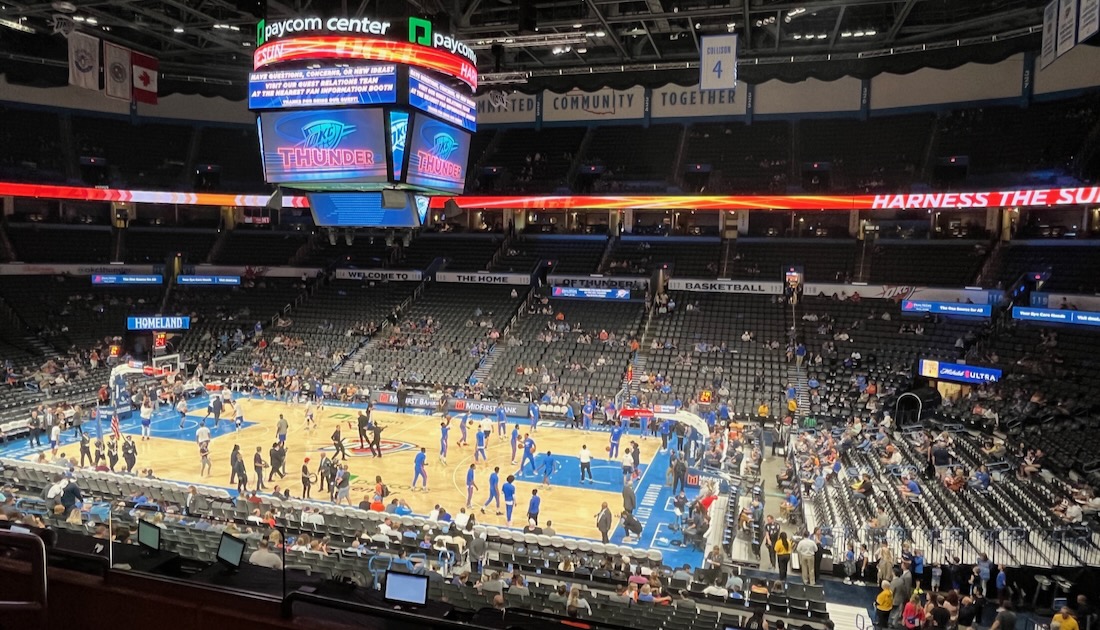
Plenty of seats should be available this season at OKC Thunder home games

I’ve been on a 2-year long diatribe on this blog against tanking in the NBA, mostly because of my frustration with the OKC Thunder playing for better draft position instead of winning.

NBA teams never, ever say the word ‘tanking.’ They use the word ‘process,’ instead. If you want to know, tanking is the process of sitting your best players in favor of less experienced back-of-the-bench guys in hopes they will lose instead of win.

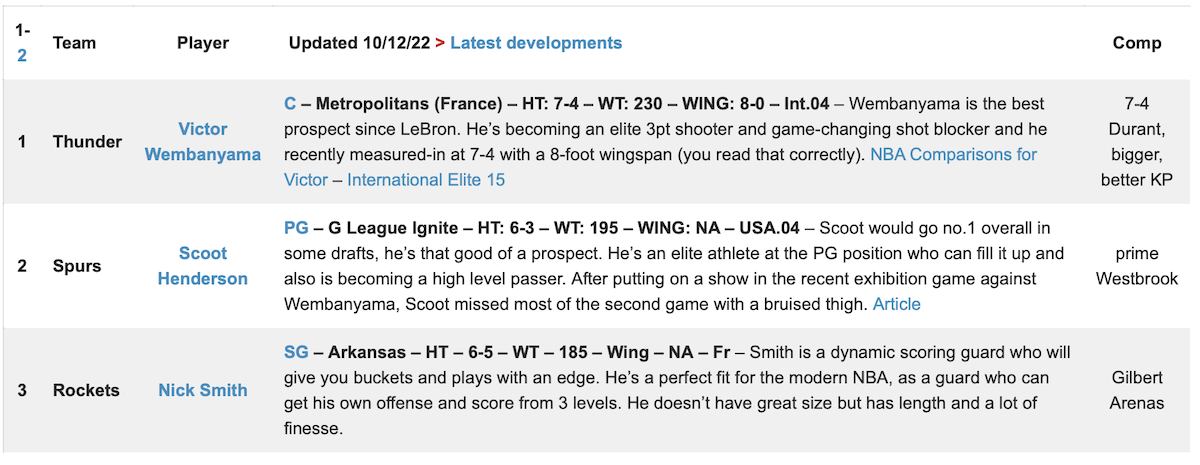
Enough losing and you get more ping-pong balls and potentially a better position in the annual NBA draft. It’s all so teams can capture the next unicorn for their roster, who in this year’s case is 7-4 Victor Wembanyama from France.

Wembanyama wowed the NBA world this summer when he dominated a couple of games played in Las Vegas against international and G-League teams.

For what it’s worth, a website called NBA Draftroom already has the Thunder selecting Wembanyama as the No. 1 pick in next summer’s draft.

What does that tell you about where the Thunder are in The ProcessTM? It means the Thunder must lose enough games this year so they finish among the bottom three teams. That will give them the best odds (14%) of receiving the No. 1 pick.

It’s still a long shot.

Source: nbadraftroom.com

So, that leaves me with the point I’ve tried to make for months. Tanking disrespects fans, corporate sponsors AND current players, as well. I could go on all day about ticket prices, sponsorship packages and the lean crowds we saw at Paycom Center last season.

But, my friend Ed Godfrey says I’m an NBA Don Quixote tilting at windmills. I’ve aired my own theory of how the league could discourage tanking.

Ed put a pin into my trial balloon.

“I don’t think the league cares about tanking,” Ed said. “If they wanted to stop it all they have to do is give every non-playoff team an equal chance of getting the No. 1 pick.”

In fact, NBA commissioner Adam Silver has addressed tanking in a couple of articles recently published on ESPN.com

Here’s the money quote from the most recent article:

“It’s one of these things where there’s no perfect solution, but we still think a draft is the right way to rebuild your league over time,” Silver said. “We still think it makes sense among partner teams, where a decision was made where the worst-performing teams are able to restock with the prospects of the best players coming in. So we haven’t come up with a better system.”

That leaves fans, sportswriters and bloggers with the responsibility to come up with ideas to negate tanking.

I proposed in a blog post earlier this year that the league institute a late-season lottery tournament among non playoff qualifiers that would reward the team with the best record with the No. 1 pick.  It’s the ultimate play-in.

My friend Steve Buck has given the tanking issue a lot of thought, as well. He’s come up with his own proposal that I think has a lot of merit.

Steve suggests that the league monitor “load management” among teams and how often healthy players are sitting out.

“Teams can practice load management if they want,” Steve said. “But teams that play their best players most frequently are rewarded with better draft odds than teams that routinely do load management. If your roster is truly bad, you get help. But if you are gaming minutes, you receive a penalty in reduced odds.”

Steve has it all sketched out down to the deadline for teams to announce a player sitting out and a requirement to reduce ticket prices for fans who often buy tickets just to see a specific star player.

“Only one player can be on ‘load management’ per night max, and a player is only allowed four load management nights per season,” Steve said. “Load management must be announced 24 hours before a given game and the club choosing to rest players must find a way to compensate single game ticket holders that bought seats for a specific contest through the NBA sanctioned ticket vendor.”

His scenario also includes evaluating injured players for game-ready status. The Thunder’s Shea Gilgeous-Alexander last season, for instance. We had to take the team’s word (or maybe the team’s physician) that SGA was not game ready for about the last 20 games or so of the season.

“That’s tough to prove,” Godfrey said. “If SGA has a ‘minor’ injury and the Thunder don’t want to risk further injury by not playing him the last 20 games when they are out of the playoffs, how are you going to prove that is tanking and not a decision in the best interest of the player’s and the team’s future?

“And the player’s union would get involved.”

So, what have we solved? Nothing, I guess. But I hope the tanking dialogue continues until the NBA takes substantial action to level odds for all non-playoff qualifiers, as Ed suggested.

A final word about draft odds from Silver as quoted in the ESPN article.

“You’re dealing with a 14% chance of getting the first pick,” Silver said. “I recognize at the end of the day analytics are what they are and it’s not about superstition. A 14% chance is better than a 1% chance or a no percent chance. But even in terms of straightforward odds, it doesn’t benefit a team to be the absolute worst team in the league, and even if you’re one of the poor-performing teams, you’re still dealing with a 14% chance [of winning the lottery].”

So, why can’t you level the odds for non playoff qualifiers?

Stay tuned.

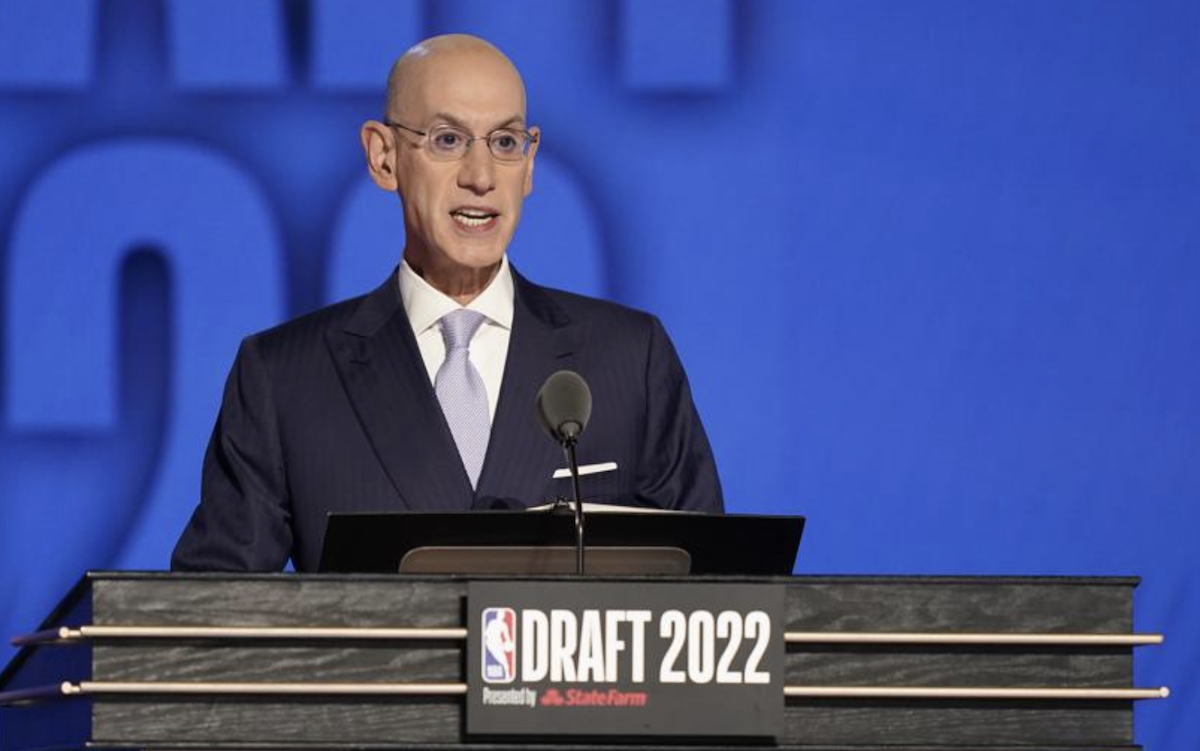
Adam Silver at NBA draft. (source: Associated Press)

Healthcare for all needs to happen

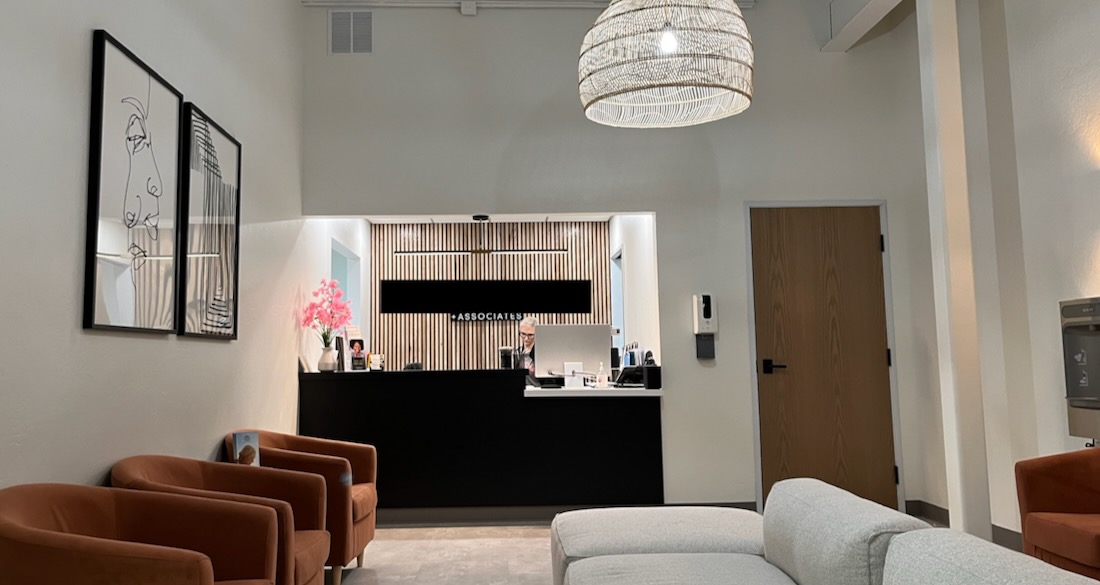
clinic

The healthcare industry has thrown yet another obstacle at American consumers, and it has me seething.

Here’s some background.

My primary physician recently sent me to a specialist for a healthcare concern I’m having. I had never been to this specialist’s office before.

So, a couple days after my doctor made the recommendation, I received a call from the specialist’s clinic. A time was arranged for an office visit, followed by questions about my insurance.

Count me among the nation’s elderly, so my insurance is Medicare and a secondary insurance.

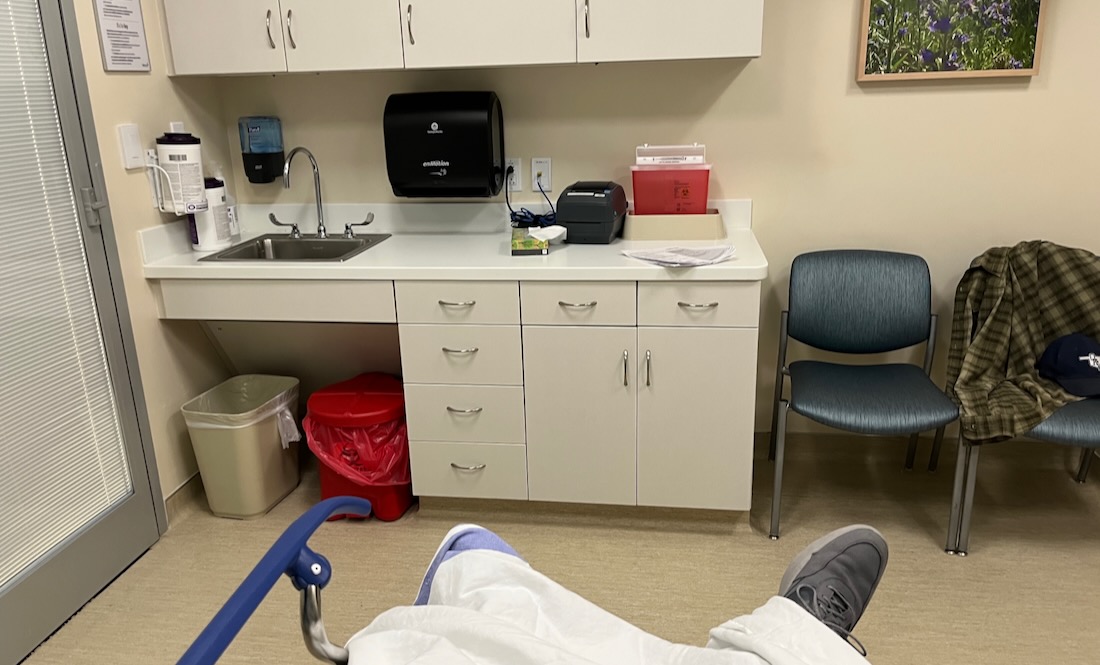
Next, I was hit with a demand that I’ve never experienced from any hospital, clinic, doctor or healthcare specialist. I was required to provide a debit or credit card number for the provider in advance of the office visit.

“We require all of our patient’s to have a credit or debit card on file,” I was told.

What?

I was angry as I mulled over the requirement well before the appointment.

But I showed up for the doctor’s visit, filled out required paperwork and then was confronted by the request for the debit or credit card.

So, I hit the innocent receptionist with all the GET OFF MY LAWN fury of an over-the-hill 69-year-old man.

This is a first, I told her, loudly. So, if I have a balance after the insurance portion is paid, you will draft it out of my account?

She told me that the clinic implemented the requirement because of one-time patients who refused to cover the out-of-pocket portion owed the physician.

I get it. We’ve had some pretty big out-of-pocket expenses over the years that we’ve slowly paid off over time to providers. At times, we’ve even had our balances turned over to collection agencies.

But they all got paid, eventually.

That’s just a hazard of the American healthcare system, since we are one of the few developed countries in the world that does not have universal healthcare for all.

I didn’t ask to be sick. No one does.

Anyway, I told the nice young woman that if I DID have a balance after insurance paid its portion, I would promptly cancel the card they have on hand before they had a chance to draft it from my account.

She said I had the option of requiring the clinic to contact me first and ask to draft the amount before actually doing so.

My old-man fury was slightly diminished.

But my anger is not on my behalf. It’s for the millions of Americans — working or not — who don’t ask to be sick but are victimized by a system that saddles them with humongous healthcare costs when they do become ill.

When folks can’t pay their healthcare bills and are turned away from medical providers, they end up going to the emergency room for their healthcare. And that’s the absolute most expensive option.

But that’s the American WayTM.

So, what’s the purpose of this diatribe? I’m ranting because I consider healthcare a basic human right, and our system treats it like it’s a Mercedes that we can’t afford.

Let’s join the rest of the world and implement healthcare for all.

I know, I know. Fearmongers claim it would bankrupt the country or severely diminish healthcare coverage for the average American.

That’s an old argument that I used to hear on my grandmother’s radio as she listened to the H.L. Hunt-sponsored “Life Line” shows in the early 1960s. And that’s before Medicare was even implemented.

Medicare has been an incredibly successful lifeline for elderly Americans.

We could slowly implement universal healthcare as an option in place with private health insurance for those who choose to keep it. Or lower the qualifying age for Medicare to, say, 60. Or 55.

We can make it happen. It’s going to happen.

All in on Sam Presti & the Thunder season

Presti screen
OKC Thunder general manager Sam Presti speaks to the media in the weeks leading up to the 2022-23 season.

As my friend and debate partner in all things OKC Thunder, Steve Buck has often accused me of being anti-Sam Presti.

It’s an accusation that I loudly protest even as I have questioned the Thunder’s apparent philosophy of losing games on purpose, otherwise known as tanking. Teams tank because losing positions them for better draft position as they work to build their roster.

As my friends at church would say, “love the sinner, hate the sin.”

Steve has described it to me as a “player development” philosophy rather than actual tanking, which the NBA frowns upon. In 2018, Dallas Mavericks owner Mark Cuban was fined $600,000 for admitting on the Dan Patrick Show that the Mavs lost games on purpose. 

In comments made on the Dan Patrick Show,, Cuban said that “once we were eliminated from the playoffs, we did everything possible to lose games.”

I’ve never heard Sam Presti say anything about losing on purpose. But I have heard him discuss “commitment to the process” and “not taking shortcuts.”

We saw how that played out as the Thunder went 24-58 in 2021-22, often keeping key players with minor ailments on the injury list and out of the lineup for long stretches. The team even cut a player late in the season who was playing above expectations, which threatened the team’s commitment to ‘The ProcessTM”

Frustration mounts for me when it’s apparent the Thunder are ‘exploring the roster’ with no interest in winning the game night after night. That’s what we’ve seen the last couple of years.

So, what have we heard from Presti leading up to the Oct. 19 season opener against the Timberwolves? Here are some sample comments from the Thunder GM over the past few weeks.

“What we’re looking for is overall improvement over a long period of time,” Presti said in a media appearance. “That’s not the most sexy, exciting thing that I could say to you.

“I’m not trying to mislead anybody, but it would be easier to try to find something that’s more catchy or exciting. But we just want a long-term, overall improvement. That doesn’t mean each season has to go the same way.”

As I did in a post a year ago, I’m asking the Thunder to play to win every game. I’m sure neither the franchise nor its sponsors enjoyed the nights last season when the Paycom Center was less than half full. 

It’s pretty apparent to me that people are not going to commit time or money to a team they perceive as not trying to win, even if there is a long (emphasize “long”) term goal of capturing the next unicorn in the draft.

My perception is that the fans come last in this tanking or “player development” scenario that’s played out over the past couple of years.

That’s a position that my friend Steve takes issue with.

“Strongly disagree on your last point,” he told me this week. “Presti wants to give a title to the city; isn’t that for the fans? It is fair to say he is not distracted by outside noise; he is focused on the long game.

“And he is accountable to Clay Bennett and he has likely set the goal of winning titles”

There’s a whole debate over whether fans would be more excited by a team that’s competing late in the season for the final playoff spot or if they would rather wait on an NBA title that may never come. 

That’s pie in the sky in the sweet bye and bye.

I’m definitely in the camp that wants the Thunder to play to win every night and be in the chase for a playoff spot, even if it’s the play-in game.

That would make the long, cold winter much more interesting for all of us.

But back to Steve’s original complaint. I’m a huge fan of Sam Presti. I am awed by his acumen for judging talent and finding diamonds in the rough at whatever position the Thunder are drafting. I love the way he welcomes new players to OKC and gets them involved with the community.  I love the way he represents the Thunder and OKC itself.

As Dan Patrick said last year, “Sam Presti is the best GM the NBA has seen in a long, long time.”

A last comment from Presti on the upcoming season: “Let’s wait for it to play out before we decide that’s what it’s going to be.”

I’m all in on that.

thunder tip2021
Thunder tip off in an early 2021-22 season game

Farewell to the Edmond-OKC commuter bus

Edmond bus1
The Edmond Citylink bus parked at the Festival Marketplace downtown.

Attention, Edmond-to-downtown Oklahoma City bus commuters: I come bearing bad news. The Edmond Citylink bus service to downtown OKC is ending on December 30.

I know this is not big news to most of my NW OKC-Edmond neighbors. There’s a certain stigma to taking public transportation in a well-to-do community where the automobile is king.

But all my adult life I’ve wanted to live in a city where public transportation was close enough to me that I could easily take it to work if I chose.

Never happened.

Once, I lived in a house near NW 50th and Hudson in Oklahoma City, and the city bus passed right by my residence. But the hours of my job in downtown OKC began in mid-afternoon and didn’t end until midnight or later.

So, there was no bus option to get home.

Then I married and, together with my wife, moved to far northwest OKC near Edmond Road and Western. There was no public transportation options within miles of my car-centric neighborhood.

Then I learned about Edmond’s Citylink bus service that connects downtown Edmond to downtown Oklahoma City. It’s called the Expresslink bus.

By now, my work was located in the Research Park at NW 8th and Lincoln just east of downtown. Turns out, the Expresslink bus went right by the Research Park.

So, looked at the schedule and figured out that I could drive 3 miles to the Edmond Festival Marketplace, park my car and catch the free 7:15 am bus that would let me off right at the Research Park entrance.

Did I mention that it’s free?

So, it cost me nothing to ride and saved gas expense and wear and tear on my car. I could step out of my office and walk just a few yards to catch the bus back to Edmond at the end of the day.

Perfect. I caught the Expresslink bus off and on for several years.

Then my professional life moved to a work-from-home situation. I’ve only taken the Expresslink bus one time in the past three years or so.

I’m off the bus now, so to speak, but still found the recent news disheartening that Edmond will end the Expresslink bus at the end of the year.

Most of the time, when I rode that route, there were 12-to-18 people who rode with me on the 7:15 am bus.

Among Edmond residents who often took the Expresslink bus downtown was my friend Dan Lovejoy.

“The bus is nice,” Dan said when I asked him about why he took the bus instead of driving into OKC. “It’s not much slower than driving – and I can work or rest on it. It forces me to leave on a schedule and not stay too late.”

Many — or most — riders boarded the bus as an alternative to rush hour driving, as Dan did.

“One distinguishing characteristic of successful public transport is — do people who don’t have to take it actually take it?” he said. “On Edmond Express at least, people rode it who didn’t have to ride it.”

Today, Dan drives an electric vehicle, which cuts down fuel costs. He also has a job in which he works at home a couple days a week, so he’s not taking the bus on a routine basis.

“I wonder if there are a lot of folks like me who just aren’t commuting much any more,” he said.

Citylink hearaing

I’m convinced the pandemic has had a major impact on Expresslink ridership. Many people like Dan are able to work from home at least a couple days a week.

I emailed Christy Batterson, Edmond Transit Program Manager, to inquire about ridership numbers, but she did not respond.

The transportation news isn’t all bad, however. There’s a silver lining in far distant clouds.

Edmond is part of the Regional Transportation Authority of Central Oklahoma, which has long-range plans to operate a commuter rail service from Edmond to downtown OKC to Norman.

That’s a pretty exciting prospect, not only for a rail fan like me, but for potentially hundreds of Edmond commuters who could take the train in to downtown OKC each work day.

Of course, it all depends on overcoming the stigma of boarding public transportation in Edmond, Oklahoma.

Edmlond bus2

Still an Apple fanboy after all these years

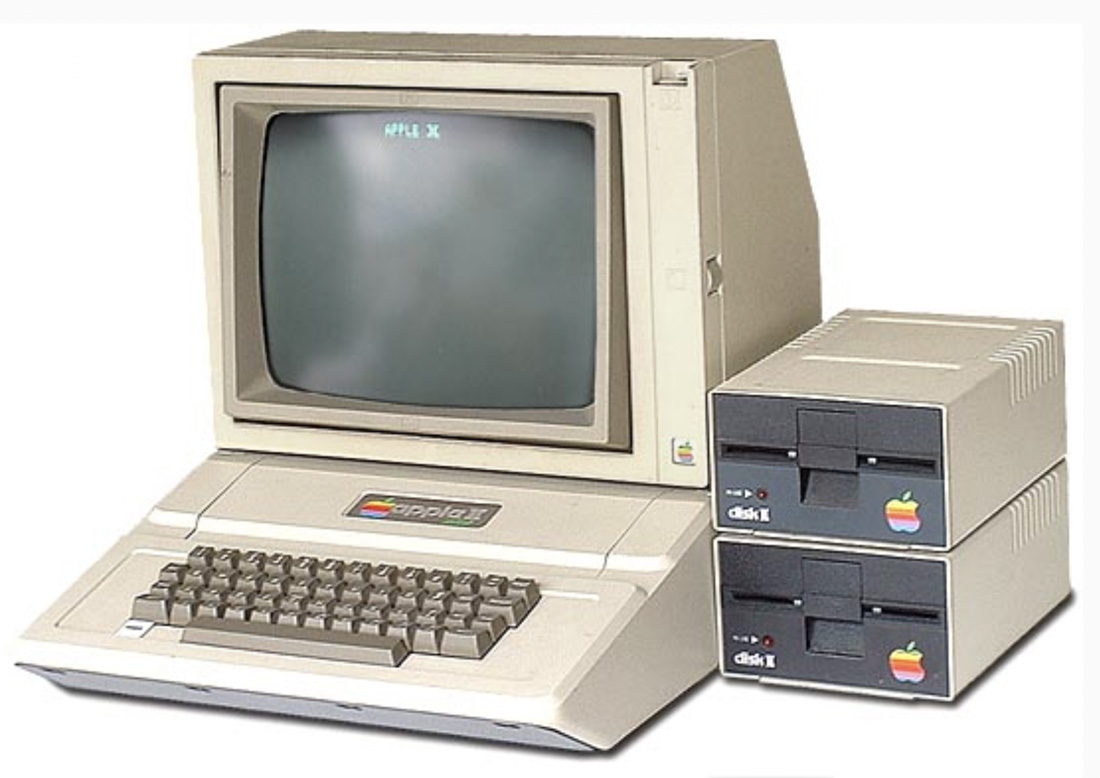
The Apple IIe with two 5-1/4 inch floppy disks, just like my first setup

I read a magazine article in the late 1970s about a couple of young Californians who built a new stand-alone computer in the garage of a Cupertino, Calif. home.

They started a company called Apple Computer to sell their innovation.

I had never used a computer at that point in life. As a journalism student at Abilene Christian University, we did all of our writing either on our own antiquated typewriters or on IBM Selectric typewriter in the newsroom of ACU’s student newspaper.

Anyway, the more I read about Apple and its Apple II computer, the more fascinated I became with both the company and the concept. Like most people, when I thought of computers, IBM and its massive room-sized mainframes came to mind.

After graduating from ACU, I went to work at the Southwest Times Record in Fort Smith, Ark. We worked on typewriters when I arrived in late August 1978, but by the Spring of 1979 the paper had installed its first computer terminals for reporters and editors to use.

They were so-called “dumb” terminals that were tied to a mainframe computer. They crashed a lot, usually right at deadline.

Meanwhile, I was still keeping up with Apple and its computer, but thought it was way beyond what I could afford.

Besides, who ever thought of having a computer in your house?

Fast forward about seven years. I was working at The Oklahoman when J.T. Goold, one of my co-workers, said he had a used Apple IIe for sale. It had been his father’s,

So, I ponied up about $500 and bought the Apple IIe, which came with a green monitor and two 5-1/4 inch floppy disks.

That Apple IIe sealed my love of all things Apple. I learned to use word-processing software on that computer, as well as a spreadsheet, a simple database and a page-design program.

In a few months, I added a 1,200-baud modem, which opened up a whole new online world of what were then known as bulletin boards. Then came AppleLink.

I tried my hand at learning some BASIC programming skills, but never got much further than making a little routine that filled the screen with a single sentence.

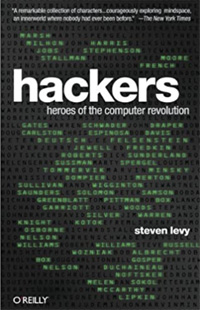
I’ve written all of this because I’m deep into Steven Levy’s book, “Hackers: Heroes of the Computer Revolution.” The Apple II and its creator, Steve Wozniak, play a huge role.

In Hackers, Levy detailed the founding and growth in the early 1970s of the Homebrew Computer Club in the San Francisco Bay Area. The club attracted scores of computer hackers who shared a vision of a future where everyone had a stand-alone computer of their own.

Levy wrote: “These were people intensely interested in getting computers into their homes to study, to play with, to create with … and the fact that they would have to build the computers was no deterrent.”

Steve Wozniak attended the very first Homebrew Club meeting, but it was a few years before he actually built his first computer. His friend Steve Jobs convinced him to create a company as partners and sell his computer invention.

So they began building computers in the garage of the home of Jobs’ parents. The Apple II became a runaway bestseller, bringing computers to millions of people.

I became an Apple fanboy after reading that early magazine article in the 1970s. The used Apple IIe that J.T. Goold sold me in the mid-1980s ensured it would last.

And here we are today.  I’m writing this on an Apple MacBook Air while the my Apple iPhone keeps buzzing with text alerts and notifications.  I’m reading Levy’s excellent “Hackers” on an Apple iPad Mini.

It’s been a long-term relationship, to say the least.  Still an Apple fanboy after all these years.

Siri has a hot take

Her screen
Screen shot of the ‘Her’ trailer

We were traveling back to OKC from Hammon, OK, on Saturday when I asked my virtual assistant, whom I will call “Siri,” for the score of the Cincinnati-Arkansas football game.

“Arkansas leads Cincinnati 14-0 at halftime,” Siri responded.

Then I asked her for the score of the OU game. The Sooners were playing UTEP, and I wasn’t expecting much of a match.

“Oklahoma is dominating UTEP 28-10 at halftime,” Siri responded.

My wife picked up on how Siri gave us the score.

“I wouldn’t say that OU is ‘dominating,” Paula said.

“Yeah, but that’s how Siri sees it,” I replied.

Then it hit me. Siri had a take on the game! My virtual assistant supplied by Apple not only gave me the score, but an opinion on how things were going.

Even if Siri was stretching things a bit.

SiriAnyway, this made me think about artificial intelligence. Siri, Alexa, Google’s assistant all have some personality built in, I assume. I only have experience with Siri and Alexa, and they both can have a quirky personality.  Alexa seems more upbeat.

If you want a fictional vision of the future of artificial intelligence and virtual assistants, watch the movie “Her.”

If you’ve not seen Her, it’s a 2018 film about a lonely, incredibly downbeat man named Theodore (Joaquin Phoenix) in the not-too-distant future who buys a new AI-powered computer operating system. He calls it “Samantha.”

Played by Scarlett Johansson, Samantha engages Theodore in a round-the -clock conversation, learning about his life and environment while anticipating his every need.

Ultimately, Theodore falls in love with Samantha, whose intelligence seems to be expanding exponentially.

At the end of the movie, Samantha tells Theodore that he’s just one of scores of men she’s “dating.”  Then she drops the news on him that she’s taking off with some of her other AI counterparts to bigger and better things (which I assume to be a world takeover).

It doesn’t exactly bode well for mankind.

Her raises a lot of questions about the future of AI, and I’m not sure the answers are what we like. At least Samantha had a personality and a take on the issues in Theodore’s life, even if she was over the top.

Maybe that’s where Siri is headed. Let’s just hope she doesn’t conspire with Alexa and Google to try to take over the world in an AI coup.

Hotwheels fire alarm in the kitchen

After the smoke cleared in the microwave

I was on kitchen patrol earlier this week, focused on rinsing a bowl in the sink when some unexpected loud popping and sizzling noises from a few feet away caught my attention.

So, I turned and saw smoke billowing out of a microwave that sits on a cart and serves us as our emergency backup microwave.

WHAT’S HAPPENING?

I scrambled around the edge of the kitchen counter and peered in, but all I could see was a cloud of gray smoke and flames while being hit with an incredible stench.

As I screamed for help from my wife, our son, Sam the Chihuahua — anyone — I found the right button and shut the microwave down.

When the smoke cleared, I saw four Hotwheels cars inside the machine. Flames were still coming out of two of them.

The culprit

Meanwhile, our 3-year-old grandson was in the living room screaming and crying.

it wasn’t a coincidence.

While his Papa’s attention was focused on the dishes, Solomon had loaded up the microwave with his favorite toys and somehow found the power button.

Now he was distraught because he thought he had destroyed his favorite Hotwheels.

We gave it a few minutes and then removed the cars with a wet paper towel in case they were still hot. The Hotwheels were all badly singed, and a tire had begun to melt on one of them.

I told this story to my friends Ed Godfrey and Linda Lynn, and all they could come up with were some bad puns.

“This gives new meaning to Hotwheels,” Ed said.

“Were the tires FIREstone?” Linda asked.

Hardy-harr-harr.

We consoled Solomon while also making it clear that he is never again to touch the microwave or put anything in it. Ever.

The cow had long left the barn, but we took the ultimate step to prevent a repeat of the near disaster.

We unplugged it.

Phone tracking: ‘They are listening.’ Maybe

The Springs
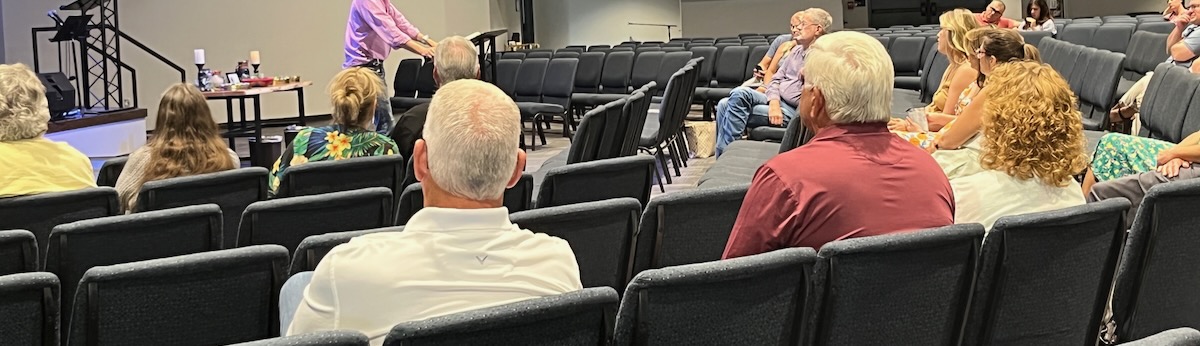
A Sunday morning adult class at The Springs Church of Christ in Edmond

First off, let me say up front that I am NOT wearing an aluminum helmet as I write this. And our windows are not covered with foil to keep mind-controlling radio waves out.

But sometimes weird coincidences happen, especially with our cell phones.

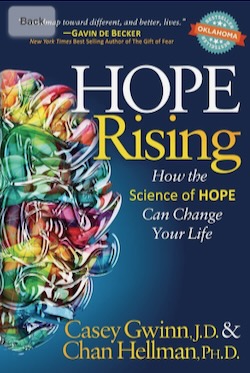
Hope RisingI was sitting in a Sunday morning class on the topic of ‘hope’ at our church a few weeks ago, listening to a lesson presented by Chad Hellman, Ph.D., a University of Oklahoma professor and co-author of the excellent book “Hope Rising: How the Science of Hope Can Change Your Life.”

Dr. Hellman discussed subjects like how childhood trauma impacts the future lives of children, and how pursuing “hope” as he defined it can help people — young and old — set goals and achieve them as they pursue a better life.

My wife, Paula, was seated next to me, and near the end of Dr. Hellman’s presentation she got a text alert from Apple news on her phone. It promoted an article on the order of “12 steps you can take for a happier life.”

Paula showed me the alert on her phone’s screen and whispered “they’re listening.”

We both smiled at the irony.

But it’s happened before. We’ve been in the car on trips having conversations on some topic when ads served up by Facebook on our phones eerily matched the subject.

Cue the Twilight Zone theme.

If you search “is my phone tracking my conversation” online, dozens of articles will pop up on the subject, including this one from the Washington Post that seeks to quell our fear.

Here’s the bottom line based on interviews with experts:

“It’s an old wives’ tale,” said Eric Seufert, who founded the marketing consultancy Heracles Media and runs a popular blog for app developers. “It’s this kind of mythical, horrific, but ultimately untrue, fear.’

‘The short answer is: No, your phone isn’t listening. But why is this rumor so hard to shake?’

Other articles take the possibility more seriously that conversations are being tracked by our phones, including this one from Fox News headlined: “You are not paranoid: your phone really is listening in.”

So, it’s a mixed bag of believers and skeptics. I only know from my own experience like the one during Dr. Hellman’s presentation on a Sunday morning.

Excuse me while I go look for some aluminum foil.

The horse is here to stay

horseless carriage
A turn of the 20th-Century horseless carriage.

‘The horse is here to stay, but the automobile is only a novelty — a fad.’ — American banker to potential investor in 1903

Even at the dawn of the 20th century, your crazy uncle was spouting off nonsense about things he didn’t know anything about.

I guess back in those days, social media rants took place at the local church, tavern or letter to the editor. New technologies have always brought out the doubters and naysayers, I guess.

One hundred years ago. Sarah T. Bushnell published a biography called “The Truth About Henry Ford” in which she told the story of the banker who advised the attorney that drew up incorporation papers in 1903 for Ford’s automotive company.

The attorney had been asked to invest in the Ford Motor Co., but was hesitant and sought out advice from his banker.

“My advice is not to buy the stock,” the banker said. “You might make money for a year or two, but in the end you would lose everything you put in. The horse is here to stay, but the automobile is only a novelty — a fad.”

We all know how that turned out.

Read more on the turn-of-the-20th-century opposition to the horseless carriage in “Get a Horse!”, an article written in the 1920s by one of the inventors of the automobile, Alexander Winton.

Fast forward 100 years.

We’re at the beginning of a revolutionary transition in which electric vehicles will replace gasoline and diesel powered vehicles. Auto manufacturers are building more EVs each year with commitments to make electric vehicles the vast majority of their production by the 2030s.

There seem to be an incredible number of Teslas already on Oklahoma roads.

Despite the upward trajectory and inevitable march of technology, I’m seeing rants against EVs every day on the social media platforms where I hang out. A lot of ‘crazy uncles’ are poo-pooing the potential of electric vehicles, along with alternative power generation from wind and solar energy.

ev scamsI’ve seen photos and graphs and charts that allege that electric energy is just as harmful to the environment as fossil fuels because of the mining for minerals and the ultimate disposal of batteries.

If you Google “electric vehicles” and “scam,” you get dozens of articles showing that the world is being played.

I’m no expert, but I choose to believe that scientists and innovators have taken all of that into consideration.

So, I assume a lot of folks — especially Oklahomans — are feeling threatened by alternative power and transportation because of our long-standing ties to the oil and gas industry.

It’s sort of ironic that oil and gas-dominated Oklahoma is home to one of the world’s first large scale electric vehicle battery remanufacturing and recycling ventures, Spiers New Technologies.

Founded less than a decade ago by Dirk Spiers, the company has shown phenomenal growth, quickly outgrowing its original 23,000 square feet of manufacturing space to now occupying its current 200,000 square feet in its operations center along SE 89th Street just east of I-35.

Spiers also operates a European location and provides battery lifecycle services to virtually every automaker with the exception of Tesla. The company showed such potential that it was acquired in 2021 by Cox Automotive.

I’ve had the opportunity to interview Dirk on several occasions and hear his views on the future of electric vehicles. You can read an earlier post with Dirk here.

But I want to share some of his perspective again in this post, because I think it’s both worthy and accurate.

“In the next five years, the cost of an electric vehicle will be cheaper than a combustion engine,” Spiers said. “So, we are only at the beginning of where we are going.

“The Devon tower — and I think it is a great building — is now more than 50 percent empty. That shows you how they (and Oklahoma City) misread the future. And now the Devon tower stands there as a symbol of Oklahoma City prosperity, but it is half empty. A relic of an industry in decline.

“The good thing is that you know eventually that everyone will drive an electric car. Those cards have been played. So, we are on the right side of history” 

Although he added that the transition is not going to happen all at once, we’re watching Dirk’s predictions playing out every day.

Meanwhile, I’ll end this with the long-ago perspective of another futurist, former U.S. Supreme Court Justice H.B. Brown in a 1908 article entitled “The Horseless Carriage Means Trouble.”

“The automobile is doubtless a most useful vehicle, but one is not likely to lavish upon it the fond attention he bestows upon his horse or dog. A man may admire his own carriage, but his affections are reserved for the horse that draws it and the dog that follows it. Whatever the outcome may be, every true admirer of the horse will pray that it may not be the extinction or dethronement of the noblest of all domestic animals.”

Now there’s your crazy uncle.

negative screen]

Newspapers on quest to level search playing field

newsad2

A couple weeks ago, as I flipped through my edition of The Oklahoman newspaper I was confronted by end-of-the-world sized type in a full-page advertisement.

“DON’T LET BIG TECH CANCEL LOCAL NEWS,” the headline screamed.

Beneath it were a couple of paragraphs of text, one of which read:

“Local news strengthens our community, but local newspapers across the country are under threat. Big Tech takes advantage of the news and information created by local publishers, but they won’t pay for it.”

The ad was placed by a newspaper industry group and targeted “Big Tech” giants Google and Facebook, although neither were named in the copy.

In the ad, the newspaper group urged Congress to adopt an antitrust “safe harbor” law — the Journalism Competition and Preservation Act (JCPA). That legislation would allow newspapers to negotiate collectively for payments from Google and Facebook for using headlines and snippets of their work in search results.

We all use these sites. When users click on the headlines surfaced on a Google search, they are linked back to the full stories on the original newspaper websites. 

I was intrigued.

I thought newspapers welcomed traffic driven from Google or Facebook to their websites, because they are in a desperate battle for readers and for survival as an industry.

Online readership has become a critical element to sustaining newspapers into the future. I thought readers following a headline back to the original newspaper website would be like a gift from God.

I’ll give you an example:

Let’s say there’s been an oil well explosion near Cordell in Southwest Oklahoma. I hear a rumor of the explosion at the grocery store, so I do a Google search for oil well, explosion and Cordell.

Google returns a headline from the Cordell Beacon, which I click on to read the Beacon’s story in its website. Google drove that traffic to the Cordell paper. 

Brett Wesner
Brett Wesner

That’s not the complete story, says Brett Wesner, president of Wesner Publications, which publishes the Cordell Beacon. Wesner also is chair of the National Newspaper Association, an industry group that represents thousands of smaller community newspapers nationwide.

While newspapers need the traffic driven from aggregators like Google, the tech giants sell billions of dollars in advertising to their own websites based on the content they present and the eyeballs it attracts.

“Google and Facebook generated $4 million in U.S. advertising revenue every 15 minutes during the first quarter of 2022,” Wesner wrote in an editorial that has been widely distributed. “That amount could fund hundreds of local journalists in every state in the country.”

Wesner is a Cordell native and San Francisco resident, from where he oversees his Wesner Publications group, which includes 10 community newpapers across the state. A Brown University graduate, he was David Boren’s press secretary in the late 1980s.

newsad1Traffic generated from Google and Facebook is critical to newspapers, Wesner said. Yet, the news those publications generate is just as important to the tech giants, he insisted.

If Google or Facebook lost access to Cordell news because the Beacon refused to allow it to post anything, it wouldn’t cause much of a ripple.

“But what if everybody started doing that?” Wesner asked in reply to my question about the JCPA “safe harbor” legislation. “Then when you Googled the Uvalde shooting, for instance, the only listings you get are your crazy uncle Bill’s rantings on a Facebook post. You don’t have access to any real media takes. If you Googled them, if those were the only listings you got, how credible would that make them on news issues. Not very.

“So, we need them. They need us.”

And that brings us to the proposed bipartisan legislation that seems to have a lot of Congressional support. But it’s slow moving.

“I think we will get to the negotiating table,” Wesner said. “I think they JCPA will be the path for that. We have had a lot of support from both sides of the aisle.”

The U.S. industry has a template for Google and Facebook payments for content. Both the European Union and Australia have recently passed legislation that requires the tech giants to compensate local news outlets for using their content. 

How much money would newspapers expect to gain from collective negotiations with Google and Facebook?

“We don’t know the answer to that until we begin negotiating,” Wesner said. “The problem is we can’t even begin negotiating without this antitrust legislation.”

The search for a solution continues.