OKC’s Sharina Perry invents a sustainable future with Utopia Plastix

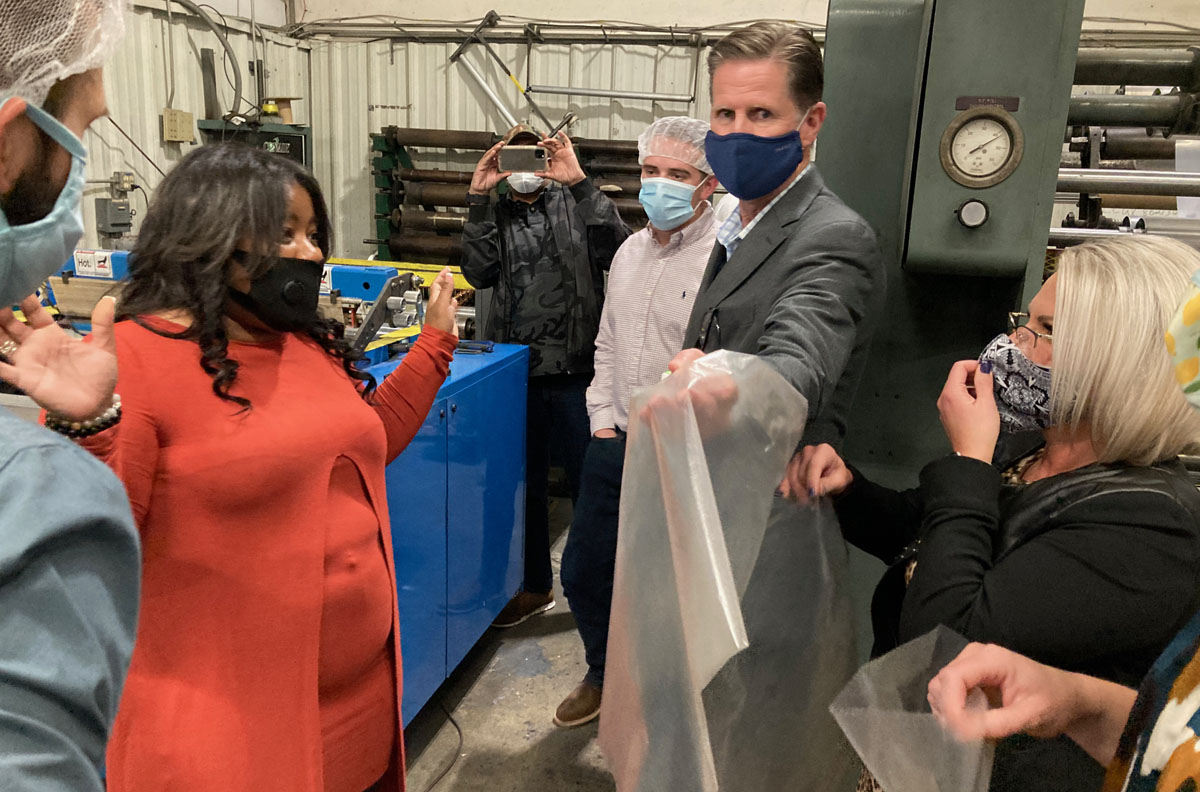
Sharina Perry (left) showcases bags made out of Utopia Plastix’s plant-based alternative plastic material that she invented.

Editor’s note: Along with my colleagues from the Oklahoma Center for the Advancement of Science & Technology (OCAST), I recently had the opportunity to meet Oklahoma City innovator Sharina Perry and hear the story of her remarkable journey as an inventor and entrepreneur. This is the story I wrote from that visit:

By Jim Stafford

Her audience sat spellbound for more than an hour recently as Sharina Perry shared her journey into entrepreneurship and her vision for her Oklahoma based companies all centered around developing and distributing her invention of Utopia Plastix.

Representatives from the Oklahoma Center for the Advancement of Science and Technology (OCAST), the Oklahoma Manufacturing Alliance and the New Product Development Center at Oklahoma State University heard Perry’s tale about overcoming numerous obstacles to advance her invention.

Collectively, those organizations are part of what has become known as the Oklahoma Innovation Model (OIM), which supports innovation and technology advancements that help diversify Oklahoma’s economy.

Perry founded Utopia Genetics to distribute products made with Utopia Plastix, a trademarked product, as well as Utopia Solutions that makes Utopia Plastix.

Utopia Plastix was developed as patent-pending, plant-based alternatives for petroleum-based plastics such as plastic bags and single-use straws.

But Perry’s journey began with a different mission.

Masked for COVID protection, the OIM group listened to the presentation at Oklahoma City’s Poly Films, Inc., as Perry described how she began searching for plant materials that could help reduce incurable tumors that ravaged her nephew.

The prohibitive cost of clinical trials to gain Food and Drug Administration approval for any potential new drug delayed that quest.

However, it opened a door for Perry to take what she had learned into a different direction.

“In the process, I realized that God had a plan,” she told her audience. “I’m a person of faith, and Utopia is about my journey and using my gifts and the gifts of others.”

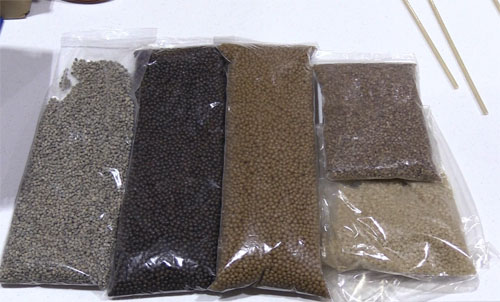
Materials used in Utopia Plastix production from resins developed by Sharina Perry.

She pivoted into compounding plant-based products as an alternative for petroleum-based plastics after learning that Starbucks was offering $10 million for the first successful alternative to single-use plastic straws.

In some areas of the country, single-use plastic straws are now banned, as well as plastic bags that are popular with retailers.

Perry is not a chemist. Instead, she had a long career in satellite and cable industries before taking her first steps down this new path.

So, she dove into the research, working to create a strong paper straw made of Hemp. She provided the paper for the first Hemp straw created by Hoffmaster, Inc. Once produced, she learned that hemp would not be feasible for use as a straw that would be a food contact item and current cost of production would not be feasible.

Research led her to some important discoveries.

“I learned of other plants that had stronger fiber, a stronger core, had a greater yield per acre and actually performed better than hemp at a lower cost per seed,” she said. “And what we found out was that most companies had not heard anything about using plant material in their plastic applications.”

Perry is African American and female with no manufacturing background. Perhaps it’s no surprise that when she reached out to Oklahoma’s manufacturing community for assistance, there was lukewarm response.

“When I started on this journey, I thought having access to what I needed was going to be easy in Oklahoma,” she said. “It was not.”

So, she found a company in Texas that would compound her plant resin into pellets that could be used in the process.

Eventually, Perry perfected a process that resulted in usable plastic alternative straws, and contracted with a straw manufacturer, GCA Products, Inc., in Dallas.

“We’ve had a ton of people come in and say they have the next-best resin,” said Hunter Dunlap, vice president of Operations for GCA Products. “But Sharina is one of the only ones that stayed alive. Through Sharina’s dedication and partnership, we are actually producing straws as we speak for (food product distributor) Ben E. Keith.”

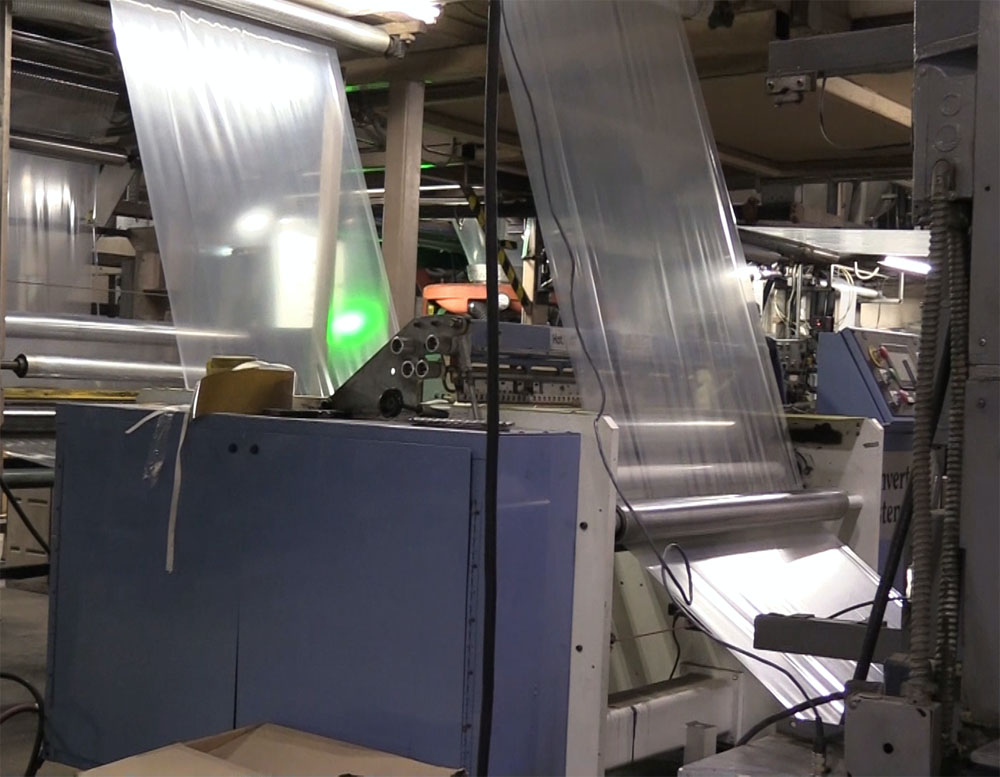
Perry also established a relationship with Poly Films., Inc., which has successfully used her plant-based material to produce what are known in the industry as blown plastic bags.

Kevin McGehee, vice president of Poly Films, guided the OIM group on a tour to watch the bags as they were produced, handing out finished product as souvenirs. Poly Films is a family-owned manufacturer that produces plastic bags and other products for a wide range of clients.

The bottom line, Perry said, is that she has created a business model that benefits farmers, processors, manufacturers and distributors. The crops she uses are high yield “rotational” crops often used to replenish the soil after wheat or corn has been grown on it.

“It’s just kind of a win-win-win all the way down,” GCA’s Hunter said. “We saw that early on, and decided to start the partnership with Sharina. It’s gone very well.”

Perry shared some potential uses that her plastic alternative could be used in addition to single-use straws and plastic bags. That includes plastic cutlery, building materials, roofing products, even diapers. And more.

Utopia Plastix material in production at OKC’s Poly Films Inc.

“There are so many lanes our products can be used in,” she said. “It’s bigger than me. I could have sold this a long time ago. I get offers all the time.”

Before the meeting ended, representatives from the Oklahoma Innovation Model eagerly discussed ways to connect Perry with more Oklahoma manufacturers and industries such as aerospace.

“This has been fantastic,” said Dan Luton, OCAST programs director. “Not only the technology and the product, but also your story and how it got here. There are people who could use your product now; they just don’t know you are here.”

Utopia Plastix did not win the $10 million Starbucks prize. It started too late. But Perry has journeyed far beyond that original incentive.

“We can now use agriculture to replace everyday items, and that creates a sustainable model for our community and our country,” Perry said. “There was already a demand and we want people to know that we are here to help satisfy it. We want Oklahoma to be positioned to do it, and to benefit disadvantaged and minority farmers, as well.”

That’s the win-win-win that Perry is seeking.

Jim Stafford writes about Oklahoma innovation and research and development topics on behalf of the Oklahoma Center for the Advancement of Science & Technology (OCAST).

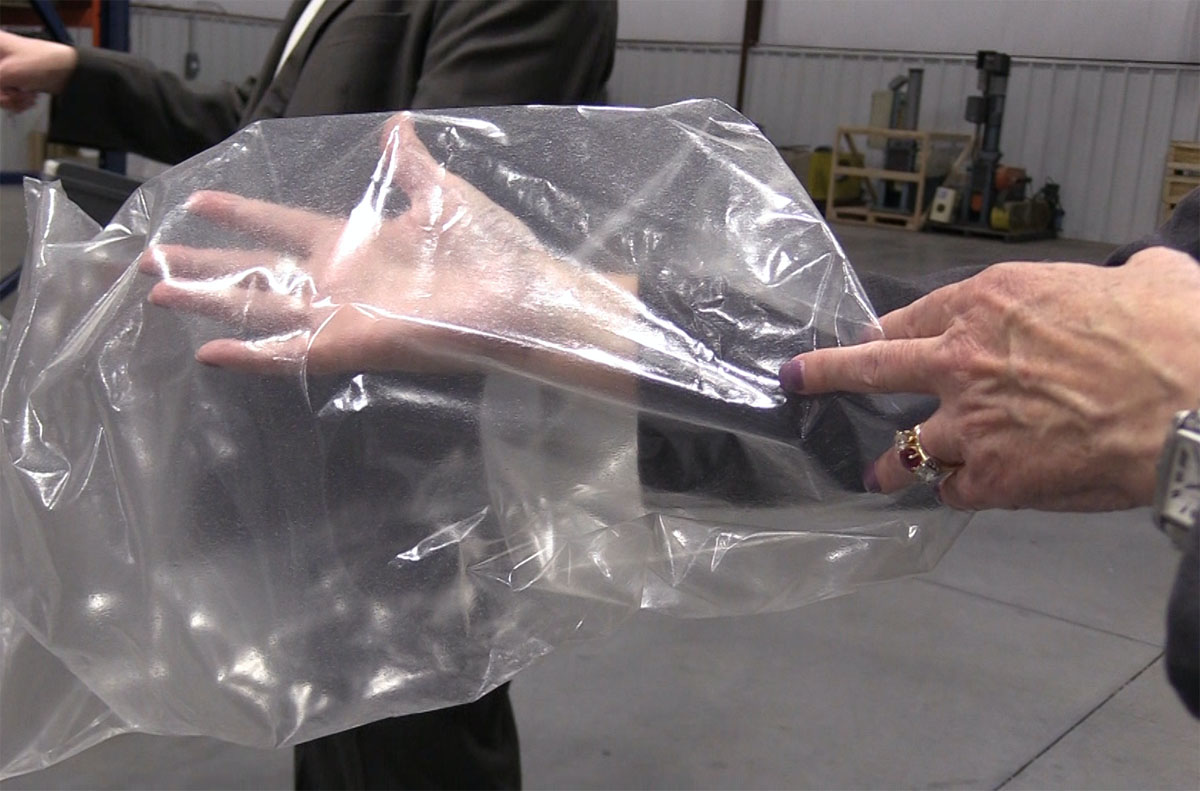
A freshly produced Utopia Plastix bag after it came off the production line at OKC’s Poly Films Inc.

Catching static: Memories of listening to baseball on AM radio

I was driving in eastern Oklahoma way back in the early 1990s when my wife had enough. “Turn off that static!” she demanded.
At the time, I was listening intently to a Texas Rangers baseball game on the AM radio broadcast of Fort Worth, Texas, station WBAP.

To be honest, I had not even noticed the static.

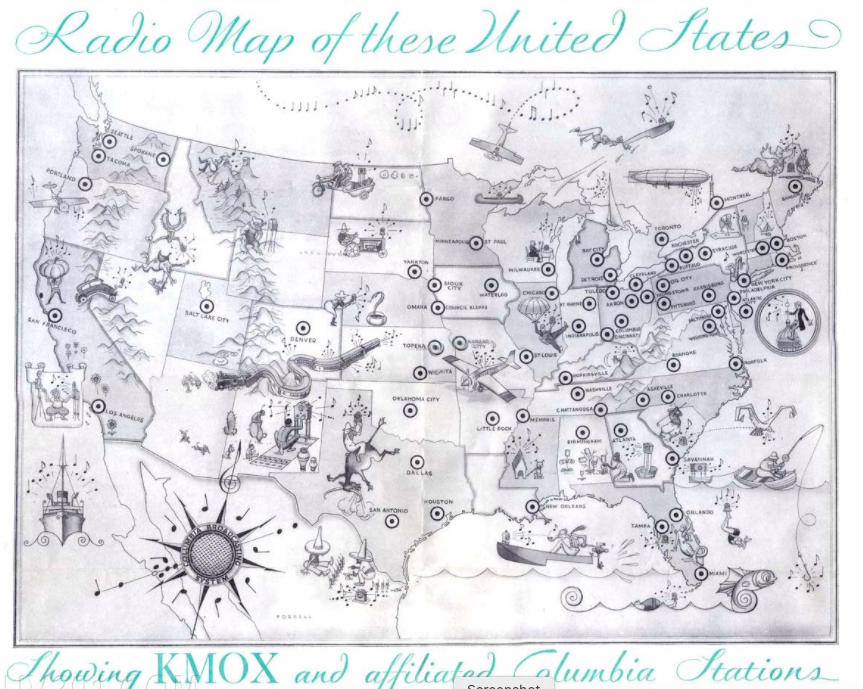
That was life in the olden days, when baseball fans like me would tune into distant AM radio stations like WBAP and KMOX in St. Louis to follow our favorite teams.

As a teenager, I lived on KMOX and the soothing voice of Jack Buck calling the Cardinals games. Later on, it was Mark Holtz and Eric Nadel with the Rangers.

Bonus: Read this terrific New York Times article on the power of KMOX as a reporter tries to outdrive the station’s coverage during a Cardinals’ game broadcast.

After dark, the distant signal from my favorite AM stations boomed across the AM receiver located either in my bedroom or my car.

But static was a price you paid to listen to distant AM radio broadcasts. In the spring and summer, static was almost always present because of thunderstorms somewhere between you and the radio tower.

So, you learned to pick out the play-by-play from the static. I sort of trained myself to tune out the static, which is why I faced the wrath of my wife. 

It wasn’t only the distant sports stations that I tuned into as a teenager. WLS in Chicago was my go-to station to listen to the latest Top 40 hits.
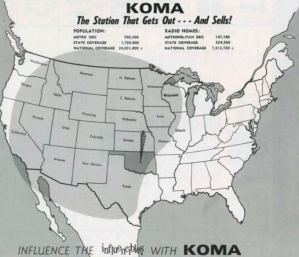
Recently, someone posted a map on LinkedIn that showed the vast coverage of Oklahoma City’s KOMA. Unfortunately, I lived in the wrong part of the country as a kid to become a KOMA fan.

Anyway, the days of straining to hear baseball play-by-play or Top 40 music through a static-riddled broadcast are mostly in the past. I subscribe to MLB.com’s audio broadcasts now, which bring in the Rangers, Cardinals or any Major League team static free and crystal clear.

With bluetooth, I stream the broadcast to the car’s sound system and never miss a pitch.

And I no longer endure the wrath of someone who doesn’t understand the pleasure of ignoring the static to enjoy the game.

MaxQ-Oklahoma Blood Institute collaboration launched during pandemic

I like to say that Oklahoma’s life science cluster stretches from Ardmore in the south through Oklahoma City to Stillwater, to Tulsa and on to Ponca City in the north.
Many of the various entities in Oklahoma’s biotech corridor — research, academic and health care — are usually brought together one time a year at the annual BIO International Convention in whatever city  it is held.

Except for 2020, of course.

Like almost every other conference in the world, the COVID-19 pandemic forced the BIO show this year to become a virtual gathering instead of at the San Diego Convention Center.

However, the pandemic couldn’t stop a unique collaboration launched earlier this year between a Stillwater-based company called MaxQ and the Oklahoma Blood Institute (OBI) — the state’s largest blood collection agency.

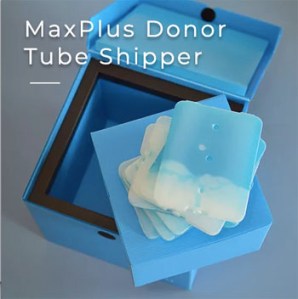
MaxQ invented a patented cold-storage packaging system that serves hospitals, research institutions and blood banks nationwide. OBI evaluated and began using MaxQ’s MaxPlus tube transport shippers earlier this year to ensure safe transport of critical blood products.

If you’re not familiar with MaxQ, here’s a story I wrote about the company on behalf of OCAST about five years ago.

MaxQ was founded by a team of then-Oklahoma State University students in 2012, and has since gained equity investment led by i2E, along with grant funding from the National Science Foundation. Saravan Kumar is MaxQ’s CEO.
MaxQ also won a $200,000 Oklahoma Applied Research Support grant from the Oklahoma Center for the Advancement of Science and Technology (OCAST) that supported development of foam insulation technology.

Today, the MaxPlus solutions are used in more than 520 hospitals, Level I trauma centers, emergency medical transport and blood centers globally.

Congratulations to MaxQ for developing an Oklahoma-made product that meets so many needs in the life sciences industry.

Below is a short story I recently received from MaxQ about its collaboration with OBI:

MaxQ, a Stillwater, Oklahoma, cold chain packaging solutions company, partnered with the state’s premier blood collection organization, Oklahoma Blood Institute (OBI), to deliver the most advanced blood packaging solutions. Oklahoma Blood Institute is the sixth largest, nonprofit blood collector in America. With 185,000 donors annually, OBI services approximately 230 medical facilities across Oklahoma, Texas, and Arkansas.

MaxQ, through its dedicated testing lab and validation services, assisted OBI in updating protocols to validate their packaging and shippers used to transport blood products. The collaboration has helped OBI save time and resources.

Through this collaborative relationship and in working with OBI’s operational team, MaxQ carefully studied blood center operations, the journey of a blood unit from a donor to recipient, and the impact of existing packaging solutions. The current industry standard bulky foam and cardboard boxes are heavy, cumbersome to pack and non-sustainable.

Using its proprietary Maxify™ technology, MaxQ developed the MaxPlus family of blood-specific packaging solutions that places donor blood product safety at its core. The smaller, lighter and highly reusable MaxPlus shippers are easy to pack, fully qualified against industry’s stringent standards, and generate significant savings.

The OBI team evaluated and successfully implemented the MaxPlus shippers for transport of donor specimen tubes early this year amidst the COVID-19 pandemic.

“The entire experience from concept to product delivery was fantastic,” said Carla Bartholomew, OBI Technical Operations Systems analyst. “We were replacing containers that were not very durable and were being replaced at an alarming rate. Enter the MaxQ team and their solution. Now the ubiquitous red tube boxes make me smile every time I see one in the hallway. The guys from MaxQ were very knowledgeable and passionate about transport containers. They listened to our concerns about size and weight and designed a solution tailor made for our needs. I look forward to working with them on future projects.”

The MaxPlus tube transport shippers employed by the major blood centers in the U.S. are quickly evolving as the new industry standard. This collaboration of two Oklahoma based entities is currently solving decades old blood transport challenges globally. The MaxPlus solutions are used today in over 520 hospitals, Level I trauma centers, Emergency medical transport and blood centers globally. Protecting and safely delivering every single unit of donated blood product to patients in need.

About MaxQ
MaxQ is Temperature Controlled Packaging Re-Imagined! Trusted by over 500 hospitals and clinics globally, MaxQ is revolutionizing the shipping of temperature-sensitive investigational drugs and other biologics with advanced breakthroughs in thermal insulation sciences and transparency. Its patented MAXIFYTM technology enables a new category of payload-specific, advanced packaging solutions with unprecedented features, thermal performance, and cost efficiency.  www.packmaxq.com/

OBI Media Inquiries
Contact Heather Browne, Marketing & Media Manager, at 405-419-1330 or heather.browne@obi.org with questions or to schedule an interview.

MaxQ contact:
Shoaib Shaikh
Office: 405 334 5720
Cell: 918 813 2955

Tracking the growth of Oklahoma’s leading public companies

I was recently asked to contribute a couple of stories to the special Oklahoma Inc. section published by The Oklahoman. It was an opportunity to write short profiles on a couple of the state’s leading public companies.

So I signed on.

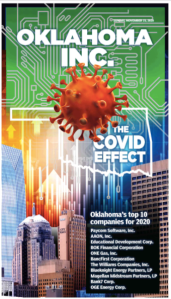
If you’re not familiar with it, Oklahoma Inc. ranks all 28 public companies in our state based on three key categories: one-year return to shareholders, revenue growth and earnings per share growth.


I was fortunate to be able to select the companies I wanted to profile, so I chose Paycom and AAON, ranked Nos. 1 and 2 in the 2020 Oklahoma Inc. standings. Paycom’s stock is traded on the New York Stock Exchange, while AAON is traded on the NASDAQ market.

You can read the stories here (subscription required). Paycom 
AAON

Paycom is the shining star among Oklahoma public companies.

I first interviewed Paycom founder Chad Richison for The Oklahoman shortly after Paycom was founded in 1998, with no clue that it would some day employ more than 3,000 Oklahomans and build an awesome campus in far Northwest OKC.

Paycom moves fast, both with the innovative HR software it offers clients and in its philanthropic efforts across Oklahoma and in the cities in which it operates. I cited an example of Paycom’s philanthropy in my story, but have since been made aware of something even more recent.

The company most recently announced a donation of $30,000 to Folds of Honor to help provide scholarships to military families. That contribution closely follows the $10,000 it gave to Central Oklahoma Habitat for Humanity to support its Critical Home Repair program.

AAON, meanwhile, has a great story about how the pandemic is driving demand for its heating, air conditioning and ventilation technologies.  

Congratulations to Paycom, AAON and all the companies that made the top 10 of this year’s Oklahoma Inc.

One More Thing: Apple brings back totally uncool ‘PC’ and it’s awesome

John Hodgman revives his take as the uncool “PC” at Apple’s One More Thing event

I’m a long-time Apple fanboytm, so when I see that a new Apple product event is about to drop, I wait for it with the same impatient anticipation that consumed fans of Game of Thrones or The Sopranos.

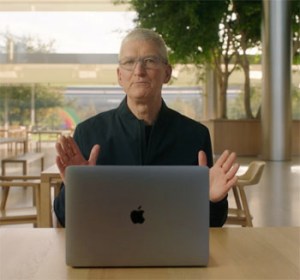
Apple held its latest event today, entitled “One More Thing,” plagiarizing the famous Steve Jobs line. The company introduced three Macs built around its own silicon architecture that it calls the M1 chip.

One More Thing did not disappoint, although the highlight of the event for me turned out to be a huge surprise.

Apple brought back John Hodgman as “PC,” and it was a drop-the-mic moment. If you’re not familiar with Apple’s “I’m a Mac and I’m a PC” ads from the early 2000s, I invite you to check out some on this YouTube channel. They are hilarious.

Anyway, Hodgman shows up at the very end after Apple CEO Tim Cook had already signed off.

It was sort of like how Matthew Broderick resurfaces at the end of Ferris Bueller’s Day Off to tell everyone to go home because the movie is over.

Apple CEO Tim Cook

Hodgman bursts on to the screen and says “Stop! Hang on! Wait! One more thing.” Then as the totally uncool PC, he demands to know why Apple is making all these advancements.

I laughed out loud when PC demonstrated how “fast” he is. Check out the whole Apple event or fast forward to 44:29 to watch Hodgman’s performance. 

Definitely worth it.

Oh, and one more thing (apologies). Apple’s new M1 computers, the MacBook Air, the Mac Mini and the 13-inch MacBook Pro, all look incredible. Can’t wait to get my hands on them.

Oklahoma Innovators: NASA awards SBIR contract to Stillwater’s XploSafe

I’ve worked on the periphery of Oklahoma City’s startup community for about two decades, first as a business news reporter at The Oklahoman newspaper, then as communications specialist for i2E, Inc., and now as a freelance writer.

It’s pretty exciting to see local companies announce a breakthrough discovery, a new product or investment that will carry their innovation into the commercial market.

Unfortunately, many worthy developments don’t always make it onto the pages or websites of local news media, whether it’s a newspaper, television or even digital news site.

There are hundreds of voices seeking media attention every day, so it can be pretty daunting to attract the attention of an editor or reporter.

So, I’ve decided that this blog can be a conduit for my entrepreneur friends to find an audience for their news. From time to time, I’ll publish news that comes my way that hasn’t found its way into any other media.

For example, today I want to share some exciting news from a Stillwater-based company called XploSafe. If you don’t know XploSafe, the company describes itself as a provider of “critical safety solutions for homeland security and chemical safety.”

XploSafe has its roots in the Oklahoma State University laboratories of co-founders Allen Apblett, Ph. D., and Nick Materer, Ph. D., both chemistry professors, along with former OSU graduate student Shoaib Shaikh, also a co-founder and now CEO.

I learned about XploSafe more than 10 years ago when Shoaib pitched the concept in the Donald W. Reynolds Governor’s Cup business plan competition (now known as the Love’s Entrepreneur’s Cup).

Since then, XploSafe has expanded its mission beyond explosive detection to chemical vapor sampling and other areas where detection of potentially dangerous materials is critical.

Recently, XploSafe was awarded a $125,000 Phase 1 Small Business Innovation Research (SBIR) contract from NASA to develop specialized air filtration units for the next-generation of American space suits.

XploSafe released the exciting SBIR news in mid-October, but received little media attention. I invite you to read their announcement from October 15 below.

Stillwater, OK – 15 October 2020 – XploSafe announced today that it has been awarded a Phase I SBIR contract from the National Aeronautics and Space Administration (NASA) to develop specialized air filtration units for the next-generation of American space suits.

The award amount is $125,000 over a six-month period.

These filtration units will help keep the space suit’s internal air-flow free of any toxic, trace contaminants, which naturally build-up while astronauts use their suits. XploSafe aims to capture these contaminants within their proprietary sorbent media, which could then be vacuum regenerated to enable longer spacewalks and substantially improve time in-suit over the duration of a mission. Such a capability will be required for NASA’s upcoming Artemis missions, in which the United States intends to return to the moon by 2024.

The design of XploSafe’s filtration units would provide astronauts with safer air to breathe, as well as lighter, easier to use suits. XploSafe’s filtration unit would be housed within the Exploration Portable Life Support System (xPLSS) backpack of the next-generation xEMU suits, alongside other critical life-support systems. The company holds multiple patents for vapor nanoconfinement technology that facilitates high-capacity absorption, stabilization, and consistent recovery (removal) of a wide range of volatile, semi-volatile, and even reactive organic compounds.

XploSafe’s Operations Manager, Michael Teicheira, had the following to say: “we are ecstatic about this opportunity to showcase the research and development efforts of XploSafe here on the national and even international stage. The prospect of our products enabling astronauts to spend more time in space is an enthralling one, and we are so grateful for this opportunity to show what a small Oklahoma research company can achieve.”

XploSafe based in Stillwater, Oklahoma, is a provider of critical safety solutions for homeland security and chemical safety. Their XploSens explosives detection, XPell peroxide safety products, and XCel+ chemical vapor sampling badges are used by first responders, industrial safety officers, threat assessment officials, and laboratory and chemical manufacturing personnel all over the world.

For questions, please contact Shoaib Shaikh, Co-Founder and CEO, at Shoaib@XploSafe.com, or visit XploSafe online at www.XploSafe.com.

Congratulations to Shoaib and the XploSafe team.

An October ice storm and an unexpected Staycation

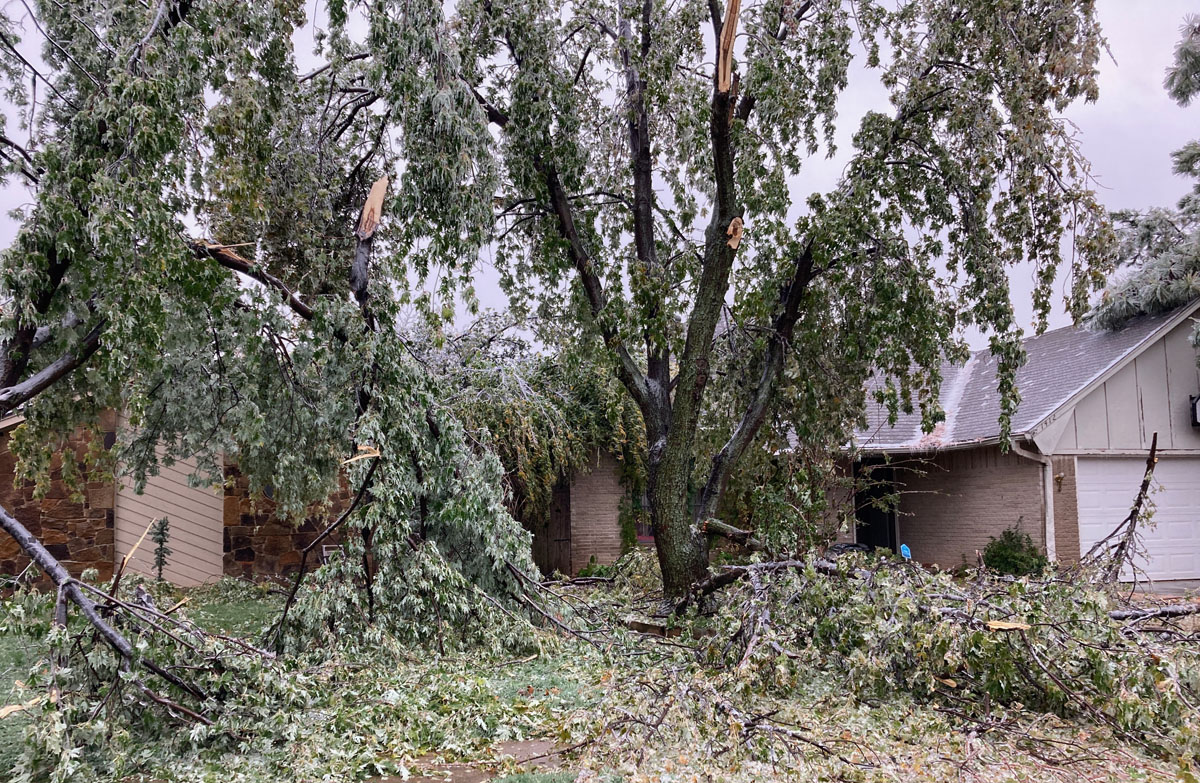
Typical of trees with limbs down in our neighborhood because of the October ice storm.

Our house went dark about 7:20 this morning. No big deal. Power went off yesterday and came back on about an hour later.

But by 3 p.m., we figured out this might be a long-term outage. We had driven out of our neighborhood a couple of times and were amazed by the number of trees that were down with limbs covering both the street and sometimes the roofs of homes.

Winter arrived extra early with an October ice storm that threatened to take out every tree and power line in Oklahoma County. Late this evening we saw that OG&E was reporting nearly 300,000 customers without power.

As I prepared for a night of “adventure sleeping” in our living room in front of the gas logs in the fireplace, my wife suggested it was time to seek a hotel room for the night.

Yeah, right. So, I reluctantly fired up the Priceline app on my phone and began to see what our choices were. We sought a hotel in Northwest OKC or Edmond.

But as I scrolled through the choices, every one had a note that said “no rooms available.”

I switched to Expedia, and got the same thing.  I even tried to find an available Bricktown hotel, but there was no room at the Inn for us.

Adventure sleeping it would be. Our household consists of me, my wife, Paula, daughter, Sarah, and her 16-month old son, Solomon. 

Paula did not want Solomon sleeping in a cold house.

So, I decided to stop by a few hotels in the Quail Springs Mall area to put my name on the list if there were any cancellations. First up was the Holiday Inn North, but the desk clerk told me they were 10 rooms “overbooked” and gave me the front desk number to call later to check.

A room at the Inn

Next stop was the Holiday Inn Express at the intersection of Memorial Road and the Lake Hefner Road. This place was Grand Central Station judging by the people going in and out, but I approached the desk anyway and ask about cancellations.

The clerk gave me some paper to write my name and phone number, but then the manager on duty walked in from out of the back and said they just might have a room for us. Turns out they did, and I whipped out my payment on the spot to secure it.

It was a Christmas an October miracle!

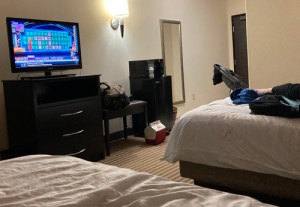
So, we’re lounging in the room tonight, making the most of our Ice Storm Staycation.

Here’s hoping it ends first thing tomorrow.

The COVID test, Part 2: Results

Breaking news on the COVID front. The COVID-19 test I took on Thursday came back negative today.

Huge exhale.

As a reminder, my daughter, Sarah, and I both had COVID tests done at the IMMY Labs free “Swab Pod” mobile testing site near UCO.  Here is a blog post about our experience.

Sarah’s test came back negative, as well.

If you were wondering what type of test we took, the IMMY website describe it as a “PCR” test, whatever that means. I understand that it’s more accurate than the tests that return results in 15 minutes.

The negative result was important to me because I’m technically a “senior citizen” with underlying medical conditions.

For Sarah, it was important, because the negative result allows her to get back to her job immediately.

Now, on with our lives.

The COVID test. Don’t fear the reaper

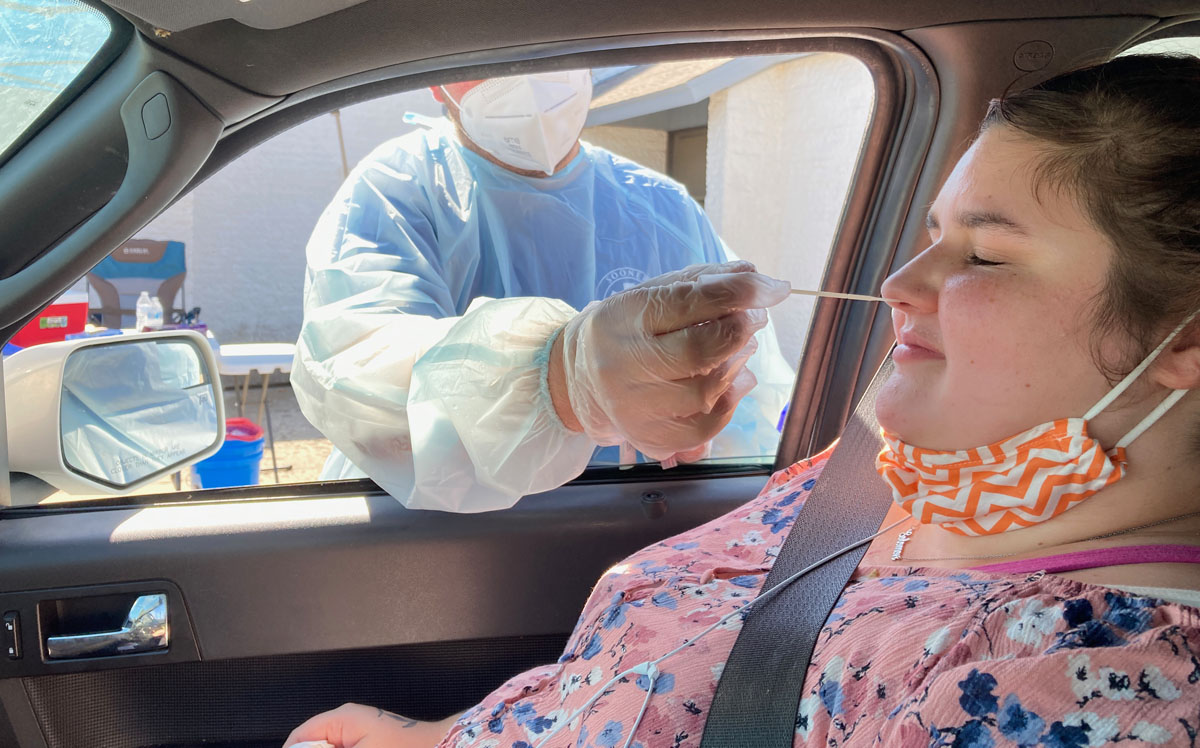
My daughter, Sarah, reacts as a nurse inserts a swab into her sinus cavity for a COVID test.

You’ve no doubt seen video clips of people being tested for COVID-19 where a health care professional inserts a long cotton swab into their nostril. I wince each time because it looks like they’re trying to make the brain squeaky clean instead of probing for virus.

So, wouldn’t you know it that my turn came today for a COVID test.

Both my daughter and I have been showing some symptoms, although she was originally diagnosed with an ear infection. And I have ongoing allergy challenges.

But Sarah also has a hacking cough and needed to have the test done for her work. I have been incredibly tired in recent days, so I decided to join her.

Our first decision was where to have the test done.

My friends at Norman-based IMMY, a developer and manufacturer of innovative lines of diagnostic tests and reagents for infectious diseases, have also developed an FDA approved COVID test. It set up a subsidiary company called IMMY Labs to conduct the testing.

IMMY conducts free, drive-by testing daily in the Edmond/Oklahoma City area and locations across the state that include Tulsa, Blanchard, Norman, Moore, Midwest City, Chickasha, Purcell and more. They call their testing sites the Swab Pod. Results are promised in two days or less.

So, Sarah and I chose the Swab Pod near the UCO campus and drove over for our tests this afternoon.

I have to admit that I was fairly apprehensive. Those news clips didn’t do me any favors.

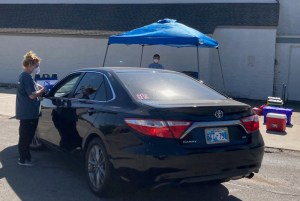
We drove up about 5 minutes before our scheduled time and got in line behind about three other vehicles. There was a check-in table where they scanned a registration code on our phone and placed vials on our windshield beneath the wipers.

The vehicle in front of us pauses for a quick swab test.

We were told to fall in line and follow the vehicles to the nurse’s station. Less than two minutes later we were there.

The nurse approached Sarah’s side first, and I took photos as she was swabbed. It took only seconds, and she didn’t show any discomfort.

My time came. I closed my eyes, leaned back in the seat and anticipated the worst, which I’m not sure what that would have been. The swab scraping my brain? Hitting a nerve? Blinding me?

The nurse inserted the swab and counted down from five. Just like that it was over. I had a tickling sensation and almost sneezed. That was it.

We drove off the lot and were on our way in less than 30 seconds, slightly giddy at how painless and easy it was. We’ll know the results probably sometime tomorrow.

The lesson for me? Don’t fear the reaper.

Stay tuned.

C is for Cookie. That’s good enough for me

The crowd waits for cookies outside Crumbl Cookies on the recent Free Cookie Day

I have an admission to make. I am The Original Cookie Monster. No cookie is safe around me, which you can kind of tell by sizing up my physique.

Anyway, the recent entrance of Crumbl Cookies into the Oklahoma City market caught my attention because of a couple of reasons.

Reason No. 1: OK, my daughter got a job there before the store opened for its first day of business.

Reason No. 2: See the “Cookie Monster” comment in the first line.

When my wife and I showed up on Free Cookie Day during Crumbl’s grand opening week, there was a 20-minute wait in line down the sidewalk outside the door.

We waited it out, of course. The cookie was warm and delicious. 

Crumbl is a franchised location of a chain launched less than three years ago in Logan, Utah, by founder Jason McGowan. The OKC store, opened by franchise owners C.J. Roundy and Jefferson Palmer, was store No. 115.

So you can see how quickly the concept has spread across the nation.

I spoke with Roundy the other day, and he told me the pair located their store in OKC’s Chisholm Creek shopping center because it fit all their criteria for launching a store: prime shopping location with high traffic count, demographics and a business-friendly community.

Here are a few other observations from the franchise co-owner:

“Our grand opening, compared to others in the Midwest and South region, was probably one of the better ones ever,” Roundy said. “We had 10,000 cookies go through our door in three days.”

Did you catch that? 10,000 COOKIES IN THREE DAYS.

“It was hectic,” he said. “We had lines out the door Friday and Saturday, almost all day long. We had really high sales. I would say our sales were about 15 to 30 percent higher than what we expected. It was really fantastic for us. “

Crumbl cookies are large, but not cheap. A single cookie will cost you $3.48. A box of 4 is $10.98.

“We are a premium product, but we use only the best quality ingredients,” Roundy said. “Everything is made fresh in our store. We really think the price that we charge is equivalent to the quality.”

Sarah Stafford outside Crumbl Cookies on opening day

One last thing. Since Crumbl is a franchise based in Utah, it doesn’t fit the “shop local” criteria that has become a theme for many residents across the city.

“All of our employees are from here; It’s only my business partner and I who moved here,” Roundy told me. “But we moved here in the hopes of being here a long time. We want to open six or seven more locations in the Oklahoma City area. We want this to feel local even though it started in another state.”

Crumbl employs cutting edge technology in its cookie marketing, offering catering, curbside pickup and home delivery. There’s an eye-catching Crumbl website, mobile app and a company-developed point-of-sale software system that gives customers the option of checking out at kiosks without actually having to go up to the sales counter.

Roundy said Crumbl’s cookie lineup rotates weekly with chocolate chip and sugar cookies being constants. He hopes the store, located on the N. Pennsylvania segment of Chisholm Creek shopping center, becomes a regular staple for the city’s cookie lovers.

So, what does that mean for me?

Well, I know that C is for Crumbl Cookie. That’s good enough for me. Apologies, Cookie Monster.