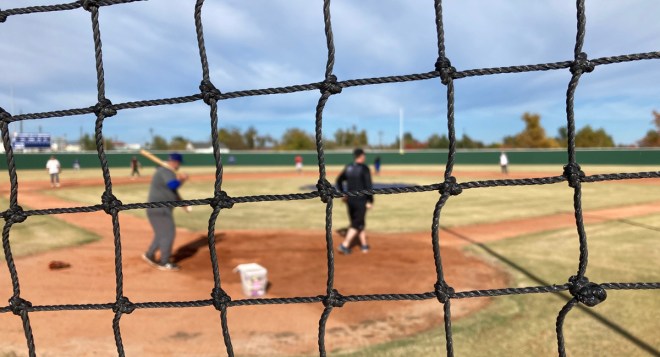
A group of OKC adults turned the Northeast High School baseball field into their own ‘Field of Dreams’ for an afternoon
Moneyball is one of my favorite movies. It shows the impact that using computer statistics to drive player development had on Major League baseball and the Oakland Athletics in the early 2000s.
The movie features a host of memorable scenes, including one where Oakland outfielder David Justice asks new first baseman Scott Hatteberg what he feared most at the position.
Hatteberg had been a catcher all of his professional career, and to that point had never played even an inning at first base.
“A baseball hit in my general direction,” was Hatteberg’s honest reply to Justice’s question.
That’s exactly how I felt Sunday afternoon as I stood in right field at the Northeast High School baseball field.
I was there at the invitation of my friend, Russ Florence, who invited a group of fellow adults to “have a catch” with him. A lifelong baseball fan, Russ began his informal monthly “catch” several months ago.
It was sort of a Field of Dreams-come-to-real-life opportunity for those of us who once played the game or have followed it all of our lives.
The baseball dreamers who came out Sunday included several guys my age or older, a few younger and a couple of women who showed more agility than most of their male counterparts.
I dug my old baseball glove out of the closet and joined about a dozen others at the Northeast field.
Unfortunately, the experience revealed exactly how the passage of time has robbed me of athletic ability, real or imagined.
Once upon a time, I thought of myself as a pretty good baseball player. Now that was in Little League in College Station, Texas, followed by Pony League as a 13- and 14-year-old.
Here’s how it went five decades later on a warm November afternoon beneath a bright blue sky.
First, we warmed up by playing catch with a partner about 40 feet away. I put most of my throws into the ground in front of him or several feet to his left.
My shoulder ached after about 15 minutes. My glove hand screamed with pain from catching baseballs in the heart of the mitt.
Then came the real embarrassment. I stood in right field as Russ hit flies and grounders to players stationed at infield and outfield positions.
He hit one in my general direction.
My feet felt like they were in quicksand as I “ran” toward it. I could not bend over far enough to even make a stabbing attempt at a catch.
I hung my head in shame. No one seemed to notice.
Russ hit about three other balls in my direction. I managed to catch one on the bounce barehanded, but caught none before they hit the ground. I decided if a ball wasn’t hit within three feet of where I was standing, I had no chance.
But the day wasn’t a total loss. I had the opportunity to visit with some old — and new — friends. The weather was pleasant watching from the dugout, where I spent much of my time.
“It really scratches an itch for a lot of people,” Russ told me afterward. “None of us is as good as as we once were — or as good as we THINK we once were. I’m glad you were there.”
Thank you, Russ, for inviting this ‘ghost’ of a former player to experience your OKC version of the Field of Dreams.
Even if it brought home a sobering reality of aging.
When I was a kid, we had a big set of Encyclopedia Americana in our house that was my go-to Google-of-the-day for every bit of fact finding and trivia that drew my interest.
Once, when I was a teenager, my dad and I had a disagreement over some fact about a foreign country or its people, I can’t remember which.
However, my dad was spouting an opinion as fact that I was certain was wrong. So, I grabbed an encyclopedia, looked it up and read the part to him that proved that he was wrong.
“Now you’re taking it too far,” he said, clearly irritated.
Translation: don’t let your facts get in the way of my entrenched beliefs.
Anyway, I’m writing this because we’re seeing people in our society make up their minds and cling to ‘alternative facts’ when clearly there is no evidence to back them up. Or there’s evidence that shows that it is wrong and they still cling to their beliefs.
The dispute over vaccines, for instance. People would rather take their Uncle Jimmy Joe’s word that the COIVID-19 vaccines are making thousands of people sick or, worse yet, killing them, than accept statistics kept by health care professionals and scientists that show vaccines are incredibly safe and effective.
I’m pretty sure it’s really an issue motivated first and foremost by political beliefs. Red state. Blue state.
But we all stake out our territory on different issues and refuse to budge even when we’re smacked in the face by reality. I’m sure I’m guilty, as well.
And that leads me to an issue that really disturbed me this week. One of my neighbors whom I like and enjoy hanging out with in his driveway, stated as fact that a high-ranking OKC city official gets a cut from every concession sold at Scissortail Park because he made a donation to its construction.
I ask him to offer some proof. “They reported it on Channel 9,” he said.
If it had been reported on TV or in the newspaper, and there was evidence to support the allegation, the story would be huge and talked about by everyone in the city. The official would likely lose his job.
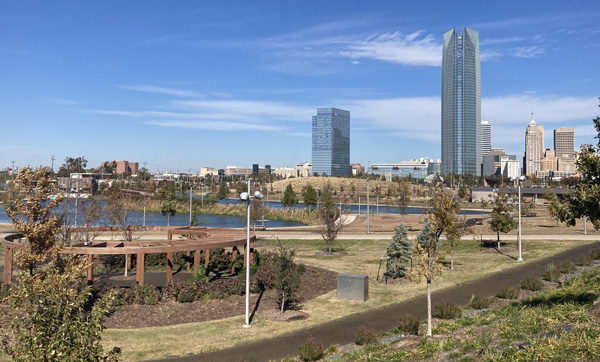
Scissortail Park in early November
Instead, it’s told as fact by a retired OKC resident who is skeptical about the whole MAPS program and Scissortail Park, as well. He doesn’t need actual proof, because he heard the story told as fact from others who share his point of view.
I even ran the allegation past a respected reporter for The Oklahoman that I trust and who told me that “none of it is true.” I’m taking his word for it, because, if true, it would have been a giant Page 1 headline.
The disturbing aspect is that my neighbor repeats the story to anyone who will listen, and in my far north OKC neighborhood there are a lot of takers.
I think some of it has to do with the fact that our neighborhood is so far out of the city’s core that people like my neighbor don’t see the benefit that MAPS and Scissortail Park have brought to our city.
As I walked back home after the encounter the other day, I couldn’t help but think of my dad and his long ago wrongly held opinion-as-fact. Even the Encyclopedia Americana couldn’t budge him off his belief.
Sad to say, that’s how it is with a lot of American society today.
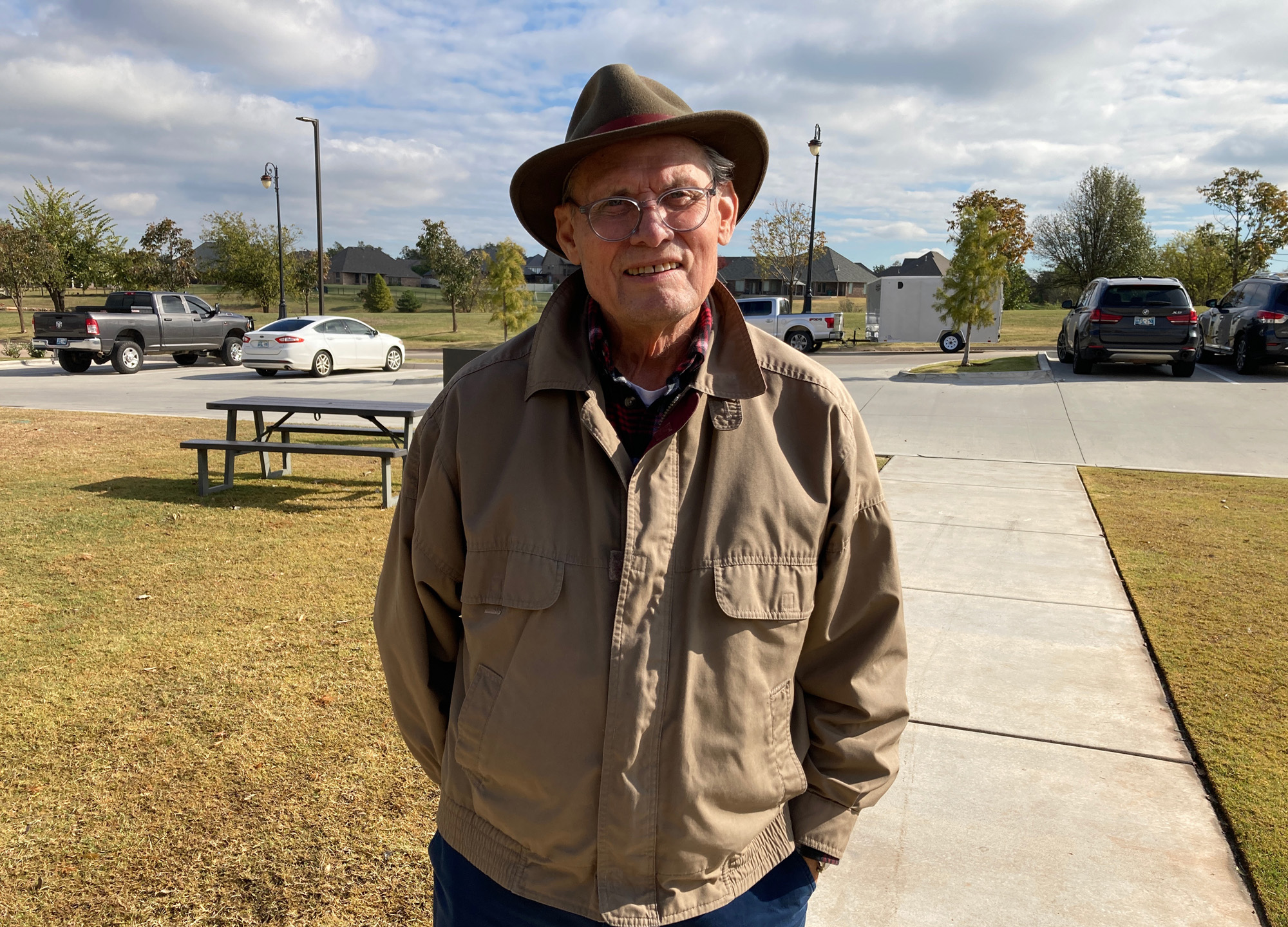
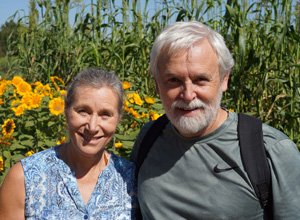
Dr. Robert Floyd, scientist and author of A Thinker and Seeker
Editor’s Note: During my years as a Business news reporter for The Oklahoman, I had the opportunity to interview Oklahoma Medical Research Foundation scientist Robert Floyd, Ph.D., several times. He has since retired and written an autobiography, which I’ve read and written this review.
In the beginning, Robert Floyd, Ph.D., was a farm boy whose family grew tobacco on their Kentucky homestead.
But they couldn’t keep him down on the farm.
Dr. Floyd eventually became a world-renowned bioscientist, and for the last 34 years of his career pursued discoveries of groundbreaking compounds at the Oklahoma Medical Research Foundation.
In his autobiography released earlier this year, Dr. Floyd describes the journey that took him from the family farm on Calvary Ridge in central Kentucky to college, then to graduate school and on to post-doc positions. In 1974, he came to Oklahoma City and the OMRF.
I met Dr. Floyd late in his career when I was a life science reporter for The Oklahoman in the early 2000s. I’m pretty sure we first met at a BIO International Conference in San Francisco.
I had the opportunity to interview Dr. Floyd several times over the years and learned about the groundbreaking compounds he discovered in his OMRF laboratory that today are being used to treat deadly brain cancers and hearing loss.
But I knew nothing about his rural roots and how he came to Oklahoma until he provided me a copy of his autobiography, A Thinker and Seeker: My Journey to Be a Biomedical Scientist, (BrownWalker Press, 364 pages).
In his book, Dr. Floyd separates his journey into three sections, beginning with life on the farm, then his pursuit of higher education and life as a post-doc, concluding with his years as an OMRF scientist.
Dr. Floyd goes deep into Floyd family history and his own experiences growing up on a working Kentucky farm. I even learned from his book how the tobacco leaves are harvested by hand, then cured in a drying barn before being shipped to an auction house.
After a high school education that didn’t serve him especially well, particularly in math skills, Dr. Floyd enrolled at the University of Kentucky. His goal was to become a high school agriculture teacher like his uncle Frank Williams.
But he discovered plant pathology as a UK senior and decided to go to graduate school at Kentucky to pursue a master’s degree in agronomy. From there, he moved to Purdue University, where he earned a Ph.D. in biochemistry.
The next phase of the book follows Dr. Floyd through various post-doc assignments, including one at Washington University in St. Louis, where he worked with Barry Commoner, who was a well known and often times controversial environmentalist.
Dr. Floyd also shares a lot about his personal life, how he met and married his wife, Marlene, the houses they bought and sold along the way, and a couple of harrowing cross-country automobile trips they took as they moved from one assignment to another.
The final section of the book is a year-by-year look at Dr. Floyd’s career at OMRF. We learn how he was hired, the focus of his research and how he became a respected and sought after scientist who traveled and spoke to conferences all over the world.
His laboratory was continually funded through the OMRF years by National Institutes of Health research grants. Eventually, he became an NIH grant reviewer himself who considered grant applications from other scientists throughout the U.S.
Since Dr. Floyd is someone I’ve known professionally for almost 20 years, I read this book with interest. I found the chapter on his family’s history and his life on the farm especially fascinating.
Dr. Floyd’s book, A Thinker and Seeker is available in bookstores, at Amazon.com or through the author himself at rafloyd0753@gmail.com.
We’re about to welcome the launch of the OKC Thunder’s ’21-’22 season, and the debate over tanking continues for a second straight year.
Do the Thunder continue to “explore the roster” and chase the league’s worst record in hopes of drafting the next unicorn?
Or do they take this young roster and try to be competitive in a very good Western Conference?
Sam Presti said recently that the team will take no shortcuts. You can read into that whatever meaning you choose.
“What we want to do is be playing meaningful basketball at the end of the year,” Presti said. “We want to try to do everything we can to put ourselves in position to optimize the group that we have, and there’s just no shortcuts to that. It comes back to the commitment to the process that’s in place and being willing to be patient with that as we go through, especially with this much change as we’ve experienced.”
Here’s the takeaway from that: “commitment to the process.” Translation: “lose for the lottery.”
I know that puts me at odds with my fellow Thunder fans who celebrate tanking and see a championship caliber team in the future as a result.
There seems to be a couple schools of thought within NBA fandom.
One school says that if you don’t win the NBA championship, your entire season is a bust.
So tank until you can build the roster up.
The other school says that competing at a high level against the best players in the world and making a playoff run is great entertainment. Yes, we may come up short in the end, but we’ve got something to cheer for through the long, cold winter months.
Remember the fun we had in the early 2010s when the Thunder went deep into the playoffs, even if they came up short?
We were living high as Oklahoma City Thunder fans. Those are cherished memories of mine almost a decade later.
But you know what? Those Thunder teams didn’t win the championship.
That doesn’t diminish the memory for me in the least.
My friend Steve Buck argues that the Thunder team of that era was a championship caliber team even if it didn’t win it all.
“Here’s the deal…for many of those years we were capable of winning the title,” he says. “That’s the goal here…get a club rebuilt that is capable to contend. Playing for a one and out is not the goal. You want to position yourself to win it all.”
My point is that we didn’t win it all, but, gee, we had fun.
And now we’re losing for the lottery. It makes for long, bleak seasons. And there’s no promise of a unicorn at the end. Or even of a top three pick (see this year’s lottery fiasco).
Here’s to the new season and hoping the Thunder will be over-achievers.
Let’s not chase the luck of the lottery once again. Let’s play to win now.
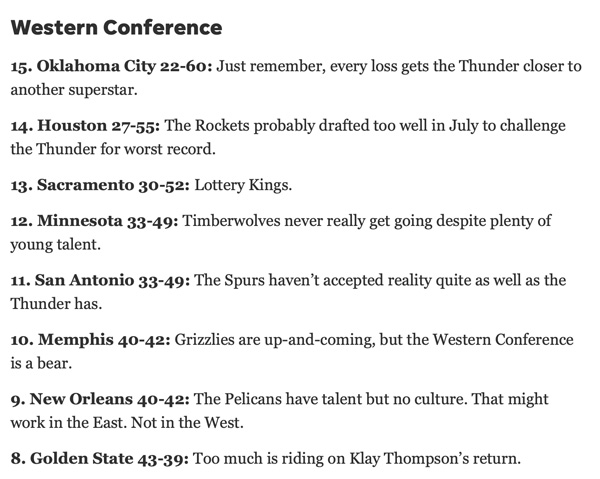
BONUS: Here is how Berry Tramel has the bottom of the West ranked going into the season:
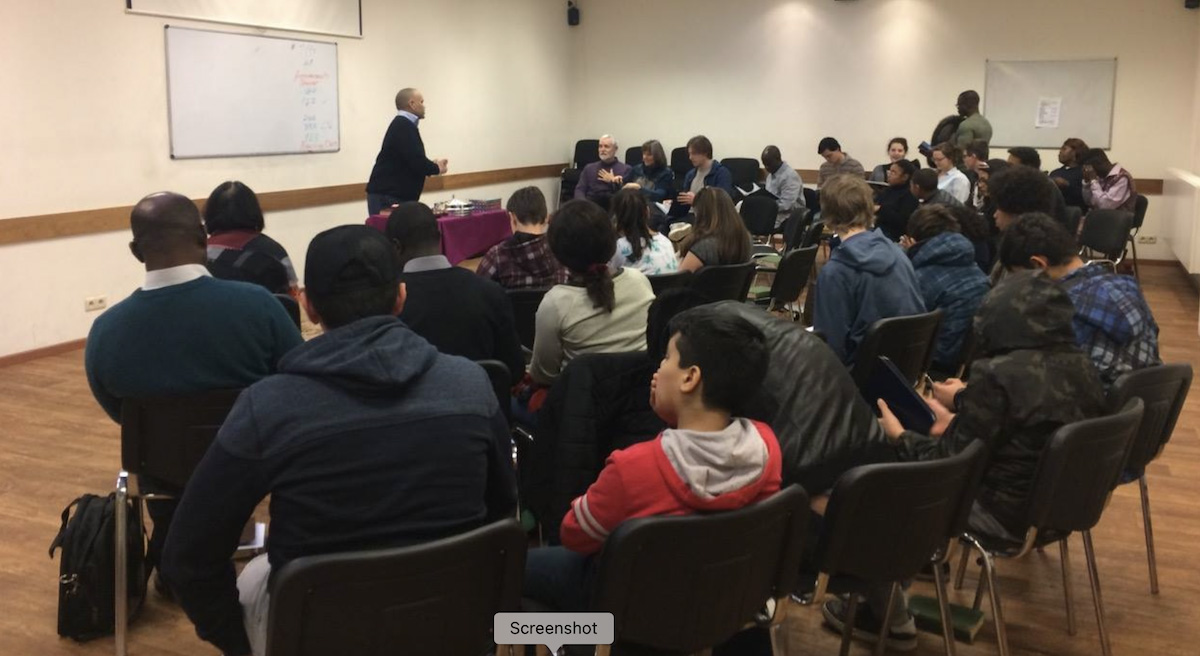
Paul Brazle leads a church service in Belgium, where he has served as a missionary for more than 30 year.
Editor’s note: I’m a member of The Springs Church of Christ, which has been a long-time supporter of Paul Brazle and his wife, Carol, who have served as missionaries to Belgium for over 30 years. I’ve grown to admire the Brazles for their commitment and tenacity. But I’ve also wondered how an American Christian like Paul approaches the job of “missionary” to a European country that had a large Christian population centuries before the U.S. was even founded. So, I asked him to participate in this Q&A about that topic as an American missionary in Europe. I’m grateful for his candor. Here are his thoughtful and refreshing answers (some edited for length):
Question: Where did you grow up and what was your family’s background?
Answer: My dad was a preacher and a Bible teacher too, who emphasized “missions” a lot. In fact, in something of a parallel to what you are getting at with these questions, Dad was an American from Kansas who moved to Canada (via Montana) and so was often called a “missionary.” That meant that I grew up as not only a “preacher’s kid” but also a “missionary’s kid.” Dad provided for me (and my siblings) to have mission experiences. So, after one year of college I got to spend a year in Florence, Italy, as a “missions apprentice.”
Q: What led you to decide to lead a mission effort in Belgium?
A: In connection with my apprentice year in Italy, a classmate and buddy of mine went to Belgium at the same time. We connected a couple of times during the year and got to know the situation among our church fellowship network there as well as in Italy. At the end of the year, before returning to Canada, I hooked up with a summer mission project in Belgium. This was coordinated by my older brother with schoolmates from Oklahoma Christian University (then OCC) after he had also spent a year in Belgium as a “mission apprentice” (These days we call these “missions internships” in our circles.) Long story short, I got to be in Belgium for such “short-term missions” projects two more times. Then, when I married Carol, we surveyed and compared opportunities in Italy and Belgium and ended up choosing Belgium.
Carol and Paul Brazle
Q: How are you received by Belgium natives? I’m assuming that a lot of native Europeans would be resentful of an American coming over and presuming to teach me about religion.
A: There is certainly a basis for that assumption. For any number of reasons. More and more as America’s church scene becomes increasingly confusing or “worldly.” So, we steer well clear of the missionary designation where we can. That said, when we are ID’d as “religious practitioners” the question will come up again: “what for?” We seem to get the most benefit from asking the question: “If people are struggling with their faith in a Catholic context, or having left that previously, we ask to be free to offer an alternative way to embrace faith (again).” There aren’t many here who argue against freedom of religion; they just still laugh a bit when they see where it has led in the states. By the way, we came here in 1986. So, we have been here 35 years-plus. We came with a 3- and a 1-year old, added two more over time, raised them here in Flanders.
Q: So, how have you reacted to native Europeans who may resent your coming over to Europe and attempting to bring your faith to them as an American missionary?
A: Indeed, this touches very directly to something in my experience. I mentioned my dad being thought of by some as a “missionary” from Montana (or Kansas — i.e. almost Bible Belt) to Canada (Saskatchewan, just across the border from Montana). Much more challenging or awkward as it turns out, is the idea of an American Christian going to Belgium as a missionary to “preach and convert.” After all, after Italy, Belgium has likely sent out more (Catholic) missionaries than anyone over the centuries. Most of the Jesuits have had their base there. Father Damian went to Hawaii from Belgium. After I learned this, I became much more careful about the context and the listening ears where I drop the “missionary” word. I generally say we are doing church work. (Caveat: The visa designation on my ID always called me a “zendeling”… wait for it: a missionary.)
Q: What languages do you speak?
A: Our work is in Flemish (basically the same as Dutch; we speak “Nederlands”). I also can speak French well enough (learned in school in Canada; we use it in Brussels and south Belgium) and then I learned Italian that year in Florence. Dutch is a lot like low-German, so I can make my way there on a tourist level. I can still read most of the Greek alphabet, but that’s about it. When we came to Flanders, I had the basis of those four summer projects when I took random notes and was not shy to make big blunders. We both, Carol and I, did a month-long full time “snel-cursis” to get started and went from there.
Q: How has your Belgium ministry evolved over the years?
A: When we came, we had been invited by a small Flemish congregation. After some orientation and language study, we picked up on that. But within about 7-8 years, the Berlin Wall had fallen, immigration patterns were changing rapidly and the demographic of Antwerp- — one million people — was too, before our eyes. We watched, trying to figure it out, while our church morphed into a half international group. Since then, it has continued, and we are now a full-fledged multi-cultural congregation, with a sister congregation sharing our location which is Spanish-speaking. Our assembly to worship Sunday AM is in Dutch and English. Along with that, we have some activity among refugee immigrants.
Q: How do you connect with Belgium natives, and how do you connect with the immigrant community?
A: This one is a little more challenging: do I address “what have we tried” or “what has worked?” A lot of our contact (i.e. efforts to reach out and to connect) with the “Belgians” has come through what many call “friendship evangelism”. An example: from the start Paul started singing with a vocal ensemble and we have become part of that “family”. We have learned a lot from them — hopefully, they also from us.
Another “mainstay” in our contact efforts, first with Belgians, then more and more with immigrants, has been to offer English conversation lessons. We have learned to know a lot of folks over the years with this, and a lot of them learned about our church opportunity through it. With the actual refugees of recent years, our activity has been limited compared to some colleagues across Europe — but our Spanish pastor was a refugee himself with his family from Venezuela, and they have helped to step up our connections with them as a church family. Helping where we can with what they need.
Paul and Carol Brazle with a group in Solwaster Liege, Belgium
Q: How do you measure success of your ministry?
A: That is the eternal question, isn’t it? In missions, even more than in ‘home-based’ ministry, I think. What does success look like? Some say you can’t measure spiritual things that way. Some want to see newsletters about conversions all the time. That’s a challenge in a ‘zone’ like Western Europe, for sure. In mission circles, they call Europe “hard soil”. Still, we are not too despairing when we look back and see relationships built over decades and people who say their lives have been changed. We always would wish there were more to show, it seems. But what there is, is gratifying.
Q: What is the state of Christianity in Europe? And how curious are they about “our” (American) brand of Christianity?
A: Even though the various nations have different forms of government, some with monarchies still tied to a state church in name, most have populations that are mostly secular and agnostic, even while many adhere to family traditions based in church and faith. There are a small percentage of folks in each nation that are active adherents in their faith. Europeans are generally very regional in their church diversity. For example, Germany has a generally Protestant part and a Catholic part. Belgium was considered to be 98 percent Catholic as late as 1985 when we came here. That has changed. That said, our Belgian friends marvel with bemusement at the denominational map of the U.S. with many streets having 5-10 different churches within a mile or two.
Q: From my life experience, it appears that the American Christian community assumes it is superior or practices religion more correctly than the rest of the world … how does the practice of Christianity in Belgium differ than here in the states?
A: Indeed, that attitude comes across all too much. It hinders attempts to share a message of a refreshing new –or old – look at how to do faith. Generally, we assume (in U.S. churches) that too much tradition will thwart a simple and straight-forward Christian practice. Rather, it sometimes looks like one set of traditions or habits has just replaced another. There can be some good things found in tradition. I think the key is finding a balance. The way the balance looks (or is measured) will just be different in social settings that are 200-300 years old compared with those of 1,200-1,500 years.
Q: When you welcome youth groups and others to Belgium during summer visits, what do you tell them about Europeans and the Belgium church that they might not be aware of when they arrive?
A: First off, we try to help them understand what the proverbial “ugly American” looks like. And how not to be that. We recommend just looking around more and speaking less — or at least, more quietly. We also warn them that when they make European friends, be careful about inviting them to come for a visit… They just might! And, if they do, they will plan to stay 3-4 weeks.
Q: The Springs/Quail Springs church has been a long-time sponsor of yours… what would you say to The Springs members that maybe you haven’t already said.
A: Indeed, it has turned out to be a long stretch. And we are thankful. The Springs church is our spiritual family, at “home.” (I told someone last summer we were going to visit our “home, away from home.”) There are a number who have visited and helped. That was a blessing. The support in prayer, and in funds, has been affirming and has blessed us with energy and will to keep on keeping on. So, that’s what we want to do!
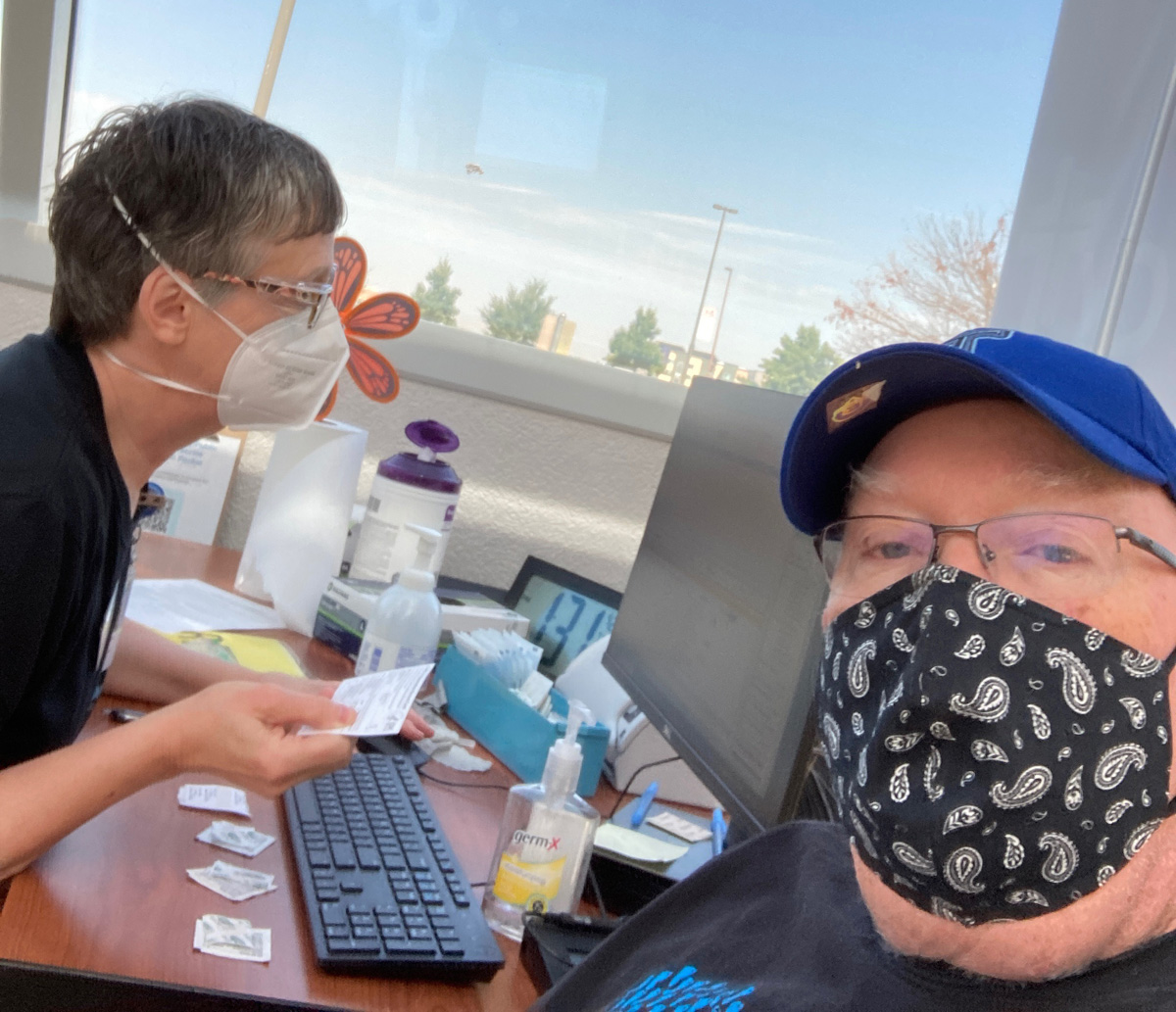
Waiting to receive COVID-19 ‘booster shot’ this week at Mercy OKC.
When I was a kid, it seemed my mom took me to the doctor every six months or so to get a “booster shot” of some vaccine or another. We never questioned the validity or effectiveness of the vaccines in the early 1960s that I can remember.
Earlier this week, I received the COVID-19 “booster shot” at Mercy Hospital in keeping with recommendations from the Centers for Disease Control that people my age (65-plus) get a third dose when six months have elapsed from their original shots.
I’ve learned about the incredible documentation that scientific findings are required to have and how experiments must be repeatable with the same results to be declared valid. Therapeutics designed for humans go through multiple stages of trials for safety and efficacy.
In short, I’ve learned to trust the science. It is developed in highly controlled processes by people with high intelligence and credibility. These folks have undergone the most rigorous education and training before they tackle their own scientific exploration.
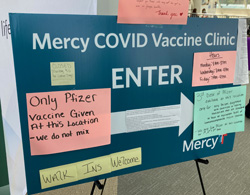
‘Walk Ins Welcome’
So, I had no second thoughts about walking in to the Mercy vaccination clinic this week and getting the booster. In fact, their sign now reads “walk-ins welcome,” as opposed to January when it was a madhouse of thousands of people turning up to get vaccinated.
I know, I was there.
This time, I was in and out in about 20 minutes, including the 15-minute wait period after I received the dose. I woke up on the day after the booster with a sore arm, but that’s been about the only real impact.
Why did I get the booster so readily? For one, I hope to protect myself from infection of a virus that keeps mutating and making the rounds. But I did it also to be a good citizen who’s helping to put an end to this plague.
I call it doing something for the greater good.
But the decision to get the vaccine or the booster shot isn’t so easy for significant minority of my fellow Oklahomans. They read conspiracy theories about the vaccine or that it was “rushed” or that we don’t know what’s in it.
Can anyone tell me everything that’s in the flu vaccine?
I left a shoebox full of baseball cards at my mom’s house when I went off to college in the early-1970s.
It was the last time I ever saw them.
My collection was nothing more than a mix-and-match assortment of Topps baseball cards I began buying with allowance money in the early to mid-1960s, along with cards I cut off the back of Post cereal boxes.
As a kid, I gave no thought to their future value — financial or sentimental.
Instead, I played with them all the time. I built my own all-star teams out of the cards and played a made-up game with them. I pinned them to the spokes of my bike with a clothes pin, giving it that awesome motorcycle sound for about 30 seconds until the cardboard wore out. I traded them with friends.
Anyway, for more than a decade I never gave them another thought.
Then I rediscovered card collecting in the mid-1980s and searched my mom’s house high and low for that shoebox of cards. I came up empty.
My folks had moved two or three times since I left them with her, so I assume she threw them out at some point.
But baseball cards lured me back in a small way in the ’80s. I went to baseball card shows and began buying unopened boxes of Upper Deck cards. I put them in a closet and hoped they would grow in value over the decades.
They haven’t.
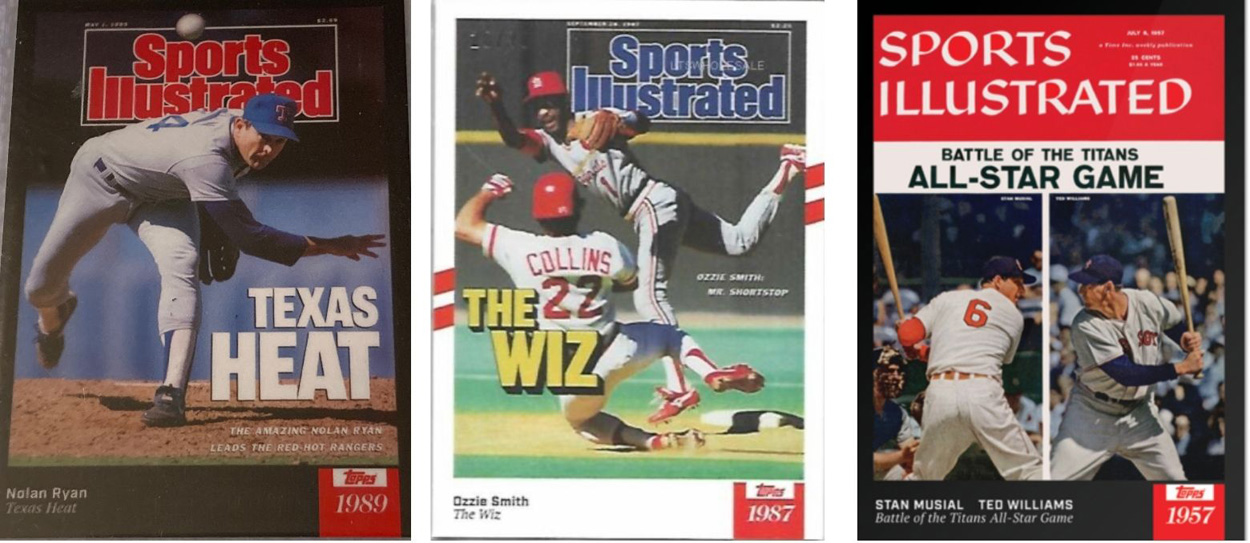
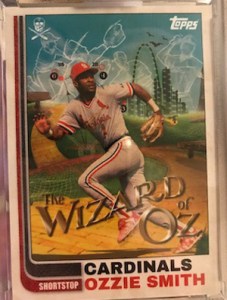
Then a couple months ago, my friend Ed Godfrey rekindled my interest once again in baseball cards. He showed me some recent Topps cards he bought that were replicas of old Sports Illustrated covers. They are impressive.
“I’ve started buying some cards again online,” Ed said. “Stuff I like.”
What he likes are the SI replicas and another Topps series called Project 70 that takes historic Topps cards of the past and adds artistic flair.
Ozzie Smith Project 70 card from Topps
“They describe Project 70s as a re-imagination of cards,” he told me. “They’ll take a ’57 card of Mickey Mantle and have an artist add their own style to it. Some of their cards are looking like pieces of art and not baseball cards.”
So, Ed bought some of the Project 70 cards, as well as Sport Illustrated cover cards of his favorite St. Louis Cardinals players.
“It’s a way to get old guys like me to buy cards again,” he said. “I’ve got a cover with Stan Musial and Ted Williams, and a cover with just Musial. A Mark McGuire 60 home run cover. I got an Ozzie Smith cover, ‘The Wiz,’ that’s cool. I bought several of them.”
He’s displaying some of these cards on his fireplace mantel.
“I need a bigger house with a man cave just so I can display them,” he said with a laugh.
About a month ago, a small package arrived in the mail for me. I opened it to discover it was a Topps Sports Illustrated card of my favorite baseball player, Nolan Ryan.
Ed bought it for me. It’s on my fireplace mantel. And I’ve spent the past few days cruising the Topps website just to see what else is out there.
I’ve also discovered that baseball card collecting has made quite a comeback during the pandemic. So much so, that fights have broken out in some stores as collectors compete with one another to add the latest cards to their collections. Target suspended baseball card sales because of the melees.
(An aside: Sad news. Topps is going to be displaced in a couple years as official baseball card producer by an outfit called Fanatics, which signed an exclusive deal with Major League Baseball and the Players Association.)
Not sure that I’m going to dive headfirst into card collecting, although I love the SI cover series. I’m content with the stash I have in my closet from the ’80s.
But I’m still mourning the loss of my baseball cards from the ’60s (thanks, Mom).
Then there are the lucky ones like my friend Ed.
“I have all my old cards I bought as a kid,” he said. “My mom kept them. Most of them are from the early ’70s.
“I’ll never sell my cards. My daughters will probably sell them when I die.”
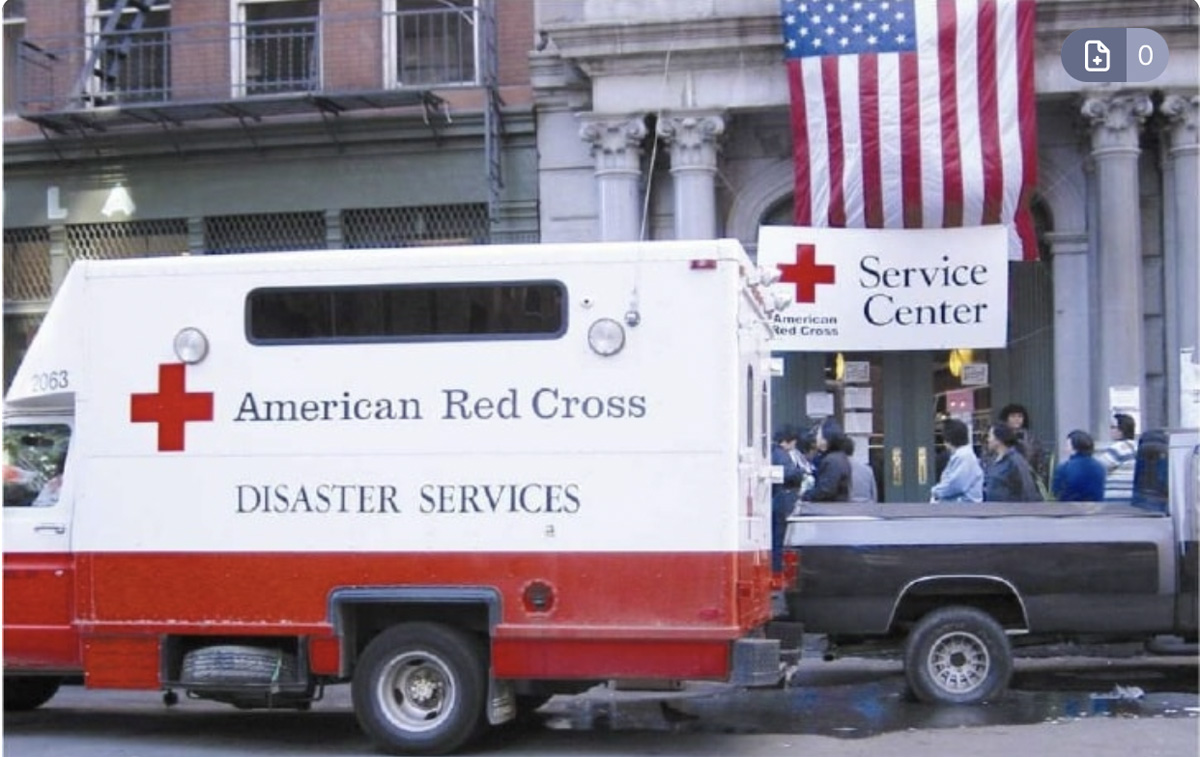
Red Cross van at the Red Cross Service Center in New York City after the attack on September 11, 2001.
The events of September 11, 2001, were seared into the collective minds of all Americans. Everyone who was alive when the twin towers fell can remember exactly where they were when they either heard the news or saw the events unfold in real time on their television.
I heard someone today describe it as “our generation’s Pearl Harbor.”
In the week after 9/11 exactly 20 years ago, I could think of little else. How? Why? Who? There were no flights for days. Travel was at a virtual standstill.
Then my mother called me during the week after 9/11 and told me she was flying to New York City on September 18 as a Red Cross volunteer.
I almost dropped the phone.
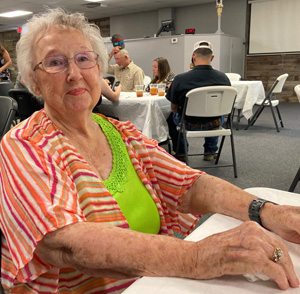
Ella Jean Stafford
Mom — we call her ‘Mema’ — had served as a Red Cross volunteer for years. She and my dad were trained as Red Cross responders. Both retired, they would take a Red Cross van to disaster spots after big weather events, like the Carolinas or the Gulf Coast and be gone from their home in Fort Smith, Ark., sometimes for weeks.
So, the Red Cross called and asked if she would fly to New York and become a trainer for hundreds or thousands of new volunteers who would serve the hurting population of the city.
She said yes, of course. Her family was nervous, but proud that she was willing to go.
This is her story:
“I left Fort Smith on an American commuter flight to Dallas, changed to non-stop jet to LaGuardia. It was not the first flight into NYC. The Red Cross office was already up and running in Brooklyn from Day One. I was asked by our state Red Cross office to volunteer to teach the classes required for every volunteer arriving before they were assigned to their work areas.
“I arrived in NYC to an empty airport, with phones not in service and no one to welcome us. Passengers on my flight were very scarce; the plane probably was about one-third capacity. I arrived exactly one week after the disaster, stayed in an elite hotel on Broadway, left for work by bus at 6:30 am, got back to hotel around 9 pm, had one day off in three weeks. We were treated with respect and courtesy by locals both traveling and eating.
“I never saw Ground Zero — it was blocked off to all traffic from six blocks away. I saw plenty of smoke and ashes from my travels from Manhattan, where I was lodged, to Brooklyn to work. Lots of workers suffered breathing problems from being out in the air full of ashes and dust. My most memorable moment was when a New York native on the subway said ‘if this had not happened, we wouldn’t have given you the time of day. But now with so many volunteers here, we welcome you, everyone.’
“Every time I had a class, I was very emotional because the casualty list kept growing and the distress shown by the New York natives was very strong. I hope I never again witness such destruction in America. It’s my daily prayer — God bless our country!”
This was her perspective looking back after 20 years. She told me that because it happened in the age before everyone carried smart phones with cameras, she did not have a single photograph made during the three weeks she was in New York.
I’m proud of you, Ella Jean Stafford, and thankful for your service in our nation’s time of need. I salute you.
If you’ve read horror stories about all the sensitive customer information stolen by hackers and online thieves in recent years, then you should know about Oklahoma City’s TokenEx.
No, wait. TokenEx has nothing to do with online data theft except this. It created a patented concept called “tokenization” that protects sensitive information for its customers. There’s no “password” to unlock; just random numbers that have no relation to the information the thieves are seeking.
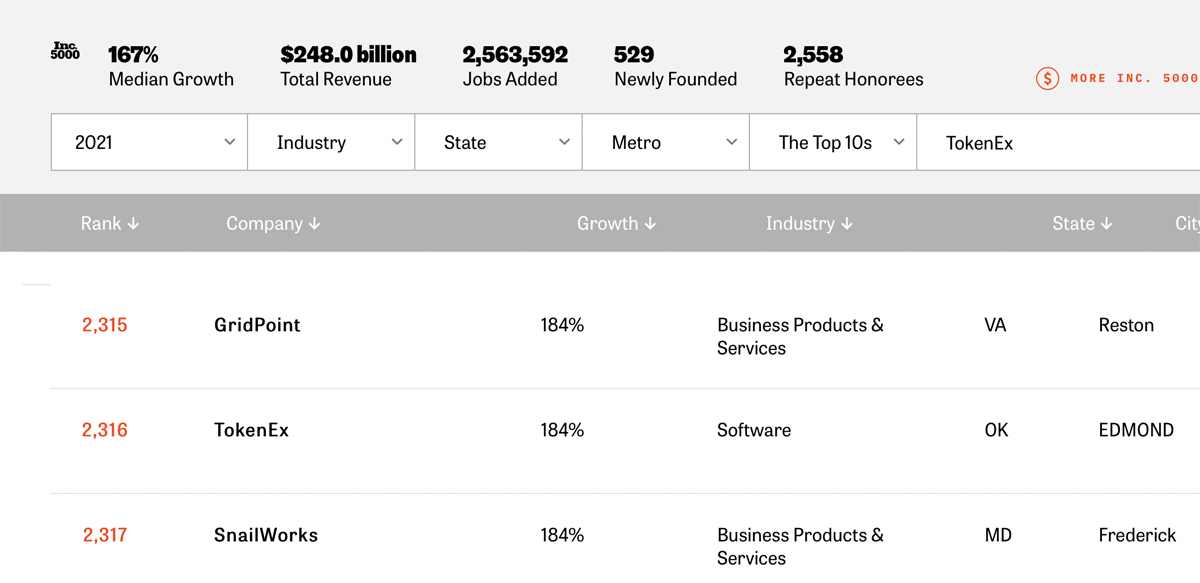
Anyway, I’ve kept up with co-founder Alex Pezold and TokenEx for almost a decade now through my work at i2E, Inc. It has become a fast-growing company, and, in fact, one of the fast growing in the U.S., according to Inc. Magazine.
For the last five years that I worked as a Business news reporter at The Oklahoman in the early 2000s, my job was to cover Oklahoma’s ‘tech’ industry.
It was exciting to see new Oklahoma technologies bubbling up all the time. Health care was big. Software. Products developed in labs of university professors.
Sometimes, I got an early look at an emerging technology through the Donald W. Reynolds Governor’s Cup collegiate business plan competition. Now called the Love’s Entrepreneur’s Cup, the annual event is managed by i2E, Inc., the not-for-profit corporation that provides business advisory services and investment to Oklahoma startups.
Students from campuses across Oklahoma compete annually in the Love’s Cup and pitch some amazing technologies.
Anyway, back in 2009 I met a young Oklahoma State University student named Shoaib Shaikh, who pitched a concept developed around explosive detection technology at the Love’s Cup. The intellectual property was developed in the labs of a couple of OSU professors.
The team did not make the finals of the event.
But guess what? The students and the professors continued to pursue the technology and launched a business to advance it. It was called XploSafe, LLC.
Today, more than 10 years later, XploSafe is an emerging Oklahoma success story and still based in Stillwater. And Shoaib is its CEO and chief financial officer.
XploSafe has broadened its menu of safety products to include homeland security and first responder applications, air monitoring for chemical and vapor detection, transportation security and hazmat safety.
The company continues to make groundbreaking news on a regular basis. Just two months ago I published news that XploSafe had been awarded the Green Chemistry Challenge Award by the Environmental Protection Agency for a sorbent product it developed for the removal of phosphorus and nitrogen from water.
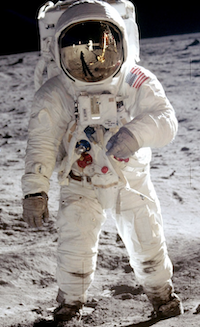
This week, I received a news release from XploSafe that revealed it has been awarded a $750,000 Phase II Small Business Innovation Research (SBIR) program research contract from NASA. XploSafe will develop sorbents to protect astronauts from potentially harmful contaminants in their spacesuits.
It’s great to see this Oklahoma company continue to push the innovation envelope with groundbreaking products. Congratulations, XploSafe!
Here is the entire XploSafe news release about the NASA award:
XploSafe Wins $750K Phase II NASA SBIR Research Contract
Stillwater, OK – 19 August 2021 – XploSafe announced today that it has been awarded a $750,000 Phase II SBIR contract from the National Aeronautics and Space Administration (NASA) to advance the development of vacuum-regenerable sorbents for the next-generation of American spacesuits over the next two years.
The XploSafe sorbents shall keep the spacesuit’s internal air-flow free of potential toxic, trace contaminants, which can pose severe health threat to the crewmembers. This capability is necessary for NASA’s upcoming Artemis missions, in which the United States intends to return to the moon by 2024, and the XploSafe team is aiming to submit working prototypes to the team at NASA’s Johnson Space Center for testing within the first 12 months of the project. This can have major a positive impact on the logistics of future space missions by replacing the current non-regenerable sorbent with a vacuum-regenerable sorbent.
Dr. Moumita Bhattacharya, Research Scientist I at XploSafe, stated that “we felt that we had not only met, but greatly exceeded the goals set forth by the team at NASA during the Phase I. Winning a follow-up contract was validation that we had done just that.”
During this Phase II project XploSafe aims to develop and deliver prototypes of the new Trace Contamination Control System that can be directly integrated into the spacesuits’ life support system.
The new sorbent technology will advance the viability of NASA’s crewed deep space exploration objectives. To enable longer spacewalks, lighter launch payloads, and substantially improve time in-suit over the duration of upcoming missions.
XploSafe’s Operations Manager, Michael Teicheira, had the following to say: “the awarding of this Phase II contract shows just how special our research during the proof-of-concept phase was. Our team is excited to continue showcasing the research and development efforts of XploSafe here on the biggest stage, and we are grateful for another opportunity to show the world what Oklahoma can offer.”
XploSafe based in Stillwater, Oklahoma is a provider of critical safety solutions for homeland security and chemical safety. Their XploSens explosives detection, XPell peroxide safety products, and XCel+ chemical vapor sampling badges are used by first respondes, industrial safety officers, threat assessment officials, and laboratory and chemical manufacturing personnel all over the world. The company holds multiple patents for vapor nanoconfinement technology that facilitates high-capacity absorption, stabilization, and consistent recovery (removal) of a wide range of volatile, semi-volatile, and even reactive organic compounds.
For questions, please contact Shoaib Shaikh, Co-Founder and CEO, at Shoaib@XploSafe.com, or visit XploSafe online at www.XploSafe.com.

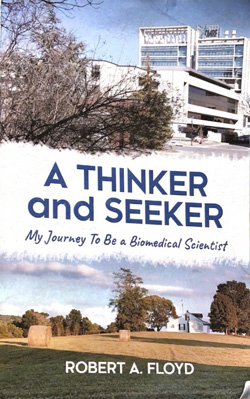 But I knew nothing about his rural roots and how he came to Oklahoma until he provided me a copy of his autobiography, A Thinker and Seeker: My Journey to Be a Biomedical Scientist, (BrownWalker Press, 364 pages).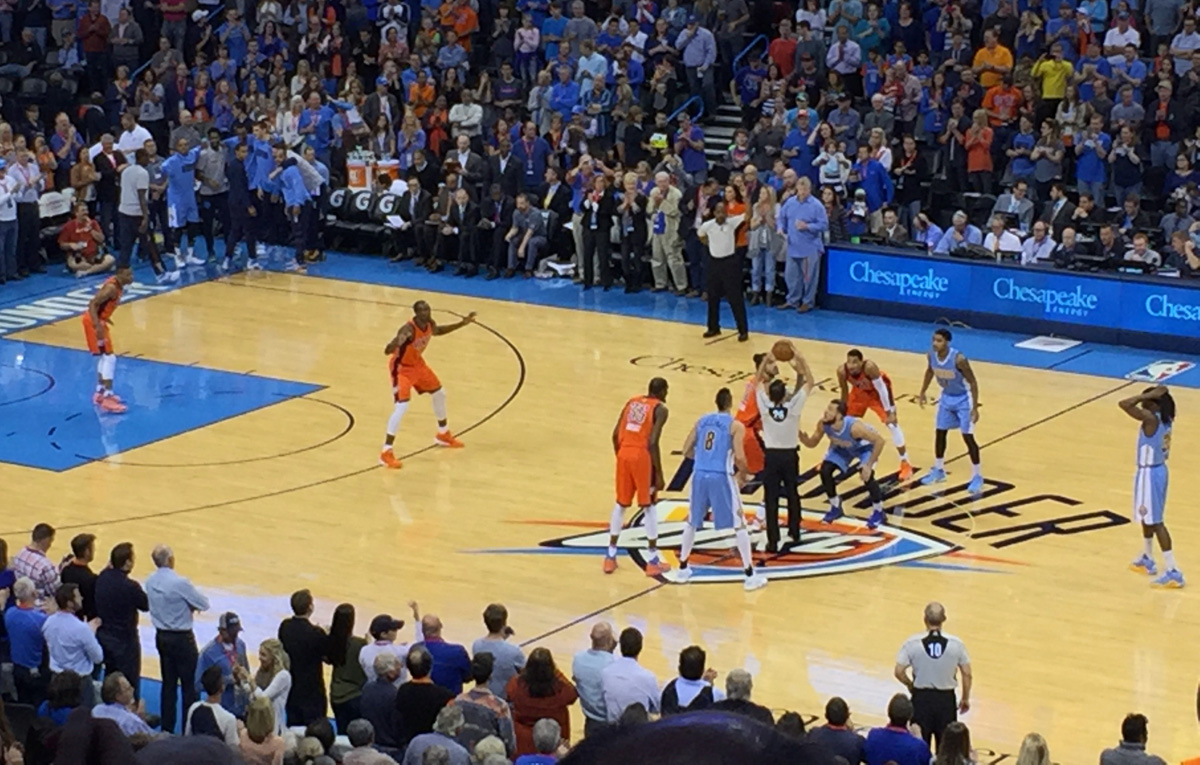

 The company continues to make groundbreaking news on a regular basis. Just two months ago I published news that XploSafe had been awarded the
  Jim Stafford's BlogOKC