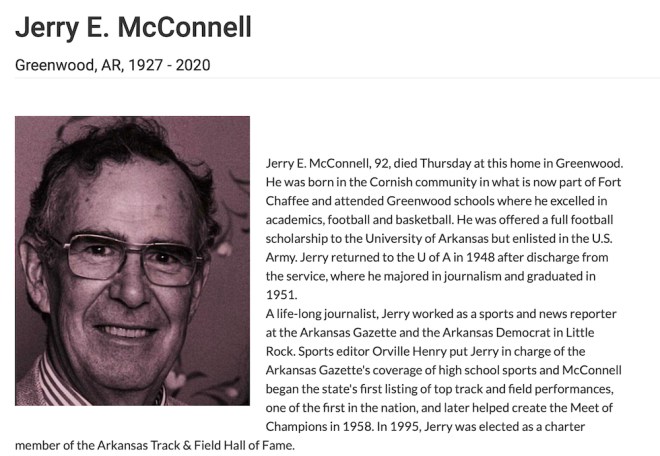
Grateful for the impact of Jerry McConnell

In 1983, I was a very raw young sports reporter at the Southwest Times Record (SWTR) in Fort Smith, Ark., with dreams of some day working at the Dallas Morning news.

Fort Smith was my first stop out of college, and I worked on the sports desk, then the news desk for a couple years, then back to sports as the Sports Editor.

But I dreamed of Dallas and working with the likes of Blackie Sherrod and Randy Galloway. I even wrangled an interview there but came up with no job and the advice to gain more experience.

Then one day a friend with whom I worked on the SWTR news desk — I’ll call her “Patti” — suggested that I send a resume to the Sports Editor of The Daily Oklahoman in Oklahoma City. His name was Jerry McConnell, and Patti had worked for him when he was the managing editor the Arkansas Democrat in Little Rock.

So, I fired off a resume to Jerry with absolutely no expectations.

By coincidence, my timing turned out to be perfect.

One of the Sports copy editors at The Oklahoman had just quit, and football season was starting.

Jerry gave me a call and asked me to come interview. I drove over to OKC and met with Jerry and his Assistant Sports Editor, Bob Colon.

Jerry hired me, and I relocated to OKC in early September 1983.

Turned out that I was not well prepared for the daily pressure and grind of The Oklahoman Sports Desk. We put out three editions each night, sometimes fully remaking almost the entire section between editions.

I was mistake-prone and unlikely to make an edition’s deadline on any given night. I had no design skills.

But Jerry was a patient editor and boss. Rather than scream at me, or worse, fire me, he allowed me to make my mistakes, and gently helped me grow as a professional. He also was in the office every night until at least the first edition was finished, so he was accessible.

Jerry also shared many fascinating stories from across his long career. I loved to sit and listen to him spin a yarn in his gravely baritone voice.
So, I’ve always been grateful to Jerry for his kind and steady hand as a boss and a friend. He eventually retired from The Oklahoman and moved back to his hometown of Greenwood, Ark.

In retirement, he wrote a book, an oral history of the Arkansas Democrat.

Jerry passed away last June at the age of 92.

To my regret, I only recently learned of his death. You can read his obituary to see what impact he had on his profession and the community, both in Arkansas and Oklahoma.

Jerry touched the lives of many, many people in the newspaper industry and beyond. I’ll always be grateful for what he did for me.

My friend Patti was one of those for whom Jerry made a difference. Here’s what she had to say about him:

“He was a super friend to me and taught me a lot in Democrat days… He passed peacefully at home just after we last saw him. His last words to me were, “Love you too babe”… He liked you a lot. I will miss him ever!”

Thank you, Jerry McConnell, for bringing me to Oklahoma City and making a difference in my life.

I wish I had a magic potion to restore fading newspaper glory

My friend Casey recently told me that the newspaper is great for when you want to know what happened 24 hours ago. 

Ouch!

As a former newspaper guy who started his career on a manual typewriter back in 1978, Casey’s honest truth really hurt.  

No one is wanting the newspaper — all of them — to succeed more than me. But I see what’s happening all over the country (and world, I guess). People are seeking their news sources online with instant alerts for which they aren’t likely to pay a dime.

There’s nothing earthshaking in that news. It’s a reality that we all know. How many people under the age of 30, no, 40, no, 50 are newspaper subscribers? A handful; 5 percent? 1 percent? 

In fact, Pew Research recently released results of a survey that showed more people now get their news content via social media than the newspaper.

My friend Casey is roughly 30 years old. He prefers instant updates and free content.

Some of my former newspaper colleagues are discouraged because they are convinced that if the paper would just (insert remedy of choice), subscribers would come back. I’m afraid that ain’t happening.

Subscribing to a newspaper takes commitment, financially and in time.  It’s the model from, oh, 1990 and earlier. Young people aren’t buying it, literally. You know why? They were never newspaper subscribers in the first place.

I wish I had a magic potion.  

My ideas tend to run toward things like a cool app similar to that of Starbucks where I can put money on my account ahead of time and draw it down as I consume coffee (or, newspaper content). 

More analysis and less breaking news from 24 hours ago might help. But there’s always that obstacle of free content.

So what’s the answer?  The papers (all of them collectively) are going to have to figure out a way to make their online content so alluring that folks like Casey would be willing to make a small monthly investment. 

That’s the model that The Athletic sports site is pursuing, although I think it’s too early to call it a success. 

That still doesn’t keep the presses running.  

Meanwhile, I’ll just fetch the latest edition of the paper off my driveway for as long as it lasts. I don’t want the physical newspaper to disappear, even though I can access it online. 

I’m from Generation Past.

Once upon a time, virtually every house on my block had a paper out in the driveway before daylight.  Now it’s only on my driveway and one or two others.

Recently, I was at a local hospital waiting on my daughter’s appointment when a nurse came by. I was reading my paper.

“Ooh, we don’t see many of those around here these days,” she said. “Where did you get it?”

I had some breaking news for her.

“Off my driveway this morning,” I said.

Then there is my friend Casey, who assures me he loves the newspaper and always has. “Just not enough to subscribe to it,” he said.

Ouch.