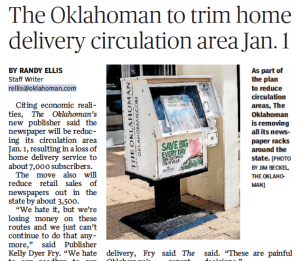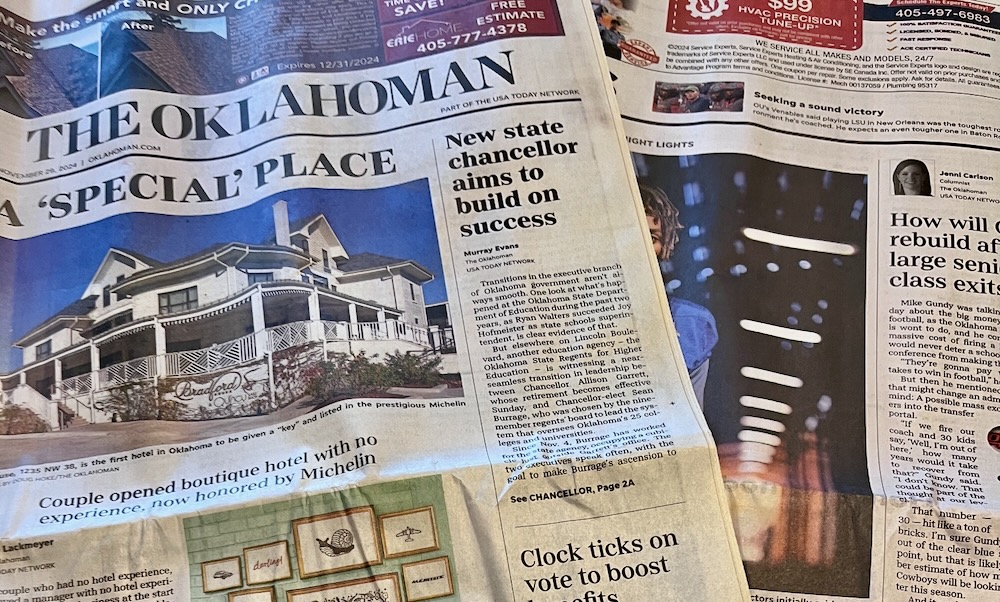
We’re going to miss our old newsprint when it’s gone

newsprint

A few years ago my former colleague at The Oklahoman newspaper, Richard Mize, lamented the demise of the metal coffee can. The coffee industry eliminated the once ubiquitous coffee can and replaced it with plastic cans or closable pouches.

“Where will we put our bacon drippings?” Richard asked.

Good question, Richard. The coffee industry was totally unconcerned about the fallout in households across the nation where bacon grease was stored in empty coffee cans. How dare they.

Anyway, I see a similar crisis brewing in American households. Newsprint is rapidly disappearing from our driveways and kitchen tables.

Instead of picking up our actual paper from the driveway each morning,  Americans are more likely to read an online version — or, more disappointing, not read any newspaper at all.

Earlier this year I wrote about the decline of my first newspaper employer, the Southwest Times Record in Fort Smith, Ark.

In fact, I’ve seen firsthand the impact the shortage of old newsprint has had on my neighbors in recent years.

Since I am virtually the only print subscriber of The Oklahoman on my street, a neighbor twice asked me for my old newspapers to use for packing before she moved and again when her daughter moved into her own apartment. I gladly shared my bounty of old newsprint.

So this leads me to the point of this post: how we’re going to miss the many ways old newspapers are used around the house — or used to be. Here are a few:

  • As liner for a birdcage (now that’s low-hanging fruit, I know).
  • As fish wrap (a common newsprint stereotype).
  • Lining the floor next to an outside door when potty training your puppy. It worked on my now departed Boston Terrier decades ago.
  • Packing in preparation to make a move (see example above)
  • Creating pirate hats. As children, my sister and I learned to fold the newspaper into the most awesome pirate hats we could imagine. We proudly wore them around our house or paraded through the neighborhood.
  • Making kites. My dad made a newsprint kite for me when I was about 10 years old, and it actually flew as well as the store-bought kind.
  • As floor liner when doing a paint job or an art project.
  • Newsprint is great as backing on a counter when you are cutting a watermelon, then wrapping the rinds before throwing them out.
  • Packed away in your closet or attic to hold on to keepsake articles for the memories.
  • Current event articles clipped for school projects.
  • Finally, a rolled up newspaper makes a fine rod of discipline for a wayward pet. I only had to roll the paper up and raise it above my head to stop my Boston Terrier from committing an offense such as chewing up a shoe.

We’re going to miss newsprint for many reasons beyond just reading the paper when its gone.

BONUS: If you’ve got other ways you’ve recommissioned old newspapers in the past, leave them in comments below.

This just in from my friend Josh O’Brien on an alternative use for old newspapers: “Another use: cleaning big mirrors or windows — much better than paper towels.”

Richard Mize (see above) added: “One more thing: I use three sheets of newsprint to light my charcoal chimney for grilling!”

Another alternative use from Steve Buck, my fellow Geezer on the 3 Old Geezers podcast.  “paper mache.

From David Yarbrough in Fort Smith, Ark: “Use as fly (or wasp) swatter, although not as ergonomically designed as plastic ones.”

One more from Linda Lynn: “Gift wrapping. And to protect table from kids’ art projects … and for art projects like collages and paper mache.  We even used to create Christmas trees with newspaper.”

From Steve Barrymore: “I save mine all year then use as a weed barrier in the garden at planting time. I then cover it with mulch. Eliminates weeding.”

From Kathy Consbruck in Nebraska: “Mine go to the pet shelter. They line the kennels with them.”

From Phyllis Welsh Bennett: “A long time ago, I used strips of colored Sunday comics to make a chain to adorn a Christmas tree at The Oklahoman. Last week I gave a stack of old papers to someone needing it to pack glassware for a move. Each weekday I put my newspaper in the waiting area of the Teachers’ Retirement System. I’m told a lot of TRS members enjoy reading a paper newspaper!”

From LaRita Dawn Watson: “I save mine for my Dad to read since he lives outside the delivery area and won’t read the online version. I have used to clean windows and mirrors, and it works better than any cloth! I’ve used it in all the ways mentioned and will truly miss it when it’s gone. It feels good to turn the pages and read.”
In my hometown, the long decline of a Fort Smith institution

Screenshot
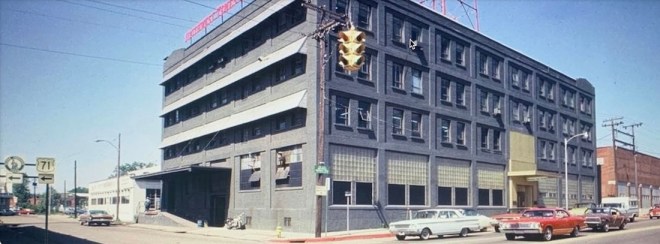
The Southwest Times Record building in what appears to be the early 1960s. (Photo courtesy of Southwest Times Record former employees Facebook group)

Here’s a bit of nostalgia for you. When I walked into the Southwest Times Record newsroom for the first time as an employee in 1978, I encountered a bustling community of talented writers, editors and photographers all scrambling to publish local news seven days a week.

The Fort Smith newspaper was a great place to learn the craft as my first job out of college. There are many folks among my former colleagues there whom I will never forget. I worked at the SWTR for five years in a variety of positions before moving to Oklahoma City and working for The Oklahoman for almost a quarter of a century.

My parents were among the 40,000 or so SWTR subscribers who fetched the newspaper off their driveway every morning. Established as the Fort Smith Times in 1884, the SWTR had a strong following not only in Fort Smith, but across a multi-county region of Western Arkansas and Eastern Oklahoma.

So, it’s been disheartening to watch the SWTR decline as a community force over the past few years as the number of subscribers declined and employees were laid off. It’s a situation not unlike that in many other cities across the nation.

Now owned by industry giant Gannett, I’m not sure there remains a single Fort Smith-based editor or reporter chasing down local news stories.

In fact, my 90-year old mother, who subscribed to the SWTR in our hometown of Fort Smith for more than five decades, finally gave it up a couple years ago because the paper had so little local news. Sometimes she still reads the obituaries published online.

As for me, I’ve stayed connected to the SWTR by subscribing to the paper’s free emailed daily newsletter that allows a peek at its headlines and free access to the obituaries.

It all makes you wonder when the hammer will fall and Gannett will halt publication of a physical paper for any remaining subscribers, leaving only online access.

Well, we’re close.

Screenshot

I received a notice recently that the SWTR was transitioning to a “mail only” newspaper with no more home delivery. Here’s what the email said, in part.

“Beginning tomorrow, look for your copy of the Southwest Times Record and our other regional publications to arrive with your daily mail. As announced in the Jan. 10 edition and in letters mailed to subscribers, the U.S. Postal Service will be delivering the Southwest Times Record to optimize resources amidst increasing digital readership demand.”

Now subscribers can read ‘news’ that is already at least 24-hours old when it arrives in the mail. What’s that old saying about nothing as stale as yesterday’s newspaper?

So, why am I writing this?

Well, it’s not a diatribe against the current ownership, because I see what’s happened to my old employer as a product of emerging technologies and a big change in how the public consumes news. Online access to news — much of it free — has removed the incentive to subscribe to a daily newspaper that lands on your driveway every morning.

I’m mourning the SWTR for its former employees and the folks who subscribed to the paper for decades. It’s like watching a close relative slowly fade away from an incurable cancer.

Here in OKC, I’m still a subscriber to The Oklahoman’s physical newspaper, which is delivered to my driveway every day but Saturday. Yet, when I look up and down my street as I pick up the newspaper each morning, I see no other papers on my neighbors’ driveways. None.

However, I’m confident the path determined for the Southwest Times Record won’t be a template for The Oklahoman. It remains an enterprising news organization, despite repeated rounds of staff reductions.

That notice I received of the SWTR’s “all mail” newspaper delivery prompted me to ask a couple of former colleagues and longtime SWTR employees who still live in the Fort Smith area their thoughts on what has become of their former newsroom.

Patti Cox was a longtime news editor at the SWTR with whom I worked on the news desk. She shared her perspective with me as both a former employee and a current subscriber.

“It is very sad turn of events for Fort Smith,” she said. “We still are taking the day-late-in-the-mailbox paper but not sure for how long or why. End of so many meaningful things like insightful, timely local news and commentary. Long gone are noisy newsrooms filled with reporters, editors, interns with common purpose and multiple deadlines.”

Carrol Copeland, longtime SWTR photographer and creator of a Facebook group called Southwest Times Record former employees that has 162 members, also shared his thoughts with me.

“Back in the day, we covered local news, and there was very little worldwide or nationwide news in it,” Carrol said. “Probably 80 to 90 percent of it was local news. At one point we had the Poteau office and the Van Buren office, and somewhere around 150 employees.”

That was then. This is now.

“There’s not even a physical location anymore,” Carrol said, who recalled tornadoes, spectacular crimes and criminal trials that he covered over the years. “I think it comes down to a lack of income. If you can’t sell advertising you can’t have people to work for you.

“Now that people are going to the Internet or Youtube for their news, no one is advertising anymore. The technology overtook them.”

How will the daily newspaper voice be filled for former SWTR subscribers who loved its local news angle? Digital news services that focus on local news offer some hope.

Here in Oklahoma City, we have Oklahoma Watch and Nondoc, among others, which are sort of complementary to The Oklahoman, for now.

In Fort Smith, there’s an online site called Talk Business & Politics that focuses on Fort Smith and Northwest Arkansas. It was started by a former SWTR editor. I read it first thing each morning five days a week.

Actually, as I think about it, I’m not sure folks aged 30 and younger will miss holding an actual newspaper because it’s likely they never read one on a daily basis anyway.

But for those who grew up with ink-stained hands, it’s a difficult transition.

“I just know I loved newspapers and the dedicated (mostly young) quirky stressed out folks who worked for them,” Patti Cox told me. “Grateful for the lifetime lessons learned there.

“Good memories, my friend.”

We’ll carry those memories with us long after the final edition is published. It’s coming.

I wish I had a magic potion to restore fading newspaper glory

My friend Casey recently told me that the newspaper is great for when you want to know what happened 24 hours ago. 

Ouch!

As a former newspaper guy who started his career on a manual typewriter back in 1978, Casey’s honest truth really hurt.  

No one is wanting the newspaper — all of them — to succeed more than me. But I see what’s happening all over the country (and world, I guess). People are seeking their news sources online with instant alerts for which they aren’t likely to pay a dime.

There’s nothing earthshaking in that news. It’s a reality that we all know. How many people under the age of 30, no, 40, no, 50 are newspaper subscribers? A handful; 5 percent? 1 percent? 

In fact, Pew Research recently released results of a survey that showed more people now get their news content via social media than the newspaper.

My friend Casey is roughly 30 years old. He prefers instant updates and free content.

Some of my former newspaper colleagues are discouraged because they are convinced that if the paper would just (insert remedy of choice), subscribers would come back. I’m afraid that ain’t happening.

Subscribing to a newspaper takes commitment, financially and in time.  It’s the model from, oh, 1990 and earlier. Young people aren’t buying it, literally. You know why? They were never newspaper subscribers in the first place.

I wish I had a magic potion.  

My ideas tend to run toward things like a cool app similar to that of Starbucks where I can put money on my account ahead of time and draw it down as I consume coffee (or, newspaper content). 

More analysis and less breaking news from 24 hours ago might help. But there’s always that obstacle of free content.

So what’s the answer?  The papers (all of them collectively) are going to have to figure out a way to make their online content so alluring that folks like Casey would be willing to make a small monthly investment. 

That’s the model that The Athletic sports site is pursuing, although I think it’s too early to call it a success. 

That still doesn’t keep the presses running.  

Meanwhile, I’ll just fetch the latest edition of the paper off my driveway for as long as it lasts. I don’t want the physical newspaper to disappear, even though I can access it online. 

I’m from Generation Past.

Once upon a time, virtually every house on my block had a paper out in the driveway before daylight.  Now it’s only on my driveway and one or two others.

Recently, I was at a local hospital waiting on my daughter’s appointment when a nurse came by. I was reading my paper.

“Ooh, we don’t see many of those around here these days,” she said. “Where did you get it?”

I had some breaking news for her.

“Off my driveway this morning,” I said.

Then there is my friend Casey, who assures me he loves the newspaper and always has. “Just not enough to subscribe to it,” he said.

Ouch.