One more thing: there are no more surprises in Apple product events

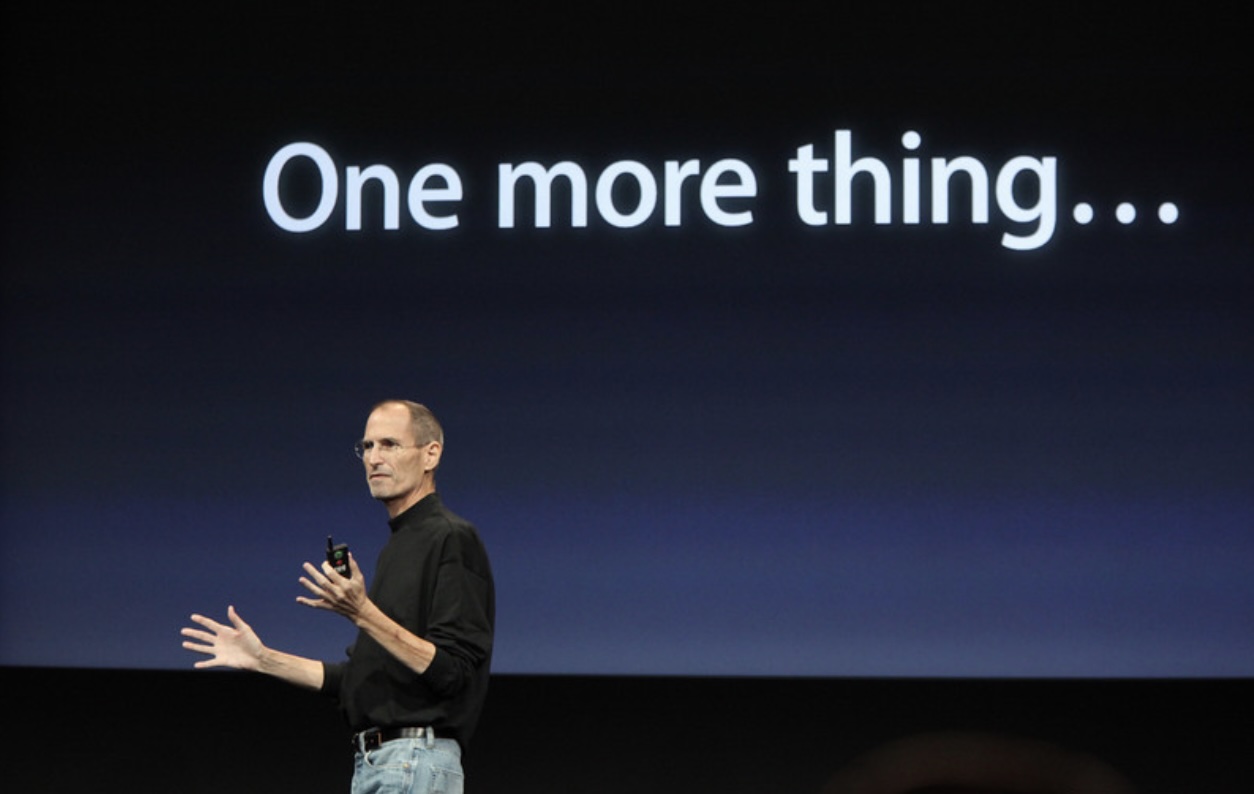
Steve Jobs makes a ‘one more thing’ announcement at a live Apple product event.

This past Tuesday, Apple Inc. introduced its latest line of iPhones in a special pre-recorded event that showcased iPhone 17 and an extra thin iPhone Air.

Along with showcasing the latest Apple Watches and Airpods, the event lasted just over an hour. It included introductions from Apple CEO Tim Cook plus key Apple staff, as well as customer testimonials, music and ads to showcase it all. You can watch it here. 

Unfortunately for me, I knew in advance almost every product that was introduced, down to the new iPhone Air.

Thanks for spoiling it, Mark Gurman.

Gurman is a tech writer for Bloomberg News who covers everything Apple like Helen Thomas covered the White House once upon a time. The author of the Power On newsletter, Gurman had already detailed almost everything Apple debuted, down to the specs of the iPhone Air and cameras in the iPhone 17 Pro Max.

I didn’t want to know any of that before I watched the Apple event. I long for the days of the “One More Thing” that the late Steve Jobs would surprise the audience at Apple product events. I was just as surprised and awed as everyone else when he pulled the first iPod out of the pocket of his Levi’s in 2001.

Watch Jobs make some “one more thing” introductions in the video below.

I’m not sure how Gurman gets his info, but I assume it must come with Apple’s cooperation or willfully ignoring his insider scoops. Reporters and podcasters that I follow seem happy with the situation because Gurman’s reporting gives them something to discuss on an ongoing basis from week-to-week.

I realize that all of this doesn’t matter to about 99.9% of the public, but as a long-time Apple Fanboy, it’s a big deal. There was time that Jobs was so obsessed over keeping future products secret that he took steps like issuing memos with slight alterations sent to different employees to catch leakers.

Just as it should be.

Oh, and one more thing. I long for the pre-COVID years when Apple’s product events were all performed live in front of an audience and streamed to the rest of us. It was way more fun when new Macs or iPads or software were introduced by Jobs or Phil Schiller or Craig Federighi, and demoed right on the stage.

That was live theater, and I loved it.

But here we are in 2025, and we all can predict  virtually every new product in advance as a pre-recorded Tim Cook introduces it as Apple’s “best ever.”

No suspense. No surprise. No one more thing.

Get off my lawn.

UPDATE:

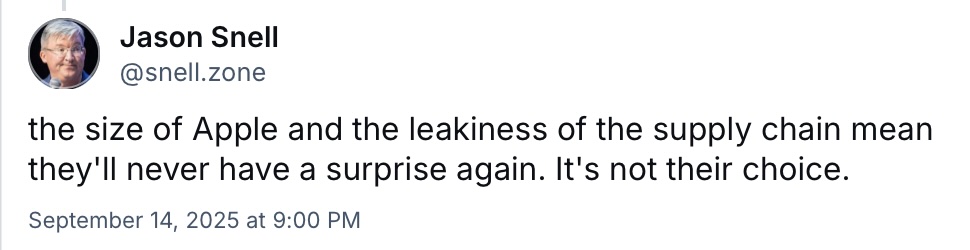
Here is what Jason Snell, former editor of Macworld magazine who has covered Apple for decades, had to say about new product developments that are leaked to the public.
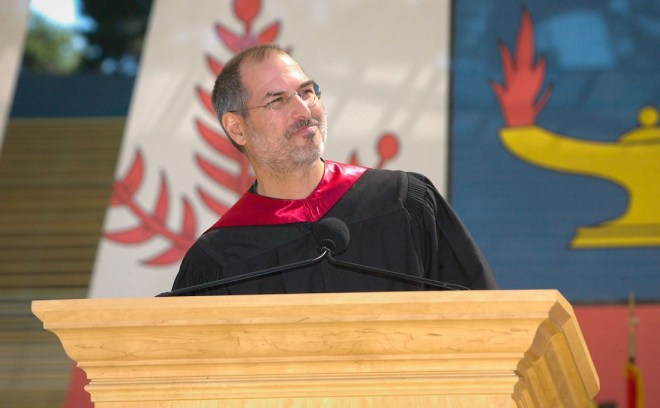
Steve Jobs in his own words

Steve Jobs during 2005 Stanford Commencement speech.

If you follow this blog or know me personally, you’re probably aware that I’m a fan of Apple Inc. and its co-founder, the late Steve Jobs.

Jobs’ story is well known. Co-founding Apple in 1976 with Steve Wozniak; building the Apple I in the garage of his childhood home; creating the Macintosh computer in 1984; getting fired from his own company in 1985; returning to Apple a decade later to become CEO and leading development of groundbreaking products.

The company has since soared to incredible financial stature.

Along the way, Jobs was diagnosed with cancer and eventually died from it in October 2011.

Books have been written about Jobs after his death and movies made about his life. I’ve read two books that I would highly recommend, especially Steve Jobs by Walter Isaacson. The other is Becoming Steve Jobs by Brent Schlender and Rick Tetzeli.

The Isaacson book sort of reinforces the image I had of Jobs as a creative person who drove himself and others really hard, mostly without tact or apparent empathy. As much as I admire the innovations he brought to the market, I don’t think I could have worked for Steve Jobs.

But I’m still a fan, because of his enormous impact on our world (iPhone, anyone?). And the fact that the arc of his life reads like a Greek tragedy.

So, when I discovered Make Something Wonderful: Steve Jobs in His Own Words, published by the Steve Jobs Archive, I had to read it, too.

Available for free on Apple Books or on the Web at the Steve Jobs Archive, the 319-page book contains speeches, presentations and emails by Jobs.

It’s sort of the ultimate inside look at how he thought and worked, especially the emails he sent to himself with information and thoughts he didn’t want to let get away.

There are lots of good quotes in the book, including the entire transcript of his 2005 Stanford University Commencement speech. You can also watch it on YouTube.

So, I’ve selected a few quotes that I found memorable and will share in this post.

For instance, way back in 1983, Steve already saw the future in which computers were going to tie millions of people around the world together though networking capabilities.  The Internet was about 6 months old, and few people actually knew it existed. 

Talking to the International Design Conference in Aspen in June of that year, Jobs said:

“… I think that that’s exactly what’s going to happen as we start to tie these things [computers] together: they’re going to facilitate communication and facilitate bringing people together in the special interests that they have.
And we’re about five years away from really solving the problems of hooking these computers together in the office. And we’re about ten to fifteen years away from solving the problems of hooking them together in the home.”

In a 1984 speech to Apple employees the day before the Macintosh debuts in the famous “1984” ad run during the Super Bowl:

“IBM wants it all, and is aiming its guns on its last obstacle to industry control: Apple. Will Big Blue dominate the entire computer industry? [Audience: No!] The entire information age? [Audience: No!] Was George Orwell right about 1984?”

In a 1984 interview with reporter Michael Moritz:

“I want to build products that are inherently smaller than any of the products on the market today. And when you make things smaller, you have the ability to make them more precisely. Obviously, a perfect example of that is a watch. It’s beautiful, but the precision has to be the scale of the object itself, and so you make it very precise.”

From a 1996 speech to Palo Alto, Calif., high school students:

“Be a creative person. Creativity equals connecting previously unrelated experiences and insights that others don’t see. You have to have them to connect them. Creative people feel guilty that they are simply relaying what they “see.” How do you get a more diverse set of experiences? Not by traveling the same path as everyone else …”

In an email exchange in 1997 with a software engineer after returning to Apple as Interim-then-full-time CEO:

“… there is something good here worth saving. I don’t quite know how to express it, but it has to do with the fact that Apple is the ONLY alternative to Windows and that Apple can still inject some new thinking into the equation.”

Finally, an excerpt from his Stanford Commencement speech in 2005, a year after he had been diagnosed with pancreatic cancer.

“Your time is limited, so don’t waste it living someone else’s life. Don’t be trapped by dogma—which is living with the results of other people’s thinking. Don’t let the noise of others’ opinions drown out your own inner voice. And most impor­tant, have the courage to follow your heart and intuition. They somehow already know what you truly want to become. Everything else is secondary.”

Before his death, Fortune magazine called him the Beethoven of the business world.  That’s a pretty good description.

I highly recommend Make Something Wonderful if you are a fanboy like me or merely curious about Steve Jobs.

I’m a Mac (fanboy): Apple ads across the years

Imamac
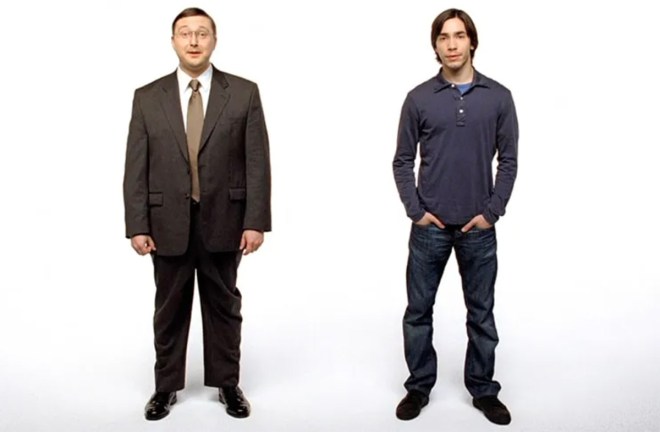
John Hodgman (left) as PC and Justin Long as Mac (Apple photo)

It’s no secret that I’ve been an Apple fanboy ever since I first read about the company and how it was founded in the 1970s in a Cupertino, Calif., garage by two guys named Steve.

In fact, my first computer was the Apple II, which brought personal computers to millions of people back in the day.

I’ve also been a fan of its advertising campaigns across the decades. Along with its groundbreaking technology, Apple has always taken a different and memorable approach to advertising its products.

But it gained notoriety in 1984 with the debut of the Macintosh.

Apple’s 1984 Super Bowl ad, which skewered IBM while introducing the Mac, is hailed as perhaps the most groundbreaking ad ever. It only aired one time. In case you missed it or it’s been a while, you can play it below.

Then, co-founder Steve Jobs left the company when he was fired by John Scully, the CEO he hired. Apple wandered in the wilderness for a decade before Jobs returned, first as interim CEO and then with the full title.

One of Jobs first and most memorable acts upon his return was to launch Apple’s Think Different campaign. I loved it, and apparently millions of other people did, as well. The company’s sales began to soar. Watch the ultimate Think Different ad here, that celebrates The Crazy Ones.

Another well received Apple ad campaign was known as the Switcher ads, featuring regular people who had switched from PCs to Macs.

My favorite Apple ad campaign of all time was the I’m a Mac campaign that ran from 2006 to 2009. I’m a Mac was actually a series of short vignettes starring Justin Long as the Mac and John Hodgman as the PC.

Long was one cool dude, while Hodgman was hopelessly uncool, out of date and out of touch with popular culture.

But mostly, the ads were funny, which hooked me immediately.

Although it’s been 12 years since the ads were aired, you can easily find them on YouTube. Here’s my favorite I’m a Mac ad of them all, featuring Patrick Warburton, who also played “Puddy” on Seinfeld.

Enjoy the comedy.

BREAKING NEWS: Just saw this from the Wall Street Journal about Apple Inc.

Apple Inc. became the first U.S. company to reach $3 trillion in market value, the latest milestone in a pandemic-era surge that carried shares of the iPhone maker and other large technology companies to unprecedented highs.

Apple shares crossed the milestone when they topped $182.856 Monday. The share price has more than tripled since the pandemic lows of March 2020, adding around $2 trillion in market capitalization.