Tin soldiers and Nixon coming

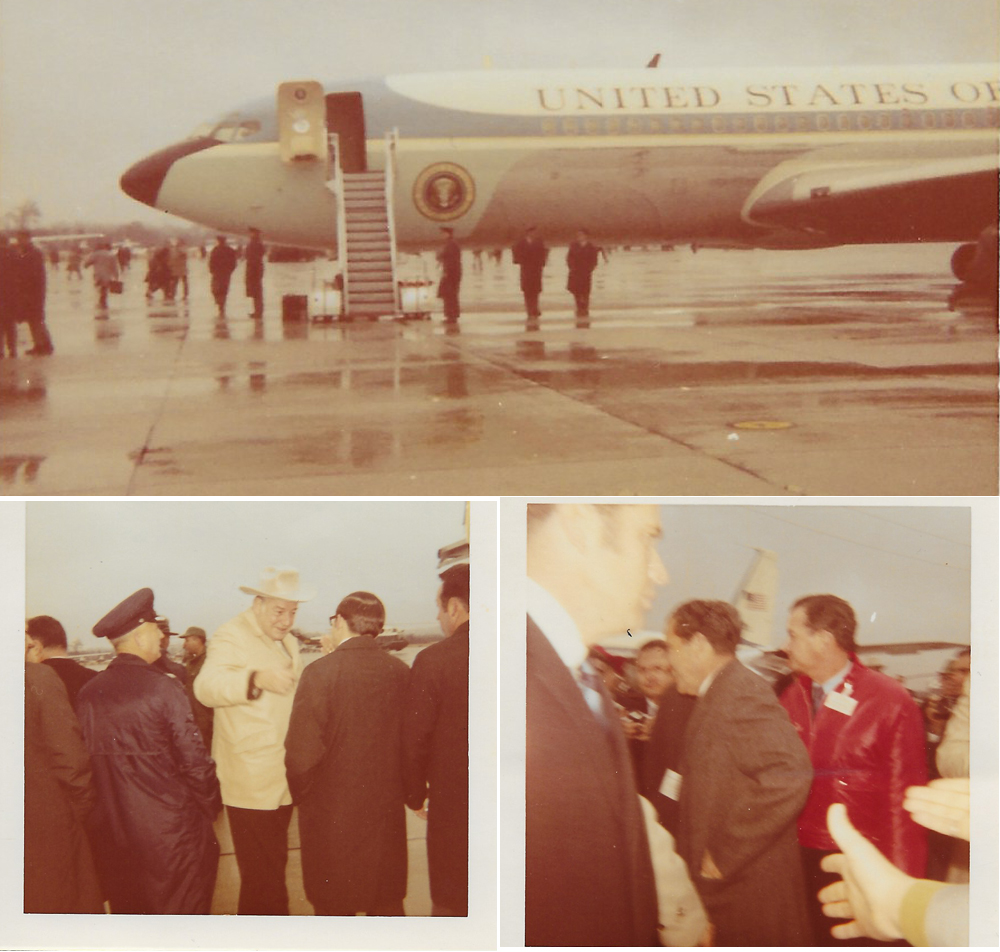
Air Force One sits on the tarmac at the Fort Smith Municipal Airport on December 6, 1969; Winthrop Rockefeller (white hat in left photo), and Richard Nixon shook hands with the crowd before departing for Fayetteville.

On December 6, 1969, President Richard Nixon flew into Fort Smith, Ark., on Air Force One as he traveled to Fayetteville and the “Game of the Century” between the Arkansas Razorbacks and Texas Longhorns.

That makes today a huge personal anniversary for me.

I was among the approximately 2,000 people who greeted Nixon at the airport 50 years ago today. I was 16 and living in Fort Smith with my mom and sister while my dad served a tour of duty in Vietnam.

But I wasn’t there to protest the war. I was there to see history in the person of a sitting President arrive in Fort Smith, no matter how brief the visit.

I borrowed my mom’s car and drove out to the airport a full two hours before Air Force One arrived and snagged a great spot by the rope barrier that had been set up. Security was pretty light. No one frisked us or questioned us as we ran onto the tarmac area in an attempt to beat the crowd to the best viewing spot.

When Nixon finally arrived, I don’t remember any actual remarks, although there was a podium set up. But I do remember that he came down the line of people along the rope to shake our hands. He was accompanied by Arkansas Gov. Winthrop Rockefeller (white cowboy hat in left photo above).

When the President got about two people from me, someone apparently suggested that it was time to board the helicopter that would complete the trip to Fayetteville. Nixon turned away and took a step toward the waiting helicopter. The crowd let out a collective groan, and the President immediately turned back and resumed shaking our hands (mine, too!). He continued shaking hands down to the high school bands that were playing, where he shook hands with some of the young musicians.

It was a highlight of my youth, despite the fact that Nixon turned out to be, well, Richard Nixon. Watergate and the corruption of his administration surfaced years later.

Two memories stand out from that day.

One was shaking the President’s hand.

The second memory occurred before Nixon arrived. A guy holding a small Instamatic-type camera climbed on top of one of the barrels set up to hold the rope barricade and immediately drew sharp reprimands from the security detail. The camera guy was incensed as he climbed down, and yelled “come the revolution, you’re going to get yours!”

It was a sign of the times, even in a small Southern city like Fort Smith.

OU showcases Stephenson Cancer Center at End2Cancer conference

A scientists presents his findings at the End2Cancer conference at the Samis Education Center on the OU Health Center campus

By Jim Stafford

The University of Oklahoma Health Sciences Center and the NCI-Designated Stephenson Cancer Center delivered an academic doubleheader for about 200 cancer research scientists at the recent 2019 END2Cancer conference at the Samis Education Center on the Health Center campus.

For the main event, scientists came to share their research or hear presentations given by counterparts from across the country who are pursuing breakthrough discoveries in the area of cancer treatment. At the two-day conference, the scientists focused on emerging nanotechnology and cancer drug delivery applications.

At the same time, OU showcased its renowned Stephenson Cancer Center on the Health Sciences Center campus, said Rajagopal Ramesh, Ph.D., conference chair and professor, Department of Pathology at the University of Oklahoma College of Medicine.

“The whole idea in organizing this conference for the third consecutive year – beyond the science – was to put Oklahoma on the map and have the Stephenson Cancer Center recognized for the great science that we do in the diagnosis and treatment of cancer,” Ramesh said. “We have eminent speakers coming in from all over the country, and the majority of them have never been to the state of Oklahoma or to the Stephenson Cancer Center.”

The NCI-Designated Stephenson Cancer Center ranks in the top 50 in the nation for cancer care in the 2019-2010 U.S. News & World Report ranking and currently ranks No. 1 among all cancer centers in the nation for the number of patients participating in clinical trials.

“They were highly impressed,” Ramesh said. “The first thing I hear when they come in is ‘Wow, I never knew such an outstanding cancer center with top-notch research infrastructure exists.’ We wanted them to come in and have the opportunity to go to the Stephenson Cancer Center and look at some of the cutting-edge clinical trials we are doing at the center.”

Ramesh pursues his own cutting-edge research at the Stephenson Cancer Center, developing nanoparticles that can deliver drugs specifically to tumors and minimize the toxicity that is often a cancer treatment side effect. He specializes in the diagnosis and treatment of lung cancer.

Ramesh recently received a grant from the U.S. Department of Defense to explore a means by which tumor cells may be avoiding immunotherapy in lung cancer. The study is unique in that it is being conducted on lung cancer patients in real time while they are on a clinical trial receiving an immunotherapy medication.

The Oklahoma Center for the Advancement of Science and Technology (OCAST) also supports Ramesh’s lung cancer research with a $135,000 Health Research grant.

“OCAST has been beneficial not only to my lab but across the entire state of Oklahoma,” Ramesh said. “The whole idea of OCAST is to bridge the transition from academic research to an industry setting in the state of Oklahoma. By receiving funds from OCAST, we are able to generate new ideas and test them first in the lab.”

Wei Chen, Ph.D., professor and dean of the College of Mathematics and Sciences at the University of Central Oklahoma, is another OCAST-supported scientist who moderated an END2Cancer panel discussion and presented findings from his own nanotech-based research at the conference.

“Ending cancer is everybody’s dream,” Chen said. “So everybody in this conference and many researchers around the world are contributing to the fight against cancer. We are making good inroads both in terms of nanotechnology and other methodologies. But cancer is a very tough enemy, as we know. Therefore, we still have a long way to go.”

Jim Stafford writes about Oklahoma innovation and research and development topics on behalf of the Oklahoma Center for the Advancement of Science & Technology (OCAST).

Don’t criticize me! Steve Jobs shows how to respond to criticism


I’ve never responded particularly well to criticism.  I tend to have an instant reaction and lash out at the person providing the critique with words that I regret.  It’s something that I’m aware of and have to guard against constantly.

But it seems that I never handle it as well as I should. Call it a character flaw (among many).

Anyway, I saw this clip of Steve Jobs responding to an insulting question from an audience member at a 1997 developers conference. The guy wanted to show that Jobs didn’t know what he was talking about as far as software programming, along with a second question on what he had been doing the past seven years.

Jobs’ response blows me away. Instead of becoming angry and hurling an insult back at the guy (as I almost certainly would have), he sat and thought for several seconds. You can see that the wheels are turning as he formulates his answer and responds initially with a cliche about pleasing some of the people some of the time.  His long answer actually provided insight into why Apple developed products as it did.

Finally, he responds directly to the insult by admitting that he sometimes doesn’t know what he’s talking about and that mistakes will be made. At least someone is making some decisions for the company, he told the audience.  

Jobs’ response seems heartfelt and honest. It’s something I hope I can emulate in the future.  

I invite you to click on the video and watch Jobs respond to the insult.  I hope you find it as inspiring as I do.


Oklahoma’s Saab story: a prophecy fulfilled

I hope you saw this story in Monday’s editions of The Oklahoman about the Saab Group, a Swedish Aerospace firm, reportedly passing on Oklahoma as the location to build a new military trainer jet because of workforce concerns.

If you didn’t read it, click this link to catch you up to date: 

The reporting by Oklahoman reporter Dale Denwalt made the words of Oklahoma City businessman Phil Busey seem almost prophetic. The story quoted State Sen. Adam Pugh, who said that the Saab Group decided it would not be able to find enough skilled workers to sustain its workforce at an Oklahoma location.

Saab reportedly wanted to know if it could find people to work at the plant. ‘In the end, they decided they couldn’t, and so they’re taking their business somewhere else,’ state Sen. Adam Pugh told members of Leadership Oklahoma at a recent aerospace forum.

Busey is founder and CEO of a company called Delaware Resource Group (DRG), minority-owned aerospace industry federal defense contractor. DRG employs upwards of 700 people, including software engineers, worldwide who support contracts with the U.S. Department of Defense, as well as major aerospace companies such as Boeing and Lockheed Martin.

I recently had the opportunity to interview Mr. Busey along with Debbie Cox, my colleague from the Oklahoma Center for the Advancement of Science and Technology (OCAST). Our interview was the basis for an OCAST video and a column I wrote on behalf of the agency. You can read it and watch the video interview here. 

We were surprised by the urgency that Busey showed in advocating for an improvement in public education and workforce development across our state.

Phil Busey

“Our challenges really come back to the issues of workforce development,” Busey told us. “Public education is the No. 1 challenging issue we see here in Oklahoma.”

Thousands of aerospace positions in the state remain unfilled because there aren’t enough Oklahomans equipped with STEM skills – science, technology, engineering and mathematics, Busey said.

That means that we need to build a deeper pool of young Oklahomans equipped with STEM skills that are critical to the sustainability of the state’s aerospace industry.

But it goes beyond workforce development, he said. It’s also about the image of our state that is reflected in legislation like the recent open carry law that allows virtually anyone in Oklahoma to carry a gun without a license or shooter education.

“The challenge is that we are having to rebrand ourselves,” Busey said. “The social legislation issues, the open carry issues and the public education issues all have to be addressed. Because people really don’t understand who we are … We have to talk to them about what our culture is really like, who we are, what kind of values we have, that we are inclusive, that we have all types of development going on with MAPS and the successes we have had downtown.”

The bottom line is that there are currently between 1,500 and 2,000 open positions here in Oklahoma in the high paying aerospace industry. We have to fill that pipeline.

Busey has organized his own working group of community, education and business leaders to brainstorm ways to enhance Oklahoma’s workforce development and improve our image.

“We’re trying to develop pipelines with our universities,” Busey said. “And then be able to talk with people who we need to recruit from outside Oklahoma that it is a good place to live. We all don’t walk around with 45s on our hips. Public education, we have to do something to improve that. It is a deal breaker.”

I wish I had a magic potion to restore fading newspaper glory

My friend Casey recently told me that the newspaper is great for when you want to know what happened 24 hours ago. 

Ouch!

As a former newspaper guy who started his career on a manual typewriter back in 1978, Casey’s honest truth really hurt.  

No one is wanting the newspaper — all of them — to succeed more than me. But I see what’s happening all over the country (and world, I guess). People are seeking their news sources online with instant alerts for which they aren’t likely to pay a dime.

There’s nothing earthshaking in that news. It’s a reality that we all know. How many people under the age of 30, no, 40, no, 50 are newspaper subscribers? A handful; 5 percent? 1 percent? 

In fact, Pew Research recently released results of a survey that showed more people now get their news content via social media than the newspaper.

My friend Casey is roughly 30 years old. He prefers instant updates and free content.

Some of my former newspaper colleagues are discouraged because they are convinced that if the paper would just (insert remedy of choice), subscribers would come back. I’m afraid that ain’t happening.

Subscribing to a newspaper takes commitment, financially and in time.  It’s the model from, oh, 1990 and earlier. Young people aren’t buying it, literally. You know why? They were never newspaper subscribers in the first place.

I wish I had a magic potion.  

My ideas tend to run toward things like a cool app similar to that of Starbucks where I can put money on my account ahead of time and draw it down as I consume coffee (or, newspaper content). 

More analysis and less breaking news from 24 hours ago might help. But there’s always that obstacle of free content.

So what’s the answer?  The papers (all of them collectively) are going to have to figure out a way to make their online content so alluring that folks like Casey would be willing to make a small monthly investment. 

That’s the model that The Athletic sports site is pursuing, although I think it’s too early to call it a success. 

That still doesn’t keep the presses running.  

Meanwhile, I’ll just fetch the latest edition of the paper off my driveway for as long as it lasts. I don’t want the physical newspaper to disappear, even though I can access it online. 

I’m from Generation Past.

Once upon a time, virtually every house on my block had a paper out in the driveway before daylight.  Now it’s only on my driveway and one or two others.

Recently, I was at a local hospital waiting on my daughter’s appointment when a nurse came by. I was reading my paper.

“Ooh, we don’t see many of those around here these days,” she said. “Where did you get it?”

I had some breaking news for her.

“Off my driveway this morning,” I said.

Then there is my friend Casey, who assures me he loves the newspaper and always has. “Just not enough to subscribe to it,” he said.

Ouch.


Fondly recalling my first love in computing — an Apple //e

The original Apple //e, released in 1983


A few weeks ago I had the opportunity to tour the NextThought, LLC, offices on the University of Oklahoma’s South Research campus. The company  specializes in educational technology and “connected” online learning.

As founder and CEO Ken Parker escorted me through the open office, I spotted what appeared to be an original Macintosh computer on one of the desks. Ken asked me if that was my first computer.

I said that my first computer was actually an Apple //e.

Ken turned and gave me a high five.  Turns out that his first computer also was an Apple //e, which debuted in 1983.

Of course, Ken learned how to write software on his Apple //e and went on to build an incredible career developing financial services and now educational software.

My interest in the Apple //e was all the cool things I could do with software already available on it such as the original Visicalc spreadsheet, word processing and games. AppleWorks became my go-to software product.

For instance, I used AppleWorks to develop a spreadsheet with which I ran a fantasy baseball league for several years.  Of course, I had to spend several hours each week inputing data from the newspaper into the spreadsheet to make it work.

I did make a couple of unsuccessful stabs at learning to write software on the machine.  Maybe it was a lack of patience that held me back.

i recall writing a little program that printed “My name is Jim Stafford.”  The first time I inputed “run,” into the program, the screen filled with my name and wouldn’t stop. I had to do a hot reboot to get it to stop.  Only later did I realize that my little program needed a line to tell it how many times to print “My name is Jim Stafford” and then a line that said “end” to make it stop.

The Apple //e sat on my kitchen table for a half dozen years before I finally, reluctantly, retired it. It controlled my checking account. I tracked stocks on it. I wrote articles and even created a little newsletter. I added a modem and surfed local OKC online “bulletin boards.”

Finally, I gave it to my uncle to use in his business.  I moved on to the more modern Mac.

I still miss my original Apple.


A cup of joe with the new Mayor of Fort Smith

Whenever I drive over to my hometown of Fort Smith, Ark., to visit my widowed mother, I manage to squeeze in a visit to my favorite local coffee shop, Fort Smith Coffee Co.

Located just off downtown’s Garrison Ave., Fort Smith Coffee Co. has a great vibe with a mix of young hipsters and older folks like me (who skew the demographics of the place!). It has good coffee, good background music, plenty of sun and is a great place to hang.

So, I grabbed a cup of coffee and sat on a stool with the sun at my back watching people come and go.

Suddenly, a handsome man wearing a suit and tie came through the door. He seemed to know everyone, laughing and joking with other patrons as he ordered his coffee.

As I started to depart a few minutes later, it occurred to me that this was George McGill, Fort Smith’s newly elected Mayor.  He was seated near the exit reading the newspaper as I headed to the door, so I walked up and said “you look like you could be the Mayor.”

He laughed, stood up and shook my hand as we introduced ourselves. We talked for a few minutes, and he touted the city for all the good things that are happening like a recent music festival and a downtown public art project called “The Unexpected.”

Then he told me that his election as Mayor says a lot about the city because “African-Americans make up only 8 percent of the population.”

I agree. I’m proud of Fort Smith for electing George McGill as its Mayor, and for the exciting things going on like public art and construction of the new U.S. Marshall’s museum along the Arkansas River.

And that a place like Fort Smith Coffee Co. was thriving on a Saturday morning.

My friend Ed told me that I drove a long way to get a cup of coffee. Yeah, but I get to see my Mom and all the positive changes going on in Fort Smith, so it’s always worth it.

Paul McCartney knows just how OKC feels

When Kevin Durant told OKC two weeks ago “It’s not you, it’s me” and moved in with the Golden State Warriors, there was something familiar about the scenario. It was the type of relationship-gone-bad about which movies are made and songs are written. One person left stunned and hurt as their lover announces out of the blue that he or she is moving on to a new partner.

kd pixThen I was driving down the road Saturday when the Beatles’ “I’m Looking Through You” came on the radio. It hit me. Paul McCartney’s bitter lyrics about the partner who jilted him was a perfect description of how thousands of OKC fans felt watching @KDTrey35 being introduced as a Warrior. Well, it hit me that way, anyway.

Here is a sampling of the lyrics written 50 years ago. They perfectly describe the KD-OKC breakup:

I’m looking through you,
Where did you go?
I thought I knew you,
What did I know?
You don’t look different, but you have changed.
I’m looking through you, you’re not the same.

Your lips are moving,
I cannot hear.
Your voice is soothing,
But the words aren’t clear.
You don’t sound different,
I’ve learned the game.
I’m looking through you,
You’re not the same.

Why, tell me why, did you not treat me right?
Love has a nasty habit of disappearing overnight.

You’re thinking of me,
The same old way.
You were above me,
But not today.
The only difference is you’re down there.
I’m looking through you,
And you’re nowhere.

Why, tell me why did you not treat me right?
Love has a nasty habit of disappearing overnight.

I’m looking through you, 
Where did you go?
I thought I knew you,
What did I know?
You don’t look different,
But you have changed.
I’m looking through you,
You’re not the same!

Yep, KD. You don’t look different. But you have changed.

There’s a novel in here somewhere

OK, about three or four years ago I began a novel. I’ve written one chapter. It’s sort of an action-adventure-drama-mystery. I’m probably going to scrap it and pursue something different. But I thought I might post the chapter here to see if I can get any feedback. I still haven’t made up my mind, but check back in a day or two and see it is posted.

Jim