Earlier this week, my wife asked me to run down to the nearby Dollar General store to pick up a loaf of bread. I jumped into the car and headed that way.
As I neared the store, which is roughly a half mile from our house, I realized I did not have my wallet. Darn!
Then I realized I had my iPhone, and Dollar General accepts Apple Pay.
No wallet. No problem.
I ran into the store, grabbed a couple loaves of bread and headed to the checkout where I payed with the magic of no-touch Apple Pay and my iPhone.
I’ve become a huge Apple Pay fan. I will choose Target over, say, Walmart, because not only does Target offer a nicer shopping environment it also accepts Apple Pay.
Anyway, this got me to thinking about all the handy tools the iPhone (and others Smart Phones, I assume) offer that remind me of the versatility of a Swiss Army Knife.
I can’t tell you how many times I’ve found myself carrying something to the trash bin on the side of our house late at night in pitch black without light to aid navigation. But now, I touch the flashlight on the iPhone and I’m guided to and from the bin without tripping over anything.
There are so many other examples. Counting steps when I’m walking. Sending emergency funds on the spot to a child in need in a faraway place. Downloading and reading free books from the library. Sending a Subway gift card to a child in need in a faraway place. Ordering an Uber and watching the progress of the arriving car on a map. Receiving and reading lab results ordered by my doctor. Pointing the phone to the sky and seeing information about the type of aircraft and destination of a flight overhead. Pointing the screen at yourself and taking a selfie.
Oh, and making a phone call. I could go on and on.
When Steve Jobs introduced the iPod from a San Francisco stage in 2007, he said “today, Apple is going to reinvent the phone.”
It did.
Watch Jobs’ introduction of the device.
With the emergence of iPhone and the many apps dreamed up by developers, the concept of the Smart Phone has washed over so many areas of our lives. It changed telecommunications and it changed how we live. I think for the better.
That’s why the iPhone IS the Swiss Army Knife of communication.
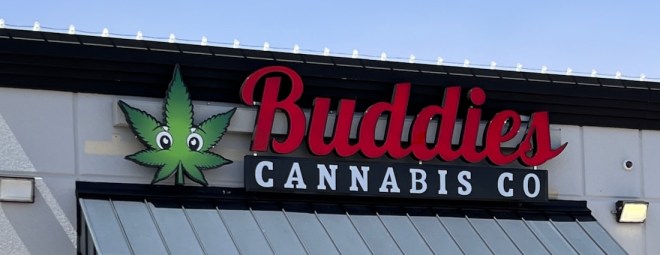
Sign atop the “Buddies Cannabis Co.” dispensary along N. Western Ave.
I once had a co-worker who spoke fondly — and often — about the awesomeness of “African Trip Weed.” I was pretty sure what he meant.
That was back in the ’80s, when America declared its War on Drugs and put a lot of people into prison for dealing, possessing, using marijuana, whether it was ‘Trip Weed’ or not.
Fast forward to 2023.
Oklahoma has declared marijuana suitable for medicinal use and opened the door to a tsunami of Medicinal Cannabis — maybe that word won’t offend Grandma so much.
So, there are legal marijuana shops in strip centers and street corners all across OKC. Just drive up and down a major retail corridor like May Ave. or Penn and count the Medicinal Marijuana stores.
I’m not here to argue the merits for or against marijuana use and its benefits or its dangers.
However, I’m completely taken by the creativity the weed dealers use to name their businesses. If there’s a clever pun that can be used in the name, someone has claimed it.
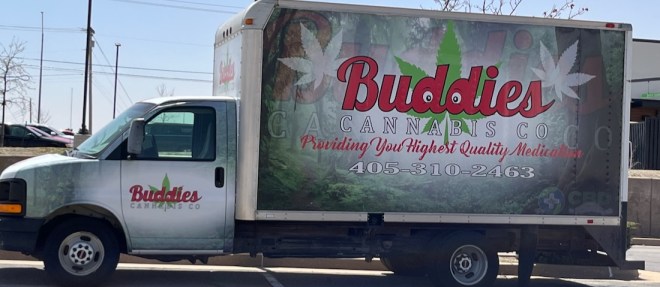
Perhaps my favorite is located on N Western Ave. just north of Memorial Road. There sits “Buddies” waiting to serve your medicinal needs.
Now that’s a clever play on words, even if it’s an obvious one. You don’t have to wonder what business “Buddies” is in.
I go up-and-down Western often, so I see the “Buddies” sign a lot. It got me to wondering about the most clever names for Oklahoma City marijuana joints (pun intended).
So, I asked my friend, Open AI’s Chat GPT, to come up with a list of the top 25 clever marijuana dispensary names in Oklahoma City.
Here’s what ChatBot came up with.
Pot of Gold Dispensary
The Happy Ogle
Puffin’ Stuff
Green Grannies
Joint Venture
The Dankery
Budding Bloomers
Dr. Reefer’s
Bud Brothers
The Green Scene
Higher Ground Dispensary
Treehouse Club
Green Love
Ganja Queen
Calm Waters Cannabis Co.
Higher Calling
Best Buds Dispensary
Dankland
T-Town Medical Marijuana Dispensary
The Pot House
Mary Jane Dispensary
The Med Shed
The High Road Dispensary
Smokin’ Gun Dispensary
Buzzn Dispensary
Joint Venture may be my favorite. But where is “One Toke Over the Line (Sweet Jesus)?”
If you’ve seen a weed store with a clever name that’s not on this list, reply to this post and let me know the name. That’s what “Buddies” are for.
Anticipation, because there’s even more drama to play out in real time over the next two weeks.
And then there was something we all needed. Diversion.
OK, it’s not an emotion, but diversion is important because there’s a lot of disturbing events like war, economic upheaval and political turmoil that greet us daily. The NCAA Tournament provides much a needed respite.
So, that brings me to the point of this blog post. Hello, Spring!
The NCAA Tournament — and all of sports — make this the most wonderful time of the year.
For instance, when the NCAA Tournament crowns a champion the first week in April, Major League Baseball will be celebrating Opening Day in parks around the country.
And the OKC Dodgers open their season on March 31. The NBA playoffs begin in mid-April — hopefully with the OKC Thunder as a play-in qualifier. The Masters. The NFL Draft. The Kentucky Derby on the first Saturday of May. There is the women’s NCAA Tournament along with college softball and baseball. And hockey playoffs, as well.
It’s been a long, cold lonely winter for many people, so the sports calendar tells us “here comes the sun” in both a literal and figurative sense.
Sort of like the renewal of life that Spring itself brings, we find joy and hope, anticipation and welcome diversion in the Spring sports calendar.
Thanks to the NCAA Tournament for kicking it all off with an incredible level of excitement.
I’ll celebrate it just like this every Spring.
Arkansas coach Eric Musselman goes shirtless in celebration of victory over Kansas.
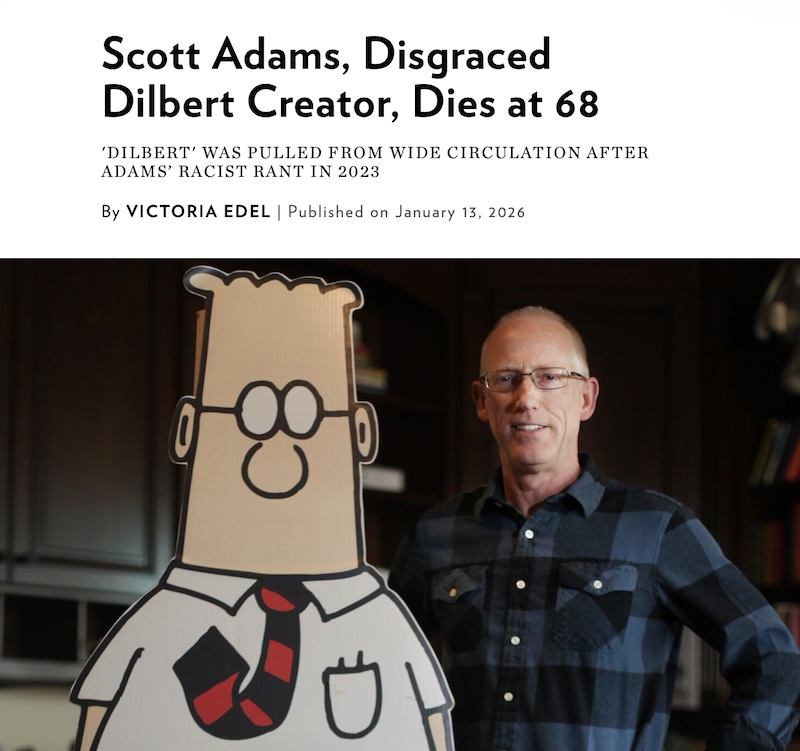
Editor’s Note: Scott Adams died this week from the effects of cancer. I wrote the column below back in 2023 after he made several racist statements, and will leave it up on this blog. However, I think it’s important to acknowledge his death and that his legacy will be the way his career as a cartoonist ended rather than the brilliance of his Dilbert strip.
I went back through my social media history this morning and came across a dozen or more Dilbert comic strips I have posted over the years.
If you aren’t familiar with Dilbert, it’s an insightful, often hilarious syndicated comic strip that skewers corporate office life. It features Dilbert, an engineer, his co-worker Wally and the pointy-haired boss, among others.
Wally was my personal favorite because of his ability to goldbrick every day and get away with it while still drawing his salary. Oh, and he always has a coffee cup in his hand.
So, it hit me hard when a text over the weekend from a former co-worker at The Oklahoman delivered some devastating news.
Dilbert author Scott Adams revealed himself to be a racist with some horrific comments on his streaming video program, “Real Coffee with Scott Adams.” Here’s an article from the San Jose Mercury News reporting Adams’ comments.
On the program, Adams cited the results of a poll of Black Americans on racial views, then calling Blacks a “hate group,” and recommending that white Americans segregate themselves.
“Based on the current way things are going, the best advice I would give to white people is to get the hell away from Black people,” Adams said.
He also bragged about spoofing the current sexual/racial identity discussion by claiming to “identify as Black” until now.
I hesitate to publicly call out anyone as a racist, but when someone like Scott Adams uses his platform to disparage an entire race of people, there’s not much doubt about his personal character.
However, Adams isn’t a first-time offender. I’ve been troubled the past few months about other things Adams has posted, like constantly backing right-wing conspiracy theories.
If you search “Scott Adams” online today, you will find headline after headline about newspapers that are cancelling Dilbert.
Although, Adams attempted to defend himself in a more recent video presentation, he also said that “most of my income will be gone by next week” and that “my reputation for the rest of my life is destroyed.”
You brought this on yourself, Scott Adams. You had to know that racist comments like this would bring down your syndicated comic empire.
Obviously, Adams wanted to get out of the business of creating a daily comic strip. Maybe he will reinvent himself as a leader of a fine organization like the Oath Keepers.
But this isn’t 1950s America where white folks felt empowered to wear their racism on their sleeves. Our society today demands empathy and understanding for everyone.
I’m going to miss Dilbert and Wally. But it had to happen.
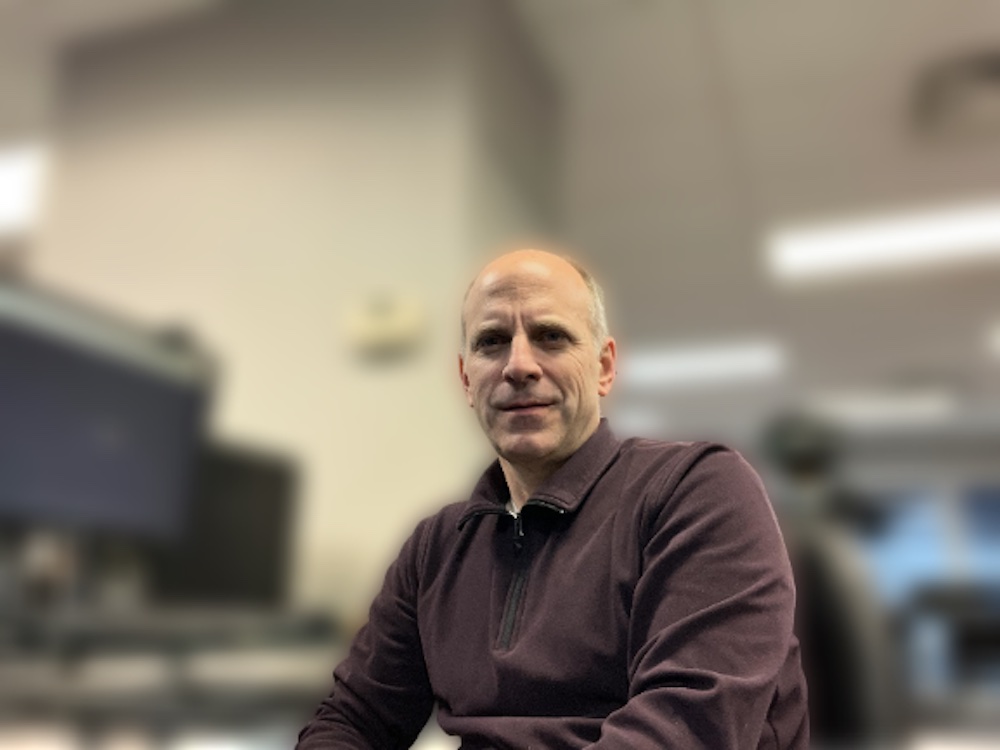
Oklahoma-based software engineer John Hassell has embraced artificial intelligence chatbots as part of his daily workflow.
In the past couple of months, I’ve heard more about artificial intelligence (AI) chatbots than any other topic, except, perhaps, the media hysteria caused by Chinese spy balloons.
According to IBM, a chatbot is a computer program that uses artificial intelligence and natural language processing (NLP) to understand questions and automate responses to them, simulating human conversation.
The essays turned out well written and with solid arguments.
Meanwhile, we’ve seen a lot of hand-wringing from ethicists over the potential of AI bots to write term papers for high school and college students or mimic the voice of well known people to have them say outrageous things.
So, the jury’s still out on what our future will look like with AI Chatbots churning out reports, papers and art. But there are people who already embrace the potential of chatbots as tools to enhance their workflow.
One of those is Oklahoman John Hassell, who works as an embedded software engineer for Tactical Electronics in Broken Arrow. I’ve known John since 2005, when he was a Ph.D. candidate at the University of Oklahoma and entered the Donald W. Reynold’s Governor’s Cup collegiate business plan competition with a concept known as ZigBeef.
As pitched by John and his team in the Governor’s Cup, Zigbeef applied RFID technology to ear tags for cattle as a way to easily identify them and ensure a safe beef supply for consumers.
ZigBeef won second place in the Graduate Division of the Governor’s Cup.
After completing his Ph.D. and pursuing ZigBeef for a number of years, John has gone on to work in embedded software development, as well as applying his skills to mobile app development.
So, I was pleased to hear from him recently when he described how ChatGPT has quickly become a major factor in his workflow.
John said he heard about AI and initially was skeptical of any potential benefits.
But an OpenAI art program known as Dall-E changed his perspective. He asked it to draw a photo from his memory of his family’s old two-story farm house near Okemah.
“On a lark, the first time I used it, I typed in a paragraph describing a mental picture of the sandy road, surrounded by a pecan tree orchard, leading up to the white farm two-story house,” he said. “OpenAI’s system produced something shockingly similar to what I was imagining. The picture it created in seconds was suitable for hanging in my office as a picture.”
Now you know why the art world has been in an uproar over AI potential.
Next, Hassell asked ChatGPT to produce some programming code that involved an obscure Linux script.
“In a second, ChatGPT comprehended exactly what I needed to do, and then provided the working code to do it,” he said. “I had been working on that issue for weeks.”
“Once again, ChatGPT provided an easily readable, accurate summary, correctly punctuated, with an interesting fact, for each legislator and their district,” John said. “It was not completely accurate and had to be checked. Nevertheless, it saved an incredible amount of tedium and time in writing this program.”
I wanted to know more about the perspective John has gained about AI and the Chabot, so I asked him a few more questions. Here they are in Q&A format:
Q: How has AI helped streamline or enhance what you do?
A: I’ve actually started to migrate away from my standard resource of programming help, sites like StackOverflow and Google search. Now, I am able to ask specific questions that tend to get me answers quicker.
Q: Isn’t using an AI Chatbot considered cheating?
A: It is somehow cheating the same way that leveraging a calculator was somehow cheating in the 1970s, or that using a tractor instead of a mule team was cheating at the start of the last century. New technology is neither ethical or unethical, it just is. We will find if we aren’t using this technology in future years we are just left behind.”
Q: How much do you worry about inaccurate feedback you receive from Chatbot?
A: In my few short weeks of usage, it has indeed been inaccurate many times. However, the inaccurate solutions provided, or the prose presented, still brought me much farther and quick ahead than without it.
Q: There seems to be some fear about how AI will impact our future in a negative way; what is your perspective on that potential?
A: I can tell you that after using ChatGPT the past few weeks, the user interfaces on my smart phone, on my truck radio, even on most websites, seem antiquated. Having to search for, and manipulate computer controls, in such a precise and particular manner feels so “old” already. Not to be too dramatic, but this will change will be huge… and it’s happening with record speed.
Q: What else would you like us to know about the topic of AI Chatbots or your work?
A: Interestingly, I’ve gotten better at using ChatGPT in my programming work by thinking less like a computer programmer in many ways. Now, instead of overly-specifying what I need, and the way I need it, I revert to more-human prose, asking what I ultimately need… not trying to tell ChatGPT on how to find the answer for me. I’m having to de-program my decades of learning and specifying the minutiae of how to get things done with a computer. Now, ChatGPT has learned to do a lot of that. I look forward to seeing these improvements in all the tedious things we all have to deal with in interacting with all the machines that are here to help us.
Takeaway: I only heard about ChatGPT a few months ago, and thought that its impact wouldn’t show up for years while it was being perfected.
But as John Hassell has demonstrated, Chatbot’s future is now. We should embrace it.
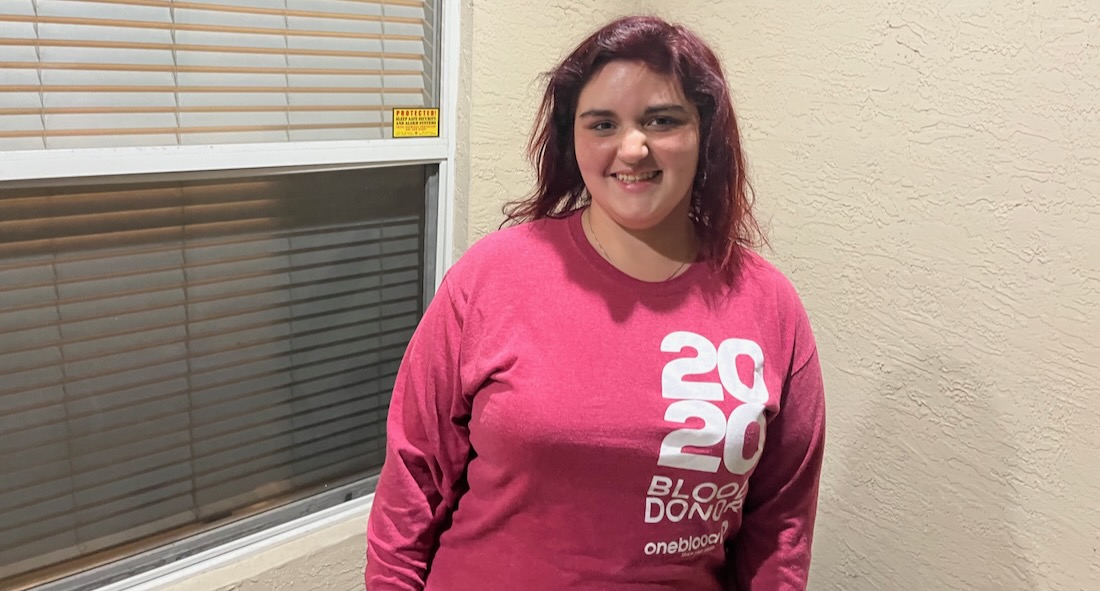
Sarah Stafford poses in her South Florida residence
EDITOR’S NOTE: For the past year and a half, my 24-year-old daughter, Sarah, has worked as a “tech” at drug-and-alcohol rehabilitation centers in South Florida. She is trained in CPR because of the potential for relapse and overdose of recovering addicts. Sarah is a recovering addict herself, and lives in a nearby home occupied by other recovering addicts with house rules that support their road to recovery. It’s not always easy, though. Temptation sometimes leads addicts to relapse with potential deadly consequences. This is Sarah’s story about a recent incident in her home.
By Sarah Stafford
Around 1:40 pm on Wednesday, January 11th, my housemate came home and went into her bedroom. About two minutes later she comes out and says, ‘Sarah can you come check on my roommate, I think she’s asleep but I also think I heard the death rattle, so can you wake her up and make sure she’s OK?’
I said ‘of course,’ and got up and went in there. The light was off cause we thought she was initially asleep. I shake her leg and say her name and she doesn’t respond. I shake her leg a little harder and say her name a lil louder, and she still wouldn’t respond. I get up and turn on the light and she’s pale but also blue around her eyes and lips. I notice a trickle of blood that’s come out of the corner of her mouth. I tell her roommate to call 911 and run into the living room and grab a thing of NARCAN. I wait a minute or two and am saying her name and lightly slapping her in the face to wake up. My housemate gets off the phone and is attempting to call our other housemate , whom the girl that OD’d is really good friends with. As I grab and administer another dose of NARCAN. the fire department calls us back asking if she has a pulse.
I check both her carotid and radial pulses, which were there but very faint. The fire department tells us we need to begin giving compressions. I look at my housemate, and she says she doesn’t know how, so I begin giving compressions consistently for about three minutes, and I’m getting exhausted.
The fire department tells me to do five. break two. which I begin doing, and as I start doing that my housemate I’m working on is starting to show signs of coming back. She’s gasping a bit and her eyes are starting to roll back. As the paramedics rush in 8-9 deep, I’m still working on her and she sits up gasping and choking but still isn’t really there. Three or four paramedics help her stand up and assist her outside to the gurney, where they give her a third dose of NARCAN in an IV. She goes to the ER and gets discharged that same evening. I was able to see her more alive and as OK as she can be after something like that as I help her pack her things and she returned to detox that night.
My comments: As scary of a situation it was, I’m grateful we had the best possible outcome for such a thing, and I’m grateful my housemate said something when she did or it could’ve been a completely different outcome. NARCAN saves lives, and I truly got to see that. While I hope to not have to do anything like that again I’m grateful I’ll know exactly what I need to do.
Editor’s note: Sarah, I’m so proud of you for jumping in and putting your life-saving skills to work and saving this young woman’s life. You are making a difference. Stay on this difficult road to recovery and continue to make a difference for the people you live with and serve.
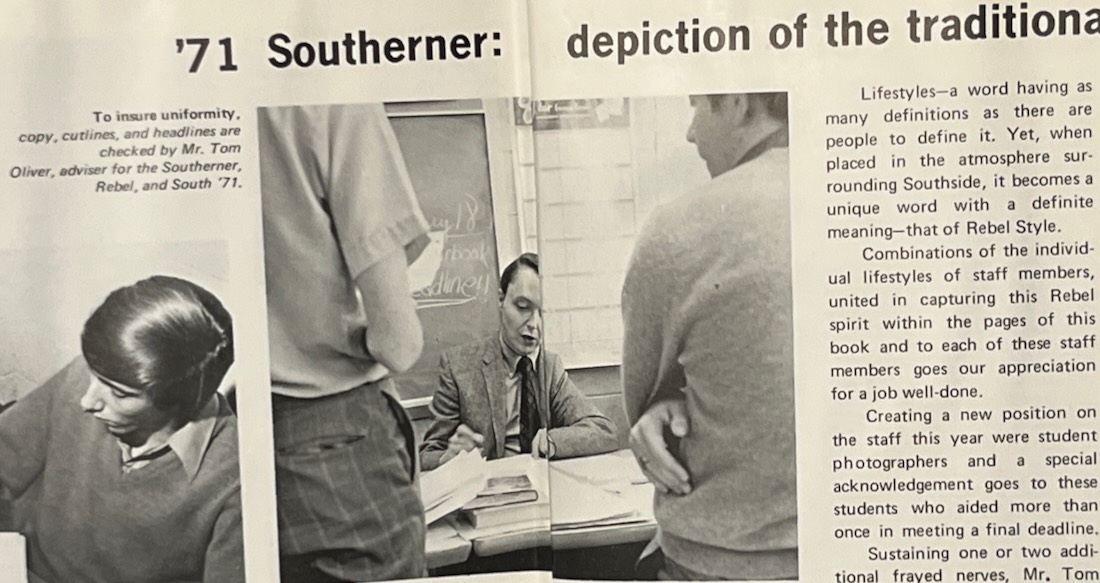
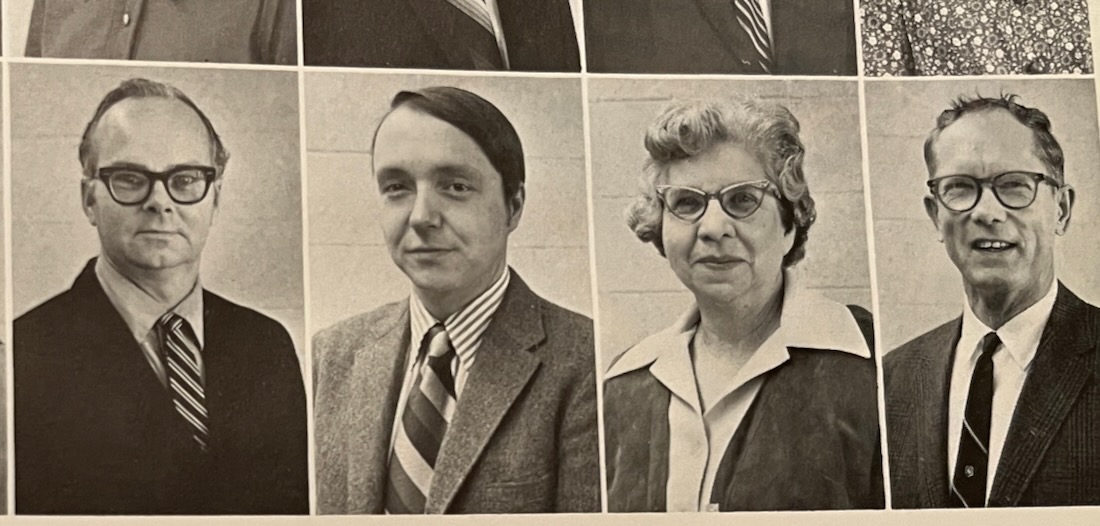
In a 1971 yearbook photo, Tom Oliver is shown editing students’ work as yearbook/newspaper advisor
As do a lot of communities around the country, someone from my hometown maintains a Facebook group called “If You Ever Lived in Fort Smith, Arkansas.”
I’m not on the Group’s page often, but it’s fun to occasionally scroll through and see what people are talking about.
Certain topics dominate the Fort Smith page: Dragging Grand Ave. in the ’70s … Enjoying a giant Worldburger of the past … and remembering stores like Hunt’s and The Boston Store that were once shopping mainstays.
About five years ago, a fellow Southside High School grad, Eddie Weller, posted about favorite Fort Smith teachers he recalled. Because I’m an Army brat, I only attended school in Fort Smith for three years.
But there was one teacher that certainly had an impact on my future. His name was Tom Oliver.
Mr. Oliver taught Journalism at Southside. I took Mr. Oliver’s class as a senior because I had a far-fetched dream of some day being a newspaper reporter.
So, I posted on the Facebook Group about Mr. Oliver being a memorable teacher, and it was like a call-and-response for a conversation that began five years ago and continues to stir memories today.
Here are some selected memories of Tom Oliver by his former students (Mr. Oliver died in the early 1990s, so it’s too bad he’s no longer around to read what his former students say.).
My original comment:
“My journalism teacher at Southside, Tom Oliver. Showed a lot of patience to a wanna be who had few skills in HS. I ended up making a career out of newspapers, so thanks to Mr. Oliver for encouraging me.”
Response from Eddie Weller:
“TO” as we called Mr. Oliver (but not to his face . . . ) … He did have patience. I remember senior year we rotated a column among the editorial board. I wrote a semi-funny one (tried to be humorous) for my first try. I used a phrase to get a chuckle that he asked me if I should use. He let me decide. He explained he was not sure my parents, for instance, would understand why I used the phrase. That was thoughtful on his part as a teacher. It made me really think — even a small phrase could make or break a mood you were trying to set. And “Ye Olde Pub” (the publications/journalism room for the uninitiated) was always a great place to be. He gave great freedom to the newspaper staff, yet knew when to reel it in. Truly an amazing teacher!”
From Sandra Curtis Kaundart:
“Tom Oliver, my mentor, was the greatest teacher ever! … I majored in journalism because of him, worked at a couple of small papers, later did my practice teaching with him, and ended up teaching journalism and English for 31 years.”
From Scott Carty:
“Tom Oliver was one of my heroes. i found one of his old yearbook pictures in the storage room and put mirror-headed thumbtacks thru his eyes and labeled it EltonTom. Made him smile.”
From Jim Morris:
“I had too much fun in his class. Just ask Scott Carty”
From David Yarbrough: “Tom Oliver didn’t do a lot of chalkboard teaching. He picked leaders (editors) and let those students fill their roles assigning stories and photos. He let them do the editing and design of the paper. Only occasionally did he make a quite suggestion. In the real world, you could compare him to a hand-off publisher who trusted his staff. He also encouraged students to explore all kinds of arts and studies. He took staffers to state and national conferences to open horizons.”
My own story isn’t anything spectacular. The student newspaper had a regular “Newsmakers” column of one-paragraph stories (emulating, I believe, a popular Page 1A “In the News” feature in the Arkansas Gazette), and I was assigned to write a Newsmaker item for each issue of the paper.
Did I tell you that I was terrible as a cub reporter? That one-paragraph Newsmaker assignment might as well have been a 10-page term paper.
But I managed to scrape something together for each edition, and Mr. Oliver gently edited my effort. Like all of my favorite teachers and professors over the years, he showed tremendous patience with me.
I remember Tom Oliver as being fairly young at the time and in tune with popular culture. His was a class that I looked forward to attending every single day. Similar to my favorite college professor, who also taught journalism.
I can’t tell you exactly what clicked for me, except perhaps the camaraderie of being around others that had an interest in journalism. Oh, and the thrill of seeing something you wrote in print.
In a touch of irony, years later, I served as Sports Editor of the Southwest Times Record in Fort Smith. Mr. Oliver worked part time for me on the Sport Desk on Friday nights during football season, helping us gather scores and write short summaries.
Mr. Oliver actually remembered me from my not-so-memorable one-year stint in his high school journalism class. He told me he was surprised that I pursued a newspaper career because he wasn’t sure that I had the interest as a student.
I guess my candle didn’t burn too brightly in high school. But I did have a dream.
Thank you, Tom Oliver, for being an encouraging teacher and not steering me away from the far-fetched dream of the 17-year-old me.
Tom Oliver’s (second from left) 1971 Southside High School yearbook photo
As a public service, I’m repeating a newspaper headline from this week that I’m sure a lot of people missed because it’s 2023 and there’s no longer a place for the daily paper in their lives.
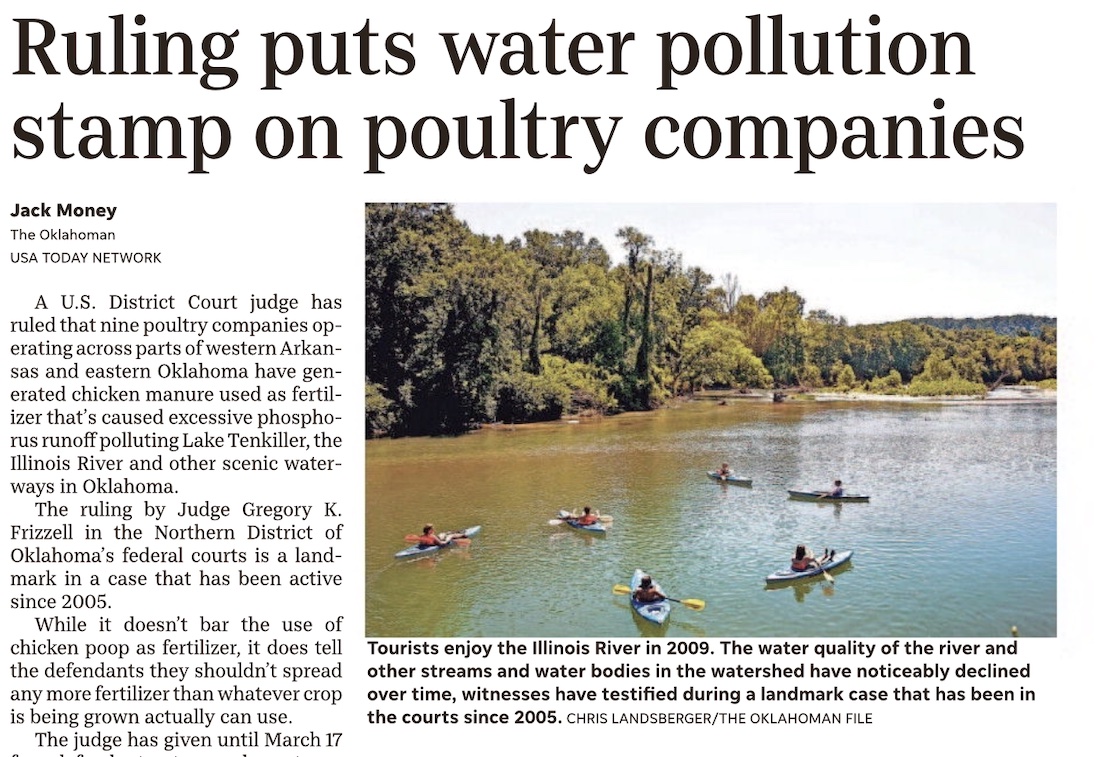
“Ruling puts water pollution stamp on poultry companies”
I had deja vu all over again when I stumbled across the story on page 4A of Friday’s edition of The Oklahoman.
The case began in 2005 when then Oklahoma Attorney General Drew Edmondson filed a lawsuit on behalf of the state against 13 integrated poultry companies.
Edmondson alleged the poultry companies — most based in Western Arkansas — had polluted the Illinois River basin from the spread of chicken manure across pasture and cropland .
So, why is this important enough that I write a blog post about it?
Well, in 2008 I was a Business News reporter for The Oklahoman, with agriculture as one of my beats. When a hearing began in February 2008 in Federal Court in Tulsa on Edmondson’s bid for an injunction against spreading poultry manure in the Illinois River watershed, my job required I cover it for the paper.
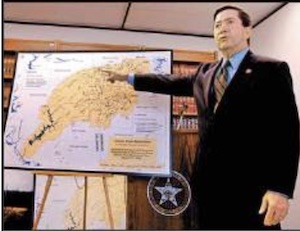
Drew Edmondson at poultry hearing.
The hearing was held in Tulsa federal courthouse before Judge Gregory K. Frizzell.
Turns out, the injunction hearing turned into a long-haul of court dates. It ran through four February hearings before a week’s pause, and then picked up in March for another week.
There was testimony from “expert” witnesses and acrimony between attorneys for both sides.
Judge Frizzell was clearly frustrated over the slow pace of the hearing.
“Frankly, this is the longest preliminary injunction hearing I’ve ever conducted,” Frizzell was quoted as saying in one of my stories.
What do I remember of the hearing 15 years later? Seared into my memory is how vigorously attorneys from both sides of the case — plaintiff and defendants — attacked the credibility of every expert who testified.
In fact, attorneys worked so hard to destroy the credibility of the witnesses that the actual testimony seemed like an afterthought.
My friend Russ Florence also sat through each day of the hearing because his Tulsa-based public relations firm, Schnake Turnbo Frank, was working on behalf of the defendants. Today, Russ is President and CEO of Schnake Turnbo and is currently writing a book on the history of the firm, which includes a section on the trial.
Russ writes: “Like the Road Runner and Wile E. Coyote, each side tried to out-maneuver each — politically, legally, and publicly. They circled one another, trying to deliver a punch that would resonate …”
I was grateful when the hearing finally ended and I didn’t have to make a daily commute to Tulsa and back. Several months later Judge Frizzell denied the injunction request.
The actual trial over the pollution issue began the next year. I was no longer working at the paper, so someone else had the pleasure to cover it.
And now, almost 15 years later, we have our verdict. The poultry companies — 13 of them originally — are responsible for the poultry manure pollution of the Illinois Watershed.
“So much has happened since then,” Russ told me. “Some of the poultry companies have been acquired by others. Several of the key players have retired. And to think, I was single then, and am now married and have a fifth grader.”
And what of the punishment imposed on the responsible poultry companies?
“The parties are hereby directed to meet and attempt to reach an agreement with regard to remedies to be imposed in this action. In the event the parties are unable to reach an accord, the court shall enter judgment,” Judge Frizzell wrote in his ruling.
That’s it? It’s a ruling easily could have been imposed back in, say, 2009.
Seems like a joke that took way too long to get to the punchline.
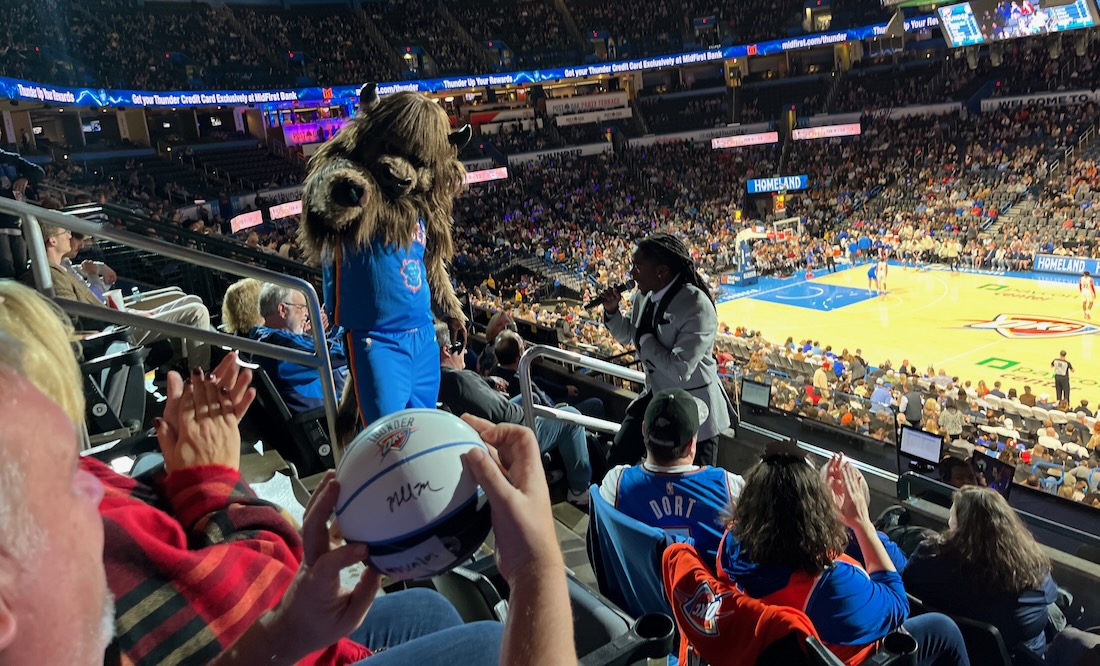
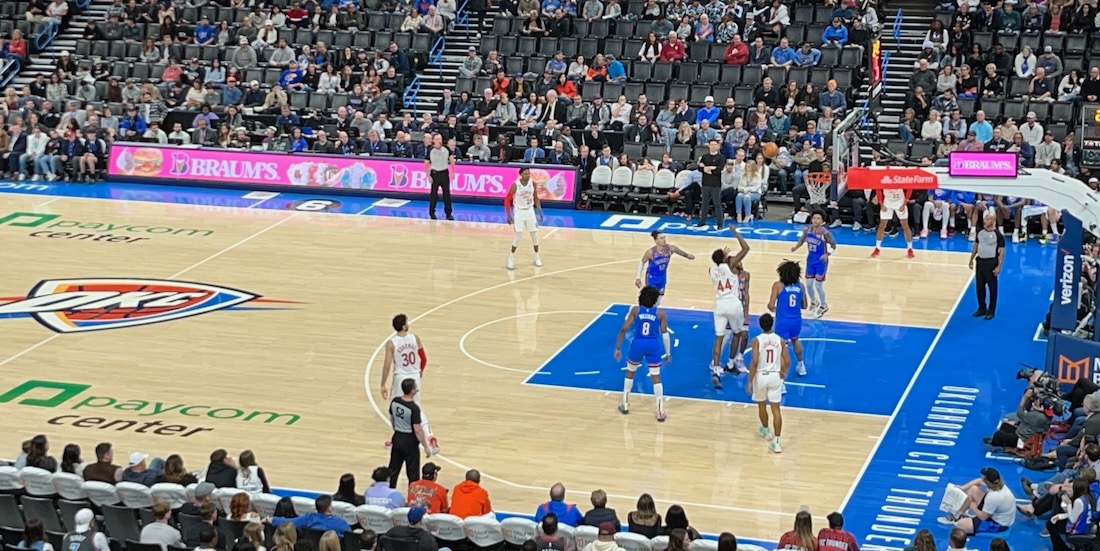
Thunder mascot Rumble makes an appearance in the stands at a recent OKC game.
I’ve heard a lot recently about this Artificial Intelligence app called ChatGPT, which allegedly will answer any question and write a report or an essay on any topic.
I figured that I owe BlogOKC readers an explanation of what ChatGPT is, so I went right to the source. Here’s what the Chatbot told me.
“ChatGPT is a large language model developed by OpenAI. It is trained on a dataset of internet text, which enables it to generate human-like responses to a wide range of text-based prompts. It can be used for tasks such as text completion, question answering, and conversation. It is based on the GPT (Generative Pre-training Transformer) architecture.”
A little long-winded, but there you have it.
So, I came up with a topic for my Chatbot to address to see how awesome it could be. Since much of my time seems to be focused on the Oklahoma City Thunder and my opposition to its tanking philosophy to rebuild for the future, I thought I would ask Chatbot for its take on the subject.
Here’s Chatbot’s take on why tanking is not the right philosophy for the Thunder:
“Tanking, or losing on purpose, is a controversial strategy that can have negative consequences for teams in the NBA. For the Oklahoma City Thunder, tanking may not be the best route to rebuild their team and become a contender in the league.
“One of the main reasons why tanking is a bad route for the Thunder is that it can have a negative impact on the team’s culture and morale. When a team is losing on purpose, it can be difficult for players and coaches to stay motivated and maintain a positive attitude. This can lead to a lack of effort and poor performance on the court, which can ultimately harm the team’s development. Additionally, it can also lead to a lack of fan support and engagement with the team, making it harder for the team to attract and retain fans.
“Another reason why tanking is a bad route for the Thunder is that it doesn’t guarantee success in the future. The NBA draft is not a sure thing and even the top draft picks do not always turn into star players. Therefore, tanking may not result in the Thunder getting the high-quality players they need to become a contender in the league. Additionally, even if they do get a high draft pick, it takes time for young players to develop and it’s not guaranteed that they will become the star player the team needs.
“Additionally, tanking can also lead to a lack of stability for the team. When a team is consistently losing, it can be difficult to keep coaches, players, and management in place. This can lead to frequent changes and a lack of continuity, which can make it difficult for the team to build a sustainable winning culture.
“Furthermore, tanking can also be detrimental to the league as a whole. When teams are not trying to win, it can lead to a lack of excitement and interest in the league, which can negatively impact the league’s reputation and overall revenue.
“In conclusion, while tanking may seem like a quick fix, it can have negative consequences for teams like the Oklahoma City Thunder. Tanking can lead to a negative team culture, lack of fan support, lack of stability, and lack of success, and it can also harm the league as a whole. Instead, the Thunder may be better served by taking a more gradual approach to rebuilding, focusing on player development and making strategic moves in the draft and free agency.”
Did you read that? “Detrimental to the league.” Chatbot went right to the heart of why tanking doesn’t fly for me, and I hope millions of other fans. If a lot of teams are playing to lose, the interest will wane everywhere.
I think Chatbot is dead on in its assessment of the impacts of tanking, including decrease in attendance and a loss of revenue.
All in all, I would grade this essay with an A+.
Chatbot, you’ve impressed me with this argument.
After I read this essay, I decided to have Chatbot argue the other side of the equation for balance. So I ask it to write 450 words on why tanking is good for the Thunder.
Here’s what it wrote in favor of tanking:
“Tanking, or losing on purpose, is a controversial strategy that teams in the NBA have used in order to rebuild their rosters and improve their chances of success in the long term. The Oklahoma City Thunder are currently in a position where tanking could be the best route to rebuild their team and become a contender in the league once again.
“One of the main reasons why tanking is the best route for the Thunder is that it would give them a better chance of getting a high draft pick. The NBA draft is the primary way for teams to acquire young, talented players who can help them improve in the future. The higher a team’s draft pick, the more likely they are to select a player who can make a significant impact on their team. By losing on purpose, the Thunder would increase their chances of getting a high draft pick and selecting a player who could be a cornerstone of their team for years to come.
“Another reason why tanking is the best route for the Thunder is that it would give them more financial flexibility. The NBA has a salary cap that limits how much teams can spend on player salaries. When a team is not competitive, they may not be able to attract top-tier free agents who can help them improve. By rebuilding through the draft and developing young players, the Thunder would have more financial flexibility to make moves in the future.
“In addition, tanking would give the Thunder a better chance of building a team that can contend for a championship in the future. Building a championship team is a difficult and time-consuming process that requires a combination of talented players, good coaching, and a solid organizational structure. By losing on purpose and getting high draft picks, the Thunder would be more likely to acquire the young, talented players they need to build a championship team.
“Furthermore, tanking would also give the Thunder a chance to give more playing time to their young players and prospects. This would be beneficial for their development and would also help the team to evaluate their potential.
“In conclusion, there are several reasons why tanking is the best route for the Oklahoma City Thunder to rebuild their team. The Thunder are currently not in a position to compete for a championship, and tanking would give them a better chance of getting a high draft pick, more financial flexibility, and a better chance of building a team that can contend for a championship in the future. Additionally, it would also give more playing time to the young players and prospects and help in their development. While tanking is a controversial strategy, it can be a necessary step for teams like the Thunder to rebuild and become a successful team again in the future.”
ChatBot presented some compelling arguments in favor of tanking for a rebuild. It hit on an argument that my friend, Steve Buck, often makes in favor of tanking: player development.
Chatbot wrote: “Furthermore, tanking would also give the Thunder a chance to give more playing time to their young players and prospects.”
Again, Chatbot wrote a compelling essay without an factual errors that I can detect. I give it an A+ on this assignment, as well.
However, I’ve still not moved an inch from anti-tanking stance.
Chatbot, when I finally found you at the OpenAI web page, you surprised me with some fine writing and compelling arguments.
Well done.
Editor’s note: My first attempt to have ChatGPT to write essays for and against tanking by the Oklahoma City Thunder was done via an app I downloaded to my iPhone from the Apple App Store. I’ve since discovered that app is ChatGPT filtered through a company hoping to make money by charging a weekly fee for the free, open-source app. So, I signed up on the OpenAI page and had the Chatbot write me new, much improved essays.
Our daughter, Sarah, is reunited with her son, Solomon, at DFW airport
I was sitting in an OKC coffee shop this past Wednesday, getting some work done and anticipating picking my daughter up at Will Rogers World Airport later that night.
Sarah was flying in from South Florida to celebrate a late Christmas with us and her 3 -year-old son, Solomon.
We had our evening planned for a big OKC airport reunion between mother-and-child before a short drive home.
Then my phone dinged with an alert.
I looked down and saw that it was from American Airlines. It said ‘your flight is delayed.’
Oh great.
Sarah was scheduled for a 7:37 EST flight from West Palm Beach Airport to DFW. It was now scheduled for an 8:20 departure.
So that made for an incredibly short connection window at DFW.
American flight 2640 originally was scheduled to land about 9:30ish at DFW with only an hour to navigate the airport before catching a 10:40 flight to OKC. To add yet another layer of panic, a change of terminals was required to find the departure gate.
That appeared to be the Impossible Challenge now. So I called my wife, Paula, to see what she thought.
Sarah also received the text and had already called her mom.
We weighed our options and decided we needed to head to Dallas just in case. Sarah had WiFi on her plane, so she could update us on the odds of making her OKC connection.
I headed home so we could hit the highway.
Then we got another text. The flight was back to 7:37 departure.
Great, we could stand down. Back to the original plan of meeting Sarah at roughly 11:40 in OKC.
Meanwhile, Sarah was headed to the airport in Florida, but got yet another text alert that said departure time was now 8:03 pm. This one added a tag line: “Possible missed connection to OKC.”
We headed south.
Sarah arrived at the airport, but didn’t go directly to the security line because of the apparent delay.
Then the airline dropped the ultimate hammer. Yet another alert. The flight was back to a 7:37 departure.
Sarah and several of her fellow passengers had to hustle through security.
We drove on.
Sarah made the flight and it departed the gate, but sat another 30 minutes or so on the tarmac.
Meanwhile, the pilot made an announcement that the flight would take additional time because they would be forced to fly around thunderstorms looming to the west.
The flight took off, and we drove on to DFW, expecting to get there a full hour before it landed. We arrived about 10 pm and looked on the flight board. Flight 2640 from West Palm Beach was arriving at 10:25.
Whoa! As the flight pulled up to its gate in Terminal C, we got a text alert telling her she had 15 minutes to make the OKC flight at its gate in Terminal A.
Paula and I had gone back and forth as to whether we really needed to make this rushed trip to DFW. But the text confirmed the wisdom of our decision.
It was another 5 minutes or so before Sarah emerged from the plane and walked to the baggage area where we waited.
The lesson we learned: don’t rely on the airlines’ squishy updates. Get to your gate on time and be prepared.
We were tired and frazzled. But the mother-and-child reunion at DFW Airport made it all worthwhile.
We all piled into the car and headed north, back to OKC.