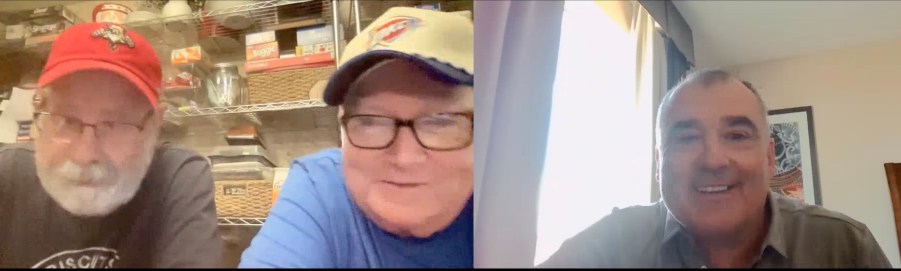
A screenshot from the 3 Old Geezers recent podcast recording session
Along with my friends Steve Buck and Ed Godfrey, I will celebrate a special anniversary on Nov. 6. Two years ago we launched the 3 Old Geezers podcast, which took years of sport debate via group text messages to a worldwide audio forum.
Steve serves as our host and keeps things on track, while Ed fills the podcast with humor and angry get-off-my-lawn rants about, well, anything and everything. I mainly serve as their foil because my perspective doesn’t fit in their neat little boxes.
I wrote about the 3 Old Geezers podcast back when we started at the end of 2023, and you can read it here.
We have no set agenda each week, except to cover the latest Thunder news, as well as that of other pro and college sports. We also may go off on an occasional non-sports rant.
Here are links to our two most recent episodes so you can discover for yourself what we’re all about. These links are to Apple podcasts, but we’re on Spotify or most places where you listen to your favorite content.
Here’s what my fellow Geezers say about the podcasting experience:
From Geezer Steve: “Having the opportunity to hang out with Jim and Ed regularly is something I cherish. Always spirited. Always funny. Just three guys who love sports bobbing and weaving through a conversation. When the idea surfaced one day that we should record our ramblings, the idea seemed like a natural. So, regardless our listener count, we keep going because its a chance to spend time with good friends. And time with friends is something I am learning to cherish more each and every day.”
From Geezer Ed: “Frankly, I am doing a podcast because I enjoy the company. And after 40 years in the newspaper business, I like telling stories, and now I can tell some whoppers. Besides, I can’t let Geezer Jim’s goofy opinions go unchecked. I enjoy the company and the conversation.”
My reasons for doing the pod are similar to Steve and Ed in that I enjoy hanging with the guys, as well as airing my thoughts on sports subjects, whether they are in line with conventional thinking or not.
For the most part, we’ve kept an every-other-week podcast schedule, except for an extended break we took over the summer, before relaunching the pod on Oct. 17.
We’re committed to posting a new episode weekly throughout the OKC Thunder season, which means we’ll have to do some remote when one or more Geezers are tied up with work or out of town. Episode 45 was recorded with Steve calling in from out of town, so we’re off to a good start.
I hope you listen to and enjoy the sample episodes using the links above. Then subscribe and keep up with our Geezer rants, raves and get-off-our-lawn takes.
The 3 Old Geezers podcast is presented through the generosity of MentaliTEA and Coffee in Bethany. I hope you will visit them and enjoy a coffee or tea and something tasty off their food menu.
What comes to mind when you see the words ‘speed trap?’ Barney Fife, perhaps?
Yeah, you know what they are. A cop car parked behind a sign or tree just off the highway, typically at the edge of a small town in an area where speed limit suddenly drops from say, 65 mph to 45.
Gotcha!
Way back in the olden days when I was in college driving from Abilene, Texas, back home to Fort Smith, Ark., I learned to be extra cautious when I drove through Stringtown, OK.
Stringtown was notorious for handing out speeding tickets to drivers passing through town on U.S. 69 and unaware that speed limit changed abruptly. It already had a reputation as a speed trap, and my dad warned me about it before I made my first trip.
By 2014, most everyone who didn’t hail from Stringtown had had enough. It was revealed that 76 percent of the town’s revenue — $483,000 in 2013 — was generated by traffic tickets, far more than the 50 percent cap set by the state legislature.
So, the Oklahoma Department of Public Safety announced that Stringtown police officers no longer could enforce traffic laws on state and federal highways.
Turns out that Stringtown was a repeat offender. It also drew state sanctions in the 1980s, three decades before the latest action. Read about it in this 2014 article from The Oklahoman.
But speed traps live on today in other communities across the state.
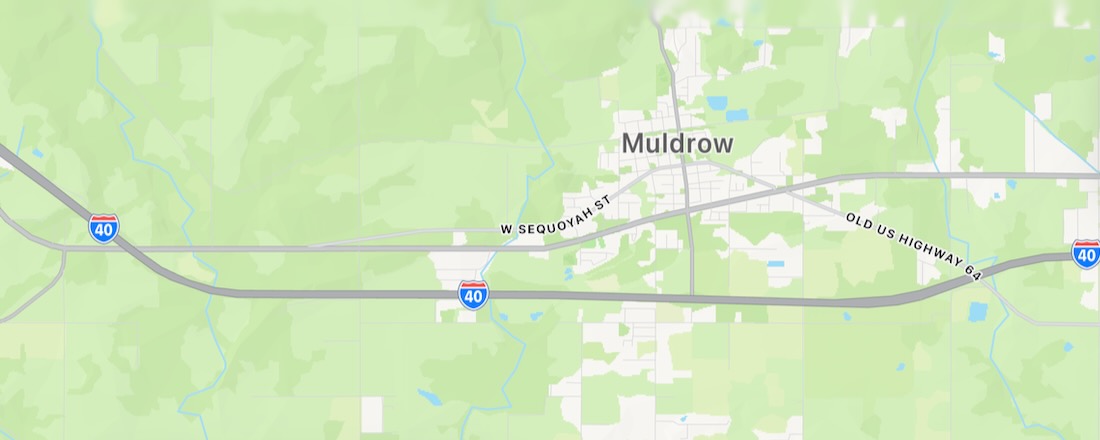
I drove through one in Muldrow, OK, just this past weekend. I saw a Muldrow police SUV hidden behind some barrels in the median of I-40 shortly before 7 am on Sunday.
Yes, Muldrow city officers were patrolling the Interstate! Maybe a quarter mile of I-40 goes through Muldrow city limits, which apparently gives their officers the right to patrol that stretch and hand out traffic tickets to protect their citizens.
I wasn’t even aware that stretch of I-40 was within the city limits of the city of Muldrow because it looks like a fairly rural area. Fortunately, I did not get pulled over — this time.
But the fact that he was out there monitoring traffic before sunup along the short stretch of Interstate that passed through the city limits really irked me.
So, I called the Muldrow Police Department on Monday to ask if they patrol the Interstate and why.
“Yes, because it is part of our city limits,” I was told.
OK, my next question was “does the city have an agreement with the state that allows it to patrol the Interstate in place of Highway Patrol?”
“I have no idea,” she said. “You will have to ask someone else that question.”
I’ve read that the state has to authorize communities to patrol state and federal highways that pass through their city limits, although I wasn’t sure that’s accurate. So I looked it up.
“The Commissioner may designate any portion of the National System of Interstate and Defense Highways, and those portions of the federal-aid primary highways and the state highway system which are located within the boundaries of and on the outskirts of a municipality for special traffic-related enforcement by the Oklahoma Highway Patrol Division and issue a written notice to any other law enforcement agency affected thereby. Upon receipt of such notice, the affected law enforcement agency shall not regulate traffic nor enforce traffic-related statutes or ordinances upon such designated portion of the National System of Interstate and Defense Highways or such designated portions of the federal-aid primary highways and the state highway system without prior coordination and written approval of the Commissioner.”
I’ll translate: The state highway commissioner can forbid municipalities from enforcing traffic laws on state and federal highways.
Muldrow’s next door neighbors in Roland also patrol their stretch of I-40, according to my friend and lifelong Roland resident Frank Day. In fact, I found this story about Roland’s well deserved speed trap reputation from a 1999 edition of The Oklahoman.
Reddit users provided many more known speed traps. “Asher, Big Cabin, Savanah, Calera… really any small town with a highway through it,” offered a user who goes by FakeMikeMorgan.
Anyway, small town speed traps always remind me of Deputy Barney Fife and his “Checkpoint Chickie” speed trap in Mayberry on The Andy Griffith Show back in the day. Watch a clip below.
I’m asking readers to submit their least favorite speed traps from around Oklahoma — and beyond. I’ll add them to this post and we can compile a list to help our fellow travelers in the future.
Consider it a service, like flashing your lights at ongoing vehicles after you pass a cop-in-waiting.
You’re welcome.
Here a speed trap contribution from Inona Harness via her son, Casey. Waukomis, OK, which is due south of Enid. Thank you, Inona!
A robotic arm working on the floor of a Shawnee manufacturer in roughly 2017.
One day in the summer of 2017, I toured the GF Central Plastics plant in Shawnee on an assignment with the Oklahoma Center for the Advancement of Science and Technology (OCAST).
The visit was an eye-opener for me.
Central Plastics makes plastic and metal fittings, as well as specialty parts primarily for the natural gas industry. At that time it operated out of a 500,000 square foot facility and employed roughly 500 people.
What caught my attention was the incredible use of robotics in the company’s manufacturing process. There were about 30 of these large yellow robotic arms that picked up a piece of metal or plastic and placed it exactly where it needed to go in the machine that would mold it into whatever it was intended to be.
Here’s what I wrote at the time:
“The robotic arms employed in the process never stop, repeating their assignment 24 hours a day, seven days a week. Their human co-workers are busy ensuring the machines have needed parts to work with, as well as inspecting and packaging finished pieces. ‘The primary goal of the robotics and automation is not to eliminate people, but allow us to continue to grow and continue to improve the quality of our products,’ Bryan Lucas, GF Central Plastics vice president for Operations, told me.
Mark Smith, GF Central Plastics Managing Director and President, put it another way:
“One of the abilities the robot has, is I’ve got 24/7 operation from them.” he told me. “They don’t take vacations, and they don’t need to sleep like I do.”
While I’m not certain that Lucas or Smith are still in their positions with the company, I’m pretty sure that at this very moment there are scores of robotic arms picking up parts and slamming them into the production machine exactly where they need to be placed. And then removing them when they are finished and stacking them in the right bin.
So, what does that have to do with anything today, eight years later?
I’ve been thinking about how robotics and artificial intelligence might be used in the production of ubiquitous smartphones — iPhones and Android phones. Phones are full of tiny parts that have to be fit into a small space in exactly the same way millions of times over and over.
Are robotics used to produce the phones? According to what I was told by my know-it-all friend, ChatGPT, much of phone assembly in 2025 is done by robotics.
Here’s what my AI pal told me:
“Yes — robotics manufacturing is already widely applied to devices as small and precise as smartphones. In fact, smartphone production is one of the most advanced examples of robotics and automation in action.”
Unless Chatbot was hallucinating, there’s a ton of robotics that go into each phone. It cited Foxconn, maker of the iPhone, as a major user of robotics in the manufacturing process.
“In some facilities, entire production lines are almost fully automated,” it said.
So, that makes me wonder if the thousands and thousands of low-paid workers are still needed to produce smart phones. Are those folks still needed to assemble the cases with tiny screws, perhaps? Can’t that process be automated?
This is all leading me to the purpose of this blog post. If there is almost 100 percent automation in the assembly of iPhones, why can’t Apple Inc. at least build a pilot project in the U.S. to see how production would go here.
I understand there is required testing of each unit and then the packaging and shipping, so there are humans involved in the process.
If the robotic arms were assembling millions of phones in the U.S., would the scale of that production keep the costs somewhere close to what it is in China or India? And they would save on shipping costs, too, so price of phones might stay close to what they are today.
We all know that Trump is pressuring Apple and other high-tech manufacturers to bring their manufacturing into the U.S. If nothing else, a pilot plant located in the states would appease the President, who could slap (more) tariffs on China- or India-made phones at any moment.
I just read an awesome book, “Apple in China,” about how the company is trapped by the large scale of manufacturing investment it has made in China. It has recently moved some of that production to India and elsewhere.
I’m not a visionary, but I’m thinking that we could someday soon unbox our new iPhone and see the words “Designed in California, Assembled in the USA.”
Are you listening, Tim Cook?
I’m great at spending someone else’s money. But it could happen.
BONUS CONTENT: Watch some robotic arms in action in the video below.
DOUBLE BONUS CONTENT: Here is some info that ChatGPT provided me about robotic arms in smartphone manufacturing.
Robotics manufacturing is already widely applied to devices as small and precise as smartphones. In fact, smartphone production is one of the most advanced examples of robotics and automation in action.
Here’s how robotics is applied in smartphone manufacturing:
Microscale Precision Assembly: Specialized robotic arms with extremely fine motion control place tiny components such as microchips, sensors, and capacitors onto circuit boards. These parts are far too small for human hands to place consistently. Surface-Mount Technology (SMT): Automated machines solder thousands of micro-components onto printed circuit boards at high speed and with extreme precision. Optics & Camera Module Assembly: Robotic systems align and insert delicate camera lenses and sensors with tolerances measured in microns. Battery & Screen Placement: Large but fragile components like batteries and OLED screens are installed by robotic arms that apply uniform pressure without damaging them. Quality Control & Testing: Robotics and machine vision systems test buttons, touchscreens, speakers, and other parts to ensure durability and functionality.
– Micro-assembly with Collaborative Robots (Cobots): Some processes still require human oversight (like cable placement or adhesive application), but cobots assist workers by handling the repetitive and delicate positioning work.
So while people often imagine robots assembling cars or appliances, the highest level of robotic precision is actually in electronics manufacturing — smartphones, tablets, and semiconductors.
Companies Using Robotics in Smartphone Assembly
Foxconn (Hon Hai Precision Industry)
World’s largest electronics manufacturer (makes iPhones for Apple).
Uses thousands of robots, called Foxbots, for tasks like soldering, polishing, dispensing adhesives, and precision assembly.
In some facilities, entire production lines are almost fully automated.
Pegatron
Another major iPhone assembler.
Uses robotic arms for component placement and automated optical inspection (AOI) to check for microscopic defects.
Samsung Electronics
Runs highly automated factories in South Korea and Vietnam.
Uses robotics for screen production (OLED and AMOLED panels) because they require sub-millimeter precision.
Xiaomi, Oppo, and Huawei suppliers
Many Chinese factories use robotic arms for final assembly and packaging.
Robotic vision systems test touchscreens and fingerprint sensors before shipping.
🤖
Types of Robotics Technology Used
SMT (Surface Mount Technology) Pick-and-Place Robots
Place up to 100,000 components per hour on a circuit board.
Robotic Dispensing Systems — Apply adhesives in perfect micro-lines to secure parts like glass panels.
Automated Optical Inspection (AOI) — Uses robotic vision and AI to detect microscopic defects.
Laser Robots — Used for cutting phone frames, engraving, and even removing defective solder joints.
📱 Why Robotics Is Essential for Smartphones
Smartphones have billions of transistors and hundreds of components packed into a device only millimeters thick.
Human assembly alone can’t achieve the precision or consistency needed.
Robotics improves yield, speed, and quality control while reducing labor costs.
👉 So yes, robotics not only can be applied to smartphones — it’s already at the core of how every major smartphone is made today.
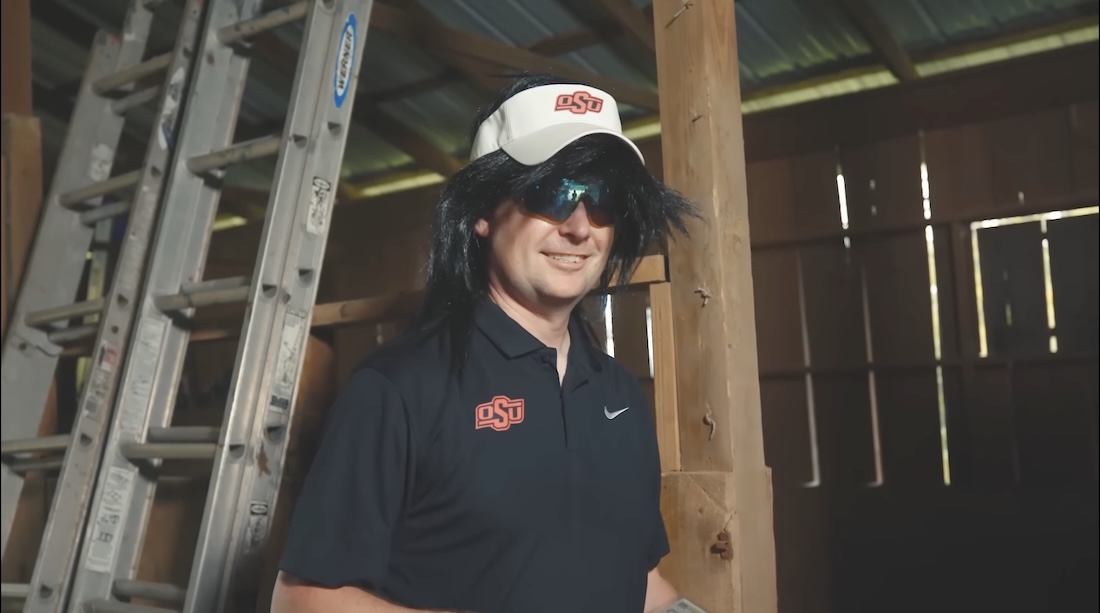
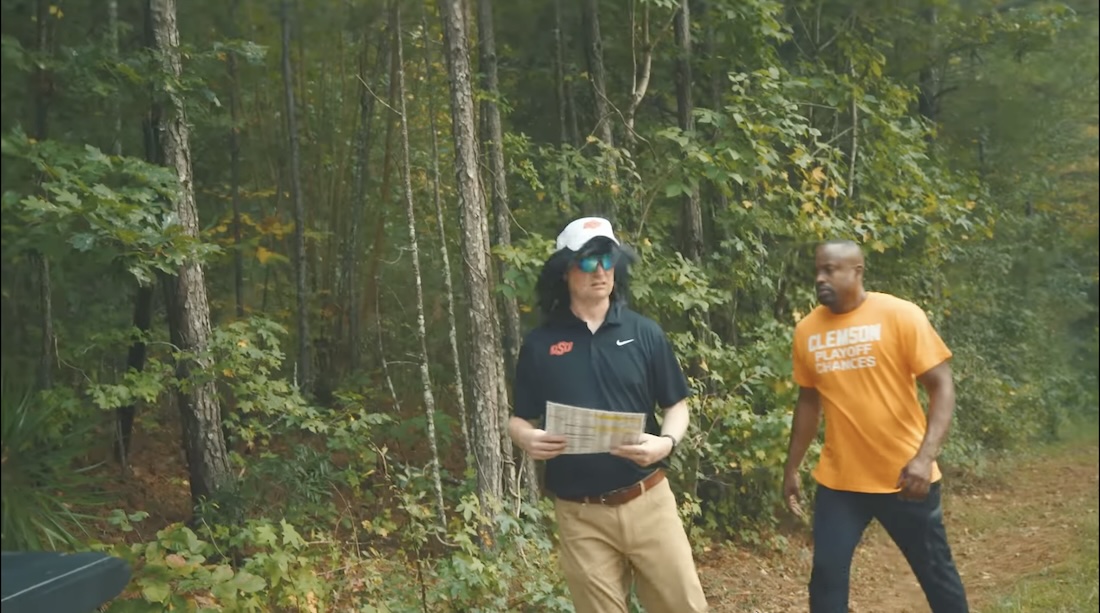
A Mike Gundy-like OSU character was welcomed to SEC Shorts this week.
There was a time in my life when watching Saturday Night Live was one of my most important weekly routines. Sadly, age and the long ago retirement of the Not Ready for Prime Time Players greatly diminished my SNL viewing.
Now I click on weekly SNL highlights posted on Twitter/X to watch individual skits. Saves me time and allows me to go to bed hours earlier on Saturday nights.
However, I’ve adopted a new viewing routine in 2025. It’s a weekly show posted online every Monday during football season called “SEC Shorts.”
You should be watching, too, if you are a college football fan.
SEC Shorts is a weekly, fast-paced 5 to 8-minute show that satirizes the immediate past weekend results from Southeast Conference football games. The writers/producers/actors are comic geniuses, in my view, because each episode is not only hilarious, but right on target with its send-ups.
I discovered SEC Shorts during the 2024 season, so I’ve only watched a dozen or so episodes from last year and into the start of this season. And in my limited view, this week’s episode towers over all the others.
Why? I’ll just say that this week’s short centers on a farmer and his “Going for Two Second Chance Farm.” No spoilers, except to say that OSU and Clemson are both welcomed into the SEC Shorts family.
You can watch the episode below.
My friend Ed Godfrey also watched the latest episode and declared it “Oscar worthy.” Another friend, Steve Buck, declared them “masters” after last week’s episode. Their videos attract millions of viewers, according to the SEC Shorts website.
Here’s something astounding about SEC Shorts.
College football games are played on Saturdays, and a fresh SEC Shorts episode is posted the following Monday morning. That means the SEC Shorts producers have to create the concept, write the script, access props and film the entire thing in one day.
Since I knew so little about SEC Shorts background or how it got started, I found its website to catch up on who these guys are.
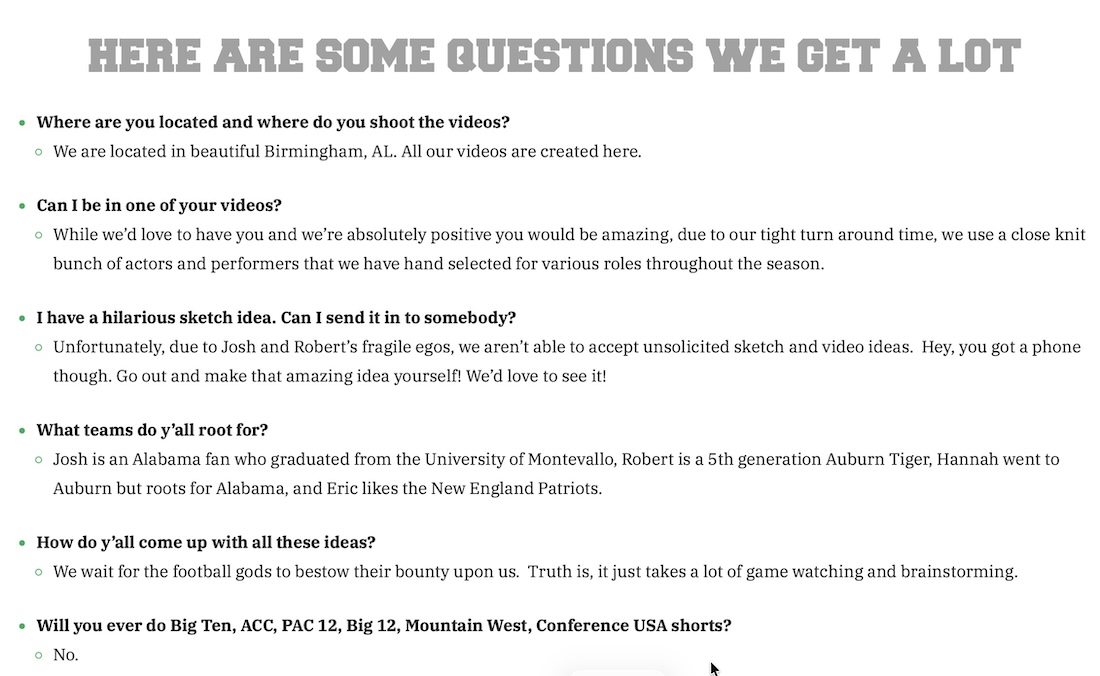
Turns out, the show was created by a couple of Alabama guys — Robert Clay and Josh Snead — back in 2014. They filmed their first episode and submitted it to the Paul Finebaum simulcast radio/TV show in September of that year, and the rest is history, as their website says.
Today, there’s a cast of 5, including Robert and Josh, who write, act and film each episode, with additional support from a few others as needed. The website also offers a ‘behind the scenes’ photo gallery of some of their productions in progress.
Here’s the lead paragraph from the “Our Story” section of their website:
“Who doesn’t want to see themselves on TV? It was this noble motivation that launched SEC Shorts in the fall of 2014. Robert Clay and Josh Snead were wasting away in the basement of a medical publishing company, where they spent all day editing gross medical lectures that would make even the most seasoned surgeons gag. As they sat across from each other in the Inverness Dairy Queen, eating their fourth chocolate dip cone of the week, they realized there had to be a better way.”
It’s obvious they don’t take themselves too seriously, unlike, say, fans who hail from Alabama, Georgia or several other SEC destinations.
If you are tired of hearing “SEC! SEC!” chanted during broadcasts of SEC teams, remember there’s a small crew of comic geniuses just waiting to poke a little fun at their Saturday heroes when the games are over.
Watching a fresh SEC Shorts episode each week certainly brightens my Mondays. It should be on your schedule, too.
BONUS CONTENT: Read the Frequently Asked Questions section from the SEC Shorts website below.
Steve Jobs makes a ‘one more thing’ announcement at a live Apple product event.
This past Tuesday, Apple Inc. introduced its latest line of iPhones in a special pre-recorded event that showcased iPhone 17 and an extra thin iPhone Air.
Along with showcasing the latest Apple Watches and Airpods, the event lasted just over an hour. It included introductions from Apple CEO Tim Cook plus key Apple staff, as well as customer testimonials, music and ads to showcase it all. You can watch it here.
Unfortunately for me, I knew in advance almost every product that was introduced, down to the new iPhone Air.
Gurman is a tech writer for Bloomberg News who covers everything Apple like Helen Thomas covered the White House once upon a time. The author of the Power On newsletter, Gurman had already detailed almost everything Apple debuted, down to the specs of the iPhone Air and cameras in the iPhone 17 Pro Max.
I didn’t want to know any of that before I watched the Apple event. I long for the days of the “One More Thing” that the late Steve Jobs would surprise the audience at Apple product events. I was just as surprised and awed as everyone else when he pulled the first iPod out of the pocket of his Levi’s in 2001.
Watch Jobs make some “one more thing” introductions in the video below.
I’m not sure how Gurman gets his info, but I assume it must come with Apple’s cooperation or willfully ignoring his insider scoops. Reporters and podcasters that I follow seem happy with the situation because Gurman’s reporting gives them something to discuss on an ongoing basis from week-to-week.
I realize that all of this doesn’t matter to about 99.9% of the public, but as a long-time Apple Fanboy, it’s a big deal. There was time that Jobs was so obsessed over keeping future products secret that he took steps like issuing memos with slight alterations sent to different employees to catch leakers.
Just as it should be.
Oh, and one more thing. I long for the pre-COVID years when Apple’s product events were all performed live in front of an audience and streamed to the rest of us. It was way more fun when new Macs or iPads or software were introduced by Jobs or Phil Schiller or Craig Federighi, and demoed right on the stage.
That was live theater, and I loved it.
But here we are in 2025, and we all can predict virtually every new product in advance as a pre-recorded Tim Cook introduces it as Apple’s “best ever.”
No suspense. No surprise. No one more thing.
Get off my lawn.
UPDATE:
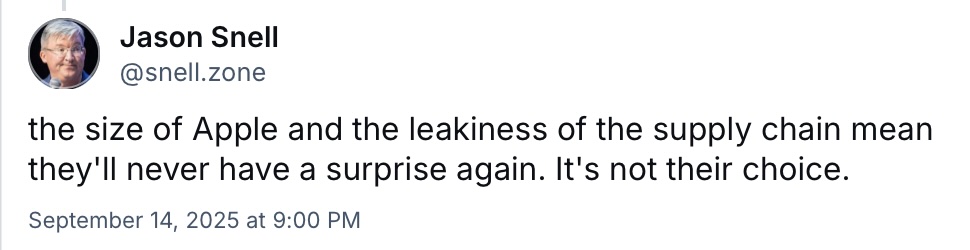
Here is what Jason Snell, former editor of Macworld magazine who has covered Apple for decades, had to say about new product developments that are leaked to the public.
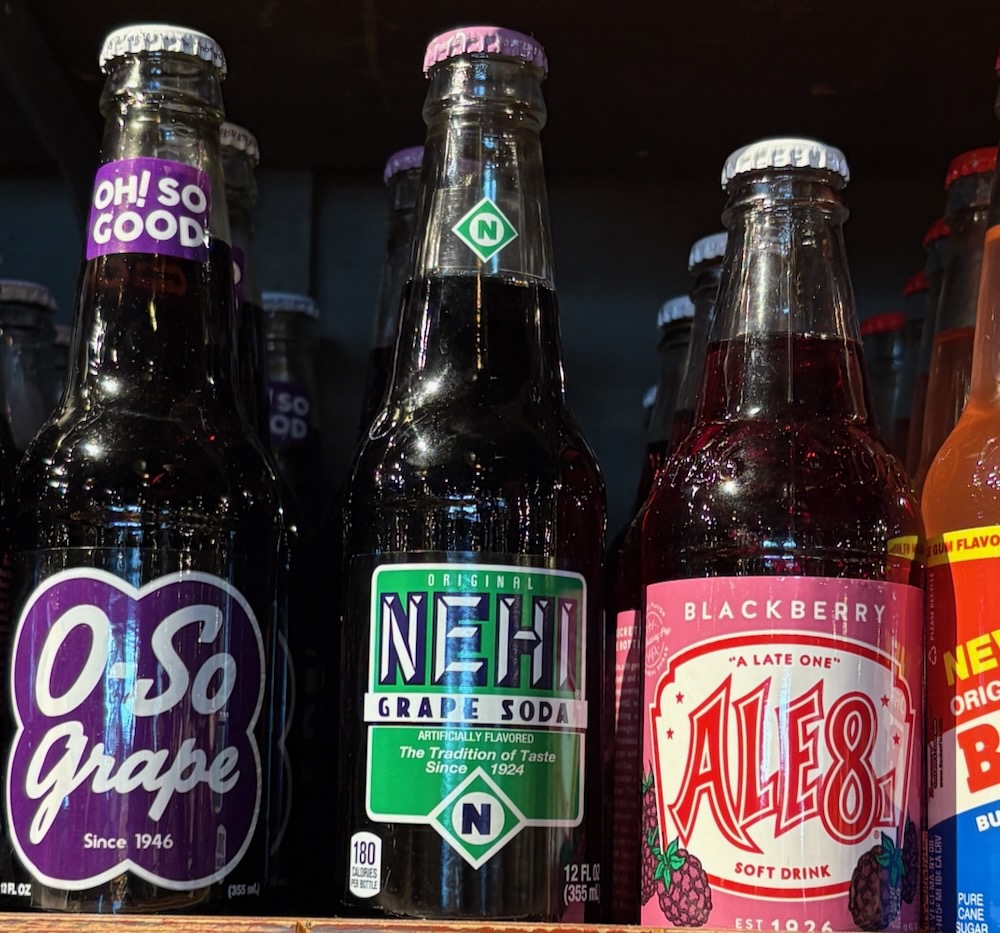
I discovered this bottle of grape Nehi during a recent visit to an OKC Cracker Barrel store.
If you are a fan of the long-running television comedy — dramady? — series, M*A*S*H, which aired from 1972-’83, then you are well aware that Radar O’Reilly’s favorite drink was Nehi grape soda.
Radar’s love of grape Nehi was a running theme across many seasons of the show. According to this History Oasis article, Nehi was mentioned in 47 episodes, with Radar once trading a month’s worth of coffee ration for a single case of his favorite soft drink.
I always perked up when grape Nehi was mentioned in a M*A*S*H episode, because it was the absolute favorite soft drink of my late grandmother, Vida Stafford. In fact, I’m pretty sure it was the only soft drink she would consume. There were always grape Nehi’s in her refrigerator.
As a kid, I helped myself to a grape Nehi whenever I visited my grandparents home in Booneville, Ark. I became a big fan of it myself.
Then over the years, I lost track of grape Nehi and assumed it was no longer being produced because I never saw the brand in stores. I haven’t even seen it at Pop’s in Arcadia, which is the mother-of-all-soda retailers, although maybe I just overlooked it.
So that brings me to August 2025. I discovered Cracker Barrel sells grape Nehi among the many nostalgic candy and soda brands it offers.
My wife and I were recently on a scouting mission to Cracker Barrel to gauge the pulse of its angry MAGA patrons during the brief period in which it changed its logo. (OK, we actually were there to enjoy some comfort food).
When we arrived at the store along I-35 in far north OKC, it was filled with customers, and we had about a 35-minute wait for a table. I didn’t hear any chatter about the logo or ‘going woke,’ but as I sauntered through the store during our wait, I stumbled upon a soda display that had a grape Nehi right in the middle.
It made my night. Grape Nehi lives!
A wave of nostalgia actually washed over me at the sight of the grape Nehi because of the memories made 60 years ago or more. I found myself right back in my grandmother’s kitchen rummaging through her refrigerator in search of a grape Nehi.
Did I load up on grape Nehi that night? I did not, but I do plan to try a bottle soon to see if it lives up to what I remember.
There are decades of wonderful memories wrapped up in that single bottle of grape Nehi. I hope it doesn’t let me down.
BONUS CONTENT: I ran across this article about a company in Cleveland, Miss., that has bottled Nehi sodas for almost 100 years. It was published in the Bolivar Bullet, a newspaper based in Cleveland.
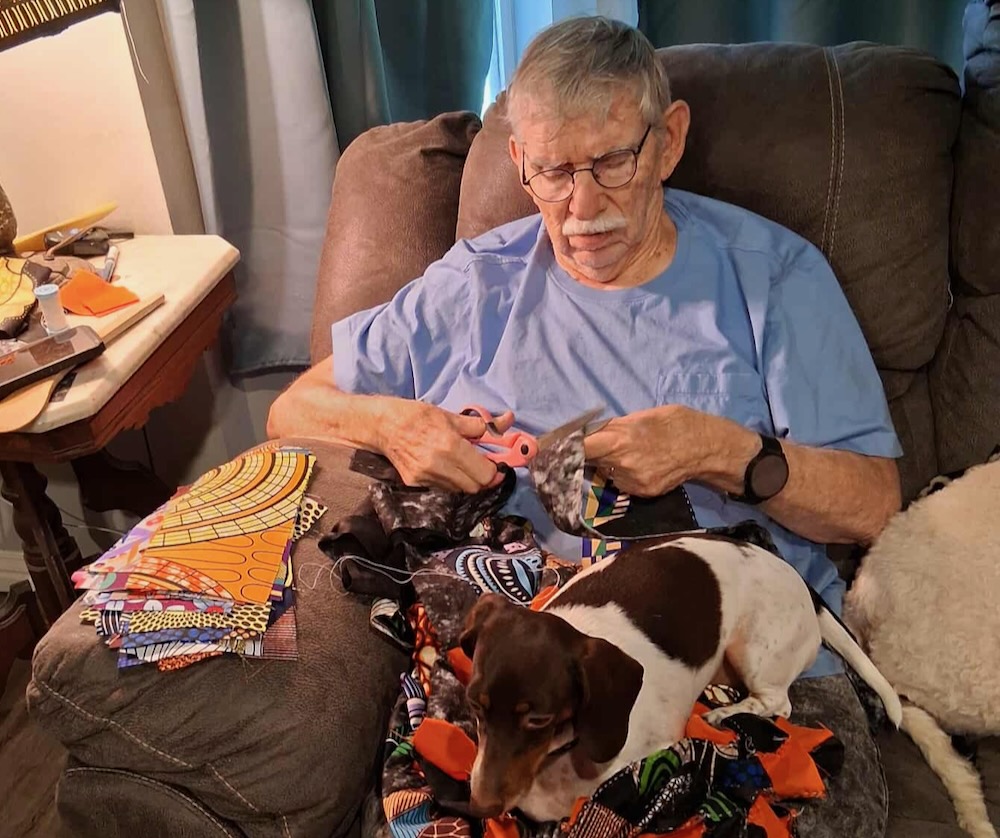
Frank Day works on a hand-stitched quilt, accompanied by one of his favorite pets.
Let me tell you about my friend Frank Day of Roland, OK, whom I have known since approximately 1971 when we both worked for Hunt’s Department Store in Fort Smith, Ark.
Over the years, we drank gallons of coffee together, ran trot lines at 2 am in the Arkansas River and stalked raccoons in the middle of the night in the Paw Paw Bottoms, among other adventures.
But life took me to Oklahoma City in 1983 for a job with The Daily Oklahoman newspaper, so we haven’t seen a lot of each other in the intervening years.
Today Frank is 75 years old and retired after more than two decades as fleet sales manager for Fort Smith’s Randall Ford. I think he can best be described in 2025 as a one-man quilting bee.
What?
That’s right. Frank Day began hand-stitching beautiful quilts over two decades ago, and continues his quilting avocation today.
Frank, I thought I knew you.
There goes my image of the typical quilter as someone’s grandmother.
Turns out that quilting is something Frank learned as a child from his mother, Dortha Day and turned it into an ongoing hobby many decades later.
“When I grew up, Mother was quilting all the time,” Frank told me. “She belonged to a quilting club, a bunch of women who got together at someone’s house and could finish a quilt in one day. I grew up watching her, and she showed me how to do it.”
Frank’s wife of more than 50 years, Vicki, added her perspective.
“Frank’s mother Dortha always had a quilt rack on the ceiling,” Vicki said. “I remember Granny, everyone called her Granny, quilting on the old quilting frames and singing hymns. When the grandchildren came along they would all play under the quilt frame.”
However, Frank had never made a quilt until his first grandchild was born more than 20 years ago. He produced his first quilt for grandson, Trevor, and has continued quilting through the years.
“I said I’m going to get some material and make a quilt,” Frank said of that first attempt. “Vicki said ‘you don’t know how.’ I said, ‘you watch me.’ I got the material and sat down and started sewing. And I got it done.”
That first quilt led into one for each grandchild, then special quilts for relatives and friends. Sometimes he makes them for folks who’ve had a stretch of bad health or difficult life situation, like a former coworker at Randall Ford to whom he presented a quilt.
“She started crying, but it was because she was happy to get it,” Frank said.
A quilt is not made in a day. Or a week. It might require more than a month of work for a solo quilter like Frank Day.
“From start to finish, if it’s a king-sized quilt, you have about 250 hours in it,” he said. “That’s cutting the material out — I hand sew everything, nothing is made on a machine. I hand stitch it, get the backing for it, get the lining for it and put the blocks on top.”
Did you catch that … 250 hours for a single quilt. That’s 6-1/4 40-hour working weeks of quietly sitting alone stitching blocks of material together into what can be a beautiful pattern.
My own grandmother was a quilter, and I recall she had a large wooden frame that she let down from the ceiling that helped her make her quilts.
Frank uses a ‘hoop’ that he holds in his lap as he quilts. Usually, one of his favorite dogs is sitting nearby or even on his lap as he quietly works.
Although he hasn’t made quilts to sell, Frank told me that comparable hand-made quilts can be priced at $1,800-$2,500 because of all the time required to produce one.
“It’s very time consuming, and most people don’t have the patience for it,” he said.
I learned that Frank was a quilter after Vicki posted some pictures of beautiful quilts on Facebook and I complimented her on her quilting talent. She corrected me and said it was all Frank.
“When Frank made his first quilt before Trevor, our first grandchild, was born, we had been married for 30 years and he never made one before,” Vicki said. “I asked him why he never made one before and his answer was “I never had a reason to make one.”
“Frank’s quilting has bloomed over the years. He made one for our son, Paul, as a wedding gift and then for our daughter Jenny. He made one out of cancer warrior scarves that Ford gave to dealerships for Breast Cancer Awareness.”
Each quilt is made with a purpose.
“Frank had a good friend, Dudley Sparkman, who was the best man and friend you could ask for,” Vicki said. “Sadly, he had a massive heart attack on his 50th birthday and passed around two weeks later. Tina Sparkman, Dudley’s wife, asked Frank if he would make a lap quilt out of some of his shirts. That was probably one of the hardest quilts he ever made because on the friendship they shared.”
Quilters like Frank Day who make the time to sit and hand-stitch a beautiful design are a rarity in 2025. Today, most quilts are machine stitched.
Frank calls hand-made quilting a “dying art” that he’s keeping alive in his corner of the world. Currently, he’s working on a quilt for Vicki as he recovers from a recent knee-replacement surgery.
“It’s helped me keep my sanity when I’ve had to sit for long stretches as I recovered from knee surgery that put me down,” he said. “I’ve finished one and got close to half of another one put together.”
It’s one stitch after another after another for a quilter like Frank Day. That translates into hundreds of hours to produce just one quilt.
It’s a marathon, not a sprint.
Frank has run that marathon for more than two decades.
And that’s why I describe him as the ultimate one-man quilting bee.
BONUS CONTENT:
I asked ChatGPT to explain the concept of a “Quilting Bee” to me. Here’s what it told me:
A quilting bee is a social gathering where a group of people—traditionally women—come together to work on quilting projects, usually a large quilt, while also enjoying conversation and community.
Key Features:
– Collaboration: Multiple people contribute to making one quilt. Often, the quilt top is pieced together ahead of time, and the bee focuses on quilting (stitching the layers together). – Social aspect: It’s as much about socializing and bonding as it is about the sewing. These gatherings were historically important social events, especially in rural communities. – Tradition: Quilting bees have roots in 18th and 19th century America, when they served as a practical and communal way to create bedding before mass production. – Modern bees: Today, quilting bees still exist, though they might be less formal or might happen in quilting guilds, workshops, or even online.
Think of a quilting bee as a mix of a sewing circle, a social event, and a creative collaboration.
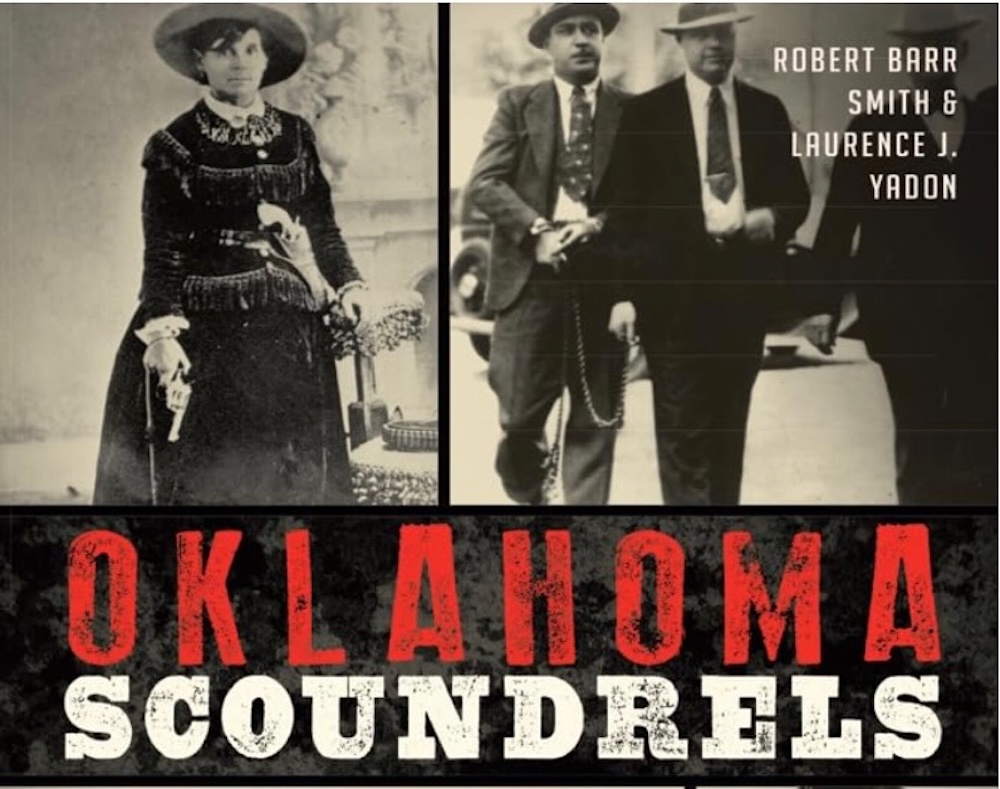
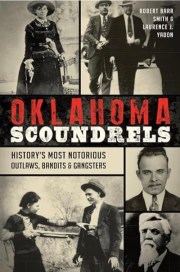
Cover of the Oklahoma Scoundrels book that described law enforcement dispute from the 1800s.
The introduction to “Oklahoma Scoundrels: History’s Most Notorious Outlaws, Bandits & Gangsters” about the state’s wild territorial days gave me a feeling of déjà vu all over again, as Yogi Berra used to say.
The book, authored by Robert Barr Smith and Laurence J. Yadon and published in 2016, describes the challenge facing Oklahoma Territory law enforcement in the late 1800s. Native American tribes relied on their own police known as the Lighthorse to keep order. The United States relied on U.S. Marshals and their deputies.
This is where the tale gets interesting, because it could have been written about eastern Oklahoma in the wild west of law enforcement in the 2020s.
Here’s a quote from the book about 1800s Oklahoma Territory law enforcement:
“Save for occasional abuses, the system worked well. Except for one problem. Tribal jurisdiction was very limited. A tribe’s Lighthorse law officer — say the Creek police — could arrest only members of his own tribe and men of other tribes who committed crimes within the Creek nation.
“The jurisdiction of the United States was similarly complex: a deputy marshal could only arrest United States citizens. A marshal could arrest an Indian only if a crime was committed against a U.S. citizen or involved alcohol (bootlegging being the perennial curse of the territory).”
Sounds familiar, doesn’t it?
The Supreme Court’s landmark McGirt decision in 2020, which recognized the sovereignty of the Muscogee (Creek) tribe and eventually expanded to the rest of the Five Civilized Tribes, created confusion among entities that provide law enforcement throughout eastern Oklahoma.
In the wake of the McGirt decision, state of Oklahoma law enforcement agencies lost authority to prosecute many crimes involving Native Americans — either as victims or perpetrators — on reservation land. Instead, federal or tribal authorities now have jurisdiction in many cases.
Major crimes such as murder or rape involving Native Americans fall under federal jurisdiction via the Major Crimes Act. Tribal courts handle misdemeanors and other offenses.
While the five tribes — Cherokee, Choctaw, Chickasaw and Seminole, in addition to Muscogee (Creek) — celebrated the decision as affirming their sovereignty, Oklahoma Gov. Kevin Stitt has been vocal in his criticism. He has been relentless in efforts to have the ruling overturned, claiming it has caused a public safety crisis in eastern Oklahoma, with criminal cases dismissed and prisoners released, as well as a threat to the state’s authority.
The tribes scoff at Stitt’s claims and say their law enforcement and courts are capable, plus they have signed enforcement agreements with multiple cities and counties across their territories in eastern Oklahoma.
A 2023 Tulsa World article focused on the ‘cross-deputization agreements,’ which allow local law enforcement agencies to jointly enforce tribal, state and federal laws.
“All Tulsa Police officers are cross-deputized with the Muscogee Nation Lighthorse and Cherokee Marshals,” the World article said. “As of 2022, the Muscogee (Creek) Nation had 63 cross-deputization agreements with entities within its sovereign boundaries.”
Back to the Oklahoma Scoundrels tale.
The book says the U.S. and tribal systems of law enforcement sometimes clashed over jurisdiction in the Oklahoma Territory. It describes a deadly shootout between U.S. Marshals and tribal court officials in eastern Oklahoma.
“The worst conflict came in 1872 near the Arkansas border at Going Snake Schoolhouse, then being used as a temporary tribal courthouse. U.S. officers tried to arrest the defendant, the court objected and the resulting shootout with court personnel, spectators and even the defendant left at least 10 men dead and the defendant on the run.”
Whoa! Ten men died over a law enforcement dispute.
Turns out, we’ve sort of replayed that confrontation in a real-world 2025 dispute. Only not as deadly.
In January of this year, a Muscogee Nation Lighthorse Police deputy chief got into a scuffle with a jailer at the Okmulgee County Jail, despite cross enforcement agreements in place.
“Body-worn camera footage from the Lighthorse officer shows jail official Matthew J. Douglas refusing the detainee, claiming that it was against the jail’s policy to accept prisoners from Lighthorse police. Some jail staff can be heard on the video saying Lighthorse officers are not ‘real police.’
“A physical altercation between Douglas and Lighthorse Deputy Chief Dennis Northcross began behind a closed door, video shows. As other Lighthorse officers tried to enter the room, a brief shoving match ensued at the door.”
Whew! At least in the 2025 version, no guns were drawn or officers from either side gunned down.
You know that old saying about history repeating itself. Well, it happens.
And that’s why I have déjà vu, all over again.
SPONSORED CONTENT: I came across Oklahoma Scoundrels while researching books on Oklahoma Outlaws for my mother in-law. Once I got into the book, from the first chapter on Belle Starr, I couldn’t put it down. It is captivating content on well known and not-so-well known Oklahoma Territory criminals from the 1800s. Buy it at Amazon and read for yourself. https://amzn.to/4medMMW
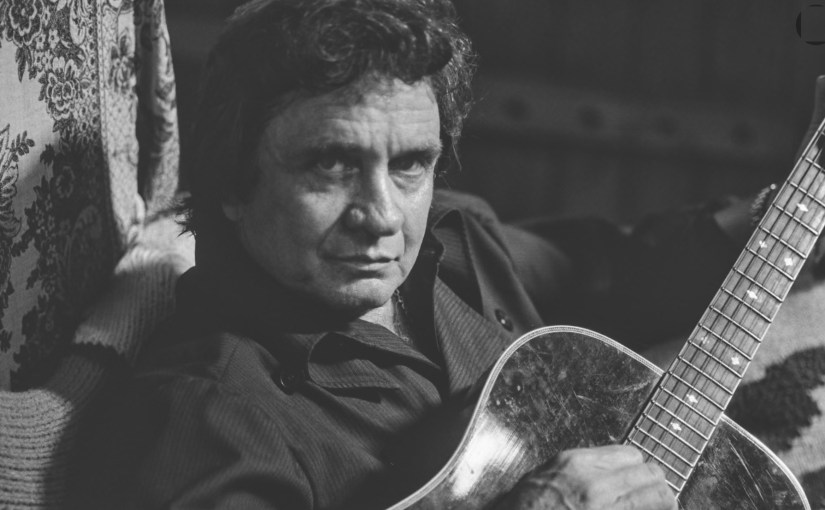
In 1968, my parents went to see a concert by Johnny Cash while we were living as a military family on the island of Okinawa. That should tell you how big of a star the Man in Black was in the ’60s, because my parents never, ever went to a concert unless it was Southern Gospel like the Gaithers.
Cash was an Arkansas native, as were my parents, so there was a connection. We were among the nearly 100,000 American military personnel and dependents living on the island that year at the height of the Vietnam war.
Johnny’s concert for military personnel on Okinawa occurred the same year that my dad bought the ‘Johnny Cash Live at Folsom Prison’ album, which got a lot of play in our house over the years.
Maybe because I heard the album so often I became a fan of Johnny Cash, although my knowledge of his song catalog from among his more than 100(!) albums doesn’t go very deep.
My friend Ed Godfrey can offer much more insight into Johnny’s music.
Johnny Cash began as sort of a rockabilly star in the 1950s, recording at the famous Sun Studios in Memphis. Then he became a genuine pop culture phenomenon in the 1960s when a wider audience embraced his music.
In fact, he starred in his own network TV show in the late ’60s and early ’70s, and recorded popular duets with his wife, June Carter Cash, Bob Dylan, Tom Petty and many others.
If you saw the movie “Walk the Line,” you know that Cash had some well documented run-ins with the law in the ’60s because of a drug addiction. He revived his career with help of June Carter and the release of the Live at Folsom Prison album.
His star power dimmed a bit in the ’80s and ’90s, although it seems to me the impact and legend of Johnny Cash has only grown since his 2003 death.
I think his legend endures because he was the complete package, great music, songwriter, deep bass vocals, the familiar guitar licks, the hair and, most of all, the courage to stand up for those rejected by society when that was far from the norm among entertainers.
Listen to his song, “Man in Black,” to gain some perspective.
In his final years, with his health waning, Johnny Cash covered other artists’ songs that I think are some of his best, even if he was frail and his voice had lost a lot of its force. My favorites are Hurt, and, especially, Further on Up the Road, an awesome cover of a Bruce Springsteen song.
Anyway, I decided to make a list of my top 10 favorite Johnny Cash recordings, whether written by him or covers of other artists. I’ve also invited Ed Godfrey to weigh in with his list, too.
Here are my top 10 songs recorded by Johnny Cash:
No. 1 — Folsom Prison Blues
A song he wrote in the early 1950s while still in the Air Force, it became probably his more popular recording and his signature song.
No. 2 — Ring of Fire
The horns, the imagery … a great song that was co-written by June Carter Cash before she married Johnny. Must have been a hot romance!
No. 3 — I Walk the Line
Cash’s deep bass voice, the guitar intro, Johnny’s hum at the beginning of each chorus, the pledge of fidelity — I love it all. Of course, the Gregory Peck movie based off this song was all about infidelity. Oh, the irony.
No. 4 — Sunday Morning Coming Down
I can just see a lonely, broke alcoholic ambling along on a big city sidewalk on a Sunday morning, longing for a life in this awesome Kris Kristofferson cover.
No. 5 — Further on Up the Road
Another superb cover, this one written by Bruce Springsteen. Ed says that he’s adding it to his funeral playlist. Me, too.
No. 6 — A Boy Named Sue
My dad and I had a great time listening to this song together back in the ’60s. Written by Shel Silverstein.
No. 7 — Girl from the North Country
A great song of lost love, and wonderful duet with Bob Dylan, the song’s author.
No. 8 — Jackson
Fun duet by Johnny and June Carter Cash; this got lots of airplay over the years.
No. 9 — Hurt
A late-in-life cover of a Nine Inch Nails song, Great guitar, piano that backed Johnny’s delivery.
No. 10 — The Man Comes Around
Johnny wrote this song and recorded it one year before his death. It’s obvious that he saw the end coming
BONUS SONGS
Don’t take your guns to town — Johnny had a way of telling a sad story; this one fits right in.
Five Feet High and Rising — Might not be everyone’s favorite, but I’ve liked this song for decades. I can just see Johnny as a kid with his family panicked over water that’s flooding the family’s hardscrabble acres.
Now, I present the Johnny Cash top 10 list from Ed Godfrey that you should really respect:
No. 1 – Sunday Morning Coming Down
When Cash first performed this on his TV show, network executives asked him not to sing the lyric “wishing I was stoned.” Cash sang it just as Kris Kristofferson wrote it anyway. I guess the network executives had no problem with having a beer for breakfast and one more for dessert.
No. 2 – Cocaine Blues
Cash’s version of this song on his “Live From Folsom Prison” album is just fantastic.
No. 3 – Ring of Fire
Cash said the idea to add Mexican trumpets to June Carter’s and Merle Kilgore’s lyrics came to him in a dream.
No. 4 – Unchained
Unchained is a song on Cash’s album by the same name produced by Rick Rubin. Their collaboration caused a resurgence of Cash’s career in the ’90s. Unchained is an album of covers and my favorite Cash album, even eclipsing “Live From Folsom Prison.” I have left instructions with my family to have Unchained played at my funeral.
No. 5 – I Walk The Line
Cash wrote the song as a promise of fidelity to his first wife. That didn’t work out, but the song is still great.
No. 6 – Flesh And Blood
I love the details in the lyrics of this song. It begins, “Beside a singin’ mountain stream, where the willow grew, where the silver leaf of maple, sparkled in the mornin’ dew.” Then in the next verse after the chorus, “I leaned against a bark of birch, and I breathed the honey dew, I saw a north-bound flock of geese, against a sky of baby blue.” I close my eyes and picture myself there.
No. 7 – Meet Me In Heaven
Another song off the Unchained album that I have asked to be played at my funeral.
No. 8 – Hurt
I am not a big fan of music videos, but this song is actually better and more powerful with the video. It was another collaboration with Rubin.
No. 9 – Folsom Prison Blues
I mean, this song has to be included, right? I can’t leave off Folsom Prison Blues on a list of best Johnny Cash songs.
No. 10 – I’ve Been Everywhere
Did I mention how much I like the Unchained album? This is another song off that album. Hank Snow first adapted it from a song originally written with Australian place names, but nobody performs it better than Cash.
Honorable Mentions: God’s Gonna Cut You Down and The Kneeling Drunkard’s Plea. Two more songs that came from the six albums Cash made with Rubin. The Kneeling Drunkard’s Plea also is on the Unchained album.
BONUS CONTENT FROM KENT TAYLOR:
You know Jim, I’ve been thinking about your Johnny Cash article since you posted it. I also grew up listening to my parent’s Johnny Cash vinyls. I’d have to put A Boy Named Sue at the top because it reminds me of my dad every time I hear it. He loved that song.
I thought that, as a kid, I had heard every JC song ever sung. However, it wasn’t until the past 10-15 years or so that I’ve heard songs I’d never heard before. One that I have grown fond of is Chicken in Black. If you’ve not heard it, I’d encourage you to listen to it.
SPONSORED LINK: I purchased this Vekkia Rechargeable LED Neck Reading Light on Amazon, a book light for reading in bed, not knowing what to expect. I bought it so I could read in bed without disturbing my wife. Turns out, it’s perfect, because it shapes around your neck, with two LED lights that you can adjust to shine onto your book page. Check it out! https://amzn.to/3IPaDF4
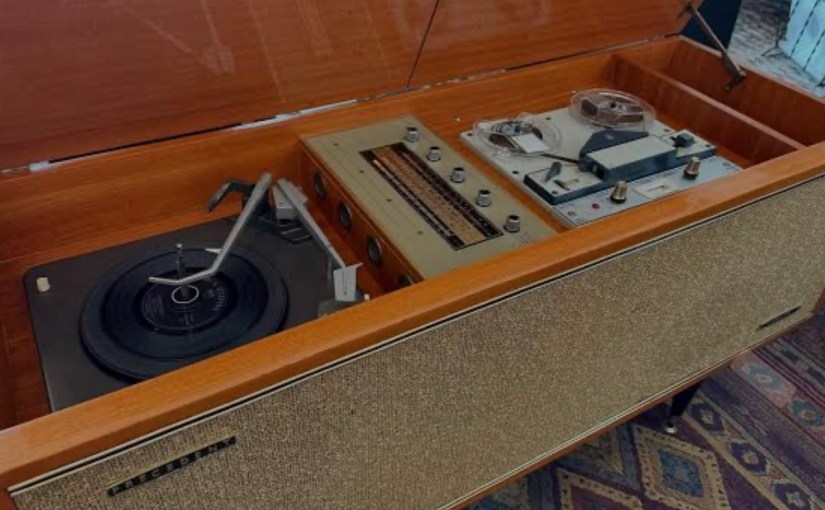
A turntable console with reel-to-reel tape much like my parents had in the 1960s.
When the Paul-is-Dead rumors began floating around in the late 1960s, I was devastated. There was evidence everywhere that Paul McCartney had died in a car crash and The Beatles went on with a look-alike substitute.
I was 16 in 1969 and read — and clipped — every article I could find that shared evidence of Paul’s demise. For instance, there was the hand over Paul’s head on the Sgt. Pepper’s Lonely Hearts Club album that symbolized death. And the whole cover resembled a funeral gathering.
There was more. Paul was dressed as a walrus on the Magical Mystery Tour poster, said to symbolize death, and a line from the song Glass Onion says “here’s another clue for you all, the walrus was Paul.”
But the clue that sealed it for me was the rumor that if you played Revolution 9 backward you could hear the words “turn me on dead man” and the sounds of a car crash.
My family owned a giant stereo console that had both a turntable and a reel-to-reel tape player. So, I played Revolution 9 from the White Album on the turntable and recorded it on the reel-to-reel.
When I turned the tape backward and played it I heard those terrifying words. “Turn me on dead man.” And the sounds of what could be a car crash.
That clinched it for me, at least for the next couple of years until it became evident to me that Paul McCartney was indeed, Paul McCartney.
I’ve written all of this not to show how gullible I was as a teenager; rather to talk about technology and what we had then and what we have today.
In the late 1960s, our family had the latest and greatest in the giant console with the turntable and the reel-to-reel.
That’s how we rolled in 1969.
Vinyl records, both 33 rpm long play albums and 45 rpm discs that played a single song each on front and back, were as common then as, well, iPhones today.
Everyone I knew had a record player or two in their homes. My sister and I had a little portable record player that we would take out into the carport and play our favorite singles on.
When I was a sophomore in high school, I took all the money I had saved up and bought a portable stereo turntable at Kmart that served me well for years.
But advances in technology made turntables obsolete in the early 1970s as 8-track tape players became everyone’s obsession. I installed a cheap Kraco 8-track in my car, which seemed to ruin as many tapes as it successfully played.
Then came cassette tape players that were much smaller — and dependable — than 8 tracks. But analog taped recordings didn’t have much of a future, because they gave way to CDs — compact discs — in the 1980s.
I remember the frustration of my dad in the ’80s when he had to buy a CD player because it had become the technology on which most music was recorded and played.
“They keep changing the formats just so we will have to spend money to buy something new,” he told me.
But time advanced as did technology.
MP3 players began to emerge in the late 1990s replacing CDs and making music much more portable. And in 2001, Apple Inc. debuted the groundbreaking iPod, which CEO Steve Jobs famously said allowed you to carry “1,000 songs in your pocket.”
So, here we are in 2025.
Today we have massive music services like the iTunes Store and Spotify that allow us to hear virtually any song ever recorded at any time.
And technology advances continue to make yesterday’s formats obsolete. The old console turntable and reel-to-reel tape player my parents owned was probably sent to a landfill decades ago.
But some things remain. The memories of chasing down Paul-is-Dead clues on that big old console. Hearing my dad — who passed on in 2012 — complain about changing technology.
And Paul McCartney — the real Paul McCartney — endures. As of July 7, 2025, he’s as alive as he was in 1969. I continue to listen to his music, but now in a digital format that reaches my ears through a pair of AirPods Pro 2.
That’s how we roll in 2025.
BONUS CONTENT
So, what’s next in how music is recorded and enjoyed? I’ve read a lot about how future music will be made by artificial intelligence, but what I’ve heard of it so far lacks the creativity of human song writers and performers. I’ll take humans any day.
I asked ChatGPT what it sees for the future of music, and this is how it answered:
1. AI and Generative Music
AI tools can now compose, produce, and even perform.
Personalized or adaptive soundtracks for games, workouts, moods.
2. Immersive & Spatial Audio
Formats like Dolby Atmos Music and 360 Reality Audio offer 3D sound experiences.
Becoming popular in streaming and VR/AR contexts.
3. Blockchain & NFTs
Exploring decentralized ownership, royalty tracking, and digital collectibles.
4. Holographic & Virtual Performances
Digital twins of artists (dead or alive) performing live.
Integration into virtual worlds and the metaverse.
5. Brain-Computer Interfaces (BCI)
Experimental: Listening to or composing music via brainwaves.
Potential for direct neural engagement with music.



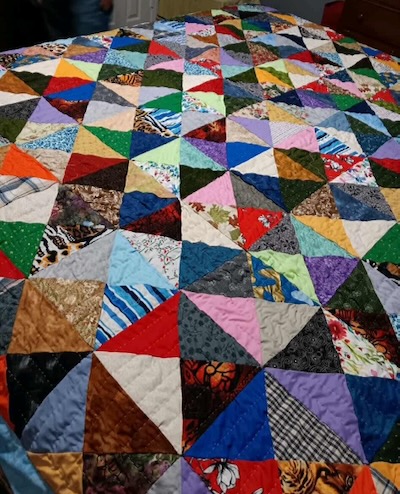 That’s right. Frank Day began hand-stitching beautiful quilts over two decades ago, and continues his quilting avocation today.
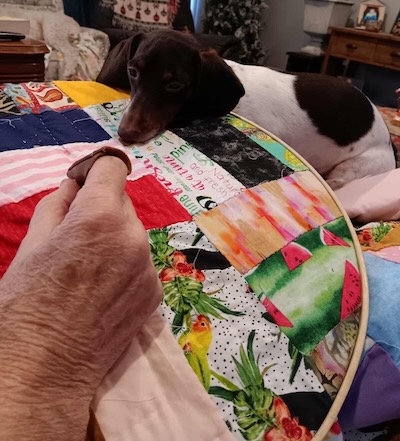 Frank uses a ‘hoop’ that he holds in his lap as he quilts. Usually, one of his favorite dogs is sitting nearby or even on his lap as he quietly works.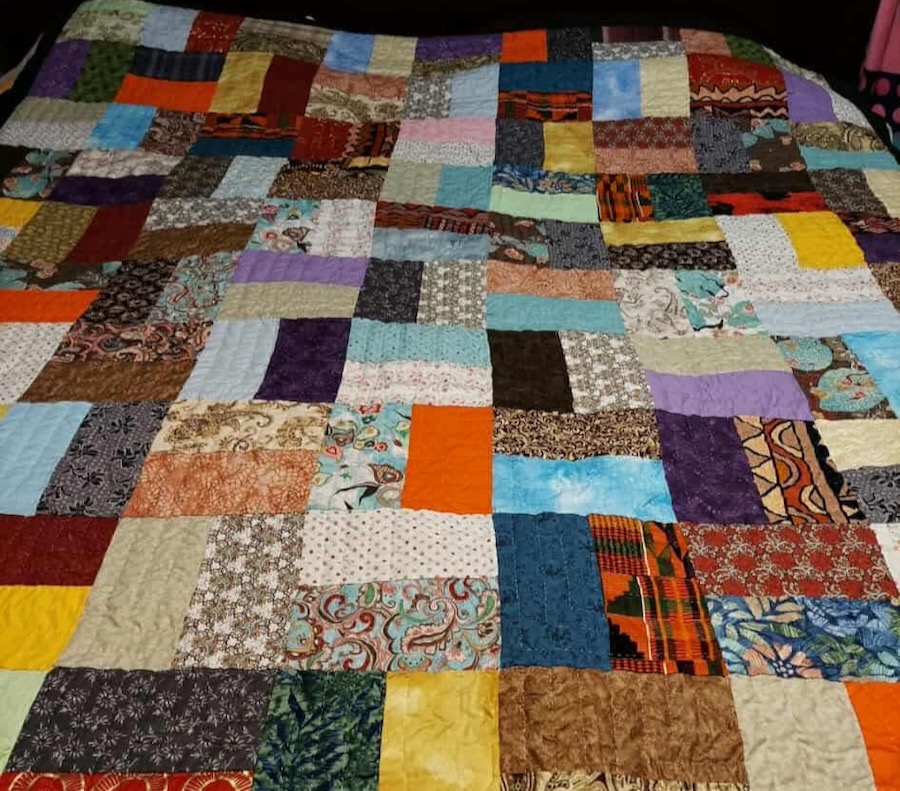
 SPONSORED CONTENT: I came across Oklahoma Scoundrels while researching books on Oklahoma Outlaws for my mother in-law. Once I got into the book, from the first chapter on Belle Starr, I couldn’t put it down. It is captivating content on well known and not-so-well known Oklahoma Territory criminals from the 1800s. Buy it at Amazon and read for yourself.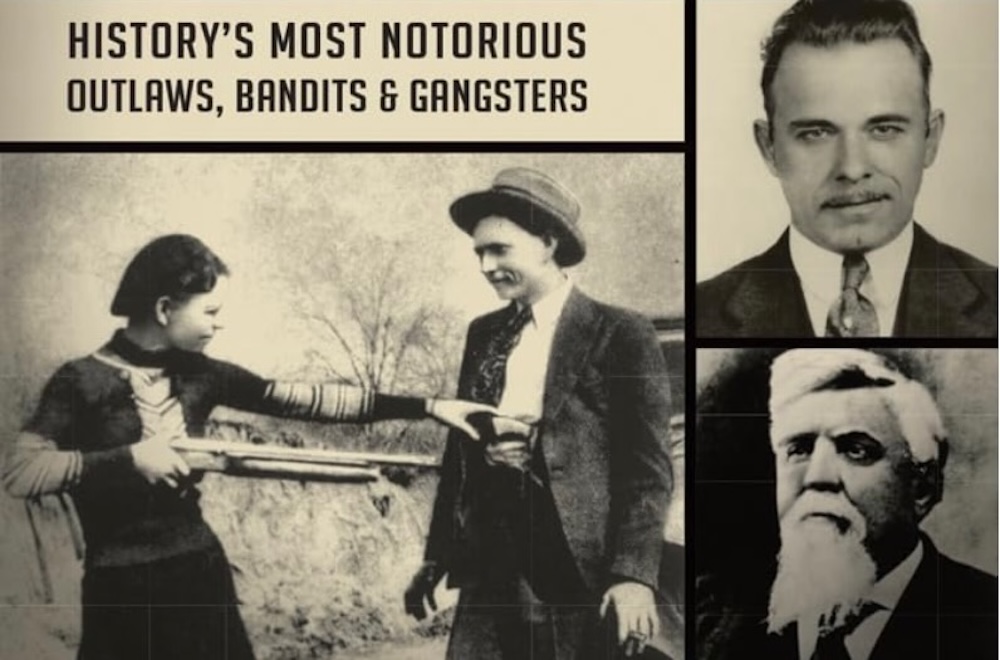
 SPONSORED LINK: I purchased this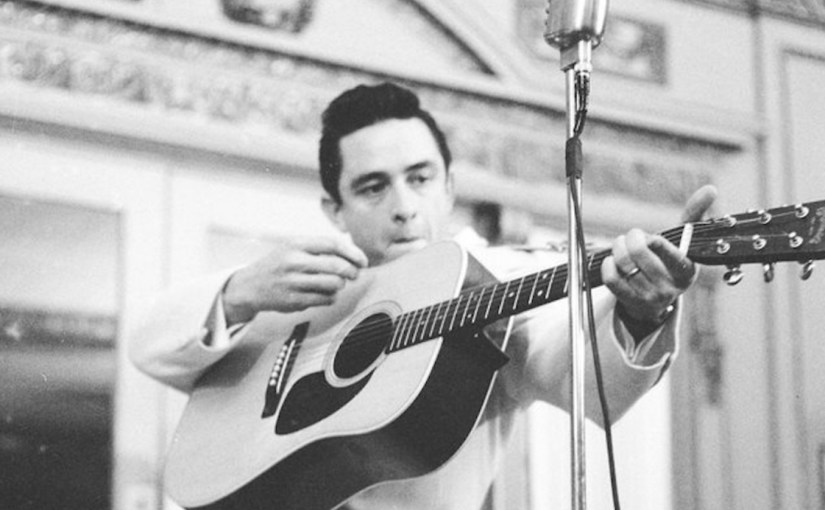
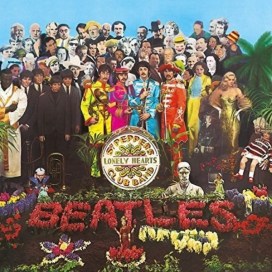 For instance, there was the hand over Paul’s head on the Sgt. Pepper’s Lonely Hearts Club album that symbolized death. And the whole cover resembled a funeral gathering.
 When I was a sophomore in high school, I took all the money I had saved up and bought a portable stereo turntable at Kmart that served me well for years.
 Jim Stafford's BlogOKC