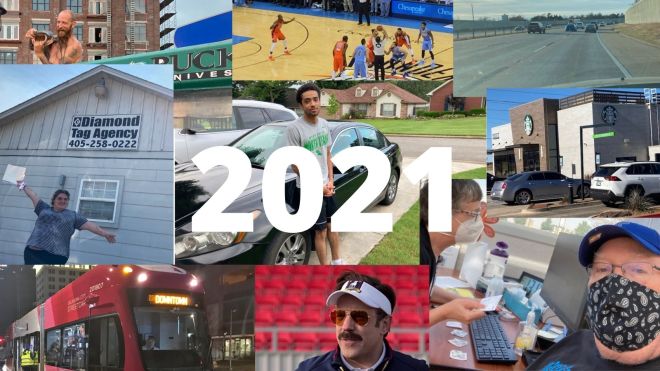
Merry Christmas from the Family

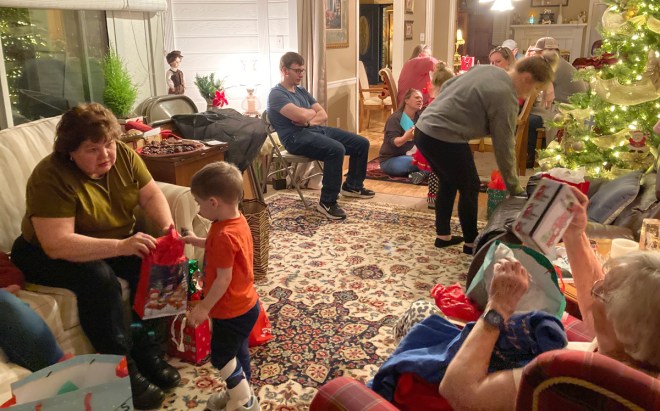
The Stafford Christmas gathering in Fort Smith, Ark., December 2021

We’ve spent hours (and hours) listening to Christmas music since October, mainly because my wife keeps the radio on her car tuned to a local station that plays nothing but holiday tunes for two full months.

So, that means I’ve had the opportunity to hear plenty of Christmas songs that I love, as well as many that are total clunkers. But they still get airtime.

Here are a few of what I would call secular Christmas songs that are in heavy rotation, as they say in the biz, and what I love or hate about them.:

Happy Xmas (War is Over)

This is a total non-religious ode from John and Yoko to the hope that Christmas and the New Year bring the world. It’s become a favorite of mine over the years. I love the youthful voices in the choir. It’s played over and over throughout the season.


So this is Christmas and what have you done?
Another year over, a new one just begun.

And so this is Christmas,
I hope you have fun,
The near and the dear one
The old and the young

A very merry Christmas
And a happy new year,
Let’s hope it’s a good one
Without any fear

Little Saint Nick

Might as well tackle one that makes me cringe whenever I hear it. I don’t object to the first line as does my friend, Dan, but it’s like the Beach Boys brought surfer music to Christmas with this cringeworthy song. Yuck.


Christmas comes this time each year
Ooh, ooh

Well way up North where the air gets cold
There’s a tale about Christmas
That you’ve all been told
And a real famous cat all dressed up in red
And he spends the whole year workin’ out on his sled

It’s the little Saint Nick (little Saint Nick)
It’s the little Saint Nick (little Saint Nick)…

Grandma Got Run Over by a Reindeer

Yes, this is a total novelty song, but it cracks me up every time I hear it. Was it really Santa and his reindeer that whacked Grandma? Or perhaps Grandpa had a hand in the “accident?”


Grandma got run over by a reindeer
Walking home from our house Christmas eve
You can say there’s no such thing as Santa
But as for me and grandpa we believe…

Now we’re all so proud of grandpa
He’s been taking this so well
See him in there watching football
Drinking beer and playing cards with cousin Mel…

Let It Snow! Let It Snow! Let It Snow! (Dean Martin version)

This song brings images of Christmas cold and snow and being close to the one you love. Dean Martin brings a sort of smugness to the delivery of Let It Snow that appeals to me for some reason. Also, are there some comparisons to this song with “Baby, It’s Cold Outside,” another (slightly more controversial) song that Dean Martin sang as well?


Oh, the weather outside is frightful
But the fire is so delightful
Since we’ve no place to go
Let it snow, let it snow, let it snow

It doesn’t show signs of stopping
And I brought some corn for popping
The lights are turned down low
Let it snow, let it snow, let it snow

When we finally kiss goodnight
How I’ll hate going out in the storm
But if you’ll really hold me tight
All the way home I’ll be warm…

Baby It’s Cold Outside

I simply must go
Baby it’s cold outside
The answer is no
Baby it’s cold outside
The welcome has been
How lucky that you dropped in
So nice and warm
Look out the window at the storm
My sister will be suspicious
Gosh your lips look delicious…

You’re a Mean One, Mr. Grinch

Another novelty song that dates back to the ’60s, but I’m fascinated by the incredible number of insults the song makes to the foul Mr. Grinch. It’s in the regular rotation of the local Christmas music station.


You’re a mean one
You really are a heel
You’re as cuddly as a cactus
You’re as charming as an eel
Mr. Grinch, you’re a bad banana
Mr. Grinch, with the greasy black peel

You’re a vile one
You got termites in your smile
You have all the tender sweetness
Of a seasick crocodile…

Wonderful Christmastime

This is a huge departure from, say, Helter Skelter or Back in the USSR, for Paul McCartney. But his music has grown lighter and more sentimental since his Beatles days. This song is way overplayed on the local Christmas music station.

Wonderful Christmastime
The moon is right
The spirits up
We’re here tonight
And that’s enough
Simply havin’ a wonderful Christmastime

The party’s on
The feelin’s here
That only comes
This time of year
Simply havin’ a wonderful Christmastime
Simply havin’ a wonderful Christmastime…

I could go on and on about the dozens of secular Christmas songs that we hear all the time or have heard over the years. The Chipmunk Song, anyone? But I’ll end this with a few lines from a favorite of mine from Robert Earl Keen, because everyone has a big, messy family gathering over the Christmas holiday, right? (Disclaimer: alcohol plays no role in our family gatherings)

Merry Christmas from the Family

Mom got drunk and Dad got drunk
At our Christmas party
We were drinking champagne punch
And homemade egg-nog

Little sister brought her new boyfriend
He was a Mexican
We didn’t know what to think of him
‘Til he sang “Feliz Navidad, Feliz Navidad…

Fred and Rita drove from Harlingen
I can’t remember how I’m kin to them
But when they tried to plug their motor home in
They blew our Christmas lights

Cousin David knew just what went wrong
So we all waited out on our front lawn
He threw the breaker and the lights came on
And we sang “Silent Night, oh Silent Night”…

Merry Christmas from our family to yours.

Traffic stop on the Lake Road

lake road
The Lake Hefner Parkway

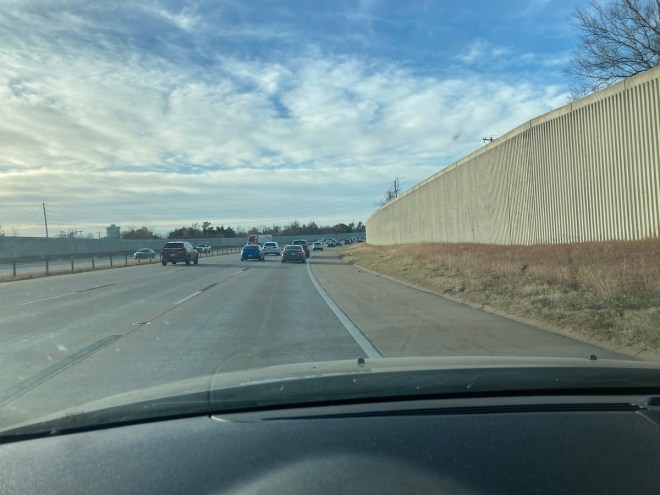
I was focused on the sports radio banter this morning and negotiating heavy traffic on the Lake Hefner Parkway when my 2-year-old grandson began shouting “GiGi! GiGi!”

I didn’t pick up on it immediately.

However, Solomon was relentless from his car seat in the back. “GiGi! GiGi!”

Suddenly, a red Ford Escape cut sharply into my lane just in front of me. I looked at it and thought that it resembled my family’s vehicle. Then the Ford Escape slowed, put on its blinker and began pulling to the shoulder amid the heavy traffic.

That’s when I saw it. The small sticker on the bumper. That WAS our car. Then it hit me why Solomon was shouting GiGi! My wife Paula, his grandmother, had cut us off on the Lake Road and was pulling us over.

So, I pulled in behind her. She hopped out of her car and began running to our car.

I imagined the worst. Had someone in our family died and this is how she was going to break the news to me, here on the shoulder of the Lake Hefner Parkway?

I rolled down my window and she said, “I think I left my phone in your car.”

What?

Apparently, she had left the phone in the car when she buckled Solomon into his car seat. And her phone was critical to her work-from-home job.

After we left for Solomon’s appointment, Paula realized she didn’t have her phone, jumped in the car and began chasing after us. She managed to catch up on the Lake Road, but couldn’t get my attention until she cut me off with Solomon shouting “GiGi!,” his favorite name for her.

Paula crawled into the back seat and said “call my phone.” I called it and her phone began ringing from the back seat. She couldn’t find it and crawled back out.

“Call it again,” she said. I called, and it started ringing. She crawled across the back seat again.

I glanced back and saw it.

Paula’s phone was sticking out of the back pocket of her jeans. It had been there the entire time.

We both (sort of) laughed when we realized where the phone actually was.

And I’ll never let her live it down.

Oklahoma, we have all been here before

Jenni

It seems like deja vu all over again for Oklahoma.

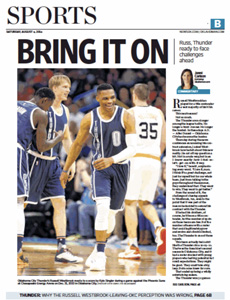
I’m talking about the similarities between Lincoln Riley’s unexpected departure from OU this week and that of Kevin Durant from the OKC Thunder in 2016. The feeling of being blindsided. The widespread anger.  The loyal hero who steps up.

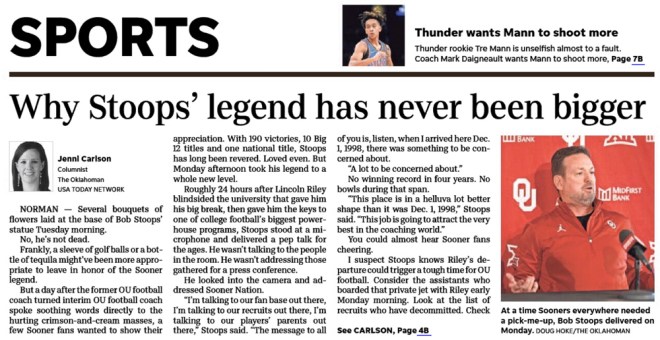
As I read Jenni Carlson’s column in The Oklahoman this morning on how Bob Stoops has further endeared himself to OU fans by stepping up in the wake of Lincoln Riley’s departure, another name instantly came to mind. 

Russell Westbrook.

Russ pageRuss stepped up big time in 2016 after Kevin Durant unexpectedly abandoned the OKC Thunder ship. He said “why not” and signed a 3-year contract extension before the season even began.
Here’s how he was quoted by espn.com:

“There’s nowhere else I would rather be than Oklahoma City,” Westbrook said at a news conference to announce the deal. “You guys have basically raised me. I’ve been here since I was 18, 19 years old. You guys did nothing but great things for me. Through the good and the bad, you guys supported me through it all, and I appreciate it. Definitely when I had the opportunity to be able to be loyal to you guys, that’s the No. 1 option. Loyalty is something that I stand by.” 

It was an incredibly feel good moment after the anger generated across the state when KD announced on the Players Tribune on July 4 that he was taking his talents to the Left Coast. His announcement prompted me to write a blog post with some lyrics from The Beatles that were appropriate for the occasion.

Now we have Coach Stoops stepping up as interim coach at a critical time for Sooners. On Twitter, fans heaped praise on Stoops not only for stepping in but for the calming comments he made at the news conference announcing his temporary return.

And why not, to borrow Russ’s famous phrase.

Drive-thru rage and the shame of it all

drvie thru
The scene of the crime

I’ve recently discovered that I’ve operated under a false image of who I am. I assumed as a follower of Christ, I would always turn the other cheek.

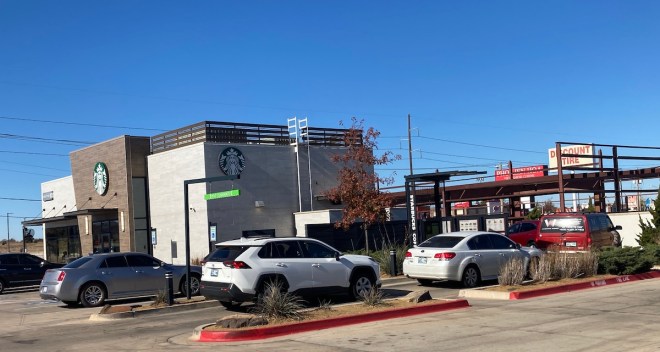
Turns out that the real me came out in a Starbucks drive-thru here in OKC.  My wonderful self-image was destroyed when I got behind the wheel.

I’ll set the stage.

My wife and I, along with our 2-year grandson, were heading out to Dallas for a brief getaway for a couple days.  I wanted a cup of coffee before hitting the highway. So we drove to a local Starbucks, which had quite a line of cars in the drive-thru.

The line went all the way out to the parking lot of the shopping center in which it is located, so I put my blinker on and waited my turn, leaving room for other cars in the busy lot to pass on my left.

I was waiting patiently to pull into the drive-thru when a small car rushed by me on the left and wheeled into the drive-thru. I was beyond incensed.

Before I realized it, I jumped out of my car and raced over to the line-cutter’s car and rapped hard on his window.

All the while, my wife was pleading with me to come back to our car.

The young man rolled down his window, and I started screaming: “What are you doing?! Couldn’t you see I was sitting there with my blinker on waiting to pull into the line?” The guy responded: “how was I supposed to know?’  I screamed again that he should have seen the blinker, and then he said “I’m leaving.”

He quickly backed out and left the lot. I went back to my car. My wife said I was lucky he didn’t jump out and punch me.

Suddenly, my righteous indignation gave way to an incredible sense of shame. What had I done?

I was the old man screaming ‘get off my lawn!’

michelle millben
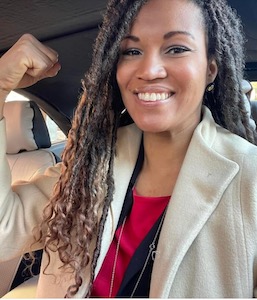
Michelle Millben

About two days later, I saw a post on Facebook from Michelle Millben, an Oklahoma native who lives in Virginia. Michelle is an incredible public speaker whom I heard a few years back at the Oklahoma WISE Conference, and have followed her posts ever since.

Anyway, Michelle told a story about playing peacemaker for a couple of guys who were about to come to blows at the gas pumps of a service station.

She saw what was happening and approached the pair, speaking in a calming voice.

I admire the way that Michelle diffused the situation and played the peacemaker for people she didn’t even know.

As for me, the only way is up from the depths of my behavior. Michelle’s post and my crazy rant have really helped me to reassess my own demeanor.

I hope I can be the peacemaker in the future, and not the old ‘get-off-my-lawn’ guy who hangs his head in shame today.

An OKC Field of Dreams and ghosts of baseball past

fieldofdreams
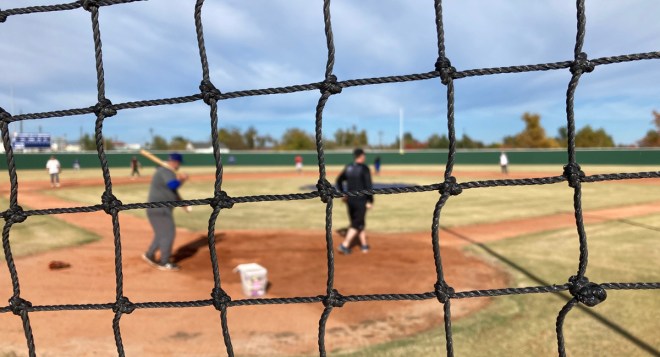
A group of OKC adults turned the Northeast High School baseball field into their own ‘Field of Dreams’ for an afternoon

Moneyball is one of my favorite movies. It shows the impact that using computer statistics to drive player development had on Major League baseball and the Oakland Athletics in the early 2000s.

The movie features a host of memorable scenes, including one where Oakland outfielder David Justice asks new first baseman Scott Hatteberg what he feared most at the position.

Hatteberg had been a catcher all of his professional career, and to that point had never played even an inning at first base.

“A baseball hit in my general direction,” was Hatteberg’s honest reply to Justice’s question.

That’s exactly how I felt Sunday afternoon as I stood in right field at the Northeast High School baseball field.

I was there at the invitation of my friend, Russ Florence, who invited a group of fellow adults to “have a catch” with him.  A lifelong baseball fan, Russ began his informal monthly “catch” several months ago.

It was sort of a Field of Dreams-come-to-real-life opportunity for those of us who once played the game or have followed it all of our lives.

The baseball dreamers who came out Sunday included several guys my age or older, a few younger and a couple of women who showed more agility than most of their male counterparts.

I dug my old baseball glove out of the closet and joined about a dozen others at the Northeast field.

Unfortunately, the experience revealed exactly how the passage of time has robbed me of athletic ability, real or imagined.

Once upon a time, I thought of myself as a pretty good baseball player. Now that was in Little League in College Station, Texas, followed by Pony League as a 13- and 14-year-old.

Here’s how it went five decades later on a warm November afternoon beneath a bright blue sky.

First, we warmed up by playing catch with a partner about 40 feet away. I put most of my throws into the ground in front of him or several feet to his left.

My shoulder ached after about 15 minutes. My glove hand screamed with pain from catching baseballs in the heart of the mitt.

Then came the real embarrassment. I stood in right field as Russ hit flies and grounders to players stationed at infield and outfield positions.

He hit one in my general direction.

My feet felt like they were in quicksand as I “ran” toward it. I could not bend over far enough to even make a stabbing attempt at a catch.

I hung my head in shame. No one seemed to notice.

Russ hit about three other balls in my direction. I managed to catch one on the bounce barehanded, but caught none before they hit the ground. I decided if a ball wasn’t hit within three feet of where I was standing, I had no chance.

But the day wasn’t a total loss. I had the opportunity to visit with some old — and new — friends. The weather was pleasant watching from the dugout, where I spent much of my time.

“It really scratches an itch for a lot of people,” Russ told me afterward. “None of us is as good as as we once were — or as good as we THINK we once were. I’m glad you were there.”

Thank you, Russ, for inviting this ‘ghost’ of a former player to experience your OKC version of the Field of Dreams.

Even if it brought home a sobering reality of aging.

Don’t let your facts get in the way of my beliefs

encyclopedia2
A set of Encyclopedia Americana from the 1960s.

When I was a kid, we had a big set of Encyclopedia Americana in our house that was my go-to Google-of-the-day for every bit of fact finding and trivia that drew my interest.

Once, when I was a teenager, my dad and I had a disagreement over some fact about a foreign country or its people, I can’t remember which.

However, my dad was spouting an opinion as fact that I was certain was wrong. So, I grabbed an encyclopedia, looked it up and read the part to him that proved that he was wrong.

“Now you’re taking it too far,” he said, clearly irritated.

Translation: don’t let your facts get in the way of my entrenched beliefs.

Anyway, I’m writing this because we’re seeing people in our society make up their minds and cling to ‘alternative facts’ when clearly there is no evidence to back them up. Or there’s evidence that shows that it is wrong and they still cling to their beliefs.

The dispute over vaccines, for instance. People would rather take their Uncle Jimmy Joe’s word that the COIVID-19 vaccines are making thousands of people sick or, worse yet, killing them, than accept statistics kept by health care professionals and scientists that show vaccines are incredibly safe and effective.

I’m pretty sure it’s really an issue motivated first and foremost by political beliefs. Red state. Blue state.

But we all stake out our territory on different issues and refuse to budge even when we’re smacked in the face by reality. I’m sure I’m guilty, as well.

And that leads me to an issue that really disturbed me this week. One of my neighbors whom I like and enjoy hanging out with in his driveway, stated as fact that a high-ranking OKC city official gets a cut from every concession sold at Scissortail Park because he made a donation to its construction.

I ask him to offer some proof. “They reported it on Channel 9,” he said.

If it had been reported on TV or in the newspaper, and there was evidence to support the allegation, the story would be huge and talked about by everyone in the city. The official would likely lose his job.

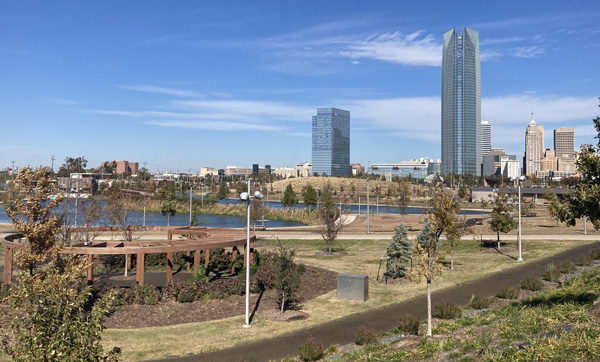
scissortail park1
Scissortail Park in early November

Instead, it’s told as fact by a retired OKC resident who is skeptical about the whole MAPS program and Scissortail Park, as well. He doesn’t need actual proof, because he heard the story told as fact from others who share his point of view.

I even ran the allegation past a respected reporter for The Oklahoman that I trust and who told me that “none of it is true.” I’m taking his word for it, because, if true, it would have been a giant Page 1 headline.

The disturbing aspect is that my neighbor repeats the story to anyone who will listen, and in my far north OKC neighborhood there are a lot of takers.

I think some of it has to do with the fact that our neighborhood is so far out of the city’s core that people like my neighbor don’t see the benefit that MAPS and Scissortail Park have brought to our city.

As I walked back home after the encounter the other day, I couldn’t help but think of my dad and his long ago wrongly held opinion-as-fact. Even the Encyclopedia Americana couldn’t budge him off his belief.

Sad to say, that’s how it is with a lot of American society today.

Dr. Robert Floyd: A Thinker and Seeker

Robert Floyd
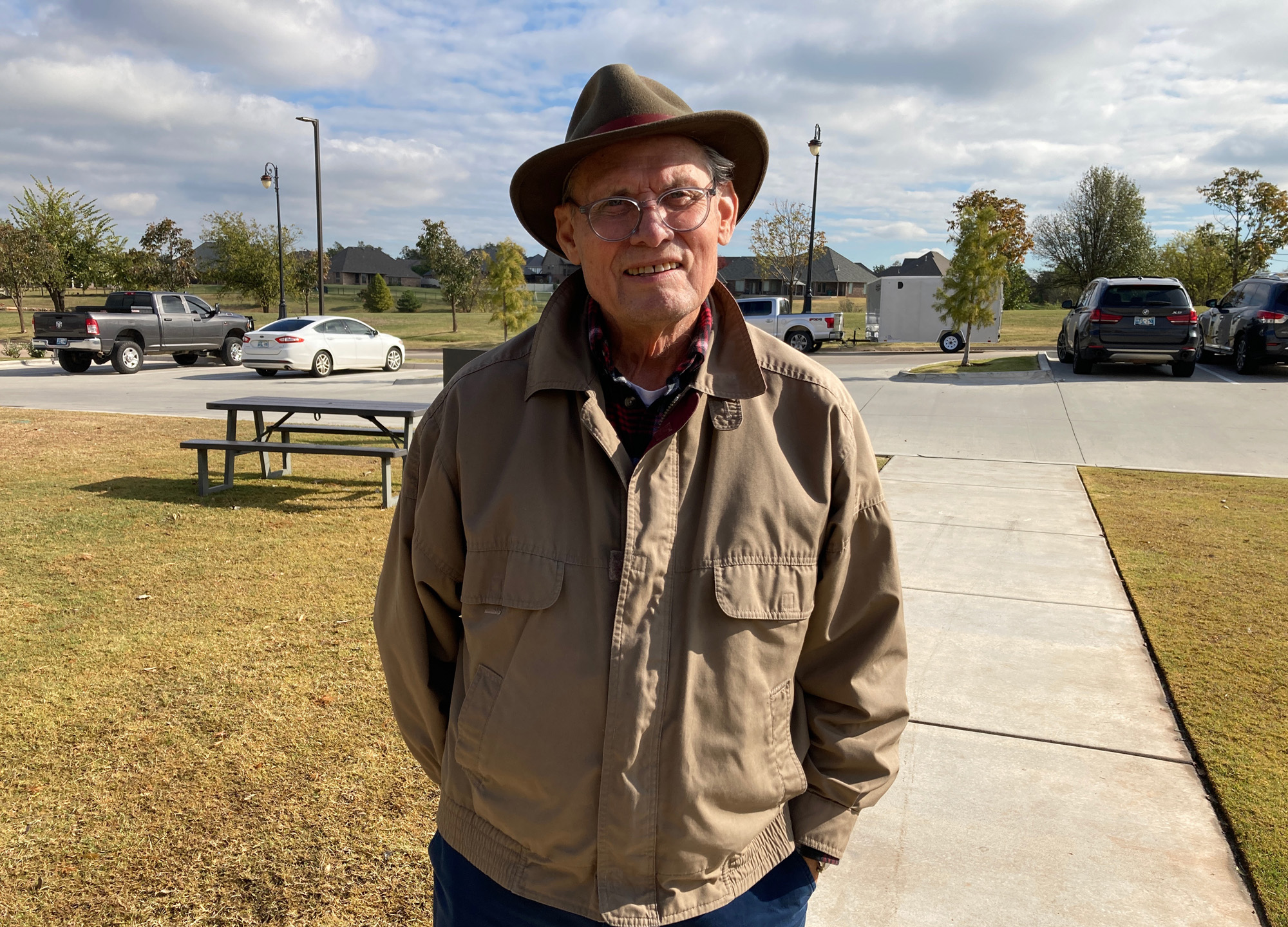
Dr. Robert Floyd, scientist and author of A Thinker and Seeker

Editor’s Note: During my years as a Business news reporter for The Oklahoman, I had the opportunity to interview Oklahoma Medical Research Foundation scientist Robert Floyd, Ph.D., several times. He has since retired and written an autobiography, which I’ve read and written this review.

In the beginning, Robert Floyd, Ph.D., was a farm boy whose family grew tobacco on their Kentucky homestead.

But they couldn’t keep him down on the farm.

Dr. Floyd eventually became a world-renowned bioscientist, and for the last 34 years of his career pursued discoveries of groundbreaking compounds at the Oklahoma Medical Research Foundation.

In his autobiography released earlier this year, Dr. Floyd describes the journey that took him from the family farm on Calvary Ridge in central Kentucky to college, then to graduate school and on to post-doc positions. In 1974, he came to Oklahoma City and the OMRF.

I met Dr. Floyd late in his career when I was a life science reporter for The Oklahoman in the early 2000s. I’m pretty sure we first met at a BIO International Conference in San Francisco.

I had the opportunity to interview Dr. Floyd several times over the years and learned about the groundbreaking compounds he discovered in his OMRF laboratory that today are being used to treat deadly brain cancers and hearing loss.

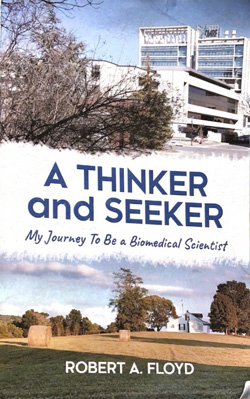
Floyd bookBut I knew nothing about his rural roots and how he came to Oklahoma until he provided me a copy of his autobiography, A Thinker and Seeker: My Journey to Be a Biomedical Scientist, (BrownWalker Press, 364 pages).

In his book, Dr. Floyd separates his journey into three sections, beginning with life on the farm, then his pursuit of higher education and life as a post-doc, concluding with his years as an OMRF scientist.

Dr. Floyd goes deep into Floyd family history and his own experiences growing up on a working Kentucky farm. I even learned from his book how the tobacco leaves are harvested by hand, then cured in a drying barn before being shipped to an auction house.

After a high school education that didn’t serve him especially well, particularly in math skills, Dr. Floyd enrolled at the University of Kentucky. His goal was to become a high school agriculture teacher like his uncle Frank Williams.

But he discovered plant pathology as a UK senior and decided to go to graduate school at Kentucky to pursue a master’s degree in agronomy. From there, he moved to Purdue University, where he earned a Ph.D. in biochemistry.

The next phase of the book follows Dr. Floyd through various post-doc assignments, including one at Washington University in St. Louis, where he worked with Barry Commoner, who was a well known and often times controversial environmentalist.

Dr. Floyd also shares a lot about his personal life, how he met and married his wife, Marlene, the houses they bought and sold along the way, and a couple of harrowing cross-country automobile trips they took as they moved from one assignment to another.

The final section of the book is a year-by-year look at Dr. Floyd’s career at OMRF. We learn how he was hired, the focus of his research and how he became a respected and sought after scientist who traveled and spoke to conferences all over the world.

His laboratory was continually funded through the OMRF years by National Institutes of Health research grants. Eventually, he became an NIH grant reviewer himself who considered grant applications from other scientists throughout the U.S.

Since Dr. Floyd is someone I’ve known professionally for almost 20 years, I read this book with interest. I found the chapter on his family’s history and his life on the farm especially fascinating.

Dr. Floyd’s book, A Thinker and Seeker is available in bookstores, at Amazon.com or through the author himself at rafloyd0753@gmail.com.

.

Fan’s message to Thunder: Let’s play to win

thunder
The Thunder’s season-opening tipoff in 2015.

We’re about to welcome the launch of the OKC Thunder’s ’21-’22 season, and the debate over tanking continues for a second straight year.

Do the Thunder continue to “explore the roster” and chase the league’s worst record in hopes of drafting the next unicorn?

Or do they take this young roster and try to be competitive in a very good Western Conference?

Sam Presti said recently that the team will take no shortcuts. You can read into that whatever meaning you choose.

“What we want to do is be playing meaningful basketball at the end of the year,” Presti said. “We want to try to do everything we can to put ourselves in position to optimize the group that we have, and there’s just no shortcuts to that. It comes back to the commitment to the process that’s in place and being willing to be patient with that as we go through, especially with this much change as we’ve experienced.”

Here’s the takeaway from that: “commitment to the process.”   Translation: “lose for the lottery.”

In today’s column in The Oklahoman,  Berry Tramel laid it out. “Losing is the path to winning.”

Ouch.

But put me down for trying to be competitive.

I know that puts me at odds with my fellow Thunder fans who celebrate tanking and see a championship caliber team in the future as a result.

There seems to be a couple schools of thought within NBA fandom.

One school says that if you don’t win the NBA championship, your entire season is a bust.

So tank until you can build the roster up.

The other school says that competing at a high level against the best players in the world and making a playoff run is great entertainment.  Yes, we may come up short in the end, but we’ve got something to cheer for through the long, cold winter months.

Remember the fun we had in the early 2010s when the Thunder went deep into the playoffs, even if they came up short?

We were living high as Oklahoma City Thunder fans.  Those are cherished memories of mine almost a decade later.

But you know what?  Those Thunder teams didn’t win the championship.

That doesn’t diminish the memory for me in the least.

My friend Steve Buck argues that the Thunder team of that era was a championship caliber team even if it didn’t win it all.

“Here’s the deal…for many of those years we were capable of winning the title,” he says. “That’s the goal here…get a club rebuilt that is capable to contend. Playing for a one and out is not the goal.  You want to position yourself to win it all.”

My point is that we didn’t win it all, but, gee, we had fun.

And now we’re losing for the lottery.  It makes for long, bleak seasons.  And there’s no promise of a unicorn at the end. Or even of a top three pick (see this year’s lottery fiasco).

Here’s to the new season and hoping the Thunder will be over-achievers.

Let’s not chase the luck of the lottery once again.  Let’s play to win now.

BONUS: Here is how Berry Tramel has the bottom of the West ranked going into the season:

Tramel Predict

Perspective: An American missionary in Europe

paul church service
Paul Brazle leads a church service in Belgium, where he has served as a missionary for more than 30 year.

Editor’s note: I’m a member of The Springs Church of Christ, which has been a long-time supporter of Paul Brazle and his wife, Carol, who have served as missionaries to Belgium for over 30 years. I’ve grown to admire the Brazles for their commitment and tenacity. But I’ve also wondered how an American Christian like Paul approaches the job of “missionary” to a European country that had a large Christian population centuries before the U.S. was even founded. So, I asked him to participate in this Q&A about that topic as an American missionary in Europe. I’m grateful for his candor.  Here are his thoughtful and refreshing answers (some edited for length):

Question: Where did you grow up and what was your family’s background?

Answer: My dad was a preacher and a Bible teacher too, who emphasized “missions” a lot. In fact, in something of a parallel to what you are getting at with these questions, Dad was an American from Kansas who moved to Canada (via Montana) and so was often called a “missionary.” That meant that I grew up as not only a “preacher’s kid” but also a “missionary’s kid.” Dad provided for me (and my siblings) to have mission experiences. So, after one year of college I got to spend a year in Florence, Italy, as a “missions apprentice.”

Q: What led you to decide to lead a mission effort in Belgium?

A: In connection with my apprentice year in Italy, a classmate and buddy of mine went to Belgium at the same time. We connected a couple of times during the year and got to know the situation among our church fellowship network there as well as in Italy. At the end of the year, before returning to Canada, I hooked up with a summer mission project in Belgium. This was coordinated by my older brother with schoolmates from Oklahoma Christian University (then OCC) after he had also spent a year in Belgium as a “mission apprentice” (These days we call these “missions internships” in our circles.) Long story short, I got to be in Belgium for such “short-term missions” projects two more times. Then, when I married Carol, we surveyed and compared opportunities in Italy and Belgium and ended up choosing Belgium.

Paul and Carol
Carol and Paul Brazle

Q: How are you received by Belgium natives? I’m assuming that a lot of native Europeans would be resentful of an American coming over and presuming to teach me about religion.

A: There is certainly a basis for that assumption. For any number of reasons. More and more as America’s church scene becomes increasingly confusing or “worldly.” So, we steer well clear of the missionary designation where we can. That said, when we are ID’d as “religious practitioners” the question will come up again: “what for?” We seem to get the most benefit from asking the question: “If people are struggling with their faith in a Catholic context, or having left that previously, we ask to be free to offer an alternative way to embrace faith (again).” There aren’t many here who argue against freedom of religion; they just still laugh a bit when they see where it has led in the states. By the way, we came here in 1986. So, we have been here 35 years-plus. We came with a 3- and a 1-year old, added two more over time, raised them here in Flanders.

Q: So, how have you reacted to native Europeans who may resent your coming over to Europe and attempting to bring your faith to them as an American missionary?

A: Indeed, this touches very directly to something in my experience. I mentioned my dad being thought of by some as a “missionary” from Montana (or Kansas — i.e. almost Bible Belt) to Canada (Saskatchewan, just across the border from Montana). Much more challenging or awkward as it turns out, is the idea of an American Christian going to Belgium as a missionary to “preach and convert.” After all, after Italy, Belgium has likely sent out more (Catholic) missionaries than anyone over the centuries. Most of the Jesuits have had their base there. Father Damian went to Hawaii from Belgium. After I learned this, I became much more careful about the context and the listening ears where I drop the “missionary” word. I generally say we are doing church work. (Caveat: The visa designation on my ID always called me a “zendeling”… wait for it: a missionary.)

Q: What languages do you speak?

A: Our work is in Flemish (basically the same as Dutch; we speak “Nederlands”). I also can speak French well enough (learned in school in Canada; we use it in Brussels and south Belgium) and then I learned Italian that year in Florence. Dutch is a lot like low-German, so I can make my way there on a tourist level. I can still read most of the Greek alphabet, but that’s about it. When we came to Flanders, I had the basis of those four summer projects when I took random notes and was not shy to make big blunders. We both, Carol and I, did a month-long full time “snel-cursis” to get started and went from there.

Q: How has your Belgium ministry evolved over the years?

A: When we came, we had been invited by a small Flemish congregation. After some orientation and language study, we picked up on that. But within about 7-8 years, the Berlin Wall had fallen, immigration patterns were changing rapidly and the demographic of Antwerp- — one million people — was too, before our eyes. We watched, trying to figure it out, while our church morphed into a half international group. Since then, it has continued, and we are now a full-fledged multi-cultural congregation, with a sister congregation sharing our location which is Spanish-speaking. Our assembly to worship Sunday AM is in Dutch and English. Along with that, we have some activity among refugee immigrants.

Q: How do you connect with Belgium natives, and how do you connect with the immigrant community?

A: This one is a little more challenging: do I address “what have we tried” or “what has worked?” A lot of our contact (i.e. efforts to reach out and to connect) with the “Belgians” has come through what many call “friendship evangelism”. An example: from the start Paul started singing with a vocal ensemble and we have become part of that “family”. We have learned a lot from them — hopefully, they also from us.

Another “mainstay” in our contact efforts, first with Belgians, then more and more with immigrants, has been to offer English conversation lessons. We have learned to know a lot of folks over the years with this, and a lot of them learned about our church opportunity through it. With the actual refugees of recent years, our activity has been limited compared to some colleagues across Europe — but our Spanish pastor was a refugee himself with his family from Venezuela, and they have helped to step up our connections with them as a church family. Helping where we can with what they need.

Paul Solwaster Liege Belgium
Paul and Carol Brazle with a group in Solwaster Liege, Belgium

Q: How do you measure success of your ministry?

A: That is the eternal question, isn’t it? In missions, even more than in ‘home-based’ ministry, I think. What does success look like? Some say you can’t measure spiritual things that way. Some want to see newsletters about conversions all the time. That’s a challenge in a ‘zone’ like Western Europe, for sure. In mission circles, they call Europe “hard soil”. Still, we are not too despairing when we look back and see relationships built over decades and people who say their lives have been changed. We always would wish there were more to show, it seems. But what there is, is gratifying.

Q: What is the state of Christianity in Europe? And how curious are they about “our” (American) brand of Christianity?

A: Even though the various nations have different forms of government, some with monarchies still tied to a state church in name, most have populations that are mostly secular and agnostic, even while many adhere to family traditions based in church and faith. There are a small percentage of folks in each nation that are active adherents in their faith. Europeans are generally very regional in their church diversity. For example, Germany has a generally Protestant part and a Catholic part. Belgium was considered to be 98 percent Catholic as late as 1985 when we came here. That has changed. That said, our Belgian friends marvel with bemusement at the denominational map of the U.S. with many streets having 5-10 different churches within a mile or two.

Q: From my life experience, it appears that the American Christian community assumes it is superior or practices religion more correctly than the rest of the world … how does the practice of Christianity in Belgium differ than here in the states?

A: Indeed, that attitude comes across all too much. It hinders attempts to share a message of a refreshing new –or old – look at how to do faith. Generally, we assume (in U.S. churches) that too much tradition will thwart a simple and straight-forward Christian practice. Rather, it sometimes looks like one set of traditions or habits has just replaced another. There can be some good things found in tradition. I think the key is finding a balance. The way the balance looks (or is measured) will just be different in social settings that are 200-300 years old compared with those of 1,200-1,500 years.

Q: When you welcome youth groups and others to Belgium during summer visits, what do you tell them about Europeans and the Belgium church that they might not be aware of when they arrive?

A: First off, we try to help them understand what the proverbial “ugly American” looks like. And how not to be that. We recommend just looking around more and speaking less — or at least, more quietly. We also warn them that when they make European friends, be careful about inviting them to come for a visit… They just might! And, if they do, they will plan to stay 3-4 weeks.

Q: The Springs/Quail Springs church has been a long-time sponsor of yours… what would you say to The Springs members that maybe you haven’t already said.

A: Indeed, it has turned out to be a long stretch. And we are thankful. The Springs church is our spiritual family, at “home.” (I told someone last summer we were going to visit our “home, away from home.”) There are a number who have visited and helped. That was a blessing. The support in prayer, and in funds, has been affirming and has blessed us with energy and will to keep on keeping on. So, that’s what we want to do!

A booster shot for the greater good

Booster shot
Waiting to receive COVID-19 ‘booster shot’ this week at Mercy OKC.

When I was a kid, it seemed my mom took me to the doctor every six months or so to get a “booster shot” of some vaccine or another. We never questioned the validity or effectiveness of the vaccines in the early 1960s that I can remember.

Earlier this week, I received the COVID-19 “booster shot” at Mercy Hospital in keeping with recommendations from the Centers for Disease Control that people my age (65-plus) get a third dose when six months have elapsed from their original shots.

I was fully vaccinated with both doses of the Pfizer vaccine back in January.

My friend Steve asked me recently if I hesitated or had any second thoughts before taking the vaccine. I told him “absolutely not,’ and here’s why:

Although I have no scientific training in my background, I’ve had the opportunity over the past 20 years as a newspaper reporter and writer to visit with dozens of scientific researchers and their labs at the University of Oklahoma Health Sciences Center and the Oklahoma Medical Research Foundation.

I’ve learned about the incredible documentation that scientific findings are required to have and how experiments must be repeatable with the same results to be declared valid. Therapeutics designed for humans go through multiple stages of trials for safety and efficacy.

In short, I’ve learned to trust the science.  It is developed in highly controlled processes by people with high intelligence and credibility. These folks have undergone the most rigorous education and training before they tackle their own scientific exploration.

Mercy sign
‘Walk Ins Welcome’

So, I had no second thoughts about walking in to the Mercy vaccination clinic this week and getting the booster. In fact, their sign now reads “walk-ins welcome,” as opposed to January when it was a madhouse of thousands of people turning up to get vaccinated.

I know, I was there.

This time, I was in and out in about 20 minutes, including the 15-minute wait period after I received the dose. I woke up on the day after the booster with a sore arm, but that’s been about the only real impact.

Why did I get the booster so readily? For one, I hope to protect myself from infection of a virus that keeps mutating and making the rounds. But I did it also to be a good citizen who’s helping to put an end to this plague.

I call it doing something for the greater good.

But the decision to get the vaccine or the booster shot isn’t so easy for significant minority of my fellow Oklahomans. They read conspiracy theories about the vaccine or that it was “rushed” or that we don’t know what’s in it.

Can anyone tell me everything that’s in the flu vaccine?

You can read my thoughts on the reasons behind the COVID-19 vaccine resistance in an earlier blog post from a couple of months ago. I stand behind what I wrote.

Times have changed since my mom took me to get my booster shots as a kid in the ’60s. Trust the science.