Educational consortium designs intern program to help turn Tulsa into bioscience ‘hub’

Editor’s note:  My friends at the Oklahoma Center for the Advancement of Science and Technology invited me to this week’s Bioscience Networking Luncheon in Tulsa, where I heard an interesting presentation on internship opportunities in the Tulsa area.  This is what I wrote about the event.

Kathleen Curtis, Ph.D., addresses audience at OCAST-sponsored Bioscience Networking Luncheon at the OSU Center for Health Sciences in Tulsa.

By Jim Stafford

TULSA – The eight member organizations of the Tulsa Area Bioscience Education and Research Consortium (TABERC) have aspirations to make Tulsa a “hub” of bioscience education and research, Kathleen Curtis, Ph.D., told a recent bioscience networking luncheon here.

Curtis was among speakers at the 2nd Annual Bioscience Networking Luncheon on the Oklahoma State University Center for Health Sciences (OSU-CHS) campus. The event was presented by the Oklahoma Center for the Advancement of Science and Technology (OCAST) for about 60 Tulsa area bioscience professionals.

Curtis is a professor of physiology and interim chair of the Department of Pharmacology and Physiology at OSU-CHS and chair of the Tulsa area research consortium.

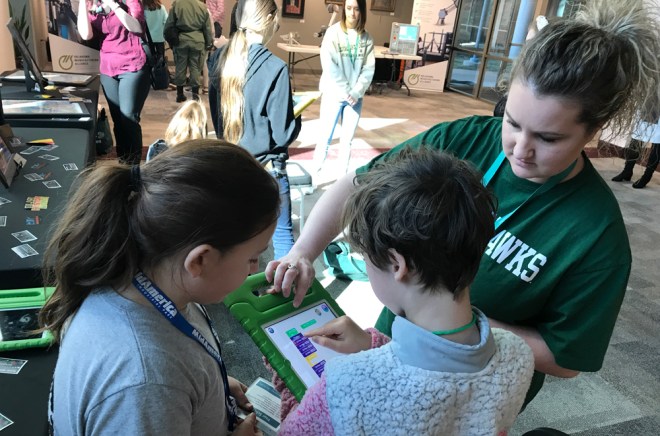
TABERC has developed a vibrant internship program to help bioscience research flourish in Tulsa, Curtis said. Student interns gain hands-on skills by working on real world research projects in participating laboratories

“I was just sitting here counting on my fingers about the number of interns we have placed over the last 13 years,” Curtis said during her presentation. “I’m thinking it’s somewhere between 60 and 70 research interns in just 13 years that we’ve provided hands-on bench experience with bioscience research.”

Educational institutions that compose TABERC are Northeastern State University, OSU-Center for Health Sciences, Oral Roberts University, Rogers State University, Tulsa Community College, Tulsa Technology Center, the University of Oklahoma-Tulsa, and the University of Tulsa.

“All of these internships are completely funded by dues paid by our member organizations,” Curtis said.

Internships are also a key element of OCAST’s mission to grow and diversify Oklahoma’s economy through technology development. Its Intern Partnership Program is a cost-share initiative that places Oklahoma college students in laboratories and business across the state.

For instance, the Oklahoma Life Science Fund, an early stage venture capital fund that focuses on biotech opportunities, has been awarded three past grants to employ interns through the OCAST program.

Fund manager William Paiva, Ph.D., was in the audience as Curtis pitched the TABERC program. Internships provide students with experiences that they can’t gain on campus, he said.

“Our interns spent 50 percent of their time looking at new deals, new investment opportunities doing the due diligence, doing the valuations, structuring the deals, helping raise the co-investors into the deals,” Paiva said. “The other half of their time I would actually loan them out to the CEOs of our portfolio companies to work on specific projects for the companies.”

“It wasn’t stuff you learn in the classroom,” Paiva said. “It was real world experience.”

Paiva said he recently submitted an application for a fourth OCAST Intern Partnership grant.

Meanwhile, TABERC’s Curtis wrapped up her presentation with an appeal to the networking luncheon audience.

“If you know of opportunities to place students or money to fund students, please talk to us,” she said. “We’ll put it to good use to train students and advance the research that will help make Tulsa a hub for bioscience.”

Other speakers at the bioscience luncheon included Dr. Kayse Shrum, president of OSU Center for Health Sciences and Oklahoma Secretary of Science and Innovation; Carol Curtis, Ph.D., with i2E, Inc.; Bill Murphy with the Tulsa Regional Chamber; and Paul Gignac, Ph.D., associate professor of Anatomy and Cell Biology at OSU-CHS.

Jim Stafford writes about Oklahoma innovation and research and development topics on behalf of the Oklahoma Center for the Advancement of Science & Technology (OCAST).

Tulsa’s AAON makes it rain – and snow – in high tech Norman Asbjornson Innovation Center


Editor’s note: This report was written after I toured the AAON manufacturing campus in Tulsa at the invitation of my friends at the Oklahoma Center for the Advancement of Science and Technology (OCAST).

By Jim Stafford

TULSA – Mark Fly can make it rain at the massive Norman Asbjornson Innovation Center on the manufacturing campus of Tulsa’s AAON Inc. And snow.

Fly is executive director of AAON’s new R&D laboratory, a 134,000 square foot building that opened in 2019, and was a key designer of the facility. The Norman Asbjornson Innovation Center (NAIC) consists of 10 testing chambers, some of which can simulate heat, cold, rain, snow, wind and humid or arid conditions to test the durability of AAON’s industrial heating and air conditioning equipment in the most brutal of conditions.

“In our extreme environmental chamber, it can snow up to two inches an hour or rain eight inches an hour and do so with a simulated wind of 50 miles per hour,” Fly told me and colleagues from the Oklahoma Center for the Advancement of Science and Technology (OCAST) as he recently led us on a tour of the NAIC.

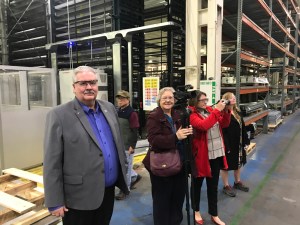
Mark Fly with AAON takes us through a tour of the company’s manufacturing and warehouse floor

“Our environmental chambers can be controlled to minus 20 degrees or up to 130 degrees, and humidity from 10 percent well into the 90 percent range,” Fly said. “We can simulate any outdoor environment in the world.”

AAON is a publicly traded (NASDAQ: AAON) manufacturer of commercial and industrial air conditioning and heating units. It employs approximately 1,900 people who work in 1.5 million square feet of manufacturing space at its Tulsa headquarters.

Named after company co-founder Norman Asbjornson, the NAIC provides AAON with testing capabilities that are unequaled in the industry, said Gary Fields, AAON’s president.

AAON employs 47 engineers among its 125-person R&D division affectionately known as “Area 51.”

“The innovation that we are noted for here at AAON is very much accentuated in this laboratory,” Fields said. “R&D has been the core value of AAON since the beginning.”

AAON was founded in 1988 when Asbjornson and partners purchased the heating and air conditioning division of the John Zink Company. Asbjornson is AAON’s CEO and chairman of the board.

Today, AAON employs 2,400 people across the company that also includes locations in Longview, Texas, and the Kansas City, Mo., area. Annual revenue is approximately $500 million from a diverse customer base.

“One of our premier customers that would be noteworthy would be the Jacob Javits Convention Center in Manhattan, N.Y.,” Fields said. “We shipped 26 units that were as much as 77 feet long; each unit took two truckloads to get to the facility.”

Nike Inc., on the west coast, is another premier AAON customer, Fields said.

OCAST has supported AAON’s R&D over the years with Oklahoma Applied Research Support (OARS) projects involving computer modeling on energy measurement and prediction, as well as controls, Fly said. The company also has been a participant in the OCAST Intern Partnerships program that places promising Oklahoma college students in real world work environments.

“Oklahoma has always been a very manufacturing-friendly state,” Fly said. “It is very supportive from both a tax and incentive standpoint, which includes programs like OCAST.”

Fly eventually led us into AAON’s sound test chamber that featured 12-inch thick concrete walls adorned with rectangular metal plates designed to echo sound.

“Customers want to know how much noise the equipment makes, because it may be going into a concert hall or a school,” Fly said as his voice reverberated back to us. “The sound is virtually the same everywhere in this room because of the echo.”

AAON performs acoustical, air flow and thermal testing simultaneously in the sound test chamber, Fields said.

“This capability exists nowhere else in the world,” he said.

Now that’s making it rain.

Jim Stafford writes about Oklahoma innovation and research and development topics on behalf of the Oklahoma Center for the Advancement of Science & Technology (OCAST).

The people’s choice in convenience store poll reflects shifting OKC market

OnCue store under construction at Western and Edmond Road

When I saw this story in The Oklahoman that the OKC 7-Eleven franchise had sold to the much larger Irving, Texas-based 7-Eleven Inc., my first thought was that the emergence of OnCue in the OKC market prompted this transaction.

OnCue is the shiny new toy in the convenience store market, and people naturally gravitate to what is new, clean and offers a bigger selection. OnCue is all those things, and it seems to be building new stores in every neighborhood across the metro. There is even one set to open in just a few weeks at the intersection of Western and Edmond Road, right across from the neighborhood we live in.

I won’t embarrass myself by admitting how giddy I was when I first saw the sign more than a year ago that OnCue was going to build at that location. Ask my daughter.

I figure that the sale of the OKC 7-Eleven franchise is similar to newspaper owners who see where the publishing industry is headed and sell their property while it still has value. They get out while they can.

All of that prompted me to run a poll on Twitter, where I asked readers to vote on which was their “go-to” convenience store brand: 7-Eleven, OnCue, QuikTrip or Love’s Travel Stops/other. I figured it would be neck-and-neck between 7-Eleven and OnCue.

Turns out it wasn’t close.

OnCue lapped the field, claiming 58 percent of 189 votes. Compare that to the 19 percent that 7-Eleven received, a smaller share than what QuikTrip got, and it has no stores in the OKC area.

I wasn’t surprised that Love’s Travel Stops trailed the field because most of its stores are convenience stops for highway travelers across the nation. It is our family’s go-to stop when we hit the highway.

Anyway, I was quite surprised by how OnCue ran away with this unscientific poll. For decades, 7-Eleven has been the destination of choice for people who need a late-night six-pack or an early morning cup of Joe on their way to work.

But that’s where today’s market is headed, even if 7-Eleven has remodeled its local stores and is building in new locations. We’ll see if new ownership can impact the trend.

Meanwhile, we noticed there is a sign in an empty lot at the intersection of Western and Danforth, just north of our neighborhood. “Coming soon: 7-Eleven.”

Bring ‘em on.

Art and The Unexpected at Stillwater’s HostBridge Technology

Warhol signed print collection in HostBridge Technology’s special events space

In my hometown of Fort Smith, Ark., there’s a downtown art project in which giant murals of contemporary urban art are painted on the sides of historic buildings. It is called The Unexpected.

The Unexpected came to mind when I stumbled across some of the world’s greatest art recently while in Stillwater to interview technology entrepreneur Russ Teubner, founder and CEO of HostBridge Technology. The ground floor of HostBridge’s unassuming downtown Stillwater headquarters is a virtual art gallery, highlighted by five large signed Andy Warhol original screen prints that are part Warhol’s Cowboys and Indians series created in 1986.

It was certainly The Unexpected for me and a highlight of my trip.

Russ Teubner poses with Warhol print of Teddy Roosevelt

Teubner placed the five Warhol paintings in a special events venue he created in what once was a shipping area for his previous company, Teubner and Associates, which was located on the same property. LED lighting highlights each print.

“I was lucky enough to source a number of very unique works of art, original Warhol screen prints that would not only define this space from a color and design standpoint, but tell the history of Oklahoma,” Teubner told me and my colleague, Debbie Cox, from the Oklahoma Center for the Advancement of Science & Technology (OCAST), as we first walked through the space.

Across one wall there was Native American legend Geronimo, along with Annie Oakley, Gen. George Armstrong Custer and a painting that depicted the Trail of Tears. A small sign above them read “Warhol.”

Along another wall hung a Warhol painting of Teddy Roosevelt, as well as a portrait of Warhol himself.

“Geronimo died in Oklahoma, Annie Oakley performed in Oklahoma, Custer fought in Oklahoma, the Trail of Tears ended in Oklahoma, and, of course, Teddy Roosevelt signed the state into existence,” Teubner said. “All those images not only remind us of the vibrance of a master artist, but also root us in our history.”

Russ Teubner in the HostBridge Technology art space

Teubner created the special events center as a community meeting space and for regular receptions hosted by his company. He was inspired to create an events center by Oklahoma State University President Burns Hargis, who renovated a downtown Stillwater building to serve as the OSU Art Museum.

The HostBridge Technology events center features a large bar area running down one side, and one of the world’s unique “wine cellars” along the back wall that was once Teubner’s computer server room.

“What do you do with an empty room that has five tons of air conditioning, world class fire suppression and very secure,” he said. “Well, that’s wine storage, right? Obviously. I took my old Dell storage cabinets, reengineered them and lit them up as wine storage cabinets.”

The wine “cellar” is highlighted by art pieces, and in adjoining rooms there are many other pieces of art, such as robots made from everyday objects, an old English telephone booth and a collection of drawings with humorous captions made by a former airline pilot.

We finally got around to our interview, but my day was made by Russ Teubner’s version of The Unexpected.

Tin soldiers and Nixon coming

Air Force One sits on the tarmac at the Fort Smith Municipal Airport on December 6, 1969; Winthrop Rockefeller (white hat in left photo), and Richard Nixon shook hands with the crowd before departing for Fayetteville.

On December 6, 1969, President Richard Nixon flew into Fort Smith, Ark., on Air Force One as he traveled to Fayetteville and the “Game of the Century” between the Arkansas Razorbacks and Texas Longhorns.

That makes today a huge personal anniversary for me.

I was among the approximately 2,000 people who greeted Nixon at the airport 50 years ago today. I was 16 and living in Fort Smith with my mom and sister while my dad served a tour of duty in Vietnam.

But I wasn’t there to protest the war. I was there to see history in the person of a sitting President arrive in Fort Smith, no matter how brief the visit.

I borrowed my mom’s car and drove out to the airport a full two hours before Air Force One arrived and snagged a great spot by the rope barrier that had been set up. Security was pretty light. No one frisked us or questioned us as we ran onto the tarmac area in an attempt to beat the crowd to the best viewing spot.

When Nixon finally arrived, I don’t remember any actual remarks, although there was a podium set up. But I do remember that he came down the line of people along the rope to shake our hands. He was accompanied by Arkansas Gov. Winthrop Rockefeller (white cowboy hat in left photo above).

When the President got about two people from me, someone apparently suggested that it was time to board the helicopter that would complete the trip to Fayetteville. Nixon turned away and took a step toward the waiting helicopter. The crowd let out a collective groan, and the President immediately turned back and resumed shaking our hands (mine, too!). He continued shaking hands down to the high school bands that were playing, where he shook hands with some of the young musicians.

It was a highlight of my youth, despite the fact that Nixon turned out to be, well, Richard Nixon. Watergate and the corruption of his administration surfaced years later.

Two memories stand out from that day.

One was shaking the President’s hand.

The second memory occurred before Nixon arrived. A guy holding a small Instamatic-type camera climbed on top of one of the barrels set up to hold the rope barricade and immediately drew sharp reprimands from the security detail. The camera guy was incensed as he climbed down, and yelled “come the revolution, you’re going to get yours!”

It was a sign of the times, even in a small Southern city like Fort Smith.

OU showcases Stephenson Cancer Center at End2Cancer conference

A scientists presents his findings at the End2Cancer conference at the Samis Education Center on the OU Health Center campus

By Jim Stafford

The University of Oklahoma Health Sciences Center and the NCI-Designated Stephenson Cancer Center delivered an academic doubleheader for about 200 cancer research scientists at the recent 2019 END2Cancer conference at the Samis Education Center on the Health Center campus.

For the main event, scientists came to share their research or hear presentations given by counterparts from across the country who are pursuing breakthrough discoveries in the area of cancer treatment. At the two-day conference, the scientists focused on emerging nanotechnology and cancer drug delivery applications.

At the same time, OU showcased its renowned Stephenson Cancer Center on the Health Sciences Center campus, said Rajagopal Ramesh, Ph.D., conference chair and professor, Department of Pathology at the University of Oklahoma College of Medicine.

“The whole idea in organizing this conference for the third consecutive year – beyond the science – was to put Oklahoma on the map and have the Stephenson Cancer Center recognized for the great science that we do in the diagnosis and treatment of cancer,” Ramesh said. “We have eminent speakers coming in from all over the country, and the majority of them have never been to the state of Oklahoma or to the Stephenson Cancer Center.”

The NCI-Designated Stephenson Cancer Center ranks in the top 50 in the nation for cancer care in the 2019-2010 U.S. News & World Report ranking and currently ranks No. 1 among all cancer centers in the nation for the number of patients participating in clinical trials.

“They were highly impressed,” Ramesh said. “The first thing I hear when they come in is ‘Wow, I never knew such an outstanding cancer center with top-notch research infrastructure exists.’ We wanted them to come in and have the opportunity to go to the Stephenson Cancer Center and look at some of the cutting-edge clinical trials we are doing at the center.”

Ramesh pursues his own cutting-edge research at the Stephenson Cancer Center, developing nanoparticles that can deliver drugs specifically to tumors and minimize the toxicity that is often a cancer treatment side effect. He specializes in the diagnosis and treatment of lung cancer.

Ramesh recently received a grant from the U.S. Department of Defense to explore a means by which tumor cells may be avoiding immunotherapy in lung cancer. The study is unique in that it is being conducted on lung cancer patients in real time while they are on a clinical trial receiving an immunotherapy medication.

The Oklahoma Center for the Advancement of Science and Technology (OCAST) also supports Ramesh’s lung cancer research with a $135,000 Health Research grant.

“OCAST has been beneficial not only to my lab but across the entire state of Oklahoma,” Ramesh said. “The whole idea of OCAST is to bridge the transition from academic research to an industry setting in the state of Oklahoma. By receiving funds from OCAST, we are able to generate new ideas and test them first in the lab.”

Wei Chen, Ph.D., professor and dean of the College of Mathematics and Sciences at the University of Central Oklahoma, is another OCAST-supported scientist who moderated an END2Cancer panel discussion and presented findings from his own nanotech-based research at the conference.

“Ending cancer is everybody’s dream,” Chen said. “So everybody in this conference and many researchers around the world are contributing to the fight against cancer. We are making good inroads both in terms of nanotechnology and other methodologies. But cancer is a very tough enemy, as we know. Therefore, we still have a long way to go.”

Jim Stafford writes about Oklahoma innovation and research and development topics on behalf of the Oklahoma Center for the Advancement of Science & Technology (OCAST).

Gear from Ada plant protects Oklahoma City firefighters and their counterparts across the globe

Globe Manufacturing plant manager Jannette Orr shows off a firefighters jacket under construction for the Oklahoma City Fire Department

Editor’s note: I recently traveled to Ada with my friends at the Oklahoma Center for the Advancement of Science and Technology, where we had the opportunity to tour a plant that makes “turnout” gear for firefighters across the world.  This is my report:

By Jim Stafford

ADA – Jannette Orr stood on MSA’s Globe turnout gear manufacturing floor in Ada and held up a firefighter coat that was under construction at the plant.

Bright yellow letters on the back read “OKLA CITY.”

Globe’s Ada plant and its 48 employees are producing 510 sets of three-layer firefighter jackets and pants for the Oklahoma City Fire Department, said Roger Page, Operations Manager for Globe’s three production facilities in Ada, Okla., Pittsfield, N.H. and Auburn, Maine.

“Recently, we reacquired the Oklahoma City contract,” Page said as he led me and colleagues from the Oklahoma Center for the Advancement of Science and Technology (OCAST) on a tour of the Ada production plant.

“Oklahoma City had previously been in our gear, and we’re excited to have them back,” he said.

Globe was founded in 1887 as a family-owned producer of protective clothing for firefighters and headquartered in Pittsfield, N.H. It was acquired in July 2017 by MSA Safety Inc., a publicly traded corporation headquartered in Pittsburgh, Pa.

Globe opened the Ada plant almost 16 years ago.

“We were having a really hard time hiring enough workers in the Pittsfield area, and we learned that Wrangler was leaving this area and had a very similar weight of fabric to that which we use,” said Page, who has worked for Globe for 36 years. “We decided to explore this area, and the Ada Jobs Foundation did a great job, almost recruiting us.”

Coalgate native Orr was among the former Wrangler employees who migrated to Globe, starting on the production floor as a stitcher. Today she is the plant manager, and personally trains new hires on the complexities of running sophisticated machinery.”

“Our workforce here is doing great,” Orr said. “We try to start them off on the right track. They work hard and steady. We make sure they have good benefits, because the employees here are like family.”

Globe uses what is known as the Toyota Sewing System in Ada to assemble the firefighter suits. It’s a manufacturing philosophy that began in Japan and moves each garment from station to station.

“As you look around the facility here, everything is done in single piece flow, with standup operations and more machines than there are people because they bump their operations as they go through the cell,” Page said. “It makes the operations a lot more flexible, and the workers aren’t stuck in one spot doing the same thing all day.”

Globe produces two of its seven styles of “turnout gear” or “bunker gear” – insider speak for firefighter protective apparel – at the Ada plant. Each firefighter garment has three layers that consist of an outer shell, a thermal liner and a moisture barrier.

“We have a host of options that can go on those base garments,” Page said. “For example, we have over 400 different sizes of radio pockets alone.”

Globe’s operation has benefited by a relationship with the Oklahoma Manufacturing Alliance, which is a partner with OCAST in the Oklahoma Innovation Model that provides assistance to small manufacturers and new ventures across the state.

“I’m just really impressed with the amount of effort that Oklahoma puts into supporting manufacturers, whether it’s the Ada Jobs Foundation, the Pontotoc Technology Center training center or the Oklahoma Manufacturing Alliance,” Page said. “All of that is phenomenal.”

In addition to Oklahoma City, Globe produces garments for firefighters in numerous other Oklahoma communities. Ada’s proximity to Oklahoma City afforded the city’s fire department an opportunity to eyeball their equipment under construction, Page said.

“It’s only fitting to be able to produce Oklahoma City’s firefighting gear an hour and a half away here in Ada,” he said. “They are excited to come down and watch their gear being built and meet the people building it.”

Jim Stafford writes about Oklahoma innovation and research and development topics on behalf of the Oklahoma Center for the Advancement of Science & Technology (OCAST).

Don’t criticize me! Steve Jobs shows how to respond to criticism


I’ve never responded particularly well to criticism.  I tend to have an instant reaction and lash out at the person providing the critique with words that I regret.  It’s something that I’m aware of and have to guard against constantly.

But it seems that I never handle it as well as I should. Call it a character flaw (among many).

Anyway, I saw this clip of Steve Jobs responding to an insulting question from an audience member at a 1997 developers conference. The guy wanted to show that Jobs didn’t know what he was talking about as far as software programming, along with a second question on what he had been doing the past seven years.

Jobs’ response blows me away. Instead of becoming angry and hurling an insult back at the guy (as I almost certainly would have), he sat and thought for several seconds. You can see that the wheels are turning as he formulates his answer and responds initially with a cliche about pleasing some of the people some of the time.  His long answer actually provided insight into why Apple developed products as it did.

Finally, he responds directly to the insult by admitting that he sometimes doesn’t know what he’s talking about and that mistakes will be made. At least someone is making some decisions for the company, he told the audience.  

Jobs’ response seems heartfelt and honest. It’s something I hope I can emulate in the future.  

I invite you to click on the video and watch Jobs respond to the insult.  I hope you find it as inspiring as I do.


A salute to our veterans and the Veterans Day Parade

The Purple Heart recipients float at the Fort Chaffee Veterans Day parade

My dad was a small town Southern boy from western Arkansas who built a successful career in the U.S. Army across three decades. As I understand the story, it began when he quit high school in the late 1940s and joined the Army.

For that, he earned a tour of duty in Alaska. But he missed a girl from back home in Booneville, Ark., and mustered out when his commitment was up.

He returned to Arkansas, married the girl and had a child – me – within a year. But running the local gas station wasn’t enough to support a family, so he re-upped in the Army.

This tour lasted until he retired from the military in 1976 and included assignments in Korea, Okinawa and 1969 Vietnam along the way.

I provide all that background because I was over in Fort Smith this past weekend to visit my widowed Mom. She told me she wanted to go to the annual Veterans Day parade at Ft. Chaffee that began at noon on Saturday.

The crowd lines the Veterans Day Parade route

I said ‘sure,’ although without any real enthusiasm or expectations. We picked up my niece, Katy, and headed out to Chaffee, most of which is now known as Chaffee Crossing and under development by the city of Fort Smith.

We found a place to park and walked to what turned out to be sort of Parade Central, which was right outside the military barbershop where Elvis received his haircut as he was inducted into the Army. It’s now a pretty fascinating little museum, which we toured.

For me, the interesting thing about the parade, which lasted about an hour, was watching the crowd and how the veterans among us reacted when various elements marched by. Local Junior ROTC troops marched by carrying American flags, and the vets snapped to attention.

My Mom watches the Veterans Day Parade.

Those marching in the parade were quick to say “thank you” to the veterans they recognized along the way who were wearing caps or other insignia that identified them as such.

It was a feel good event for both participants and onlookers, punctuated by a large group of motorcyclists who brought up the rear of the parade, came to a halt and dismounted as we watched. The leader commanded us to turn our attention the America flag behind us and led the Pledge of Allegiance.

Turned out, I enjoyed the parade and the people watching. I was so happy that I got to take my mom to see it, even if she decided that it wasn’t as long as the previous parade she attended two years ago. (“There were so many more antique cars in the last parade,” she told me.)

So, to Master Sergeant Archie A.J. Stafford and all your fellow veterans, I salute you and your incredible sacrifice for this country.

OCAST Health Research Conference puts focus on negotiating regulatory pathway to market

Dan Clark, cofounder and president of Linear Health Sciences speaks to the recent OCAST Health Research Conference

Editor’s note: I attended the 32nd  OCAST Health Research conference at the Samis Education Center on the Oklahoma Health Center campus, and heard a presentation on negotiating the regulatory pathway for a life science device company. Here’s my report:

By Jim Stafford

Once a year, the Oklahoma Center for the Advancement of Science and Technology (OCAST) gathers scientists from across the state who are currently receiving funding from its health research program in a sort of show-and-tell educational event.

Recently, about 100 OCAST-funded life science researchers assembled at the Samis Family Education Center on the Oklahoma Health Center campus for OCAST’s 32nd Health Research Conference. The event featured a keynote presentation from Dan Clark, president of Oklahoma City-based Linear Health Sciences.

Co-founded by Clark and Oklahoma City physician Ryan Dennis, Linear Health Sciences developed a patented device known as the Orchid Safety Release Valve (SRV), which prevents dislodgement of IV catheters in hospitalized patients. It is estimated that approximately 14 percent of all IV catheters are accidentally dislodged, which requires re-sticking patients and creates higher risks of infection.

“Our device is designed to mitigate that,” Clark said. “The concept is quite simple. If you’ve ever seen someone drive away from a gas station with the hose still in the car, the hose rips away from the terminal, but no gas is spewing from the terminal and no gas is coming out of the car.

“We did the same thing, but we did it for your veins.”

The Orchid Safety Release Valve has drawn interest from both potential hospital users and investors alike.

Linear Health Sciences attracted early seed investment from i2E Inc., a partner with OCAST in what has come to be known as the Oklahoma Innovation Model of supporting entrepreneurs and innovation across the state.

“We see a really big opportunity here,” said Carol Curtis, i2E’s vice president and director of investments. “If we can improve patient outcomes through the device, but also capture a good portion of the market, it’s a win for investors as well as patients, physicians and the health care system.”

Clark’s presentation to his audience of scientists focused on how Linear Health’s founders learned from their experiences as they negotiated the challenging regulatory pathway.

“The context of our device is not difficult to understand, but to put it into practice, all the way from design inputs and strategy to validating those inputs to traceability across all the different elements, that was tough,” he said. “We became students again.”

Linear Health has submitted what is known as a 510(K) application to the Food and Drug Administration, which is a premarket submission to demonstrate that its device is safe and effective. The company is relying on the expertise of contracted outside experts to help it navigate the regulatory challenges of advancing its medical device.

Clark’s advice to his audience of scientists hoping to advance their own concepts centered on utilizing contractors and external resources to manage the regulatory challenges that will confront them and shape their decisions.

“While you are designing your own experiments, your regulatory path is going to dictate what experiments and what understanding of methodologies is required to get there,” he said.

Clark said Linear Health anticipates FDA regulatory clearance of its device early next year, after which the Orchid Release Safety Valve should soon reach early adopters waiting to put it to use.

Jim Stafford writes about Oklahoma innovation and research and development topics on behalf of the Oklahoma Center for the Advancement of Science & Technology (OCAST).