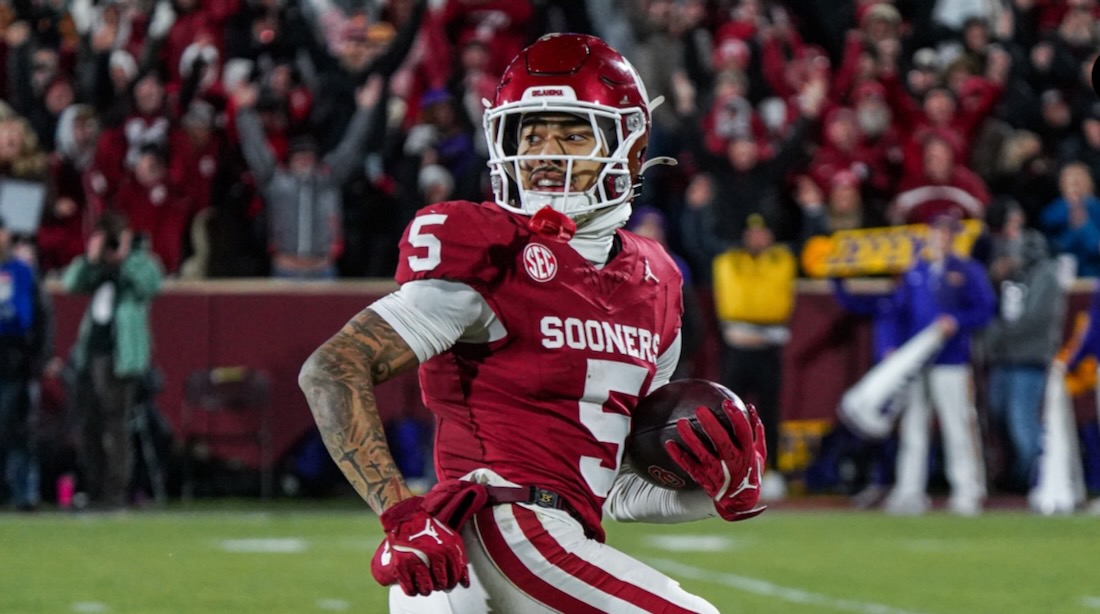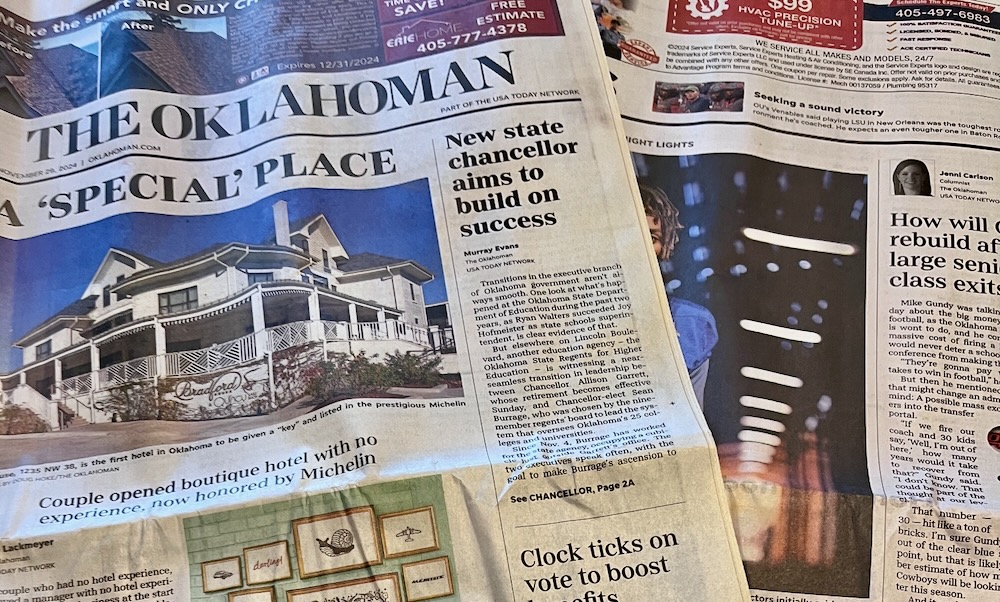
OU receiver Isaiah Sategna races toward goal line in victory over LSU.
When OU wide receiver Isaiah Sategna blew past LSU defensive backs in busted coverage last week to catch a game-sealing 58-yard TD pass, I missed the moment.
I could say that I was out back on our patio grilling or answering an unexpected knock at the door, but it would not be true.
The truth is that because it was late in a really tight game and I was invested in the outcome as someone who has bought into OU, I found something else to do at that moment.
Why?
Well, turning my back on a close game in which I have a rooting interest goes back many decades. I’m not even sure what to call it. Lack of courage? Can’t face reality?
Call it what you will, but I prefer to call it my double-reverse jinx.
As a pre-teen in the early 1960s, the Arkansas Razorbacks were my team. I lived and died with the Hogs. In those days, you mostly had only radio broadcasts on which to follow college football games.
So, when the Hogs were playing on an autumn afternoon I was tuned in — until I wasn’t. I specifically remember, when, in the second half of a really close game with the Razorbacks in a precarious position, I abandoned the radio, ran out into the back yard and started throwing a football around.
A few minutes later, I went back in and caught a couple minutes of the broadcast, but the outcome was still pending. I went back outside.
When the Hogs won that game with me not listening, I decided that all their success hinged on me not ever listening again when the outcome was on the line. Somehow, I controlled their fate.
My double-reverse jinx helped the Hogs have a great decade of success in the ’60s.
Fast forward to the late ’80s when I worked on the sports desk as a copy editor at The Daily Oklahoman. That meant that my daily working hours were from roughly 3-4 pm until midnight or 1 am.
Those working hours afforded the opportunity to drive out to the then-new Remington Park race track in the early afternoon on almost a daily basis to watch and wager on the horse races.
You know where this is going.
Yep, if I had $2 on a horse and it was among the leaders as they came off the final turn and into the stretch, I would turn my back and only listen to the track announcer’s call. One afternoon, I had maybe $5 on a horse and spent the entire race in the men’s room, safe from ruining the outcome by actually watching my horse.
I took a lot of grief from my newsroom colleagues for not being able to watch the outcome of races on which I had wagered. But that’s how I rolled.
Fast forward to 2025. It’s still how I roll when watching the Sooners, the Razorbacks, even the Thunder. When the game gets tough and the outcome precarious, I bail on the game.
And then it happens. Shai Gilgious-Alexander hits a game clinching 3. Isaiah Sategna makes a game winning catch.
The old double-reverse jinx does it again.
BONUS CONTENT: Don Mecoy, a friend and past contributor to BlogOKC, shared some of his own experience in not jinxing his favorite teams:
“Super Bowl V. Cowboys-Colts. I got on my bike during the game and rode and rode. Didn’t help.
“National Championship game in 2000. Sat in the same spot on the couch throughout the first and second half. Really had to pee by the end of the game. And I was hungry too. Literally didn’t get up once.”
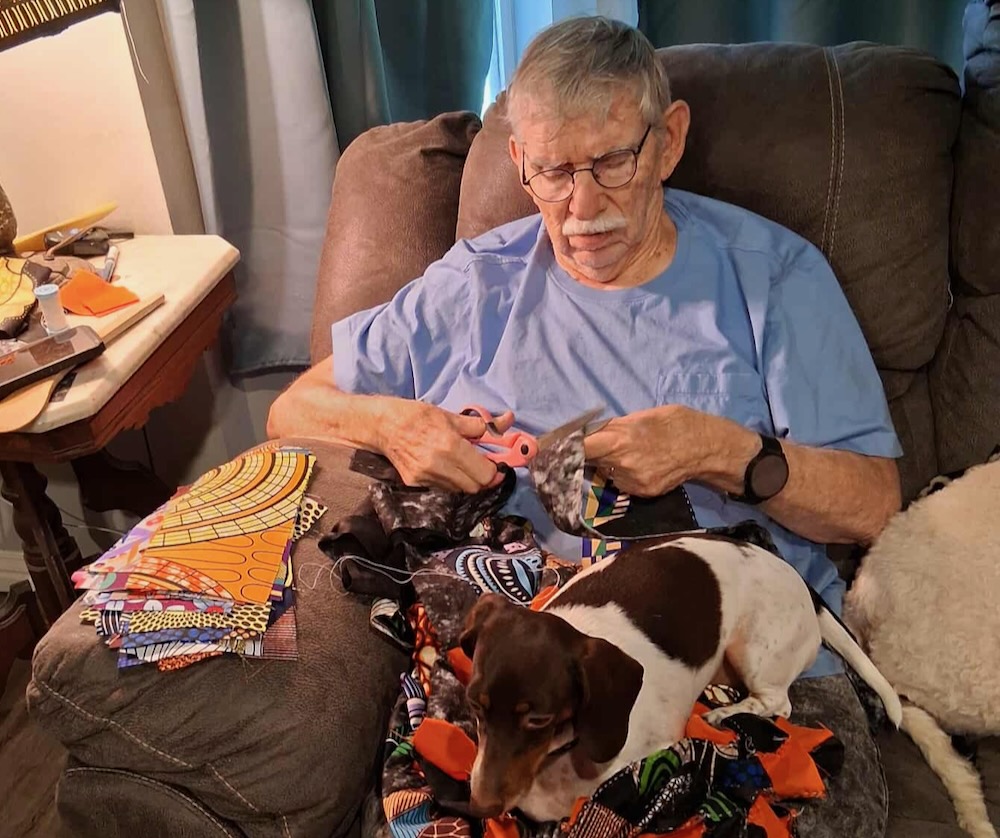
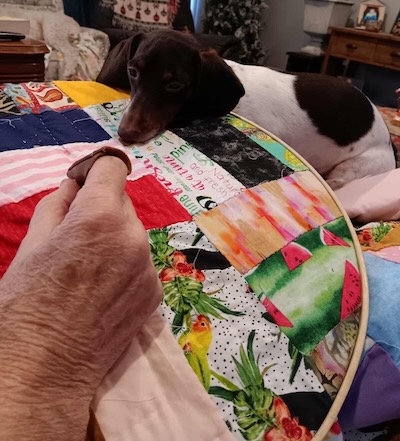
Frank Day works on a hand-stitched quilt, accompanied by one of his favorite pets.
Let me tell you about my friend Frank Day of Roland, OK, whom I have known since approximately 1971 when we both worked for Hunt’s Department Store in Fort Smith, Ark.
Over the years, we drank gallons of coffee together, ran trot lines at 2 am in the Arkansas River and stalked raccoons in the middle of the night in the Paw Paw Bottoms, among other adventures.
But life took me to Oklahoma City in 1983 for a job with The Daily Oklahoman newspaper, so we haven’t seen a lot of each other in the intervening years.
Today Frank is 75 years old and retired after more than two decades as fleet sales manager for Fort Smith’s Randall Ford. I think he can best be described in 2025 as a one-man quilting bee.
What?
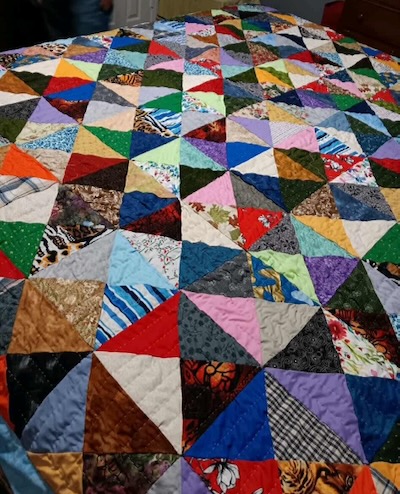
That’s right. Frank Day began hand-stitching beautiful quilts over two decades ago, and continues his quilting avocation today.
Frank, I thought I knew you.
There goes my image of the typical quilter as someone’s grandmother.
Turns out that quilting is something Frank learned as a child from his mother, Dortha Day and turned it into an ongoing hobby many decades later.
“When I grew up, Mother was quilting all the time,” Frank told me. “She belonged to a quilting club, a bunch of women who got together at someone’s house and could finish a quilt in one day. I grew up watching her, and she showed me how to do it.”
Frank’s wife of more than 50 years, Vicki, added her perspective.
“Frank’s mother Dortha always had a quilt rack on the ceiling,” Vicki said. “I remember Granny, everyone called her Granny, quilting on the old quilting frames and singing hymns. When the grandchildren came along they would all play under the quilt frame.”
However, Frank had never made a quilt until his first grandchild was born more than 20 years ago. He produced his first quilt for grandson, Trevor, and has continued quilting through the years.
“I said I’m going to get some material and make a quilt,” Frank said of that first attempt. “Vicki said ‘you don’t know how.’ I said, ‘you watch me.’ I got the material and sat down and started sewing. And I got it done.”
That first quilt led into one for each grandchild, then special quilts for relatives and friends. Sometimes he makes them for folks who’ve had a stretch of bad health or difficult life situation, like a former coworker at Randall Ford to whom he presented a quilt.
“She started crying, but it was because she was happy to get it,” Frank said.
A quilt is not made in a day. Or a week. It might require more than a month of work for a solo quilter like Frank Day.
“From start to finish, if it’s a king-sized quilt, you have about 250 hours in it,” he said. “That’s cutting the material out — I hand sew everything, nothing is made on a machine. I hand stitch it, get the backing for it, get the lining for it and put the blocks on top.”
Did you catch that … 250 hours for a single quilt. That’s 6-1/4 40-hour working weeks of quietly sitting alone stitching blocks of material together into what can be a beautiful pattern.
My own grandmother was a quilter, and I recall she had a large wooden frame that she let down from the ceiling that helped her make her quilts.
Frank uses a ‘hoop’ that he holds in his lap as he quilts. Usually, one of his favorite dogs is sitting nearby or even on his lap as he quietly works.
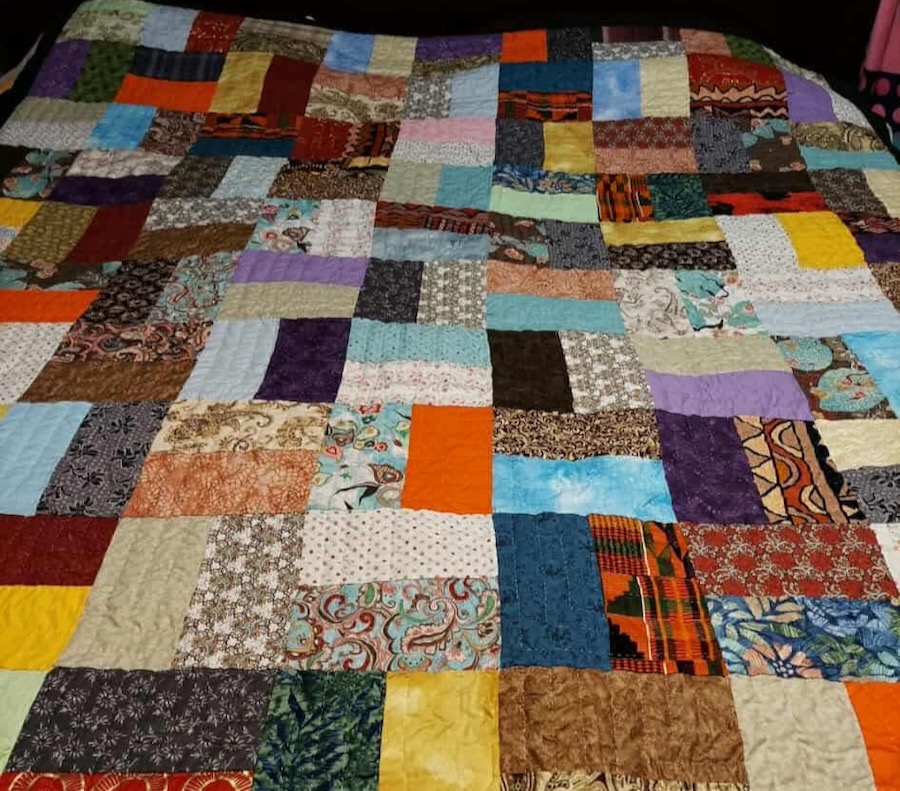
Although he hasn’t made quilts to sell, Frank told me that comparable hand-made quilts can be priced at $1,800-$2,500 because of all the time required to produce one.
“It’s very time consuming, and most people don’t have the patience for it,” he said.
I learned that Frank was a quilter after Vicki posted some pictures of beautiful quilts on Facebook and I complimented her on her quilting talent. She corrected me and said it was all Frank.
“When Frank made his first quilt before Trevor, our first grandchild, was born, we had been married for 30 years and he never made one before,” Vicki said. “I asked him why he never made one before and his answer was “I never had a reason to make one.”
“Frank’s quilting has bloomed over the years. He made one for our son, Paul, as a wedding gift and then for our daughter Jenny. He made one out of cancer warrior scarves that Ford gave to dealerships for Breast Cancer Awareness.”
Each quilt is made with a purpose.
“Frank had a good friend, Dudley Sparkman, who was the best man and friend you could ask for,” Vicki said. “Sadly, he had a massive heart attack on his 50th birthday and passed around two weeks later. Tina Sparkman, Dudley’s wife, asked Frank if he would make a lap quilt out of some of his shirts. That was probably one of the hardest quilts he ever made because on the friendship they shared.”
Quilters like Frank Day who make the time to sit and hand-stitch a beautiful design are a rarity in 2025. Today, most quilts are machine stitched.
Frank calls hand-made quilting a “dying art” that he’s keeping alive in his corner of the world. Currently, he’s working on a quilt for Vicki as he recovers from a recent knee-replacement surgery.
“It’s helped me keep my sanity when I’ve had to sit for long stretches as I recovered from knee surgery that put me down,” he said. “I’ve finished one and got close to half of another one put together.”
It’s one stitch after another after another for a quilter like Frank Day. That translates into hundreds of hours to produce just one quilt.
It’s a marathon, not a sprint.
Frank has run that marathon for more than two decades.
And that’s why I describe him as the ultimate one-man quilting bee.
BONUS CONTENT:
I asked ChatGPT to explain the concept of a “Quilting Bee” to me. Here’s what it told me:
A quilting bee is a social gathering where a group of people—traditionally women—come together to work on quilting projects, usually a large quilt, while also enjoying conversation and community.
Key Features:
– Collaboration: Multiple people contribute to making one quilt. Often, the quilt top is pieced together ahead of time, and the bee focuses on quilting (stitching the layers together). – Social aspect: It’s as much about socializing and bonding as it is about the sewing. These gatherings were historically important social events, especially in rural communities. – Tradition: Quilting bees have roots in 18th and 19th century America, when they served as a practical and communal way to create bedding before mass production. – Modern bees: Today, quilting bees still exist, though they might be less formal or might happen in quilting guilds, workshops, or even online.
Think of a quilting bee as a mix of a sewing circle, a social event, and a creative collaboration.
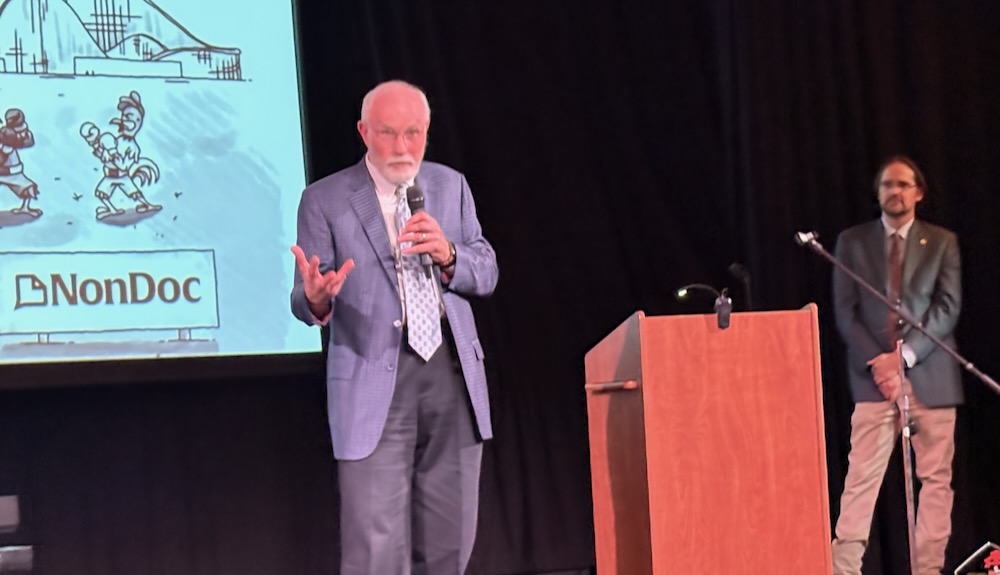
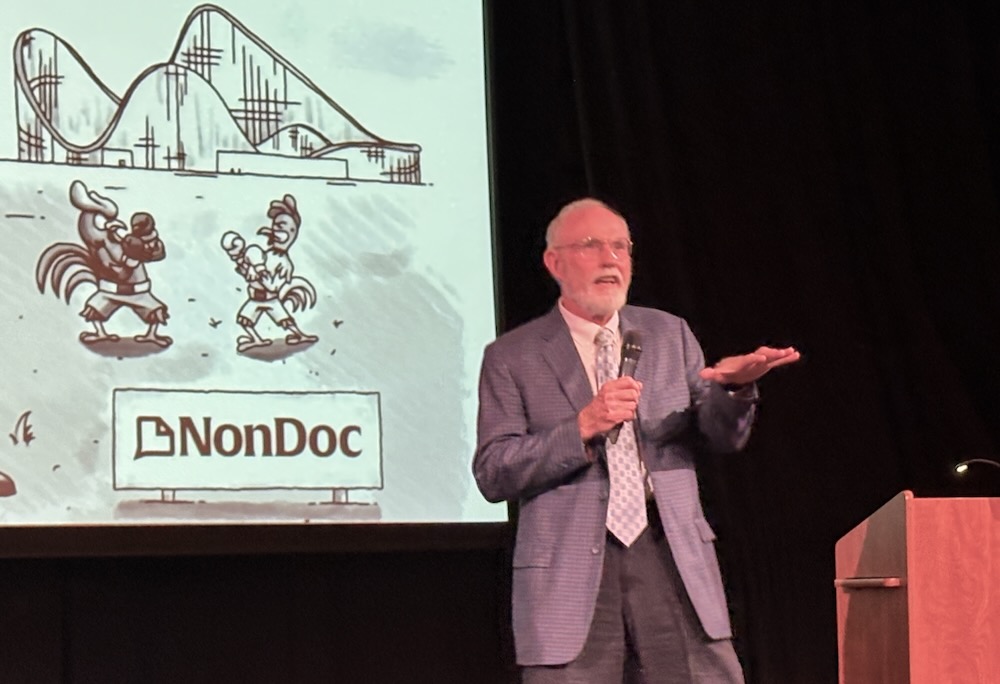
Michael McNutt tells a story as he addresses the audience at his Nondoc retirement ceremony
Michael McNutt’s retirement celebration from the NonDoc online news organization was under way earlier this week when he shared a story with me from almost 30 years ago and said I played a role.
A story for which I had no recollection.
Michael is a friend and former colleague at The Oklahoman who served as the newspaper’s Enid correspondent for probably a decade before moving to the Oklahoma City newsroom.
McNutt’s retirement ceremony, organized as a fund raiser for NonDoc, was outstanding. I’ll come back to it.
As for the memory that he shared with me, McNutt recalled that I was assigned to help him conduct a focus group for The Oklahoman in northwest Oklahoma in advance of the 1996 presidential election. Michael said that I called him on the day of the focus group and alerted him that I was going to be a no-show because my wife and I were having a baby — in Abilene, Texas.
I don’t recall the focus group assignment, but I do recall that on June 18, 1996, Paula and I received a call that the baby we hoped to adopt was to be born that very day in Abilene. We jumped into the car, drove 330 miles and arrived at Abilene’s Hendrick Medical Center in time for the birth of our son, Ryan.
Anyway, it was a story that took me back to that milestone event, and obviously was an event that stuck in McNutt’s mind over the remainder of his reporting and editing career.
A St. Louis native, McNutt worked as a reporter and editor for The Oklahoman for nearly 30 years. He had a distinguished post-newspaper career, as well, working for an Oklahoma governor and a state agency, before the recent tour with Nondoc.
NonDoc honored Michael with this week’s celebration because he is retiring as managing editor of the enterprising, not-for-profit online news organization that fills a lot of holes left behind by the decline of traditional newspapers.
McNutt’s retirement celebration brought me and about 75 others to the Will Rogers Theater events center on Monday evening.
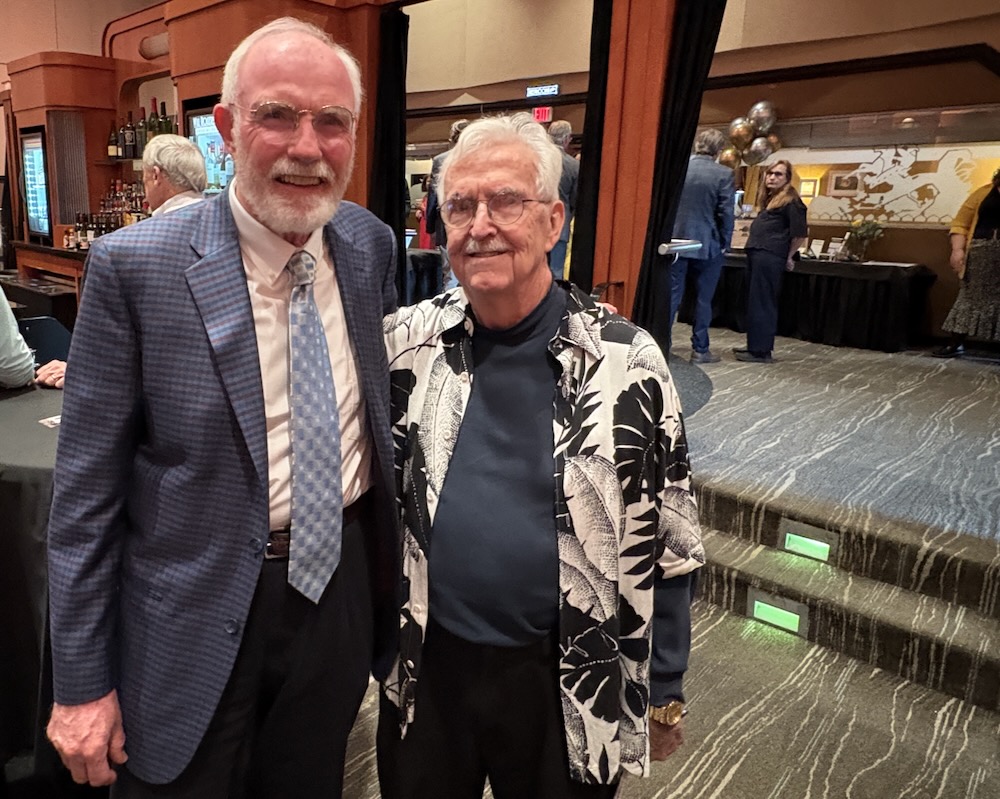
Michael McNutt with Mick Hinton, a former colleague at The Oklahoman.
Throughout his 40-year journalism career, Michael earned the respect of his colleagues, as well as elected officials across the state and of the people he really served — readers of his reporting and editing through the years.
I didn’t work on a day-to-day basis with Michael at The Oklahoman, but I got to know him as a thoughtful, approachable, empathetic person, as well as a baseball fan who remains devoted to his St. Louis Cardinals in both good times and bad.
A University of Missouri graduate, McNutt began his journalism career for the Rolla, Mo., newspaper before taking a job at the Enid News & Eagle in the 1980s. His wife, Kathryn McNutt, is also a longtime editor/reporter and veteran of The Oklahoman who now works at OKC’s Journal Record.
McNutt told me that he left The Oklahoman’s Enid bureau position in 2000 to become an editor and reporter in the paper’s OKC newsroom. He held editing positions on the state and city desks, and also covered the state capitol for eight years.
After leaving The Oklahoman in 2013, Michael served as spokesman and communications officer for Gov. Mary Fallin, before assuming the role of communications director for Oklahoma’s Office of Juvenile Affairs. He took the Nondoc position about two years ago.
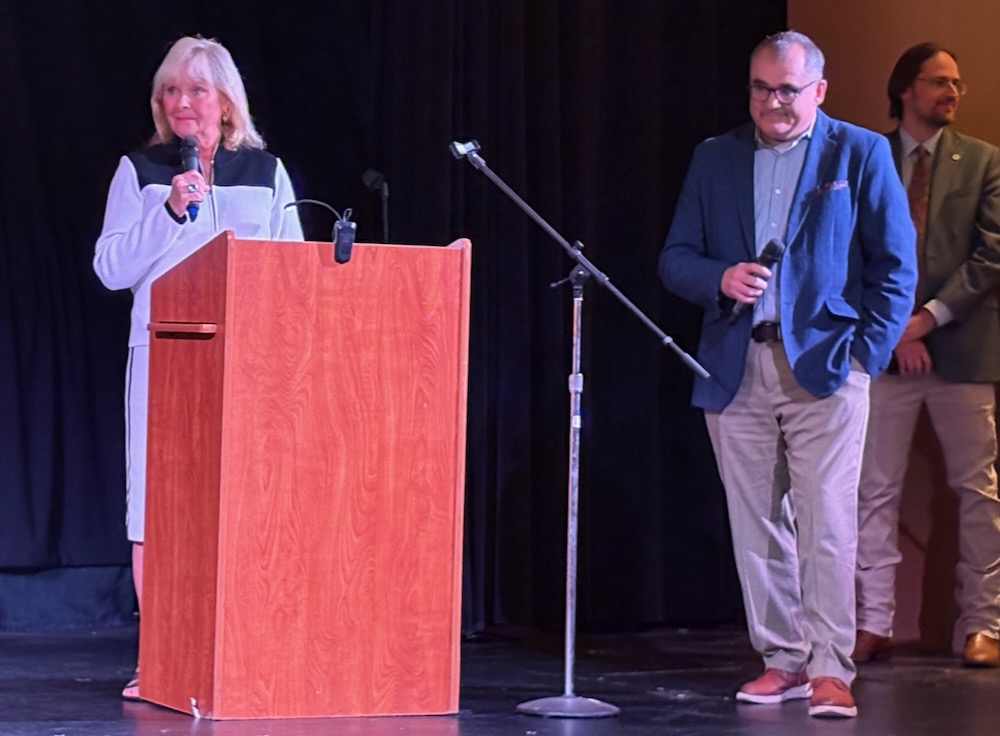
Former Gov. Mary Fallin shared the stage with Steven Buck, former administrator of the Oklahoma Office of Juvenille Affairs.
You could see evidence of the respect Michael earned in the audience at the NonDoc retirement ceremony. The room was filled with former newspaper colleagues, as well as state agency and elected officials, including former Gov. Fallin.
In fact, Fallin was a featured speaker, hailing McNutt for the work he did on her behalf, but also sharing some funny moments from his years on her staff. She was joined on stage by Steven Buck, who was OJA Administrator when Michael moved from the Governor’s office to that agency.
Buck shared his thoughts with me on the experience of working with Michael at OJA:
“When I found myself seeking a communications director for the Office of Juvenile Affairs, Michael quickly emerged as the best candidate. I had known him previously and greatly respected his work ethic but to serve as a lead advisor to me, I needed some one with great discernment, communication ability, confidence to hold me accountable and, of most importance, a commitment to mission and serving kids. There was not a single day in our work together that I regretted hiring him; he far exceeded my expectations and remains one of my most trusted colleagues.”
That’s the highest of praise.
I thought Tres Savage, NonDoc’s editor-in-chief, did a terrific job as emcee of the event, which served as a fundraiser for the Sustainable Journalism Endowment. The endowment provides funding for NonDoc to operate.
McNutt was the final speaker of the ceremony and told an intriguing story about how he was ‘almost fired’ from his job as a new reporter for the Enid newspaper just because he did his job. Michael said he received a tip that Enid city councilors met in secret at a local restaurant before each Council meeting and, along with a newspaper photographer, he “crashed” the meeting.
Michael McNutt speaking as Tres Savage, Nondoc’s Editor-in-Chief, looks on.
After his story appeared in the next day’s newspaper, a group of councilors marched into the editor’s office demanding that he be fired. The editor stood behind his reporter and told the elected officials to “follow the law.”
As for me, I had a terrific time at McNutt’s sendoff, greeting lots of my former Oklahoman colleagues, sharing time with both Michael and Kathryn and laughing at some of the stories I heard.
It was like a grand reunion.
Thank you, NonDoc, for giving him such a well deserved retirement recognition and to my friend, Steve Buck, for inviting me to sit at your table.
We’re all better off because of the work that Michael McNutt did over his career.
BONUS CONTENT — While Michael told me a story about an event I didn’t recall, I also shared with him about the first — and only — time I visited his office at The Oklahonan’s Enid bureau. Since I was from the “home office” of the paper and worked in the opulent (now former) newsroom along Broadway Extension, I had visions of McNutt working out of a similar abode in Enid. However, it turned out that he worked in a tiny office in a corporate building that was like a 1960s time capsule. I’m not sure exactly what I expected, but today all I can see in my mind is the bright green shag carpet in his office.
DOUBLE BONUS CONTENT — As I was visiting with Kathryn McNutt, along with other well wishers, someone brought up Michael’s avocation of making a daily, early morning run, no matter the weather. She told us that when the weather turned cold and the terrain ice covered, she made sure he wore baseball cleats on his run. One of the speakers at the retirement event spoke of once confronting a man in his neighborhood who was running in early morning darkness and wearing a ski mask, hockey jersey and baseball cleats. It was, of course, Michael McNutt.
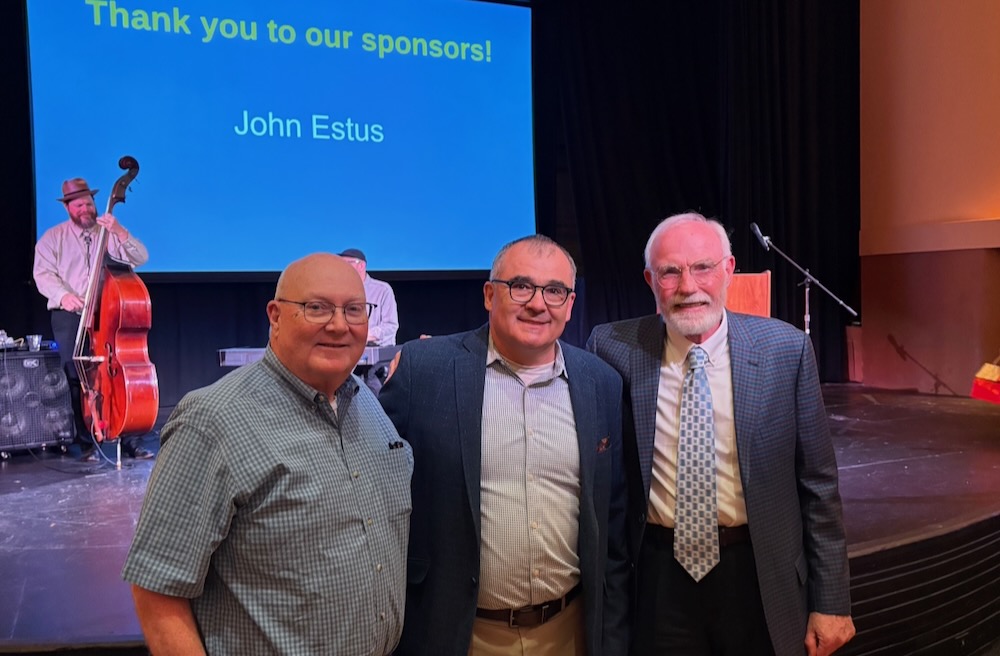
From left, Jim Stafford, Steven Buck, Michael McNutt
A screenshot of The Gold Sheet taken from a Chicago Sun Times article.
Here’s a memory that goes back to the 1980s when I worked in the downtown OKC newsroom of The Daily Oklahoman.
Every Thursday afternoon during football season, I would walk about three blocks down to Taylor’s Newsstand from the paper’s Broadway & 6th Street headquarters.
You might remember Taylor’s Newsstand. It was located in the Century Center mall attached to the Sheraton Hotel. Taylor’s offered an awesome variety of magazines and newspapers from around the country. I fact, I bought a lot of Sunday papers from Denver, Kansas City and Dallas at Taylor’s over the years.
But that’s not what drew me to the newsstand on Thursdays in the fall. It was a publication that Taylor’s sold called The Gold Sheet.
Man, I loved to get my hands on The Gold Sheet each week.
If you are unfamiliar with it, The Gold Sheet was a football handicapping publication. A tout sheet. Still is, in digital form.
It was printed on heavy gold paper that unfolded into a large single sheet that contained predictions and analysis on every Division 1 and NFL football game for the coming weekend.
I’m pretty sure that my friend ‘David’ introduced me to The Gold Sheet, and I became a loyal reader.
I wasn’t much of a gambler, but coworkers at the newspaper in that mid-1980s era connected me to a bookie here in town who would would take my tiny wagers of $10 or $20.
So, The Gold Sheet became a big part of my weekly rhythm throughout the 1980s, when I was still single and willing to wager a few dollars on football.
Yes, I know it’s shocking that gambling on football (and other sports) occurred in OKC. But it did in the ’80s, and I’m certain you wouldn’t have to work too hard to find a bookie today who would take your wagering action.
A Bold Prediction: Oklahoma will have legal, online sports wagering within the next 5 years.
As for The Gold Sheet itself, it contained a prediction on the outcome of every game along with a couple of sentences that backed up each pick. It made for great reading, if nothing else.
Maybe because today is Super Bowl Sunday– by far the No. 1 day annually for sports wagering (sorry Final Four, Kentucky Derby et al) — I stumbled across a reference online this morning to The Gold Sheet.
And that got me to wondering what became of my favorite handicapping publication.
So, I did a little online research and discovered a Chicago Sun Times article from 2022 that revealed that it is now part of an online handicapping website called WagerTalk Media.
The article also outlined the history of The Gold Sheet, which was launched in Los Angeles by the late Mort Olshan in 1956. It remained a physical publication until the end of the 2019 football season, when it morphed into a digital publication.
A wave of nostalgia washed over me when I discovered the Chicago Sun Times article, which included a picture of The Gold Sheet from back in the day.
My weekly wagering days are long gone. But The Gold Sheet remains a fond memory of that time in my life.
BONUS CONTENT: Steve Lackmeyer, my friend and former colleague at The Oklahoman, wrote about the demise of Taylor’s Newsstand when it finally closed for good in 2009. Turns out The Gold Sheet outlasted the newsstand where I first discovered the publication.
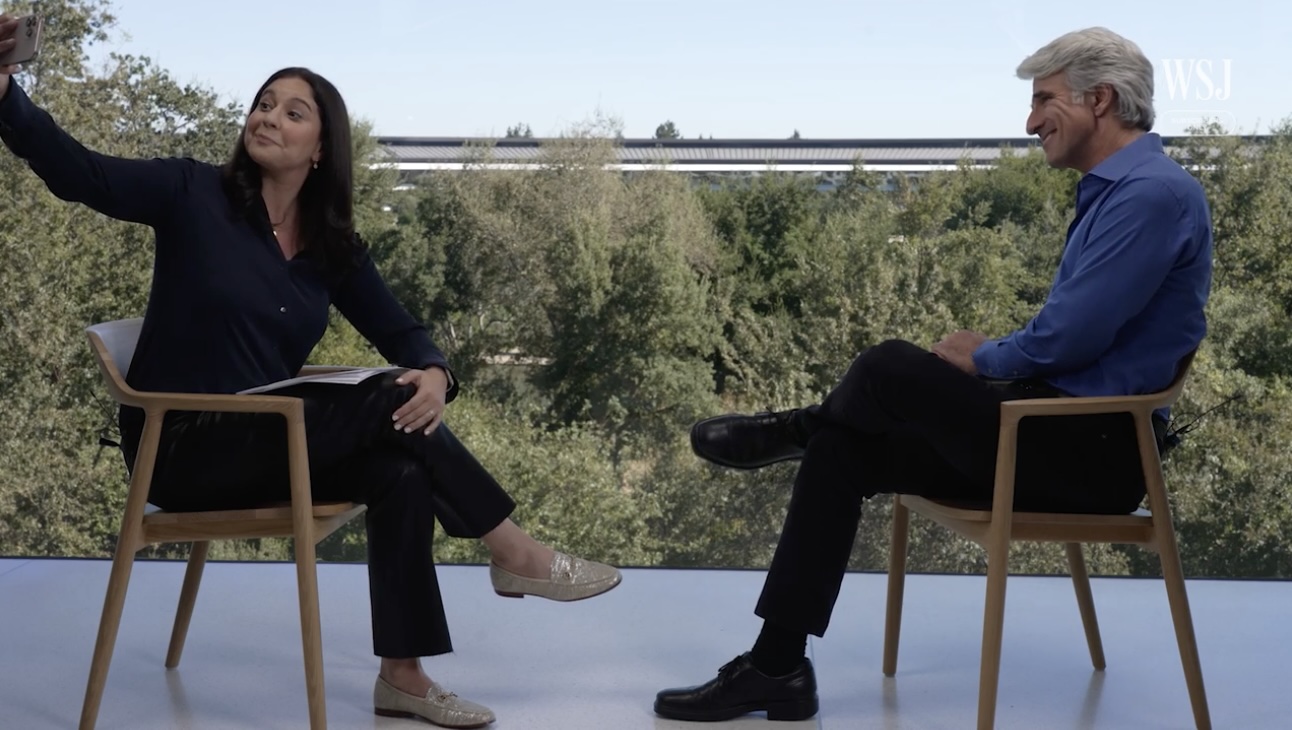
The Wall Street Journal’s Joanna Stern takes a selfie with Apple software chief Craig Federighi
If you’ve ever been fooled by a photo that had something added — or eliminated — you should watch this fascinating video interview by Wall Street Journal tech reporter Joanna Stern with Apple Inc.’s software chief Craig Federighi. The interview focused on Apple Intelligence, which is Apple’s version of artificial intelligence.
Near the end of the 25-minute interview, Stern raises her iPhone and takes a selfie of herself and Federighi as they are seated across from each other at the company’s Apple Park headquarters in Cupertino, Calif.
Then it got really interesting.
Stern showed the photo to Federighi and, using Apple’s most recent photo editing software, quickly edited out a water bottle and a microphone that the photo had captured.
She edited the photo with the intention of showing how easy it is to remove unwanted objects from photos, then asked Federighi about Apple’s approach to allowing users to alter reality in their photos. Or even adding in objects or people who weren’t there.
Federighi’s thoughtful answer about Apple’s decisions on limiting AI use in its photo software intrigued me.
“There were a lot of debates internally, ‘do we want to make it easy to remove that water bottle or microphone’ because that water bottle was there when you took that photo,” he said. “The demand from people to clean up what seem like extraneous details in a photo that don’t fundamentally change the meaning of what happened has been very, very high. So we were willing to take that small step.”
However, the company ensured that if a photo was altered, it was reflected in the metadata for that photo. And Federighi said Apple drew a line on further editing to alter the reality of their photos.
“We are concerned that the great history of photography and how people view photographic content as something that you can rely on, that is indicative of reality …” Federighi said. “And our products, our phones are used a lot, and it’s important to us that we help convey accurate information, not fantasy … we make sure that if you do remove a little detail in a photo, we update the metadata on the photo so you can go back and check that this is an altered photo.”
It’s clear that Apple has given this subject a lot of thought and is working to distance itself and its software from ‘deepfakes’ that seem to be showing up everywhere. Just check your Facebook feed.
Here’s a link to an article in Info Security Magazine that lists the top 10 deepfakes from 2022.
That debate over editing photos took me back to my days as a reporter and editor at The Oklahoman in the 1980s and 1990s. It was a time certainly before digital photos and software that let you easily alter the reality of a picture.
However, I recall there was quite a debate at the paper over whether drinks in the hands of people at a party should be edited out, by cropping or by being retouched by an artist.
So, editing photos has been an issue for decades.
And that led me to contact Doug Hoke, The Oklahoman’s current photo manager who worked at the paper all through the pre-digital age of the ’80s and ’90s.
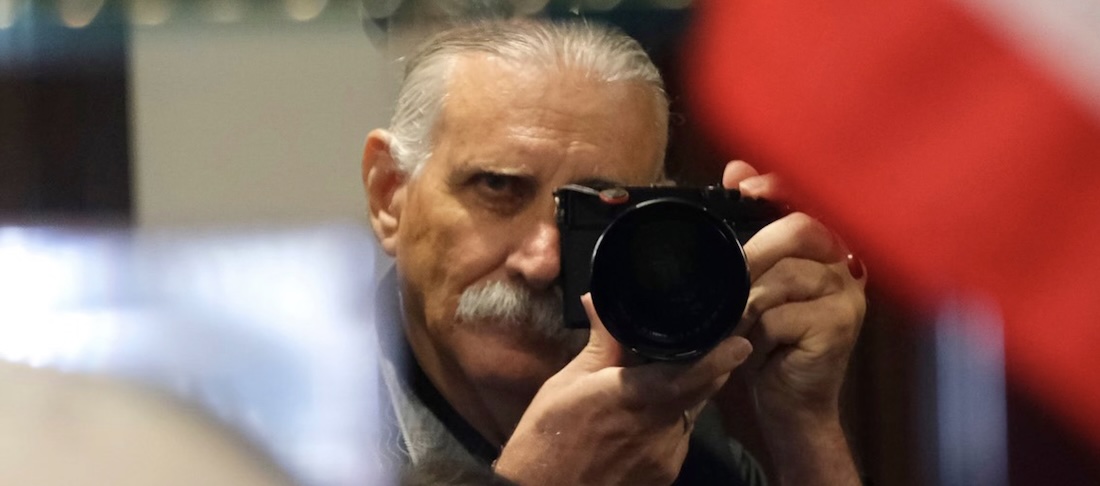
Doug Hoke from his profile image on Facebook.
Doug is one of my favorite photographers, with a long history of shooting great photos. His work was regularly featured in Sports illustrated in the pre-digital days.
I asked Doug if my memory was correct and altered photos were an issue back in the day. Here’s what he said in response to the question:
“Way back when if Gaylord (the publisher) didn’t want something in the paper, it wasn’t there,” he said. “The airbrushing of photos was originally done to help with the reproduction, as coarse screens and letter press technique left much to be desired. That evolved into the removal of items, like cocktail drinks, (or) the adding of details like clothing, lengthening hems, adding material to swimsuits, closing up v-necks, etc.
“When the digital age hit, the ease that photos could be altered called for new guidelines for photography. What is the common practice now is no pixels should be added or removed, except by cropping, and cleaning up dust spots on the chip. Toning and adjusting contrast should only be to help reproduce the image as accurately as possible.”
Doug said he supports Apple’s limits to digital editing that distorts the reality of photos.
“When Apple first announced that they would only allow small details to be removed, I applauded them,” he said. “Craig is correct that photography is based in reality, and I firmly believe that the photos should remain as untouched as possible. You may think that water bottle is in the way, but future generations will look at these details with amazement. Think of old photos you look at, you study every detail in the photo to get a better sense of history. If we remove all those details now, no one will ever see them.”
There’s a distinction between photograph and a photo illustration, Doug said. Or there once was.
“The line between photograph and illustration has been blurred and will never be the same,” he said. “Publications try to hold onto the strict guidelines of what is a photo and what is an illustration but the public probably doesn’t really care. I don’t think the general public has a strong grasp of reality anymore. Games, TikTok, IG, X, whatever they look at. If they think an image is cool they like it without giving any thought to whether it is accurate or not.
“We have had to reject several ‘photos’ that were obviously enhanced by AI, mostly portraits. Accepting photos from unknown sources will be a huge lift in the near future as AI will just continue to get better. Really glad Apple took a stand and said just because we can doesn’t mean we should.”
Did you catch what Doug said? The public is suffering from both ignorance and apathy on whether a photo has been altered.
But we should be concerned. Thank you, Apple, for taking a stand.
A few years ago my former colleague at The Oklahoman newspaper, Richard Mize, lamented the demise of the metal coffee can. The coffee industry eliminated the once ubiquitous coffee can and replaced it with plastic cans or closable pouches.
“Where will we put our bacon drippings?” Richard asked.
Good question, Richard. The coffee industry was totally unconcerned about the fallout in households across the nation where bacon grease was stored in empty coffee cans. How dare they.
Anyway, I see a similar crisis brewing in American households. Newsprint is rapidly disappearing from our driveways and kitchen tables.
Instead of picking up our actual paper from the driveway each morning, Americans are more likely to read an online version — or, more disappointing, not read any newspaper at all.
Earlier this year I wrote about the decline of my first newspaper employer, the Southwest Times Record in Fort Smith, Ark.
In fact, I’ve seen firsthand the impact the shortage of old newsprint has had on my neighbors in recent years.
Since I am virtually the only print subscriber of The Oklahoman on my street, a neighbor twice asked me for my old newspapers to use for packing before she moved and again when her daughter moved into her own apartment. I gladly shared my bounty of old newsprint.
So this leads me to the point of this post: how we’re going to miss the many ways old newspapers are used around the house — or used to be. Here are a few:
As liner for a birdcage (now that’s low-hanging fruit, I know).
As fish wrap (a common newsprint stereotype).
Lining the floor next to an outside door when potty training your puppy. It worked on my now departed Boston Terrier decades ago.
Packing in preparation to make a move (see example above)
Creating pirate hats. As children, my sister and I learned to fold the newspaper into the most awesome pirate hats we could imagine. We proudly wore them around our house or paraded through the neighborhood.
Making kites. My dad made a newsprint kite for me when I was about 10 years old, and it actually flew as well as the store-bought kind.
As floor liner when doing a paint job or an art project.
Newsprint is great as backing on a counter when you are cutting a watermelon, then wrapping the rinds before throwing them out.
Packed away in your closet or attic to hold on to keepsake articles for the memories.
Current event articles clipped for school projects.
Finally, a rolled up newspaper makes a fine rod of discipline for a wayward pet. I only had to roll the paper up and raise it above my head to stop my Boston Terrier from committing an offense such as chewing up a shoe.
We’re going to miss newsprint for many reasons beyond just reading the paper when its gone.
BONUS: If you’ve got other ways you’ve recommissioned old newspapers in the past, leave them in comments below.
This just in from my friend Josh O’Brien on an alternative use for old newspapers: “Another use: cleaning big mirrors or windows — much better than paper towels.”
Richard Mize (see above) added: “One more thing: I use three sheets of newsprint to light my charcoal chimney for grilling!”
From David Yarbrough in Fort Smith, Ark: “Use as fly (or wasp) swatter, although not as ergonomically designed as plastic ones.”
One more from Linda Lynn: “Gift wrapping. And to protect table from kids’ art projects … and for art projects like collages and paper mache. We even used to create Christmas trees with newspaper.”
From Steve Barrymore: “I save mine all year then use as a weed barrier in the garden at planting time. I then cover it with mulch. Eliminates weeding.”
From Kathy Consbruck in Nebraska: “Mine go to the pet shelter. They line the kennels with them.”
From Phyllis Welsh Bennett: “A long time ago, I used strips of colored Sunday comics to make a chain to adorn a Christmas tree at The Oklahoman. Last week I gave a stack of old papers to someone needing it to pack glassware for a move. Each weekday I put my newspaper in the waiting area of the Teachers’ Retirement System. I’m told a lot of TRS members enjoy reading a paper newspaper!”
From LaRita Dawn Watson: “I save mine for my Dad to read since he lives outside the delivery area and won’t read the online version. I have used to clean windows and mirrors, and it works better than any cloth! I’ve used it in all the ways mentioned and will truly miss it when it’s gone. It feels good to turn the pages and read.”
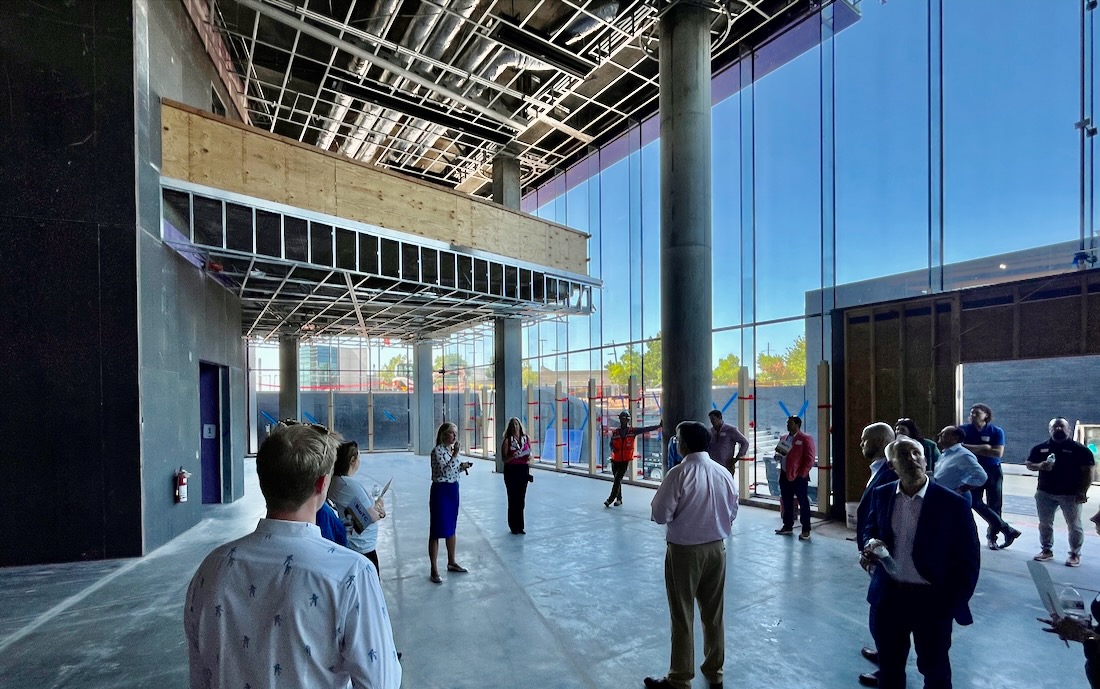
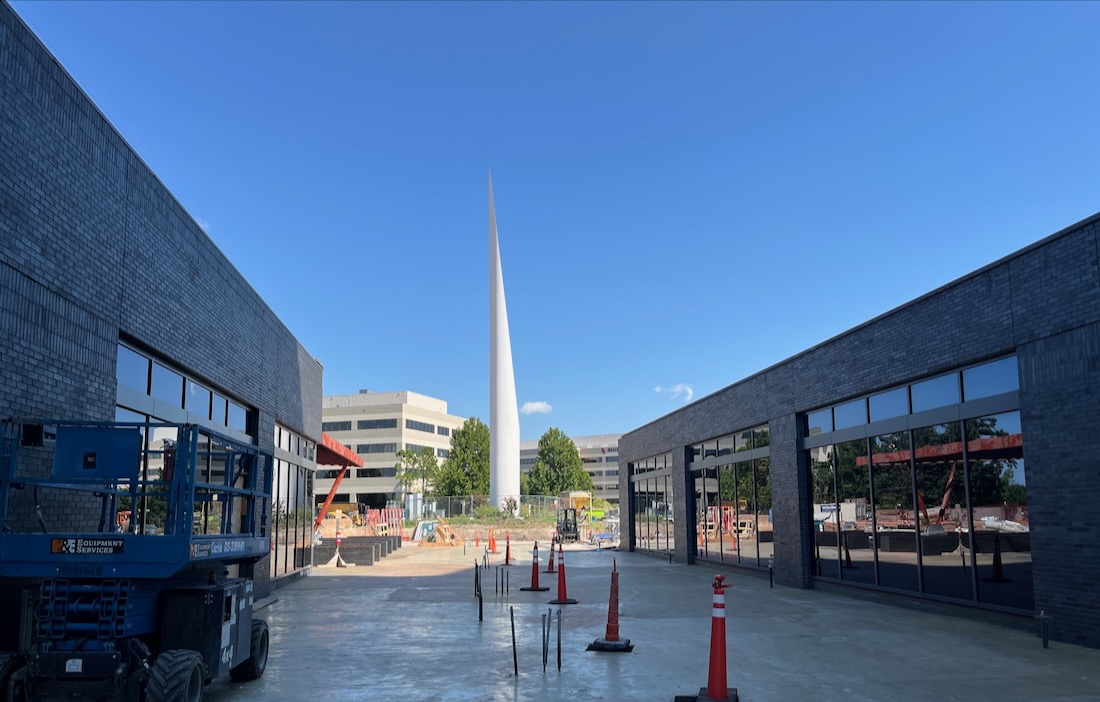
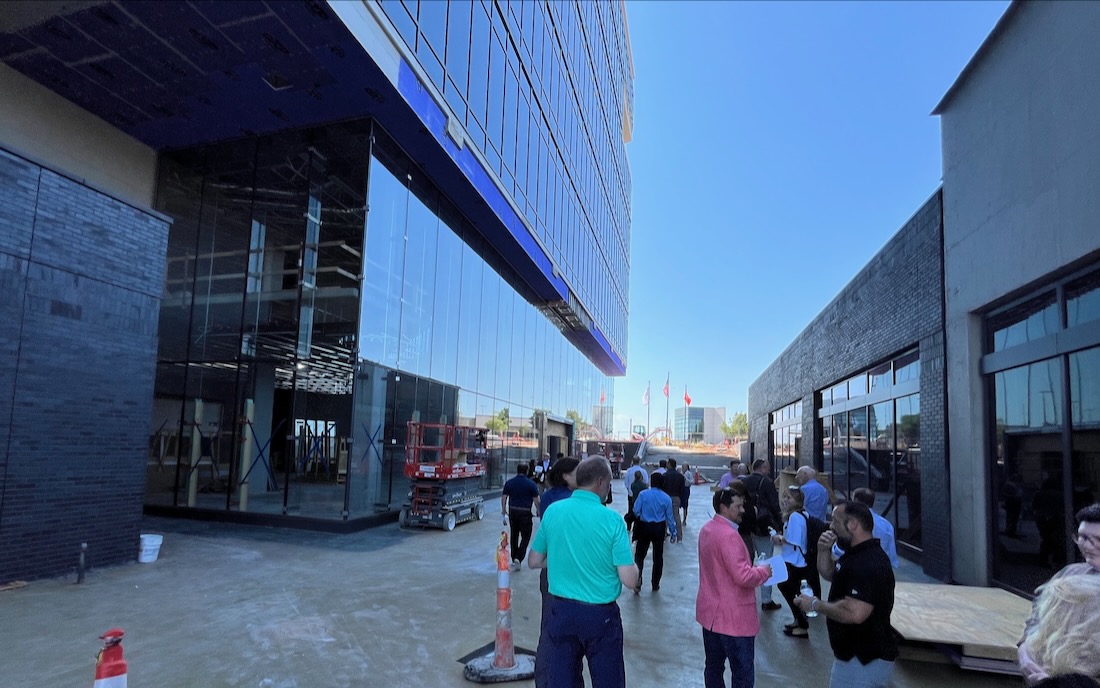
Second floor of the Convergence tower under development in OKC’s Innovation District.
If you’re like me, you’ve been curious about the new Convergence tower rising from the ground the past couple of years along I-235 just east of downtown.
The eight-floor Convergence tower is a $200 million privately funded development in the heart of OKC’s Innovation District. The project includes the adjacent, MAPS funded Innovation Hall with a future hotel also planned for the site.
A pair of prominent OKC real estate investors/developers in Richard Tanenbaum, CEO of Tanenbaum Holdings, and Mark Beffort, CEO of Robinson Park Investments, have led the Convergence project.
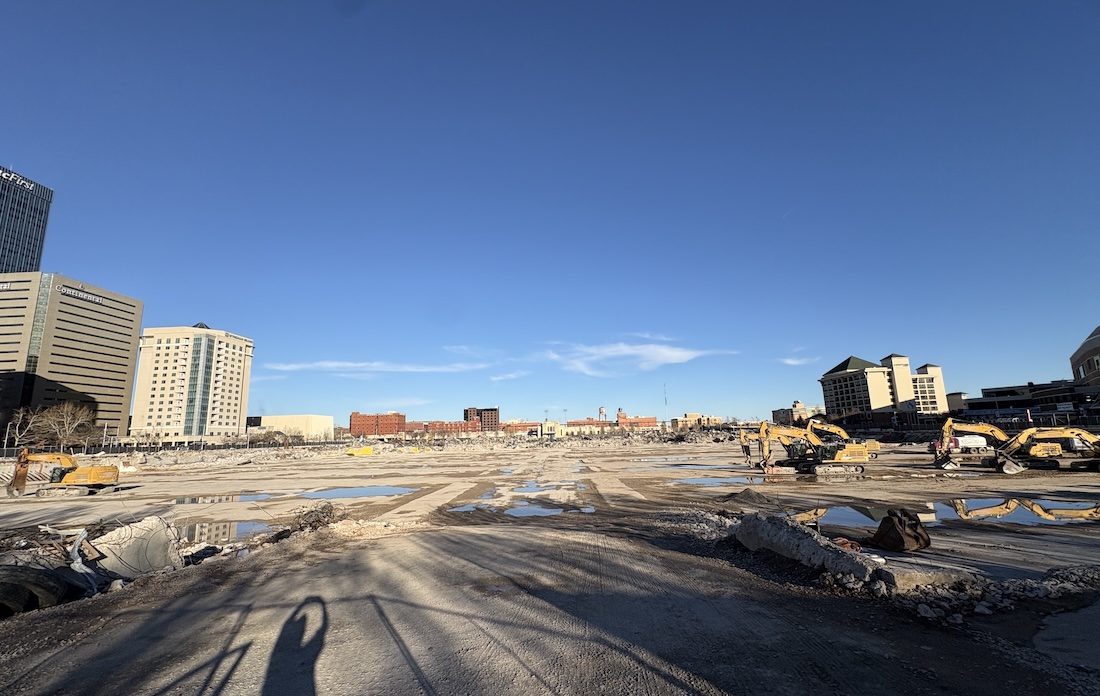
Convergence sits on a pretty small plot of land — 5.5 acres — that surrounds the tiny Stiles Park and its Beacon of Hope, which shines a green light into the night sky like a giant flashlight. The project will have underground parking.
Stiles Park holds its ground as part of the Convergence project
The Convergence website descibes the project as an “ecosystem reshaping Oklahoma City’s economy through innovation, collaboration, diversity and advanced technology.”
The project is certainly reshaping OKC’s Innovation District.
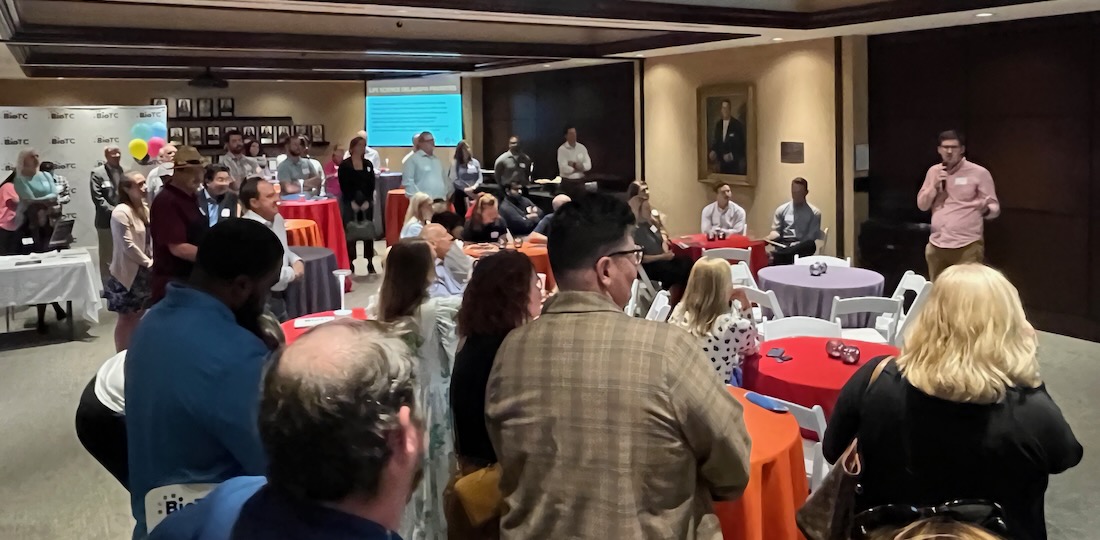
Anyway, I wrangled a ticket to attend the Greater OKC Chamber’s recent networking event and walking tour of the still-under-construction Convergence development.
My professional background includes many years of covering Oklahoma’s emerging biotech industry, first as a reporter for The Oklahoman newspaper and later as a writer and then freelancer for i2E, Inc., the not-for-profit that mentors and invests in many of the state’s entrepreneurial startups.
So, that led me to gather with about 75 folks at the OklahomaOur Blood Institute, which sits at the intersection of NE Eighth Street and Lincoln Blvd. It’s maybe a 50-yard walk from OBI to the new development.
Here’s what I learned that afternoon during the networking event and walking tour:
First, the Oklahoma Bioscience Association has been rebranded as Life Science Oklahoma, which made its debut at the annual BIO show in San Diego this past June. My friend, Dr. Craig Shimasaki, co-founder and CEO of OKC’s Moleculera Biosciences, is co-chair of Life Sciences Oklahoma, along with Andrew Westmuckett, director of technology ventures at the Oklahoma Medical Research Foundation.
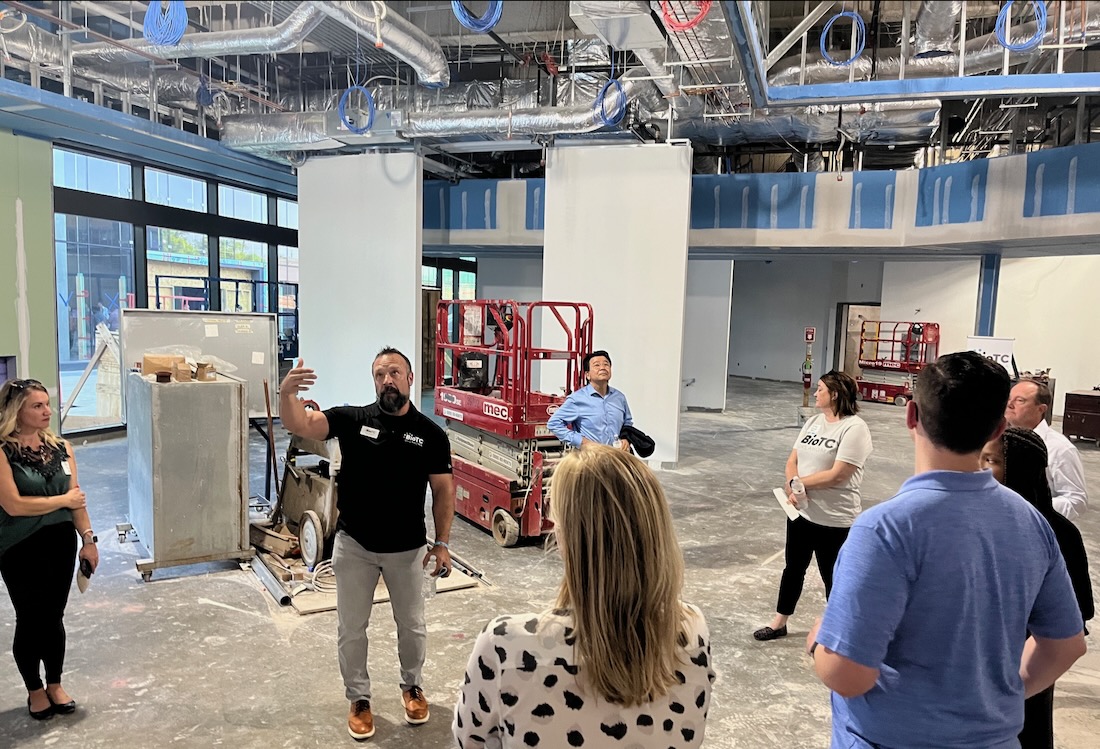
Education will play a major role at the Innovation Hall, which features a Bio Pharmaceutical Workforce Training Center called BioTC. We received a good explanation of how the space will accommodate aspiring biotech workers from Koey Keylon, BioTC’s, executive director. It will offer one-week, hands-on short courses in biotechnology manufacturing in which students will learn the biotech process and how to use sophisticated technology involved. It also offers an advanced two-week certification curriculum.
Koey Keylon, executive director of BioTC, shows off the educational space in the Innovation Hall
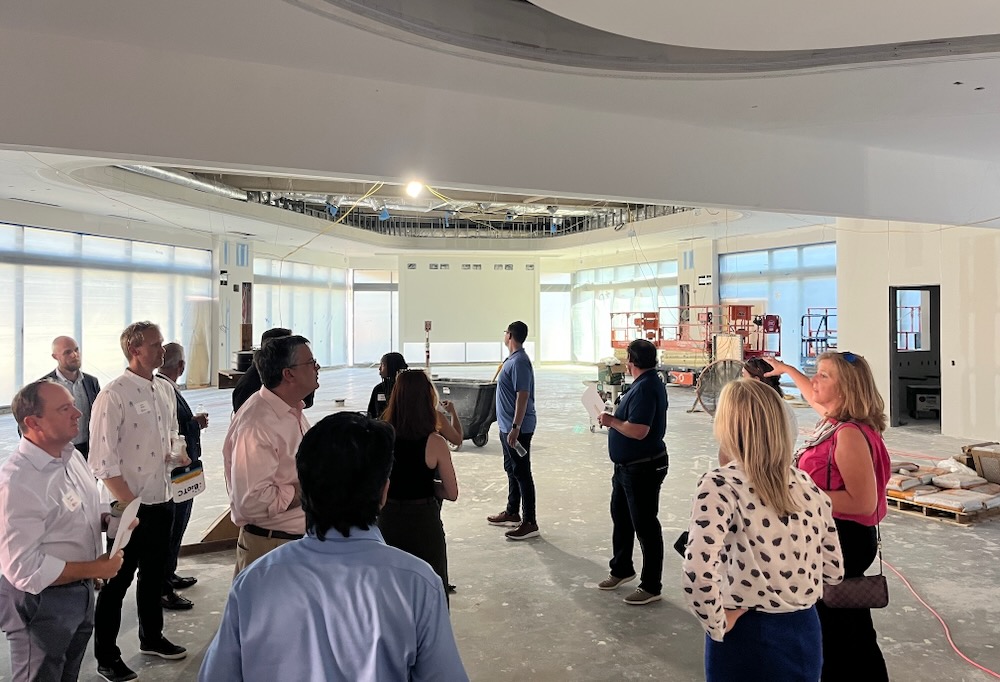
Innovation Hall also includes a large Event Hall, a cafe and lounge open to the public, four conference rooms and two small “phone booth” size work/meeting spaces.
Innovation Hall is part of MAPS 4 Innovation District funding, which contributed $11 million to the development, with another $10 million or so from non-MAPS sources, according to the City of OKC.
After we toured the Innovation Hall, we entered the first floor of the Convergence tower. Much of the first floor will be occupied by Wheeler Bio, an up-and-coming contract development and manufacturing organization in the life sciences space. Wheeler Bio also will have administrative offices on upper floors of the building.
All this was empty space as we toured it, but you could see the possibilities and envision the future.
By the way, I highly recommend you crossing over I-235 onto Eighth Street to drive slowly past the Convergence project for a closer view, then meander through the Innovation District that includes OSU’s Hamm Institute for American Energy adjacent to Convergence on the north side, University Research Park to the south and OU Health Sciences Center to the north and east.
In a year or maybe less, Convergence tower and Innovation Hall should be filled with bioscience research and manufacturing professionals. as well as students aspiring for a biotech career, while offering great meeting and hangout space in the Innovation Hall.
I can’t wait to see it all in action.
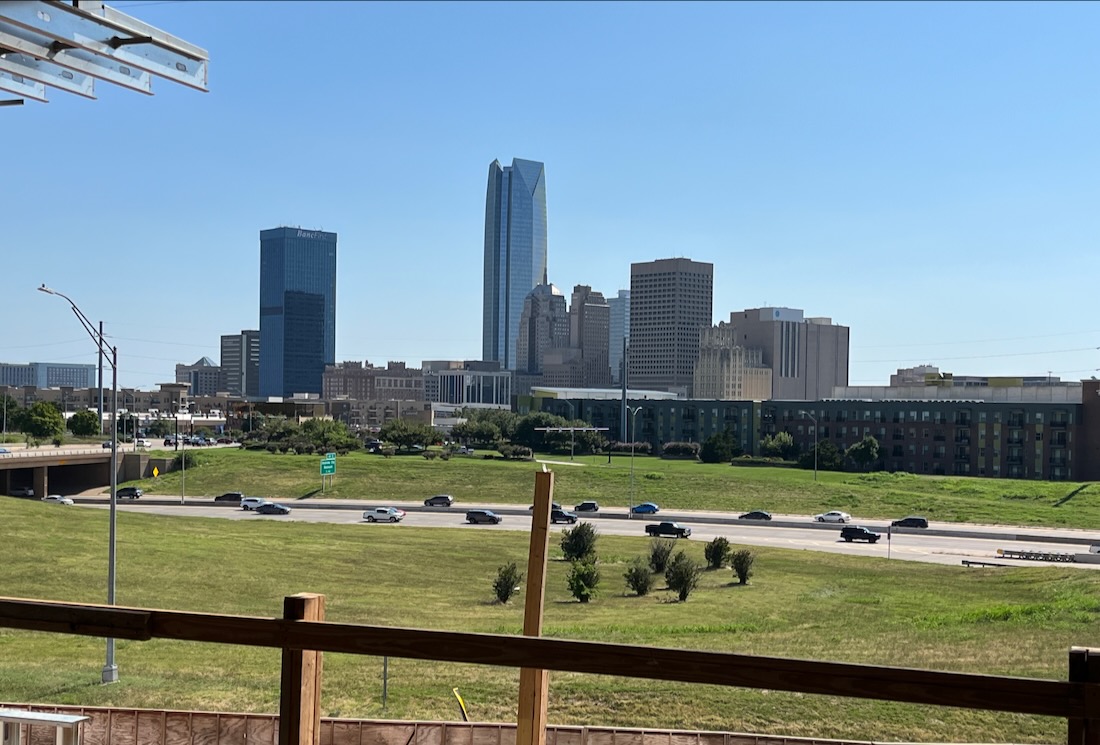
View of downtown OKC from second floor of the Convergence Tower
Event space in the Innovation Hall
Walking between buildings on a tour of the rising Convergence project in OKC.
Jeff Seymour, executive vice president of the Greater OKC Chamber, welcomes guests to the recent networking event and Convergence project walking tour.
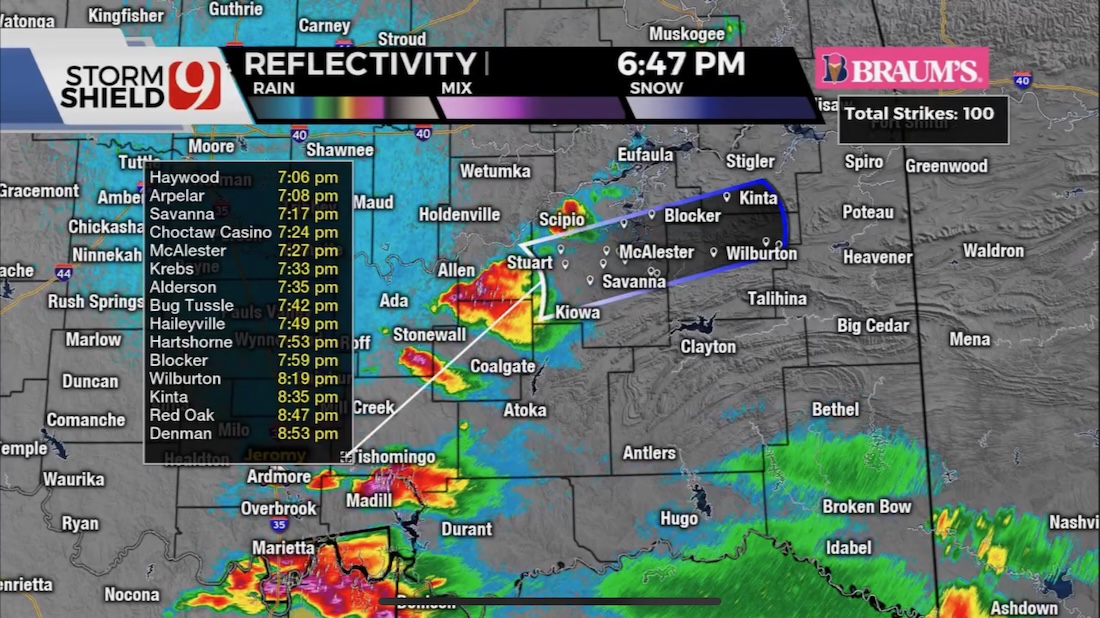
Whenever weather threatens OKC or western Oklahoma, our local TV stations abandon network programming and go with wall-to-wall weather coverage.
My family tunes in every time, and not just for potential life-saving information. We’re fascinated by the combination of theatrical performance, legitimate weather warnings and relentless self promotion.
“We’re declaring a News9 tornado warning for you folks in Custer County!” weatherman David Payne practically screams as he directs Val and Amy into the path of the storm.
It’s like passing a car wreck on the Interstate, you can’t NOT look at it. Everyone has their favorite/least favorite TV meteorologist. Our go-to weather Drama Queens happen to be from Channel 9.
Anyway, it seems like programming has been interrupted every other night this Spring, but I would never suggest that it’s related to climate change, would I?
As we’ve watched the powerful color-coded radar scans and learned that we’re seeing details THAT NO OTHER STATION IN OUR MARKET CAN PROVIDE, the whole scenario got me thinking back to something I wrote about two decades ago.
Today, we’re in a digital world in which we can track incoming storms on color radar not only only our television screens, but on our phones, computers and tablets. That was all just emerging in 2004 when I was a Business News reporter at The Oklahoman who embraced the digital life.
Not all of my colleagues were ready to move on from their analog past, so I wrote the following column as an ode to the great digital divide:
It is autumn 2004, and a pair of coworkers are sitting in opposite cubicles facing each other. One has his back to the window. His name is “Digital.” His co-worker goes by the moniker “Analog.”
Digital: Hey, there’s a weather alert crawling across the bottom of my computer screen!
Analog: (looking out the window over Digital’s shoulder) It looks sunny to me. There’s a little cloud to the south.
Digital: Yeah, but the color-coded radar I’m looking at on my screen shows a major thunderstorm headed this way. It’s just north of Chickasha.
Analog: I trust my eyes. I’ll worry about the weather when I look out this window and see a big black cloud.
Digital: You are so 1990s. (picks up the phone to call his wife) Hello, honey, you better monitor the weather, it’s looking rough outside. Where are the kids? Outside playing? Well, bring them in. The radar on my computer screen is showing a big storm just north of Chickasha, and it’s headed this way.
Analog: I still only see blue sky out the window.
Digital: (still speaking into phone) I don’t care if it’s sunny out, I’m telling you my radar is showing a big storm brewing just south of here. I’ll call you with further updates. Bring the kids inside! Call my cell phone when you have them rounded up (hangs phone up).
Analog: I think you are scaring your family for no reason. You should trust your eyes. Look out the window! It’s sunny.
Digital: I don’t need a window! I’m wired into the weather service right here. I can zoom in on the screen and see within a half mile where the storm is, which way it’s moving and what the temperature is. See, it’s 62 degrees outside.
Analog: I can just walk outside and get a feel for the temperature.
Digital: Then I assume you aren’t concerned about your family’s welfare. They won’t be ready for this one when it blows through town.
Analog: We have a “safe room” in our garage.
Digital: (wireless telephone rings) Hello. You’ve got the kids? Good. Now, what’s your plan for when the storm hits?
Analog: My eyes are telling me it’s still sunny outside.
Digital: (still speaking into phone) Will you have time to drive to the community shelter? Yes, I know it’s still sunny outside, but the radar shows the storm has moved closer to the metro area. Herd the kids to the hall closet if you need to. OK, love you. Bye.
Analog: Hey, I’ve got to run out on an assignment. I’ll be back this afternoon.
Digital: Well, let me have your cell phone number so I can contact you in case there’s a weather emergency or something.
Analog: I don’t have a cell phone. Never had a need for one.
Digital: (head bangs against desk; heavy sigh) I give up.
Analog: (starts to walk out of the office) Later.
Digital: (jumps up and runs after Analog) Here, take my umbrella just in case.
That’s how we rolled in 2004. It was a different era. Pre-iPhone. Pre-News9 tornado warning.
Any resemblance to actual people is mere coincidence.
The Southwest Times Record building in what appears to be the early 1960s. (Photo courtesy of Southwest Times Record former employees Facebook group)
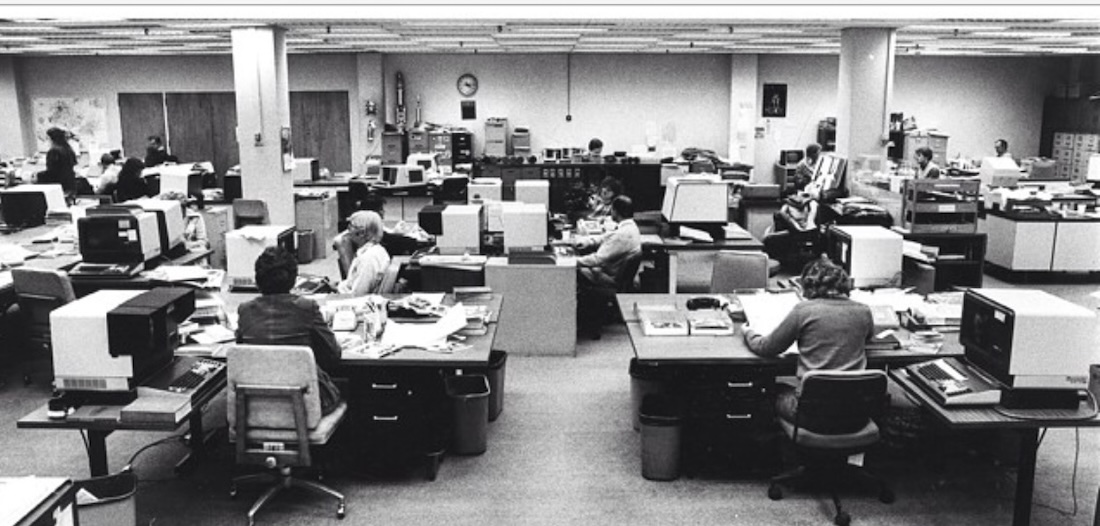
Here’s a bit of nostalgia for you. When I walked into the Southwest Times Record newsroom for the first time as an employee in 1978, I encountered a bustling community of talented writers, editors and photographers all scrambling to publish local news seven days a week.
The Fort Smith newspaper was a great place to learn the craft as my first job out of college. There are many folks among my former colleagues there whom I will never forget. I worked at the SWTR for five years in a variety of positions before moving to Oklahoma City and working for The Oklahoman for almost a quarter of a century.
My parents were among the 40,000 or so SWTR subscribers who fetched the newspaper off their driveway every morning. Established as the Fort Smith Times in 1884, the SWTR had a strong following not only in Fort Smith, but across a multi-county region of Western Arkansas and Eastern Oklahoma.
So, it’s been disheartening to watch the SWTR decline as a community force over the past few years as the number of subscribers declined and employees were laid off. It’s a situation not unlike that in many other cities across the nation.
Now owned by industry giant Gannett, I’m not sure there remains a single Fort Smith-based editor or reporter chasing down local news stories.
In fact, my 90-year old mother, who subscribed to the SWTR in our hometown of Fort Smith for more than five decades, finally gave it up a couple years ago because the paper had so little local news. Sometimes she still reads the obituaries published online.
As for me, I’ve stayed connected to the SWTR by subscribing to the paper’s free emailed daily newsletter that allows a peek at its headlines and free access to the obituaries.
It all makes you wonder when the hammer will fall and Gannett will halt publication of a physical paper for any remaining subscribers, leaving only online access.
Well, we’re close.
I received a notice recently that the SWTR was transitioning to a “mail only” newspaper with no more home delivery. Here’s what the email said, in part.
“Beginning tomorrow, look for your copy of the Southwest Times Record and our other regional publications to arrive with your daily mail. As announced in the Jan. 10 edition and in letters mailed to subscribers, the U.S. Postal Service will be delivering the Southwest Times Record to optimize resources amidst increasing digital readership demand.”
Now subscribers can read ‘news’ that is already at least 24-hours old when it arrives in the mail. What’s that old saying about nothing as stale as yesterday’s newspaper?
So, why am I writing this?
Well, it’s not a diatribe against the current ownership, because I see what’s happened to my old employer as a product of emerging technologies and a big change in how the public consumes news. Online access to news — much of it free — has removed the incentive to subscribe to a daily newspaper that lands on your driveway every morning.
I’m mourning the SWTR for its former employees and the folks who subscribed to the paper for decades. It’s like watching a close relative slowly fade away from an incurable cancer.
Here in OKC, I’m still a subscriber to The Oklahoman’s physical newspaper, which is delivered to my driveway every day but Saturday. Yet, when I look up and down my street as I pick up the newspaper each morning, I see no other papers on my neighbors’ driveways. None.
However, I’m confident the path determined for the Southwest Times Record won’t be a template for The Oklahoman. It remains an enterprising news organization, despite repeated rounds of staff reductions.
That notice I received of the SWTR’s “all mail” newspaper delivery prompted me to ask a couple of former colleagues and longtime SWTR employees who still live in the Fort Smith area their thoughts on what has become of their former newsroom.
Patti Cox was a longtime news editor at the SWTR with whom I worked on the news desk. She shared her perspective with me as both a former employee and a current subscriber.
“It is very sad turn of events for Fort Smith,” she said. “We still are taking the day-late-in-the-mailbox paper but not sure for how long or why. End of so many meaningful things like insightful, timely local news and commentary. Long gone are noisy newsrooms filled with reporters, editors, interns with common purpose and multiple deadlines.”
Carrol Copeland, longtime SWTR photographer and creator of a Facebook group called Southwest Times Record former employees that has 162 members, also shared his thoughts with me.
“Back in the day, we covered local news, and there was very little worldwide or nationwide news in it,” Carrol said. “Probably 80 to 90 percent of it was local news. At one point we had the Poteau office and the Van Buren office, and somewhere around 150 employees.”
That was then. This is now.
“There’s not even a physical location anymore,” Carrol said, who recalled tornadoes, spectacular crimes and criminal trials that he covered over the years. “I think it comes down to a lack of income. If you can’t sell advertising you can’t have people to work for you.
“Now that people are going to the Internet or Youtube for their news, no one is advertising anymore. The technology overtook them.”
How will the daily newspaper voice be filled for former SWTR subscribers who loved its local news angle? Digital news services that focus on local news offer some hope.
Here in Oklahoma City, we have Oklahoma Watch and Nondoc, among others, which are sort of complementary to The Oklahoman, for now.
In Fort Smith, there’s an online site called Talk Business & Politics that focuses on Fort Smith and Northwest Arkansas. It was started by a former SWTR editor. I read it first thing each morning five days a week.
Actually, as I think about it, I’m not sure folks aged 30 and younger will miss holding an actual newspaper because it’s likely they never read one on a daily basis anyway.
But for those who grew up with ink-stained hands, it’s a difficult transition.
“I just know I loved newspapers and the dedicated (mostly young) quirky stressed out folks who worked for them,” Patti Cox told me. “Grateful for the lifetime lessons learned there.
“Good memories, my friend.”
We’ll carry those memories with us long after the final edition is published. It’s coming.
New Seattle Supersonics owner Clay Bennett showcases a Sonics jersey after purchasing the NBA franchise in 2006.
EDITOR’S NOTE: When it was announced in July 2006 that a group of investors from Oklahoma City had purchased the Seattle Supersonics NBA franchise, everyone in OKC knew what that meant. The team would relocate to Oklahoma City sooner or later. Probably sooner. That happened in 2008. Sorry Seattle. I was working in The Oklahoman newsroom at the time as a Business News reporter, and hit upon the idea of buying some potential Internet domain names that the future OKC Sonics (we thought) might want. Then I could sell the rights to that domain name to the team owners for a nice profit. Buy low, sell high. It didn’t work out, but I did get a nice story out of my brief tenure as an Internet domain name squatter. It was published as a column in The Oklahoman back in 2006. And that was the sole purpose of buying a domain name. This is that story.
By Jim Stafford
Like a tsunami traveling across hundreds of miles of ocean, it didn’t take long for ripples from last week’s $350 million acquisition of the Seattle SuperSonics to wash into Oklahoma.
A group of Oklahoma businessmen now own the Sonics, and less than a day after the deal was announced another group of enterprising Oklahomans spotted opportunity in a possible relocation of the team to the Sooner State.
We huddled in The Oklahoman newsroom.
A colleague I’ll call “Don” suggested that we research available Internet domain names using such words “Oklahoma, OKC, Sonics and Super-Sonics.” We could pool our resources and buy up the most promising real estate.
“I’m in,” I told him. The new team owners will need some prime Internet real estate if they relocate to Oklahoma, and we wanted to own it when they got here.
So began a race not unlike the Oklahoma Land Run of 1889, although the mode of transportation this time was a high-speed Internet connection. Using the domain broker GoDaddy.com, we did a search of virtually every combination of Oklahoma, OKC, Oklahoma City, Sonics and Super-Sonics.
Apparently, some Sooners had already anticipated the deal and staked out some virtual land before we got into the race. Names like oklahomasonics.com, okcsonics.com and sonicsokc.com were all gone. Even okiesonics.com was no longer available.
We settled on okc-sonics.com as the best of the unclaimed property. We formed a 50-50 partnership and sealed the deal through GoDaddy. Total investment: $9.40.
When word spread that a pair of Internet real estate moguls inhabited the newsroom, several of our colleagues began clamoring to join the investment group. They wanted in for $1 each, but Don and I decided the value already had risen beyond the original purchase price.
We decided to expand our investment empire the next day and claim another domain name. This time we went for sonics-okc.com. Another $9.40.
An editor who heard of our venture happened to wander by the business news desk. What were our intentions in owning these domain names, he inquired.
We’re not going to hold anybody up, we assured him. If the new owners of the Sonics want one of these domain names for the team’s Web site, we’ll demand nothing more than season tickets for each of us. And our spouses. On the floor. Plus parking.
The editor decided to play devil’s advocate. “Let me ask you this,” he said. “On whose computer and whose time did you make this deal?”
Gulp. The devil IS in the details.
Uh, we only took this move to assure the new Oklahoma owners that prime domain names will be available to them if they need it. Just kidding about the season tickets. HA! HA! We won’t really need to be on the floor anyway. And we can pay for our own parking.
Meanwhile, Don began looking for a possible exit strategy. He located the domain name auction site afternic.com where homesolutions.com recently brought a bid of $9,210. Therapy411.com reeled in a $2,000 bid.
Suddenly, new opportunities seem possible. We will wash our hands of this Sonics deal just as soon as our auction is over.
The auction won’t end until our reserve price is reached. We will set it just high enough to cover a pair of season tickets. Parking included.