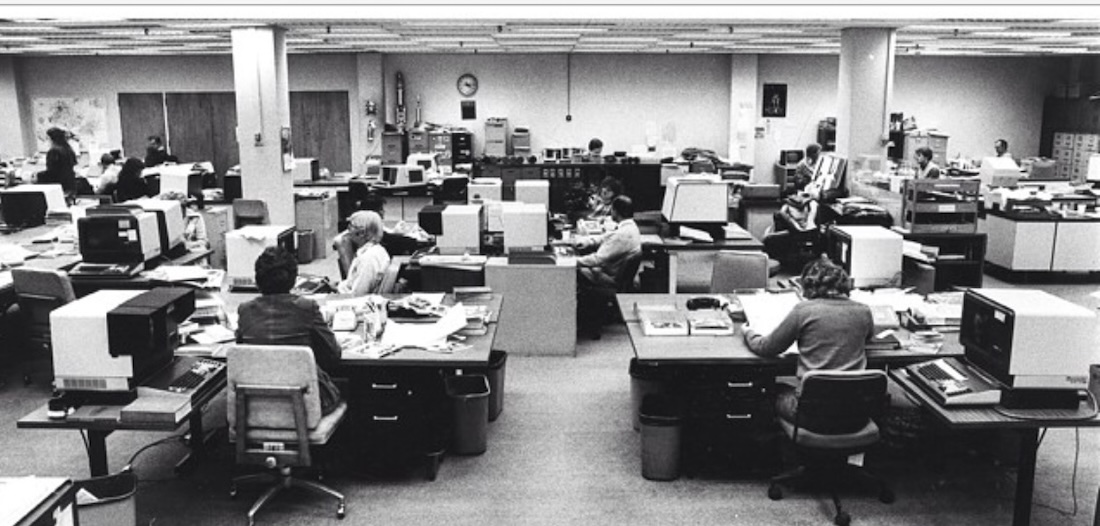
The Daily Oklahoman newsroom in the 1980s. Then Sports Editor Jerry McConnell is on the far right.
When I joined The Daily Oklahoman sports desk in the fall of 1983, it was a black and white world. Published photographs were all black and white. The newspaper pages themselves were black and white (and read all over!).
It’s hard to overstate the impact the newspaper had on Oklahoma City and beyond. The paper’s circulation was north of 200,000 and we circulated in every county in the state. When someone wanted a sports score or a football recruiting update, or to complain about a headline, they called the paper.
I know because I was on the receiving end of those calls a lot.
We drew our pages by hand on sheets of paper, which were sent down to the composing room to be put together by a large crew of folks. There was an often frenetic scene in composing as people rushed around at a frantic pace on deadline, shouting ‘we need a cut!’ for an editor to help them splice story that was too long as it was pasted on the page.
Some nights I acted as a copy editor on the sports desk, working to smooth the rough edges off of copy, as well as writing headlines. Other nights, I actually drew the pages, although I had such a lack of artistic vision that my pages usually looked as if they were part of a third-grade art project.
Anyway, desktop publishing was introduced in the newsroom in 1987. Our jobs dramatically changed, as we ‘drew’ our pages on a computer screen and they came out of the printers as one compete sheet instead of having to be pasted down by hand. There were far fewer people needed in the composing room.
Desktop publishing required more people to work on the sports desk to lay out individual pages. We were a little community that endured the stressful race to make three deadlines a night, often remaking much of the sports section for each deadline.
As desktop publishing became more sophisticated, one of my co-workers on the sports desk saw what was coming. He predicted that technology would advance so far that copy editors would all be replaced some day by ‘automatic headline writers.’
Doug Simpson, you saw where things were headed 30 years before it became reality. In fact, a recent Google search revealed dozens of sites offering AI headline writing, including the popular “Grammarly” site that offers a ‘free headline generator.’
There has been ongoing controversy over news sites that use AI to write their actual copy, including a disturbing story from 2023 about some Sports Illustrated copy generated by AI. Sports Illustrated was once considered the Gold Standard of sports writing.
So where will it all end? Will artificial intelligence really displace millions of white collar jobs, including the software coding jobs that created AI in the first place?
Call me a skeptic, but I can’t see AI replacing airline pilots, health care professionals or school teachers, among many other professions.
But then, I think back to what my newspaper colleague Doug predicted more than three decades ago. There ARE automatic headline writers in 2026.
So, I’ll close this with a quote from one of my favorite movies, Caddyshack, which reflects the attitude of our AI overlords. It’s a scene where caddy Danny Noonan confesses to Judge Smalls during a round of golf that he might not be able to go to college because his parents don’t have enough money.
“Well, the world needs ditch diggers, too,” the judge tells Danny as he walks away.
A robotic arm working on the floor of a Shawnee manufacturer in roughly 2017.
One day in the summer of 2017, I toured the GF Central Plastics plant in Shawnee on an assignment with the Oklahoma Center for the Advancement of Science and Technology (OCAST).
The visit was an eye-opener for me.
Central Plastics makes plastic and metal fittings, as well as specialty parts primarily for the natural gas industry. At that time it operated out of a 500,000 square foot facility and employed roughly 500 people.
What caught my attention was the incredible use of robotics in the company’s manufacturing process. There were about 30 of these large yellow robotic arms that picked up a piece of metal or plastic and placed it exactly where it needed to go in the machine that would mold it into whatever it was intended to be.
Here’s what I wrote at the time:
“The robotic arms employed in the process never stop, repeating their assignment 24 hours a day, seven days a week. Their human co-workers are busy ensuring the machines have needed parts to work with, as well as inspecting and packaging finished pieces. ‘The primary goal of the robotics and automation is not to eliminate people, but allow us to continue to grow and continue to improve the quality of our products,’ Bryan Lucas, GF Central Plastics vice president for Operations, told me.
Mark Smith, GF Central Plastics Managing Director and President, put it another way:
“One of the abilities the robot has, is I’ve got 24/7 operation from them.” he told me. “They don’t take vacations, and they don’t need to sleep like I do.”
While I’m not certain that Lucas or Smith are still in their positions with the company, I’m pretty sure that at this very moment there are scores of robotic arms picking up parts and slamming them into the production machine exactly where they need to be placed. And then removing them when they are finished and stacking them in the right bin.
So, what does that have to do with anything today, eight years later?
I’ve been thinking about how robotics and artificial intelligence might be used in the production of ubiquitous smartphones — iPhones and Android phones. Phones are full of tiny parts that have to be fit into a small space in exactly the same way millions of times over and over.
Are robotics used to produce the phones? According to what I was told by my know-it-all friend, ChatGPT, much of phone assembly in 2025 is done by robotics.
Here’s what my AI pal told me:
“Yes — robotics manufacturing is already widely applied to devices as small and precise as smartphones. In fact, smartphone production is one of the most advanced examples of robotics and automation in action.”
Unless Chatbot was hallucinating, there’s a ton of robotics that go into each phone. It cited Foxconn, maker of the iPhone, as a major user of robotics in the manufacturing process.
“In some facilities, entire production lines are almost fully automated,” it said.
So, that makes me wonder if the thousands and thousands of low-paid workers are still needed to produce smart phones. Are those folks still needed to assemble the cases with tiny screws, perhaps? Can’t that process be automated?
This is all leading me to the purpose of this blog post. If there is almost 100 percent automation in the assembly of iPhones, why can’t Apple Inc. at least build a pilot project in the U.S. to see how production would go here.
I understand there is required testing of each unit and then the packaging and shipping, so there are humans involved in the process.
If the robotic arms were assembling millions of phones in the U.S., would the scale of that production keep the costs somewhere close to what it is in China or India? And they would save on shipping costs, too, so price of phones might stay close to what they are today.
We all know that Trump is pressuring Apple and other high-tech manufacturers to bring their manufacturing into the U.S. If nothing else, a pilot plant located in the states would appease the President, who could slap (more) tariffs on China- or India-made phones at any moment.
I just read an awesome book, “Apple in China,” about how the company is trapped by the large scale of manufacturing investment it has made in China. It has recently moved some of that production to India and elsewhere.
I’m not a visionary, but I’m thinking that we could someday soon unbox our new iPhone and see the words “Designed in California, Assembled in the USA.”
Are you listening, Tim Cook?
I’m great at spending someone else’s money. But it could happen.
BONUS CONTENT: Watch some robotic arms in action in the video below.
DOUBLE BONUS CONTENT: Here is some info that ChatGPT provided me about robotic arms in smartphone manufacturing.
Robotics manufacturing is already widely applied to devices as small and precise as smartphones. In fact, smartphone production is one of the most advanced examples of robotics and automation in action.
Here’s how robotics is applied in smartphone manufacturing:
Microscale Precision Assembly: Specialized robotic arms with extremely fine motion control place tiny components such as microchips, sensors, and capacitors onto circuit boards. These parts are far too small for human hands to place consistently. Surface-Mount Technology (SMT): Automated machines solder thousands of micro-components onto printed circuit boards at high speed and with extreme precision. Optics & Camera Module Assembly: Robotic systems align and insert delicate camera lenses and sensors with tolerances measured in microns. Battery & Screen Placement: Large but fragile components like batteries and OLED screens are installed by robotic arms that apply uniform pressure without damaging them. Quality Control & Testing: Robotics and machine vision systems test buttons, touchscreens, speakers, and other parts to ensure durability and functionality.
– Micro-assembly with Collaborative Robots (Cobots): Some processes still require human oversight (like cable placement or adhesive application), but cobots assist workers by handling the repetitive and delicate positioning work.
So while people often imagine robots assembling cars or appliances, the highest level of robotic precision is actually in electronics manufacturing — smartphones, tablets, and semiconductors.
Companies Using Robotics in Smartphone Assembly
Foxconn (Hon Hai Precision Industry)
World’s largest electronics manufacturer (makes iPhones for Apple).
Uses thousands of robots, called Foxbots, for tasks like soldering, polishing, dispensing adhesives, and precision assembly.
In some facilities, entire production lines are almost fully automated.
Pegatron
Another major iPhone assembler.
Uses robotic arms for component placement and automated optical inspection (AOI) to check for microscopic defects.
Samsung Electronics
Runs highly automated factories in South Korea and Vietnam.
Uses robotics for screen production (OLED and AMOLED panels) because they require sub-millimeter precision.
Xiaomi, Oppo, and Huawei suppliers
Many Chinese factories use robotic arms for final assembly and packaging.
Robotic vision systems test touchscreens and fingerprint sensors before shipping.
🤖
Types of Robotics Technology Used
SMT (Surface Mount Technology) Pick-and-Place Robots
Place up to 100,000 components per hour on a circuit board.
Robotic Dispensing Systems — Apply adhesives in perfect micro-lines to secure parts like glass panels.
Automated Optical Inspection (AOI) — Uses robotic vision and AI to detect microscopic defects.
Laser Robots — Used for cutting phone frames, engraving, and even removing defective solder joints.
📱 Why Robotics Is Essential for Smartphones
Smartphones have billions of transistors and hundreds of components packed into a device only millimeters thick.
Human assembly alone can’t achieve the precision or consistency needed.
Robotics improves yield, speed, and quality control while reducing labor costs.
👉 So yes, robotics not only can be applied to smartphones — it’s already at the core of how every major smartphone is made today.
Steve Jobs makes a ‘one more thing’ announcement at a live Apple product event.
This past Tuesday, Apple Inc. introduced its latest line of iPhones in a special pre-recorded event that showcased iPhone 17 and an extra thin iPhone Air.
Along with showcasing the latest Apple Watches and Airpods, the event lasted just over an hour. It included introductions from Apple CEO Tim Cook plus key Apple staff, as well as customer testimonials, music and ads to showcase it all. You can watch it here.
Unfortunately for me, I knew in advance almost every product that was introduced, down to the new iPhone Air.
Gurman is a tech writer for Bloomberg News who covers everything Apple like Helen Thomas covered the White House once upon a time. The author of the Power On newsletter, Gurman had already detailed almost everything Apple debuted, down to the specs of the iPhone Air and cameras in the iPhone 17 Pro Max.
I didn’t want to know any of that before I watched the Apple event. I long for the days of the “One More Thing” that the late Steve Jobs would surprise the audience at Apple product events. I was just as surprised and awed as everyone else when he pulled the first iPod out of the pocket of his Levi’s in 2001.
Watch Jobs make some “one more thing” introductions in the video below.
I’m not sure how Gurman gets his info, but I assume it must come with Apple’s cooperation or willfully ignoring his insider scoops. Reporters and podcasters that I follow seem happy with the situation because Gurman’s reporting gives them something to discuss on an ongoing basis from week-to-week.
I realize that all of this doesn’t matter to about 99.9% of the public, but as a long-time Apple Fanboy, it’s a big deal. There was time that Jobs was so obsessed over keeping future products secret that he took steps like issuing memos with slight alterations sent to different employees to catch leakers.
Just as it should be.
Oh, and one more thing. I long for the pre-COVID years when Apple’s product events were all performed live in front of an audience and streamed to the rest of us. It was way more fun when new Macs or iPads or software were introduced by Jobs or Phil Schiller or Craig Federighi, and demoed right on the stage.
That was live theater, and I loved it.
But here we are in 2025, and we all can predict virtually every new product in advance as a pre-recorded Tim Cook introduces it as Apple’s “best ever.”
No suspense. No surprise. No one more thing.
Get off my lawn.
UPDATE:
Here is what Jason Snell, former editor of Macworld magazine who has covered Apple for decades, had to say about new product developments that are leaked to the public.





 Jim Stafford's BlogOKC