Today is Opening Day for 22 Major League Baseball teams, including my Texas Rangers, who opened against Philadelphia this afternoon (Rangers lost, 5-3). Opening Day has always been one of my favorite days of the year, because it means the long Winter is finally over and there is the promise of new life, even for my favorite team.
A long ago Opening Day is one of those special days where I know exactly where I was.
And I’m not talking about the baseball.
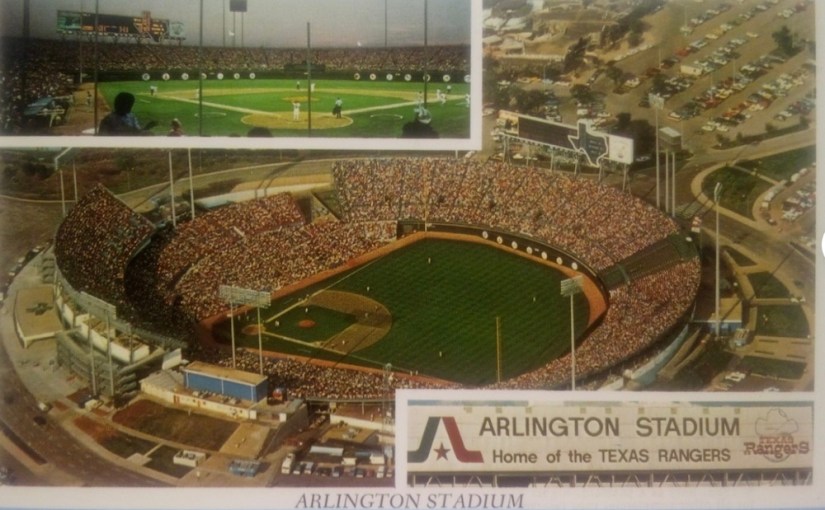
The year was 1983. The setting was the now departed Arlington Stadium in Arlington, Texas. The game was the season opener between the Rangers and the Chicago White Sox.
I looked it up, and it was a Monday night game . Only 13,140 fans showed up with few expectations for the Rangers that season.
I was in that crowd along with Eric Brooks, a fellow sportswriter at the Southwest Times Record newspaper in Fort Smith, Ark.. We drove to Arlington to catch the 1983 season opener because I was a Rangers fan and Eric was a fan of MLB in general.
It was my first — and only — MLB Opening Day game. And what a memory it became.
Here’s what I remember from the night: virtually nothing about the baseball game itself.
But it turned out to also be a night that many American sports fans recall because of an historic upset. North Carolina State beat Houston to claim the NCAA men’s basketball championship.
It was also special to me because Eric and I got to watch the incredible finish to that game while we were at Arlington Stadium with the Rangers game still in progress. You might remember that the Jim Valvano-coached Wolfpack scored one of college basketball’s greatest upsets when Lorenzo Charles scored the game winner at the final buzzer.
So, how were we able to watch that from the stands at Arlington Stadium?
While the NCAA game certainly wasn’t broadcast on the Rangers scoreboard, a fan seated in our section held a small, portable black-and-white television in his lap.
When we saw several people gather around the guy with the TV, Eric and I got up and joined the crowd. We could see the screen pretty well and knew that it was late in the NCAA championship game.
So, we stayed put to watch the frantic finish with that small crowd of college basketball crazies.
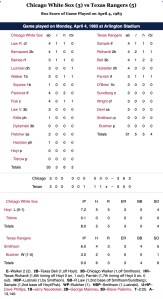
As for the Rangers game, Texas defeated Chicago starting pitcher Lamarr Hoyt that night, 5-3, in two hours and 25 minutes. I found the box score.
After the game, Eric and I headed over to the local Bennigan’s Restaurant for a late dinner. Eric spotted White Sox owner Jerry Reinsdorf seated at a table with team GM Roland Hemond.
I would not have known who they were, but Eric was a big MLB fan who recognized the baseball executives. He wanted to rush over and strike up a conversation, although I talked him into waiting until they were finished eating.
Fast forward 43 years.
Today was another season opening day for the Rangers, who will play their 2026 home opener on April 3. The expectations are certainly higher than they were in 1983, but I won’t be in Arlington next week when the Rangers open at home against the Cincinnati Reds.
No big deal. I’ll always have my memories of that long ago season opener and watching the NCAA finals on a tiny black-and-white portable TV in the Arlington Stadium stands.
The site of the former Myriad Convention Center is empty as it awaits construction on new arena.
A few weeks ago, my friend Ed and I had an appointment in Midtown OKC when we decided to go take a look at the site of the Incomparable Myriad to see the progress made on its demolition.
As you probably know, the gigantic concrete box that opened in 1972 as the Myriad Convention Center was demolished to make way for a new billion dollar arena built for the Oklahoma City Thunder. Along its 53-year journey, the name transitioned from the Myriad to the Cox Business Center and finally to the Prairie Surf Studios.
I admit I was surprised when we approached the 2-square block site of the Myriad and there was nothing but a gigantic empty lot. The site looked even larger to me than it actually is, because now it’s a sea of dirt stretching from E.K. Gaylord Blvd. to Robinson Ave.
Ed slowed down to let me jump out to take some photos while he drove around the block(s). When I got back into the car, we shared some of the experiences we had at the old arena.
Then Ed said, “you should write a blog post about your Myriad memories.”
So, that’s the purpose of this post. I’m sharing my favorite memories of the building that date back to the late ’70s. But I’ve also asked Ed and several other Oklahomans to share their Myriad memories.
I’ve got three memories that stand out to me.
My first visit to the Myriad took place in roughly 1979 or ’80 when I accompanied a group of folks from Fort Smith, Ark., to attend the National Finals Rodeo. I was a young sports writer at the Southwest Times Record and was sent on assignment with the Fort Smith Old Fort Days Rodeo committee to experience the NFR.
What stands out in my mind is the location from which I witnessed the rodeo. They stationed me on the actual arena dirt behind the protection of metal fencing. So you might say I had an up-close-and-personal look at the National Finals Rodeo.
My second Myriad memory is attending a John (Cougar) Mellencamp concert at the venue in February 1986. I’m not a big concert goer, but I was (and am) a fan of John Mellencamp’s music, so I enjoyed being part of a full house, both on the floor and in arena seats. I was struck by how awesome the violinist (fiddler?) was who accompanied him on several songs.
Finally, my favorite Myriad memory is that of New Years Eve 1990. I took my future wife, Paula, to see the Oklahoma City Cavalry on our first date. I know, I’m a real romantic. Turns out, Paula may be a bigger basketball fan than am I, and has seen far more OKC Thunder games at Paycom Center over the years than I have.
Now I’m turning this over to 10 Oklahomans who share diverse memories from their experiences at the Myriad over the decades.
First up is Oklahoma City Mayor David Holt, who is also Dean of the Oklahoma City University School of Law and author of the book: Big League City: Oklahoma City’s Rise to the NBA
If you get a little misty-eyed about the Myriad, it’s understandable. It may not have been much to look at, but it was the center of our community’s life in a unique way that will never happen here again.
The Myriad opened in 1972. Until the opening of the Ford Center in 2002, it was the city’s primary arena. Until the opening of the Oklahoma City Convention Center in 2021, it was also the city’s primary convention center. And until the city’s explosion in growth around the time of the Thunder’s arrival in 2008, the demand on the Myriad’s schedule was mostly for community events. All of this is worth noting, because it means that for about four decades, practically every major moment we experienced as a resident of this city was at the Myriad. The Myriad occupied an emotional place in Oklahoma City life that no venue will ever occupy again. In 2026, we utilize many venues to host that which was once held at the Myriad. And increased demand for national entertainment events and conventions means that community events once held at the Myriad are less likely to occur at its successor venues.
It is probably also worth noting that the prime decades for the Myriad were some of the worst decades in the city’s overall history. From a historical perspective, we can appreciate that. But within that narrative, we were living our lives. The milestones of our individual lives were largely unencumbered by the greater challenges facing our city. And those milestones occurred at the Myriad. Any OKC resident born between 1950 and 1985 is going to have a very long list of personal experiences tied to the Myriad. For me, it will always be the place I graduated high school, took the Bar exam and delivered my first two State of the City addresses. It was where I attended countless memorable athletic events and concerts. It was the focal point of our city’s shared experience. We’ll each carry those warm feelings forward as we experience the glorious new future destined for this site in the heart of our city.
Ed Godfrey is a now-retired longtime reporter at The Oklahoman who shares an unforgettable memory of the Myriad from 26 years ago.
Memories of the Myriad? There are many. I recall a great Whitney Houston concert there in 1987 and a tremendous Reba McEntire performance the following year.
But my most vivid memory came on March 13, 1998. I was the county courthouse reporter for The Oklahoman newspaper and covering a trial when the jury went out to deliberate that afternoon.
I left my pager number with someone in the judge’s office and asked to be paged when there was a verdict. With time to kill, I made the short walk to the Myriad to meet some colleagues from work and go to an NCAA basketball tournament game between 13th-seeded Valparaiso and 4th-seeded Ole Miss.
Thankfully, the jury didn’t reach a verdict before the end of the game, because it allowed me to witness one of the greatest buzzer beaters in NCAA history.
Valparaiso trailed 69-67 with 2.5 seconds left and had to inbound the ball from under its own basket and go the length of the court. I thought the game was over, as I’m sure everybody in the Myriad did.
I mean, how would Valparaiso even get a shot up, other than a Hail Mary, with just 2.5 seconds left? Ole Miss put a defender in front of Valparaiso’s Jaime Sykes, who was inbounding the ball.
Sykes heaved the ball over the halfcourt line to a leaping Bill Jenkins, who caught the pass and tossed it to Bryce Drew, who was streaking beside him, before Jenkins’ feet even hit the floor. Drew caught it and immediately fired up a 23-foot 3-point shot to win the game.
The Myriad erupted. No one could believe what they had just seen. I don’t remember the verdict that day in the trial I was covering. I don’t even remember who was on trial or what it was about.
But I will always remember that shot and the noise in the arena at that moment
Don Mecoy had a long tenure at The Oklahoman as both a reporter and editor, closing out his career as the newspaper’s managing editor.
The Myriad, while incomparable in name only, was a happy place for me. I attended scores of events there over the decades, including graduation ceremonies, sporting events, business conferences and concerts.
I even worked there. As a reporter, I covered a 1991 appearance at the downtown arena by the Rev. Jesse Jackson. I was posted at a table along the front of the stage, with the 12,000 attendees at the National Baptist Conference seated behind me.
At one point, Jackson asked all the men in the arena to stand. I am a man, so I stood.
“Look at all these beautiful Black faces,” Jackson implored the crowd. I am not Black, so I eventually sat back down.
But I digress. My favorite event that I ever attended at the Myriad was a Yes concert. I was a pretty big fan of the prog-rock band. But the performance, delivered from a rotating round stage in the middle of the arena floor, was much better than I had expected.
I even looked it up to make sure my memory hadn’t been faulty. It was indeed at the Myriad on June 5, 1979.
Coincidentally, that’s my wedding anniversary – just 14 years before the fact, and about six years before I even met my wife.
Scott Munn is also an alumnus of The Oklahoman, toiling for decades on the sports desk as both a reporter and an editor.
There were a few people who suggested that I keep a cot in a closet. For a few years in the early to mid-1990s, I was at the Myriad every night of the winter, covering either the Blazers hockey team or the Cavalry basketball team.
The Blazers would play Friday night, the Cavs on Saturday, etc. I was able to see Ryan Minor’s brief stay with the Cavalry before he went on the play baseball for the Baltimore Orioles and become the answer to a trivia question — who replaced Cal Ripken Jr., after he ended the consecutive games played record?
I witnessed Smokin’ Joe Burton develop from a rookie forward into the greatest player in Central Hockey League history. Fights. 10,000 people in the stands almost every game. The atmosphere made you feel like you were at an NHL game.
The Myriad had typical arena smells. Fried onion burgers, hot popcorn and Little Caeser’s Pizza. Even the parking garage under the arena had an odd, indescribable smell, which I think was a combination of automobile fuel and mold.
I really hated to see the Myriad go down. I saw a lot of games, stood for my share of national anthems — both American and Canadian (yes, I can sing “Oh Canada”). I tried to get one of those orange folding chairs from press row, just for memory-sake. But my “connection” never got back to me, so I figure those chairs went to the landfill like the rest of the grand old place.
Larry Newman is retired from a long career in the technology industry, but also worked part time on The Oklahoman’s sports desk while an OU student in the early 1980s.
My favorite memories of the Myriad involved time spent with my dad. We had season tickets to the Oklahoma City Blazers and Stars for about seven seasons in the late 1970s and early 1980s.
We rarely missed a game and enjoyed watching many great players when Oklahoma City was the farm club of the Calgary Flames and Minnesota North Stars.
Dad went to heaven three years ago, but the cherished memories remain vivid.
Steve Buck is a longtime friend, avid sports fan and public servant who worked for two governors and now is CEO of Care Providers Oklahoma.
Growing up in Altus, going to the Myriad was a magical treat. Even as I aged, I could never call it anything but “The Myriad” (sorry Cox). I experienced so many great events from hockey matches to CBA Hoops (Go Calvary!) and NCAA tournaments to State FFA conventions.
But the concerts are the events I remember the most. I saw some great ones, but by far the most historic was the May, 1991 event dubbed as “Farm Fest ’91”. One of my good friends helped organize the event to support our state’s farmers and the line-up of Oklahoma connected country superstars was unbelievable … Garth Brooks. Vince Gill. Restless Heart. Joe Diffie. Just an incredible night of music and an extraordinary reflection of the star power that calls our state home.
Marc Anderson and his wife, Michelle, served as Den Masters to my son’s Cub Scout Pack in the late 1990s.
I moved to OKC in 1991 and as I became entrenched in the community I would attend games at the Myriad with friends. Here are some core memories of the arena:
The May 1999 tornado and being evacuated to the parking garage during the game (Blazers?).
Also, graduations! My son, Reece, graduated in May 2014, daughter Quinn in 2016 and youngest son Beck in 2017, all at the Myriad.
There are some secondary memories, as well. Blazers hockey games, Oklahoma Calvary games and the arena’s final days as the Prairie Sky Studio, because my son, Beck, worked there for two years.
Kent Taylor is another longtime friend who is retired from a career in the oil and gas industry.
As an Okie who grew up watching football, baseball, and basketball, I was introduced to hockey at the Myriad Convention Center. An older couple from our church first invited my wife, Jamie, and me to our first game. Over the years, we attended a number of Blazer games.
I also recall attending the men’s gymnastics competition during the Olympic Festival in 1988 or maybe it was 1989. The Olympic Festival provided the opportunity for Oklahoma City to showcase itself to the country. Maybe the Olympic Festival was the springboard that birthed the renewal of downtown OKC.
Steve Hill served as Chief of Staff to two Oklahoma City mayors, Mick Cornett and David Holt, and before that was a renowned newspaper columnist and cartoonist.
I saw so many great shows at the Incomparable Myriad.
I saw Queen, twice. I also saw ELO, Neil Young, Thin Lizzy, and Whitney Houston. I think tickets were $12 for most of those shows.
I interviewed UB40 in the Green Room at the Myriad. By “interviewed,” I mean recording a conversation fueled by a ridiculous amount of Heinekens.
UB40 was opening for the Police. Mickey Virtue, the band’s keyboard player, told me to come sit on top of the on-stage speaker monitors during their opening set. So I did. Stayed there for the Police, eliciting a funny look from guitarist Andy Summers. Best seats ever.
I was friends with the Cavalry ownership group when the CBA came to OKC. I wound up selecting and playing the music during games.
OKC’s Steve Burtt was checking into a game. As he waited for the ref to motion him in, he told me he liked the baseball cap I was wearing.
“You want it?” I asked.
“Yeah!” He replied.
I tossed him the hat off my head. He grabbed it and ran back to the bench to stow it before checking in.
The CBA.
Best part of the Cavs experience was lunchtime pick-up games on the Myriad court with my buddies Mick Cornett, Dean Blevins, and other media guys.
I forget the OKC Barons played at the Myriad/Cox Convention Center in its latter years — that team was insane with future NHL stars Jordan Eberle, Ryan Nugent-Hopkins, Taylor Hall and Justin Shultz starting for the Barons. Loved going to Barons’ games.
Russ Florence is a longtime friend, music aficionado, writer and all-around renaissance man who also serves as OKC-based partner, President and CEO of the consulting and PR firm, Schnake Turnbo Frank.
Russ wrote a story for The Oklahoman last year about a 1977 concert experience he had at the Myriad as a 13-year old. Here are some key paragraphs and a link to the entire story on The Oklahoman’s website:
Afterward, Gary and I walked out the north doors of the Myriad, into the downtown streets with thousands of long-haired fans. We were probably the only ones looking for our parents. Neither of us recalled instructions about where to meet them. Just, you know, “find us afterward, somewhere.”
Amidst the revelry and the traffic, we looked toward the corner of Sheridan and Robinson, and Gary pointed. “There they are,” he said. Indeed, there were his parents, idling in their giant Ford LTD, cigarette smoke rolling out of their windows. They didn’t have a care in the world. How did they know when the show would be over? How did they know we would find them? Where did they go while Gary and I were at the concert? I’m envisioning a couple of Crown and Cokes at a dark, wood-paneled restaurant on the city’s west side, or a little beer joint that played George Jones on the jukebox.
“How was she?” Gary’s dad asked.
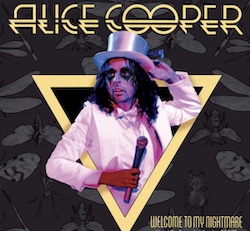
“He,” Gary said. “Alice Cooper is a ‘he.’ He was good.”
Thanks to these fellow Oklahomans who shared their memories of the Myriad Convention Center built across decades of sports events, concerts, graduations and more. And thank you, Ed, for suggesting this post.
If you have your own memories of attending an event at the Myriad, please share them in comments below.
Aerial view of the brand new Myriad Convention Center in 1972.
Almost 34 years ago, a friend and former coworker at the Southwest Times Record in Fort Smith, Ark., hit me up with a request.
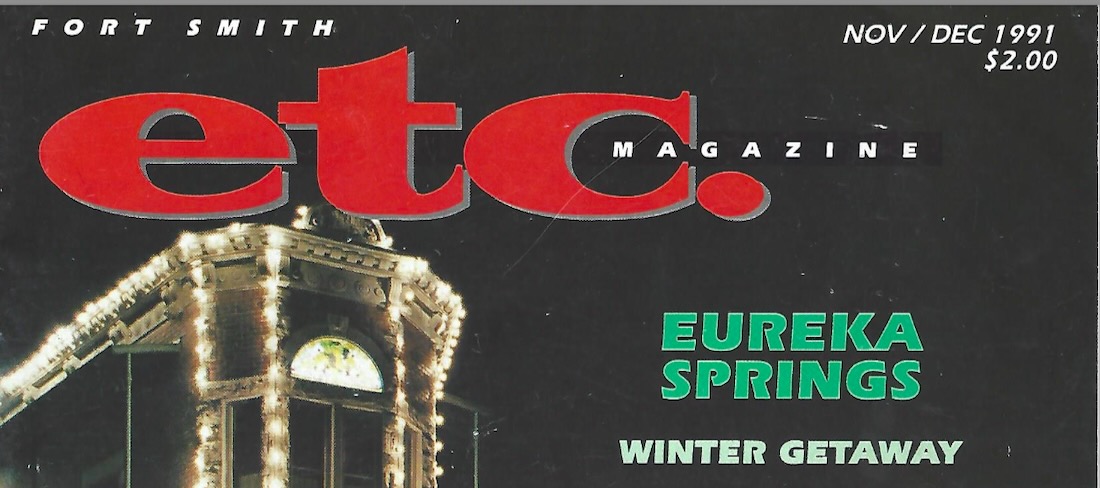
Patti had left the paper to become editor of a new local magazine called Fort Smith Etc. She asked me to write an article on the University of Arkansas’ stunning move from the now late Southwest Conference to the the rival Southeast Conference.
Arkansas announced in August 1990 that it was switching conferences, and actually made the move the following year.
The unexpected conference divorce set off shockwaves among major conferences and ushered in what has become an era of constant realignment. By 1995, the SWC was no more, with most members welcomed into the Big Eight, now known as the Big 12.
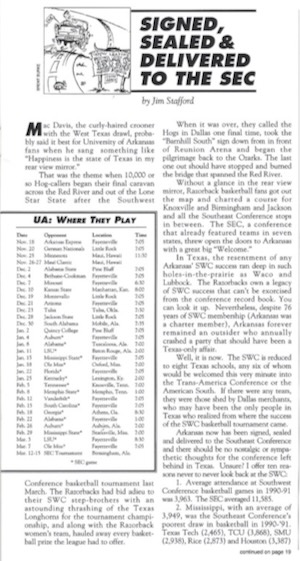
Anyway, I wrote a pretty snarky — for me — 800-word piece for the magazine that listed all the things the Razorbacks would not miss from the SWC. It was published in the Nov./Dec. 1991 edition of Fort Smith Etc. magazine.
So, why am I writing about this now when I hadn’t given the article a thought for the last 30 years or so?
Turns out a high school friend of mine and Fort Smith native I’ll call ‘Will’ discovered he had digitized copy of the article on his personal computer. Will, who also had written for the magazine, emailed it to me. Thanks, Will!
After reading what I wrote more than three decades ago, I’m still proud of how it turned out and the fact that it is still relevant today in this era of conference reshuffling.
There are a couple of references to now departed venues like Barnhill and Reunion arenas (and misplaced campus locations for the universities of Alabama and Mississippi), but it’s not too dated, I think.
With all that said, I’m reprinting the article here in BlogOKC. Hope you enjoy this trip down memory lane.
Signed, sealed & delivered to the SEC
Mac Davis, the curly-haired crooner with the West Texas drawl, probably said it best for University of Arkansas fans when he sang something like “Happiness is the state of Texas in my rear view mirror.”
That was the theme when 10,000 or so Hog-callers began their final caravan across the Red River and out of the Lone State after the Southwest Conference basketball tournament last March. The Razorbacks had bid adieu to their SWC step-brothers with an astounding thrashing of the Texas Longhorns for the tournament championship, and along with the Razorback women’s team, hauled away every basketball prize the league had to offer.
When it was over, they called the Hogs in Dallas one final time, took the “Barnhill South” sign down from in front of Reunion Arena and began the pilgrimage back to the Ozarks. The last one out should have stopped and burned the bridge that spanned the Red River.
Without a glance in the rear view mirror, Razorback basketball fans got out the map and charted Knoxville and Birmingham and Jackson and all the Southeast Conference stops in between. The SEC, a conference that already featured teams in seven states, threw open the doors to Arkansas with a great big “Welcome.”
In Texas, the resentment of any Arkansas’ SWC success ran deep in such holes-in-the-prairie as Waco and Lubbock. The Razorbacks own a legacy of SWC success that can’t be exorcised from the conference record book. You can look it up.
Nevertheless, despite 76 years of SWC membership (Arkansas was a charter member), Arkansas forever remained an outsider who annually crashed a party that should have been a Texas-only affair.
Well, it is now. The SWC is reduced to eight Texas schools, any six of whom would be welcomed this very minute into the Trans-America Conference or the American South.
If there were any tears, they were those shed by Dallas merchants, who may have been the only people inTexas who realized from where the success of the SWC basketball tournament came.
Arkansas now has been signed, sealed and delivered to the Southeast Conference and there should be no nostalgic or sympathetic thoughts for the conference left behind in Texas.
Unsure? I offer ten reasons never to never look back at the SWC:
1. Average attendance at SouthwestConference basketball games in 1990-91 was 3,963. The SEC averaged 11,585.
2. Mississippi, with an average of 3,949, was the Southeast Conference’s poorest draw in basketball in 1990-’91. Texas Tech (2,465), TCU (3,868), SMU (2,938), Rice (2,873) and Houston (3,387) all had lower attendance averages.
3. Average attendance at Southwest Conference football games in 1990 was 39,382. The SEC averaged 63,870.
4. Southwest Conference teams were forced to play a limited football schedule for two seasons because one conference member, SMU, was given the “death penalty” by the NCAA; no SEC school has ever drawn the “death penalty.”
5. The Cotton Bowl is played in an open-air stadium, often in some of the most brutal weather Texas has to offer on New Year’s Day; the Sugar Bowl, played in the New Orleans SuperDome, is never threatened by the weather.
6. Southeast Conference football games are broadcast nationally over the Turner Broadcasting System cable network. SWC games are broadcast throughout Texas on something known as the “Raycom Sports Network.”
7. Arkansas will never have to face Southwest Conference officials when playing a Southeastern Conference game.
8. Texas A&M, a school full of traditions, features an all-male corps of cheerleaders.
9. There is no horror movie titled “The Tennessee Chainsaw Massacre”
10. Few natives from any Southeastern Conference state answer to the name of “Tex.”
EDITOR’S NOTE: In what has become an annual column of its own, I look back over BlogOKC in 2024 and list my 10 favorite posts. Not most popular, but those that meant the most to me. I went back and forth, adding some then eliminating them, because each of them meant something to me. I hope you enjoy browsing the list and clicking on the headlines to read the full post. My list of personal favorites also includes a wonderful guest post by my friend, Don Mecoy. Enjoy!
Major League Baseball Commissioner Rob Manfred said the ‘Golden At-Bat’ is being discussed
When I was a young would-be sports writer just out of college working for the Southwest Times Record newspaper in Fort Smith, Ark., my editor sent me out to cover the state small school baseball tournament.
I had not seen much high school baseball through the years, so I was caught by surprise by one particular rule the small schools played by.
It was called the “Courtesy Runner.”
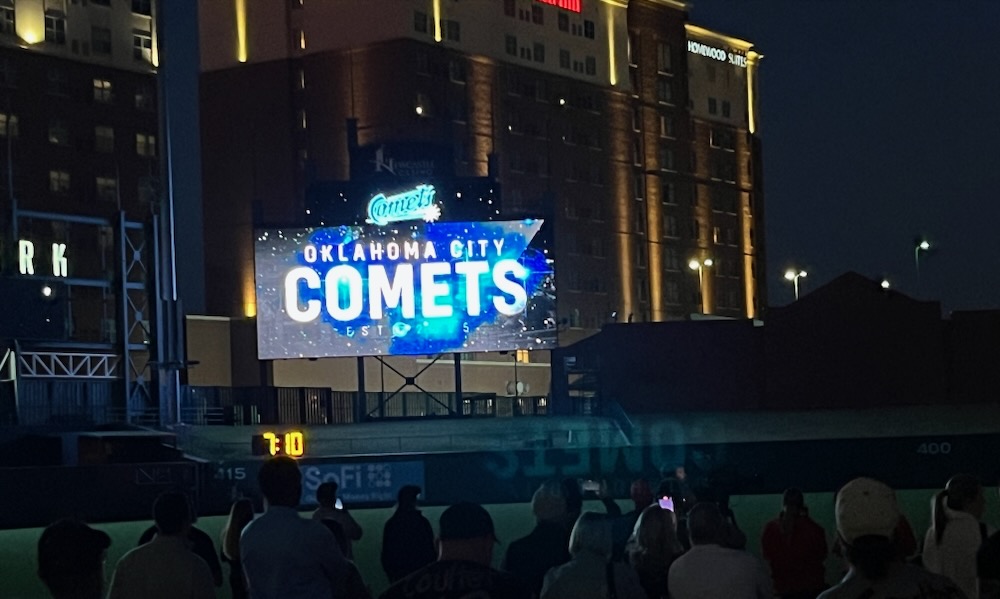
The Bricktown Ballpark scoreboard shows the team’s new name at reveal event.
The Oklahoma City Baseball Club revealed its new name, “Comets,” in a ceremony Saturday evening at the Chickasaw Bricktown Ballpark witnessed by at least a couple thousand enthusiastic fans.
I was among those who showed up for the Big Reveal, so I can attest to the collective cheer that went up when the “Comets” name and logo appeared on the scoreboard screen.
I was not expecting “Comets,” although I’m not sure what I expected. Maybe “Flycatchers,” which my friend Ed Godfrey had predicted as the future team name. Or the “Waving Wheats” or something that related to Oklahoma.
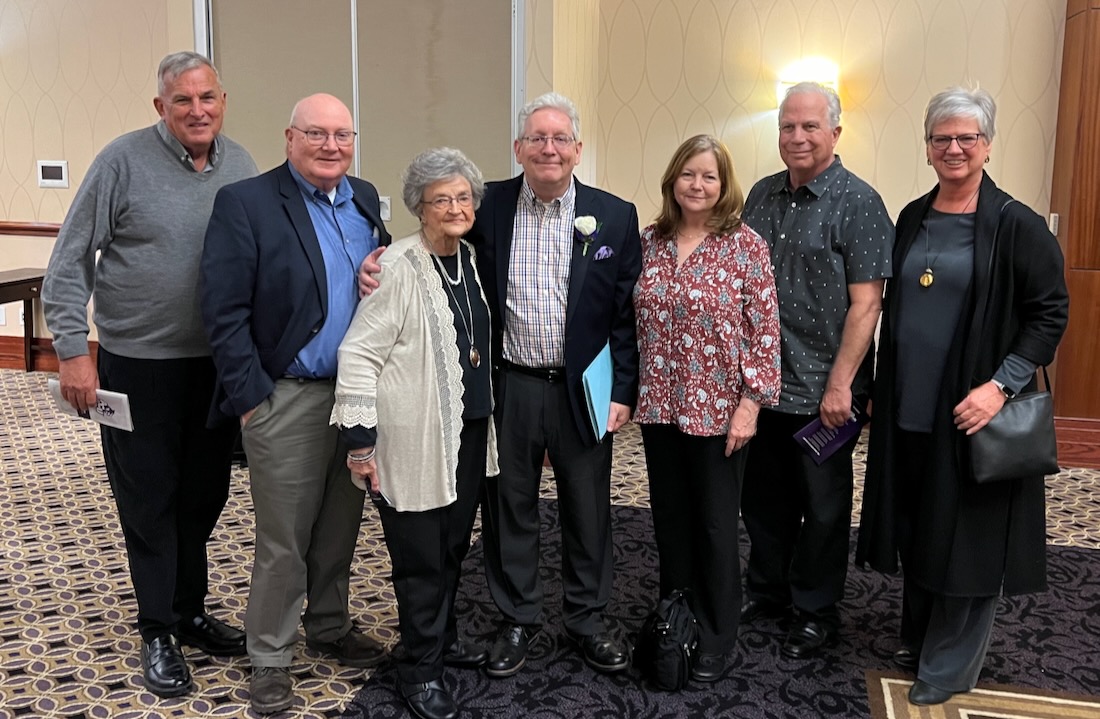
From left, Scott Kirk, Jim Stafford, Peggy Marler, Ron Hadfield, Corliss Hudson Englert, Brad Englert, Cheryl Mann Bacon
Ron Hadfield is a long-time friend who was my student editor on the Abilene Christian University newspaper, The Optimist, in 1977. Ron recently was recognized with a Lifetime Achievement Award at the ACU Athletic Hall of Fame ceremony that I was privileged to attend.
I showed up on ACU’s doorstep in 1976 as a transfer student with a dream to some day become a newspaper sportswriter, but with virtually no writing experience.
Ron likes to tell the story that on the first assignment he sent me out on, I turned in some terrible copy and proudly showed him the quotes I made up.
I deny the accuracy of his memory.
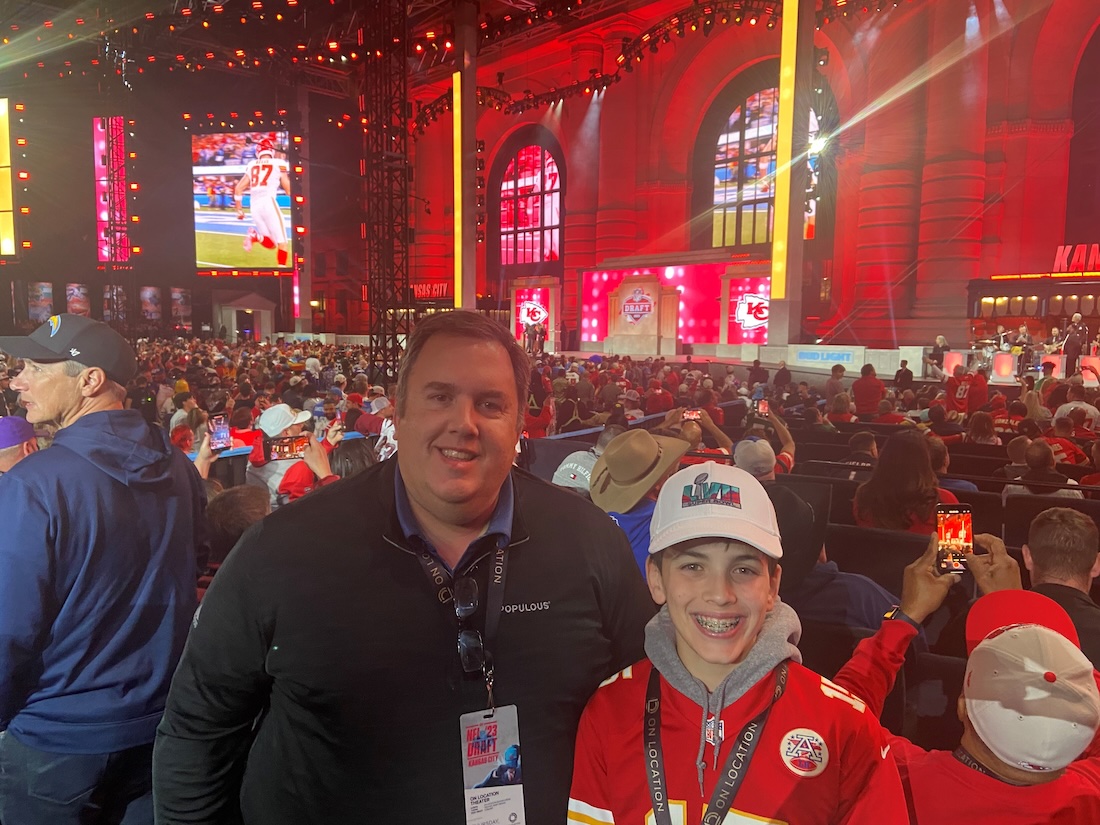
Brady Spencer with his son, John, outside Kansas City’s Union Station during the 2023 NFL draft.
A recent update in The Oklahoman newspaper on the new OG&E Coliseum under construction at the State Fairgrounds identified it as a venue designed by a firm named “Populous.”
In an even more recent story, I learned that Populous has been hired to design the new $71 million soccer stadium just south of OKC’s Bricktown.
I think I’m noticing a trend.
So, what exactly is Populous?
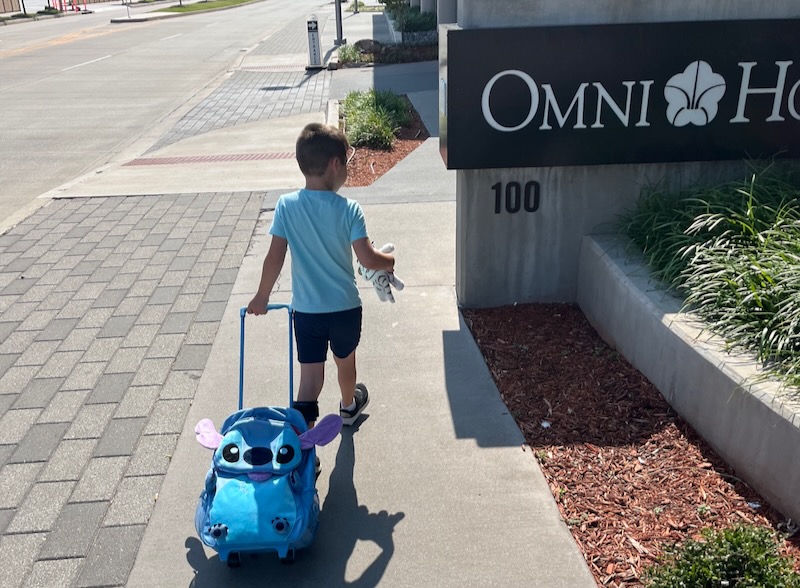
Solomon rolls his new backpack up to OKC’s Omni Hotel on Friday morning.
This is what happens when his GiGi is out of town on business and Papa is left in charge of entertainment on a Friday for our grandson, Solomon.
So, when it was just us two early Friday, Solomon said he wanted to go on a road trip. He suggested “the beach” and then Branson.
I said we couldn’t do either of those today, but maybe we could drive up to Guthrie and find a place to eat.
Solomon sort of accepted that, but later told me he wanted to go to that “nice Thunder hotel downtown.” All of us had stayed the night at OKC’s Omni Hotel last year when my wife, Paula, was booked there for a convention meeting.
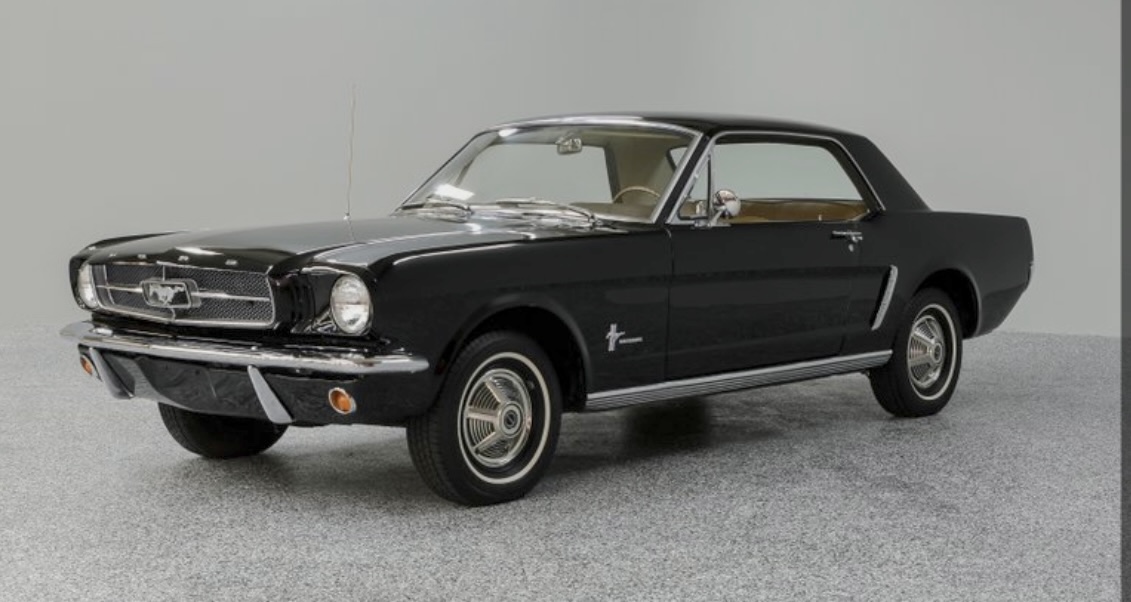
A black ’65 Mustang that looks exactly as I remember the one driven by my Aunt Dee.
This is a story of the Ford Mustang. Or, rather, two Ford Mustangs. One of them did not have a happy ending, and I was in it.
If you are hazy on your Ford Mustang history, I’ll catch you up to date a bit. The Mustang was conceived by team at Ford led by Lee Iacocca, who later gained fame as the man who saved Chrysler.
The first Mustang was introduced to the public in April 1964, as the “1964-1/2” Mustang. It was an instant hit. The public fell in love with it because it had a unique, sporty body style compared to what U.S. autos had been, which were cars shaped like boxes and quite unattractive.
My dad was among the millions of Americans who were taken by the Mustang and eventually bought one when he was stationed on the island of Okinawa while in the military. I’ll come back to that.
I read a magazine article when I was in college in the 1970s about a scrappy startup called Apple Computer, founded by two guys named Steve who built their first computers in the garage at the home of one of the Steves.
I couldn’t get enough of their story; the David-vs.-Goliath way that Apple blazed the personal computer trail that forced the industry behemoth at the time, IBM, to play catchup. Steve Jobs and Steve Wozniak were my entrepreneurial heroes.
So, I admit that I am a long-time Apple fanboy and remain one today.
But my fandom has run smack into some ugly reality. Apple is no longer the scrappy industry underdog. In fact, it is one of the world’s largest companies by market value. Yet, it has begun to flex its financial muscles like a bully that nobody likes.
Here’s a bit of nostalgia for you. When I walked into the Southwest Times Record newsroom for the first time as an employee in 1978, I encountered a bustling community of talented writers, editors and photographers all scrambling to publish local news seven days a week.
The Fort Smith newspaper was a great place to learn the craft as my first job out of college. There are many folks among my former colleagues there whom I will never forget. I worked at the SWTR for five years in a variety of positions before moving to Oklahoma City and working for The Oklahoman for almost a quarter of a century.
So, it’s been disheartening to watch the SWTR decline as a community force over the past few years as the number of subscribers declined and employees were laid off. It’s a situation not unlike that in many other cities across the nation.
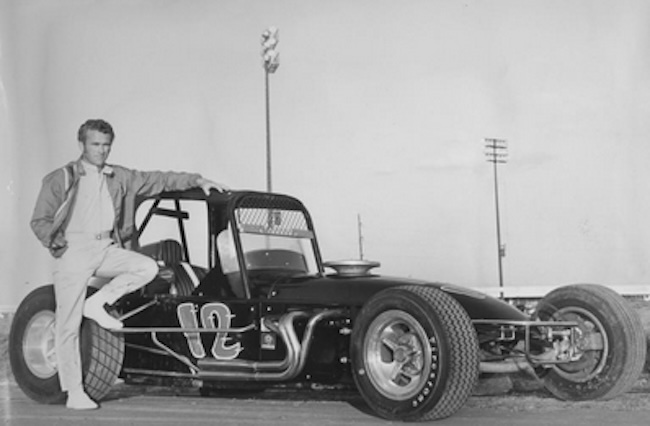
Evard Humphrey and his No. 12 super-modified sprint car
Editor’s Note: Don Mecoy is a friend and former colleague at The Oklahoman who retired as the newspaper’s managing editor at the end of 2022. A recent conversation about sports heroes from our youth when Don was a guest on the 3 Old Geezers podcast sparked his memory about a local race car driver fromthe late 1960s. Don wrote this guest blog post about that driver and those memories.
By Don Mecoy
I had my share of sports heroes when I was a kid. Roger Staubach, Lou Brock, Johnny Bench and Joe Washington were among my faves. But my personal hero — and it truly was personal — was a guy you probably never heard of: Evard “Kerfoot” Humphrey.
Evard was the driver of the No. 12 super-modified sprint car that ran every Friday night at State Fair Speedway during my youth in Oklahoma City.
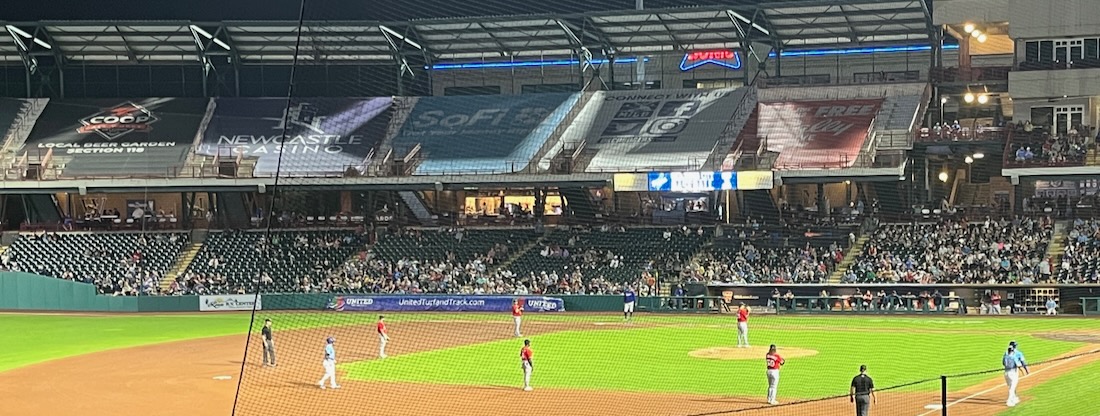
Advertising banners cover the entire upper deck seating area down the first base line of the Bricktown Ballpark.
I was enjoying a summer evening at the Chickasaw Bricktown Ballpark with a friend last year, savoring the crowd, the game and the park’s immaculate green pasture.
Then my eyes landed on the upper deck along the first baseline that extends out into right field. There were no seats or bleachers visible. Only advertising banners draped across each section.
Don’t get me wrong. Oklahoma City has a beautiful ballpark that has retained its attractiveness since it opened in April 1998. However, the tarps do nothing but detract from the ballpark’s charm.
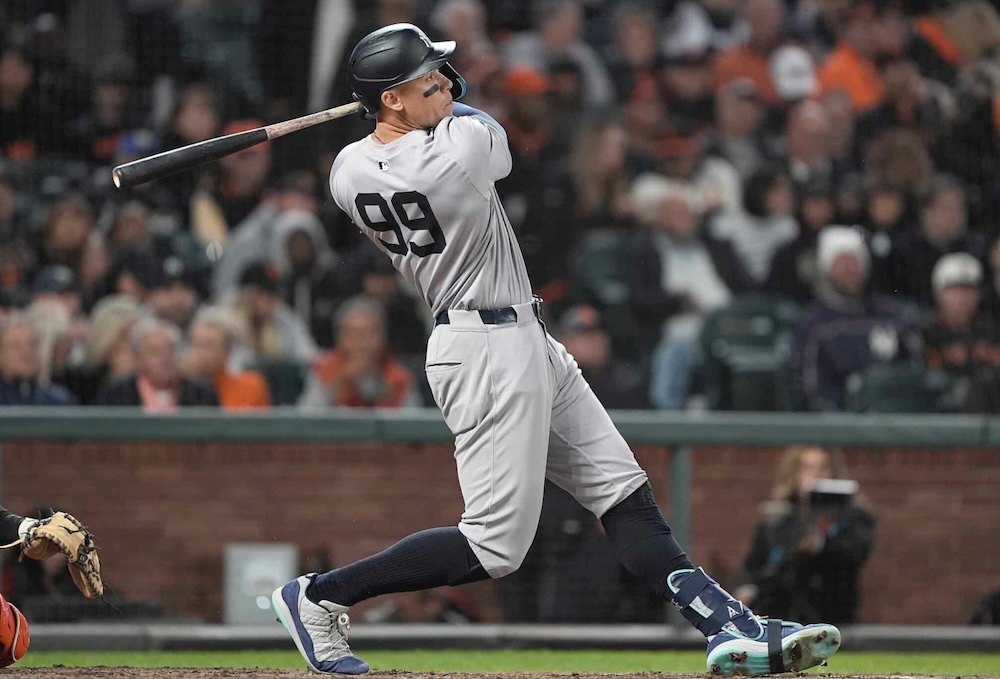
A ‘Golden At-Bat’ in future for New York Yankees star Aaron Judge?
When I was a young would-be sports writer just out of college working for the Southwest Times Record newspaper in Fort Smith, Ark., my editor sent me out to cover the state small school baseball tournament.
I had not seen much high school baseball through the years, so I was caught by surprise by one particular rule the small schools played by.
It was called the “Courtesy Runner.”
That rule allowed coaches to sub in a faster runner when a slower player got on base. But the player who was substituted for could remain in the game. Usually, the coach subbed in his fastest guy for the big, slow catcher.
I was offended by the Courtesy Runner, because I grew up following Major League Baseball and knew that once a player was substituted for, he was out of the game. No coming back in.
But the Courtesy Runner seemed popular with high school coaches in back in 1979, even if it messed up my boxscore at the end of the game. It remains in play for high schools, softball and even Little League Baseball.
And now the Courtesy Runner has been joined by other earthshaking changes infiltrating Major League Baseball itself as the game seeks a younger demographic. The pitch clock. Bigger bases. Fewer mount visits.
More is coming.
Recently, MLB Commissioner Rob Manfred discussed the possibility of baseball using what he called a “Golden At-Bat.”
“You put your best player out there out of order at a particular point in the game,” Manfred said. “That rule and things like that are only in the conversational stage right now.”
Major League Baseball Commissioner Rob Manfred said the ‘Golden At-Bat’ is being discussed
Here’s a scenario:
Let’s say the Yankees are down two runs in the 9th inning vs. the hated Red Sox with two men on base and two outs. The Golden At-Bat rule would allow them to bring Aaron Judge — their best hitter — to the plate even if his place in the batting order was six at-bats away.
I’m offended by the Golden At-Bat idea, just like I was offended by the Courtesy Runner all those years ago.
Call me a Geezer shouting GET OFF MY LAWN, but the Golden At-Bat concept seemed to come right out of left field, so to speak. It’s goofy. It’s unneeded. It’s a terrible idea.
Baseball already places a runner on second base to start the inning in extra innings. Now this?
Like me, much of the world of MLB fans reacted with horror to a rule that would skew baseball’s beloved statistics, which have withstood the test of time for more than 100 years.
There has been a chorus of boos across the nation from baseball fans, among them radio talk show host Dan Patrick. I listen to the podcast version of the DP Show daily, and heard Patrick’s reaction last week.
“I hate it,” he said. “Hate it. I hate the runner at second base to start extra innings. Don’t go too gimmicky. Does baseball need that? It felt like baseball had a good year, a great year.”
In the spirit of the Golden At-Bat, Dan asked his entourage of co-hosts, collectively known as the Danettes, to come up with some “even dumber” ideas for baseball. The guys were happy to oblige.
“Count the Golden At-Bat as two outs if the batter fails to get a hit.”
“if your team is up by 10 runs or more you have to pitch blindfolded.”
“If you throw a pitch 100 mph or more, it’s not a strike, it’s a ball.”
“One time a game, you can require the opposing team to remove one outfielder during an at-bat.”
The Danettes struck Dumb and Dumber gold with their ideas.
But, you know what? They didn’t mention the Courtesy Runner.
And I’m still offended by the Courtesy Runner after all these years.
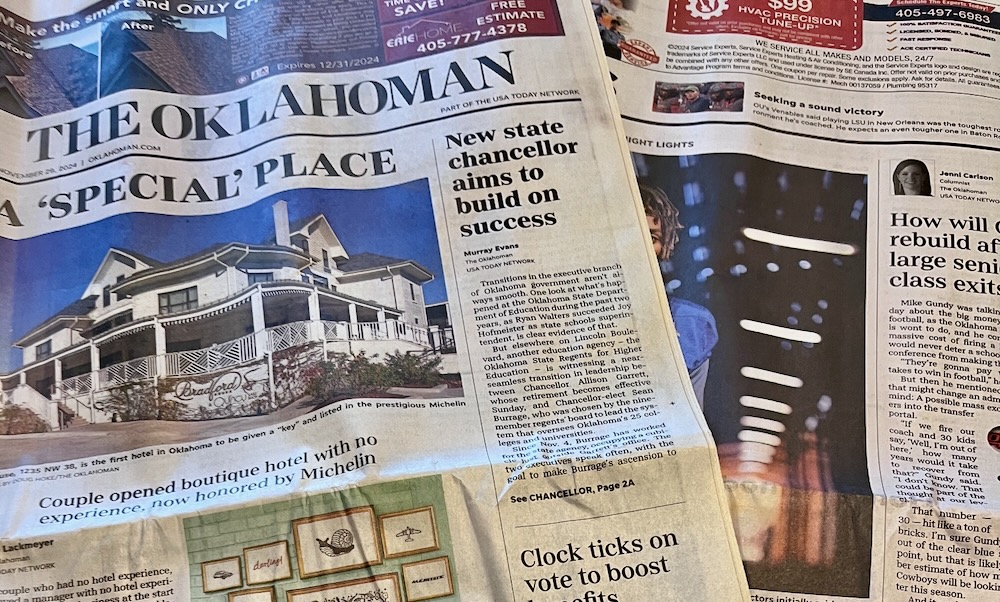
A few years ago my former colleague at The Oklahoman newspaper, Richard Mize, lamented the demise of the metal coffee can. The coffee industry eliminated the once ubiquitous coffee can and replaced it with plastic cans or closable pouches.
“Where will we put our bacon drippings?” Richard asked.
Good question, Richard. The coffee industry was totally unconcerned about the fallout in households across the nation where bacon grease was stored in empty coffee cans. How dare they.
Anyway, I see a similar crisis brewing in American households. Newsprint is rapidly disappearing from our driveways and kitchen tables.
Instead of picking up our actual paper from the driveway each morning, Americans are more likely to read an online version — or, more disappointing, not read any newspaper at all.
Earlier this year I wrote about the decline of my first newspaper employer, the Southwest Times Record in Fort Smith, Ark.
In fact, I’ve seen firsthand the impact the shortage of old newsprint has had on my neighbors in recent years.
Since I am virtually the only print subscriber of The Oklahoman on my street, a neighbor twice asked me for my old newspapers to use for packing before she moved and again when her daughter moved into her own apartment. I gladly shared my bounty of old newsprint.
So this leads me to the point of this post: how we’re going to miss the many ways old newspapers are used around the house — or used to be. Here are a few:
As liner for a birdcage (now that’s low-hanging fruit, I know).
As fish wrap (a common newsprint stereotype).
Lining the floor next to an outside door when potty training your puppy. It worked on my now departed Boston Terrier decades ago.
Packing in preparation to make a move (see example above)
Creating pirate hats. As children, my sister and I learned to fold the newspaper into the most awesome pirate hats we could imagine. We proudly wore them around our house or paraded through the neighborhood.
Making kites. My dad made a newsprint kite for me when I was about 10 years old, and it actually flew as well as the store-bought kind.
As floor liner when doing a paint job or an art project.
Newsprint is great as backing on a counter when you are cutting a watermelon, then wrapping the rinds before throwing them out.
Packed away in your closet or attic to hold on to keepsake articles for the memories.
Current event articles clipped for school projects.
Finally, a rolled up newspaper makes a fine rod of discipline for a wayward pet. I only had to roll the paper up and raise it above my head to stop my Boston Terrier from committing an offense such as chewing up a shoe.
We’re going to miss newsprint for many reasons beyond just reading the paper when its gone.
BONUS: If you’ve got other ways you’ve recommissioned old newspapers in the past, leave them in comments below.
This just in from my friend Josh O’Brien on an alternative use for old newspapers: “Another use: cleaning big mirrors or windows — much better than paper towels.”
Richard Mize (see above) added: “One more thing: I use three sheets of newsprint to light my charcoal chimney for grilling!”
From David Yarbrough in Fort Smith, Ark: “Use as fly (or wasp) swatter, although not as ergonomically designed as plastic ones.”
One more from Linda Lynn: “Gift wrapping. And to protect table from kids’ art projects … and for art projects like collages and paper mache. We even used to create Christmas trees with newspaper.”
From Steve Barrymore: “I save mine all year then use as a weed barrier in the garden at planting time. I then cover it with mulch. Eliminates weeding.”
From Kathy Consbruck in Nebraska: “Mine go to the pet shelter. They line the kennels with them.”
From Phyllis Welsh Bennett: “A long time ago, I used strips of colored Sunday comics to make a chain to adorn a Christmas tree at The Oklahoman. Last week I gave a stack of old papers to someone needing it to pack glassware for a move. Each weekday I put my newspaper in the waiting area of the Teachers’ Retirement System. I’m told a lot of TRS members enjoy reading a paper newspaper!”
From LaRita Dawn Watson: “I save mine for my Dad to read since he lives outside the delivery area and won’t read the online version. I have used to clean windows and mirrors, and it works better than any cloth! I’ve used it in all the ways mentioned and will truly miss it when it’s gone. It feels good to turn the pages and read.”
A black ’65 Mustang that looks exactly as I remember the one driven by my Aunt Dee.
This is a story of the Ford Mustang. Or, rather, two Ford Mustangs. One of them did not have a happy ending, and I was in it.
If you are hazy on your Ford Mustang history, I’ll catch you up to date a bit. The Mustang was conceived by a team at Ford led by Lee Iacocca, who later gained fame as the man who saved Chrysler.
The first Mustang was introduced to the public in April 1964, as the “1964-1/2” Mustang. It was an instant hit. The public fell in love with it because it had a unique, sporty body style compared to what U.S. autos had been, which were cars shaped like boxes and quite unattractive.
Purchasing a brand new Mustang off the showroom floor in 1964-65 would set you back $2,400, according to cars.com. Today, those antique vehicles bring from $16,000 for the coupe to $33,000 for the fastback model.
My dad was among the millions of Americans who were taken by the Mustang and eventually bought one when he was stationed on the island of Okinawa while in the military. I’ll come back to that.
Anyway, the Mustang was beloved by my dad and so many others because it had a long nose, short rear end and distinctive grill and tail lights. Eventually, it came in a 2-door coupe, convertible and the incredibly popular fast-back.
I’m writing about the Mustang because my 5 year-old grandson, Solomon, and I discovered a show on the Roku channel called “Counting Cars,” which follows a shop in Las Vegas that rehabs older vehicles and turns them into showpieces.
We streamed an episode this morning in which the shop refurbished a ’65 Mustang and turned it into a perfect candy apple-red rendition of how it must have looked on the showroom floor in 1965. Solomon could not get enough, running through the house to get his grandmother to come in and see the beautiful car.
So, two Mustang stories.
When I was a senior in high school, I lived with my aunt and uncle in Fort Smith, Ark. My aunt Dee drove a black ’65 Mustang and was so in love with the car that she told everyone she would never drive another. Its compact size made it easy for her to maneuver on the road.
Fast forward to roughly 1980, when I was a young sports reporter at the Southwest Times Record, which had its offices and newsroom in downtown Fort Smith.
One day, as I stepped out of the building onto the sidewalk, my uncle, L.R. Mendenhall, drove up and parked Aunt Dee’s Mustang right outside the SWTR’s door along Rogers Ave.
At virtually the same moment, Leroy Fry, who was the newspaper’s managing editor, walked out of the building and spotted the Mustang. I introduced my Uncle “Blue Eyes” (as he was known to our family) to Leroy. The editor told him that he had to have that Mustang and how much would my uncle sell it to him for.
“It’s not for sale,” Blue Eyes told him. “It’s my wife’s car and she says it’s the only one she will ever drive.”
End of story.
That black Mustang was my Aunt Dee’s ride or die, and I’m pretty sure when she died in roughly 2000 that the car was still in her family’s possession.
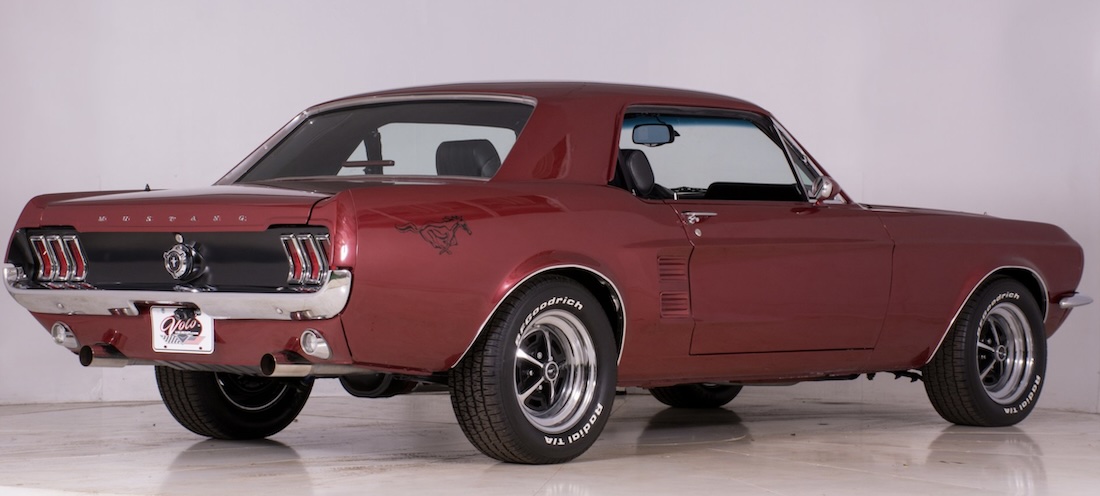
My second Mustang story involved the 1967 Mustang my dad bought while on Okinawa. He was in the Army, so our whole family lived on the island. This was in 1968 when I was 15 years old.
Dad loved his Mustang, which was painted in a sort of burnt-orange color, and drove it every day to work. He was a hot GI in a hot vehicle.
A ’67 Mustang similar to that owned by my dad, although his was more of a burnt orange in color.
I wanted to drive it, too, and begged him to let me get behind the wheel. So one weekend he asked the son of a family friend who was about 19 years old to drive me and the Mustang to an abandoned Japanese airstrip where I could drive it and stay out of harm’s way.
I remember driving back and forth on the airstrip multiple times and getting a feel for the car. Then we decided to head back to the military base where our families lived. I moved over to the passenger side, and the older kid (can’t think of his name now) took the wheel.
We drove off the airstrip and back onto the rural two-lane road that was adjacent to a field of sugar cane. My young driving instructor said, “let’s see what this car can do,” and gunned it.
I’m not sure how fast the car was traveling, but we roared down that rural road until my driver suddenly realized there was a 90-degree turn at the end and started screaming that we weren’t going to make it.
We didn’t.
The car flew off the end of the road at the hairpin curve, hit hard in the sugar cane field and landed on its side. Neither one of us had buckled our seatbelt (hey, this was the ’60s), but we were mostly uninjured. My friend cut his hand on the steering wheel when the padding came off.
We climbed out of the driver’s side, which was facing the sky and then tried to figure out how to contact our parents in this era before the cellphone was a gleam in anyone’s eye.
There was a military installation about a half mile away, so we walked to it, told the guards at the security gate what happened, and they let us call our parents. Of course, we told them exactly how it happened.
The car looked OK to me, but had to be towed to a shop somewhere on the island. Turns out the frame was bent and the insurance company declared it a total loss.
My dad was heartbroken, of course. But the fact that we were unhurt took some of the steam out.
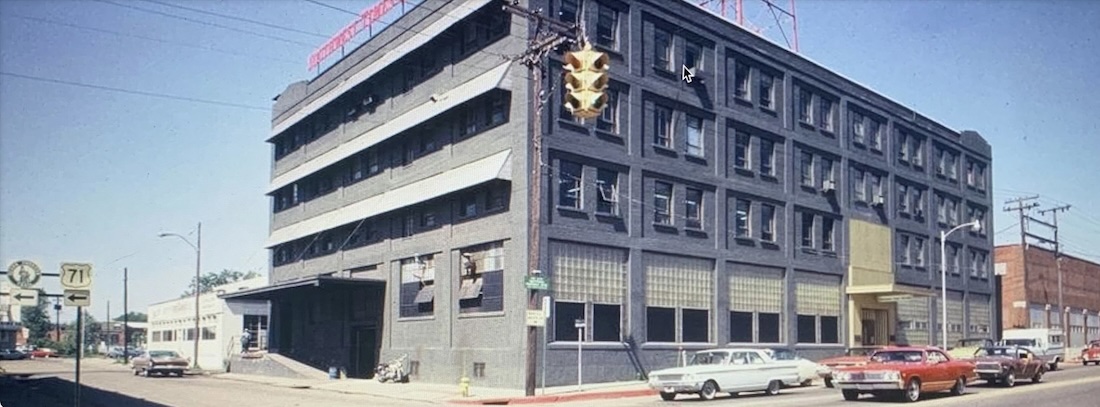
The Southwest Times Record building in what appears to be the early 1960s. (Photo courtesy of Southwest Times Record former employees Facebook group)
Here’s a bit of nostalgia for you. When I walked into the Southwest Times Record newsroom for the first time as an employee in 1978, I encountered a bustling community of talented writers, editors and photographers all scrambling to publish local news seven days a week.
The Fort Smith newspaper was a great place to learn the craft as my first job out of college. There are many folks among my former colleagues there whom I will never forget. I worked at the SWTR for five years in a variety of positions before moving to Oklahoma City and working for The Oklahoman for almost a quarter of a century.
My parents were among the 40,000 or so SWTR subscribers who fetched the newspaper off their driveway every morning. Established as the Fort Smith Times in 1884, the SWTR had a strong following not only in Fort Smith, but across a multi-county region of Western Arkansas and Eastern Oklahoma.
So, it’s been disheartening to watch the SWTR decline as a community force over the past few years as the number of subscribers declined and employees were laid off. It’s a situation not unlike that in many other cities across the nation.
Now owned by industry giant Gannett, I’m not sure there remains a single Fort Smith-based editor or reporter chasing down local news stories.
In fact, my 90-year old mother, who subscribed to the SWTR in our hometown of Fort Smith for more than five decades, finally gave it up a couple years ago because the paper had so little local news. Sometimes she still reads the obituaries published online.
As for me, I’ve stayed connected to the SWTR by subscribing to the paper’s free emailed daily newsletter that allows a peek at its headlines and free access to the obituaries.
It all makes you wonder when the hammer will fall and Gannett will halt publication of a physical paper for any remaining subscribers, leaving only online access.
Well, we’re close.
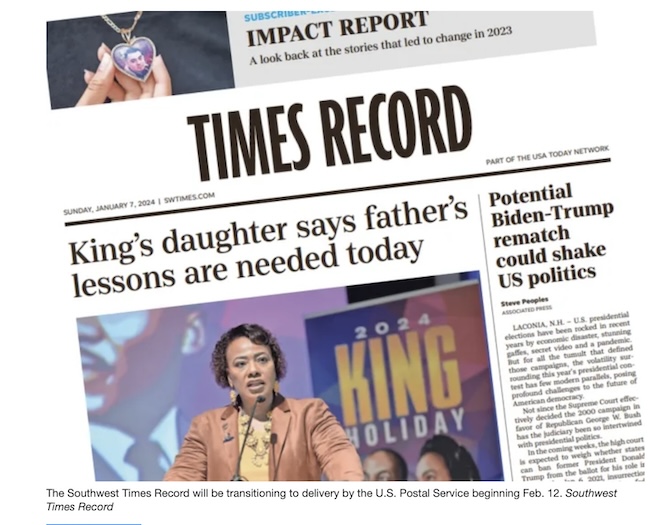
I received a notice recently that the SWTR was transitioning to a “mail only” newspaper with no more home delivery. Here’s what the email said, in part.
“Beginning tomorrow, look for your copy of the Southwest Times Record and our other regional publications to arrive with your daily mail. As announced in the Jan. 10 edition and in letters mailed to subscribers, the U.S. Postal Service will be delivering the Southwest Times Record to optimize resources amidst increasing digital readership demand.”
Now subscribers can read ‘news’ that is already at least 24-hours old when it arrives in the mail. What’s that old saying about nothing as stale as yesterday’s newspaper?
So, why am I writing this?
Well, it’s not a diatribe against the current ownership, because I see what’s happened to my old employer as a product of emerging technologies and a big change in how the public consumes news. Online access to news — much of it free — has removed the incentive to subscribe to a daily newspaper that lands on your driveway every morning.
I’m mourning the SWTR for its former employees and the folks who subscribed to the paper for decades. It’s like watching a close relative slowly fade away from an incurable cancer.
Here in OKC, I’m still a subscriber to The Oklahoman’s physical newspaper, which is delivered to my driveway every day but Saturday. Yet, when I look up and down my street as I pick up the newspaper each morning, I see no other papers on my neighbors’ driveways. None.
However, I’m confident the path determined for the Southwest Times Record won’t be a template for The Oklahoman. It remains an enterprising news organization, despite repeated rounds of staff reductions.
That notice I received of the SWTR’s “all mail” newspaper delivery prompted me to ask a couple of former colleagues and longtime SWTR employees who still live in the Fort Smith area their thoughts on what has become of their former newsroom.
Patti Cox was a longtime news editor at the SWTR with whom I worked on the news desk. She shared her perspective with me as both a former employee and a current subscriber.
“It is very sad turn of events for Fort Smith,” she said. “We still are taking the day-late-in-the-mailbox paper but not sure for how long or why. End of so many meaningful things like insightful, timely local news and commentary. Long gone are noisy newsrooms filled with reporters, editors, interns with common purpose and multiple deadlines.”
Carrol Copeland, longtime SWTR photographer and creator of a Facebook group called Southwest Times Record former employees that has 162 members, also shared his thoughts with me.
“Back in the day, we covered local news, and there was very little worldwide or nationwide news in it,” Carrol said. “Probably 80 to 90 percent of it was local news. At one point we had the Poteau office and the Van Buren office, and somewhere around 150 employees.”
That was then. This is now.
“There’s not even a physical location anymore,” Carrol said, who recalled tornadoes, spectacular crimes and criminal trials that he covered over the years. “I think it comes down to a lack of income. If you can’t sell advertising you can’t have people to work for you.
“Now that people are going to the Internet or Youtube for their news, no one is advertising anymore. The technology overtook them.”
How will the daily newspaper voice be filled for former SWTR subscribers who loved its local news angle? Digital news services that focus on local news offer some hope.
Here in Oklahoma City, we have Oklahoma Watch and Nondoc, among others, which are sort of complementary to The Oklahoman, for now.
In Fort Smith, there’s an online site called Talk Business & Politics that focuses on Fort Smith and Northwest Arkansas. It was started by a former SWTR editor. I read it first thing each morning five days a week.
Actually, as I think about it, I’m not sure folks aged 30 and younger will miss holding an actual newspaper because it’s likely they never read one on a daily basis anyway.
But for those who grew up with ink-stained hands, it’s a difficult transition.
“I just know I loved newspapers and the dedicated (mostly young) quirky stressed out folks who worked for them,” Patti Cox told me. “Grateful for the lifetime lessons learned there.
“Good memories, my friend.”
We’ll carry those memories with us long after the final edition is published. It’s coming.
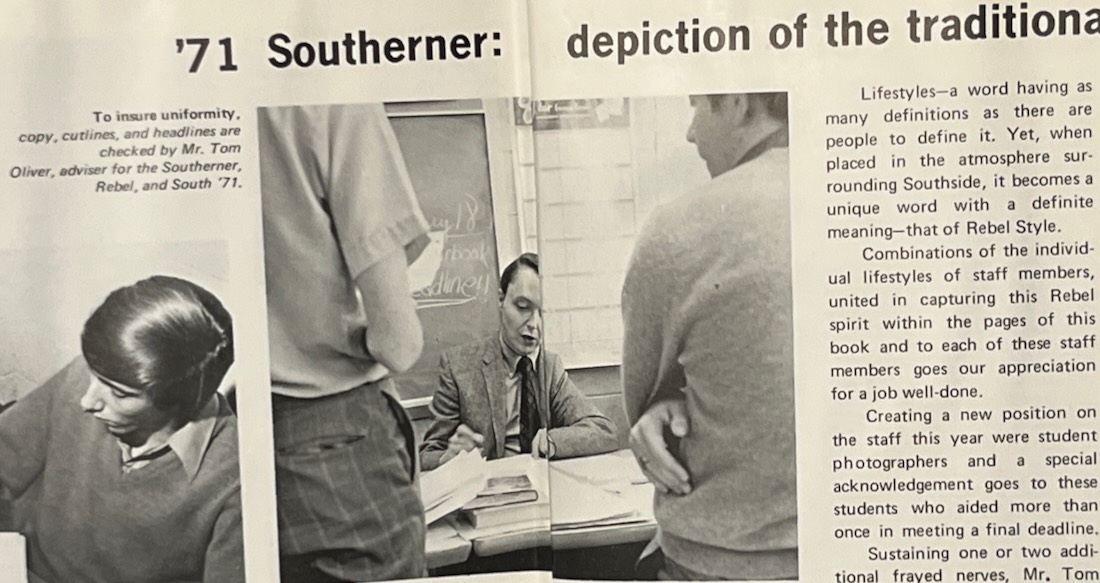
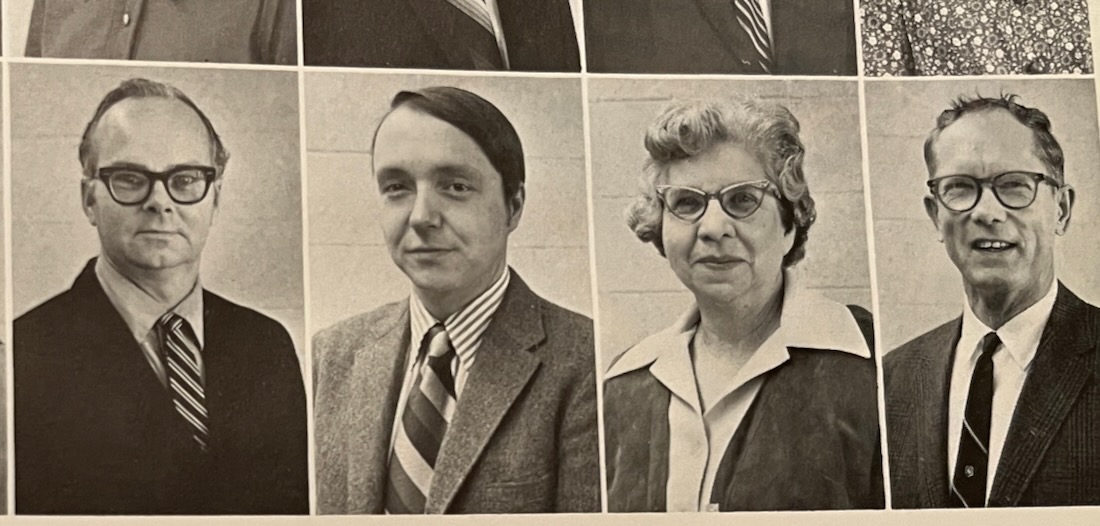
In a 1971 yearbook photo, Tom Oliver is shown editing students’ work as yearbook/newspaper advisor
As do a lot of communities around the country, someone from my hometown maintains a Facebook group called “If You Ever Lived in Fort Smith, Arkansas.”
I’m not on the Group’s page often, but it’s fun to occasionally scroll through and see what people are talking about.
Certain topics dominate the Fort Smith page: Dragging Grand Ave. in the ’70s … Enjoying a giant Worldburger of the past … and remembering stores like Hunt’s and The Boston Store that were once shopping mainstays.
About five years ago, a fellow Southside High School grad, Eddie Weller, posted about favorite Fort Smith teachers he recalled. Because I’m an Army brat, I only attended school in Fort Smith for three years.
But there was one teacher that certainly had an impact on my future. His name was Tom Oliver.
Mr. Oliver taught Journalism at Southside. I took Mr. Oliver’s class as a senior because I had a far-fetched dream of some day being a newspaper reporter.
So, I posted on the Facebook Group about Mr. Oliver being a memorable teacher, and it was like a call-and-response for a conversation that began five years ago and continues to stir memories today.
Here are some selected memories of Tom Oliver by his former students (Mr. Oliver died in the early 1990s, so it’s too bad he’s no longer around to read what his former students say.).
My original comment:
“My journalism teacher at Southside, Tom Oliver. Showed a lot of patience to a wanna be who had few skills in HS. I ended up making a career out of newspapers, so thanks to Mr. Oliver for encouraging me.”
Response from Eddie Weller:
“TO” as we called Mr. Oliver (but not to his face . . . ) … He did have patience. I remember senior year we rotated a column among the editorial board. I wrote a semi-funny one (tried to be humorous) for my first try. I used a phrase to get a chuckle that he asked me if I should use. He let me decide. He explained he was not sure my parents, for instance, would understand why I used the phrase. That was thoughtful on his part as a teacher. It made me really think — even a small phrase could make or break a mood you were trying to set. And “Ye Olde Pub” (the publications/journalism room for the uninitiated) was always a great place to be. He gave great freedom to the newspaper staff, yet knew when to reel it in. Truly an amazing teacher!”
From Sandra Curtis Kaundart:
“Tom Oliver, my mentor, was the greatest teacher ever! … I majored in journalism because of him, worked at a couple of small papers, later did my practice teaching with him, and ended up teaching journalism and English for 31 years.”
From Scott Carty:
“Tom Oliver was one of my heroes. i found one of his old yearbook pictures in the storage room and put mirror-headed thumbtacks thru his eyes and labeled it EltonTom. Made him smile.”
From Jim Morris:
“I had too much fun in his class. Just ask Scott Carty”
From David Yarbrough: “Tom Oliver didn’t do a lot of chalkboard teaching. He picked leaders (editors) and let those students fill their roles assigning stories and photos. He let them do the editing and design of the paper. Only occasionally did he make a quite suggestion. In the real world, you could compare him to a hand-off publisher who trusted his staff. He also encouraged students to explore all kinds of arts and studies. He took staffers to state and national conferences to open horizons.”
My own story isn’t anything spectacular. The student newspaper had a regular “Newsmakers” column of one-paragraph stories (emulating, I believe, a popular Page 1A “In the News” feature in the Arkansas Gazette), and I was assigned to write a Newsmaker item for each issue of the paper.
Did I tell you that I was terrible as a cub reporter? That one-paragraph Newsmaker assignment might as well have been a 10-page term paper.
But I managed to scrape something together for each edition, and Mr. Oliver gently edited my effort. Like all of my favorite teachers and professors over the years, he showed tremendous patience with me.
I remember Tom Oliver as being fairly young at the time and in tune with popular culture. His was a class that I looked forward to attending every single day. Similar to my favorite college professor, who also taught journalism.
I can’t tell you exactly what clicked for me, except perhaps the camaraderie of being around others that had an interest in journalism. Oh, and the thrill of seeing something you wrote in print.
In a touch of irony, years later, I served as Sports Editor of the Southwest Times Record in Fort Smith. Mr. Oliver worked part time for me on the Sport Desk on Friday nights during football season, helping us gather scores and write short summaries.
Mr. Oliver actually remembered me from my not-so-memorable one-year stint in his high school journalism class. He told me he was surprised that I pursued a newspaper career because he wasn’t sure that I had the interest as a student.
I guess my candle didn’t burn too brightly in high school. But I did have a dream.
Thank you, Tom Oliver, for being an encouraging teacher and not steering me away from the far-fetched dream of the 17-year-old me.
Tom Oliver’s (second from left) 1971 Southside High School yearbook photo
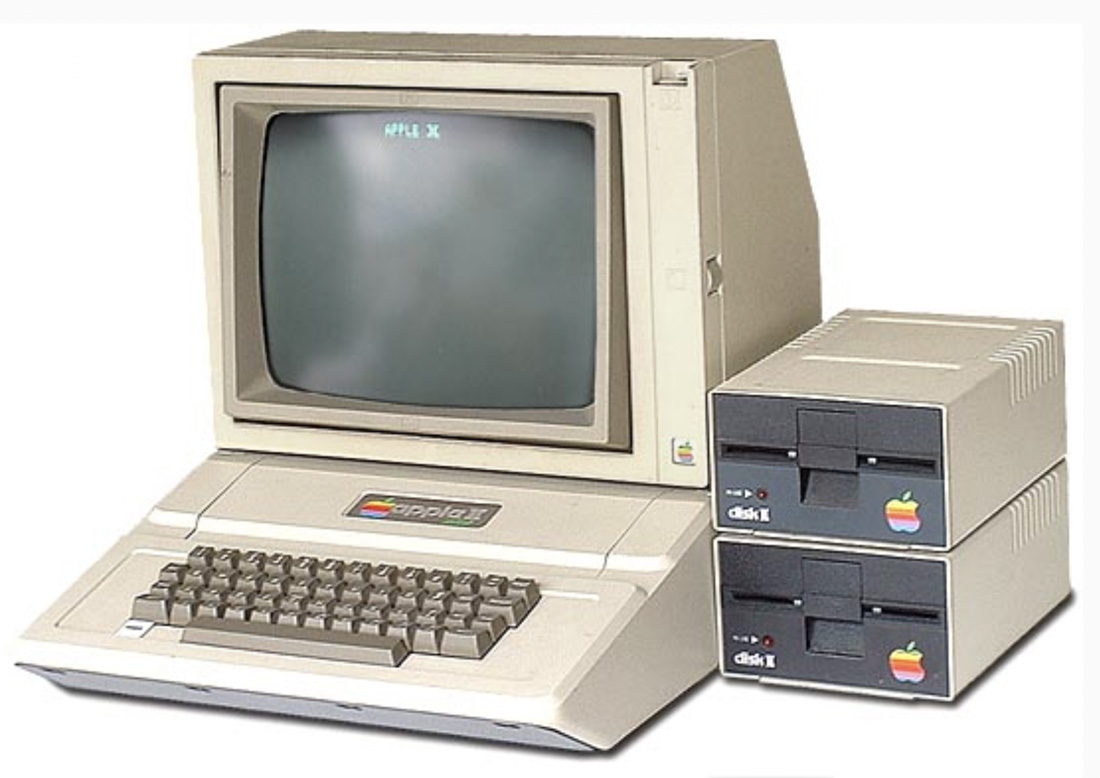
The Apple IIe with two 5-1/4 inch floppy disks, just like my first setup
I read a magazine article in the late 1970s about a couple of young Californians who built a new stand-alone computer in the garage of a Cupertino, Calif. home.
They started a company called Apple Computer to sell their innovation.
I had never used a computer at that point in life. As a journalism student at Abilene Christian University, we did all of our writing either on our own antiquated typewriters or on IBM Selectric typewriter in the newsroom of ACU’s student newspaper.
Anyway, the more I read about Apple and its Apple II computer, the more fascinated I became with both the company and the concept. Like most people, when I thought of computers, IBM and its massive room-sized mainframes came to mind.
After graduating from ACU, I went to work at the Southwest Times Record in Fort Smith, Ark. We worked on typewriters when I arrived in late August 1978, but by the Spring of 1979 the paper had installed its first computer terminals for reporters and editors to use.
They were so-called “dumb” terminals that were tied to a mainframe computer. They crashed a lot, usually right at deadline.
Meanwhile, I was still keeping up with Apple and its computer, but thought it was way beyond what I could afford.
Besides, who ever thought of having a computer in your house?
Fast forward about seven years. I was working at The Oklahoman when J.T. Goold, one of my co-workers, said he had a used Apple IIe for sale. It had been his father’s,
So, I ponied up about $500 and bought the Apple IIe, which came with a green monitor and two 5-1/4 inch floppy disks.
That Apple IIe sealed my love of all things Apple. I learned to use word-processing software on that computer, as well as a spreadsheet, a simple database and a page-design program.
In a few months, I added a 1,200-baud modem, which opened up a whole new online world of what were then known as bulletin boards. Then came AppleLink.
I tried my hand at learning some BASIC programming skills, but never got much further than making a little routine that filled the screen with a single sentence.
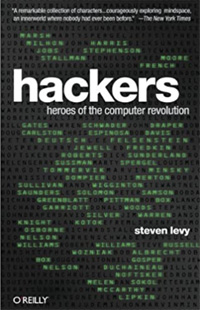
I’ve written all of this because I’m deep into Steven Levy’s book, “Hackers: Heroes of the Computer Revolution.” The Apple II and its creator, Steve Wozniak, play a huge role.
In Hackers, Levy detailed the founding and growth in the early 1970s of the Homebrew Computer Club in the San Francisco Bay Area. The club attracted scores of computer hackers who shared a vision of a future where everyone had a stand-alone computer of their own.
Levy wrote: “These were people intensely interested in getting computers into their homes to study, to play with, to create with … and the fact that they would have to build the computers was no deterrent.”
Steve Wozniak attended the very first Homebrew Club meeting, but it was a few years before he actually built his first computer. His friend Steve Jobs convinced him to create a company as partners and sell his computer invention.
So they began building computers in the garage of the home of Jobs’ parents. The Apple II became a runaway bestseller, bringing computers to millions of people.
I became an Apple fanboy after reading that early magazine article in the 1970s. The used Apple IIe that J.T. Goold sold me in the mid-1980s ensured it would last.
And here we are today. I’m writing this on an Apple MacBook Air while the my Apple iPhone keeps buzzing with text alerts and notifications. I’m reading Levy’s excellent “Hackers” on an Apple iPad Mini.
It’s been a long-term relationship, to say the least. Still an Apple fanboy after all these years.
 So, how were we able to watch that from the stands at Arlington Stadium?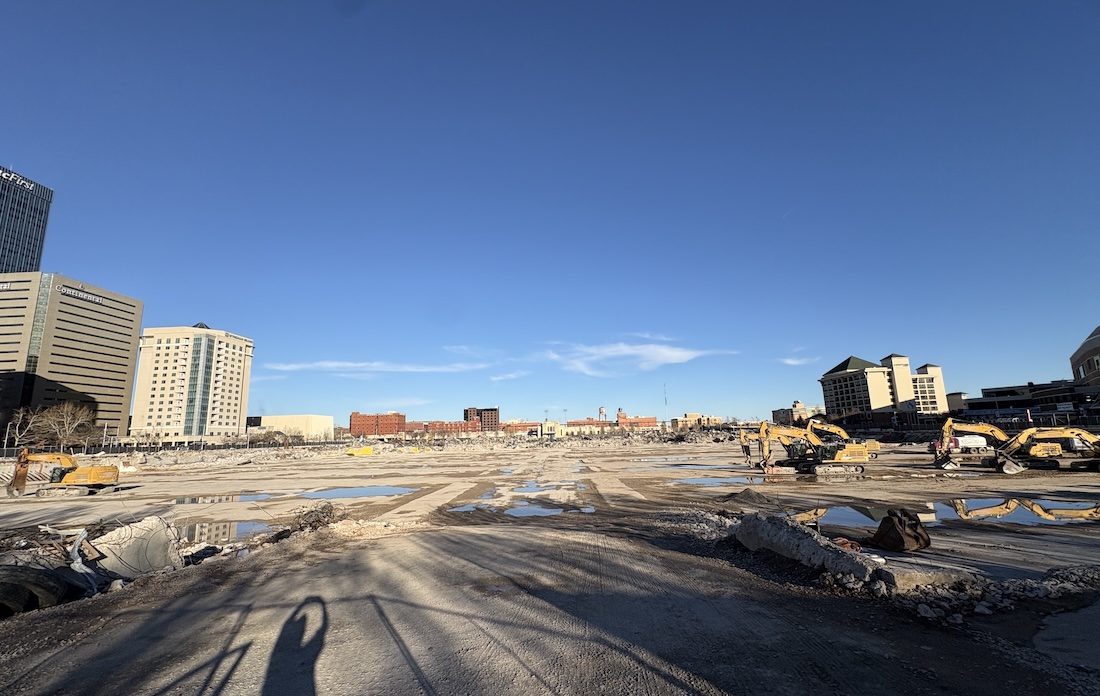
 Afterward, Gary and I walked out the north doors of the Myriad, into the downtown streets with thousands of long-haired fans. We were probably the only ones looking for our parents. Neither of us recalled instructions about where to meet them. Just, you know, “find us afterward, somewhere.”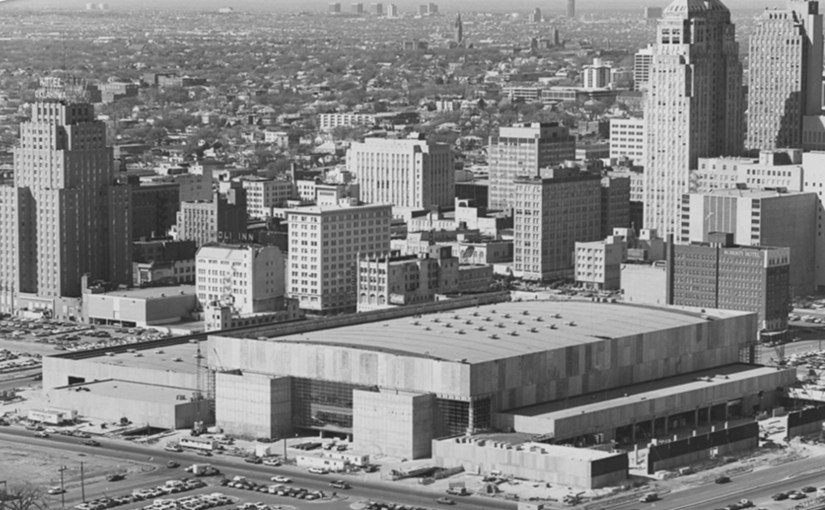
 That was the theme when 10,000 or so Hog-callers began their final caravan across the Red River and out of the Lone State after the Southwest Conference basketball tournament last March. The Razorbacks had bid adieu to their SWC step-brothers with an astounding thrashing of the Texas Longhorns for the tournament championship, and along with the Razorback women’s team, hauled away every basketball prize the league had to offer.

 Jim Stafford's BlogOKC