Paula Stafford stands close to the television as the Thunder-Mavericks games plays ojn
Watching the televised Thunder-Dallas game with my wife this past Saturday afternoon turned out to be a personal treat for me.
Not because the Thunder won or lost (they lost).
Paula and I were both disappointed to see our Thunder lose and go down 2-1 in their NBA second round playoff series to the Mavs.
Rather, it was the rare shared experience of watching a game together and being able to see Paula’s passion for the Thunder as the game progressed.
As a fan, Paula is a Thunder veteran. She’s attended a vast majority of Thunder games in the arena since the team relocated here in 2008. This year she saw most of their home games live as she accompanied her mother to the Paycom Center.
I mostly watched from home, and saw only a handful in person.
So, we watched separately most of the time. As for televised out of town games, they are usually played at night when we are trying to wind down and get our 4 year-old grandson in bed for the night.
It’s even worse for the playoffs when start times for NBA Western Conference teams like the Thunder are at 8:30 pm or later.
So Saturday afternoon brought us together in front of the TV for a rare shared watching experience.
Paula made it fun by wearing her passion on the sleeve of her Thunder T-shirt, so to speak.
Before the game, she offered a coaching tip to Thunder coach Mark Daigneault. Send Gordon Hayward out on the court to give Luka Doncic a couple hard fouls early and protect Lu Dort from accumulating fouls.
And when the Thunder have the ball, go hard at Luka, whom she perceives as soft on defense.
Later, we both decided that Hayward wasn’t tough enough to rough up Luka, so we settled on Kenrich Williams as a good matchup.
Daigneault did not heed her coaching tip.
Still, the Thunder hung with the Mavs throughout the game, even taking the lead several times.
Paula took to barking whenever Jalen Williams — J-Dub to fans — made a great play. J-Dub started the barking trend in post-game interviews, and it has spread to fans, even those at home.
As the game progressed, Paula would call her sister or our friend Donna and break down what just happened with them or celebrate a good play. Sometimes, they called her.
She chanted “Let’s go Thunder” periodically like they do in the arena, or “Rebound Thunder!” when they needed a boost.
The phone line was hot. In fact, out of the blue, her sister, JoAnne, suggested that the Thunder put Hayward on Luka to give him some hard fouls.
Where had I heard that?
But the Thunder couldn’t hold off the Mavs in the second half, and Paula was indignant over how the game was called by the refs.
“It’s hard to win when you are having to play against both the Mavericks and the refs,” she said. “Every call has gone Luka’s way because he’s getting star treatment.”
And so it went. I enjoyed watching her reaction as much as the game itself.
When it was over, Paula called her sister and our friend Donna, and they all commiserated over the loss and the unfair star treatment Luka received. The consensus was that Luka is a drama queen. I concur.
As for me, I enjoyed Paula’s enthusiasm for the Thunder to the end of the game and beyond.
In Holt’s book, “Big League City,” written in the afterglow of the Thunder franchise relocating to OKC, he talks about how critical a $120 million arena improvement special tax package was to that decision.
But that was 14 years ago, and there’s been a lot of Thunder games under the bridge, so to speak. I never gave the length of their lease agreement a second thought.
So, last week’s announcement came as both a surprise and a disappointment. Seems like Paycom Center was built only yesterday, but turns out it is already 20 years old. Arenas must age in dog years.
After my initial anger subsided, I’ve come to accept the reality that OKC — and Thunder fans like me — find themselves in.
For all sorts of reasons — amenities, size, not built specifically for the NBA, perceived second-rateness — the city must build the Thunder a new arena within the next decade.
A new showcase arena will set us back at least a half billion dollars, if not much more.
Consider that American Airlines Arena in Dallas was built in 2001 at a cost of $420 million (and the Mavericks already are pushing for a new arena). How high will inflation drive the cost past that?
Holt’s job now becomes that of selling OKC residents on another special financing package, whether it’s part of a new MAPS deal or a special sales tax like that passed in 2008. I hope the city can negotiate a deal that requires the Thunder to share some of that cost.
But I’m not holding my breath.
Paycom Center exterior (Oklahoman photo)
It’s not a scenario I’m rushing out to embrace, but I do see the reality of the OKC’s situation. Remember what happened to Seattle when that city refused to build a new arena to the Sonics’ specifications?
Thank you very much, Seattle.
And you know there are cities all over the nation that would jump at the chance to claim our franchise as their own and build it a billion dollar Taj Mahal.
Anyway, I got a glimpse this morning of what Holt is up against in convincing voters to accept a new arena. I was at church chopping up the arena prospects with a friend when someone overheard us and wanted to know the topic.
We told him we were discussing the prospects of a new arena for the OKC Thunder.
“What?” he asked. “No way. Paycom is how many years old? No way will that happen.”
And this guy is the former CEO of an OKC-based company with two college-age kids. He’s not even in the demographic that I see as most opposed to a new arena.
So that brings me to the real purpose of this blog post. Who will be most opposed and who will support the new arena? I’m weighing in with my totally non-scientific observations.
I’ll start with those I see as most likely to oppose a new arena built by OKC for the Thunder:
First, it’s people in my demographic who are over the age of 65. Or what I call the get-off-my-lawn crowd. That includes many people who live in suburban areas of the city and have never attended a Thunder game. These folks poo-poo’d the whole MAPS initiative beginning back in the early ’90s and continue to disparage it today. Apparently, they were fine with our downtown the way it was in 1989 because they never went down there. And remember, statistics show that older citizens are far more likely to show up at the voting booth whenever a new arena hits the ballot.
Second, up-and-coming young people from the urban core who are focused on social issues. They are asking ‘why would we spend half a billion dollars or more on an arena for a professional sports team while we ignore the plight of hundreds of our citizens who are without shelter, food, sanitation and health care?’ That’s a legitimate and tough question to answer .
Third, people who recognize the opportunity costs of building a new arena. If we pour half a billion dollars (or more) into a new arena, we’re limiting the potential of other legitimate economic development drivers in our community. On Facebook, one pundit cited articles that show publicly built sports arenas don’t return the promised economic impact. Another example I saw: If we tear down the old Cox Center to build a new arena, our best facility as a set location for the film industry disappears. And that’s an industry just now gaining some real momentum in Oklahoma.
So, who supports a new arena?
The first group is pretty easy. They’re the 30-year-old Thunder fans who obsess over the team’s tanking philosophy, where the Thunder will end up in the draft lottery each year and over-analyze who will be the team’s next pick. Naturally, they will support a new arena because they are offended that our players have to play home games in an obvious shanty like Paycom Center. HAVE YOU NOT SEEN CHASE CENTER IN SAN FRANCISCO? But this is a pretty small voting block, all in all.
I see the second group as led by Oklahoma City business and community leaders who endured the OKC of the 1980s and enjoy what the city has become in 2022. They can point to both the MAPS projects and the arrival of the Thunder as critical elements to turning our city from eyesore into a showcase. If we refuse to build a new arena, there’s a risk that the team could be sold and relocated to one of dozens of cities salivating for the opportunity to become their own Big League City. And we turn back the clock on two decades of economic development. I believe this is a sizable, influential voting block.
Finally, I see the third group of supporters as being that large block of Thunder fans and season ticket holders. The NBA season has become as much a part of their lives as going to church on a Sunday or taking the kids to school. It’s what they do. They schedule their lives around the Thunder season, whether it’s watching the games on TV or driving down to Paycom Center 41 times a season. There’s a legion of loyal Thunder fans whom I believe will be a major source of support for a new arena.
Mayor David Holt and OKC civic leaders have a big job ahead to gain majority support of a new arena. I don’t envy you.
But as I told my friend Steve Buck last week, I’ll grit my teeth and support a new arena, because that’s our only real option.
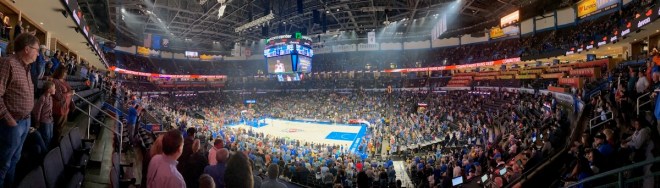
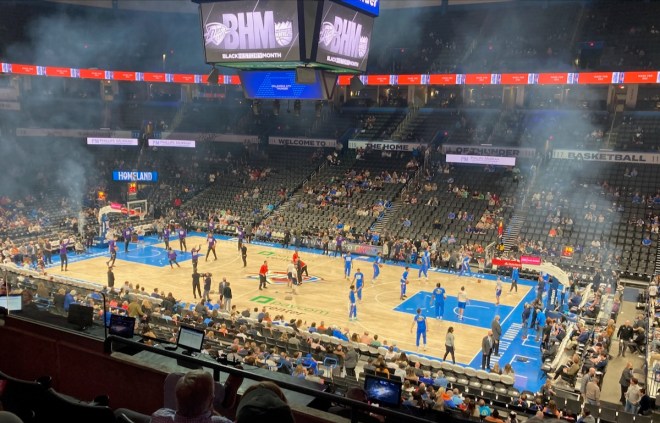
Plenty of good seats available shortly before tipoff at a Thunder game in February this season.
Editor’s note: Although I attribute the concept described in this post to radio talk show host Dan Patrick, my friend Don alerted me to the fact that it was originally floated by sports guru Bill Simmons. So, I want to give credit where it’s due, and a salute to Simmons for a worthy idea.
On the list of things in this world that make me crazy, you can put the concept of “tanking” by professional sports teams close to the top.
If you’re not a sports fan, you should know that tanking means a team is trying to maneuver for the best possible draft position. It does that by having as bad a record as possible at the end of the season.
Sometimes it’s called ‘The Process’ (wink, wink).
Teams tank not by asking their players to not play hard, but by manipulating the roster so their least experienced get most of the playing time. I offer the Oklahoma City Thunder’s mostly G-League lineup down the stretch this season as Exhibit A.
Oklahoman columnist Berry Tramel put it best last fall when he wrote “losing is the path to winning.” The idea is that if a team is horrible for two, three, four seasons it will eventually be able to draft the next ‘unicorn’ that will turn it all around.
Meanwhile, local fans lose incentive to follow their team and actually show up at games. The thousands of unused seats on a nightly basis at Paycom Center this season is a prime example.
I wrote about my opposition to tanking and the need to take a “win now” philosophy before the season began. You can read it here.
But today, I’m here to offer an alternative to the tanking strategy that will keep fans more engaged as the season concludes. I credit this idea to radio talk show host Dan Patrick, who proposed something similar on his show earlier in the season.
Here’s how it would work as I envision it:
The NBA would create an in-season, six-week tournament for the bottom teams in the standings. The league would set an in-season cutoff date of February 28 with the six teams with the league’s worst records qualifying for the tournament.
Then for the remaining six weeks of the season, qualifying teams would play to win as many games as possible before the season ends. The team that has the best record in the season-closing “tournament” would be awarded the No. 1 pick in the draft.
Teams would have every incentive to put their best roster on the court. Fans would have a reason to show up and cheer their local team down the stretch.
The league could make a big deal out of the tournament, with separate nightly standings, maybe even a trophy for the winning team. The rest of the draft order for the bottom six would follow according to their finish in the tournament.
However, it needs a name. The Race to Save Face? Bottoms Up? Sprint to the Finish? I’ll let the marketers handle that.
My friend Steve poo-poos this concept because the league’s conferences are not balanced talent-wise. But he’s a tanking enthusiast and wears unicorn-colored glasses.
So, what does happen if the team with the seventh worst record on Feb. 28 loses so many games that it has the league’s worst record by season’s end?
That team is shut out of the tournament, so it only gets the seventh pick in the draft order. But it has no incentive keep losing, and that’s the point.
Thank you, DP, for sharing this idea.
So, what’s keeping the league from adopting The Race to Save Face and creating some excitement for bottom-feeding teams?
Nothing that I can see. Let’s destroy “The Process.”



 Teams would have every incentive to put their best roster on the court. Fans would have a reason to show up and cheer their local team down the stretch.
 Jim Stafford's BlogOKC