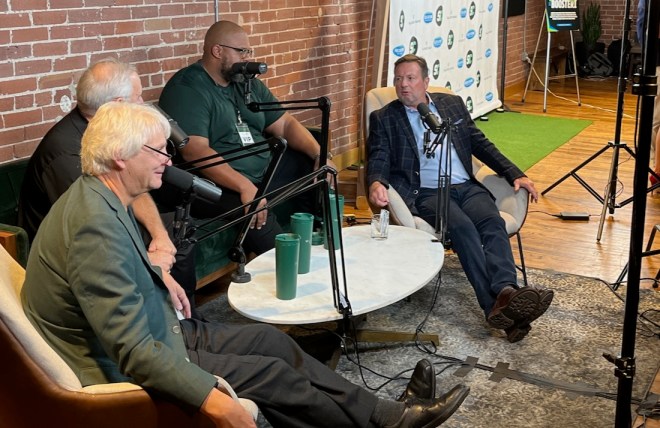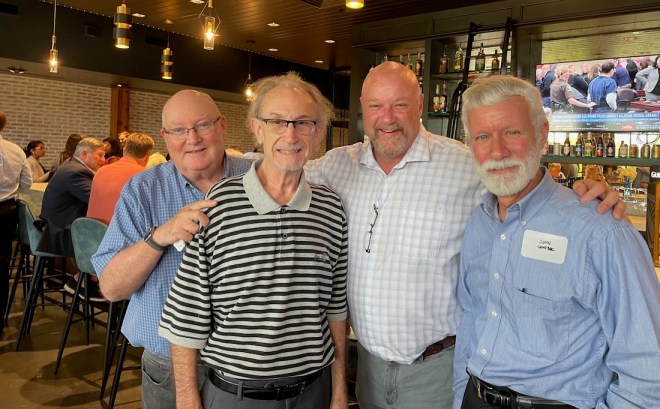
The 3 Old Geezers are (from left) Steve Buck, Ed Godfrey, Jim Stafford
I’m not a contrarian on most issues. And despite my advanced age, I’m not a get-off-my-lawn guy, either.
Honest.
But there is one issue that has brought me into good-hearted conflict with a couple of my friends. That is the issue of ‘tanking,’ by the Oklahoma City Thunder, by which the team played to lose NBA games for a couple of years in order to get better draft positions.
I’ve written about the tanking issue several times on this blog, opining on how it devalues fans, corporate sponsors and current players even if it positions the team to get better draft picks.
My friends will argue that the Thunder’s tanking strategy paid off as it ended up with Chet Holmgren, Jalen Williams, et al, and OKC emerged as a promising team in 2023-24.
But as my Momma told me long ago, the end doesn’t justify the means. Or does it?
That’s the issue on which I’ve been a vocal protestor, a position for which my friends Steve Buck and Ed Godfrey have constantly ridiculed me. We’ve had long text strings across many winter nights the past couple years debating the topic.
As the three of us argued the finer points of tanking and NBA franchise etiquette, Steve suggested that our rants would make a great podcast. We knocked that idea around for months, all agreeing that we would be naturals, but never taking any action.
Until … about two months ago.
Steve obtained some podcasting equipment and we ran out of excuses. We finally set a date and recorded a sample podcast.
Steve came up with a name, ‘3 Old Geezers,’ to match our demographic profiles, and off we went. Here’s a link to the 3 Old Geezers podcast page on the Buzzsprout hosting site. We are sponsored by MentaliTEA and Coffee in Bethany.
The 3 Old Geezers have recorded four episodes in four weeks, tackling Thunder topics, college sports and even the entertainment world in fast-paced, roughly 25 minute segments. We’ve had generally positive feedback.
For me, the podcast confirmed that I’m more agile behind a keyboard than with a microphone in my face, while both Steve and Ed have shown the ability to be clever and entertaining on the run.
If you haven’t listened yet, I invite you to listen to our latest episode, and then perhaps invest some time in the previous podcasts.
We’re all Thunder fans, but take different approaches to our fandom and perceive the team slightly differently. In fact, one Geezer has a tendency to sleep right through some of the games, which you will discover in Episode 4.
Take a listen to the 3 Old Geezers. Now, GET OFF MY LAWN!
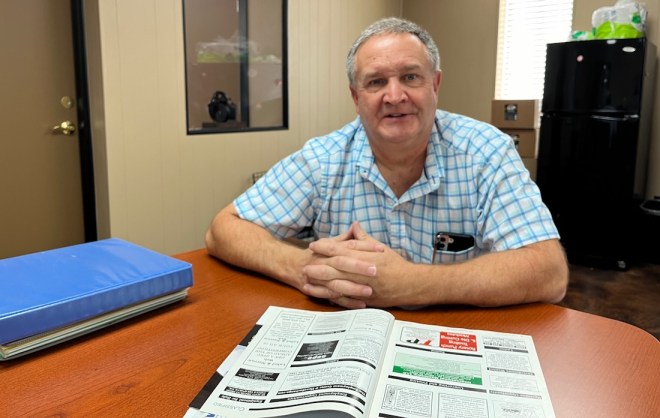
Mike West with magazine opened to classified that advertised Keystone Labels for sale
One Sunday more than two decades ago a family unfamiliar to me and my wife, Paula, happened to sit next to us on our favorite pew at what was then Quail Springs Church of Christ.
Paula introduced herself and learned this was Steve and Lisa Buck, who were visiting our church. Paula invited them to our small group meeting that night, which we called ‘Connections.’
Twenty-plus years later we have grown to be great friends with the Bucks.
Was it karma or divine coincidence?
I write that because of how I recently met another outstanding couple. Except this time it wasn’t in church; it was at The Joinery restaurant in Bricktown back in October on the occasion of the Sellout Crowd launch party. Sellout Crowd is a new online sports reporting service that launched September 1.
As I sat down at a table to consume some complementary food I carried from the buffet line, I found myself across from a couple who were unfamiliar to me. The couple introduced themselves as Mike and Tonia West.
And did they have a story of divine coincidence.
You see, Mike and Tonia were at the Sellout Crowd launch party at the invitation of sportswriter Berry Tramel, with whom they go to church at Antioch Community Church in Norman. Berry is a friend of mine and long-time colleague at The Oklahoman newspaper.
“We met Berry on our first Sunday at Antioch,” Mike told me as I sat across the table.
We chatted about Berry, their business and how they got to Oklahoma for a while before I jumped up to take some photos of the festivities. I never made it back to the table, but asked Berry later for their contact info so I could apologize for seemingly abandoning them mid-party.
Berry told me about meeting the Wests for the first time and the unique way they became owners of Oklahoma’s Keystone Labels.
“Our church has a reception type thing once a month, and we went to it one day and the Wests just sat down at our table.,” Berry said. “Mike’s a big newspaper man. They sat down and he recognized me.”
Another divine coincidence.
“We struck it off and became fast friends” Berry said. “He’s just got a heart of gold, always helping people. The one thing he likes most out of his business is when he’s able to help people; that’s what he does.”
Since that coincidental meeting, Berry and Mike have shared mission trips, both local and foreign, even traveling to Mexico together on a mission for their church.
Anyway, I called Mike up to apologize for not coming back to their table at the party, and he invited me down to tour the OKC label business that the Wests have owned since 2006.
A native of Fort Scott, Kan., Mike worked in the label business in that state before spotting a tiny classified ad in the back of an industry magazine that offered an Oklahoma City label business for sale. That was Keystone Labels.
Keystone Labels sign along SW 29th Street
Mike answered the ad through a surrogate and eventually purchased the business. Keystone Labels makes labels for scores of businesses with products like jars of barbecue sauce, pickles, honey and other food products, audio CDs and much, much more.
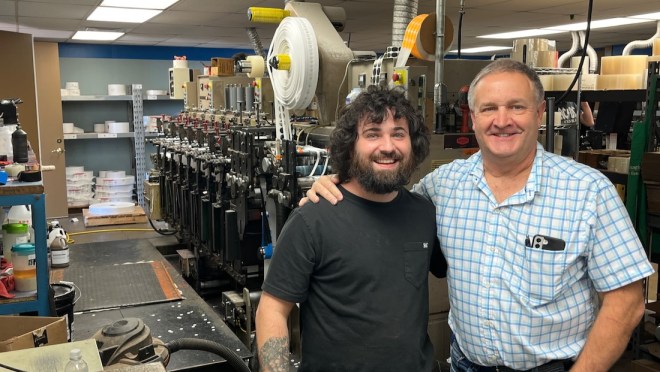
Since being owned by the Wests, Keystone Labels has become a true family business, with Tonia — a surgical nurse — working two days a week, their daughter Mikala holding down the office and nephew Chris McAllister operating one of two presses that run nonstop.
The rest of the operation’s seven employees have worked there for decades, some preceding West’s ownership. I got to watch both of the presses in action as thousands of labels were produced right in front of me while a half dozen other jobs waited for press time.
I could see that all of Keystone Labels’ employees took great pride in their work, from the graphic artists in the front to press operators Chris and Lenny, who has worked for Keystone for decades and “has never taken a day off,” Mike said.
Another long-time employee, Lonnie, handles many different tasks in the process, including turning graphic designs into press-ready plates.
Back in Fort Scott as a young man, Mike started out as a sports writer himself, making $1 an inch for his work. I said that seemed like a lot of money for those days.
“Well, considering I was only getting like 7 inches for my stories, it wasn’t a lot,” Mike said.
Mike’s dad was the high school football coach in Fort Scott, and today is retired and an active farmer in his 80s. One of his high school players was future Oklahoma State University football coach Charlie Weatherbie, a fact I learned from a Sellout Crowd article written by Tramel.
So, the visit to Keystone Labels was both informative and eye-opening for me. I saw how a small label business works and how it even has its own platemaking shop. Mike showed me the actual magazine and the four-line ad that he spotted advertising the business for sale.
I heard stories from Mike about the challenges the business has faced, including a wall being destroyed when a drunk driver drove through it in the middle of the night. I learned how Mike lives out his faith by providing support both to those he loves and those he’s never met. I learned of his daughter’s miraculous healing.
Chris McAllister and Mike West stand in front of one of Keystone Labels small offset press units.
Since this is a personal blog, I’ve got a personal note to share.
I had intended to visit Keystone Labels two weeks ago, but had to make an emergency trip to Fort Smith, Ark., to deal with a challenging family situation. I texted a note of apology to Mike, begging off because my family was “enduring the week from heck.”
As I drove over to Fort Smith my phone dinged with a message.
It was from Mike, and it contained a prayer for my family and the situation we were facing.
“He has a heart for people that is rare,” Berry said. “You can say that about a lot of people, but he is in the upper 1 percent.”
I’m so glad that Mike and Tonia West sat at Berry’s table that day, and that I sat at Mike’s table at the launch party, and that Steve and Lisa Buck sat on our pew that Sunday more than two decades ago.
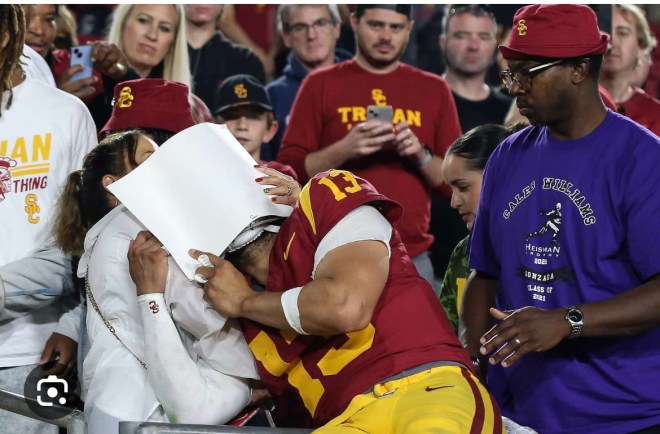
Caleb Williams sobbing in his mother’s arms after losing to Washington last week.
As a 12-year-old Little League baseball player in the mid-1960s, I pitched for a woebegone team named the Angels in Bryan, Texas. We didn’t win very many games.
Still, I wanted to win, so much so that often tears would fall as I stood on the mound late in a game in which we were hopelessly behind.
Near the conclusion of one game, our feisty third-baseman walked over to the mound and said something that has stuck with me for almost 60 years.
“Why do you always cry when you are pitching?” he demanded.
I don’t remember my answer, but I sure remember his question.
I’m writing this because of something that happened after the recent college football game between Southern Cal and Washington. You might have caught the clip of USC quarterback Caleb Williams going into the stands after the loss and being consoled by his mother as he sobbed.
I was listening to the Dan Patrick radio show this week when a caller to the show asked DP if the sight of Caleb Williams crying after the game would hurt his draft placement. The current reigning Heisman Trophy Winner, Williams is certain to be drafted among the top three picks, perhaps even first.
A self-proclaimed crier himself, Patrick reacted to the question as if it was intended to insult Williams (I’m certain it was, too). He told the caller that there’s nothing about what the QB did that would diminish his draft status.
However, the incident and questions afterward stirred some emotions in me, because I still feel the sting of my third baseman’s confrontational question so long ago.
I’ve since thought about why I cried on the mound and concluded it was because I wanted so much to be successful and the frustration that it wasn’t happening. A lot.
But I don’t see that shedding tears after (during?) an emotional game diminishes an athlete. What other athletes are famous for shedding tears during or after a game?
I can remember a few. Michael Jordan lay on the locker room floor and shed tears after winning the 1996 NBA title that he dedicated to his late father. Serena Williams cried as she met the press after a hotly contested loss in the 2018 U.S. Open finals.
My point with all of this is that there’s no shame in tears flowing in the wake of an emotional moment for an athlete. It happens.
The 2023 me is more apt to shed tears watching an emotional scene in a movie, like Roy Kent rushing to the stadium to take his place among the coaches in Ted Lasso while “She’s a Rainbow” plays in the background. Or when George Bailey discovers he really is the “richest man in town” at the conclusion of It’s a Wonderful Life.”
Of course, my career as a soft-throwing Little League pitcher ended in 1965.
Yes, there were tears and a pointed question from my third baseman. It’s a moment etched into my memory.
Berry Tramel joined Sellout Crowd colleagues Bob Stoops (right) and Sam Mayes in a broadcast during the new venture’s Launch Party at The Joinery in Bricktown.
Berry Tramel told a story to a boisterous group of roughly 150 people earlier this week at The Joinery restaurant in Bricktown. Berry tells great stories.
He recalled a phone call a few years ago from a former colleague at The Oklahoman newspaper who sought his interest in joining a new, online only sports reporting venture.
Berry said he was interested. As long as his fellow Oklahoman columnist Jenni Carlson came along, he was ready to go.
Turns out, the timing wasn’t right for Mike Koehler’s brainstorm. The deal didn’t happen. Berry and Jenni continued to carry The Oklahoman as its lead sports columnists as they had for the past two decades-plus.
Then Berry got another call from Koehler in 2023. This time, Koehler had financial backing for his project and he had a name. Sellout Crowd.
Was Berry still interested? Berry replied that as long as Jenni was still part of the plan, yes he was.
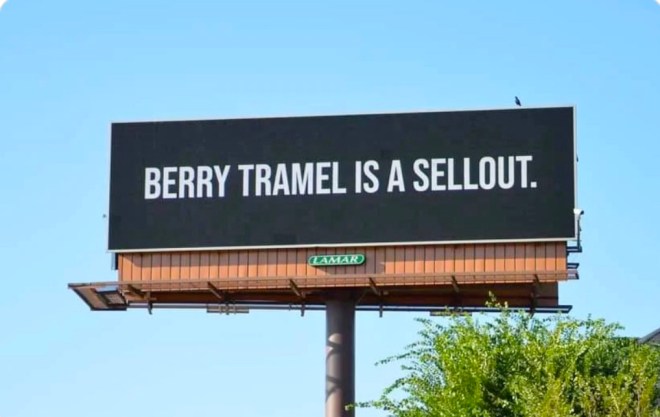
The next thing you know, “Berry Tramel is a Sellout” billboards started appearing across the OKC metro, teasing the launch of Sellout Crowd.
That’s the story that Berry told at the Sellout Crowd’s Bricktown launch party, where he was joined by Koehler, Jenni Carlson, Mike Sherman and a host of other Sellout Crowd content “creators” and backers.
All of those folks I just named are former colleagues of mine at The Oklahoman.
The Launch Party also featured Toby Keith and Bob Stoops, celebrity investors in the venture. There was Kris Murray, Koehler’s business partner and son of long-time OKC broadcaster Ed Murray.
And there was a lineup of other content creators that included former Tulsa World columnist Guerin Emig, Brett Dawson, Jon Hamm, Todd Lisenbee, Sam Mayes, brothers Ben and Sam Hutchens, Ed Murray, Bob Stoops and Eli Lederman. The team also includes a couple of other former Oklahoman colleagues of mine, Jay Spears and Jacquelyn Musgrove, both of whom provide technical expertise.
I’m spending time daily on the site and have figured out that I get most of the same type content from Berry and Jenni that I found in the newspaper. There is heavy coverage of OU, OSU and the OKC Thunder.
And video. Lots and lots of video blogs, I guess you call them.
So, you get the drift of the type of coverage the Sellout Crowd is bringing readers/viewers, and the content is not behind any sort of pay wall. In fact, it appears a number of advertisers have jumped on board, as well.
As I talked to some of the folks who showed up at the Launch Party, one guy said Sellout Crowd reminded him of The Ringer, which is the sports and culture site launched about a decade ago by Bill Simmons. I can see the resemblance, but glad Sellout Crowd has an Oklahoma focus.
Sellout Crowd itself is well put together in my opinion. You can see that lots of thought was put into making each article/post look professional in its presentation.
The Launch Party concluded with a series of remarks from Berry, Koehler and Kris Murray. Koehler also has another thriving business known as Smirk New Media.
Anyway, Koehler made some heartfelt comments, tearfully thanking those who supported his vision and those who have come on board.
Sellout Crowd founder Mike Koehler and his wife, Gaylee
“We want to honor the people for the great work they do,” Koehler told the crowd about Sellout Crowd’s presentation of its content creators. “And we got the cream of the crop.”
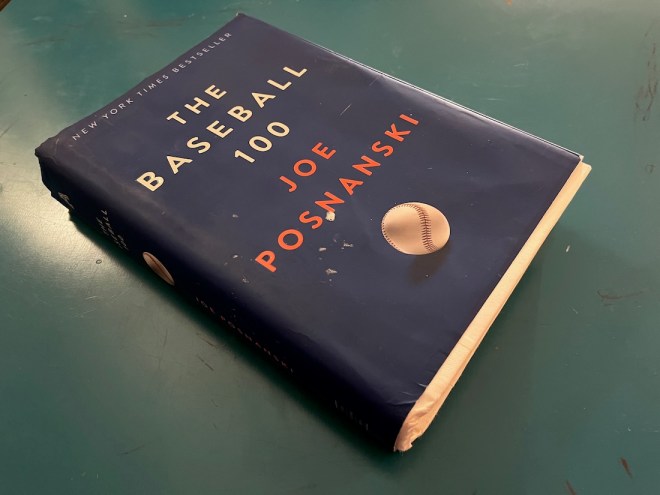
For the past five months, I’ve walked around our house carrying a massive tome that resembles those old giant-sized King James Bibles that are cherished possessions of many families.
Only this Good Book is titled The Baseball 100 (2021, The Athletic Media Co.) and written by long-time baseball writer Joe Posnanski. It was a birthday gift last April from my friend Ed Godfrey.
Thank you, Ed.
If you’re not familiar with Posnanski, he made his reputation as the baseball beat writer for the Kansas City Star newspaper before moving on to Sports Illustrated, NBC Sports and The Athletic, among his credits. Today, he’s publishing his prose on his own blog at JoeBlogs.
It’s obvious that Posnanski’s first love is baseball, and, in fact, his latest best seller in a long line of bestsellers is entitled ‘Why We Love Baseball.’
Anyway, back to The Baseball 100. I read it slowly and savored each individual profile of what Posnanski considers to be the best 100 players in Major League history. When I first opened the book, I flipped hurriedly through the pages until I found the Nolan Ryan chapter, just to make sure Posnanski included Big Tex.
Ryan came in at No. 50, and the logic of that ranking was that about half the baseball world (me included) thinks he’s one of the top pitchers ever, while the other half sees him as vastly overrated.
So, then I went back to the beginning and read the book through. What struck me was how often father-son dynamics played into the development and character of so many players.
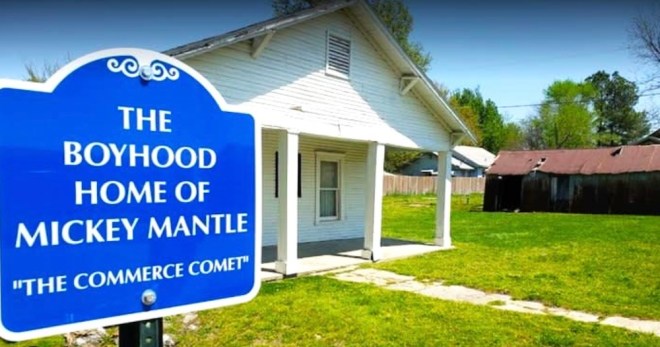
For instance, let’s consider Oklahoma native Mickey Mantle. Mantle’s father, Mutt, began pitching to him at their Commerce home when the Mick was 6 years old, making him bat from both sides of the plate. Mickey didn’t exactly want to be a switch hitter and wasn’t certain he wanted to be a baseball player from the start.
But his dad willed it even before he was born.
“Mutt knew with a chilling certainty that his future son would be called Mickey, after his favorite ballplayer, Mickey Cochrane, and that Mickey Mantle would be the best ballplayer of them all,” Posnanski writes.
Mickey Mantle did turn out to be one of the great all-time Major League players. He was the All American boy who led the New York Yankees to seven World Series titles in 12 appearances from 1951 to 1964.
Ranked No. 11 all-time by Posnanski, Mantle also was an alcoholic who cheated on his wife and was mostly absent from the lives of his children. I’m pretty sure Mutt’s obsession shaped Mickey beyond baseball.
You learn how flawed so many of our heroes were in The Baseball 100, from Mantle to Pete Rose to Ted Williams to Barry Bonds to Roger Clemens. The Baseball 100 also shares stories about baseball heroes who were model citizens, like Ozzie Smith, Stan ‘The Man’ Musial, Derek Jeter, Albert Pujols and Brooks Robinson, to name a few.
But the theme of overbearing fathers came up again and again. Consider George Brett, who is a contemporary hero to those of us of a certain age and who comes in at No. 35 in Posnanski’s rankings.
“Fear drove George Brett,” Posnanski writes. “His father, Jack, made sure of that.”
No matter how well Brett played or what amazing stats he put up for the Kansas City Royals, it was never good enough for his father. Never.
In fact, on the night before Jack Brett died of cancer, he spoke to George on the phone and asked him how he did that day. George told him he went 0-for-4. “Well, did you at least hit the ball hard?” his dad asked. “I did, Dad,” George lied to his dying father. “I hit it hard.”
Brett had struck out three times that day.
Then there is Pete Rose at No. 60. We all know how his story played out, the betting on baseball, the relentless chase of the hits record, the womanizing, the Charlie Hustle reputation.
What Posnanski tells us is that Pete’s father, Harry “Big Pete” Rose never gave him the opportunity to develop as a person. Big Pete saw him as a Major League star, and turned him into a switch hitter at 8 years of age. He even demanded that his Little League coach let him switch hit.
It’s the Mickey Mantle story playing out all over again in Cincinnati, Ohio. Except Pete Rose was banned from baseball for life for betting on the game he loved.
And then there was Ted Williams, an all-time player and war hero who fought fans, the media and his own demons. Posnanski doesn’t write about an obsessive father in his life — he barely knew his father — but does quote Williams’ own daughter who said that her father was mentally ill.
“My father was sick,” Bobby Jo (Williams) said. “And it’s a damn shame that, because he was Ted Williams and because nobody wanted to tell him like it was, including myself, he suffered and progressively became more ill by the years.”
In addition to father-son relationships, there is another major theme that runs through the book.
Posnanski writes extensively about the plight of African American stars who never got the chance to play in the Major Leagues. For decades. they were forced to play in the largely invisible (to the white audience) Negro Leagues. Their stories come to life in The Baseball 100, as well.
So, who does Posnanski rank as the No. 1 player of all time? I’ll leave it to you to get a copy of this outstanding book and find out for yourself.
Hint: Say Hey when you finally figure it out
Read The Baseball 100 and savor the stories of the heroes of our youth.
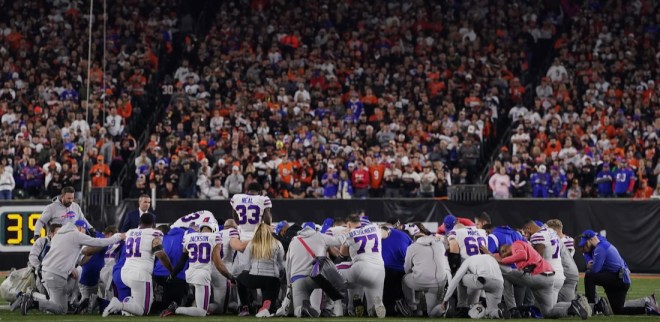
Players huddle in prayer for Buffalo Bills defensive back Damar Hamlin after he collapsed on the field in January. (New York Times photo)
We’ve all experienced moments in our lives that are burned into our memories, and we’ll always remember exactly where we were when we witnessed it or heard the news.
The Twin Towers. John Lennon’s death. The Kennedy Assassination.
On Jan. 2 of this year, millions of Americans watched as Buffalo Bills defensive back Damar Hamlin made a tackle in an NFL game vs. the Cincinnati Bengals, stood up, then collapsed on the field.
My wife and I were among those who witnessed it, watching from our living room.
Damar lay motionless on the field as trainers and emergency personnel rushed to his side. I was struck by the reaction of the players, many of whom turned away and appeared to be in grief or in prayer.
Team and security personnel surrounded Damar and blocked any views by intruding network cameras or even his own teammates. Players on both teams gathered in a big prayer circle.
Damar Hamlin had had a massive heart attack, and his heart stopped. The emergency personnel and training staff used defibrillators and brought him back to life, more than once, apparently. After many minutes, he was loaded into an ambulance and taken to a Cincinnati hospital.
We were as anxious as anyone else and silently praying for his life. We weren’t optimistic.
But you probably know the rest of the story. Damar escaped more near misses with death on the way to — and in — the hospital. Still, he grew stronger by the day and was released nine days later.
He continued to improve, and under doctor’s supervision began working out again and was eventually cleared to rejoin the team this summer.
Damar is again on the Bills roster and played his first minutes of action this past weekend.
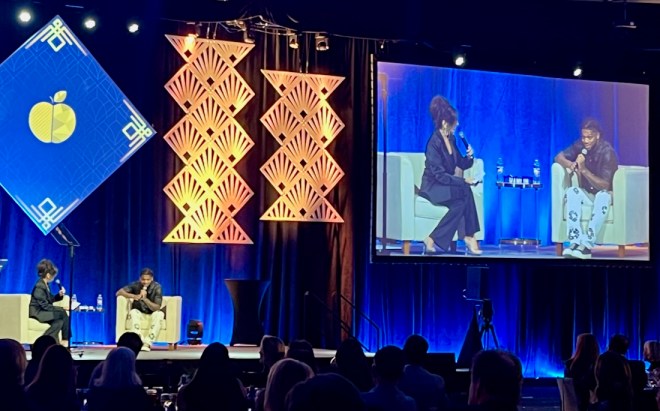
Then he flew to Oklahoma City on Tuesday to share his story with an audience of about 1,000 Oklahomans at the annual Champions of Health Awards Presentations at the OKC Convention Center.
Damar Hamlin shares the stage with News9’s Robin Marsh during a ‘fireside chat’ at the Champions of Health Awards Presentations.
I had the good fortune to be in that OKC audience as an employee of Care Providers Oklahoma, one of 11 health care related organizations that comprise the Champions of Health Coalition. All are working to improve health outcomes for Oklahomans, and the Champions of Health Awards recognize organizations or individuals that have devised innovative programs that could be replicated in other communities.
Robin introduced Damar and told him that millions of Americans had prayed for him that night from their living rooms, just as his teammates did on the field.
Soft spoken, Damar didn’t go into details of the incident, but instead focused on his mission since. Today, he’s working to ensure that the technology that saved his life is available by every sports team nationwide and that people are trained in CPR.
I was struck by one comment in particular by Damar about this mission.
“It’s kind of like a calling, & we don’t get to choose our calling,” he told us.
Amen.
Robin asked Damar about his youth and how he progressed from high school to college to the NFL. He shared the story of his personal journey, and something else stood out.
“I found a mentor,” he said. “I found someone who was older than me and successful and worked with them.”
Amen again.
I’m a big believer in cultivating a mentor and then following their example and advice. Although I never had a formal mentor, I’ve had some folks in my life who provided sage advice along the way.
Like millions of my fellow Americans, I’m so glad that Damar Hamlin survived this near death experience. Survived and emerged with his new mission, his calling.
From left, Jim Stafford, David Daviee, Rick Rainey and John Campbell. Photo by Cindy Henson
There was no media coverage, but a milestone celebration occurred last week for i2E, an Oklahoma City-based not-for-profit corporation that has had a major impact on Oklahoma’s innovation economy since its debut in 1998.
Friends and employees — both current and past — celebrated i2E’s 25th anniversary at the City and State Event Center on NE 6th Street.
Roughly 75 of us gathered to catch up with old friends and hear some historical perspective from i2E President Rex Smitherman about the not-for-profit. i2E provides education, business advisory services and investment for Oklahoma’s tech-based entrepreneurs.
I’m a former i2E employee who worked in its marketing office both as full-time employee and contract worker from 2009 to 2022.
So, the anniversary celebration was a homecoming of sorts for me to see my former colleagues.
But first you should know a little more about i2E. It was created in 1998 as the Oklahoma Technology Commercialization Center by the Oklahoma Center for the Advancement of Science and Technology, which is the state agency that supports innovation and scientific research across the state.
That original name was unwieldy, so it soon became known as i2E — Innovation to Enterprise. The first CEO was Randy Goldsmith, followed by the late Greg Main, and then Tom Walker.
I entered the picture as an employee just after Tom became CEO and I retired as a newspaper reporter with The Oklahoman. I had become acquainted with Tom when he was i2E’s Chief Operating Officer in the early 2000s and I was the paper’s technology beat reporter.
After Tom moved to Columbus, Ohio, to lead a similar institution, Scott Meacham became CEO, continued to expanded the mission and retired from that position earlier this year. Scott remains Executive Chairman of the Board.
Today, Oklahoma boasts a growing number of venture capital firms and business accelerators, but back in 1998 there was virtually no organized investment capital for entrepreneurs.
That was the bleak landscape that i2E stepped into, thanks to the vision of Sheri Stickley and William Hagstrom. The pair —Stickley with OCAST and Hagstrom an Oklahoma entrepreneur — conceived of the idea of a private company, seeded with public dollars, that would provide assistance to businesses that were spun out of Oklahoma’s universities or the minds of local inventors.
The headline described it was an “Oklahoma success story,” and that’s no exaggeration.
Rex Smitherman addresses crowd at i2E 25th anniversary celebration
As Rex outlined in his presentation at the anniversary celebration, i2E has provided business advice or investment for over 800 fledgling companies across its history. It has provided more than $83 million of investment capital to Oklahoma ventures.
Here are a few of the high impact success stories for which i2E provided advisory services and investment: WeGoLook, Selexys Pharmaceuticals, Spiers New Technologies and Alkami Technology, a billion dollar public company that was founded in OKC in 2009 by Oklahoman Gary Nelson.
And i2E’s mission continues to expand. In fact, Rex devoted much of his presentation at the anniversary celebration to looking forward to i2E’s future impact through its new programs.
Today, i2E embraces a big educational mission, having launched and managed the statewide Love’s Entrepreneur’s Cup collegiate business plan competition that will celebrate its 20th anniversary in 2024. Now, i2E is launching a pilot high school business plan competition in a partnership with the MidAmerica Industrial Park in Pryor.
There’s more expansion news. i2E developed a popular workshop for new entrepreneurs called E3, which helps them determine whether their venture has a realistic opportunity for success. Joining E3 will be a second program called Bridge2, described as an 8-week ‘pre-accelerator’ that provides $50,000 in convertible debt funding for founders.
In addition, i2E created a subsidiary a few years ago known as Plains Ventures, which now handles virtually all of the investment activities for the company.
But enough of the history and impact of i2E.
For me, the anniversary celebration was a chance to catch up with old friends, even if just for a few moments. Folks like Rick Rainey, Cindy Henson, Mark Lauinger, Srijita Ghosh, Darcy Wilborn, John Campbell, Kevin Moore, Shaun O’Fair, Rex Smitherman and former OCAST executive director Michael Carolina.
I even had the opportunity to share a few moments with our former finance director, David Daviee. My only disappointment was that not all of my former i2E colleagues made it to the event. You know who you are.
Maybe for the next ‘family reunion.’
But life goes on. As i2E’s mission continues to expand, it’s been joined in the space by a host of new Oklahoma investment and accelerator partners, both here in OKC and in Tulsa.
While the investment outlook for new entrepreneurs and ventures in 2023 is far from bleak, the time was right for an i2E when it became a reality in 1998.
It really was an idea whose time had come.
Crowd shot during the i2E anniversary celebration
BONUS: I came across an old story by the Oklahoma Council of Public Affairs, a conservative research organization that generally attacks any new idea that uses public dollars to advance an innovative concept, no matter how many people benefit. Here’s a sample of the article:
“The Oklahoma Center for Science and Technology (OCAST) should no longer receive state funding for the Oklahoma Technology Commercialization Center (OTCC). This program directly competes with the private sector and existing market participants engaged in business formation and development.”
You get the drift.
My response: Back in 1998 and for many years afterward, there was little private sector investment capital in Oklahoma competing with the i2E concept. Many new ventures likely would not even have been attempted had i2E not been in existence. Oklahoma’s innovation economy expanded because of i2E’s efforts, and now new private ventures are bringing new investment to the state.
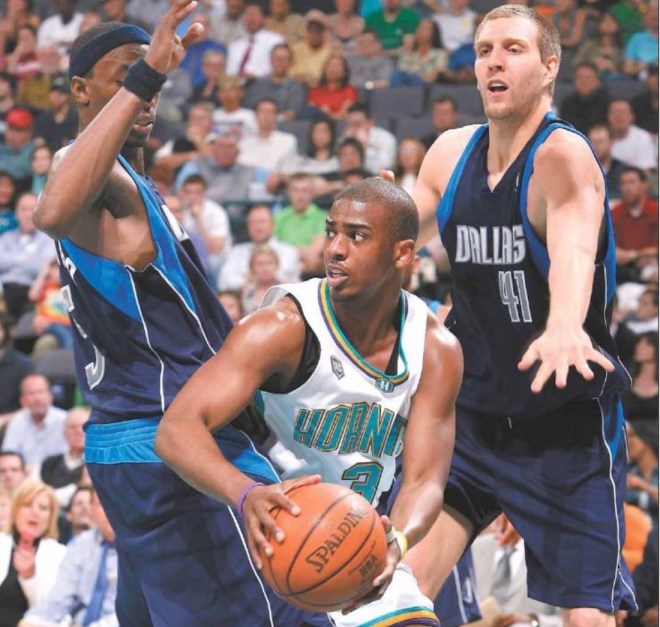
Chris Paul as an OKC Hornet handles the ball vs. the Dallas Mavericks. (Oklahoman photo)
I came across an interesting feature over the weekend in The Oklahoman that ranked the top 15 players in Oklahoma City Thunder history.
We’re roughly five weeks or so from the launch of the 2023-24 NBA season, so the timing of such a list was right to generate clicks from Thunder fans like me.
And of course, it was bound to stir up some passion and some controversy. First of all, the rankings by The Oklahoman beat writer Joe Mussatto had Russell Westbrook at No. 1 and Kevin Durant No. 2.
I posted a link to the story to my Facebook page, and right off the bat a couple of friends took exception.
“Sorry but Durant was the greatest player by far even with his bad exit…,” said Scott Rollins, a local business leader and biotechnology researcher.
“SGA behind Serge?!? Westbrook ahead of Durant, even though he stipulates that Durant is the best player to ever put on a Thunder uniform,” was the response from Tony Thornton, a former colleague at The Oklahoman.
There was one ranking I was happy to see, no matter where the player was ranked.
Chris Paul came in at No. 10, even though he had only one season as an Oklahoma City Thunder. Remember, CP3 willed our team to the playoffs in the 2020 pandemic bubble with outstanding play and leadership.
For me, Paul’s return to OKC was something of a welcome homecoming. He was a member of the New Orleans Hornets when they were forced to play two seasons in OKC in the wake of Hurricane Katrina.
Along the way, CP3 became my first NBA crush. And I got to meet him for an assignment as a Business News reporter for The Oklahoman.
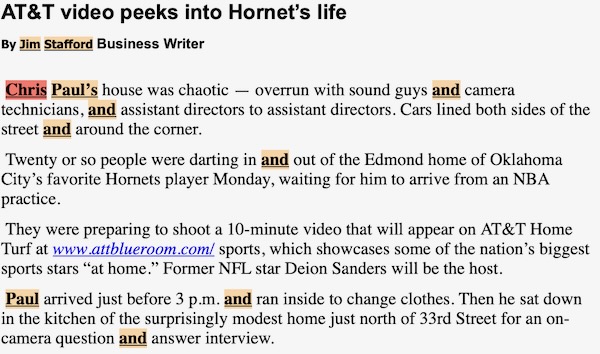
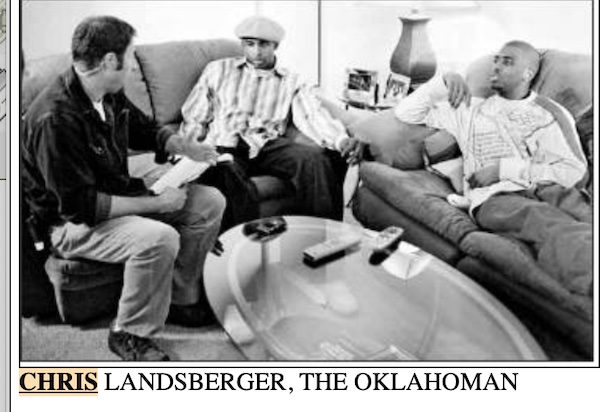
CP3 was the focus of a special marketing video made by AT&T that featured NBA players and their ‘cribs.’ Most were guys who lived in ostentatious mansions.
CP3 lived with his brother in a modest home just north of 33rd in Edmond.
So, when a film crew flew into town to shoot the video at Paul’s “crib,” my editor sent me out to cover the filming and interview the star. CP3 could not have been more accommodating, patiently answering my questions from the driveway of his home before the filming began.
As a bonus, the video included Prime Time himself, Deion Sanders, who showed up just before the filming started. I did not get to meet the future Coach Prime.
I had a second face-to-face with CP3 a couple weeks later at a Thunder game. My son, Ryan, was the lucky recipient of a drawing that allowed him to go down on the court after the game and have his photo made with Paul.
I accompanied Ryan, and CP3 recognized me from our previous encounter.
(An aside: A series of youth basketball camps were held in the OKC metro using Chris Paul’s name, and my son attended one. He said that CP3 actually showed up at the camp and did one-on-one drills with the campers).
So that’s the story behind why I consider CP3 to be my first NBA crush. And why I was happy to see him included as a top 15 player across Thunder history.
Now, let the critics roar over the rankings.
CP3 (right) with Deion Sanders (center) and the video director
Recently, my 4-year old grandson complained of a big, red welp on the back of his calf. It was result of a mosquito bite, so I recommended to my wife that she put some salve on it to soothe the itch.
I discovered that I walked into a hornet’s nest with that suggestion.
“What, are you, 90 years old?” she asked. “No one says ‘salve’ any more. It’s ‘cream’ today.”
I wasn’t about to give in so easily.
“My grandmother put salve on every itch and wound I had as a kid,” I protested. “When I had a cold, she would even smear some Vicks VapoRub on my chest. That was the go-to salve in our family.”
The debate goes on today. Cream on one side. Salve on the other. I definitely remain on Team Salve.
So, I pointed her to the definitive statement on salve: The Andy Griffith Show and a wonderful episode about a miracle salve and how it entangled Barney Fife.
I offer it to you in this post for both educational and entertainment purposes.
The first time I met Col. Pendleton Woods I was judging a high school history event at Oklahoma Christian University in the early 2000s. It was a crowded room, but Pendleton spotted me from a distance and walked over to introduce himself.
Born in 1923, Pen was almost 80 years old at the time. He knew of me because I had been a Business News reporter at The Oklahoman throughout the 1990s before taking a 3-year sabbatical at OC beginning in 2000.
Anyway, Pen introduced himself, and as I looked up from my seat I noticed he was wearing a plaid jacket. tie and a pair of slacks. There was one other detail that stood out.
His fly was open.
I later talked about meeting Pen with my friend Mike Osborne, who also worked at OC at the time. Mike had one question.
“Was his fly open?”
The knowing question made me laugh out loud, and I still smile at the memory today. But I grew to love Col. Pendleton Woods, and slowly came to know his story.
Turns out he was born and raised in Fort Smith, Ark., which is also my hometown. Pen graduated from the University of Arkansas with a journalism degree.
But that’s only the start. He was a military hero from The Greatest Generation.
Pen served in World War II with the 99th Infantry Division and was captured on a reconnaissance patrol on Dec. 10, 1944, during the German build-up to the Battle of the Bulge. He remained a prisoner until he and others escaped after Russian artillery shelled the compound shortly before the war in Europe ended on April 20, 1945.
Pen also served in the Korean War with the 45th Infantry Division of the Oklahoma National Guard. He was inducted into the Oklahoma Military Hall of Fame in 2002.
After his service in WWII, Pen settled in OKC and worked for Oklahoma Gas and Electric for years. He eventually joined the staff at Oklahoma Christian University and worked there until late in his life.
As a longtime OKC resident, Pen was an incredible community servant, volunteering for the Boy Scouts, helping bring the National Cowboy Hall of Fame to OKC, serving as executive director of the OKC Bicentennial Commission and many, many other endeavors. He authored 15 books.
After I returned to The Oklahoman in 2003, Pen would call me on a regular basis, either to pitch a story or just to catch up for a few moments.
Pen died on Dec. 1, 2014 and left a massive legacy in our local community and beyond. Read his obituary here.
I’ve written all of this about Col. Pendleton Woods because of something that happened this week. I was working on a special project for a friend at a busy local coffee shop when I happened to look down.
My fly was open.
Pen Woods was the first thought that ran across my mind after quickly closing the barn door.