‘Family reunion’ for me at i2E anniversary celebration

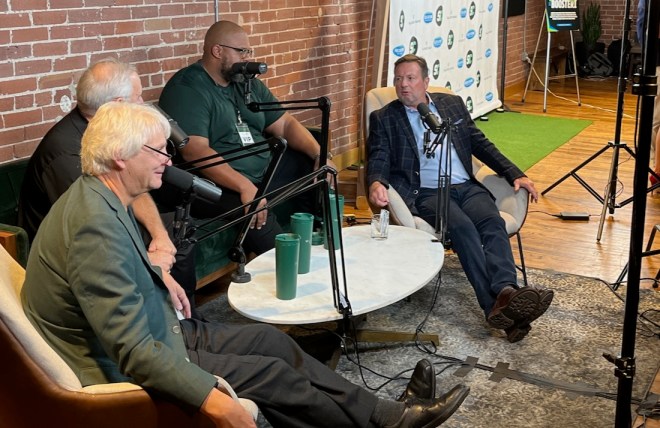
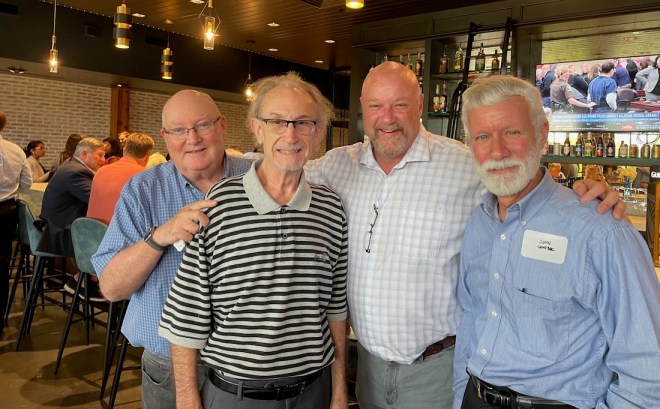
i2E group
From left, Jim Stafford, David Daviee, Rick Rainey and John Campbell. Photo by Cindy Henson

There was no media coverage, but a milestone celebration occurred last week for i2E, an Oklahoma City-based not-for-profit corporation that has had a major impact on Oklahoma’s innovation economy since its debut in 1998.

Friends and employees — both current and past — celebrated i2E’s 25th anniversary at the City and State Event Center on NE 6th Street.

Roughly 75 of us gathered to catch up with old friends and hear some historical perspective from i2E President Rex Smitherman about the not-for-profit. i2E provides education, business advisory services and investment for Oklahoma’s tech-based entrepreneurs.

I’m a former i2E employee who worked in its marketing office both as full-time employee and contract worker from 2009 to 2022.

So, the anniversary celebration was a homecoming of sorts for me to see my former colleagues.

But first you should know a little more about i2E. It was created in 1998 as the Oklahoma Technology Commercialization Center by the Oklahoma Center for the Advancement of Science and Technology, which is the state agency that supports innovation and scientific research across the state.

That original name was unwieldy, so it soon became known as i2E — Innovation to Enterprise. The first CEO was Randy Goldsmith, followed by the late Greg Main, and then Tom Walker.

I entered the picture as an employee just after Tom became CEO and I retired as a newspaper reporter with The Oklahoman. I had become acquainted with Tom when he was i2E’s Chief Operating Officer in the early 2000s and I was the paper’s technology beat reporter.

After Tom moved to Columbus, Ohio, to lead a similar institution, Scott Meacham became CEO, continued to expanded the mission and retired from that position earlier this year. Scott remains Executive Chairman of the Board.

Today, Oklahoma boasts a growing number of venture capital firms and business accelerators, but back in 1998 there was virtually no organized investment capital for entrepreneurs.

That was the bleak landscape that i2E stepped into, thanks to the vision of Sheri Stickley and William Hagstrom. The pair —Stickley with OCAST and Hagstrom an Oklahoma entrepreneur — conceived of the idea of a private company, seeded with public dollars, that would provide assistance to businesses that were spun out of Oklahoma’s universities or the minds of local inventors.

Here’s more perspective on i2E’s history from a column authored by Meacham on the occasion of its 20th anniversary five years ago.

The headline described it was an “Oklahoma success story,” and that’s no exaggeration.

i2E Rex
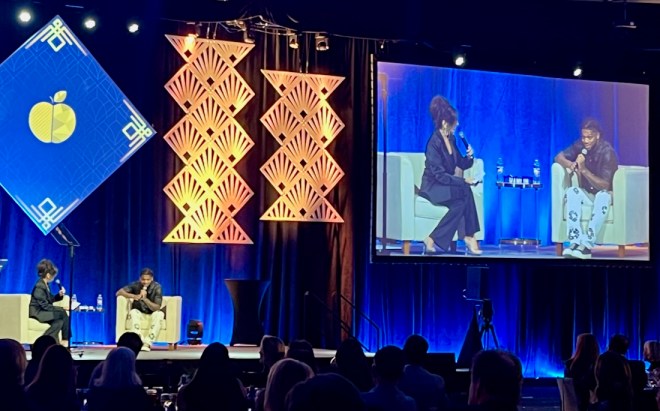
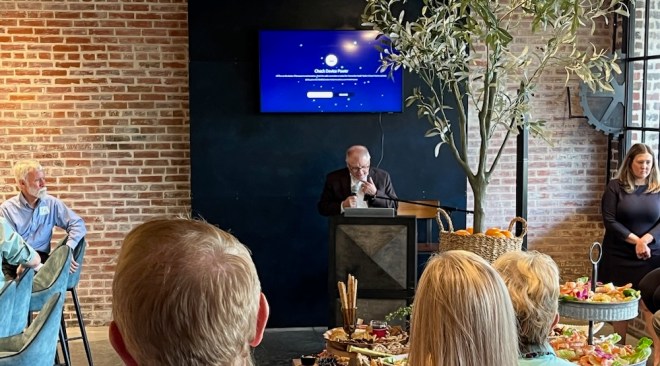
Rex Smitherman addresses crowd at i2E 25th anniversary celebration

As Rex outlined in his presentation at the anniversary celebration, i2E has provided business advice or investment for over 800 fledgling companies across its history. It has provided more than $83 million of investment capital to Oklahoma ventures.

Here are a few of the high impact success stories for which i2E provided advisory services and investment: WeGoLook, Selexys Pharmaceuticals, Spiers New Technologies and Alkami Technology, a billion dollar public company that was founded in OKC in 2009 by Oklahoman Gary Nelson.

And i2E’s mission continues to expand. In fact, Rex devoted much of his presentation at the anniversary celebration to looking forward to i2E’s future impact through its new programs.

Today, i2E embraces a big educational mission, having launched and managed the statewide Love’s Entrepreneur’s Cup collegiate business plan competition that will celebrate its 20th anniversary in 2024. Now, i2E is launching a pilot high school business plan competition in a partnership with the MidAmerica Industrial Park in Pryor.

There’s more expansion news. i2E developed a popular workshop for new entrepreneurs called E3, which helps them determine whether their venture has a realistic opportunity for success. Joining E3 will be a second program called Bridge2, described as an 8-week ‘pre-accelerator’ that provides $50,000 in convertible debt funding for founders.

In addition, i2E created a subsidiary a few years ago known as Plains Ventures, which now handles virtually all of the investment activities for the company.

But enough of the history and impact of i2E.

For me, the anniversary celebration was a chance to catch up with old friends, even if just for a few moments. Folks like Rick Rainey, Cindy Henson, Mark Lauinger, Srijita Ghosh, Darcy Wilborn, John Campbell, Kevin Moore, Shaun O’Fair, Rex Smitherman and former OCAST executive director Michael Carolina.

I even had the opportunity to share a few moments with our former finance director, David Daviee. My only disappointment was that not all of my former i2E colleagues made it to the event. You know who you are.

Maybe for the next ‘family reunion.’

But life goes on. As i2E’s mission continues to expand, it’s been joined in the space by a host of new Oklahoma investment and accelerator partners, both here in OKC and in Tulsa.

While the investment outlook for new entrepreneurs and ventures in 2023 is far from bleak, the time was right for an i2E when it became a reality in 1998.

It really was an idea whose time had come.

i2E crowd
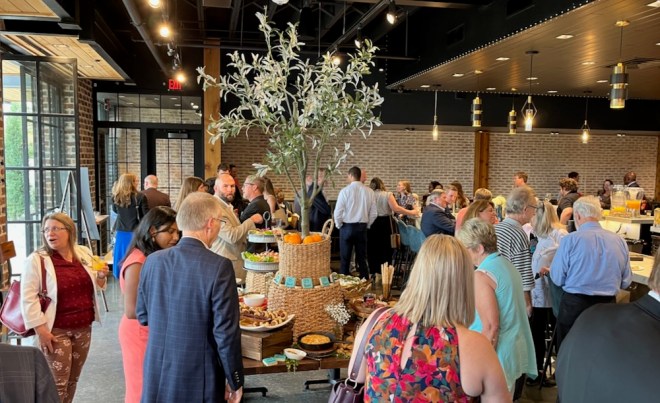
Crowd shot during the i2E anniversary celebration

BONUS: I came across an old story by the Oklahoma Council of Public Affairs, a conservative research organization that generally attacks any new idea that uses public dollars to advance an innovative concept, no matter how many people benefit. Here’s a sample of the article:

“The Oklahoma Center for Science and Technology (OCAST) should no longer receive state funding for the Oklahoma Technology Commercialization Center (OTCC). This program directly competes with the private sector and existing market participants engaged in business formation and development.”

You get the drift.

My response:  Back in 1998 and for many years afterward, there was little private sector investment capital in Oklahoma competing with the i2E concept. Many new ventures likely would not even have been attempted had i2E not been in existence. Oklahoma’s innovation economy expanded because of i2E’s efforts, and now new private ventures are bringing new investment to the state.

Chicago woes, part 2: Cunning as a savage pitted against the wilderness

Don Will
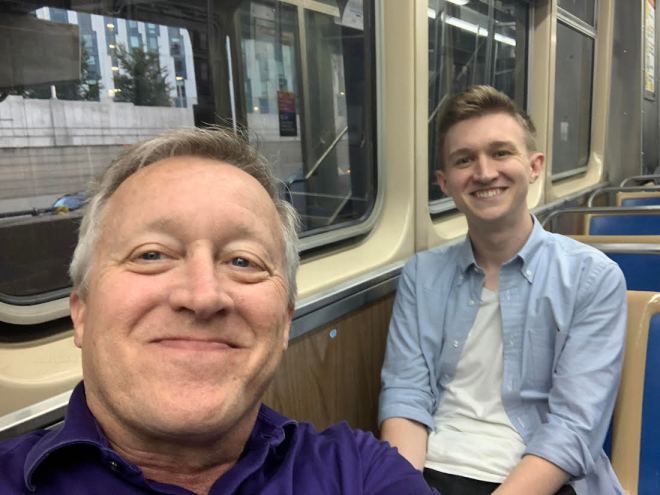
Don and Will on the Blue Line before they learned that all their moving plans had turned to dust.

Editor’s Note: Don Mecoy is a friend and former colleague at The Oklahoman who retired as the newspaper’s managing editor at the end of 2022. He shares recent misadventures in Chicago with us in this post.

By Don Mecoy

I love Chicago, even if sometimes it doesn’t love me back.

Hog Butcher for the World,
Tool Maker, Stacker of Wheat,
Player with Railroads and the Nation’s Freight Handler;
Stormy, husky, brawling,
City of the Big Shoulders

Regular readers of Jim’s Blog (“Howdy,” Jim’s extended family!) may recall my last post here about spending a night in Chicago’s O’Hare International Airport.

Undaunted, I returned to the City of Big Shoulders, and again I experienced the peculiar situation of being homeless without being destitute. Perhaps it would be better to say we were “houseless.” This time, it involved my son’s move from one apartment to another that went awry. Like a big shoulder to the solar plexus.

Here’s the setup: My son, Will, had to be out of his West Loop apartment on Sept. 1. He was scheduled to move into his new Printer’s Row apartment in South Loop the very same day. The lease was signed, the elevators were reserved, the movers were contracted and I showed up a few days early to help out with the packing and cleaning and so forth. He had just started a new job and was understandably reluctant to take much time off, and I’m completely unemployed, so I flew up.

The day before the scheduled move, we went to his new building to drop off a big deposit with the landlord and get the key. That’s when we learned that she would not accept an electronic payment despite the fact that she had previously taken a payment in that form. She wanted a cashier’s check and only a cashier’s check. Unfortunately, my son’s banking account is with an online bank, which made it nearly impossible to get what she wanted in short order. Nevertheless, we said we would obtain one that very day and return to get the key. I should mention all of the communication with the landlord was via email; she never provided Will with her phone number even after they met in person during his tour of the apartment and again when they signed the lease.

Will rushed to open an account at a nearby bricks-and-mortar bank and started trying to fund the account. That wasn’t going to get us a cashier’s check in one day, we learned. I started hitting ATMs to get cash. I called my Oklahoma credit union to see if they had any ideas. My friendly neighborhood banker suggested I could purchase a cashier’s check by taking advantage of a shared branching agreement between credit unions. Unfortunately, the nice folks at the Chicago Patrolmen’s Federal Credit Union said that would violate their policies. A teller’s check was the best they could do. And, they said, even if I showed up with cash in hand, they wouldn’t sell me a cashier’s check unless I had an account.

I was about to go to a check-cashing store to see about getting a cash advance on my credit card. But Will told me the landlord had stopped responding, so we pulled the plug after several hours of frantic money-raising efforts.

They tell me you are wicked and I believe them, for I have seen your painted women under the gas lamps luring the farm boys.
And they tell me you are crooked and I answer: Yes, it is true I have seen the gunman kill and go free to kill again.
And they tell me you are brutal and my reply is: On the faces of women and children I have seen the marks of wanton hunger.

In the midst of all this chaos, my phone died. I couldn’t field calls from my credit union, or Will, or my wife back in Oklahoma. It also left me far away from Will’s current apartment without the ability to hail an Uber or catch a bus or train because all of my data and payment methods for those forms of transport were in the dang dead phone. I walked about 6 miles that day. At least the weather was nice.

The upshot is that the landlord said she would “review” all of the emails between her and Will to determine what her next step would be. That night, she wrote to Will that she just didn’t find him trustworthy and believed he wouldn’t pay his rent on time, despite the fact that he has lived in apartments for years and never once was late with his rent. She also disputed his claim that she was leaving him homeless because “your dad lives in Chicago.” That was just one of several problems prompted by communicating solely through email. He offered to pay three months rent in advance, but we never heard from her again.

Boxes
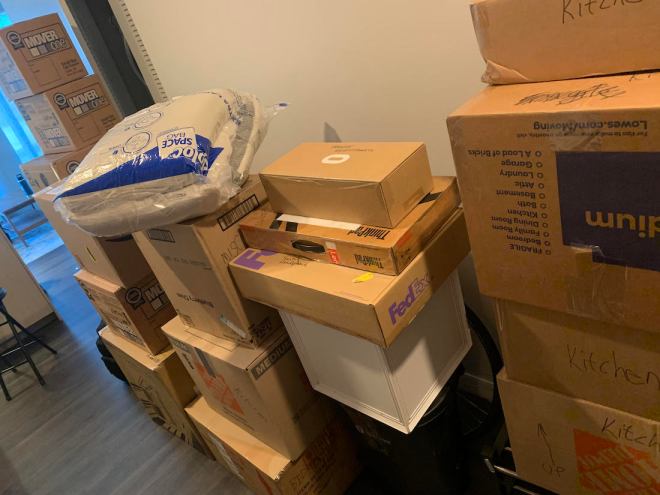
All packed up and nowhere to go.

We were tired and disappointed and angry. But we had a lot of work to do. We had to find storage for all his belongings. We had to contact the movers to make sure they would move those belongings to storage instead of to the new apartment. We had to find someplace to stay for the next few days. And we had to start hunting for a new place for Will to live. And we really needed a beer.

More than once during those troubled days I thought about “The Out-of-Towners,” a 1970 Neil Simon movie starring Jack Lemmon and Sandy Dennis about an Ohio couple’s disastrous trip to New York City. While we weren’t mugged or left penniless, we were subject to forces beyond our control in a big city.

But after all those repeated disappointments, things started looking up. The movers agreed to take in his belongings, and even store them for up to a month for no charge. We secured a hotel room. Will scheduled an apartment tour on Sept. 2, and the new place in Wicker Park was fine. The owners had planned a kitchen renovation, but when they learned that he needed it immediately they agreed to sign a lease the same day and knock a little off the rent. On Sept. 5, he became a resident of the trendy area with lots of shops and restaurants and tree-lined streets of 3-story walk ups.

And having answered so I turn once more to those who sneer at this my city, and I give them back the sneer and say to them:
Come and show me another city with lifted head singing so proud to be alive and coarse and strong and cunning.
Flinging magnetic curses amid the toil of piling job on job, here is a tall bold slugger set vivid against the little soft cities;

Apartment
The new place has great morning light.

Now we see what can be done about the landlord. This fiasco cost Will a fair amount of money. He’s paying more in rent. He had to pay for two moves instead of one. He’s out the cost of the hotel room for four nights. We obviously had no kitchen for several days, and that cost extra. I had to extend my planned stay by five days.

But I got to spend a lot of time with Will — always a good thing. I also loved being in Chicago. It’s a great town mostly filled with good folks.

Fierce as a dog with tongue lapping for action, cunning as a savage pitted against the wilderness,
Bareheaded,
Shoveling,
Wrecking,
Planning,
Building, breaking, rebuilding,
Under the smoke, dust all over his mouth, laughing with white teeth,
Under the terrible burden of destiny laughing as a young man laughs,
Laughing even as an ignorant fighter laughs who has never lost a battle,
Bragging and laughing that under his wrist is the pulse, and under his ribs the heart of the people,
Laughing!
Laughing the stormy, husky, brawling laughter of Youth, half-naked, sweating, proud to be Hog Butcher, Tool Maker, Stacker of Wheat, Player with Railroads and Freight Handler to the Nation.

–Carl Sandburg

My first NBA crush

CP3 Hornets
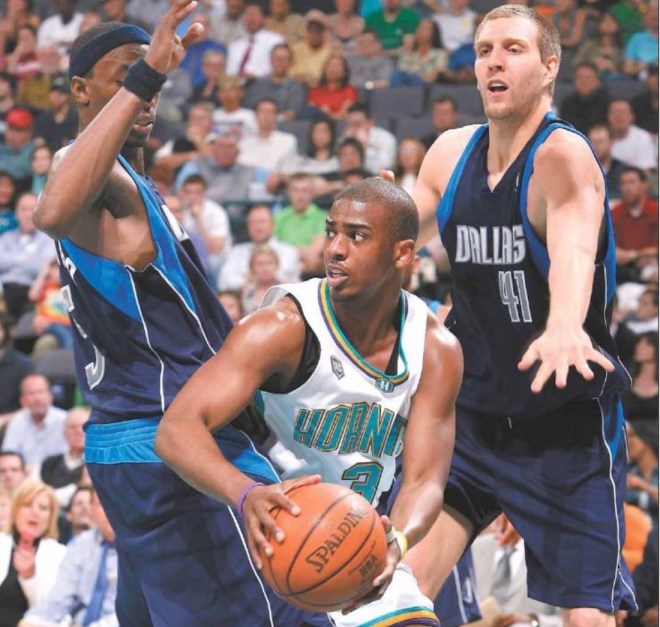
Chris Paul as an OKC Hornet handles the ball vs. the Dallas Mavericks. (Oklahoman photo)

I came across an interesting feature over the weekend in The Oklahoman that ranked the top 15 players in Oklahoma City Thunder history.

We’re roughly five weeks or so from the launch of the 2023-24 NBA season, so the timing of such a list was right to generate clicks from Thunder fans like me.

And of course, it was bound to stir up some passion and some controversy. First of all, the rankings by The Oklahoman beat writer Joe Mussatto had Russell Westbrook at No. 1 and Kevin Durant No. 2.

I posted a link to the story to my Facebook page, and right off the bat a couple of friends took exception.

“Sorry but Durant was the greatest player by far even with his bad exit…,” said Scott Rollins, a local business leader and biotechnology researcher.

“SGA behind Serge?!? Westbrook ahead of Durant, even though he stipulates that Durant is the best player to ever put on a Thunder uniform,” was the response from Tony Thornton, a former colleague at The Oklahoman.

There was one ranking I was happy to see, no matter where the player was ranked.

Chris Paul came in at No. 10, even though he had only one season as an Oklahoma City Thunder. Remember, CP3 willed our team to the playoffs in the 2020 pandemic bubble with outstanding play and leadership.

For me, Paul’s return to OKC was something of a welcome homecoming. He was a member of the New Orleans Hornets when they were forced to play two seasons in OKC in the wake of Hurricane Katrina.

Along the way, CP3 became my first NBA crush. And I got to meet him for an assignment as a Business News reporter for The Oklahoman.

CP3 was the focus of a special marketing video made by AT&T that featured NBA players and their ‘cribs.’ Most were guys who lived in ostentatious mansions.

CP3 lived with his brother in a modest home just north of 33rd in Edmond.

So, when a film crew flew into town to shoot the video at Paul’s “crib,” my editor sent me out to cover the filming and interview the star. CP3 could not have been more accommodating, patiently answering my questions from the driveway of his home before the filming began.

As a bonus, the video included Prime Time himself, Deion Sanders, who showed up just before the filming started.  I did not get to meet the future Coach Prime.

I had a second face-to-face with CP3 a couple weeks later at a Thunder game. My son, Ryan, was the lucky recipient of a drawing that allowed him to go down on the court after the game and have his photo made with Paul.

I accompanied Ryan, and CP3 recognized me from our previous encounter.

(An aside: A series of youth basketball camps were held in the OKC metro using Chris Paul’s name, and my son attended one. He said that CP3 actually showed up at the camp and did one-on-one drills with the campers).

So that’s the story behind why I consider CP3 to be my first NBA crush. And why I was happy to see him included as a top 15 player across Thunder history.

Now, let the critics roar over the rankings.

cp3 3
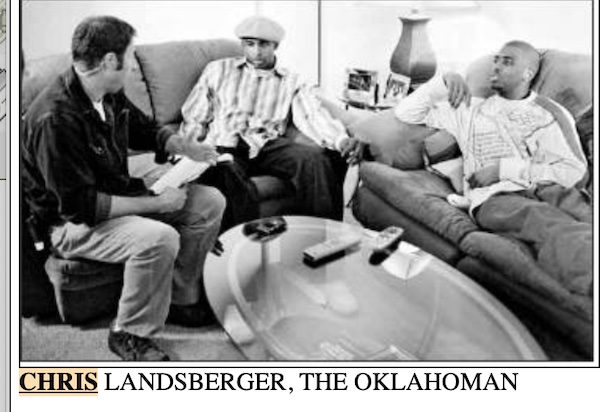
CP3 (right) with Deion Sanders (center) and the video director

Some salve for your soul


Recently, my 4-year old grandson complained of a big, red welp on the back of his calf. It was result of a mosquito bite, so I recommended to my wife that she put some salve on it to soothe the itch.

I discovered that I walked into a hornet’s nest with that suggestion.

“What, are you, 90 years old?” she asked. “No one says ‘salve’ any more. It’s ‘cream’ today.”

I wasn’t about to give in so easily.

“My grandmother put salve on every itch and wound I had as a kid,” I protested. “When I had a cold, she would even smear some Vicks VapoRub on my chest. That was the go-to salve in our family.”

The debate goes on today. Cream on one side. Salve on the other. I definitely remain on Team Salve.

So, I pointed her to the definitive statement on salve: The Andy Griffith Show and a wonderful episode about a miracle salve and how it entangled Barney Fife.

I offer it to you in this post for both educational and entertainment purposes.

Enjoy.

Hometown hero and a smile

Pen Woods

The first time I met Col. Pendleton Woods I was judging a high school history event at Oklahoma Christian University in the early 2000s. It was a crowded room, but Pendleton spotted me from a distance and walked over to introduce himself.

Born in 1923, Pen was almost 80 years old at the time. He knew of me because I had been a Business News reporter at The Oklahoman throughout the 1990s before taking a 3-year sabbatical at OC beginning in 2000.

Anyway, Pen introduced himself, and as I looked up from my seat I noticed he was wearing a plaid jacket. tie and a pair of slacks. There was one other detail that stood out.

His fly was open.

I later talked about meeting Pen with my friend Mike Osborne, who also worked at OC at the time. Mike had one question.

“Was his fly open?”

The knowing question made me laugh out loud, and I still smile at the memory today. But I grew to love Col. Pendleton Woods, and slowly came to know his story.

Turns out he was born and raised in Fort Smith, Ark., which is also my hometown. Pen graduated from the University of Arkansas with a journalism degree.

But that’s only the start.  He was a military hero from The Greatest Generation.

Pen served in World War II with the 99th Infantry Division and was captured on a reconnaissance patrol on Dec. 10, 1944, during the German build-up to the Battle of the Bulge. He remained a prisoner until he and others escaped after Russian artillery shelled the compound shortly before the war in Europe ended on April 20, 1945.

Pen also served in the Korean War with the 45th Infantry Division of the Oklahoma National Guard. He was inducted into the Oklahoma Military Hall of Fame in 2002.

After his service in WWII, Pen settled in OKC and worked for Oklahoma Gas and Electric for years. He eventually joined the staff at Oklahoma Christian University and worked there until late in his life.

As a longtime OKC resident, Pen was an incredible community servant, volunteering for the Boy Scouts, helping bring the National Cowboy Hall of Fame to OKC, serving as executive director of the OKC Bicentennial Commission and many, many other endeavors. He authored 15 books.

After I returned to The Oklahoman in 2003, Pen would call me on a regular basis, either to pitch a story or just to catch up for a few moments.

Pen died on Dec. 1, 2014 and left a massive legacy in our local community and beyond. Read his obituary here. 

I’ve written all of this about Col. Pendleton Woods because of something that happened this week. I was working on a special project for a friend at a busy local coffee shop when I happened to look down.

My fly was open.

Pen Woods was the first thought that ran across my mind after quickly closing the barn door.

Then I smiled to myself at the memory.

Starbucks
The room where it happened.


Say it ain’t so

SelloutAs I was sitting in the stands at OKC’s All Sports Stadium in roughly 1987 watching the Big 8 baseball tournament with my Daily Oklahoman colleague, Tom Kensler, a lanky young man sat down with us.

Kensler, now deceased, was the paper’s OSU beat writer in 1987. He introduced me to the newcomer.

“Jim, I want you to meet the newest member of our Sports staff, Berry Tramel,” Tom told me as I shook Berry’s hand.

Although I had worked as a copy editor on the Sports desk at the Oklahoman since 1983, I didn’t know Tramel, who worked as a sports writer at the Norman Transcript.

Something happened, however, and Berry did not become a member of The Oklahoman’s Sports staff until 1991. Maybe the Transcript offered him a raise or he still had things to accomplish at the Norman paper.

But Berry eventually joined The Oklahoman staff and became our lead sports columnist. He quickly established himself as one of the top sports writers not only in Oklahoma but across the nation.

I don’t remember much of that first conversation with Berry at the ballpark, but eventually I found him to be warm, empathetic, approachable and the most prolific and hard-working writer I’ve ever known.

Berry writes in what I consider a folksy manner that carries the reader along. He has an incredible ability to uncover the critical issue that may be plaguing — or helping — a team, a coach, a school, a state, whatever. And he’s a walking encyclopedia of sports history.

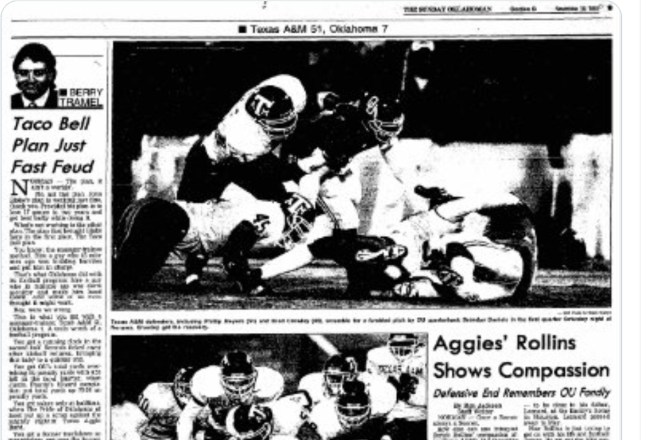
Berry’s most influential article of them all may be the infamous “Taco Bell” column from the late 1990s when he compared OU’s hiring of John Blake to a company that put a management trainee in charge of the entire business.

You can read the column here. 

Berry Taco Bell

Not everyone loves his style — ask my friend, Casey — but he’s attracted a huge following far and near over the years. Including me.

Berry was joined on The Oklahoman Sports staff in the late 1990s by Jenni Carlson, a Kansas native who brings a unique point of view to whatever she’s writing about. I’ve come to know Jenni, as well, and love reading her intriguing takes that often focus on people who have overcome long odds to become successful.

I’ve written all of this because, as most people know by now, both Berry and Jenni are leaving the paper. They’re joining a new online venture called The Sellout, Sellout Crowd, or something like that. It should debut later this month, from what I understand.

I got wind of Berry’s impending exit about three weeks ago and immediately sent him an email with the subject line “Say It Ain’t So.”

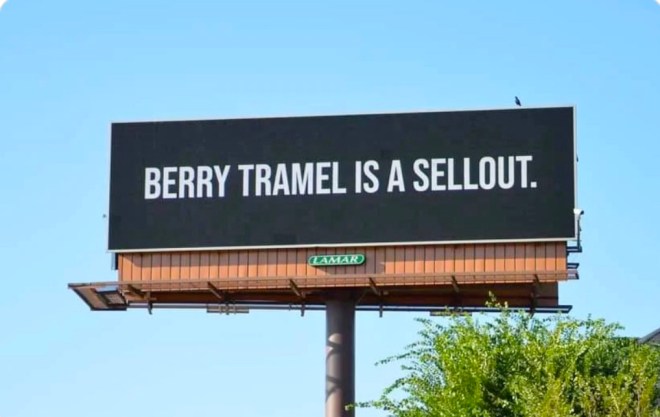
Berry responded and said it was so. He said it’s a good thing, not bad, because readers who follow him and Jenni will be able to read their work in a free online newsletter. He even wrote about his impending departure from the paper after billboards appeared saying “Berry Tramel is a Sellout.”

But I’m mourning for the newspaper because of the loss of such immense talent.  I was part of that newsroom as a writer and editor for over two decades.

Although I’ve been gone from The Oklahoman for almost 15 years, I’m still a subscriber and a daily reader of the newspaper. I still pick it up off my driveway every morning (except Saturday).

We all know that the Internet has changed the way people consume news, sending the newspaper industry into a long decline, including The Oklahoman. In my opinion, the paper has done a great job of building its online enterprise while still keeping print alive.

For now.

But the loss of Berry and Jenni is a huge blow to readers like me who look forward to unfolding the paper every day (but Saturday) and seeing what one or both have written for us. Who can replace them?

So, what’s next? I’m anxiously watching as the leaves continue to fall from the tree and the newsroom branches become bare.

Say it ain’t so.

Berry Jenni1

Class Reunion, Party of Two

yearbook ppic
A page of the 1971 Southside High School yearbook, ‘Lifestyles’

I walked into Cattlemen’s Steakhouse a few weeks ago, made my way to a back booth and was greeted by someone I had not seen in 52 years. He was an old high school chum, so it was the ultimate class reunion.

We both graduated in 1971 from Southside High School in Fort Smith, Ark. I was astounded by how much he still resembled his youthful high school self, despite now being 70 years old.

I have not aged as gracefully.

Turns out, my friend, whom I will call “Will,” was driving from New Mexico to Fort Smith to visit our home town for a few days. So, he contacted me to see if I would be up for a reunion as he passed through.

Would I? Of course!

We spent a wonderful hour and a half at a back booth catching up on our lives, families and reminiscing about days long past.

The real story is how Will found me. He told me he stumbled across this blog as he was searching for some high school classmates he had not seen in years. After reading a few BlogOKC posts, he decided to reach out, although he has no social media presence at all.

So his wife looked me up and discovered my Twitter profile. She sent me a direct message asking if I would be interested in meeting Will when he was passing through OKC.

I’ve thought of Will often over the years. He was from a well established Fort Smith family and had gone to public schools there since first grade. I moved into the school district my sophomore year only because my dad was in the Army and his military assignments took us as a family around the world. We came to Fort Smith when Dad went to Vietnam in 1969.

Being a ‘move-in’ with no local history in an old Southern town like Fort Smith was a big challenge for me. Making friends, eating lunch in the cafeteria, having a social life after school.

For some reason, Will sort of took me in. We played basketball on his driveway and connected in classes. As I recall, he was a member of the National Honor Society, wrote a column for the student newspaper and was on the Student Council, among many other school activities.

By contrast, I was sort of the Invisible Man at Southside. I had only heard of the National Honor Society, but had a secret dream to become a newspaper reporter some day. So, we had that in common.

Anyway, Will showed kindness and attention to me. After high school, he went on to college, eventually earning a master’s degree, moving to a distant state and working for social change.

I wandered aimlessly for a few years before gaining some direction by attending Abilene Christian University and earning a journalism degree. My secret dream actually came true.

Since I have never attended a single high school class reunion, I lost touch with Will along with the rest of my senior classmates.

Then he called.

There’s a lot of space to fill and life to live in 52 years. But reconnecting with my old classmate was the feel good event of the summer for me.

So good to see you, Will.

The wisdom of Linus: Be nice, and always carry a blanket

The floor is about the only place to stretch out at Chicago O’Hare International Airport.

Editor’s Note: Don Mecoy is a friend and former colleague at The Oklahoman who retired as the newspaper’s managing editor at the end of 2022. Don recently experienced the challenge of navigating the commercial airline system when multiple flights were cancelled as he attempted to return to Oklahoma City from Chicago’s O’Hare Airport.  He shared his reaction to the experience in this blog post. 

By Don Mecoy

I recently got a taste of homelessness. I wasn’t actually without a home, but I temporarily lacked access to some basic needs such as food and a place to sleep. It was a frustrating and instructional experience.

I was homeless the way that Barack Obama is jobless. I was fine.

Don Mecoy

My situation was the same that millions of Americans find themselves in every year — my flight was cancelled and I was abandoned at a large metropolitan airport. My fellow passengers and I were shooed off our American Airlines plane at about 1 a.m. last Sunday — five hours after the planned departure — and told that we would not be flying from Chicago O’Hare International Airport to Oklahoma City anytime soon. The airline offered little to help us deal with the situation or to appeal to our better nature — $12 food vouchers (all the restaurants and stores were closed until 5 a.m.); no hotel vouchers (there were no rooms available within miles of the airport anyway), and no concrete information on when we might get back to good ol’ OKC.

After a lot of waiting in lines, hand-wringing and watching our flight’s self-designated Chad unload on the helpless, but genial gate attendant, we former passengers got down to the business of making the best of a bad situation.

About a dozen simply checked out, heading off to Ubers and Lyfts to whisk them away to someplace with food and blankets, or perhaps to rent a car and drive the 12 hours to Oklahoma City. I’m not sure; I never saw them again.

I could have done the same and returned to my son’s apartment in the West Loop area of downtown Chicago. But it hardly seemed worth it for a few hours of sleep and a very early return to O’Hare, particularly since I didn’t know what time our flight was. Within a few minutes of our flight being scratched, my American Airlines app showed the next departure for my flight changing from 12:30 a.m. to 3 a.m. to 6 a.m. to 10:40 a.m. The gracious gate attendant said she “hoped” that 10:40 time would hold. It didn’t.

The rest of us started cracking open suitcases and putting on more clothes. It was freezing in the cavernous, empty airport. I once interviewed a guy who helped run what is now called Paycom Center. He told me they crank up the air conditioning long before Thunder games or other big events to account for the body heat and activity of the 18,000 or so people who will fill the arena. Perhaps that’s what the airport folks were doing in anticipation for the next day’s crowds. But the A/C never stopped producing a chilling breeze that was unavoidable everywhere except in the middle of the concourse, and I wasn’t going to sleep on those tiled floors.

There are thousands of pieces of furniture in O’Hare, and just like at every airport, they are designed to be impossible to sleep on. You’ve seen them, essentially long couches, but with stainless steel arms demarcating where each individual should sit. They work fine when you’re waiting for a plane. But when seeking a place to lay your weary head, it makes you ponder why they don’t make those arms movable like the armrests on the planes. It’s needlessly cruel. Of course, cities do the same with park benches and walls to discourage those with no bed from making one in a public place. A bed is a very important thing when you don’t have one. And a blanket.

Meanwhile, directly across from the gate where we waited to secure our food vouchers was American Airline’s Admirals Club, an expansive area for the airline’s most lucrative customers that offers recliners, food and drink, showers and other amenities. I bet they even have blankets in there. It was closed. Here’s a suggestion, American: Give the beleaguered gate attendant a key so she can offer something to abandoned folks like us. What a waste.

Seating in the American Airlines Admirals Club at Chicago O’Hare International Airport.

And lest you think the powers that be at O’Hare are heartless. There is a yoga room in the airport. It closes at 10 p.m. I would have paid good money for one of those yoga mats. Instead, I swiped a floor mat from behind a ticket counter to soften the concrete floor covered with — like every airport I’ve ever been to — the thinnest grade of carpet known to man.

I took my pilfered floor mat and began to build a nest in a semi-isolated place. I draped most of the shirts in my suitcase atop the three shirts I was wearing, rolled up a pair of pants for a pillow and tried to nap. It was futile. After what felt like an hour of trying to get comfortable, I had to get up and move to warm up. I dragged the floor mat to a fellow passenger attempting to sleep on the bare carpet. She was grateful. She had a blanket. Man, a blanket. Luxury!

Another annoyance: At nearly every gate in O’Hare there is a TV. All those TVs play the same loop of programming that includes ads for stores and restaurants in the airport. It also features Conan O’Brien interviewing Kevin Bacon on how the star’s life was changed by the recent emergence of COVID. I looked it up: the interview was taped on April 9, 2020. It was impossible to turn off the TVs, or the sound broadcast through overhead speakers. Believe me, I tried.

So I was tired, hungry, bored, but not really upset. I wasn’t missing a wedding or funeral or graduation back home. I had the wherewithal to simply leave if my health or safety was a real concern. I learned that McDonald’s was going to open at 4 a.m., so I was an hour closer to food. My fellow passengers and I seemed to enjoy strategizing about our situation amid our shared misery.

Among our group was the tallest (6 foot 2), most mature 15-year-old I’ve ever met. He was traveling alone, was not allowed to leave the airport and nevertheless was handling the situation better than 90 percent of his fellow refugees. I met the gaze of another parent, and we shared a look that felt like a silent promise that this kid was going to get home. As the sun rose, I had a conversation with a lady from Moore about our favorite books we had read while on airplanes.

After climbing off the floor around 2:30 a.m. or so, I somehow was able to book an 8:30 a.m. flight on my American Airlines app. I hurried to tell some of my fellow passengers about the discovery, but no one was able to reproduce it. A dozen or more were placed on standby for that flight, and at least four of them — including the gangly 15-year-old — boarded along with me.

Our original flight finally took off at 1:11 p.m., roughly 17 hours after it was scheduled to depart. By that time, I was well fed and sound asleep in my bed. With my blanket.

All in all, it was not a terrible experience. And it drove home a couple of maxims that I long have believed true.

Be nice. It costs nothing, and you might make a friend; perhaps even ease someone’s pain. You don’t really know what struggles anyone is dealing with, so cut folks some slack.

If you see someone carrying a blanket or a piece of foam, or wearing layer upon layer of clothing, or trying to beg, borrow or steal some food, they’re just trying to make the best of a bad situation. Have a heart.

MORE READING: My daughter, Sarah Stafford, had a similar experience that I wrote about in this blog post back in January.

A short thread on Threads

Untitled design - 1I’m here today to write about the new social media platform, Threads. But first I have to talk about Twitter, because without the bird app, I’m pretty sure there would not be a Threads.

Back in the Spring of 2008, my friend Russ Florence invited me to connect with him on Twitter, a social media platform that debuted in 2006. I was in the final year of my career as a reporter at The Oklahoman.

So, I signed up on the app and followed Russ as my lone Twitter connection.

As a Twitter newbie, I didn’t realize there was a big Twitter world out there with lots of potential accounts to follow. I loved following Russ and his personal tweets like the one from the day his dishwasher quit on him.

But one day I happened to look at Russ’s profile and saw he was following scores of other Twitter accounts. So I clicked on his follow list. It opened a new world to me because there were so many news and technology sources that I didn’t realize existed until that moment.

I followed a couple dozen right off the bat, and my interest in Twitter grew exponentially.

What I loved about it was being able to follow big national media sources like the New York Times and NPR, or more local sites like The Oklahoman and Tulsa World. Plus there were sports accounts like ESPN, and eventually MLB, NBA and NFL.  I got instant alerts anytime there was breaking news or sports.

Plus there was a growing number of Oklahomans joining every day, providing local perspectives.

I enjoyed Twitter immensely, because, until Donald Trump started opining 30 times a day on Twitter on the run-up to the 2016 election, there were few of what I call the Crazy Uncles on Twitter that you frequently find on Facebook. It was upbeat and fun.

Fast forward to 2022.

Billionaire Elon Musk completed his purchase of Twitter in October, and it’s all been downhill from there. Musk encouraged less-than-objective news sources to begin posting on Twitter. He appealed to the type of voices like podcaster Joe Rogan, who broadcast and repeat misinformation. Trolls blossomed. New rules were imposed that limited the number of tweets a subscriber could view on a daily basis.

With all that roiling long-time Twitter subscribers, along comes Threads, owned by Meta and launched through Instagram. I heard about it and signed up on Day 2. By the end of the week (last week!) I read that 110 million individual accounts had opened.

Threads looks suspiciously like Twitter in that you can comment, like and repost items with or without your own commentary. In fact, Twitter has threatened to sue Meta over the copycat status of Threads.

The downside I’ve seen so far is that you can’t set up lists that contain just the accounts — Threaders? — or topics you want to see, and posts aren’t presented in chronological order. And there’s no Threads site set up for Mac or (I assume) Windows computer users — it’s all mobile based so far.

But I’ve read those features are coming soon. Read this article from the Wall Street Journal,  if you want to know more about Threads.

So, here’s my dilemma and that of millions of other long-time Twitter users. Many — including me — have made their living posting items on behalf of employers to Twitter accounts that are well established and have many followers. Many thought leaders still post regularly to Twitter, although you can find many of the same folks over on Threads.

Instead of just dropping my Twitter account, I’m hanging on, checking both Threads and my Twitter feed on a fairly regular basis.

Until further notice, I’ll be tweeting and threading simultaneously. I welcome followers on both.

Twitter: @James_Stafford
Threads: @jimstafford

Below is a sample Threads post. Seems familiar?

threads sample

The Walkable City on my mind

Walkable1
With the help of urban planner Jeff Speck, OKC’s downtown became an inviting, walkable urban center.

I just read Jeff Speck’s “Walkable City: How Downtown Can Save America, One Step at a Time,” and I don’t know where to start with my reaction.

Do I question my choice of a virtually unwalkable neighborhood in which we live?

Do I celebrate the incredible strides Oklahoma City has taken to make our downtown livable AND walkable?

Do I ask about how a city like OKC can apply any of these principles in older, economically challenged neighborhoods that don’t lend themselves to walking?

First of all, it’s an engaging book that provides dozens of examples of cities that provide both good and bad environments for walking and urban life.

Jeff Speck, you might remember, is the urban planner and author who advocates making urban areas pedestrian friendly to encourage both economic development and urban living spaces. He consulted with the City of OKC about 15 years ago that resulted in big changes downtown, especially in the elimination of most one-way streets.

Speck outlines what he considers 10 important steps to remaking a downtown into an urban area that encourages walking (or biking) and puts cars in their place. It’s often a diatribe against city engineers, whose No. 1 mission appears to be accommodating the automobile.

Here’s a Q&A that my friend and former colleague Steve Lackmeyer did with Speck back in 2013 when he came to town for a book signing event for Walkable City. As far as I recall, there are only two mentions of OKC in Walkable City, although I think it may have been written before he dove into the challenge of remaking our downtown.

So, first, let me address my own neighborhood. My family lives in Twin Oaks, which is technically an Oklahoma City neighborhood but far removed (16 miles!) from downtown and as car-centric of a living space as possible. There’s no nearby transit, little retail within walking distance and from my own experience, a real disconnect between the people who live here and downtown OKC.

Walk Score1In fact, according to the Walk Score website that considers a number of factors for specific locations, Twin Oaks scores a 19 out of 100, or “car dependent,” according to the website. We also score a 0 for access to transit and a Bike Score of 25 for “somewhat bikeable.”

So, it’s a pretty serious indictment of this part of town as far as our urban environment.

As far as my neighbors, I’m not sure they care about what’s happening downtown, because it seems that few ever travel to downtown. I’ve even heard some question the city’s investment in amenities like our wonderful Scissortail Park.

Although this is where I’ve raised my family, in part because of proximity to excellent schools, I still count myself as a downtown advocate who’s proud of what has been achieved.

That brings me to the second question. Of course, I celebrate what our downtown has become and encourage my reluctant neighbors to join in. The remake of downtown since the passage of the first MAPs package has enhanced OKC’s reputation beyond measure.

Our population growth numbers reflect it. OKC grew from 444,000 in 1990 to more than 687,000 in 2021, advancing from the nation’s 30th largest city to the 20th overall.

City GrowthI worked downtown in the 1980s, and I can assure you there was little to brag about. We had one downtown hotel, the Sheraton, a failed retail mall and absolutely no one on the sidewalks after 5 pm. Downtown was a ghost town on weekends.

Contrast that with the life you can now find downtown virtually any day of the week, from restaurants, hotels, Bricktown, to the Chesapeake Arena and our magnificent downtown park. It’s a wonderful place to spend time.

My final question seems more difficult to address.

We’re celebrating downtown and the walkability and the life it has, but how do we address our city neighborhoods with lots of economic need? Not just walkability but creating sustainable lives and welcoming neighborhoods that support the people who live there.

I’m talking about many of those on the south side, east side and just west of downtown.

That’s the sort of question that some folks in my church asked about two decades ago. Paul and Suzanne Whitmire led the establishment of the Cross & Crown Mission at 1008 N. Mckinley, an area that teemed with abandoned houses and residents in need of jobs, food and someone who actually cared.

Since they started Cross & Crown with the help of dozens of volunteers, the Whitmires have virtually remade that neighborhood, buying and rehabbing abandoned houses, giving away food and clothing every week and helping people deal with other challenges that poverty brings.

You should check out Cross & Crown and have a conversation with Paul, who is incredibly passionate about the Mission and its, well, mission. Here’s a Q&A I did with Pau Whitmire about a year or so back. 

Paul and Suzanne Whitmire show what can be done.

Anyway, my point is that we’re excited to see the revitalization of downtown and the great vibe it created for our city. Neighborhoods like mine can take care of themselves, but there are still vast areas of OKC that need a spark like that brought by Cross & Crown.

Actually, Speck has an answer for the question of why focus so heavily on downtown.

“The downtown is the only part of the city that belongs to everybody,” he writes. “It doesn’t matter where you may find your home, the downtown is yours, too. Investing in the downtown of a city is the only place-based way to benefit all of its citizens at once.”

Still, I hope that as we celebrate the progress made with a walkable, inviting downtown, we consider ways to help far-flung OKC neighborhoods that need their own walkability initiatives.

They’ve been written off far too long.
Walkable3