Tulsa’s AAON makes it rain – and snow – in high tech Norman Asbjornson Innovation Center


Editor’s note: This report was written after I toured the AAON manufacturing campus in Tulsa at the invitation of my friends at the Oklahoma Center for the Advancement of Science and Technology (OCAST).

By Jim Stafford

TULSA – Mark Fly can make it rain at the massive Norman Asbjornson Innovation Center on the manufacturing campus of Tulsa’s AAON Inc. And snow.

Fly is executive director of AAON’s new R&D laboratory, a 134,000 square foot building that opened in 2019, and was a key designer of the facility. The Norman Asbjornson Innovation Center (NAIC) consists of 10 testing chambers, some of which can simulate heat, cold, rain, snow, wind and humid or arid conditions to test the durability of AAON’s industrial heating and air conditioning equipment in the most brutal of conditions.

“In our extreme environmental chamber, it can snow up to two inches an hour or rain eight inches an hour and do so with a simulated wind of 50 miles per hour,” Fly told me and colleagues from the Oklahoma Center for the Advancement of Science and Technology (OCAST) as he recently led us on a tour of the NAIC.

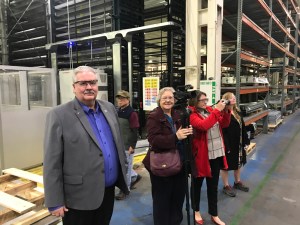
Mark Fly with AAON takes us through a tour of the company’s manufacturing and warehouse floor

“Our environmental chambers can be controlled to minus 20 degrees or up to 130 degrees, and humidity from 10 percent well into the 90 percent range,” Fly said. “We can simulate any outdoor environment in the world.”

AAON is a publicly traded (NASDAQ: AAON) manufacturer of commercial and industrial air conditioning and heating units. It employs approximately 1,900 people who work in 1.5 million square feet of manufacturing space at its Tulsa headquarters.

Named after company co-founder Norman Asbjornson, the NAIC provides AAON with testing capabilities that are unequaled in the industry, said Gary Fields, AAON’s president.

AAON employs 47 engineers among its 125-person R&D division affectionately known as “Area 51.”

“The innovation that we are noted for here at AAON is very much accentuated in this laboratory,” Fields said. “R&D has been the core value of AAON since the beginning.”

AAON was founded in 1988 when Asbjornson and partners purchased the heating and air conditioning division of the John Zink Company. Asbjornson is AAON’s CEO and chairman of the board.

Today, AAON employs 2,400 people across the company that also includes locations in Longview, Texas, and the Kansas City, Mo., area. Annual revenue is approximately $500 million from a diverse customer base.

“One of our premier customers that would be noteworthy would be the Jacob Javits Convention Center in Manhattan, N.Y.,” Fields said. “We shipped 26 units that were as much as 77 feet long; each unit took two truckloads to get to the facility.”

Nike Inc., on the west coast, is another premier AAON customer, Fields said.

OCAST has supported AAON’s R&D over the years with Oklahoma Applied Research Support (OARS) projects involving computer modeling on energy measurement and prediction, as well as controls, Fly said. The company also has been a participant in the OCAST Intern Partnerships program that places promising Oklahoma college students in real world work environments.

“Oklahoma has always been a very manufacturing-friendly state,” Fly said. “It is very supportive from both a tax and incentive standpoint, which includes programs like OCAST.”
Fly eventually led us into AAON’s sound test chamber that featured 12-inch thick concrete walls adorned with rectangular metal plates designed to echo sound.

“Customers want to know how much noise the equipment makes, because it may be going into a concert hall or a school,” Fly said as his voice reverberated back to us. “The sound is virtually the same everywhere in this room because of the echo.”

AAON performs acoustical, air flow and thermal testing simultaneously in the sound test chamber, Fields said.

“This capability exists nowhere else in the world,” he said.

Now that’s making it rain.

Jim Stafford writes about Oklahoma innovation and research and development topics on behalf of the Oklahoma Center for the Advancement of Science & Technology (OCAST).

Tin soldiers and Nixon coming

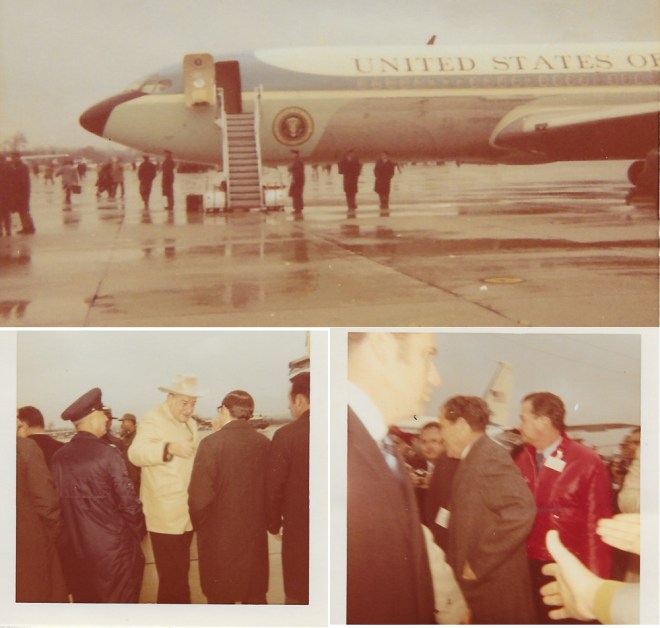
Air Force One sits on the tarmac at the Fort Smith Municipal Airport on December 6, 1969; Winthrop Rockefeller (white hat in left photo), and Richard Nixon shook hands with the crowd before departing for Fayetteville.

On December 6, 1969, President Richard Nixon flew into Fort Smith, Ark., on Air Force One as he traveled to Fayetteville and the “Game of the Century” between the Arkansas Razorbacks and Texas Longhorns.

That makes today a huge personal anniversary for me.

I was among the approximately 2,000 people who greeted Nixon at the airport 50 years ago today. I was 16 and living in Fort Smith with my mom and sister while my dad served a tour of duty in Vietnam.

But I wasn’t there to protest the war. I was there to see history in the person of a sitting President arrive in Fort Smith, no matter how brief the visit.

I borrowed my mom’s car and drove out to the airport a full two hours before Air Force One arrived and snagged a great spot by the rope barrier that had been set up. Security was pretty light. No one frisked us or questioned us as we ran onto the tarmac area in an attempt to beat the crowd to the best viewing spot.

When Nixon finally arrived, I don’t remember any actual remarks, although there was a podium set up. But I do remember that he came down the line of people along the rope to shake our hands. He was accompanied by Arkansas Gov. Winthrop Rockefeller (white cowboy hat in left photo above).

When the President got about two people from me, someone apparently suggested that it was time to board the helicopter that would complete the trip to Fayetteville. Nixon turned away and took a step toward the waiting helicopter. The crowd let out a collective groan, and the President immediately turned back and resumed shaking our hands (mine, too!). He continued shaking hands down to the high school bands that were playing, where he shook hands with some of the young musicians.

It was a highlight of my youth, despite the fact that Nixon turned out to be, well, Richard Nixon. Watergate and the corruption of his administration surfaced years later.

Two memories stand out from that day.

One was shaking the President’s hand.

The second memory occurred before Nixon arrived. A guy holding a small Instamatic-type camera climbed on top of one of the barrels set up to hold the rope barricade and immediately drew sharp reprimands from the security detail. The camera guy was incensed as he climbed down, and yelled “come the revolution, you’re going to get yours!”

It was a sign of the times, even in a small Southern city like Fort Smith.

OU showcases Stephenson Cancer Center at End2Cancer conference

A scientists presents his findings at the End2Cancer conference at the Samis Education Center on the OU Health Center campus

By Jim Stafford

The University of Oklahoma Health Sciences Center and the NCI-Designated Stephenson Cancer Center delivered an academic doubleheader for about 200 cancer research scientists at the recent 2019 END2Cancer conference at the Samis Education Center on the Health Center campus.

For the main event, scientists came to share their research or hear presentations given by counterparts from across the country who are pursuing breakthrough discoveries in the area of cancer treatment. At the two-day conference, the scientists focused on emerging nanotechnology and cancer drug delivery applications.

At the same time, OU showcased its renowned Stephenson Cancer Center on the Health Sciences Center campus, said Rajagopal Ramesh, Ph.D., conference chair and professor, Department of Pathology at the University of Oklahoma College of Medicine.

“The whole idea in organizing this conference for the third consecutive year – beyond the science – was to put Oklahoma on the map and have the Stephenson Cancer Center recognized for the great science that we do in the diagnosis and treatment of cancer,” Ramesh said. “We have eminent speakers coming in from all over the country, and the majority of them have never been to the state of Oklahoma or to the Stephenson Cancer Center.”

The NCI-Designated Stephenson Cancer Center ranks in the top 50 in the nation for cancer care in the 2019-2010 U.S. News & World Report ranking and currently ranks No. 1 among all cancer centers in the nation for the number of patients participating in clinical trials.

“They were highly impressed,” Ramesh said. “The first thing I hear when they come in is ‘Wow, I never knew such an outstanding cancer center with top-notch research infrastructure exists.’ We wanted them to come in and have the opportunity to go to the Stephenson Cancer Center and look at some of the cutting-edge clinical trials we are doing at the center.”

Ramesh pursues his own cutting-edge research at the Stephenson Cancer Center, developing nanoparticles that can deliver drugs specifically to tumors and minimize the toxicity that is often a cancer treatment side effect. He specializes in the diagnosis and treatment of lung cancer.

Ramesh recently received a grant from the U.S. Department of Defense to explore a means by which tumor cells may be avoiding immunotherapy in lung cancer. The study is unique in that it is being conducted on lung cancer patients in real time while they are on a clinical trial receiving an immunotherapy medication.

The Oklahoma Center for the Advancement of Science and Technology (OCAST) also supports Ramesh’s lung cancer research with a $135,000 Health Research grant.

“OCAST has been beneficial not only to my lab but across the entire state of Oklahoma,” Ramesh said. “The whole idea of OCAST is to bridge the transition from academic research to an industry setting in the state of Oklahoma. By receiving funds from OCAST, we are able to generate new ideas and test them first in the lab.”

Wei Chen, Ph.D., professor and dean of the College of Mathematics and Sciences at the University of Central Oklahoma, is another OCAST-supported scientist who moderated an END2Cancer panel discussion and presented findings from his own nanotech-based research at the conference.

“Ending cancer is everybody’s dream,” Chen said. “So everybody in this conference and many researchers around the world are contributing to the fight against cancer. We are making good inroads both in terms of nanotechnology and other methodologies. But cancer is a very tough enemy, as we know. Therefore, we still have a long way to go.”

Jim Stafford writes about Oklahoma innovation and research and development topics on behalf of the Oklahoma Center for the Advancement of Science & Technology (OCAST).

Gear from Ada plant protects Oklahoma City firefighters and their counterparts across the globe

Globe Manufacturing plant manager Jannette Orr shows off a firefighters jacket under construction for the Oklahoma City Fire Department

Editor’s note: I recently traveled to Ada with my friends at the Oklahoma Center for the Advancement of Science and Technology, where we had the opportunity to tour a plant that makes “turnout” gear for firefighters across the world.  This is my report:

By Jim Stafford

ADA – Jannette Orr stood on MSA’s Globe turnout gear manufacturing floor in Ada and held up a firefighter coat that was under construction at the plant.

Bright yellow letters on the back read “OKLA CITY.”

Globe’s Ada plant and its 48 employees are producing 510 sets of three-layer firefighter jackets and pants for the Oklahoma City Fire Department, said Roger Page, Operations Manager for Globe’s three production facilities in Ada, Okla., Pittsfield, N.H. and Auburn, Maine.

“Recently, we reacquired the Oklahoma City contract,” Page said as he led me and colleagues from the Oklahoma Center for the Advancement of Science and Technology (OCAST) on a tour of the Ada production plant.

“Oklahoma City had previously been in our gear, and we’re excited to have them back,” he said.

Globe was founded in 1887 as a family-owned producer of protective clothing for firefighters and headquartered in Pittsfield, N.H. It was acquired in July 2017 by MSA Safety Inc., a publicly traded corporation headquartered in Pittsburgh, Pa.

Globe opened the Ada plant almost 16 years ago.

“We were having a really hard time hiring enough workers in the Pittsfield area, and we learned that Wrangler was leaving this area and had a very similar weight of fabric to that which we use,” said Page, who has worked for Globe for 36 years. “We decided to explore this area, and the Ada Jobs Foundation did a great job, almost recruiting us.”

Coalgate native Orr was among the former Wrangler employees who migrated to Globe, starting on the production floor as a stitcher. Today she is the plant manager, and personally trains new hires on the complexities of running sophisticated machinery.”

“Our workforce here is doing great,” Orr said. “We try to start them off on the right track. They work hard and steady. We make sure they have good benefits, because the employees here are like family.”

Globe uses what is known as the Toyota Sewing System in Ada to assemble the firefighter suits. It’s a manufacturing philosophy that began in Japan and moves each garment from station to station.

“As you look around the facility here, everything is done in single piece flow, with standup operations and more machines than there are people because they bump their operations as they go through the cell,” Page said. “It makes the operations a lot more flexible, and the workers aren’t stuck in one spot doing the same thing all day.”

Globe produces two of its seven styles of “turnout gear” or “bunker gear” – insider speak for firefighter protective apparel – at the Ada plant. Each firefighter garment has three layers that consist of an outer shell, a thermal liner and a moisture barrier.

“We have a host of options that can go on those base garments,” Page said. “For example, we have over 400 different sizes of radio pockets alone.”

Globe’s operation has benefited by a relationship with the Oklahoma Manufacturing Alliance, which is a partner with OCAST in the Oklahoma Innovation Model that provides assistance to small manufacturers and new ventures across the state.

“I’m just really impressed with the amount of effort that Oklahoma puts into supporting manufacturers, whether it’s the Ada Jobs Foundation, the Pontotoc Technology Center training center or the Oklahoma Manufacturing Alliance,” Page said. “All of that is phenomenal.”

In addition to Oklahoma City, Globe produces garments for firefighters in numerous other Oklahoma communities. Ada’s proximity to Oklahoma City afforded the city’s fire department an opportunity to eyeball their equipment under construction, Page said.

“It’s only fitting to be able to produce Oklahoma City’s firefighting gear an hour and a half away here in Ada,” he said. “They are excited to come down and watch their gear being built and meet the people building it.”

Jim Stafford writes about Oklahoma innovation and research and development topics on behalf of the Oklahoma Center for the Advancement of Science & Technology (OCAST).

Don’t criticize me! Steve Jobs shows how to respond to criticism


I’ve never responded particularly well to criticism.  I tend to have an instant reaction and lash out at the person providing the critique with words that I regret.  It’s something that I’m aware of and have to guard against constantly.

But it seems that I never handle it as well as I should. Call it a character flaw (among many).

Anyway, I saw this clip of Steve Jobs responding to an insulting question from an audience member at a 1997 developers conference. The guy wanted to show that Jobs didn’t know what he was talking about as far as software programming, along with a second question on what he had been doing the past seven years.

Jobs’ response blows me away. Instead of becoming angry and hurling an insult back at the guy (as I almost certainly would have), he sat and thought for several seconds. You can see that the wheels are turning as he formulates his answer and responds initially with a cliche about pleasing some of the people some of the time.  His long answer actually provided insight into why Apple developed products as it did.

Finally, he responds directly to the insult by admitting that he sometimes doesn’t know what he’s talking about and that mistakes will be made. At least someone is making some decisions for the company, he told the audience.  

Jobs’ response seems heartfelt and honest. It’s something I hope I can emulate in the future.  

I invite you to click on the video and watch Jobs respond to the insult.  I hope you find it as inspiring as I do.


Oklahoma’s Saab story: a prophecy fulfilled

I hope you saw this story in Monday’s editions of The Oklahoman about the Saab Group, a Swedish Aerospace firm, reportedly passing on Oklahoma as the location to build a new military trainer jet because of workforce concerns.

If you didn’t read it, click this link to catch you up to date: 

The reporting by Oklahoman reporter Dale Denwalt made the words of Oklahoma City businessman Phil Busey seem almost prophetic. The story quoted State Sen. Adam Pugh, who said that the Saab Group decided it would not be able to find enough skilled workers to sustain its workforce at an Oklahoma location.

Saab reportedly wanted to know if it could find people to work at the plant. ‘In the end, they decided they couldn’t, and so they’re taking their business somewhere else,’ state Sen. Adam Pugh told members of Leadership Oklahoma at a recent aerospace forum.

Busey is founder and CEO of a company called Delaware Resource Group (DRG), minority-owned aerospace industry federal defense contractor. DRG employs upwards of 700 people, including software engineers, worldwide who support contracts with the U.S. Department of Defense, as well as major aerospace companies such as Boeing and Lockheed Martin.

I recently had the opportunity to interview Mr. Busey along with Debbie Cox, my colleague from the Oklahoma Center for the Advancement of Science and Technology (OCAST). Our interview was the basis for an OCAST video and a column I wrote on behalf of the agency. You can read it and watch the video interview here. 

We were surprised by the urgency that Busey showed in advocating for an improvement in public education and workforce development across our state.

Phil Busey

“Our challenges really come back to the issues of workforce development,” Busey told us. “Public education is the No. 1 challenging issue we see here in Oklahoma.”

Thousands of aerospace positions in the state remain unfilled because there aren’t enough Oklahomans equipped with STEM skills – science, technology, engineering and mathematics, Busey said.

That means that we need to build a deeper pool of young Oklahomans equipped with STEM skills that are critical to the sustainability of the state’s aerospace industry.

But it goes beyond workforce development, he said. It’s also about the image of our state that is reflected in legislation like the recent open carry law that allows virtually anyone in Oklahoma to carry a gun without a license or shooter education.

“The challenge is that we are having to rebrand ourselves,” Busey said. “The social legislation issues, the open carry issues and the public education issues all have to be addressed. Because people really don’t understand who we are … We have to talk to them about what our culture is really like, who we are, what kind of values we have, that we are inclusive, that we have all types of development going on with MAPS and the successes we have had downtown.”

The bottom line is that there are currently between 1,500 and 2,000 open positions here in Oklahoma in the high paying aerospace industry. We have to fill that pipeline.

Busey has organized his own working group of community, education and business leaders to brainstorm ways to enhance Oklahoma’s workforce development and improve our image.

“We’re trying to develop pipelines with our universities,” Busey said. “And then be able to talk with people who we need to recruit from outside Oklahoma that it is a good place to live. We all don’t walk around with 45s on our hips. Public education, we have to do something to improve that. It is a deal breaker.”

What is Blockchain for Business? OKC conference provides some context

Alan Dickman, IBM Blockchain Architect, delivers a primer on Blockchain for Business to an audience of OKC business leaders.

Editor’s note: I was invited by my friends at OCAST to attend the recent Blockchain for Business conference here in OKC. This is what I wrote about the experience and what I learned from the event about a subject that I know very little about.

By Jim Stafford

There is a huge gulf between the emerging blockchain-for-business technology and the cryptocurrency world, a group of 150 Oklahoma business leaders learned at the recent Blockchain for Business conference at the Baker Hughes/GE Energy Innovation Center.

The blockchain primer delivered to the Oklahoma audience by Alan Dickman, IBM Blockchain Architect, contrasted the two computing networks that are often confused for one another.

“Blockchain is really just a shared, distributed ledger that helps record transactions,” Dickman said in his keynote presentation. “Blockchain facilitates business processes that are shared among a network that is using the same ledger.”

What blockchain-for-business is not is a giant, worldwide computing network that requires every member of the network, or peer, to update their blockchain file with each transaction, Dickman said.

“That sounds like Bitcoin, where there are lots and lots of peers around the world, and what you are doing is updating each ledger,” he said. “Only a small number of blockchains have that infrastructure.”

Blockchain-for-business can limit the number of peers, and requires that each participant be identified and invited to the network. Transactions are recorded as an “immutable” record that can never be altered.

In contrast, Cryptocurrency networks are known as “permission-less,” which means that participation is unlimited. Participants can remain anonymous. The “permission-less” networks can grow unwieldy and consume large amounts of energy as each transaction is updated.

“You can have permission blockchains where you put up your own private networks,” Dickman said. “So, it depends on the use case and depends on the technology and whether you are using a permission or permission-less blockchain.”

The Blockchain for Business conference was presented by OG&E and IBM, with support from the Greater Oklahoma City Chamber; the Oklahoma Department of Commerce; the Oklahoma City Innovation District; the Oklahoma Center for the Advancement of Science and Technology (OCAST); the Tom Love Innovation Hub at the University of Oklahoma; Baker Hughes, a GE Company, the Oklahoma Manufacturing Alliance; Zilker Technology LLC.; and the Energy Web Foundation.

“From OG&E’s perspective, the business purpose of this conference was two-fold,” said Richard Cornelison, economic development manager for OG&E. “We wanted to bring a better understanding of technology, and ways to communicate to the communities we serve and into the companies we serve.”

The conference featured breakout sessions for energy industry users, government, health care and supply chain, and oil and gas.

“Blockchain is one of those emerging, potentially enabling technologies that has the capability of impacting our economy,” said Mark Ballard, programs officer with OCAST. “We’re interested in this technology because it can give businesses another opportunity to compete more effectively in the economy.”

Jim Stafford writes about Oklahoma innovation and research and development topics on behalf of the Oklahoma Center for the Advancement of Science & Technology (OCAST).

A visit to OKC’s Apple Store, but the Promised Land still not open

apple-construction

Made a trip to the Apple store in Penn Square Mall today, and all I got was this lousy photo of a sign on the dark storefront promising me a brand new store.

Problem is the store has been closed for remodeling and expansion since April. That’s like six months and counting on a remodel.

So, I headed upstairs to visit the temporary location that sort of matches the look and feel of the original Apple location.

Compared with the times I’ve visited Penn Square in the past, the mall was a virtual ghost town today. Few people were out and about, and you could almost hear an echo as you walked down the mall.

That didn’t prepare me for the size of the crowd milling about the Apple store. I should have known.

Apple’s retail location in Penn Square is a virtual tourist attraction, with big crowds no matter the day of the week. Today was no exception with a store full of shoppers, or at least tire kickers like me.

I asked an Apple Genius – well, he had a beard, tattoos and wore a blue Apple T-shirt – when the new/old location would open. He said there was no specific date set, although he said that opening by the even busier Christmas shopping season would be nice.

Here’s a photo of the store at 4 p.m. on Wednesday afternoon as I entered.

apple-store-crowd

Paul McCartney knows just how OKC feels

When Kevin Durant told OKC two weeks ago “It’s not you, it’s me” and moved in with the Golden State Warriors, there was something familiar about the scenario. It was the type of relationship-gone-bad about which movies are made and songs are written. One person left stunned and hurt as their lover announces out of the blue that he or she is moving on to a new partner.

kd pixThen I was driving down the road Saturday when the Beatles’ “I’m Looking Through You” came on the radio. It hit me. Paul McCartney’s bitter lyrics about the partner who jilted him was a perfect description of how thousands of OKC fans felt watching @KDTrey35 being introduced as a Warrior. Well, it hit me that way, anyway.

Here is a sampling of the lyrics written 50 years ago. They perfectly describe the KD-OKC breakup:

I’m looking through you,
Where did you go?
I thought I knew you,
What did I know?
You don’t look different, but you have changed.
I’m looking through you, you’re not the same.

Your lips are moving,
I cannot hear.
Your voice is soothing,
But the words aren’t clear.
You don’t sound different,
I’ve learned the game.
I’m looking through you,
You’re not the same.

Why, tell me why, did you not treat me right?
Love has a nasty habit of disappearing overnight.

You’re thinking of me,
The same old way.
You were above me,
But not today.
The only difference is you’re down there.
I’m looking through you,
And you’re nowhere.

Why, tell me why did you not treat me right?
Love has a nasty habit of disappearing overnight.

I’m looking through you, 
Where did you go?
I thought I knew you,
What did I know?
You don’t look different,
But you have changed.
I’m looking through you,
You’re not the same!

Yep, KD. You don’t look different. But you have changed.

There’s a novel in here somewhere

OK, about three or four years ago I began a novel. I’ve written one chapter. It’s sort of an action-adventure-drama-mystery. I’m probably going to scrap it and pursue something different. But I thought I might post the chapter here to see if I can get any feedback. I still haven’t made up my mind, but check back in a day or two and see it is posted.

Jim