The treadmill at the fitness center is calling my name.
When it comes to physical fitness and exercise, I’ve always gone by the motto “no pain, no pain.” The decal on the back window of my car shows my preferred marathon distance: “0.0.”
Yep, I’m that guy.
But saying all that, I have made meager attempts to hit the gym in recent years. My record is spotty. I’ll hit the gym twice a week for a few weeks, then not go back for months.
In recent years, I’ve had some ongoing health issues that have been addressed by medical professionals with a stern admonishment to do some walking.
“You need to move more,” the doctor said.
Well, yeah.
I’ve got a boat load of excuses for my sedentary lifestyle in my hip pocket, but I think I’ve run out of alibis.
When I was a kid, I heard people laughing about “dunlap” disease, where their stomach had “done lapped over their belt.” Ha ha.
Well, my “front porch” has grown to the size of the White House portico. I need to be fitted for a manzier. Or is it a “bro?” I’m looking down the barrel of a Type 2 diabetes gun.
So, this week I showed up at my local fitness center for the first time since December. Twice.
And this time, I will stay after it.
I know what you are thinking. “Yeah, right.”
But it’s a promise I made to myself, and I intend to be a promise keeper.
There’s a great scene in the Pixar flick “Toy Story 3” in which Andy’s toys find themselves in the “New Toy Room” at the Sunnyside Daycare center. The toys eagerly awaited the children to arrive so they could be played with once again.
Turned out, the New Toy Room was where the youngest, loudest and most rambunctious of the Sunnyside kids played.
So, when the door opened, dozens of rowdy youngsters raced in, screaming at the top of their lungs. Within a few seconds, every one of Andy’s toys were being slammed against the floor, pulled apart or otherwise abused.
You can watch that scene below:
I’ve written all of that because last week I got to live a real life version of the Toy Story 3 scene with my 4 year-old grandson Solomon.
We visited the Leonardo’s Children’s Museum in Enid on Friday as my wife, Paula, was engaged in a conference at a nearby Enid school. Opened in 1995, Leonardo’s is located on the fringes of downtown Enid and features two floors of interactive displays geared specifically for elementary-aged children.
Leonardo’s offers displays about potential careers like plumbing, construction, energy, medicine, finance and more. Each display features a hands-on experience for visitors. There also is a two-story indoor playground and a massive 3-story tall “Castle” playground across the street.
In addition, it has a huge Thomas the Train set that kept Solomon occupied for a good 45 minutes.
Anyway, Solomon and I arrived just before the museum’s opening at 10 am. As we were walking in, I noticed a group of children getting off a school bus and entering through a different entrance.
We didn’t realize it at the time, but it was field trip day at Leonardo’s. Elementary aged students — maybe kindergarten through third grade — were waiting in an adjacent room to enter the exhibit areas.
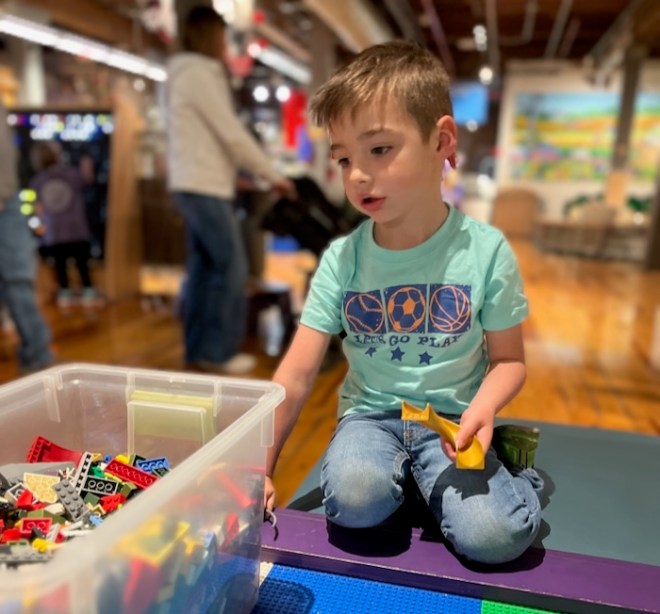
Solomon was playing with a Lego’s exhibit when the doors burst open. Dozens of kids raced in, screaming in excitement. Within 30 seconds or so they were climbing, turning handles, pounding displays that provided tools, all while babbling loudly.
It was like deja vu all over again, because all I could see was that scene out of Toy Story 3. The decibel level was incredible.
Solomon was a little intimidated because he’s only 4, but continued to play with the Legos before we moved on.
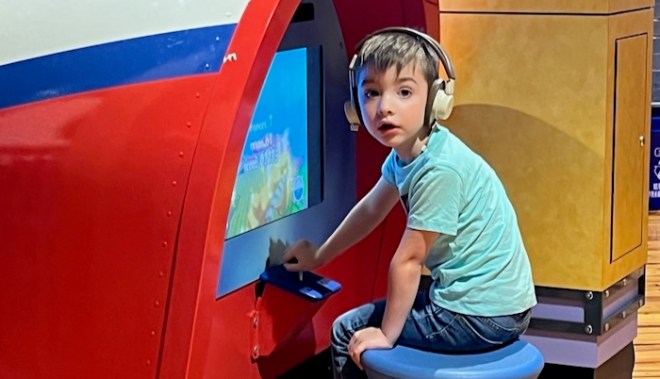
We toured exhibits that show how oil and gas is extracted from the ground (sponsored by Koch Industries), how crops are grown across Oklahoma and displays that let you crank a generator that turns a wind turbine and actually powers a light display. Solomon even piloted an airplane on a computer game-like display.
As we waited for the elevator to take us to the second floor displays, a docent told us a bit about the museum’s history. She said it was 29 years old now, and had more than doubled the exhibit space with a multimillion dollar expansion about eight years ago that was funded by Enid-area donors.
After taking a lunch break around noon, Solomon and I returned so he could play on the outdoor playground. The young woman who served as playground gatekeeper told me that the museum staff is assisted by hundreds of volunteers who keep things going.
Solomon overcame some early playground hesitation and then joined dozens of other children climbing, sliding and exploring the upper floors of the massive Castle. When he discovered an area of the playground that featured a swimming pool-sized sandbox, it sealed the deal.
He never wanted to leave. Really.
But eventually, a teacher told the children that it was time to board the buses for the return trip to Okarche or Okeene or wherever their schools were located. Solomon was left with about a half dozen other kids, while I sat alone in the helicopter parent section.
That’s when I realized how abruptly the noise level dropped, too. So, I sat and enjoyed the quiet.
Plus, my favorite teachers are now deceased. I loved you, Judy Massey and Tom Oliver.
I’m not so big on family reunions, either, although I’m not sure why. Maybe, it’s because you have to listen to your Crazy Uncle yammer on about what’s wrong with the world?
But there is a reunion that warms my heart every time. It’s the impromptu reunion of unexpectedly running into an old colleague or friend from your past life. It can set off shouts of joy and hugs all around.
Anyway, as I was watching the honorees take the stage for a brief moment in the spotlight, I noticed a couple of photographers who were recording the event.
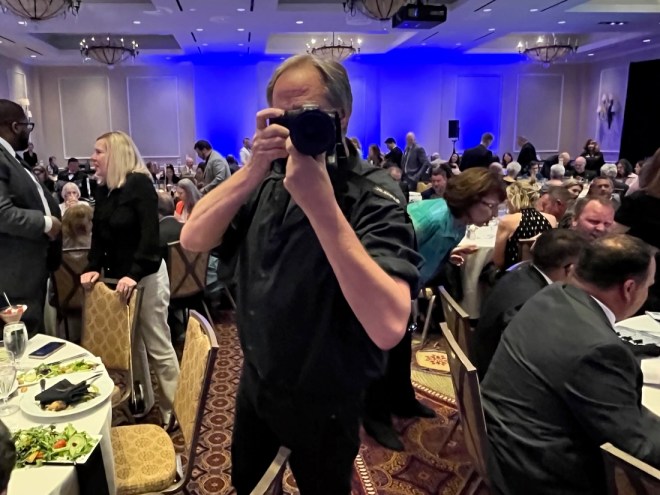
Although his back was to me the entire time, I recognized one of the photographers as Rip Stell, whom I knew from my tenure at i2E, Inc., here in OKC. I couldn’t miss him because he was taller than the other photographer and wearing his signature black shirt.
So, after Steve and all the other CEOs had been honored, I saw Rip sitting at a table not too far from where the Care Providers Oklahoma team was seated.
I jumped up and began walking toward Rip when he saw me and quickly jumped up himself. Rip gave me a big bear hug and then gave me a photographer’s pose with his camera to his eye while I shot my usual bad iPhone pic.
We had only a few seconds to chat, but it was a grand reunion.
The Love’s Cup was sort of a rapid-fire event, which required Rip to be ready for group and individual shots one after the other. His photos were outstanding year after year, with an eye for both the posed and the candid shot.
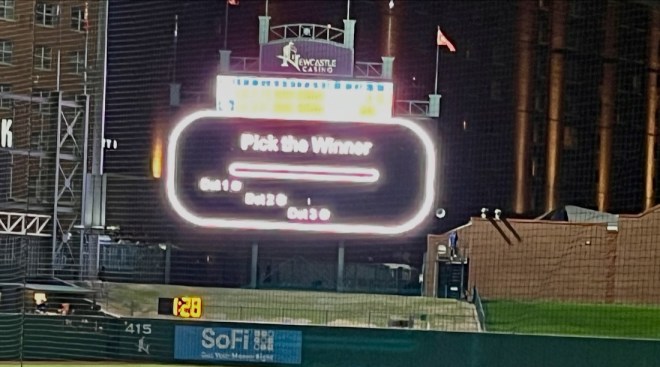
The Chickasaw Bricktown Ballpark scoreboard says ‘Pick the Winner’ as it shows the dots and course before the Dot Race starts.
Back in December, I published an article on this blog about the history of baseball’s Dot Race and how it was created here in OKC by Larry Newman in the early 1980s. You can read it here.
Larry was an employee of the Oklahoma City 89ers in those days, as well as working part time on the Sports desk at The Oklahoman.
That’s where my path crossed with Larry’s, because I worked on The Oklahoman’s Sports desk as a copy editor for most of the 1980s.
So, I saw the Dot Race in action on the 89ers scoreboard many times and learned that it was created by Larry. The Dot Race often created almost as much in-game excitement for the 1980s Oklahoma City baseball fans as the game itself.
After the blog post was published — and also mentioned on the 3 Old Geezers podcast, of which I am a part — the current-day Oklahoma City Baseball Club contacted Larry. He offered to re-create the original Dot Race for use during the 2024 season and the team accepted.
Larry went to work and created a perfect replica of his work from 40-plus years ago.
The OKC Baseball Cub plays as the Oklahoma City 89ers on Thursday nights, and the team decided to play the Dot Race during each “89ers” game.
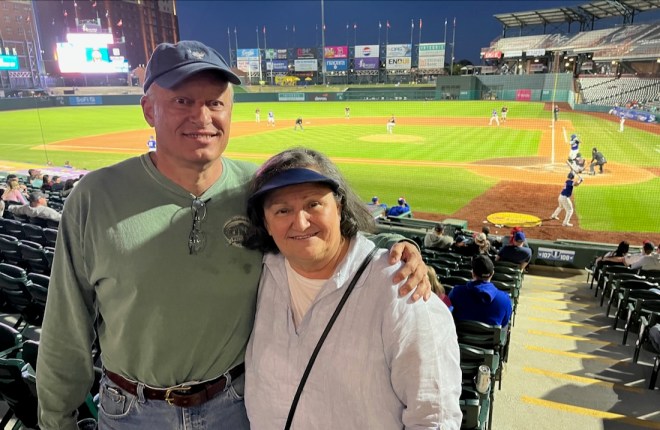
That brought Larry and his family, along with me, my fellow Geezer Ed Godfrey and Ed’s son, Cade, to the ballpark this past week to watch the first 2024 Dot Race.
Dot Race creator Larry Newman and his wife, Stephanie, at the Chickasaw Bricktown Ballpark on Thursday night before the Dot Race.
To me, it looked exactly the same as the 1980s version, although maybe a little smoother with the better technology and scoreboard capabilities in 2024. It was a small crowd that witnessed the rebirth of the original Dot Race, but I could see and hear some excitement as the dots rounded the final turn for home.
Anyway, I asked Larry to share his thoughts on the whole experience. Here’s what Larry Newman had to say about going Back to the Future to watch his 1980s Dot Race in 2024:
Larry Newman’s Dot Race thoughts
“First, I was quite surprised when you contacted me this winter to learn more about the origin of the Dot Race. After all, it had been over 43 years since I did the first Dot Race and about 38 years since I had done my last one. It was an enjoyable experience meeting with you and recalling the events that occurred to set the stage for the creation of the first Dot Race.
Thoughts about seeing other teams adopt the dot race
“By nature, I spend very little time thinking about the past, so after I left the 89ers to take a technical writing position in Phoenix, AZ. in 1987, the Dot Race became a small footnote in my mind and simply a fond memory of the eight years I spent working for the 89ers at All Sports Stadium. The only time I thought about it was when I would go to a Texas Rangers game or other major league sporting event and see a Dot Race in those other venues. I got a kick out of seeing how various teams improved the race over the years, and I enjoyed watching the fans cheering on their selected dot during the races. That always brought a smile to my face.
Thoughts about how the Dot Race came back to OKC
“Fast forward to early 2024 when AJ Navarro from the Oklahoma City Baseball Club contacted me after either listening to your podcast or reading your blog about the origin of the Dot Race.
“He said they are dedicating every Thursday home game to honor the legacy of the 89ers and were doing all they could to integrate as many elements of 89ers history on these nights.
“During our conversation, I asked Mr. Navarro if he would like me to create an authentic replica of the first generation 89ers Dot Races that he could run on their video system. He was enthusiastic about the idea.
“After receiving the video resolution specifications from Mr. Navarro, I set off to create a race that would look as much like the original dot races as possible. This meant it needed to be in black and white, no color, and a little jerky. After all, creating a Dot Race in the 1980s involved creating a 400-frame black and white animation one frame at a time. It was also a bit jerky due to computer processing limitations — very crude tools compared to today. The data was also stored on audio tape—there were no reasonably affordable disk drives or rewritable flash memory in those days! So even storing each race took a bit of time.
And the winner is…!
Thoughts about the fan reaction
“During the dot race Thursday night at the Chickasaw Bricktown Ballpark, I was mostly watching the reaction of my two adult children, Matt and Haley. Matt was born in 1989, and my daughter several years later, so neither of them had ever seen a first generation Dot Race created by their dad. My kids got quite a kick out of watching the race, so I was happy. My wife (Stephanie) also came to the game, but since we were dating in the 1980’s, she had seen many of my Dot Races at All Sports Stadium.
“The general fan reaction in the ballpark was muted but better than I expected. It was evident that some of the fans either recalled the Dot Races at All Sports Stadium or enjoyed Dot Races at other venues and enthusiastically cheered for their selected dot.
“The Oklahoma City Baseball Club does such an incredible job of filling every moment between innings with great entertainment that I suspect some fans will continue to look forward to watching the Dot Races, but it will probably struggle to stand out or gain much momentum with the fans throughout the season. There are simply so many other things competing for the attention of the fans. It’s an amazing environment for baseball and elevates the fan experience far above what I have ever experienced in any other ballpark, so it’s a good trade-off.
“I plan to attend many more games this year.”
Thank, you Larry Newman, for creating the Dot Race and for sharing it with the 2024 audience. It’s a great memory for me from days long past, and I’m sure it will create some memories for today’s fans.
Even RoboNiner made a 2024 appearance at the ballpark on Dot Race night.
Instant Karma got the driver of the blue Silverado that cut us off on Penn. (not the actual vehicle)
Instant Karma’s gonna get you Going to look you right in the face Better get yourself together, darling Join the human race
How in the world you gonna see Laughing at fools like me? Who on earth d’you think you are? A superstar? Well, right you are
— Instant Karma by John Lennon
This past weekend, my wife and I were headed south on Pennsylvania Ave. toward the Quail Springs Mall area when a blue Chevy Silverado pickup suddenly changed lanes right in front of us, then raced to the light at NW 150th.
“Hey, that guy just cut us off!” my wife said with some righteous indignation.
I was right behind the Mr. Blue Pickup at the light, but what are you going to do to get some justice? Nothing but fume.
The light turned green and Mr. Blue Pickup shot off like the green flag dropped at Daytona. This is on Penn, mind you, in a very busy corridor with cars constantly turning on and off of the street.
The speed limit is 40 mph, and Mr. Blue Pickup was roaring away at least 50. We watched him racing far ahead against no one when, suddenly, the lights of a police car in the northbound lane started flashing.
As a character named Earl from an old favorite TV show of mine often said: “Karma is a bitch.”
The police car did a U-turn and pulled over Mr. Blue Pickup before it reached the next intersection.
“You don’t see that very often,” Paula said. “The guy cut us off, sped down Penn and was nailed by a cop right in front of us.”
I resisted the temptation to pull into the parking lot where the cop was just getting out of his car so I could wave and smile at Mr. Blue Pickup.
Besides, there’s always the chance that Instant Karma would bite me, as well.
But it was a satisfying ending, so I will treat you to John Lennon’s Instant Karma.
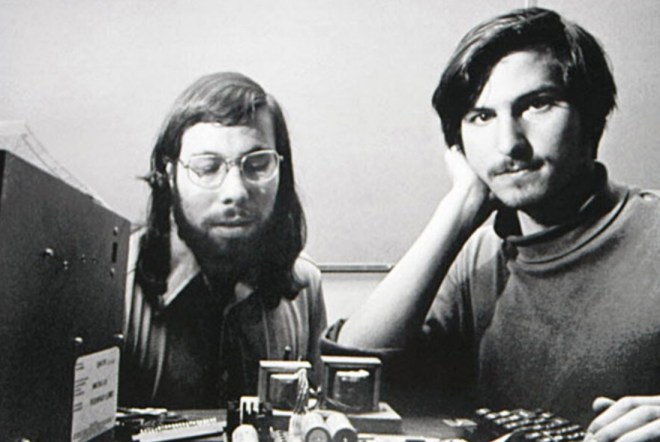
Steve Wozniak (left) and Steve Jobs together in the late 1970s.
I read a magazine article when I was in college in the 1970s about a scrappy startup called Apple Computer, founded by two guys named Steve who built their first computers in the garage at the home of one of the Steves.
I couldn’t get enough of their story; the David-vs.-Goliath way that Apple blazed the personal computer trail that forced the industry behemoth at the time, IBM, to play catchup. Steve Jobs and Steve Wozniak were my entrepreneurial heroes.
Less than a decade later I was the proud owner of an Apple IIe, and would later own multiple Macintosh computers, including the Macbook Air upon which this blog post is being written in 2024.
So, I admit that I am a long-time Apple fanboy and remain one today.
But my fandom has run smack into some ugly reality. Apple is no longer the scrappy industry underdog. In fact, it is one of the world’s largest companies by market value. Yet, it has begun to flex its financial muscles like a bully that nobody likes.
You probably have seen stories this past week about the anti-trust lawsuit filed against Apple by the U.S. Department of Justice and 17 states. The lawsuit alleges that Apple blocks developers and other companies from offering better pricing options to iPhone users and locks companies — and its users — almost exclusively to its App store.
Apple faced similar scrutiny in Europe and is currently working to comply with orders from European Union regulators to open the iPhone to what is known as “side loading.” That means developers can offer their software to consumers in an App store separate from the Apple App store.
But the antitrust suits are not what is challenging my long-standing Apple fanboy-hood. I actually prefer that any software I download to the iPhone pass through the Apple App store for security and quality reasons. Apple has done a pretty good job of vetting apps to prevent fraud or malware from slipping through.
What’s disappointed me about my favorite company — according to industry reporting — is how in recent years it has ruthlessly steamrolled innovative startups.
I’ve read reports about Apple’s tactic of appealing to the U.S. Patent Office to nullify patents owned by smaller competitors, and then developing and patenting its own software that is almost identical to that of the little guys.
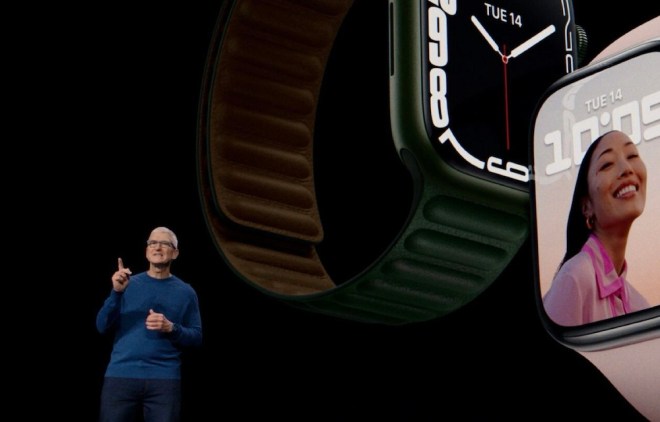
Apple CEO Tim Cook during a product announcement. (Wall Street Journal)
The article provides examples of Apple inviting founders to its HQ to discuss their innovations, then hiring multiple employees away from the competitors and creating software that does exactly what the original company created.
That action leads to claims of patent infringement by the smaller companies, and often ends with Apple taking it through the Patent Office appeals process. Here’s an example from the Wall Street Journal:
“Since 2012, Apple has attempted to invalidate more patent claims before the Patent Trial and Appeal Board than any other petitioner, according to intellectual-property research firm Patexia.
“Apple said it pays licensing fees to many companies of different sizes. The spokeswoman said it has licensed more than 25,000 patents from smaller companies over the past three years.”
OKLAHOMA ANGLE
Dr. David Albert
There’s an Oklahoma connection to this story. One of the companies from which Apple allegedly appropriated technology for the Apple Watch was AliveCor Inc., founded by Dr. David Albert, well known cardiologist, inventor and native Oklahoman.
I’ve known Dr. Albert for at least a decade through my past work with i2E, Inc.
AliveCor developed a technology in 2017 that would conduct electrocardiograms for Apple Watch users. Apple invited Dr. Albert to its HQ, where he demonstrated the technology for executives, according to the Wall Street Journal story.
In 2018, Apple released the Apple Watch 4, which offered an electrocardiogram capability. AliveCor filed a patent infringement suit against Apple in 2021.
It has not gone well for AliveCor, as you might expect. Here’s more from the Wall Street Journal:
“In December, the commission ruled in favor of AliveCor, barring imports into the U.S. of all Apple Watches with the heart-sensing capabilities.
Separately, Apple took the dispute to the Patent Trial and Appeal Board system … That board invalidated the AliveCor patents under dispute, thereby nullifying the import ban. AliveCor has appealed that ruling.”
I heard about the AliveCor lawsuit a couple years ago and reached out to Dr. Albert for comment for a blog post I intended to write back then.
Dr. Albert responded: “Jim, I cannot discuss our ongoing litigation — sorry.”
I elected not to write anything at that time, but the recent Wall Street Journal article opened the door this week.
I’m a fan of AliveCor and the other startups that have developed innovative technology only to be crushed by the tech giant. I’m disappointed that Apple has apparently evolved into an industry bully that sees no problem in squashing the little guys.
It’s like no one at Apple’s Cupertino, Calif., HQ remembers that it was once the scrappy startup founded by two Steves who built computers in their parents’ garage.
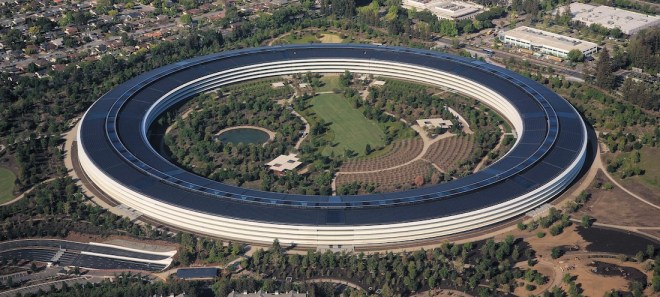
Apple’s headquarters in Cupertino, Calif.
Apple’s founders built a lot of goodwill among consumers and fanboys like me. I’m hoping their successors don’t let it slip away.
BONUS CONTENT!My friend Larry Newman is a long-time user of Apple technology, and was employed by Seagate Technology and other tech companies for most of his career. Now retired, he weighs in with his thoughts on the situation with Apple and Big Tech:
“I made an incredible living thanks in no small part to Apple products. I don’t know the details of the current government antitrust charges against them. But I’m guessing most of us would be quite disappointed in the lack of ethics displayed by the overwhelming majority of big tech companies. Regardless, I would rather big USA-based tech companies win than foreign ones. Our government would better serve citizens by using their influence to encourage repatriation of tech manufacturing jobs back to US soil.
“When I started working at Seagate in 1992, their manufacturing plants in the United States were employing thousands of people. But once one competitor began moving manufacturing overseas, all others had to follow to remain competitive and survive. Simple import restrictions/duties would have eliminated the migration of the jobs.
“Another thing to consider is platform security. Although no technology platform is 100% secure, Apple systems are clearly less vulnerable than more open systems.”
All 18 feet and 4,866 pounds of a 1970 Lincoln Continental Mark III are positioned in my neighbor’s garage.
I was enjoying some Sunday afternoon basketball this past weekend when my 4-year-old grandson urgently called me.
“Papa, come see this cool car!”
So, I stepped out the front door to see what got him so excited. This kid loves cars of all types.
Parked outside of my neighbor’s house on a car-hauling rental trailer sat a monstrous relic of the past. Turned out it was a 1970 Lincoln Continental Mark III that had seen its best days long ago.
Solomon and I walked out for a closer inspection. It was sort of a maroon color, or had been. But it seemed to have everything intact, with no (major) dents or busted headlights.
I looked it up on the Google, and a 1970 Lincoln Continental Mark III is 18-feet long and weighs 4,866 pounds of pure steel. That will come into play later in this story.
It might as well have been a yacht on the back of that trailer.
Anyway, as we were oohing and aahing over the behemoth, my next door neighbor, Akili, walked out and joined us. He was the proud owner of this vehicle, which he purchased with the intent of restoring it to its former glory.
Akili brought it to his house to store in his garage where he can pursue his restoration project.
Solomon and I went back to our yard, where I remained as my grandson played with friends from next door. A few minutes later, I watched as Akili slowly backed the trailer into his sloped driveway until the back of the monster was in the garage.
Akili’s son, Corey, had joined him as did a third man, Tim, who is their family friend. They unhooked the Lincoln and gathered at the front as if to push it off the trailer and down the ramp into the garage.
That led me to walk over and offer to help them push it off. Offer accepted. It wouldn’t be so simple
Akili climbed up the trailer, got behind the wheel and took the emergency brake off. Did I mention the car had no actual brakes beside the emergency brake?
The three of us in the front began to push. Nothing happened. Two-plus tons of steel didn’t budge.
As we puzzled over the next move, my neighbor from the other side of my yard came over and asked if we wanted her to ask her husband join us. There was a chorus of ‘yes!’.
We were soon joined by her husband, Greg, who brought a hydraulic jack and some apparent experience in moving huge vehicles.
So, I’ll fast forward. Akili put me behind the wheel with instructions to take the emergency brake off at his signal. Greg jacked up the front of the trailer. Everyone pushed. The car moved only a few inches. I sat.
My view from behind the wheel of the Lincoln
Eventually, Greg jacked the trailer high enough that it tilted back and the car rolled into the garage, but not completely off the trailer’s ramps. More puzzling over the next move.
Wheels were blocked, the car was jacked up and pushed by all of us this time. It finally came free of the trailer and then was positioned in the garage with about 6 inches of clearance to close the garage door.
Whew!
All of this took well over an hour. When the car was finally in its proper place, everyone cheered. Someone even said, “this was kind of fun.”
Well, I wouldn’t describe it exactly like that, but was great to see neighbors working together and helping another out of a spot.
I’m going to be impatiently waiting to see the finished product emerge in all of its 1970s glory from that garage one day.
Before there was a 3 Old Geezers podcast there was the 3 Old Geezers text exchange, a sort of daily debate over the Thunder and the world at large.
The group included my friends Steve Buck and Ed Godfrey, who disagreed strongly with my stance against tanking — which translates to losing on purpose to get a better draft position — by the Oklahoma City Thunder, or any NBA team, for that matter.
We went back and forth for a couple of years with Steve often reacting with ‘we need to take this debate to a podcast.’ It was a nice thought, but none of us had any podcast experience or equipment.
Then Steve came up with a couple of microphones and technology to connect to a recording device like a computer.
We had no more excuses.
So, last fall we launched the 3 Old Geezers podcast — LISTEN HERE — which has had only moderate success. But it allows us to vent our old man rage in get-off-my-lawn type rants.
Ed’s righteous indignation over perceived ills like bad officiating in college softball or the challenges of new technology have been well worth the effort. His humorous Old Man rants are exactly why I’m participating.
Steve hosts with a steady hand, suggesting appropriate and timely topics, while I’m mostly reacting to what’s been said or forgetting the Mayor’s name or even the web address of this blog. It happens.
Anyway, last week, Steve suggested we include some of our text exchanges in this blog to provide insight into where our material comes from.
Great idea. I’ve gone back through our Geezer text string and come up with some material that has led to blog discussion. Here’s a taste:
JANUARY 9 Jim Stafford: This is from a Geezer’s wife last night after she came home from the game: “I’m so impressed with our coach because of how many players he uses in a game. Instead of using just the starting five with two or three of the same substitutes like our old coaches, he uses a lot of players throughout the game, and you never know which one might come in.”
Ed Godfrey: He will be relying on that bench this month with a heavy slate of games.
Steve Buck: Paula knows. Jim on the other hand yearns for the Scottie Brooks days of predetermined rotations
Jim Stafford: I love Foreman Scottie! He was my favorite coach until Mark Daigneault came along.
Ed Godfrey: WHAT? Daigneault is your favorite coach now? Next thing you know you will be telling us Chet Holmgren is better than Mike Muscala.
Steve Buck: #truth
Jim Stafford: I like Daigneault’s courtside demeanor. Man, you can’t get him flustered. I’m still mulling over Chet vs. Muscala.
Back to reality. Here’s the latest on Muscala that I sent my Geezer partners:
As I said online, it’s a Christmas miracle!
More text debate:
JANUARY 29 Ed Godfrey: They changed the comics today. No Shoe! No B.C.! No Wizard of Id! Who wants Pearls Before Swine? Non Sequitor? Jump Start?
Jim Stafford: Welcome to the 21st Century
Ed Godfrey: Who reads newspapers? People from the 20th Century!
Screenshot
So, are you getting the drift? The Geezer text stream never ends. Here’s one more for good measure:
FEBRUARY 20
Ed Godfrey: Just asked Alexa to play Eddie’s playlist again. She played an Eighties playlist. I give up.
Steve Buck: What exactly is on Eddie’s playlist?
Ed Godfrey: Chris Stapleton, Tyler Childers, Turnpike
Troubadours, Johnny Cash, Coltor Wall, Zach Bryan.
Steve Buck: Yeah…no overlap with 80’s lol
Screenshot
So, there you have it. Our failures to communicate in unending text rants found their place in a podcast.
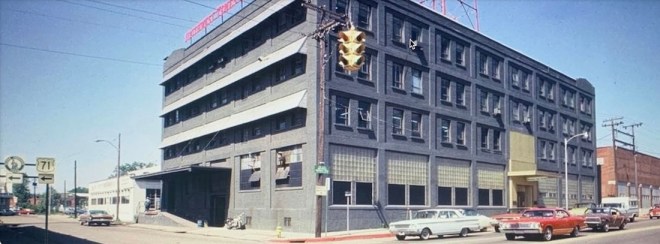
The Southwest Times Record building in what appears to be the early 1960s. (Photo courtesy of Southwest Times Record former employees Facebook group)
Here’s a bit of nostalgia for you. When I walked into the Southwest Times Record newsroom for the first time as an employee in 1978, I encountered a bustling community of talented writers, editors and photographers all scrambling to publish local news seven days a week.
The Fort Smith newspaper was a great place to learn the craft as my first job out of college. There are many folks among my former colleagues there whom I will never forget. I worked at the SWTR for five years in a variety of positions before moving to Oklahoma City and working for The Oklahoman for almost a quarter of a century.
My parents were among the 40,000 or so SWTR subscribers who fetched the newspaper off their driveway every morning. Established as the Fort Smith Times in 1884, the SWTR had a strong following not only in Fort Smith, but across a multi-county region of Western Arkansas and Eastern Oklahoma.
So, it’s been disheartening to watch the SWTR decline as a community force over the past few years as the number of subscribers declined and employees were laid off. It’s a situation not unlike that in many other cities across the nation.
Now owned by industry giant Gannett, I’m not sure there remains a single Fort Smith-based editor or reporter chasing down local news stories.
In fact, my 90-year old mother, who subscribed to the SWTR in our hometown of Fort Smith for more than five decades, finally gave it up a couple years ago because the paper had so little local news. Sometimes she still reads the obituaries published online.
As for me, I’ve stayed connected to the SWTR by subscribing to the paper’s free emailed daily newsletter that allows a peek at its headlines and free access to the obituaries.
It all makes you wonder when the hammer will fall and Gannett will halt publication of a physical paper for any remaining subscribers, leaving only online access.
Well, we’re close.
I received a notice recently that the SWTR was transitioning to a “mail only” newspaper with no more home delivery. Here’s what the email said, in part.
“Beginning tomorrow, look for your copy of the Southwest Times Record and our other regional publications to arrive with your daily mail. As announced in the Jan. 10 edition and in letters mailed to subscribers, the U.S. Postal Service will be delivering the Southwest Times Record to optimize resources amidst increasing digital readership demand.”
Now subscribers can read ‘news’ that is already at least 24-hours old when it arrives in the mail. What’s that old saying about nothing as stale as yesterday’s newspaper?
So, why am I writing this?
Well, it’s not a diatribe against the current ownership, because I see what’s happened to my old employer as a product of emerging technologies and a big change in how the public consumes news. Online access to news — much of it free — has removed the incentive to subscribe to a daily newspaper that lands on your driveway every morning.
I’m mourning the SWTR for its former employees and the folks who subscribed to the paper for decades. It’s like watching a close relative slowly fade away from an incurable cancer.
Here in OKC, I’m still a subscriber to The Oklahoman’s physical newspaper, which is delivered to my driveway every day but Saturday. Yet, when I look up and down my street as I pick up the newspaper each morning, I see no other papers on my neighbors’ driveways. None.
However, I’m confident the path determined for the Southwest Times Record won’t be a template for The Oklahoman. It remains an enterprising news organization, despite repeated rounds of staff reductions.
That notice I received of the SWTR’s “all mail” newspaper delivery prompted me to ask a couple of former colleagues and longtime SWTR employees who still live in the Fort Smith area their thoughts on what has become of their former newsroom.
Patti Cox was a longtime news editor at the SWTR with whom I worked on the news desk. She shared her perspective with me as both a former employee and a current subscriber.
“It is very sad turn of events for Fort Smith,” she said. “We still are taking the day-late-in-the-mailbox paper but not sure for how long or why. End of so many meaningful things like insightful, timely local news and commentary. Long gone are noisy newsrooms filled with reporters, editors, interns with common purpose and multiple deadlines.”
Carrol Copeland, longtime SWTR photographer and creator of a Facebook group called Southwest Times Record former employees that has 162 members, also shared his thoughts with me.
“Back in the day, we covered local news, and there was very little worldwide or nationwide news in it,” Carrol said. “Probably 80 to 90 percent of it was local news. At one point we had the Poteau office and the Van Buren office, and somewhere around 150 employees.”
That was then. This is now.
“There’s not even a physical location anymore,” Carrol said, who recalled tornadoes, spectacular crimes and criminal trials that he covered over the years. “I think it comes down to a lack of income. If you can’t sell advertising you can’t have people to work for you.
“Now that people are going to the Internet or Youtube for their news, no one is advertising anymore. The technology overtook them.”
How will the daily newspaper voice be filled for former SWTR subscribers who loved its local news angle? Digital news services that focus on local news offer some hope.
Here in Oklahoma City, we have Oklahoma Watch and Nondoc, among others, which are sort of complementary to The Oklahoman, for now.
In Fort Smith, there’s an online site called Talk Business & Politics that focuses on Fort Smith and Northwest Arkansas. It was started by a former SWTR editor. I read it first thing each morning five days a week.
Actually, as I think about it, I’m not sure folks aged 30 and younger will miss holding an actual newspaper because it’s likely they never read one on a daily basis anyway.
But for those who grew up with ink-stained hands, it’s a difficult transition.
“I just know I loved newspapers and the dedicated (mostly young) quirky stressed out folks who worked for them,” Patti Cox told me. “Grateful for the lifetime lessons learned there.
“Good memories, my friend.”
We’ll carry those memories with us long after the final edition is published. It’s coming.
Evard Humphrey and his No. 12 super-modified sprint car
Editor’s Note: Don Mecoy is a friend and former colleague at The Oklahoman who retired as the newspaper’s managing editor at the end of 2022. A recent conversation about sports heroes from our youth when Don was a guest on the 3 Old Geezers podcast sparked his memory about a local race car driver fromthe late 1960s. Don wrote this guest blog post about that driver and those memories.
By Don Mecoy
I had my share of sports heroes when I was a kid. Roger Staubach, Lou Brock, Johnny Bench and Joe Washington were among my faves. But my personal hero — and it truly was personal — was a guy you probably never heard of: Evard “Kerfoot” Humphrey.
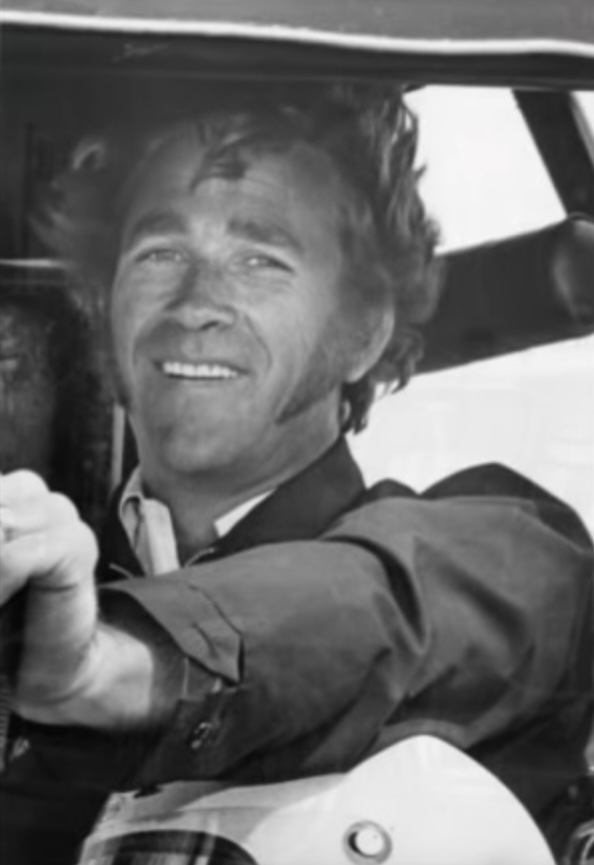
Evard in the Black Magic No. 12 super-modified dirt-track racer.
Evard was the driver of the No. 12 super-modified sprint car that ran every Friday night at State Fair Speedway during my youth in Oklahoma City. My Daddy — a preacher, shade-tree mechanic and race fan — liked Evard, so I did too. Evard won a couple of season championships at State Fair Speedway in the years just before my family moved to OKC in 1967. And he was highly competitive in the first several years we sat in the fourth-corner stands at the beloved dirt track.
Some grainy video of Evard’s “Black Magic” No. 12 is available on YouTube:
I watched Evard win a lot of races, and as I became more knowledgeable about racing, I could see that he was a smooth and cagey driver and a gentleman on the track. He cut other drivers a lot of slack. He didn’t tear up his equipment, or anyone else’s. Unlike most of my other sports heroes, Evard wasn’t a highly paid athlete — he ran a salvage yard.
I was grown and raising a family of my own when I saw Evard’s obituary in The Oklahoman in November of 2007. At the time, I was a writer on the business desk at the newspaper, and we had recently added blogs to our newspaper website. I decided to write a post about Evard. It was brief, but heartfelt.
‘Forty years after the first race I witnessed, I remain a fan of the sport. But there will never be a driver that I pull harder for than I did Evard Humphrey. According to his obituary, Evard was 72 and “loved by all” — even some folks who never met him.’
The day that short item appeared in the paper, my phone started ringing. I heard from Evard’s son-in-law, Terry Doss, who drove the “Black Magic” super-modified car after Evard hung up his racing suit. He thanked me on behalf of the family, and said Evard deserved all the love — not just as a successful driver but as an all-around great guy.
Shane Carson, one of the most successful dirt track racers and promoters to get his start in OKC, called to thank me and to tell me that his cars typically carried the number 12 because of his love for Evard. Others called to echo my feelings of Evard, and share memories of OKC’s wonderful dirt-track venue.
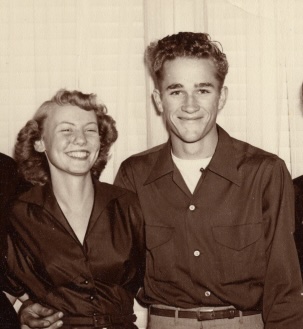
Pat and Evard Humphrey
The blog post also drew the attention of Evard’s charming wife, Pat, and she came to the newspaper office to meet me. I told her how I was thrilled sometimes to see Evard walking through the stands, wearing his racing suit, to sit with his family between races or when his car had failed. She told me I should have talked to him; he loved to mix it up with his fans. But for 9-year-old me, he was on a pedestal too high to approach.
She was delighted to flip through our file of her late husband’s photos in our library. A librarian told me all our photos were being digitized and then would be thrown out. Since Evard’s file had already been captured, we gave Patty those old black-and-white memories. That may have been one of my most rewarding moments in journalism.
In researching this article, I learned that Pat passed away last year. She seemed like a joyful person. I hope she enjoyed those photos.
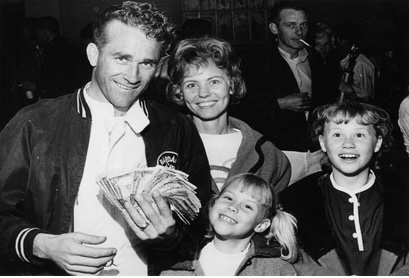
Looks like Evard won the trophy dash. He might even have pulled off the rare “sweep,” winning his heat race, trophy dash and the A feature.












 Jim Stafford's BlogOKC