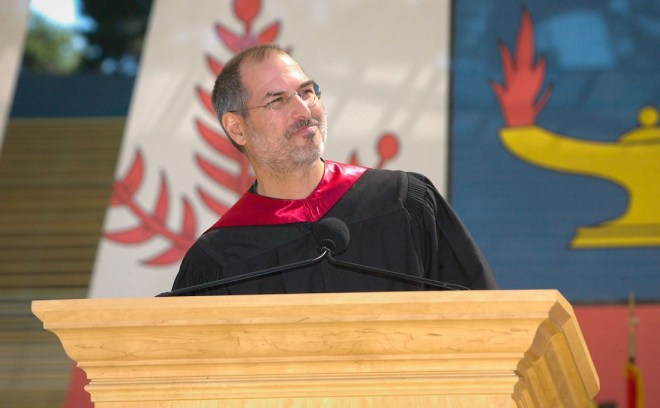
If you follow this blog or know me personally, you’re probably aware that I’m a fan of Apple Inc. and its co-founder, the late Steve Jobs.
Jobs’ story is well known. Co-founding Apple in 1976 with Steve Wozniak; building the Apple I in the garage of his childhood home; creating the Macintosh computer in 1984; getting fired from his own company in 1985; returning to Apple a decade later to become CEO and leading development of groundbreaking products.
The company has since soared to incredible financial stature.
Along the way, Jobs was diagnosed with cancer and eventually died from it in October 2011.
Books have been written about Jobs after his death and movies made about his life. I’ve read two books that I would highly recommend, especially Steve Jobs by Walter Isaacson. The other is Becoming Steve Jobs by Brent Schlender and Rick Tetzeli.
The Isaacson book sort of reinforces the image I had of Jobs as a creative person who drove himself and others really hard, mostly without tact or apparent empathy. As much as I admire the innovations he brought to the market, I don’t think I could have worked for Steve Jobs.
But I’m still a fan, because of his enormous impact on our world (iPhone, anyone?). And the fact that the arc of his life reads like a Greek tragedy.
So, when I discovered Make Something Wonderful: Steve Jobs in His Own Words, published by the Steve Jobs Archive, I had to read it, too.
Available for free on Apple Books or on the Web at the Steve Jobs Archive, the 319-page book contains speeches, presentations and emails by Jobs.
It’s sort of the ultimate inside look at how he thought and worked, especially the emails he sent to himself with information and thoughts he didn’t want to let get away.
There are lots of good quotes in the book, including the entire transcript of his 2005 Stanford University Commencement speech. You can also watch it on YouTube.
So, I’ve selected a few quotes that I found memorable and will share in this post.
For instance, way back in 1983, Steve already saw the future in which computers were going to tie millions of people around the world together though networking capabilities. The Internet was about 6 months old, and few people actually knew it existed.
Talking to the International Design Conference in Aspen in June of that year, Jobs said:
“… I think that that’s exactly what’s going to happen as we start to tie these things [computers] together: they’re going to facilitate communication and facilitate bringing people together in the special interests that they have.
And we’re about five years away from really solving the problems of hooking these computers together in the office. And we’re about ten to fifteen years away from solving the problems of hooking them together in the home.”
In a 1984 speech to Apple employees the day before the Macintosh debuts in the famous “1984” ad run during the Super Bowl:
“IBM wants it all, and is aiming its guns on its last obstacle to industry control: Apple. Will Big Blue dominate the entire computer industry? [Audience: No!] The entire information age? [Audience: No!] Was George Orwell right about 1984?”
In a 1984 interview with reporter Michael Moritz:
“I want to build products that are inherently smaller than any of the products on the market today. And when you make things smaller, you have the ability to make them more precisely. Obviously, a perfect example of that is a watch. It’s beautiful, but the precision has to be the scale of the object itself, and so you make it very precise.”
From a 1996 speech to Palo Alto, Calif., high school students:
“Be a creative person. Creativity equals connecting previously unrelated experiences and insights that others don’t see. You have to have them to connect them. Creative people feel guilty that they are simply relaying what they “see.” How do you get a more diverse set of experiences? Not by traveling the same path as everyone else …”
In an email exchange in 1997 with a software engineer after returning to Apple as Interim-then-full-time CEO:
“… there is something good here worth saving. I don’t quite know how to express it, but it has to do with the fact that Apple is the ONLY alternative to Windows and that Apple can still inject some new thinking into the equation.”
Finally, an excerpt from his Stanford Commencement speech in 2005, a year after he had been diagnosed with pancreatic cancer.
“Your time is limited, so don’t waste it living someone else’s life. Don’t be trapped by dogma—which is living with the results of other people’s thinking. Don’t let the noise of others’ opinions drown out your own inner voice. And most important, have the courage to follow your heart and intuition. They somehow already know what you truly want to become. Everything else is secondary.”
Before his death, Fortune magazine called him the Beethoven of the business world. That’s a pretty good description.
I highly recommend Make Something Wonderful if you are a fanboy like me or merely curious about Steve Jobs.

 Jim Stafford's BlogOKC