34 years later, article stirs memories of Arkansas’ stunning exit from SWC

Fort Smith Etc. magazine cover from 1991

Almost 34 years ago, a friend and former coworker at the Southwest Times Record in Fort Smith, Ark., hit me up with a request.

Patti had left the paper to become editor of a new local magazine called Fort Smith Etc. She asked me to write an article on the University of Arkansas’ stunning move from the now late Southwest Conference to the the rival Southeast Conference.

Arkansas announced in August 1990 that it was switching conferences, and actually made the move the following year.

The unexpected conference divorce set off shockwaves among major conferences and ushered in what has become an era of constant realignment. By 1995, the SWC was no more, with most members welcomed into the Big Eight, now known as the Big 12.

Anyway, I wrote a pretty snarky — for me — 800-word piece for the magazine that listed all the things the Razorbacks would not miss from the SWC. It was published in the Nov./Dec. 1991 edition of Fort Smith Etc. magazine.

So, why am I writing about this now when I hadn’t given the article a thought for the last 30 years or so?

Turns out a high school friend of mine and Fort Smith native I’ll call ‘Will’ discovered he had digitized copy of the article on his personal computer. Will, who also had written for the magazine, emailed it to me. Thanks, Will!

After reading what I wrote more than three decades ago, I’m still proud of how it turned out and the fact that it is still relevant today in this era of conference reshuffling.

There are a couple of references to now departed venues like Barnhill and Reunion arenas (and  misplaced campus locations for the universities of Alabama and Mississippi), but it’s not too dated, I think.

With all that said, I’m reprinting the article here in BlogOKC. Hope you enjoy this trip down memory lane.

Signed, sealed & delivered to the SEC

Mac Davis, the curly-haired crooner with the West Texas drawl, probably said it best for University of Arkansas fans when he sang something like “Happiness is the state of Texas in my rear view mirror.”
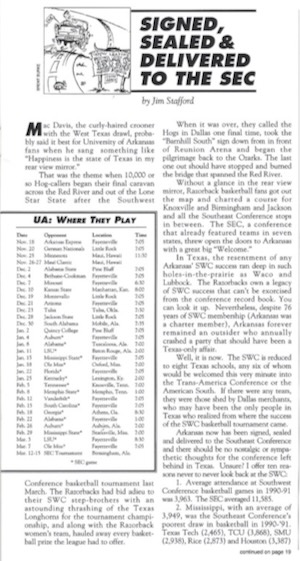
That was the theme when 10,000 or so Hog-callers began their final caravan across the Red River and out of the Lone State after the Southwest Conference basketball tournament last March. The Razorbacks had bid adieu to their SWC step-brothers with an astounding thrashing of the Texas Longhorns for the tournament championship, and along with the Razorback women’s team, hauled away every basketball prize the league had to offer.

When it was over, they called the Hogs in Dallas one final time, took the “Barnhill South” sign down from in front of Reunion Arena and began the pilgrimage back to the Ozarks. The last one out should have stopped and burned the bridge that spanned the Red River.

Without a glance in the rear view mirror, Razorback basketball fans got out the map and charted Knoxville and Birmingham and Jackson and all the Southeast Conference stops in between. The SEC, a conference that already featured teams in seven states, threw open the doors to Arkansas with a great big “Welcome.”

In Texas, the resentment of any Arkansas’ SWC success ran deep in such holes-in-the-prairie as Waco and Lubbock. The Razorbacks own a legacy of SWC success that can’t be exorcised from the conference record book. You can look it up.

Nevertheless, despite 76 years of SWC membership (Arkansas was a charter member), Arkansas forever remained an outsider who annually crashed a party that should have been a Texas-only affair.

Well, it is now. The SWC is reduced to eight Texas schools, any six of whom would be welcomed this very minute into the Trans-America Conference or the American South.

If there were any tears, they were those shed by Dallas merchants, who may have been the only people inTexas who realized from where the success of the SWC basketball tournament came.

Arkansas now has been signed, sealed and delivered to the Southeast Conference and there should be no nostalgic or sympathetic thoughts for the conference left behind in Texas.

Unsure? I offer ten reasons never to never look back at the SWC:

1. Average attendance at SouthwestConference basketball games in 1990-91 was 3,963. The SEC averaged 11,585.

2. Mississippi, with an average of 3,949, was the Southeast Conference’s poorest draw in basketball in 1990-’91. Texas Tech (2,465), TCU (3,868), SMU (2,938), Rice (2,873) and Houston (3,387) all had lower attendance averages.

3. Average attendance at Southwest Conference football games in 1990 was 39,382. The SEC averaged 63,870.

4. Southwest Conference teams were forced to play a limited football schedule for two seasons because one conference member, SMU, was given the “death penalty” by the NCAA; no SEC school has ever drawn the “death penalty.”

5. The Cotton Bowl is played in an open-air stadium, often in some of the most brutal weather Texas has to offer on New Year’s Day; the Sugar Bowl, played in the New Orleans SuperDome, is never threatened by the weather.

6. Southeast Conference football games are broadcast nationally over the Turner Broadcasting System cable network. SWC games are broadcast throughout Texas on something known as the “Raycom Sports Network.”

7. Arkansas will never have to face Southwest Conference officials when playing a Southeastern Conference game.

8. Texas A&M, a school full of traditions, features an all-male corps of cheerleaders.

9. There is no horror movie titled “The Tennessee Chainsaw Massacre”

10. Few natives from any Southeastern Conference state answer to the name of “Tex.”
The Populous impact on OKC sports venues & my friend, Brady Spencer

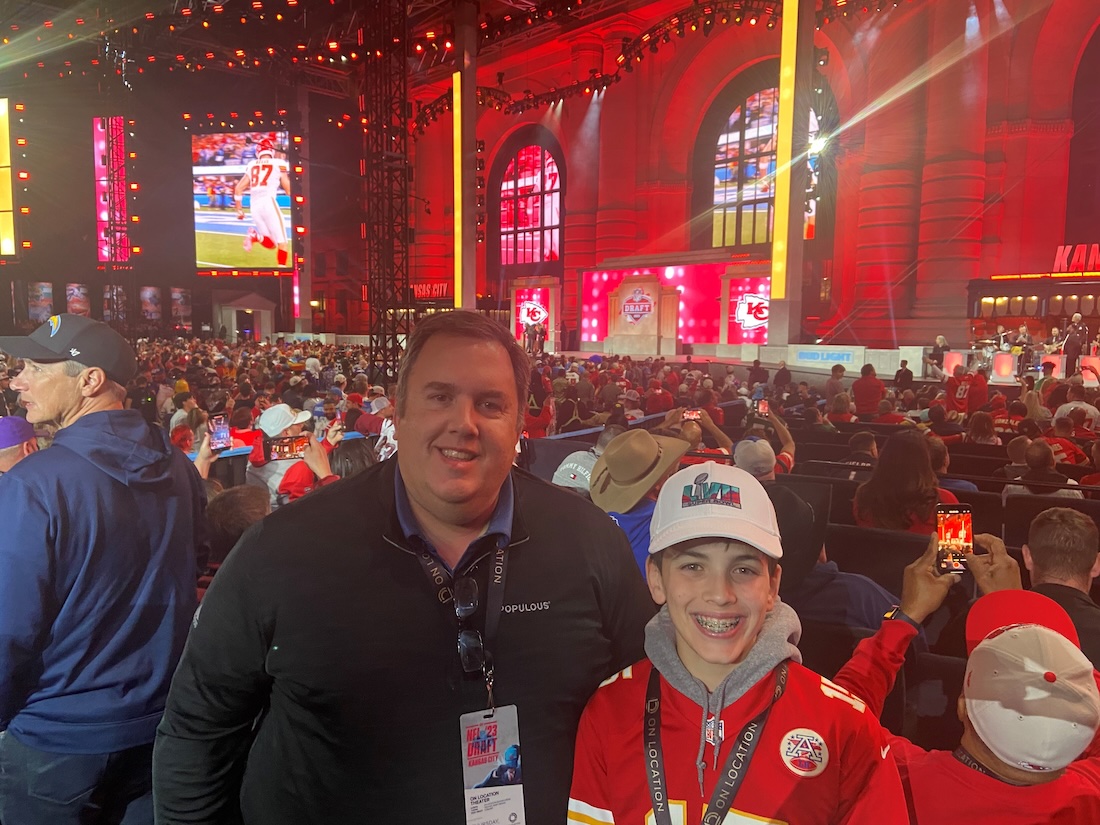
Brady and John
Brady Spencer with his son, John, outside Kansas City’s Union Station during the 2023 NFL draft.

A recent update in The Oklahoman newspaper on the new OG&E Coliseum under construction at the State Fairgrounds identified it as a venue designed by a firm named “Populous.

In an even more recent story, I learned that Populous has been hired to design the new $71 million soccer stadium just south of OKC’s Bricktown.

I think I’m noticing a trend.

There’s more.

I learned from other sources that Populous designed the fabulous OKC Convention Center, which opened in 2020. And Populous was hired to design Paycom Center’s upgrades in 2022.

Populous also is among the candidates to design OKC’s new $1 billion(ish) arena that will soon be built on the site of what was once known as The Myriad. It’s right across the street from Paycom Center.

So, what exactly is Populous?

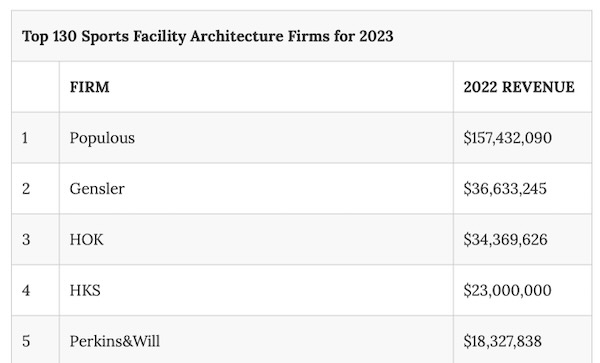
Turns out, it is an international architecture firm and the nation’s leading (by revenue) sports architecture company, based in Kansas City, Mo.

Screenshot

Populous has satellite offices around the world — including Norman, OK — and boasts a portfolio of more than 3,000 projects globally, including Wembley Stadium, T-Mobile Arena, Oriole Park at Camden Yards and many others.

Actually, Populous has been on my personal radar for quite some time because a close family friend named Brady Spencer is a Senior Principal/Senior Architect with the firm in its Kansas City office.

Some background:

I moved to Mena, Ark., in the summer of 1972, a year out of high school, and became acquainted with Greg and Lynelle Spencer.

At a banquet in the fall of 1972, they told me they were expecting their first child, who turned out to be Brady. They have another adult son, Matthew, who lives in Georgia.

The Spencers relocated to Springdale, Ark., when Brady was in the fourth grade, so most of his youth was spent in Northwest Arkansas. I stayed in touch with the Spencer family across the years.

So, after seeing the Populous-OKC link, I decided to call Brady and ask him about his career and role with Populous.

An avid fan of University of Arkansas sports as a child — “I remember going to Razorback football games with Dad” — Brady naturally enrolled at the Fayetteville school after high school.

Brady majored in architecture and graduated from the University of Arkansas School of Architecture in 1996. He told me that he began contemplating post-graduation employment and location in the fourth year of the five-year architectural program.

Brady settled on Kansas City and joined what was then known as HOK-Sports in 1996. He’s been with the firm ever since, although it evolved into Populous in 2009 when he and a group of fellow HOK architects spun out into their own company they called Populous.

“This last May was my 28th anniversary with the firm,” he told me.

Along the way, Brady married (Joanie), had a son (John), earned a Master of Architecture Management from the University of Kansas and has been on the design team for some of the nation’s most notable sports venues.

Among them have been NRG Stadium in Houston, State Farm Stadium in Phoenix, Arrowhead Stadium renovation in Kansas City, Raymond James Stadium in Tampa, Fla., and many others.

“I’ve focused on NFL stadiums and some college football,” Brady said. “I’ve worked with our Populous Event team that partners with the NFL on (venue oversight for) 21 Super Bowls. It’s most rewarding doing it in a stadium that I designed.”

Back in 2009, his alma mater came calling for renovations and updates on facilities across the University of Arkansas campus, including Razorback Stadium. Brady is not only an alum, but football season ticket holder.

“That one was near and dear to my heart, having grown up there and gone to school there,” he said. “I was just there yesterday (Sept. 14) when John and I went to the Razorback game. It’s fun to see the stadium every time I go back to a game.”

While Brady Spencer has not been directly involved in any of the OKC projects — the Fairgrounds Arena, the OKC Convention Center, the Paycom Center renovations, the upcoming soccer venue — he told me he’s aware of the Populous role in all of them.

“The thing about all our projects, it’s not ever just one person,” he said. “It always takes a team of us to complete.”

I’d call that 28 years of institutional knowledge.

Siri has a hot take

Her screen
Screen shot of the ‘Her’ trailer

We were traveling back to OKC from Hammon, OK, on Saturday when I asked my virtual assistant, whom I will call “Siri,” for the score of the Cincinnati-Arkansas football game.

“Arkansas leads Cincinnati 14-0 at halftime,” Siri responded.

Then I asked her for the score of the OU game. The Sooners were playing UTEP, and I wasn’t expecting much of a match.

“Oklahoma is dominating UTEP 28-10 at halftime,” Siri responded.

My wife picked up on how Siri gave us the score.

“I wouldn’t say that OU is ‘dominating,” Paula said.

“Yeah, but that’s how Siri sees it,” I replied.

Then it hit me. Siri had a take on the game! My virtual assistant supplied by Apple not only gave me the score, but an opinion on how things were going.

Even if Siri was stretching things a bit.

SiriAnyway, this made me think about artificial intelligence. Siri, Alexa, Google’s assistant all have some personality built in, I assume. I only have experience with Siri and Alexa, and they both can have a quirky personality.  Alexa seems more upbeat.

If you want a fictional vision of the future of artificial intelligence and virtual assistants, watch the movie “Her.”

If you’ve not seen Her, it’s a 2018 film about a lonely, incredibly downbeat man named Theodore (Joaquin Phoenix) in the not-too-distant future who buys a new AI-powered computer operating system. He calls it “Samantha.”

Played by Scarlett Johansson, Samantha engages Theodore in a round-the -clock conversation, learning about his life and environment while anticipating his every need.

Ultimately, Theodore falls in love with Samantha, whose intelligence seems to be expanding exponentially.

At the end of the movie, Samantha tells Theodore that he’s just one of scores of men she’s “dating.”  Then she drops the news on him that she’s taking off with some of her other AI counterparts to bigger and better things (which I assume to be a world takeover).

It doesn’t exactly bode well for mankind.

Her raises a lot of questions about the future of AI, and I’m not sure the answers are what we like. At least Samantha had a personality and a take on the issues in Theodore’s life, even if she was over the top.

Maybe that’s where Siri is headed. Let’s just hope she doesn’t conspire with Alexa and Google to try to take over the world in an AI coup.