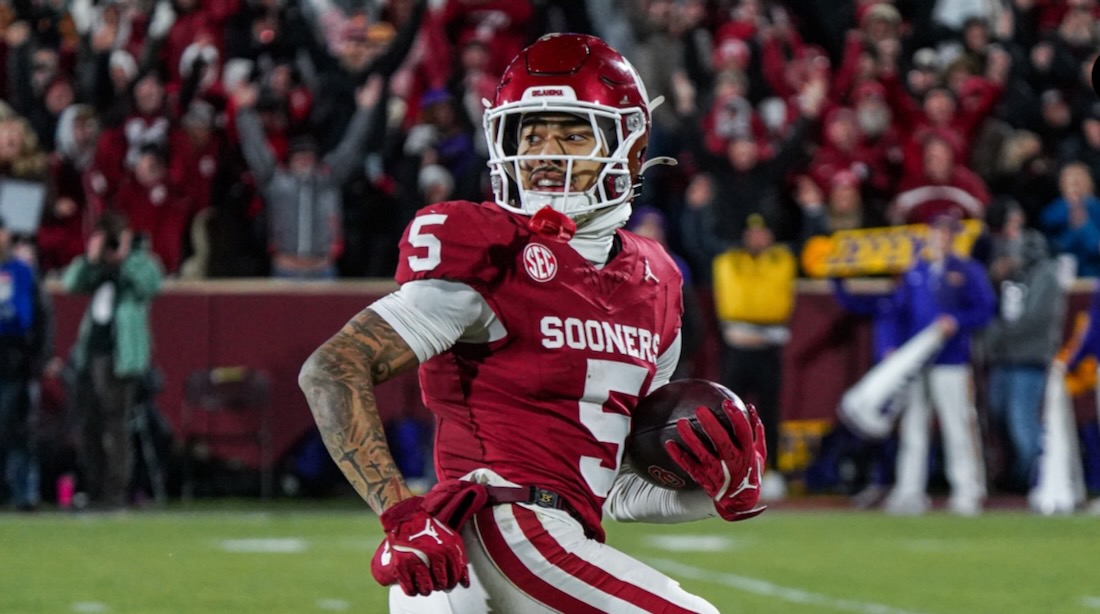
OU receiver Isaiah Sategna races toward goal line in victory over LSU.
When OU wide receiver Isaiah Sategna blew past LSU defensive backs in busted coverage last week to catch a game-sealing 58-yard TD pass, I missed the moment.
I could say that I was out back on our patio grilling or answering an unexpected knock at the door, but it would not be true.
The truth is that because it was late in a really tight game and I was invested in the outcome as someone who has bought into OU, I found something else to do at that moment.
Why?
Well, turning my back on a close game in which I have a rooting interest goes back many decades. I’m not even sure what to call it. Lack of courage? Can’t face reality?
Call it what you will, but I prefer to call it my double-reverse jinx.
As a pre-teen in the early 1960s, the Arkansas Razorbacks were my team. I lived and died with the Hogs. In those days, you mostly had only radio broadcasts on which to follow college football games.
So, when the Hogs were playing on an autumn afternoon I was tuned in — until I wasn’t. I specifically remember, when, in the second half of a really close game with the Razorbacks in a precarious position, I abandoned the radio, ran out into the back yard and started throwing a football around.
A few minutes later, I went back in and caught a couple minutes of the broadcast, but the outcome was still pending. I went back outside.
When the Hogs won that game with me not listening, I decided that all their success hinged on me not ever listening again when the outcome was on the line. Somehow, I controlled their fate.
My double-reverse jinx helped the Hogs have a great decade of success in the ’60s.
Fast forward to the late ’80s when I worked on the sports desk as a copy editor at The Daily Oklahoman. That meant that my daily working hours were from roughly 3-4 pm until midnight or 1 am.
Those working hours afforded the opportunity to drive out to the then-new Remington Park race track in the early afternoon on almost a daily basis to watch and wager on the horse races.
You know where this is going.
Yep, if I had $2 on a horse and it was among the leaders as they came off the final turn and into the stretch, I would turn my back and only listen to the track announcer’s call. One afternoon, I had maybe $5 on a horse and spent the entire race in the men’s room, safe from ruining the outcome by actually watching my horse.
I took a lot of grief from my newsroom colleagues for not being able to watch the outcome of races on which I had wagered. But that’s how I rolled.
Fast forward to 2025. It’s still how I roll when watching the Sooners, the Razorbacks, even the Thunder. When the game gets tough and the outcome precarious, I bail on the game.
And then it happens. Shai Gilgious-Alexander hits a game clinching 3. Isaiah Sategna makes a game winning catch.
The old double-reverse jinx does it again.
BONUS CONTENT: Don Mecoy, a friend and past contributor to BlogOKC, shared some of his own experience in not jinxing his favorite teams:
“Super Bowl V. Cowboys-Colts. I got on my bike during the game and rode and rode. Didn’t help.
“National Championship game in 2000. Sat in the same spot on the couch throughout the first and second half. Really had to pee by the end of the game. And I was hungry too. Literally didn’t get up once.”
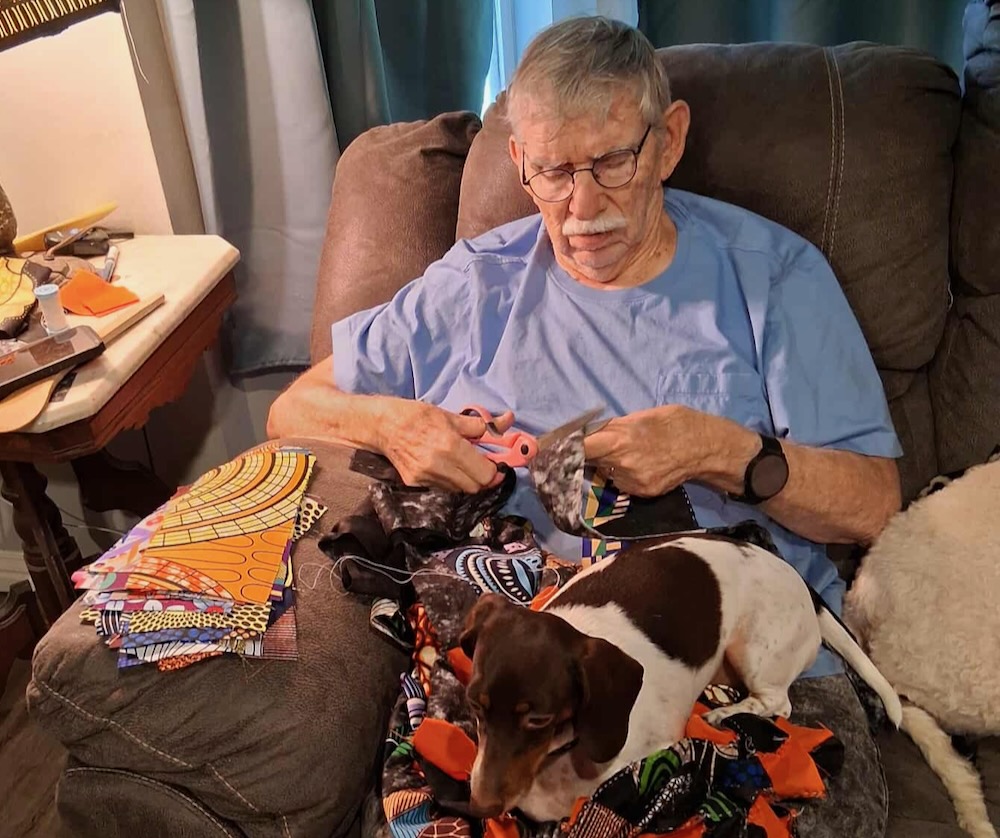
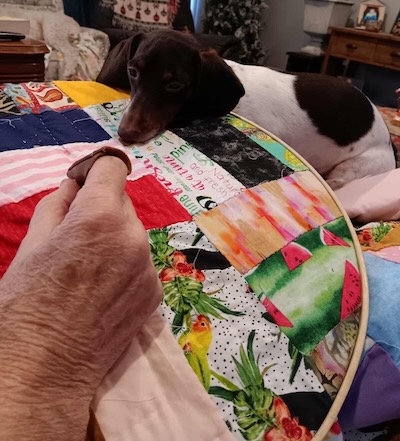
Frank Day works on a hand-stitched quilt, accompanied by one of his favorite pets.
Let me tell you about my friend Frank Day of Roland, OK, whom I have known since approximately 1971 when we both worked for Hunt’s Department Store in Fort Smith, Ark.
Over the years, we drank gallons of coffee together, ran trot lines at 2 am in the Arkansas River and stalked raccoons in the middle of the night in the Paw Paw Bottoms, among other adventures.
But life took me to Oklahoma City in 1983 for a job with The Daily Oklahoman newspaper, so we haven’t seen a lot of each other in the intervening years.
Today Frank is 75 years old and retired after more than two decades as fleet sales manager for Fort Smith’s Randall Ford. I think he can best be described in 2025 as a one-man quilting bee.
What?
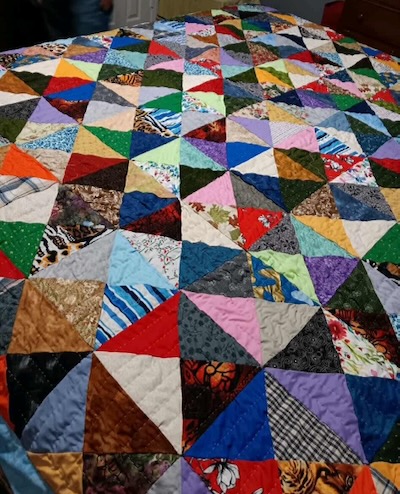
That’s right. Frank Day began hand-stitching beautiful quilts over two decades ago, and continues his quilting avocation today.
Frank, I thought I knew you.
There goes my image of the typical quilter as someone’s grandmother.
Turns out that quilting is something Frank learned as a child from his mother, Dortha Day and turned it into an ongoing hobby many decades later.
“When I grew up, Mother was quilting all the time,” Frank told me. “She belonged to a quilting club, a bunch of women who got together at someone’s house and could finish a quilt in one day. I grew up watching her, and she showed me how to do it.”
Frank’s wife of more than 50 years, Vicki, added her perspective.
“Frank’s mother Dortha always had a quilt rack on the ceiling,” Vicki said. “I remember Granny, everyone called her Granny, quilting on the old quilting frames and singing hymns. When the grandchildren came along they would all play under the quilt frame.”
However, Frank had never made a quilt until his first grandchild was born more than 20 years ago. He produced his first quilt for grandson, Trevor, and has continued quilting through the years.
“I said I’m going to get some material and make a quilt,” Frank said of that first attempt. “Vicki said ‘you don’t know how.’ I said, ‘you watch me.’ I got the material and sat down and started sewing. And I got it done.”
That first quilt led into one for each grandchild, then special quilts for relatives and friends. Sometimes he makes them for folks who’ve had a stretch of bad health or difficult life situation, like a former coworker at Randall Ford to whom he presented a quilt.
“She started crying, but it was because she was happy to get it,” Frank said.
A quilt is not made in a day. Or a week. It might require more than a month of work for a solo quilter like Frank Day.
“From start to finish, if it’s a king-sized quilt, you have about 250 hours in it,” he said. “That’s cutting the material out — I hand sew everything, nothing is made on a machine. I hand stitch it, get the backing for it, get the lining for it and put the blocks on top.”
Did you catch that … 250 hours for a single quilt. That’s 6-1/4 40-hour working weeks of quietly sitting alone stitching blocks of material together into what can be a beautiful pattern.
My own grandmother was a quilter, and I recall she had a large wooden frame that she let down from the ceiling that helped her make her quilts.
Frank uses a ‘hoop’ that he holds in his lap as he quilts. Usually, one of his favorite dogs is sitting nearby or even on his lap as he quietly works.
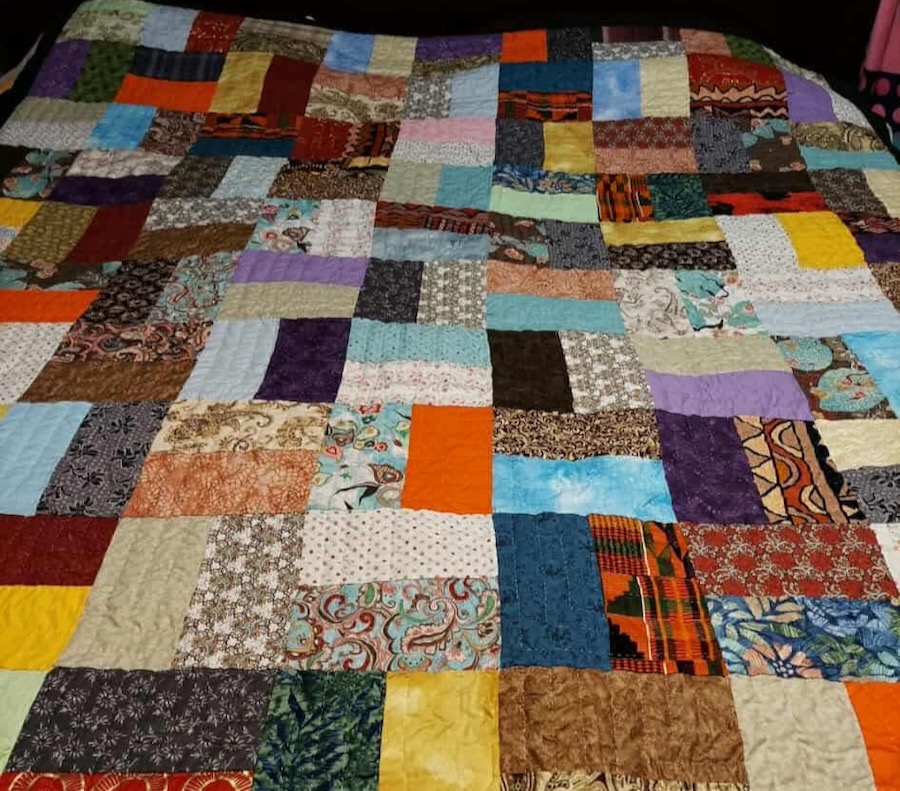
Although he hasn’t made quilts to sell, Frank told me that comparable hand-made quilts can be priced at $1,800-$2,500 because of all the time required to produce one.
“It’s very time consuming, and most people don’t have the patience for it,” he said.
I learned that Frank was a quilter after Vicki posted some pictures of beautiful quilts on Facebook and I complimented her on her quilting talent. She corrected me and said it was all Frank.
“When Frank made his first quilt before Trevor, our first grandchild, was born, we had been married for 30 years and he never made one before,” Vicki said. “I asked him why he never made one before and his answer was “I never had a reason to make one.”
“Frank’s quilting has bloomed over the years. He made one for our son, Paul, as a wedding gift and then for our daughter Jenny. He made one out of cancer warrior scarves that Ford gave to dealerships for Breast Cancer Awareness.”
Each quilt is made with a purpose.
“Frank had a good friend, Dudley Sparkman, who was the best man and friend you could ask for,” Vicki said. “Sadly, he had a massive heart attack on his 50th birthday and passed around two weeks later. Tina Sparkman, Dudley’s wife, asked Frank if he would make a lap quilt out of some of his shirts. That was probably one of the hardest quilts he ever made because on the friendship they shared.”
Quilters like Frank Day who make the time to sit and hand-stitch a beautiful design are a rarity in 2025. Today, most quilts are machine stitched.
Frank calls hand-made quilting a “dying art” that he’s keeping alive in his corner of the world. Currently, he’s working on a quilt for Vicki as he recovers from a recent knee-replacement surgery.
“It’s helped me keep my sanity when I’ve had to sit for long stretches as I recovered from knee surgery that put me down,” he said. “I’ve finished one and got close to half of another one put together.”
It’s one stitch after another after another for a quilter like Frank Day. That translates into hundreds of hours to produce just one quilt.
It’s a marathon, not a sprint.
Frank has run that marathon for more than two decades.
And that’s why I describe him as the ultimate one-man quilting bee.
BONUS CONTENT:
I asked ChatGPT to explain the concept of a “Quilting Bee” to me. Here’s what it told me:
A quilting bee is a social gathering where a group of people—traditionally women—come together to work on quilting projects, usually a large quilt, while also enjoying conversation and community.
Key Features:
– Collaboration: Multiple people contribute to making one quilt. Often, the quilt top is pieced together ahead of time, and the bee focuses on quilting (stitching the layers together). – Social aspect: It’s as much about socializing and bonding as it is about the sewing. These gatherings were historically important social events, especially in rural communities. – Tradition: Quilting bees have roots in 18th and 19th century America, when they served as a practical and communal way to create bedding before mass production. – Modern bees: Today, quilting bees still exist, though they might be less formal or might happen in quilting guilds, workshops, or even online.
Think of a quilting bee as a mix of a sewing circle, a social event, and a creative collaboration.
A screenshot of The Gold Sheet taken from a Chicago Sun Times article.
Here’s a memory that goes back to the 1980s when I worked in the downtown OKC newsroom of The Daily Oklahoman.
Every Thursday afternoon during football season, I would walk about three blocks down to Taylor’s Newsstand from the paper’s Broadway & 6th Street headquarters.
You might remember Taylor’s Newsstand. It was located in the Century Center mall attached to the Sheraton Hotel. Taylor’s offered an awesome variety of magazines and newspapers from around the country. I fact, I bought a lot of Sunday papers from Denver, Kansas City and Dallas at Taylor’s over the years.
But that’s not what drew me to the newsstand on Thursdays in the fall. It was a publication that Taylor’s sold called The Gold Sheet.
Man, I loved to get my hands on The Gold Sheet each week.
If you are unfamiliar with it, The Gold Sheet was a football handicapping publication. A tout sheet. Still is, in digital form.
It was printed on heavy gold paper that unfolded into a large single sheet that contained predictions and analysis on every Division 1 and NFL football game for the coming weekend.
I’m pretty sure that my friend ‘David’ introduced me to The Gold Sheet, and I became a loyal reader.
I wasn’t much of a gambler, but coworkers at the newspaper in that mid-1980s era connected me to a bookie here in town who would would take my tiny wagers of $10 or $20.
So, The Gold Sheet became a big part of my weekly rhythm throughout the 1980s, when I was still single and willing to wager a few dollars on football.
Yes, I know it’s shocking that gambling on football (and other sports) occurred in OKC. But it did in the ’80s, and I’m certain you wouldn’t have to work too hard to find a bookie today who would take your wagering action.
A Bold Prediction: Oklahoma will have legal, online sports wagering within the next 5 years.
As for The Gold Sheet itself, it contained a prediction on the outcome of every game along with a couple of sentences that backed up each pick. It made for great reading, if nothing else.
Maybe because today is Super Bowl Sunday– by far the No. 1 day annually for sports wagering (sorry Final Four, Kentucky Derby et al) — I stumbled across a reference online this morning to The Gold Sheet.
And that got me to wondering what became of my favorite handicapping publication.
So, I did a little online research and discovered a Chicago Sun Times article from 2022 that revealed that it is now part of an online handicapping website called WagerTalk Media.
The article also outlined the history of The Gold Sheet, which was launched in Los Angeles by the late Mort Olshan in 1956. It remained a physical publication until the end of the 2019 football season, when it morphed into a digital publication.
A wave of nostalgia washed over me when I discovered the Chicago Sun Times article, which included a picture of The Gold Sheet from back in the day.
My weekly wagering days are long gone. But The Gold Sheet remains a fond memory of that time in my life.
BONUS CONTENT: Steve Lackmeyer, my friend and former colleague at The Oklahoman, wrote about the demise of Taylor’s Newsstand when it finally closed for good in 2009. Turns out The Gold Sheet outlasted the newsstand where I first discovered the publication.
As I was sitting in the stands at OKC’s All Sports Stadium in roughly 1987 watching the Big 8 baseball tournament with my Daily Oklahoman colleague, Tom Kensler, a lanky young man sat down with us.
Kensler, now deceased, was the paper’s OSU beat writer in 1987. He introduced me to the newcomer.
“Jim, I want you to meet the newest member of our Sports staff, Berry Tramel,” Tom told me as I shook Berry’s hand.
Although I had worked as a copy editor on the Sports desk at the Oklahoman since 1983, I didn’t know Tramel, who worked as a sports writer at the Norman Transcript.
Something happened, however, and Berry did not become a member of The Oklahoman’s Sports staff until 1991. Maybe the Transcript offered him a raise or he still had things to accomplish at the Norman paper.
But Berry eventually joined The Oklahoman staff and became our lead sports columnist. He quickly established himself as one of the top sports writers not only in Oklahoma but across the nation.
I don’t remember much of that first conversation with Berry at the ballpark, but eventually I found him to be warm, empathetic, approachable and the most prolific and hard-working writer I’ve ever known.
Berry writes in what I consider a folksy manner that carries the reader along. He has an incredible ability to uncover the critical issue that may be plaguing — or helping — a team, a coach, a school, a state, whatever. And he’s a walking encyclopedia of sports history.
Berry’s most influential article of them all may be the infamous “Taco Bell” column from the late 1990s when he compared OU’s hiring of John Blake to a company that put a management trainee in charge of the entire business.
Not everyone loves his style — ask my friend, Casey — but he’s attracted a huge following far and near over the years. Including me.
Berry was joined on The Oklahoman Sports staff in the late 1990s by Jenni Carlson, a Kansas native who brings a unique point of view to whatever she’s writing about. I’ve come to know Jenni, as well, and love reading her intriguing takes that often focus on people who have overcome long odds to become successful.
I’ve written all of this because, as most people know by now, both Berry and Jenni are leaving the paper. They’re joining a new online venture called The Sellout, Sellout Crowd, or something like that. It should debut later this month, from what I understand.
I got wind of Berry’s impending exit about three weeks ago and immediately sent him an email with the subject line “Say It Ain’t So.”
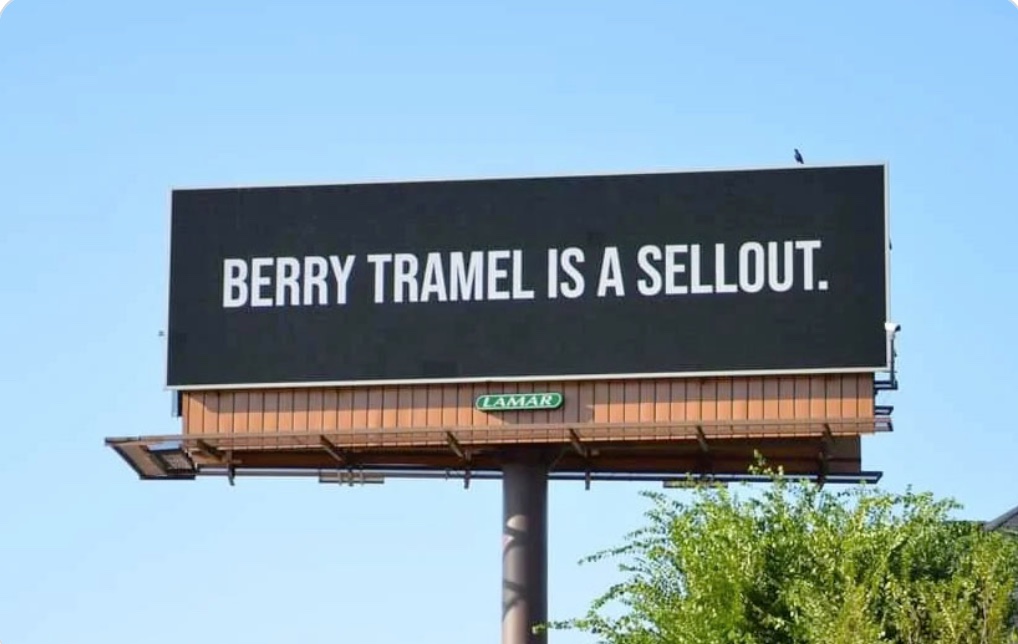
Berry responded and said it was so. He said it’s a good thing, not bad, because readers who follow him and Jenni will be able to read their work in a free online newsletter. He even wrote about his impending departure from the paper after billboards appeared saying “Berry Tramel is a Sellout.”
But I’m mourning for the newspaper because of the loss of such immense talent. I was part of that newsroom as a writer and editor for over two decades.
Although I’ve been gone from The Oklahoman for almost 15 years, I’m still a subscriber and a daily reader of the newspaper. I still pick it up off my driveway every morning (except Saturday).
We all know that the Internet has changed the way people consume news, sending the newspaper industry into a long decline, including The Oklahoman. In my opinion, the paper has done a great job of building its online enterprise while still keeping print alive.
For now.
But the loss of Berry and Jenni is a huge blow to readers like me who look forward to unfolding the paper every day (but Saturday) and seeing what one or both have written for us. Who can replace them?
So, what’s next? I’m anxiously watching as the leaves continue to fall from the tree and the newsroom branches become bare.
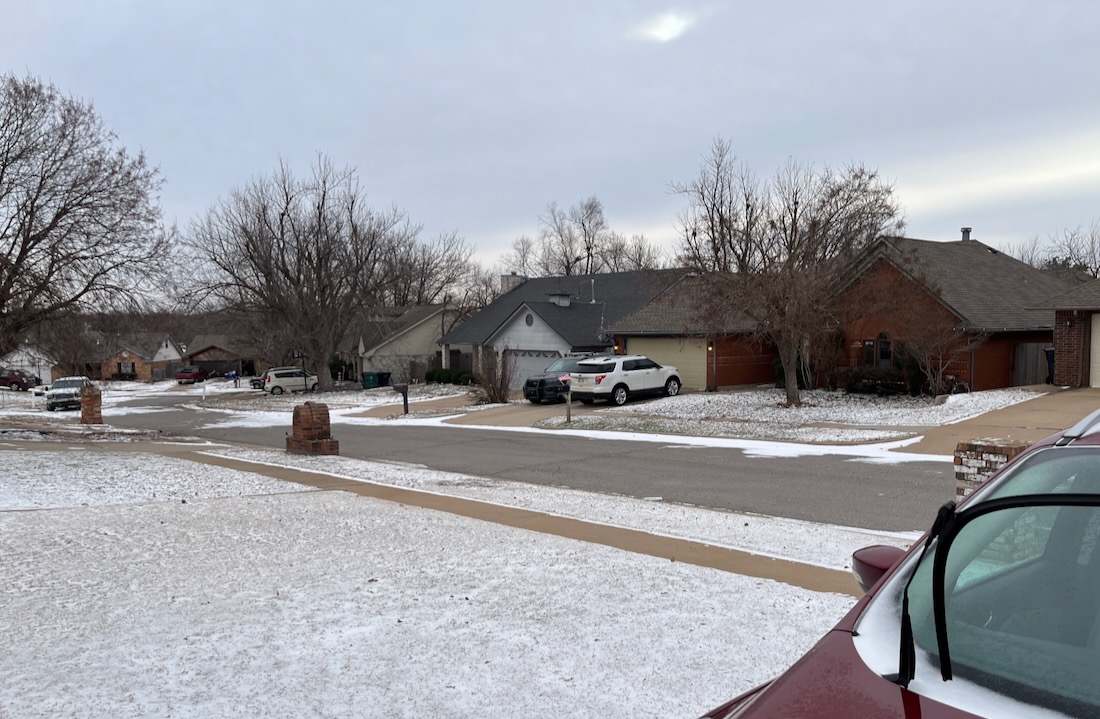
The weather in OKC was a frightful 5 degrees as I stepped out to take this photo.
As I looked out over the frozen tundra that was northwest OKC at 5 degrees this morning, I thought of another holiday season that was disrupted by bitter weather.
Back in 1983, I had just moved to Oklahoma City to work at The Daily Oklahoman newspaper. My folks lived in Fort Smith, Ark., roughly 200 miles to the east.
Anyway, as the newbie on the Sports staff at the paper, I would only get Christmas off if the holiday fell on my normal day off.
It did not, which meant that I had to drive over to Fort Smith a few days before the holiday to celebrate with my family, then drive back to work Christmas Eve and Christmas Day.
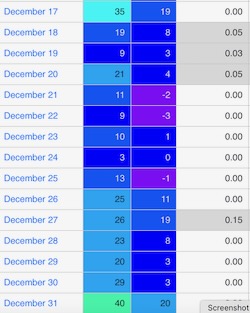
As I was preparing to leave town on roughly Dec. 18 or Dec. 19 (the dates are hazy now), a massive outbreak of Polar air settled over Oklahoma and brought sleet and snow with it.
It was apparent the roads were going to be awful, so I even checked the bus schedule to Fort Smith. I called the bus station and they told me that all bus departures were canceled.
So, I called my dad and asked him what he thought.
“Come on over,” he said. “It can’t be that bad.”
It was.
I managed to make it with no trouble to Henryetta, OK. But about 5 miles east of there, as I was climbing a fairly steep hill, my car began to fishtail and swung around 90 degrees. It went off I-40 backwards and into a snow-filled ditch.
Oh, great. These were days before we could even conceive of having a phone in our cars. How was I going to contact anyone?
As I walked up the steep shoulder to the road, a young man in a Camaro pulled over and asked if he could help. I asked him if he would call a wrecker in the next town.
He looked down at my car in the ditch and said, “I think you can drive out of this. The ditch flattens out at the bottom of the hill and you should be able to drive onto the highway. I’ll wait until I see if you can get out.”
I got back in my car, eased down the hill, made it to the flat part, and, like magic, drove right back onto the highway.
I never got to thank the Good Samaritan.
But the road was so ice covered that I drove no faster than 30 mph the remaining 85 miles to Fort Smith.
So, my trip took hours longer than expected. My parents were greatly relieved when I finally pulled up, but I was angry at my dad because he urged me to make the challenging drive.
A better mood took over, and we celebrated the holidays as a family.
There was still plenty of ice and snow to negotiate on the trip back to OKC, but I made sure I kept it on the road this time. I arrived safely back into town and made it to work my holiday shifts on time.
So, thank you, Mr. Good Samaritan, for saving Christmas in 1983.
Howard Schnellenberger on the OU sidelines in 1995. (Oklahoman photo)
I’m sure by now you’ve seen the news that former University of Oklahoma football coach Howard Schnellenberger passed away this morning.
Schnellenberger coached OU for one unspectacular season in 1995, and was fired right after the 5-5-1 season ended.
By OU standards, it was a disaster.
Schnellenberger came to OU with decades of football success on his resume and the confidence of a Gen. Douglas MacArthur. It just didn’t translate to success with the Sooners.
Although I was just an outsider looking in that year, all I could see was a pompous old man who thought his mere presence would inspire success.
Then fate brought me together with Howard for one night in 1995.
I was working as a Business News reporter at the time for the Daily Oklahoman. One of my beats was writing about Oklahoma agriculture.
You might remember that the Oklahoma Farm Bureau made Schnellenberger their spokesman in an ad campaign in 1995. The ads appeared on Oklahoma TV stations and mainly featured Howard squinting into the distance as words described the value that the Farm Bureau brings its members.
Many folks thought Howard was an odd choice for the Farm Bureau. In fact, here’s something that Oklahoman columnist Berry Tramel wrote back in ’95:
“Sudden thought: Why did the Oklahoma Farm Bureau select Howard Schnellenberger as its marketing spokesman? Aren’t most of those folks OSU graduates?”
But Schnellenberger’s most recent job before OU was that of football coach at the University of Louisville, and the executive director of the Oklahoma Farm Bureau at the time was a Kentucky native. So, there was a thin connection.
Howard Schnellenberger (Oklahoman photo)
Then one day, out of the blue, my wife and I received an invitation from the Farm Bureau to attend a “media night” at Applewoods Restaurant. OU coach Howard Schnellenberger was the special guest speaker.
Paula and I loved Applewoods and its famous apple fritters, so of course we agreed to go.
Turns out, a local television reporter and I were the only “media” members at the dinner. And only about a dozen people total were at the Farm Bureau event.
Here’s all I remember about that night. Howard stood over our tables and droned on in a low monotone for about 30 minutes. I remember nothing about what he said.
My wife had an interesting experience, too. Howard’s wife, Beverlee, was with him and sort of latched on to Paula as her new best friend for the night. She never stopped talking.
I couldn’t wait for that painful evening now 26 years distant to be over.
And it wasn’t long before Schnellenberger’s tenure as OU coach was over, as well.
In 1983, I was a very raw young sports reporter at the Southwest Times Record (SWTR) in Fort Smith, Ark., with dreams of some day working at the Dallas Morning news.
Fort Smith was my first stop out of college, and I worked on the sports desk, then the news desk for a couple years, then back to sports as the Sports Editor.
But I dreamed of Dallas and working with the likes of Blackie Sherrod and Randy Galloway. I even wrangled an interview there but came up with no job and the advice to gain more experience.
Then one day a friend with whom I worked on the SWTR news desk — I’ll call her “Patti” — suggested that I send a resume to the Sports Editor of The Daily Oklahoman in Oklahoma City. His name was Jerry McConnell, and Patti had worked for him when he was the managing editor the Arkansas Democrat in Little Rock.
So, I fired off a resume to Jerry with absolutely no expectations.
By coincidence, my timing turned out to be perfect.
One of the Sports copy editors at The Oklahoman had just quit, and football season was starting.
Jerry gave me a call and asked me to come interview. I drove over to OKC and met with Jerry and his Assistant Sports Editor, Bob Colon.
Jerry hired me, and I relocated to OKC in early September 1983.
Turned out that I was not well prepared for the daily pressure and grind of The Oklahoman Sports Desk. We put out three editions each night, sometimes fully remaking almost the entire section between editions.
I was mistake-prone and unlikely to make an edition’s deadline on any given night. I had no design skills.
But Jerry was a patient editor and boss. Rather than scream at me, or worse, fire me, he allowed me to make my mistakes, and gently helped me grow as a professional. He also was in the office every night until at least the first edition was finished, so he was accessible.
Jerry also shared many fascinating stories from across his long career. I loved to sit and listen to him spin a yarn in his gravely baritone voice.
So, I’ve always been grateful to Jerry for his kind and steady hand as a boss and a friend. He eventually retired from The Oklahoman and moved back to his hometown of Greenwood, Ark.
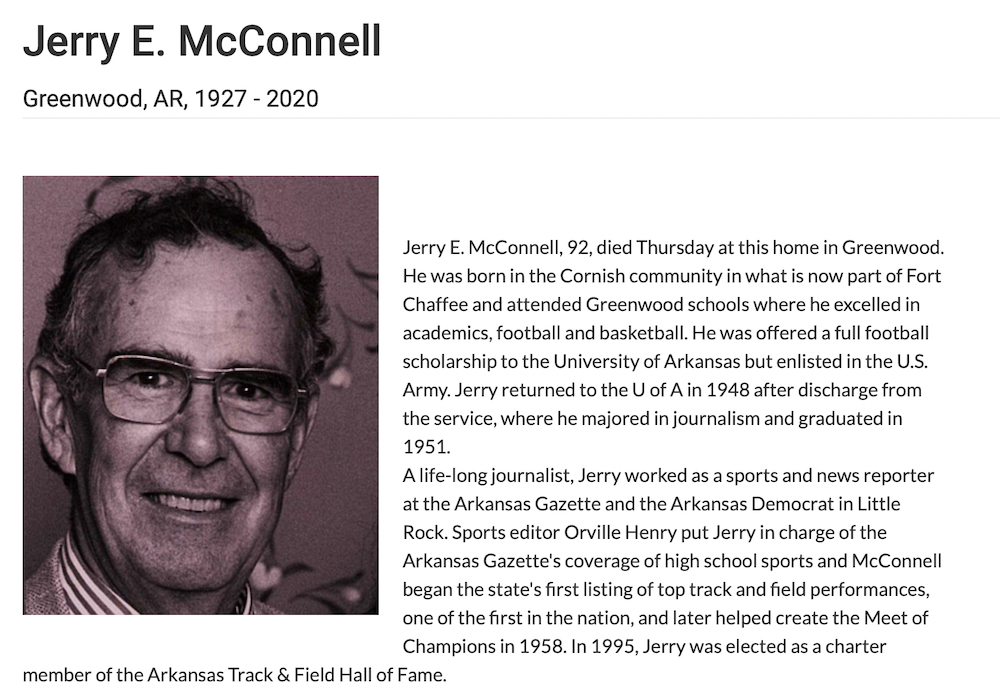
To my regret, I only recently learned of his death. You can read his obituary to see what impact he had on his profession and the community, both in Arkansas and Oklahoma.
Jerry touched the lives of many, many people in the newspaper industry and beyond. I’ll always be grateful for what he did for me.
My friend Patti was one of those for whom Jerry made a difference. Here’s what she had to say about him:
“He was a super friend to me and taught me a lot in Democrat days… He passed peacefully at home just after we last saw him. His last words to me were, “Love you too babe”… He liked you a lot. I will miss him ever!”
Thank you, Jerry McConnell, for bringing me to Oklahoma City and making a difference in my life.