The ’65 Mustang was my Aunt Dee’s ride or die

Screenshot
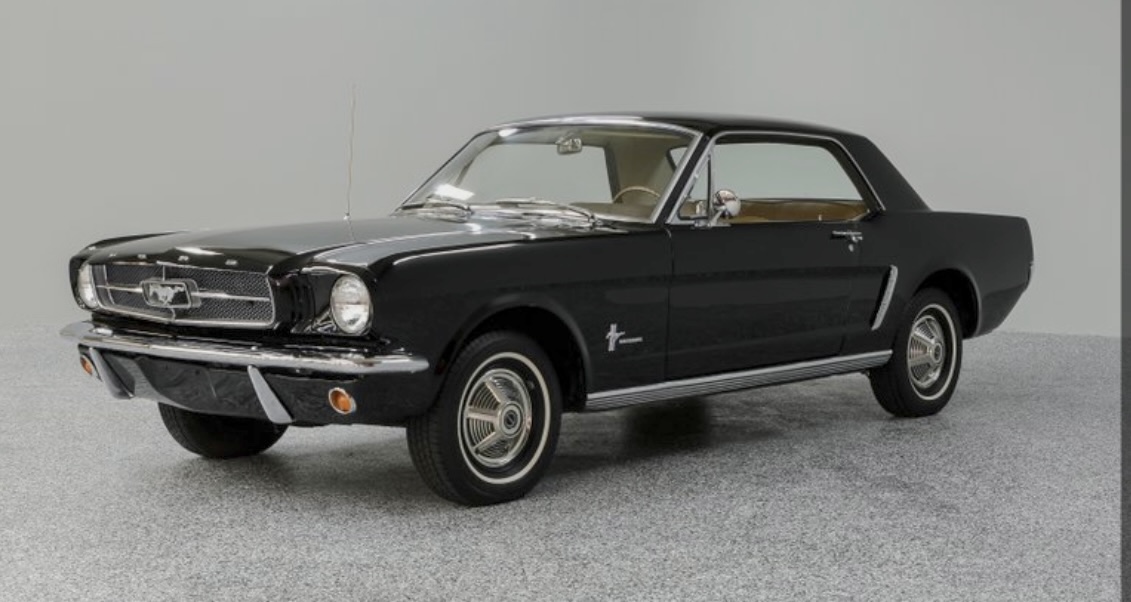
A black ’65 Mustang that looks exactly as I remember the one driven by my Aunt Dee.

This is a story of the Ford Mustang. Or, rather, two Ford Mustangs. One of them did not have a happy ending, and I was in it.

If you are hazy on your Ford Mustang history, I’ll catch you up to date a bit. The Mustang was conceived by a team at Ford led by Lee Iacocca, who later gained fame as the man who saved Chrysler.

The first Mustang was introduced to the public in April 1964, as the “1964-1/2” Mustang. It was an instant hit. The public fell in love with it because it had a unique, sporty body style compared to what U.S. autos had been, which were cars shaped like boxes and quite unattractive.

Purchasing a brand new Mustang off the showroom floor in 1964-65 would set you back $2,400, according to cars.com. Today, those antique vehicles bring from $16,000 for the coupe to $33,000 for the fastback model.

My dad was among the millions of Americans who were taken by the Mustang and eventually bought one when he was stationed on the island of Okinawa while in the military. I’ll come back to that.

Anyway, the Mustang was beloved by my dad and so many others because it had a long nose, short rear end and distinctive grill and tail lights. Eventually, it came in a 2-door coupe, convertible and the incredibly popular fast-back.

I’m writing about the Mustang because my 5 year-old grandson, Solomon, and I discovered a show on the Roku channel called “Counting Cars,” which follows a shop in Las Vegas that rehabs older vehicles and turns them into showpieces.

We streamed an episode this morning in which the shop refurbished a ’65 Mustang and turned it into a perfect candy apple-red rendition of how it must have looked on the showroom floor in 1965. Solomon could not get enough, running through the house to get his grandmother to come in and see the beautiful car.

So, two Mustang stories.

When I was a senior in high school, I lived with my aunt and uncle in Fort Smith, Ark. My aunt Dee drove a black ’65 Mustang and was so in love with the car that she told everyone she would never drive another.  Its compact size made it easy for her to maneuver on the road.

Fast forward to roughly 1980, when I was a young sports reporter at the Southwest Times Record, which had its offices and newsroom in downtown Fort Smith.

One day, as I stepped out of the building onto the sidewalk, my uncle, L.R. Mendenhall, drove up and parked Aunt Dee’s Mustang right outside the SWTR’s door along Rogers Ave.

At virtually the same moment, Leroy Fry, who was the newspaper’s managing editor, walked out of the building and spotted the Mustang. I introduced my Uncle “Blue Eyes” (as he was known to our family) to Leroy. The editor told him that he had to have that Mustang and how much would my uncle sell it to him for.

“It’s not for sale,” Blue Eyes told him. “It’s my wife’s car and she says it’s the only one she will ever drive.”

End of story.

That black Mustang was my Aunt Dee’s ride or die, and I’m pretty sure when she died in roughly 2000 that the car was still in her family’s possession.

My second Mustang story involved the 1967 Mustang my dad bought while on Okinawa. He was in the Army, so our whole family lived on the island. This was in 1968 when I was 15 years old.

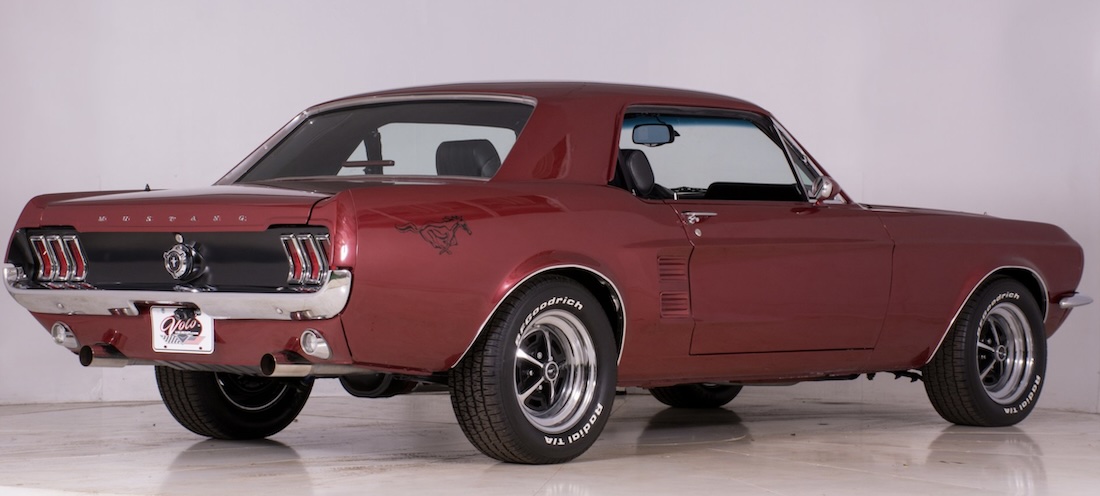
Dad loved his Mustang, which was painted in a sort of burnt-orange color, and drove it every day to work. He was a hot GI in a hot vehicle.
Screenshot
A ’67 Mustang similar to that owned by my dad, although his was more of a burnt orange in color.

I wanted to drive it, too, and begged him to let me get behind the wheel. So one weekend he asked the son of a family friend who was about 19 years old to drive me and the Mustang to an abandoned Japanese airstrip where I could drive it and stay out of harm’s way.

I remember driving back and forth on the airstrip multiple times and getting a feel for the car. Then we decided to head back to the military base where our families lived. I moved over to the passenger side, and the older kid (can’t think of his name now) took the wheel.

We drove off the airstrip and back onto the rural two-lane road that was adjacent to a field of sugar cane. My young driving instructor said, “let’s see what this car can do,” and gunned it.

I’m not sure how fast the car was traveling, but we roared down that rural road until my driver suddenly realized there was a 90-degree turn at the end and started screaming that we weren’t going to make it.

We didn’t.

The car flew off the end of the road at the hairpin curve, hit hard in the sugar cane field and landed on its side. Neither one of us had buckled our seatbelt (hey, this was the ’60s), but we were mostly uninjured. My friend cut his hand on the steering wheel when the padding came off.

We climbed out of the driver’s side, which was facing the sky and then tried to figure out how to contact our parents in this era before the cellphone was a gleam in anyone’s eye.

There was a military installation about a half mile away, so we walked to it, told the guards at the security gate what happened, and they let us call our parents. Of course, we told them exactly how it happened.

The car looked OK to me, but had to be towed to a shop somewhere on the island. Turns out the frame was bent and the insurance company declared it a total loss.

My dad was heartbroken, of course. But the fact that we were unhurt took some of the steam out.

He never owned another Mustang.
In my hometown, the long decline of a Fort Smith institution

Screenshot
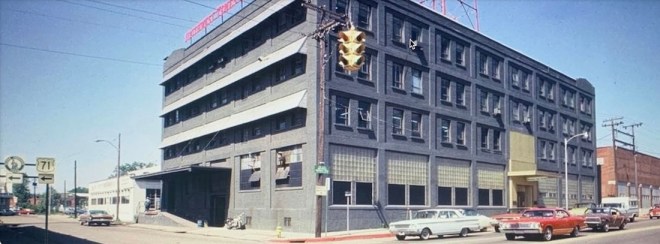
The Southwest Times Record building in what appears to be the early 1960s. (Photo courtesy of Southwest Times Record former employees Facebook group)

Here’s a bit of nostalgia for you. When I walked into the Southwest Times Record newsroom for the first time as an employee in 1978, I encountered a bustling community of talented writers, editors and photographers all scrambling to publish local news seven days a week.

The Fort Smith newspaper was a great place to learn the craft as my first job out of college. There are many folks among my former colleagues there whom I will never forget. I worked at the SWTR for five years in a variety of positions before moving to Oklahoma City and working for The Oklahoman for almost a quarter of a century.

My parents were among the 40,000 or so SWTR subscribers who fetched the newspaper off their driveway every morning. Established as the Fort Smith Times in 1884, the SWTR had a strong following not only in Fort Smith, but across a multi-county region of Western Arkansas and Eastern Oklahoma.

So, it’s been disheartening to watch the SWTR decline as a community force over the past few years as the number of subscribers declined and employees were laid off. It’s a situation not unlike that in many other cities across the nation.

Now owned by industry giant Gannett, I’m not sure there remains a single Fort Smith-based editor or reporter chasing down local news stories.

In fact, my 90-year old mother, who subscribed to the SWTR in our hometown of Fort Smith for more than five decades, finally gave it up a couple years ago because the paper had so little local news. Sometimes she still reads the obituaries published online.

As for me, I’ve stayed connected to the SWTR by subscribing to the paper’s free emailed daily newsletter that allows a peek at its headlines and free access to the obituaries.

It all makes you wonder when the hammer will fall and Gannett will halt publication of a physical paper for any remaining subscribers, leaving only online access.

Well, we’re close.

Screenshot

I received a notice recently that the SWTR was transitioning to a “mail only” newspaper with no more home delivery. Here’s what the email said, in part.

“Beginning tomorrow, look for your copy of the Southwest Times Record and our other regional publications to arrive with your daily mail. As announced in the Jan. 10 edition and in letters mailed to subscribers, the U.S. Postal Service will be delivering the Southwest Times Record to optimize resources amidst increasing digital readership demand.”

Now subscribers can read ‘news’ that is already at least 24-hours old when it arrives in the mail. What’s that old saying about nothing as stale as yesterday’s newspaper?

So, why am I writing this?

Well, it’s not a diatribe against the current ownership, because I see what’s happened to my old employer as a product of emerging technologies and a big change in how the public consumes news. Online access to news — much of it free — has removed the incentive to subscribe to a daily newspaper that lands on your driveway every morning.

I’m mourning the SWTR for its former employees and the folks who subscribed to the paper for decades. It’s like watching a close relative slowly fade away from an incurable cancer.

Here in OKC, I’m still a subscriber to The Oklahoman’s physical newspaper, which is delivered to my driveway every day but Saturday. Yet, when I look up and down my street as I pick up the newspaper each morning, I see no other papers on my neighbors’ driveways. None.

However, I’m confident the path determined for the Southwest Times Record won’t be a template for The Oklahoman. It remains an enterprising news organization, despite repeated rounds of staff reductions.

That notice I received of the SWTR’s “all mail” newspaper delivery prompted me to ask a couple of former colleagues and longtime SWTR employees who still live in the Fort Smith area their thoughts on what has become of their former newsroom.

Patti Cox was a longtime news editor at the SWTR with whom I worked on the news desk. She shared her perspective with me as both a former employee and a current subscriber.

“It is very sad turn of events for Fort Smith,” she said. “We still are taking the day-late-in-the-mailbox paper but not sure for how long or why. End of so many meaningful things like insightful, timely local news and commentary. Long gone are noisy newsrooms filled with reporters, editors, interns with common purpose and multiple deadlines.”

Carrol Copeland, longtime SWTR photographer and creator of a Facebook group called Southwest Times Record former employees that has 162 members, also shared his thoughts with me.

“Back in the day, we covered local news, and there was very little worldwide or nationwide news in it,” Carrol said. “Probably 80 to 90 percent of it was local news. At one point we had the Poteau office and the Van Buren office, and somewhere around 150 employees.”

That was then. This is now.

“There’s not even a physical location anymore,” Carrol said, who recalled tornadoes, spectacular crimes and criminal trials that he covered over the years. “I think it comes down to a lack of income. If you can’t sell advertising you can’t have people to work for you.

“Now that people are going to the Internet or Youtube for their news, no one is advertising anymore. The technology overtook them.”

How will the daily newspaper voice be filled for former SWTR subscribers who loved its local news angle? Digital news services that focus on local news offer some hope.

Here in Oklahoma City, we have Oklahoma Watch and Nondoc, among others, which are sort of complementary to The Oklahoman, for now.

In Fort Smith, there’s an online site called Talk Business & Politics that focuses on Fort Smith and Northwest Arkansas. It was started by a former SWTR editor. I read it first thing each morning five days a week.

Actually, as I think about it, I’m not sure folks aged 30 and younger will miss holding an actual newspaper because it’s likely they never read one on a daily basis anyway.

But for those who grew up with ink-stained hands, it’s a difficult transition.

“I just know I loved newspapers and the dedicated (mostly young) quirky stressed out folks who worked for them,” Patti Cox told me. “Grateful for the lifetime lessons learned there.

“Good memories, my friend.”

We’ll carry those memories with us long after the final edition is published. It’s coming.