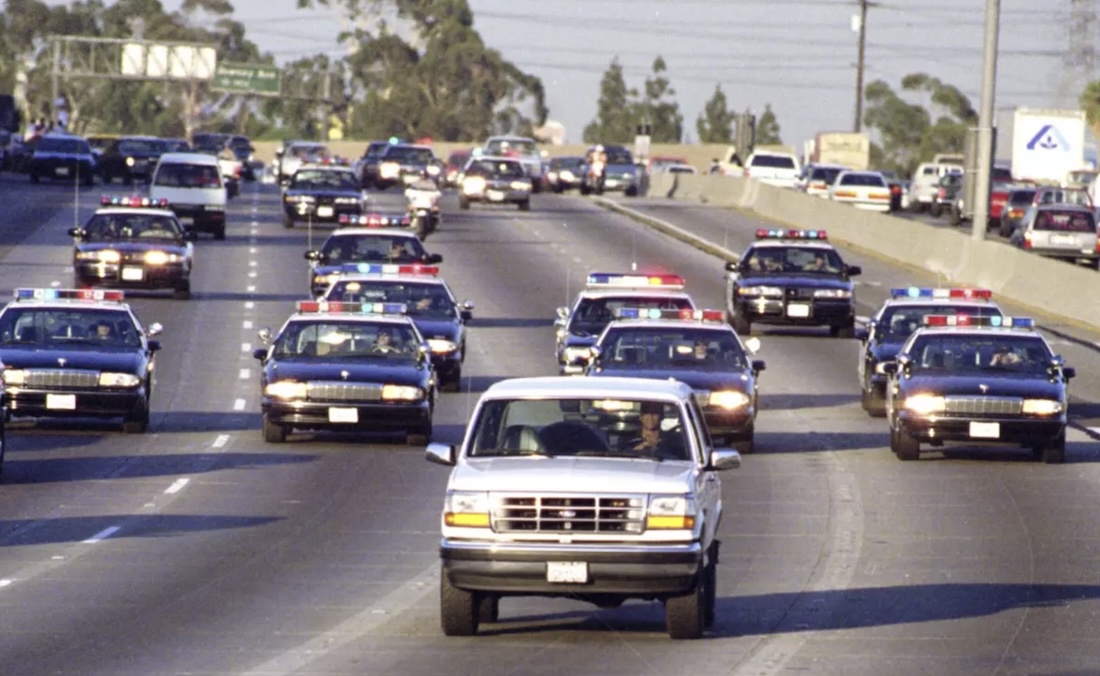
OJ Simpson car chase as seen on an LA freeway on June 17, 1994. LA Times photo
As I’m writing these words, it is the evening of June 17, 2025.
Do you remember exactly where you were 31 years ago, on June 17, 1994? I know where I was, because that’s the day of the infamous OJ Simpson ‘slow chase’ in the white Ford Bronco.
In case you are hazy on that event of three decades ago, authorities wanted to talk to OJ about the stabbing deaths of his ex-wife, Nicole Simpson, and her friend Ronald Goldman.
Maybe I should help you remember that OJ Simpson was a former record-setting running back with the Buffalo Bills of the NFL following an incredible college career at Southern Cal.
Anyway, OJ was supposed to turn himself to police in connection with the deaths in earlier in the day.
But late that afternoon he ended up in the Bronco driven by his friend Al Cowlings. Police suspected he was in that vehicle because he hadn’t shown up and Cowlings was his friend.
Strangely, though, Cowlings actually called police from the car and told them that OJ was in the back seat with a gun threatening suicide. Dozens of police cars pursued on an LA freeway, chasing at the breakneck speed of approximately 45 mph.
People lined freeway overpasses to wave and cheer OJ on.
The ordeal ended after 90 minutes when Cowling drove the Bronco back to OJ’s house, and OJ eventually gave himself up.
Well, my wife and I were in St. Louis on June 17. We went to a St. Loius Cardinals’ game that evening and got back to our hotel about 10 pm, dripping in sweat from a hot, humid night at the ballpark.
We were wiped out, ready for a shower and lights out. But we got pulled into the OJ chase when we clicked the television on.
Each of us was mesmerized, our eyes glued to the screen as the car drove along the freeway and eventually to OJ’s house, all broadcast nationwide on live TV.
Before that night, we had kept track of developments in Nicole Simpson’s murder and knew that OJ was allegedly in Chicago at the time, but a suspect.
Paula and I had discussed the case earlier in the day and we hoped that OJ had nothing to do with it because he seemed like such a likable person.
I can no longer remember who the Cardinals played that night.
But I can still see that white Ford Bronco slowly driving down an LA freeway with dozens of police cars giving chase.
It was memory that can’t be erased.
BONUS CONTENT: I looked it up and the Cardinals lost 7-4 that night to the Pirates. Game time temperature was 90. Humidity 110 percent (writer’s embellishment).
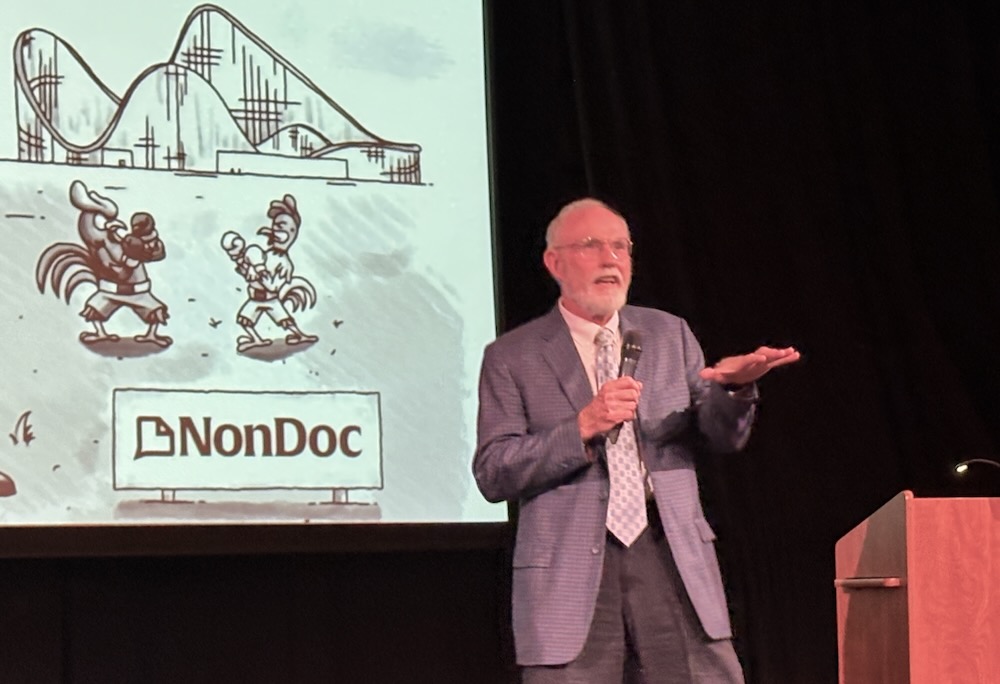
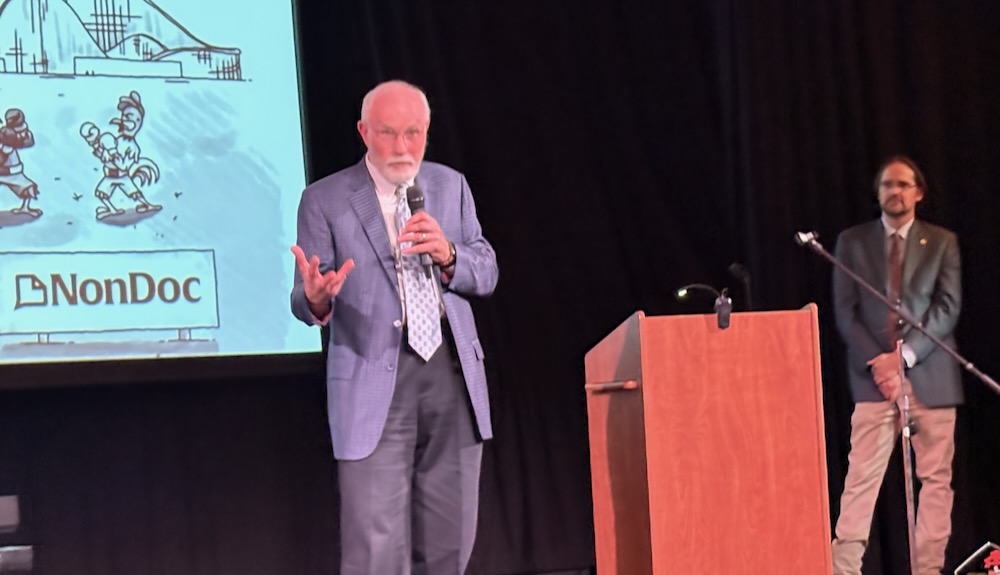
Michael McNutt tells a story as he addresses the audience at his Nondoc retirement ceremony
Michael McNutt’s retirement celebration from the NonDoc online news organization was under way earlier this week when he shared a story with me from almost 30 years ago and said I played a role.
A story for which I had no recollection.
Michael is a friend and former colleague at The Oklahoman who served as the newspaper’s Enid correspondent for probably a decade before moving to the Oklahoma City newsroom.
McNutt’s retirement ceremony, organized as a fund raiser for NonDoc, was outstanding. I’ll come back to it.
As for the memory that he shared with me, McNutt recalled that I was assigned to help him conduct a focus group for The Oklahoman in northwest Oklahoma in advance of the 1996 presidential election. Michael said that I called him on the day of the focus group and alerted him that I was going to be a no-show because my wife and I were having a baby — in Abilene, Texas.
I don’t recall the focus group assignment, but I do recall that on June 18, 1996, Paula and I received a call that the baby we hoped to adopt was to be born that very day in Abilene. We jumped into the car, drove 330 miles and arrived at Abilene’s Hendrick Medical Center in time for the birth of our son, Ryan.
Anyway, it was a story that took me back to that milestone event, and obviously was an event that stuck in McNutt’s mind over the remainder of his reporting and editing career.
A St. Louis native, McNutt worked as a reporter and editor for The Oklahoman for nearly 30 years. He had a distinguished post-newspaper career, as well, working for an Oklahoma governor and a state agency, before the recent tour with Nondoc.
NonDoc honored Michael with this week’s celebration because he is retiring as managing editor of the enterprising, not-for-profit online news organization that fills a lot of holes left behind by the decline of traditional newspapers.
McNutt’s retirement celebration brought me and about 75 others to the Will Rogers Theater events center on Monday evening.
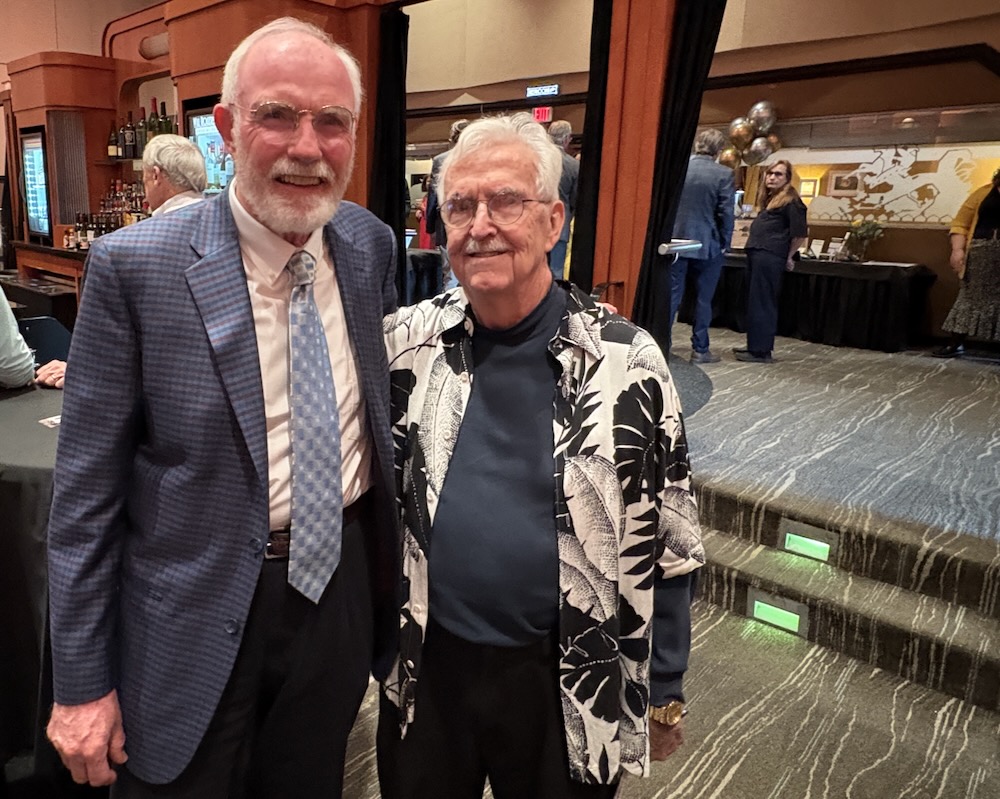
Michael McNutt with Mick Hinton, a former colleague at The Oklahoman.
Throughout his 40-year journalism career, Michael earned the respect of his colleagues, as well as elected officials across the state and of the people he really served — readers of his reporting and editing through the years.
I didn’t work on a day-to-day basis with Michael at The Oklahoman, but I got to know him as a thoughtful, approachable, empathetic person, as well as a baseball fan who remains devoted to his St. Louis Cardinals in both good times and bad.
A University of Missouri graduate, McNutt began his journalism career for the Rolla, Mo., newspaper before taking a job at the Enid News & Eagle in the 1980s. His wife, Kathryn McNutt, is also a longtime editor/reporter and veteran of The Oklahoman who now works at OKC’s Journal Record.
McNutt told me that he left The Oklahoman’s Enid bureau position in 2000 to become an editor and reporter in the paper’s OKC newsroom. He held editing positions on the state and city desks, and also covered the state capitol for eight years.
After leaving The Oklahoman in 2013, Michael served as spokesman and communications officer for Gov. Mary Fallin, before assuming the role of communications director for Oklahoma’s Office of Juvenile Affairs. He took the Nondoc position about two years ago.
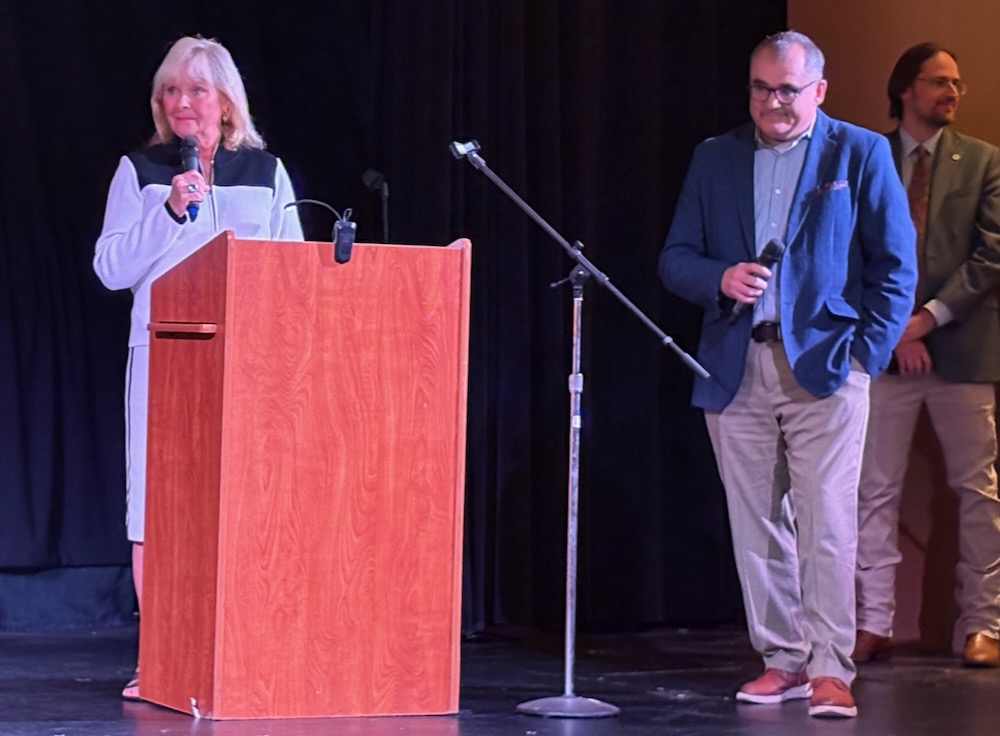
Former Gov. Mary Fallin shared the stage with Steven Buck, former administrator of the Oklahoma Office of Juvenille Affairs.
You could see evidence of the respect Michael earned in the audience at the NonDoc retirement ceremony. The room was filled with former newspaper colleagues, as well as state agency and elected officials, including former Gov. Fallin.
In fact, Fallin was a featured speaker, hailing McNutt for the work he did on her behalf, but also sharing some funny moments from his years on her staff. She was joined on stage by Steven Buck, who was OJA Administrator when Michael moved from the Governor’s office to that agency.
Buck shared his thoughts with me on the experience of working with Michael at OJA:
“When I found myself seeking a communications director for the Office of Juvenile Affairs, Michael quickly emerged as the best candidate. I had known him previously and greatly respected his work ethic but to serve as a lead advisor to me, I needed some one with great discernment, communication ability, confidence to hold me accountable and, of most importance, a commitment to mission and serving kids. There was not a single day in our work together that I regretted hiring him; he far exceeded my expectations and remains one of my most trusted colleagues.”
That’s the highest of praise.
I thought Tres Savage, NonDoc’s editor-in-chief, did a terrific job as emcee of the event, which served as a fundraiser for the Sustainable Journalism Endowment. The endowment provides funding for NonDoc to operate.
McNutt was the final speaker of the ceremony and told an intriguing story about how he was ‘almost fired’ from his job as a new reporter for the Enid newspaper just because he did his job. Michael said he received a tip that Enid city councilors met in secret at a local restaurant before each Council meeting and, along with a newspaper photographer, he “crashed” the meeting.
Michael McNutt speaking as Tres Savage, Nondoc’s Editor-in-Chief, looks on.
After his story appeared in the next day’s newspaper, a group of councilors marched into the editor’s office demanding that he be fired. The editor stood behind his reporter and told the elected officials to “follow the law.”
As for me, I had a terrific time at McNutt’s sendoff, greeting lots of my former Oklahoman colleagues, sharing time with both Michael and Kathryn and laughing at some of the stories I heard.
It was like a grand reunion.
Thank you, NonDoc, for giving him such a well deserved retirement recognition and to my friend, Steve Buck, for inviting me to sit at your table.
We’re all better off because of the work that Michael McNutt did over his career.
BONUS CONTENT — While Michael told me a story about an event I didn’t recall, I also shared with him about the first — and only — time I visited his office at The Oklahonan’s Enid bureau. Since I was from the “home office” of the paper and worked in the opulent (now former) newsroom along Broadway Extension, I had visions of McNutt working out of a similar abode in Enid. However, it turned out that he worked in a tiny office in a corporate building that was like a 1960s time capsule. I’m not sure exactly what I expected, but today all I can see in my mind is the bright green shag carpet in his office.
DOUBLE BONUS CONTENT — As I was visiting with Kathryn McNutt, along with other well wishers, someone brought up Michael’s avocation of making a daily, early morning run, no matter the weather. She told us that when the weather turned cold and the terrain ice covered, she made sure he wore baseball cleats on his run. One of the speakers at the retirement event spoke of once confronting a man in his neighborhood who was running in early morning darkness and wearing a ski mask, hockey jersey and baseball cleats. It was, of course, Michael McNutt.
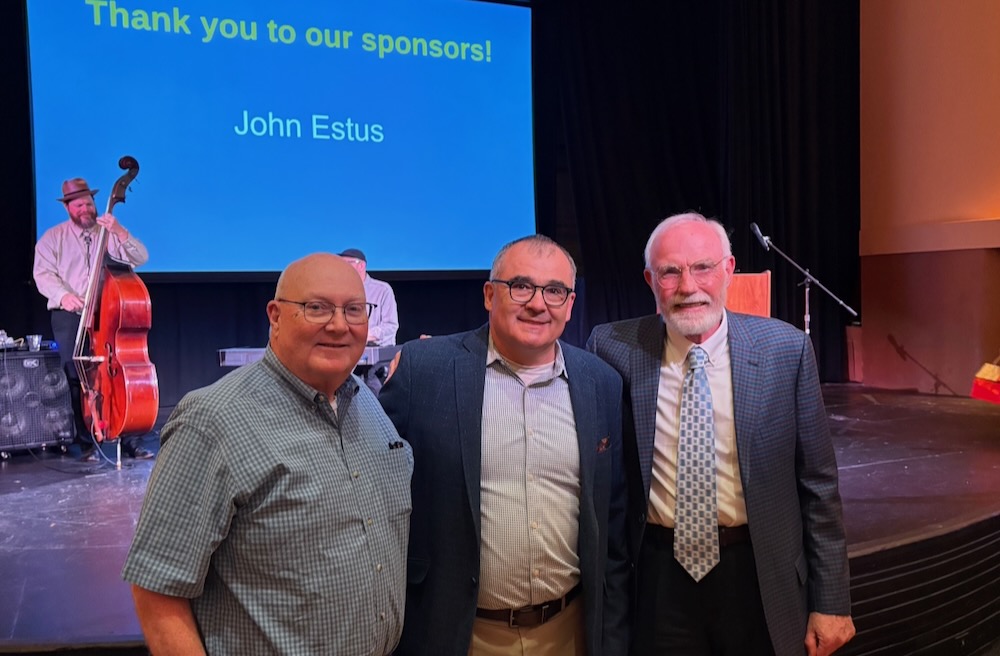
From left, Jim Stafford, Steven Buck, Michael McNutt
Dan followed up by saying that certain cities — St. Louis, Los Angeles, New York come to mind — have large fanbases, but that doesn’t translate into national interest in the game.
Plus, at that time baseball had no one player that had a national or global presence like, say, a LeBron James or Patrick Mahomes.
After I got over my initial righteous indignation, I came around to what Dan was saying about MLB. National ratings have slumped badly over the past couple of decades as young fans have put their focus on the NFL and NBA.
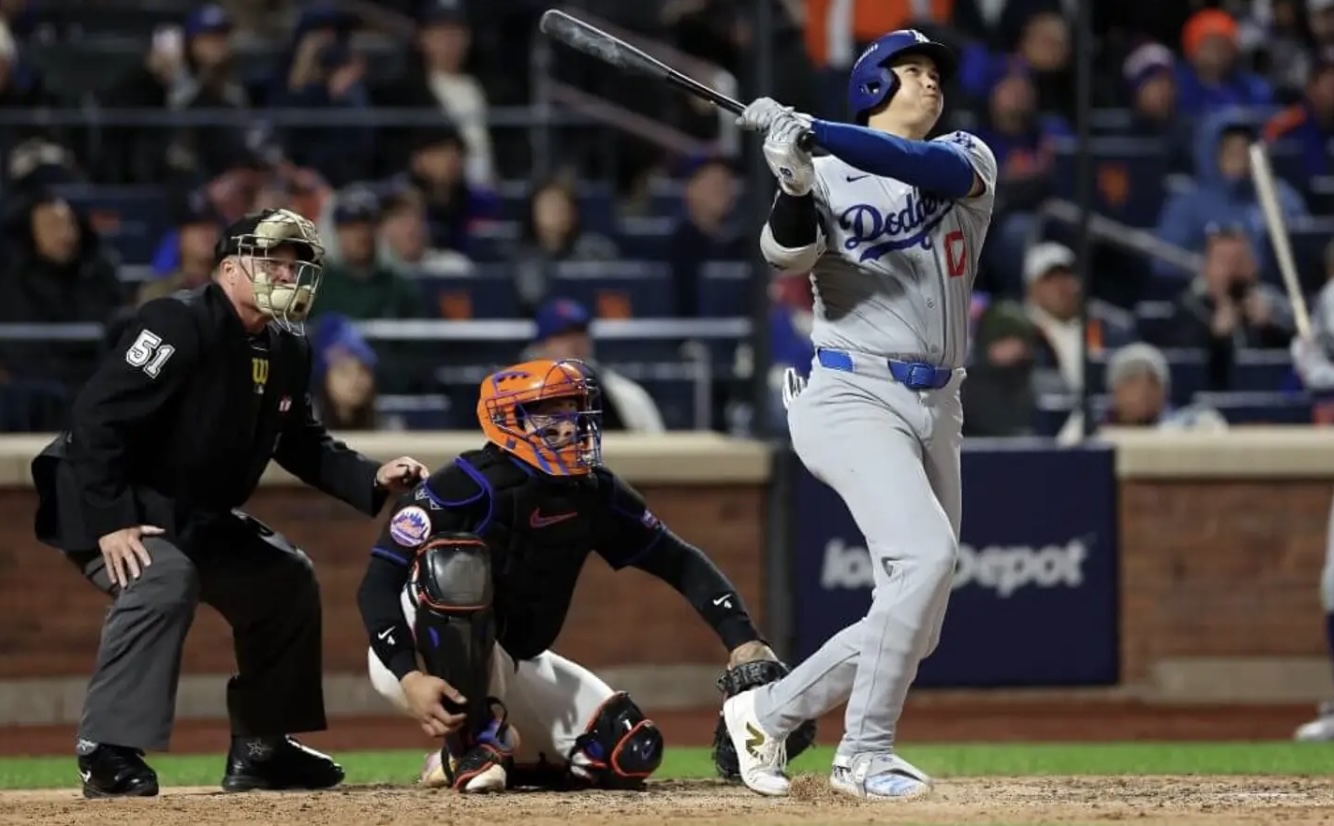
I couldn’t think of a single player that could command the attention of fans nationwide like LeBron or Mahomes. Shohei Ohtani may be the closest baseball player to a true global superstar.
Still, it’s clear that baseball, with its slow pace and not-made-for-TV presence — you can’t see all the players at once — has clearly been surpassed by the NFL and NBA.
So, when ESPN announced it would opt out of its MLB rights deal after the 2025 season, I was disappointed by not surprised. ESPN has been struggling with its viewership, too, and it is much more focused on NFL and NBA.
I was puzzled at how MLB Commissioner Rob Manfred planned to replace the ESPN revenue shared by all teams. What network would want to pay hundreds of millions to broadcast baseball and create surrounding programming?
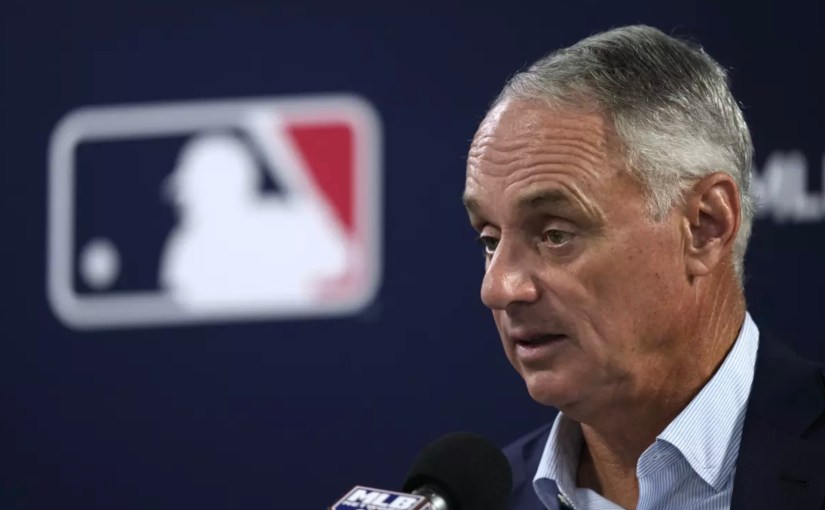
MLB commissioner Rob Manfred
Turns out, Manfred DOES have a plan, according to the Wall Street Journal article. In a lengthy and comprehensive article, the WSJ outlined the commissioners proposed scenario that appears to be a long shot.
Said the Journal:
“Manfred’s model would require teams to cede control of their local rights to the league office so that MLB could sell them collectively as a unified streaming package. Viewers would be able to purchase the games of teams they want to see without the blackouts that have long vexed devotees who actually live near where their favorite team plays.
“No cable subscription would be required. Revenue would be distributed among all teams, like it already is for national deals with Fox and Warner Bros. Discovery.
“The change that we’re talking about,” Manfred said in an interview, “is the only rational response to where the media market is today.”
There’s a huge problem with that plan.
MLB teams don’t share their local revenue with their baseball counterparts. Teams in Los Angeles, New York, Boston and Chicago all generate massive amounts of revenue through their local TV rights and are reluctant to give up any of that revenue for the Greater Good.
According to the WSJ, MLB teams lean on their local broadcast revenue more heavily than their NFL and NBA counterparts. Those sports have much larger national TV deals, and share the revenue across the league.
More from the WSJ:
“Cubs president Crane Kenney said in a recent interview at the team’s spring training facility last week in Mesa, Ariz., that his team would be willing to go along with a new TV model — as long as it accounts for his organization’s status as one of baseball’s highest-revenue teams.
“Treat us fairly,” Kenney said, “and we’re in.”
There’s little incentive for the big players to share their local broadcast revenue with their MLB brothers, unless they truly are concerned with the overall national decline of interest in the game. If a few teams folded, that might get their attention.
However, I can’t see the big market teams sharing their wealth with their small market counterparts — even if it helps sustain the sport.
This is 2025 America. Who does anything for the Greater Good?
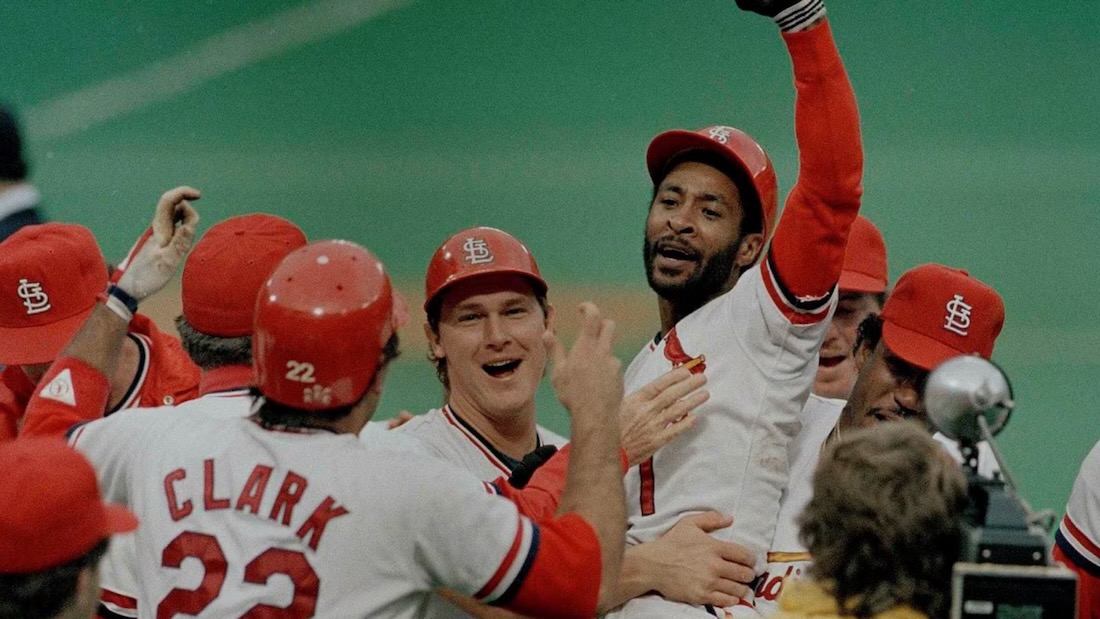
Ozzie Smith’s St. Louis Cardinals teammates celebrate his game-winning home run vs. the Dodgers in the 1985 playoffs
Editor’s note: My friend Ed Godfrey grew up in Eastern Oklahoma as a passionate St. Louis Cardinals fan, a devotion that began by listening to their games on his family’s big console radio. More than 50 years later, Ed remains a baseball fan and still follows the Cardinals with the same passion as he did as a 10-year-old Stigler Little Leaguer. I asked him to write about what sparked his fandom for the team from St. Louis, and he obliged with this essay.
By Ed Godfrey When I was a kid, baseball was king. That gives you a clue to how old I am. Yes, I am old enough to draw Social Security.
Ed Godfrey
I played Little League baseball, proudly donning the uniforms of King’s Tire Service, Guaranty Abstract and Davis Packing Company, some of the generous sponsors in Stigler who allowed the town’s pre-teen youth to live out their summer dreams on the ball diamond.
Like the Cardinals great utility man in the ’80s, Jose Oquendo, I would play everywhere on the field at some point. Dad nixed my playing days at catcher after just one game because he was afraid I would get hurt.
Center field was my best position, but I also took the bump a lot. I didn’t have Nuke LaLoosh stuff, but I could do what often none of my other teammates could do. Throw the ball over the plate.
Man, I loved baseball. Whenever I had a dime, I would ride my bicycle the six blocks from home to the Five & and Dime store in downtown Stigler and buy a pack of baseball cards.
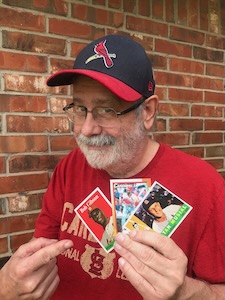
I was a pretty avid card collector in the early ’70s. And yeah, I stupidly put some of them on the spokes of my bike and glued others in a scrapbook, but most of my treasures are still intact. Thank you, mom, for not throwing away my baseball cards.
As you get older, I think the more you want to go back and be a kid again. That’s why I still buy baseball cards today. Nostalgia.
Back when I was a kid, I didn’t miss the major league game of the week on Saturday afternoons. Yeah, we got one baseball game on television each week. I also loved This Week in Baseball narrated by Mel Allen.
And I was a frequent listener of Major League Baseball games on the radio. This is how I became a St. Louis Cardinals fan.
First of all, the Cardinals were really good in the late ’60s. When I was 7, they won the ’67 World Series over the Red Sox. Then when I was 8, they lost the ’68 World Series to the Tigers.
(Don’t ask me about the ’85 World Series against the Royals, I am still ticked off about Game 6. Now, Game 6 of the 2011 World Series Game 6, that one was magical)
For many years, the Cardinals were the only major league team west of the Mississippi River and they developed a loyal following thanks to mighty KMOX-AM radio, which had a long reach throughout the South and Midwest.
KMOX helped turn countless families into Cardinals fans since 1926, including a kid in Stigler, Oklahoma.
When the Cardinals played on the West Coast and games started past my bedtime, I would sneak a transistor radio under my pillow so I could still listen to the broadcast without my parents knowing.
Otherwise, I would listen to games on our bulky old stereo-record combo that we had in our living room. In 1971, and I can still hear Jack Buck’s call of Bob Gibson striking out Willie Stargell to end the game for Gibby’s only no-hitter of his career.
“If you were here, it would have made you cry,” Buck proclaimed.
I wasn’t there but I felt like I was, thanks to one of the great baseball announcers in history.
When the Cardinals made the playoffs in the ’80s, every game, of course, was televised. But I turned the volume down on the TV and tuned in the radio for the play by play to listen to Buck. I got to hear his great “Go Crazy” call in the ’85 National League Championship Series against the Dodgers when Ozzie Smith unexpectedly hit the game-winning homer in Game 5.
I did “Go Crazy” in my apartment in Edmond, leaping from the sofa and landing on my knees in front of my TV in celebration.
A few years later I started dating my future wife. She tolerated my obsession with the Cardinals and actually enjoyed listening to Buck’s voice, even though she knew little about baseball.
Instead of going out on the town one Friday night, she drove from Norman to my apartment in Edmond and agreed to watch the Cardinals-Braves game with me on what was then Ted Turner’s superstation, TBS, which carried all the Braves games.
I promised we would go out for dinner after the game. It lasted 22 innings. My man Oquendo even came in and pitched when the Cardinals’ bullpen was depleted. (Told you he was a great utility player). He pitched several scoreless innings, but the Cards couldn’t get him a run and they lost.
Linda watched all 22 innings and never complained. Maybe she slept through an inning or two, I can’t remember for sure, but the point is she stayed until the end and then drove back home in the early morning hours. As Buck would say, “That’s a winner.”
I don’t listen to Cardinal games on the radio anymore because Buck and his broadcast partner, Mike Shannon, are no longer with us. Nothing against the new announcers, but it’s not the same for me.
This summer, I even stopped watching the Cardinals on TV because they stink this season. It’s been a long time since they have been this bad.
Well, the truth is I haven’t quit on them completely. I still sneak a peek once a while to see if the bullpen is going to blow another game and then I start cussing when they do.
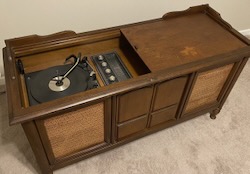 Otherwise, I would listen to games on our bulky old stereo-record combo that we had in our living room. In 1971, and I can still hear Jack Buck’s call of Bob Gibson striking out Willie Stargell to end the game for Gibby’s only no-hitter of his career.
 Jim Stafford's BlogOKC