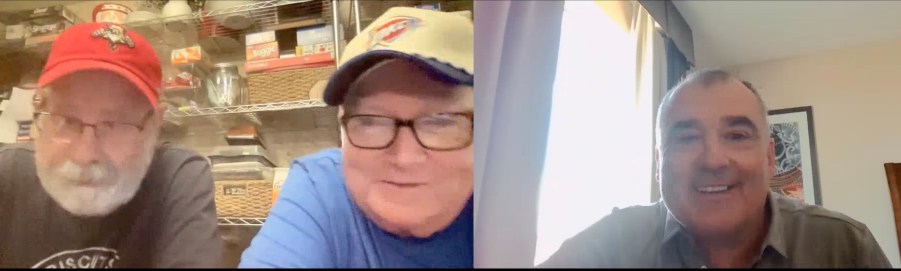
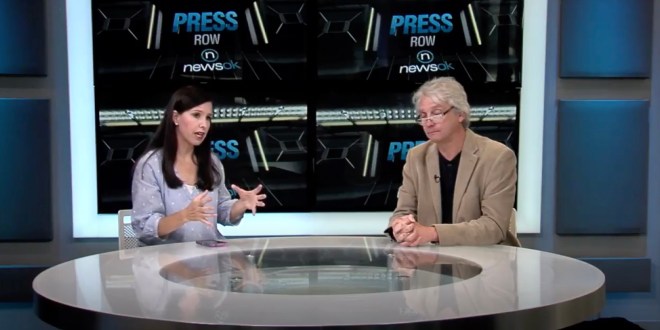
A screenshot from the 3 Old Geezers recent podcast recording session
Along with my friends Steve Buck and Ed Godfrey, I will celebrate a special anniversary on Nov. 6. Two years ago we launched the 3 Old Geezers podcast, which took years of sport debate via group text messages to a worldwide audio forum.
Steve serves as our host and keeps things on track, while Ed fills the podcast with humor and angry get-off-my-lawn rants about, well, anything and everything. I mainly serve as their foil because my perspective doesn’t fit in their neat little boxes.
I wrote about the 3 Old Geezers podcast back when we started at the end of 2023, and you can read it here.
We have no set agenda each week, except to cover the latest Thunder news, as well as that of other pro and college sports. We also may go off on an occasional non-sports rant.
Here are links to our two most recent episodes so you can discover for yourself what we’re all about. These links are to Apple podcasts, but we’re on Spotify or most places where you listen to your favorite content.
Here’s what my fellow Geezers say about the podcasting experience:
From Geezer Steve: “Having the opportunity to hang out with Jim and Ed regularly is something I cherish. Always spirited. Always funny. Just three guys who love sports bobbing and weaving through a conversation. When the idea surfaced one day that we should record our ramblings, the idea seemed like a natural. So, regardless our listener count, we keep going because its a chance to spend time with good friends. And time with friends is something I am learning to cherish more each and every day.”
From Geezer Ed: “Frankly, I am doing a podcast because I enjoy the company. And after 40 years in the newspaper business, I like telling stories, and now I can tell some whoppers. Besides, I can’t let Geezer Jim’s goofy opinions go unchecked. I enjoy the company and the conversation.”
My reasons for doing the pod are similar to Steve and Ed in that I enjoy hanging with the guys, as well as airing my thoughts on sports subjects, whether they are in line with conventional thinking or not.
For the most part, we’ve kept an every-other-week podcast schedule, except for an extended break we took over the summer, before relaunching the pod on Oct. 17.
We’re committed to posting a new episode weekly throughout the OKC Thunder season, which means we’ll have to do some remote when one or more Geezers are tied up with work or out of town. Episode 45 was recorded with Steve calling in from out of town, so we’re off to a good start.
I hope you listen to and enjoy the sample episodes using the links above. Then subscribe and keep up with our Geezer rants, raves and get-off-our-lawn takes.
The 3 Old Geezers podcast is presented through the generosity of MentaliTEA and Coffee in Bethany. I hope you will visit them and enjoy a coffee or tea and something tasty off their food menu.
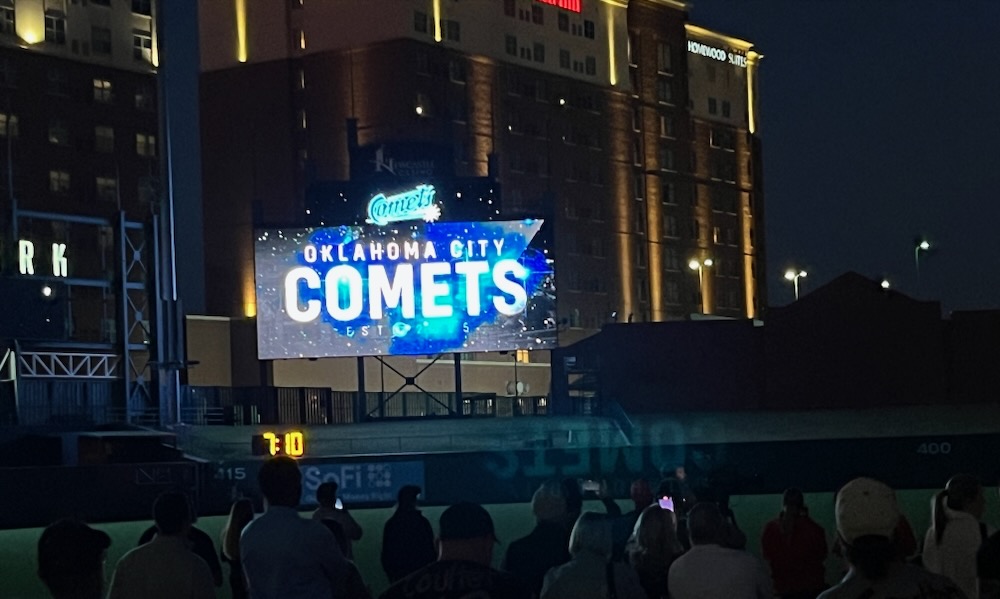
The Bricktown Ballpark scoreboard shows the team’s new name at reveal event.
The Oklahoma City Baseball Club revealed its new name, “Comets,” in a ceremony Saturday evening at the Chickasaw Bricktown Ballpark witnessed by at least a couple thousand enthusiastic fans.
I was among those who showed up for the Big Reveal, so I can attest to the collective cheer that went up when the “Comets” name and logo appeared on the scoreboard screen.
I was not expecting “Comets,” although I’m not sure what I expected. Maybe “Flycatchers,” which my friend Ed Godfrey had predicted as the future team name. Or the “Waving Wheats” or something that related to Oklahoma.
An aside: There’s is already a “Flycatchers” team in Oklahoma in the Pecos League team Blackwell Flycatchers. Yes, Blackwell.
The OKC club tried hard to make “Comets” make sense for OKC baseball fans by linking it to Commerce, OK, native and MLB Hall of Famer Mickey Mantle. If you are like me, over the age of 60 and a long-time baseball fan, you know that Mantle was known as the “Commerce Comet.”
But if you are, say, 30 years old and a casual baseball fan, you may not even know who Mickey Mantle is or that he was from Oklahoma or that he had the “Comet” nickname.
In its presentation that night at the ballpark, the team also pointed out that stadium is located on Mickey Mantle Drive.
I thought it was a pretty big reach to link the “Comet” name to Mantle, but not entirely out of order. The team also linked the “Comets” name to the number of astronauts who were native Oklahomans.
Now THAT is a reach.
Ed Godfrey attended the event with me, and he was pretty ambivalent to the “Comets.” If I remember correctly, he said “meh.”
But our mutual friend, Steve Buck, had a much stronger reaction. About two minutes after the “Comets” name reveal, Steve unloaded on the name in our group text.
“Comets!!!! Why? Help me understand please? I hate it”
Yes, but how do you really feel, Steve?
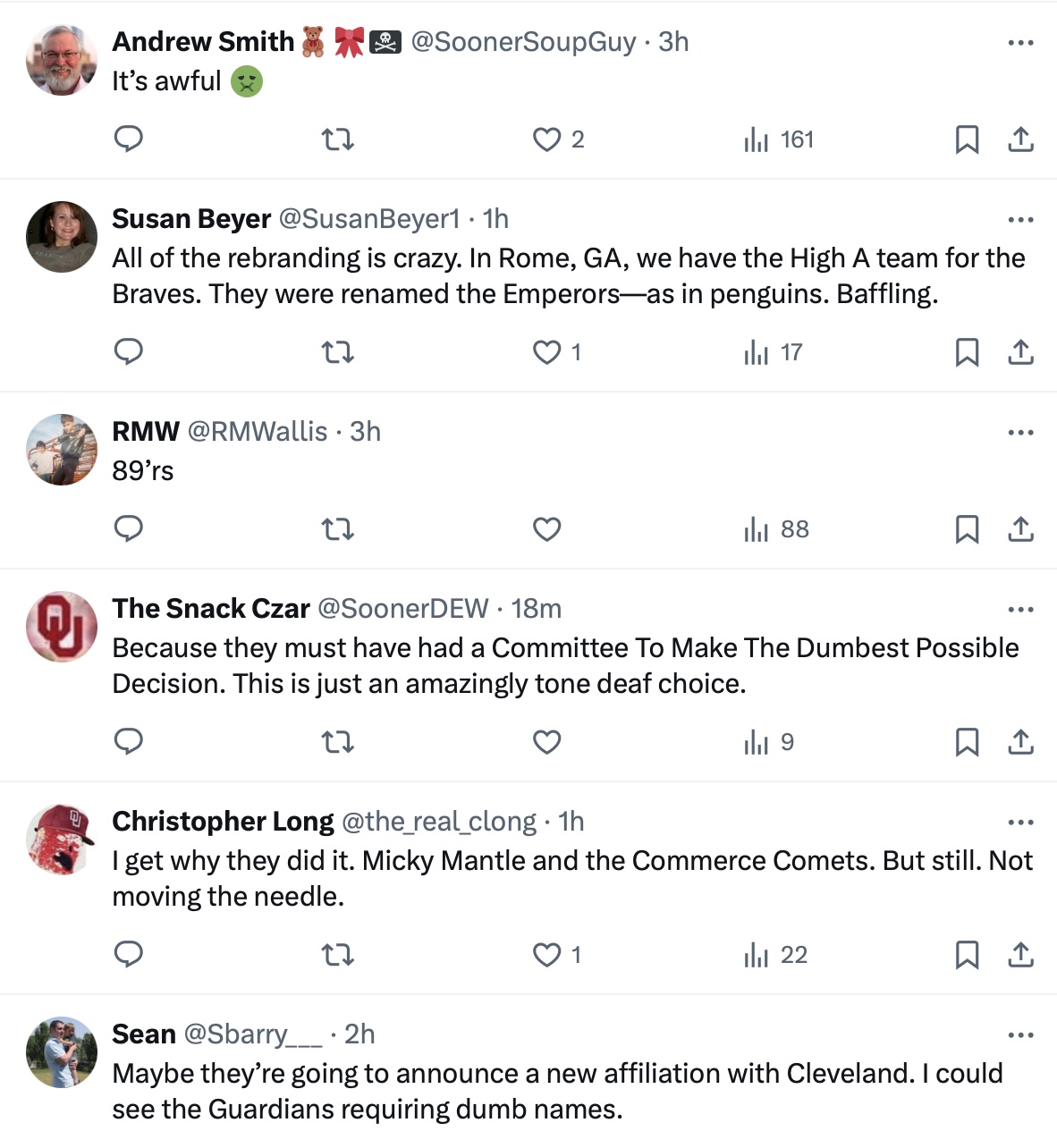
The reaction on social media was similar, with dozens of folks posting on Twitter (now X) their opposition to the new name.
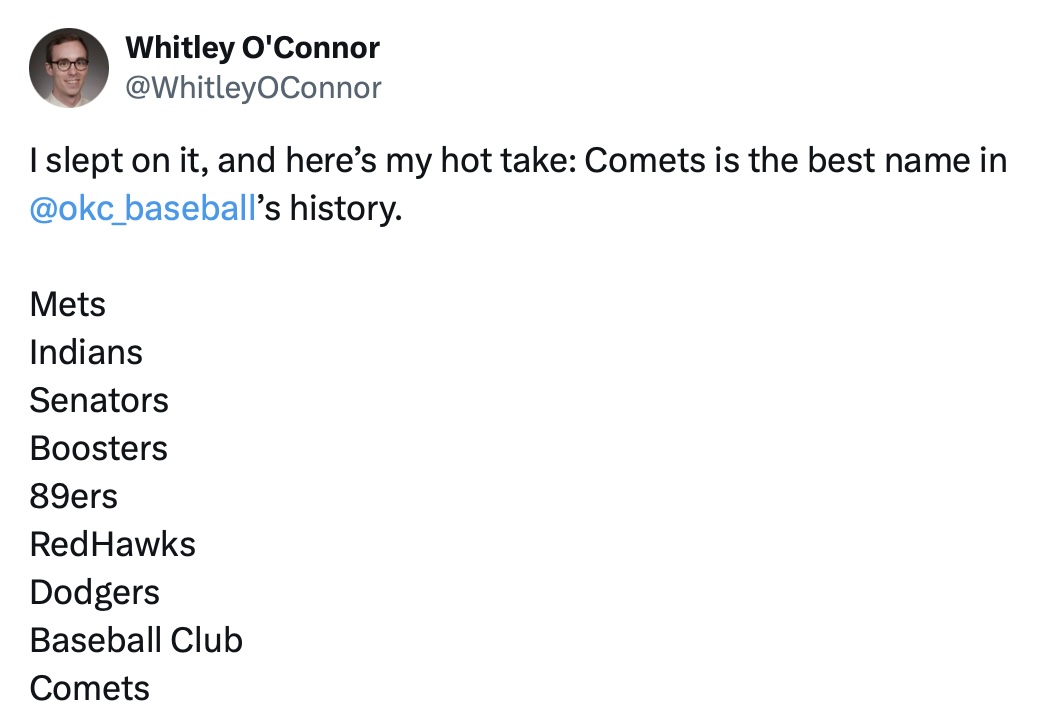
However, they aren’t ALL negative. In fact, Whitley O’Connor, co-founder of the Curbside Chronicle, went so far as to declare it the “best name in OKC Baseball’s history.”
Whitley makes a good point.
Before we left the “Comets” name reveal event on Saturday night at the Ballpark, I ran into my friend Russ Florence, and his son, Luke. Russ was all in on the new name, so I told him about Steve’s instant reaction.
“He’ll love it by the end of next season,” Russ predicted.
Bottom line: I’m pretty sure the actual name of the team won’t lure more people to the ballpark next year or drive any away. (Full disclosure: Steve Buck and I are both partial season ticket holders; and the team name won’t influence our decisions to follow the team)
Those of us who attend Comets games will be there just to watch some good ball, as my old editor, the late Bob Colon, would say.
As Ed and I were walking out of the stadium afterward, Ed said the name really didn’t matter because the team would change it in three years, anyway (presumably for the boost in merchandise sales, for you cynics).
If that is true, then the “Comets” name is perfect, I replied. A comet appears in the sky one night, and a few nights later it has disappeared.
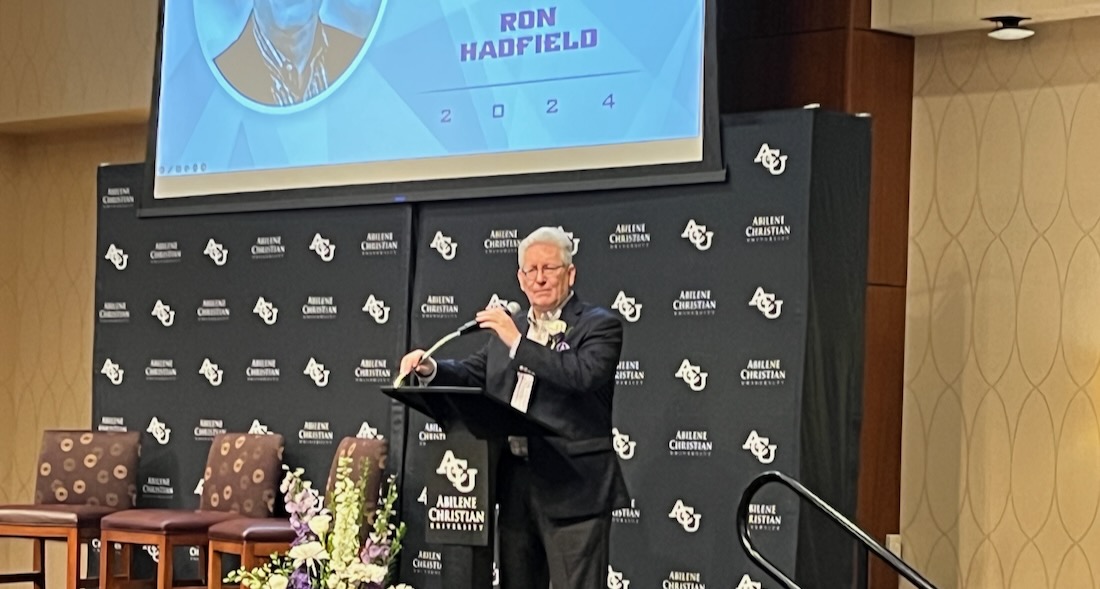
Ron Hadfield adjusts the mic as he speaks to the ACU Hall of Fame audience.
Ron Hadfield is a long-time friend who was my student editor on the Abilene Christian University newspaper, The Optimist, in 1977. Ron recently was recognized with a Lifetime Achievement Award at the ACU Athletic Hall of Fame ceremony that I was privileged to attend.
I showed up on ACU’s doorstep in 1976 as a transfer student with a dream to some day become a newspaper sportswriter, but with virtually no writing experience.
To say that I was a raw talent would be overstating my ability and potential. I didn’t have a clue.
Ron likes to tell the story that on the first assignment he sent me out on, I turned in some terrible copy and proudly showed him the quotes I made up.
I deny the accuracy of his memory.
But he was a patient editor who helped me begin to find my way as a writer.
I didn’t know the intricacies of sports — especially basketball — as well as I thought I did, and Ron helped me learn strategies such as the double high stack offense used by ACU men’s basketball coach Willard Tate.
As we shared both the Optimist newsroom and numerous ACU classes, Ron became a good friend. We each had a keen interest in sports, baseball in particular, and we traveled to Arlington, Texas, with our mutual friend, Scott Kirk, to catch Texas Rangers games on several occasions.
Ron and I even traveled to Kingsville, Texas, together to watch the 1977 ACU-Texas A&M-Kingsville game, spending the night on the North Padre Island beach.
Our 1977-’78 Optimist staff of perhaps a dozen people became a team of close friends who spent late nights getting the paper out and often playing touch football well after midnight on the ACU campus. We were popular with campus security.
Me (front row, right) with colleagues from The Optimist in 1978
Optimist staff members were all regulars at the home of Dr. Charlie Marler, who led ACU’s Journalism and Mass Communications department for many years both as professor and chair. I completed a guided study sportswriting course one summer where we met at the Marler home instead of on campus. Dr. Marler passed away in 2022.
Anyway, I graduated in August of 1978, while Ron went on to serve a second year as editor of The Optimist before graduating in 1979. I’ve never let our friendship totally lapse, even if communication was only through occasional emails or texts.
After his graduation, Ron briefly worked in private industry back in his home state of Michigan, then returned to ACU to lead the university’s marketing efforts.
For the next 40-plus years, virtually every written word, advertisement, branding strategy and logo created on behalf of Abilene Christian University was either produced or led by Ron. He was founding editor of the university’s fabulous alumni publication, ACU Today, and led the school’s development of its online presence with the emergence of the Internet.
Ron wrote many cover stories for ACU Today, as well as blog posts and news releases that captured some of the school’s iconic moments over the past four decades.
The only person to be twice named the university’s Staff Member of the Year, Ron was named ACU editor emeritus, senior writer and university historian in 2022.
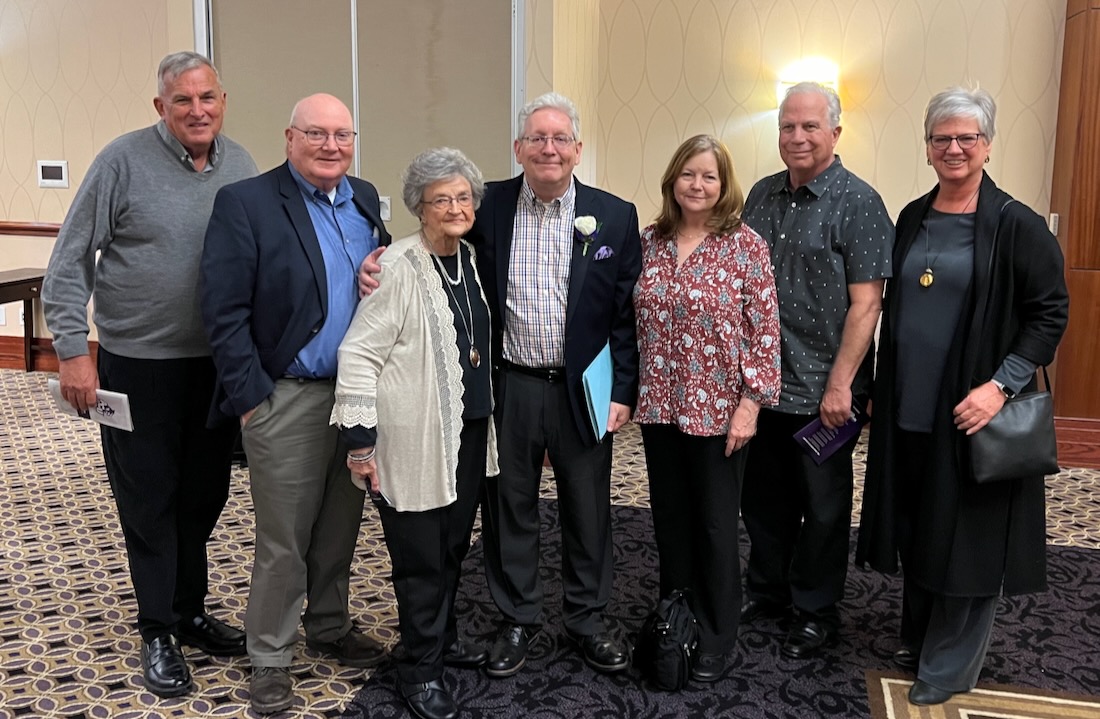
So, when Dr. Cheryl Mann Bacon invited me to sit at her table at the Hall of Fame induction ceremony, I didn’t hesitate to say ‘yes.’ Also at the table were fellow former Optimist staff members Scott Kirk (and his wife, Nancy) and Corliss Hudson Englert (along with her husband, Brad), as well as Peggy Marler, Dr. Marler’s wife of 67 years.
Dr. Bacon also was part of our Optimist group, although she was working on her master’s degree by the time I landed on campus.
From left, Scott Kirk, Jim Stafford, Peggy Marler, Ron Hadfield, Corliss Hudson Englert, Brad Englert, Cheryl Mann Bacon
It was an awesome evening in a banquet hall setting among about 200 or so ACU alums who watched as Ron was honored with the Lifetime Achievement Award, and five former athletes were inducted into the Athletic Hall of Fame.
Although I’ve never had the opportunity to experience any of ACU’s class reunions, this was the best of reunions for me.
The Dot Race as presented on the Texas Rangers scoreboard in the 1980s.
If you frequented the late All Sports Stadium to watch the Oklahoma City 89ers Triple A baseball team play during the 1980s, you probably were a fan of an animated scoreboard feature known as the Dot Race.
I know I was.
I can remember many nights at the ballpark when the Dot Race prompted thousands of fans to cheer on their favorite computerized, pixelated “Dot” like they were at Churchill Downs. Sometimes, there seemed to be more excitement surrounding the faux scoreboard race than the actual game.
If you can recall through the hazy years of the past, the three Dots — labeled Dots 1, 2 & 3 — raced down an animated speedway toward the finish line. Sometimes a dot veered into the wall or had a breakdown just when it appeared it would win the race.
A form of the Dot Race lives on in the 2020s as between-inning entertainment for the Texas Rangers and other Major League parks around the country. And as time has passed, few people recall that the Dot Race had its beginning as humble, white dots on the 89ers scoreboard in Oklahoma City.
Turns out, the Dot Race was the brainstorm of a then part-time 89ers employee and University of Oklahoma student named Larry Newman.
By coincidence, when I arrived in The Oklahoman newsroom as a sports copy editor in 1983, Larry also worked part-time at night on the paper’s sports desk, taking scores and writing up short summaries of high school basketball and football games.
I got to know him as a bright, competent young man who also had an interest in computers and software coding. One night he brought the first Macintosh computer I had ever seen in the wild into the newsroom.
So, it wasn’t long before I learned that Larry was the creator of the Dot Race, although I didn’t know the full story until a recent Saturday morning when we caught up with one another at MentaliTEA and Coffee in Bethany. It was the first time we had seen one another in roughly 40 years.
I wanted to know the story of the Dot Race, and Larry was happy to share it.
Larry Newman, creator of the Dot Race, in 2023 .
Larry Newman began working as a ticket taker for the 89ers while in high school back in the late 1970s. He eventually was asked by owners Bing Hampton and Patty Cox to take over duties of operating the scoreboard pitch count from the press box.
“I did balls and strikes for probably two or three years,” Larry said. “In that role, you are watching every single pitch of every single game throughout a baseball season. So, a lot of innings.”
The next development leading to the Dot Race involved a new scoreboard installed at All Sports Stadium in a sweetheart deal between the 89ers, the City of Oklahoma City and the Miller Brewing Co.
“The people from Miller said we will give you a brand new scoreboard and attached message center in exchange for leaving the Miller Brewing Company logo advertisement on top of the new scoreboard for some number of seasons,” he said. “That’s what the Dot Race ran on; that message center.”
That brand new scoreboard offered a three-line message center, which provided the opportunity to not only display text, but to develop simple graphics that would be displayed. It came with a couple pre-made animations that had clapping hands and home run celebrations.
So, Larry learned to do frame-by-frame animations that were written in code to magnetic tape storage — no fancy floppy discs for this scoreboard. Larry began working on his Dot Race idea because the 89ers had no between-inning entertainment during one half inning of each game.
Larry dove into the coding challenge. He said it took about 35-40 hours to create the first race course and the dots — “pixel by pixel,” but after the first one was completed, programming each individual race to run on his course took about 30 minutes a night, he said.
So, the Dot Race was born.
“When I showed the idea to 89er owners Bing Hampton and Patty Cox, they approved the idea and actually promoted it at each 89er home game,” Larry said. “The public address announcer said, ‘hey, we’ve got a new feature, the Dot Race. Pick your winning Dot.’ We did it every night and people started getting into it.”
Larry programmed a new Dot Race for every game, and fans liked it so much that some asked him to tell them in advance what the winning Dot was going to be that night. He said he never disclosed the winner prior to any race.
“I had a race once where a Dot ran into the wall and an ambulance came out and picked it up,” he said. “That one took a lot of time to build.”
During this time the 89ers switched Major League affiliation from the Philadelphia Phillies to the Rangers, which was critical to the eventual spread of the Dot Race across baseball.
One night, visiting Texas Rangers officials that included then-General Manager Tom Grieve came to OKC to watch their minor league players. The Rangers reps spoke to Larry in the press box that night.
“They came up to me and said, ‘hey we want to see this Dot Race thing; we’ve heard about it from a couple of the players,’ ” Larry recalled.
The Rangers officials watched it and saw the fans reacting to it.
“They asked, ‘how did you do that?’ I said ‘it’s a very involved process.’ “
A short time later, he got a call from the Rangers scoreboard operator. The Texas version of the Dot Race was soon born and became hugely popular.
The 89ers — but not its inventor — got credit in early DFW area newspaper articles about the Dot Race phenomenon.
A story in the August 24, 1986, edition of the Fort Worth Star-Telegram quotes Rangers PA announcer Chuck Morgan as crediting the idea to the 89ers, but said it came to the Rangers via a newspaper reporter.
But in newspaper articles about the Rangers Dot Race just a decade later, Morgan made no mention of its Oklahoma City roots.
And on the current Website called “Ballpark Brothers,” the Dot Race is 100 percent attributed to Morgan.
“The Dot Race at Arlington Stadium was first originated by Arlington Stadium announcer Chuck Morgan, who somehow got the tech guys to have 3 colored dots circle around an oval on the scoreboard, much to the fans’ glee. It was this dot race that spawned all other video races and the human races in ballparks across North America.”
I guess you can chalk that up to the loss of institutional memory over time.
So, I asked Larry if he was bitter at not receiving any recognition for creating the Dot Race phenomenon that continues to circle scoreboards in different forms around the nation.
“It didn’t upset me, but I do remember walking into the Rangers stadium not too long after they came to Oklahoma City,” Larry said. “They were handing out a small card with a dot color on it to everyone entering the stadium. Some of the cards had a red dot, some had a blue dot and some had a green dot, and it was sponsored by Wendy’s or Arby’s or someone. If the dot you were handed won the race that night, you could go to the restaurant and get a free small burger or something.
“I’m like, ‘these people are finding a way to make money off my Dot Race.’ ”
But decades have passed, and Larry Newman is now a retired technical writer whose last employers were tech giants Google and Oracle. He looks back over the years and finds the silver lining in the story.
“I’m happy that people have enjoyed it for so many years,” he said. “Absolutely.”
In the grand scheme of Dot Race life, that’s a winner.
EDITOR’S NOTE: More info on the roots of the legendary Dot Race:
Larry Newman told me the Dot Race got a big boost with the 89ers audience when 89ers Director of Communications Monty Clegg began doing play-by-play announcing of the racing dots. I contacted Monty, who now lives in the Dallas-Fort Worth metroplex, to get his side of the story and here’s what he told me:
“Larry was really creative and worked some magic with a limited slate of a three-line message center with the 89ers,” Monty said. “Bing Hampton suggested that we have a Dot Race track announcer. Since I worked in the press box, I think I was volunteered. I still remember that as the dots rounded for home, I would always say ‘And they’re spinning out of the final turn!’
The Dot Race tale is a great story, and I thank Larry Newman and Monty Clegg for letting me share it.
As I was sitting in the stands at OKC’s All Sports Stadium in roughly 1987 watching the Big 8 baseball tournament with my Daily Oklahoman colleague, Tom Kensler, a lanky young man sat down with us.
Kensler, now deceased, was the paper’s OSU beat writer in 1987. He introduced me to the newcomer.
“Jim, I want you to meet the newest member of our Sports staff, Berry Tramel,” Tom told me as I shook Berry’s hand.
Although I had worked as a copy editor on the Sports desk at the Oklahoman since 1983, I didn’t know Tramel, who worked as a sports writer at the Norman Transcript.
Something happened, however, and Berry did not become a member of The Oklahoman’s Sports staff until 1991. Maybe the Transcript offered him a raise or he still had things to accomplish at the Norman paper.
But Berry eventually joined The Oklahoman staff and became our lead sports columnist. He quickly established himself as one of the top sports writers not only in Oklahoma but across the nation.
I don’t remember much of that first conversation with Berry at the ballpark, but eventually I found him to be warm, empathetic, approachable and the most prolific and hard-working writer I’ve ever known.
Berry writes in what I consider a folksy manner that carries the reader along. He has an incredible ability to uncover the critical issue that may be plaguing — or helping — a team, a coach, a school, a state, whatever. And he’s a walking encyclopedia of sports history.
Berry’s most influential article of them all may be the infamous “Taco Bell” column from the late 1990s when he compared OU’s hiring of John Blake to a company that put a management trainee in charge of the entire business.
Not everyone loves his style — ask my friend, Casey — but he’s attracted a huge following far and near over the years. Including me.
Berry was joined on The Oklahoman Sports staff in the late 1990s by Jenni Carlson, a Kansas native who brings a unique point of view to whatever she’s writing about. I’ve come to know Jenni, as well, and love reading her intriguing takes that often focus on people who have overcome long odds to become successful.
I’ve written all of this because, as most people know by now, both Berry and Jenni are leaving the paper. They’re joining a new online venture called The Sellout, Sellout Crowd, or something like that. It should debut later this month, from what I understand.
I got wind of Berry’s impending exit about three weeks ago and immediately sent him an email with the subject line “Say It Ain’t So.”
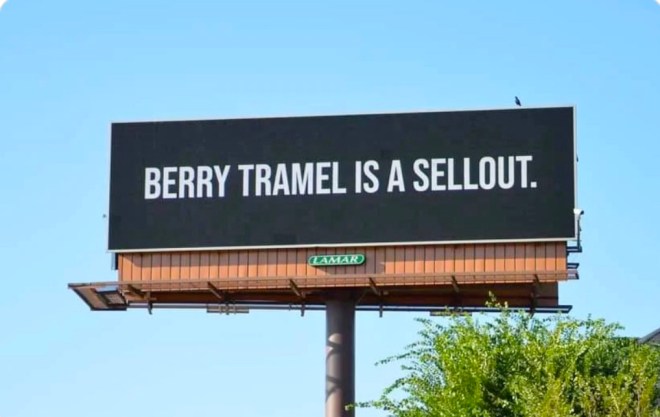
Berry responded and said it was so. He said it’s a good thing, not bad, because readers who follow him and Jenni will be able to read their work in a free online newsletter. He even wrote about his impending departure from the paper after billboards appeared saying “Berry Tramel is a Sellout.”
But I’m mourning for the newspaper because of the loss of such immense talent. I was part of that newsroom as a writer and editor for over two decades.
Although I’ve been gone from The Oklahoman for almost 15 years, I’m still a subscriber and a daily reader of the newspaper. I still pick it up off my driveway every morning (except Saturday).
We all know that the Internet has changed the way people consume news, sending the newspaper industry into a long decline, including The Oklahoman. In my opinion, the paper has done a great job of building its online enterprise while still keeping print alive.
For now.
But the loss of Berry and Jenni is a huge blow to readers like me who look forward to unfolding the paper every day (but Saturday) and seeing what one or both have written for us. Who can replace them?
So, what’s next? I’m anxiously watching as the leaves continue to fall from the tree and the newsroom branches become bare.


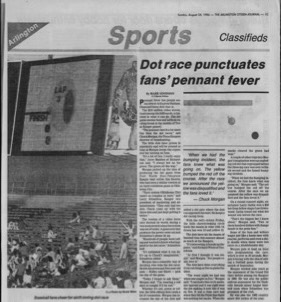 A story in the August 24, 1986, edition of the Fort Worth Star-Telegram quotes Rangers PA announcer Chuck Morgan as crediting the idea to the 89ers, but said it came to the Rangers via a newspaper reporter.
 As I was sitting in the stands at OKC’s All Sports Stadium in roughly 1987 watching the Big 8 baseball tournament with my Daily Oklahoman colleague, Tom Kensler, a lanky young man sat down with us.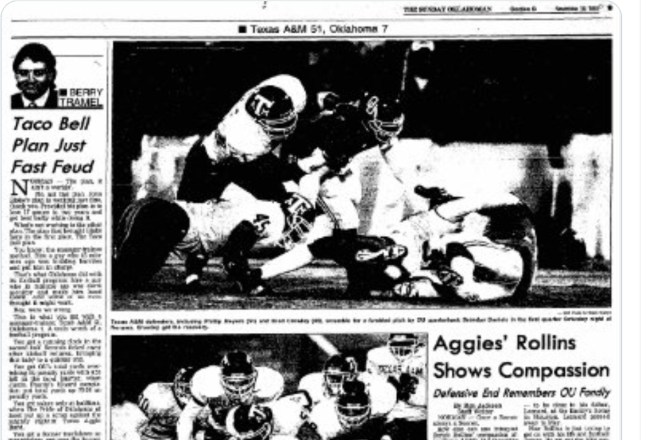
 Jim Stafford's BlogOKC