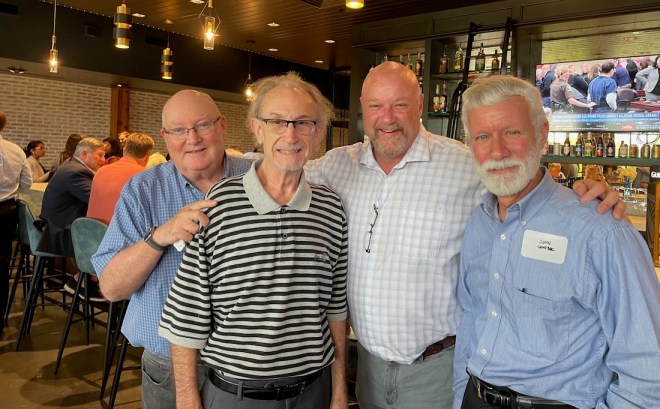
There was no media coverage, but a milestone celebration occurred last week for i2E, an Oklahoma City-based not-for-profit corporation that has had a major impact on Oklahoma’s innovation economy since its debut in 1998.
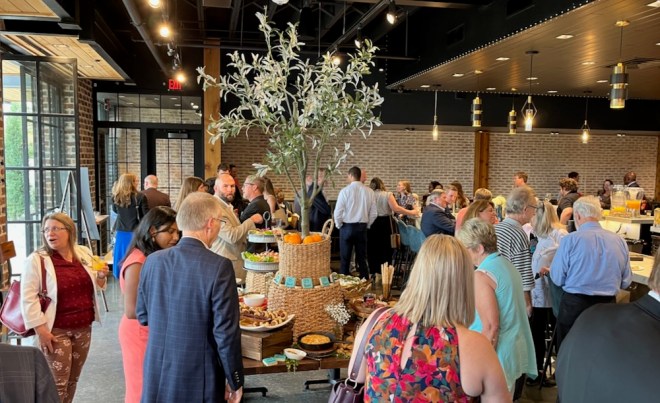
Friends and employees — both current and past — celebrated i2E’s 25th anniversary at the City and State Event Center on NE 6th Street.
Roughly 75 of us gathered to catch up with old friends and hear some historical perspective from i2E President Rex Smitherman about the not-for-profit. i2E provides education, business advisory services and investment for Oklahoma’s tech-based entrepreneurs.
I’m a former i2E employee who worked in its marketing office both as full-time employee and contract worker from 2009 to 2022.
So, the anniversary celebration was a homecoming of sorts for me to see my former colleagues.
But first you should know a little more about i2E. It was created in 1998 as the Oklahoma Technology Commercialization Center by the Oklahoma Center for the Advancement of Science and Technology, which is the state agency that supports innovation and scientific research across the state.
That original name was unwieldy, so it soon became known as i2E — Innovation to Enterprise. The first CEO was Randy Goldsmith, followed by the late Greg Main, and then Tom Walker.
I entered the picture as an employee just after Tom became CEO and I retired as a newspaper reporter with The Oklahoman. I had become acquainted with Tom when he was i2E’s Chief Operating Officer in the early 2000s and I was the paper’s technology beat reporter.
After Tom moved to Columbus, Ohio, to lead a similar institution, Scott Meacham became CEO, continued to expanded the mission and retired from that position earlier this year. Scott remains Executive Chairman of the Board.
Today, Oklahoma boasts a growing number of venture capital firms and business accelerators, but back in 1998 there was virtually no organized investment capital for entrepreneurs.
That was the bleak landscape that i2E stepped into, thanks to the vision of Sheri Stickley and William Hagstrom. The pair —Stickley with OCAST and Hagstrom an Oklahoma entrepreneur — conceived of the idea of a private company, seeded with public dollars, that would provide assistance to businesses that were spun out of Oklahoma’s universities or the minds of local inventors.
Here’s more perspective on i2E’s history from a column authored by Meacham on the occasion of its 20th anniversary five years ago.
The headline described it was an “Oklahoma success story,” and that’s no exaggeration.
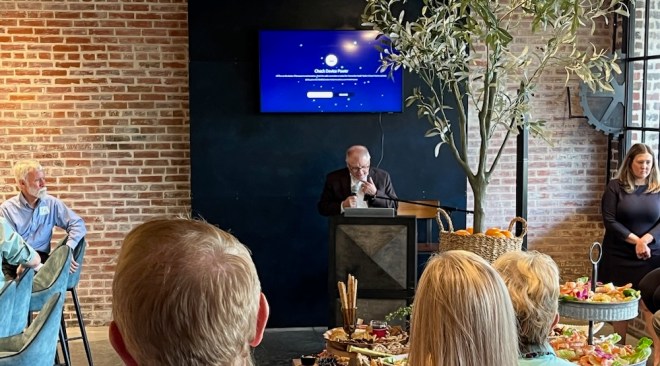
As Rex outlined in his presentation at the anniversary celebration, i2E has provided business advice or investment for over 800 fledgling companies across its history. It has provided more than $83 million of investment capital to Oklahoma ventures.
Here are a few of the high impact success stories for which i2E provided advisory services and investment: WeGoLook, Selexys Pharmaceuticals, Spiers New Technologies and Alkami Technology, a billion dollar public company that was founded in OKC in 2009 by Oklahoman Gary Nelson.
And i2E’s mission continues to expand. In fact, Rex devoted much of his presentation at the anniversary celebration to looking forward to i2E’s future impact through its new programs.
Today, i2E embraces a big educational mission, having launched and managed the statewide Love’s Entrepreneur’s Cup collegiate business plan competition that will celebrate its 20th anniversary in 2024. Now, i2E is launching a pilot high school business plan competition in a partnership with the MidAmerica Industrial Park in Pryor.
There’s more expansion news. i2E developed a popular workshop for new entrepreneurs called E3, which helps them determine whether their venture has a realistic opportunity for success. Joining E3 will be a second program called Bridge2, described as an 8-week ‘pre-accelerator’ that provides $50,000 in convertible debt funding for founders.
In addition, i2E created a subsidiary a few years ago known as Plains Ventures, which now handles virtually all of the investment activities for the company.
But enough of the history and impact of i2E.
For me, the anniversary celebration was a chance to catch up with old friends, even if just for a few moments. Folks like Rick Rainey, Cindy Henson, Mark Lauinger, Srijita Ghosh, Darcy Wilborn, John Campbell, Kevin Moore, Shaun O’Fair, Rex Smitherman and former OCAST executive director Michael Carolina.
I even had the opportunity to share a few moments with our former finance director, David Daviee. My only disappointment was that not all of my former i2E colleagues made it to the event. You know who you are.
Maybe for the next ‘family reunion.’
But life goes on. As i2E’s mission continues to expand, it’s been joined in the space by a host of new Oklahoma investment and accelerator partners, both here in OKC and in Tulsa.
While the investment outlook for new entrepreneurs and ventures in 2023 is far from bleak, the time was right for an i2E when it became a reality in 1998.
It really was an idea whose time had come.
BONUS: I came across an old story by the Oklahoma Council of Public Affairs, a conservative research organization that generally attacks any new idea that uses public dollars to advance an innovative concept, no matter how many people benefit. Here’s a sample of the article:
“The Oklahoma Center for Science and Technology (OCAST) should no longer receive state funding for the Oklahoma Technology Commercialization Center (OTCC). This program directly competes with the private sector and existing market participants engaged in business formation and development.”
You get the drift.
My response: Back in 1998 and for many years afterward, there was little private sector investment capital in Oklahoma competing with the i2E concept. Many new ventures likely would not even have been attempted had i2E not been in existence. Oklahoma’s innovation economy expanded because of i2E’s efforts, and now new private ventures are bringing new investment to the state.
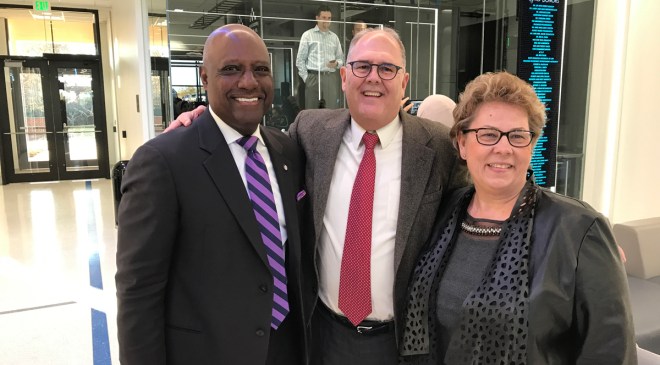
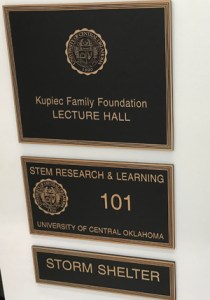 The Don Betz Center, named after the current UCO President, features state-of-the-art research and teaching labs for multiple academic disciplines and a striking lecture hall that can accommodate 80 students.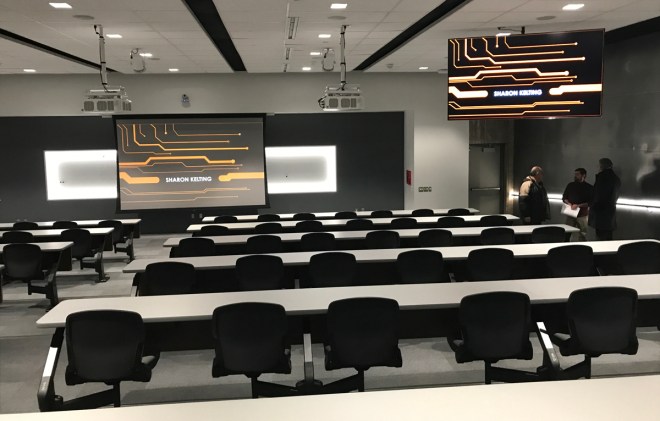
 Jim Stafford's BlogOKC