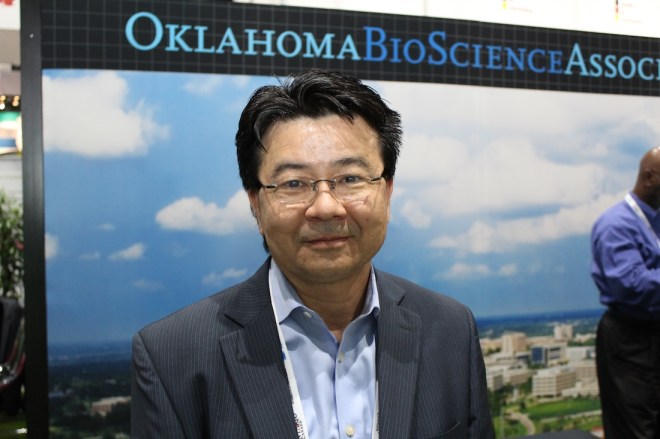
I met my friend, Dr. Craig Shimasaki, at a conference 1,600 miles from OKC

Dr. Craig Shimasaki at OKBio booth on the floor of a past Biotechnology Industry Organization conference.

Two decades ago, I was one of a group of more than 50 Oklahomans who represented Oklahoma’s life science community at the annual BIO — Biotechnology Innovation Organization — conference in San Francisco.

It was my first time to attend the BIO show and to travel as part of the group that identified itself as OKBio. The annual BIO show brings thousands of people — scientists, entrepreneurs, investors, economic development professionals and reporters — together for a week of networking and showcasing emerging life science technologies.

There was a joke that we had to travel 1,600 miles to get to know our neighbors.

Only it was not a joke, but, in fact, reality.

That 2004 BIO show was my first of what became more than a dozen trips with the OKBio group to pitch Oklahoma and our growing life sciences community in major cities like San Francisco, Chicago, San Diego, Washington, D.C., and more.

So, I met a lot of people on that first BIO trip who became important sources to me as a newspaper reporter for future articles about local startups or emerging research.

In fact, I specifically recall meeting Craig Shimasaki, MBA, Ph.D., on the floor of San Francisco’s Moscone Center. Dr. Shimasaki was stationed along with his wife in front of a display that showcased the OKC-based startup he was guiding at the time.

If you’re not familiar with Dr. Shimasaki, he’s a California native who emigrated from his home state to Oklahoma to help develop a technology that diagnosed the flu virus. Along the way, he also earned his MBA from Northwestern University, his Ph.D. in Molecular Biology and Biotechnology from the University of Tulsa, and never left the state.

Since that first introduction, I’ve become friends with Dr. Shimasaki and interviewed him probably a dozen times or more for newspaper articles on Oklahoma-based startups he founded or guided, groundbreaking research in which he was involved and books on entrepreneurship he wrote.

I’ve watched him participate in a panel discussion on ‘gut health’ at one BIO show and engage with potential investors in a Startup Stadium presentation at another. I’ve sat in on Love’s Entrepreneur’s Cup pitches by college teams for which he served as advisor. He’s led me on a tour of a world class laboratory that he oversees.

It was from Dr. Shimasaki as he discussed one of his books on biotech entrepreneurship years ago that I first encountered the term “you don’t know what you don’t know.”

And, you know, I don’t know.
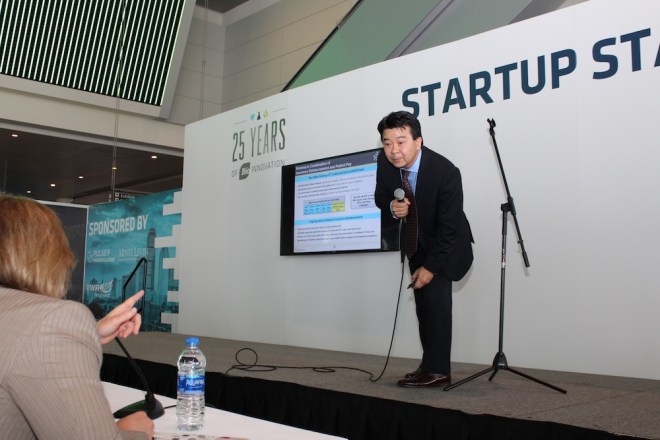
Dr. Craig Shimasaki making a presentation at a past BIO show.

I’ve written all of this because of how life sometimes leads you back to where you began.

Recently, I reconnected with Dr. Shimasaki through Moleculera Labs,  the Oklahoma City-based company for which he co-founded and serves as CEO. Molecular Labs describes itself as “a precision medicine company focused on identifying the underlying immune-mediated root of neurologic, psychiatric, and behavioral disorders.”

The company has gained a lot of attention both local and nationally for its technology that can identify the underlying cause of apparent psychiatric and behavioral disorders that afflict both children and adults. Moleculera Labs has tested more than 15,000 patients since it began offering its test panel on a commercial basis about a decade ago.

So, when Dr. Shimasaki asked me to provide some assistance in crafting press releases for breaking news the company sought to share, I was all in.

Over the past two weeks, Molecular Labs announced the addition of a long-time life science industry veteran to its Board of Directors, and also revealed that it has been awarded a $500,000 grant from the Oklahoma Center for the Advancement of Science and Technology (OCAST) that will help it develop AI technology that will be integrated into its test panels.

Here’s a link to the announcement of Rodney Cotton as a new Moleculera Board member.

And here’s a link to the news release about OCAST Oklahoma Applied Research Support grant the company received.

There is even more breaking news from Moleculera Labs this month. The company announced this past week a strategic collaboration with Quest Diagnostics by which its offers patients of its neuropsychiatric autoantibody test services the option to provide blood specimens to any of Quest’s lab centers across the U.S.

Here’s a link to the Quest Diagnostics announcement.

It’s all big news not only for Moleculera Labs, but for the state’s entire life sciences community and all of Oklahoma.

For me, it’s the latest development in a relationship that began two decades ago on the floor of the BIO show 1,600 miles from OKC.

We’ve been good ‘neighbors’ ever since.

BONUS COMMENT FROM DR. SHIMASAKI:

“The BIO International Conferences allowed us to connect, and it’s been a wonderful relationship working with Jim Stafford over the many years as he has been actively covering the biotech and life science scene in Oklahoma,” Dr. Shimasaki said.  “Jim has an innovative way to tell audiences about the interesting stories in a way that inspires and informs,”

Thanks for the kind words, Dr. Shimasaki, but it’s innovators like you who have shown me the impact that your research can have — and is having — on human health worldwide.


Another big win for Stillwater’s XploSafe

Explosafe logos

For the last five years that I worked as a Business news reporter at The Oklahoman in the early 2000s, my job was to cover Oklahoma’s ‘tech’ industry.

It was exciting to see new Oklahoma technologies bubbling up all the time. Health care was big. Software. Products developed in labs of university professors.

Sometimes, I got an early look at an emerging technology through the Donald W. Reynolds Governor’s Cup collegiate business plan competition. Now called the Love’s Entrepreneur’s Cup, the annual event is managed by i2E, Inc., the not-for-profit corporation that provides business advisory services and investment to Oklahoma startups.

Students from campuses across Oklahoma compete annually in the Love’s Cup and pitch some amazing technologies.

Anyway, back in 2009 I met a young Oklahoma State University student named Shoaib Shaikh, who pitched a concept developed around explosive detection technology at the Love’s Cup. The intellectual property was developed in the labs of a couple of OSU professors.

The team did not make the finals of the event.

But guess what? The students and the professors continued to pursue the technology and launched a business to advance it. It was called XploSafe, LLC.

Today, more than 10 years later, XploSafe is an emerging Oklahoma success story and still based in Stillwater. And Shoaib is its CEO and chief financial officer.

XploSafe has broadened its menu of safety products to include homeland security and first responder applications, air monitoring for chemical and vapor detection, transportation security and hazmat safety.

space suitThe company continues to make groundbreaking news on a regular basis. Just two months ago I published news that XploSafe had been awarded the Green Chemistry Challenge Award by the Environmental Protection Agency for a sorbent product it developed for the removal of phosphorus and nitrogen from water.

This week, I received a news release from XploSafe that revealed it has been awarded a $750,000 Phase II Small Business Innovation Research (SBIR) program research contract from NASA. XploSafe will develop sorbents to protect astronauts from potentially harmful contaminants in their spacesuits.

It’s great to see this Oklahoma company continue to push the innovation envelope with groundbreaking products. Congratulations, XploSafe!

Here is the entire XploSafe news release about the NASA award:

XploSafe Wins $750K Phase II NASA SBIR Research Contract

Stillwater, OK – 19 August 2021 – XploSafe announced today that it has been awarded a $750,000 Phase II SBIR contract from the National Aeronautics and Space Administration (NASA) to advance the development of vacuum-regenerable sorbents for the next-generation of American spacesuits over the next two years.

The XploSafe sorbents shall keep the spacesuit’s internal air-flow free of potential toxic, trace contaminants, which can pose severe health threat to the crewmembers. This capability is necessary for NASA’s upcoming Artemis missions, in which the United States intends to return to the moon by 2024, and the XploSafe team is aiming to submit working prototypes to the team at NASA’s Johnson Space Center for testing within the first 12 months of the project. This can have major a positive impact on the logistics of future space missions by replacing the current non-regenerable sorbent with a vacuum-regenerable sorbent.

Dr. Moumita Bhattacharya, Research Scientist I at XploSafe, stated that “we felt that we had not only met, but greatly exceeded the goals set forth by the team at NASA during the Phase I. Winning a follow-up contract was validation that we had done just that.”

During this Phase II project XploSafe aims to develop and deliver prototypes of the new Trace Contamination Control System that can be directly integrated into the spacesuits’ life support system.

The new sorbent technology will advance the viability of NASA’s crewed deep space exploration objectives. To enable longer spacewalks, lighter launch payloads, and substantially improve time in-suit over the duration of upcoming missions.

XploSafe’s Operations Manager, Michael Teicheira, had the following to say: “the awarding of this Phase II contract shows just how special our research during the proof-of-concept phase was. Our team is excited to continue showcasing the research and development efforts of XploSafe here on the biggest stage, and we are grateful for another opportunity to show the world what Oklahoma can offer.”

XploSafe based in Stillwater, Oklahoma is a provider of critical safety solutions for homeland security and chemical safety. Their XploSens explosives detection, XPell peroxide safety products, and XCel+ chemical vapor sampling badges are used by first respondes, industrial safety officers, threat assessment officials, and laboratory and chemical manufacturing personnel all over the world. The company holds multiple patents for vapor nanoconfinement technology that facilitates high-capacity absorption, stabilization, and consistent recovery (removal) of a wide range of volatile, semi-volatile, and even reactive organic compounds.

For questions, please contact Shoaib Shaikh, Co-Founder and CEO, at Shoaib@XploSafe.com, or visit XploSafe online at www.XploSafe.com.

Oklahoma Innovators: NASA awards SBIR contract to Stillwater’s XploSafe

I’ve worked on the periphery of Oklahoma City’s startup community for about two decades, first as a business news reporter at The Oklahoman newspaper, then as communications specialist for i2E, Inc., and now as a freelance writer.

It’s pretty exciting to see local companies announce a breakthrough discovery, a new product or investment that will carry their innovation into the commercial market.

Unfortunately, many worthy developments don’t always make it onto the pages or websites of local news media, whether it’s a newspaper, television or even digital news site.

There are hundreds of voices seeking media attention every day, so it can be pretty daunting to attract the attention of an editor or reporter.

So, I’ve decided that this blog can be a conduit for my entrepreneur friends to find an audience for their news. From time to time, I’ll publish news that comes my way that hasn’t found its way into any other media.

For example, today I want to share some exciting news from a Stillwater-based company called XploSafe. If you don’t know XploSafe, the company describes itself as a provider of “critical safety solutions for homeland security and chemical safety.”

XploSafe has its roots in the Oklahoma State University laboratories of co-founders Allen Apblett, Ph. D., and Nick Materer, Ph. D., both chemistry professors, along with former OSU graduate student Shoaib Shaikh, also a co-founder and now CEO.

I learned about XploSafe more than 10 years ago when Shoaib pitched the concept in the Donald W. Reynolds Governor’s Cup business plan competition (now known as the Love’s Entrepreneur’s Cup).

Since then, XploSafe has expanded its mission beyond explosive detection to chemical vapor sampling and other areas where detection of potentially dangerous materials is critical.

Recently, XploSafe was awarded a $125,000 Phase 1 Small Business Innovation Research (SBIR) contract from NASA to develop specialized air filtration units for the next-generation of American space suits.

XploSafe released the exciting SBIR news in mid-October, but received little media attention. I invite you to read their announcement from October 15 below.

Stillwater, OK – 15 October 2020 – XploSafe announced today that it has been awarded a Phase I SBIR contract from the National Aeronautics and Space Administration (NASA) to develop specialized air filtration units for the next-generation of American space suits.

The award amount is $125,000 over a six-month period.

These filtration units will help keep the space suit’s internal air-flow free of any toxic, trace contaminants, which naturally build-up while astronauts use their suits. XploSafe aims to capture these contaminants within their proprietary sorbent media, which could then be vacuum regenerated to enable longer spacewalks and substantially improve time in-suit over the duration of a mission. Such a capability will be required for NASA’s upcoming Artemis missions, in which the United States intends to return to the moon by 2024.

The design of XploSafe’s filtration units would provide astronauts with safer air to breathe, as well as lighter, easier to use suits. XploSafe’s filtration unit would be housed within the Exploration Portable Life Support System (xPLSS) backpack of the next-generation xEMU suits, alongside other critical life-support systems. The company holds multiple patents for vapor nanoconfinement technology that facilitates high-capacity absorption, stabilization, and consistent recovery (removal) of a wide range of volatile, semi-volatile, and even reactive organic compounds.

XploSafe’s Operations Manager, Michael Teicheira, had the following to say: “we are ecstatic about this opportunity to showcase the research and development efforts of XploSafe here on the national and even international stage. The prospect of our products enabling astronauts to spend more time in space is an enthralling one, and we are so grateful for this opportunity to show what a small Oklahoma research company can achieve.”

XploSafe based in Stillwater, Oklahoma, is a provider of critical safety solutions for homeland security and chemical safety. Their XploSens explosives detection, XPell peroxide safety products, and XCel+ chemical vapor sampling badges are used by first responders, industrial safety officers, threat assessment officials, and laboratory and chemical manufacturing personnel all over the world.

For questions, please contact Shoaib Shaikh, Co-Founder and CEO, at Shoaib@XploSafe.com, or visit XploSafe online at www.XploSafe.com.

Congratulations to Shoaib and the XploSafe team.