Gov. Stitt, let’s value lives over dollars

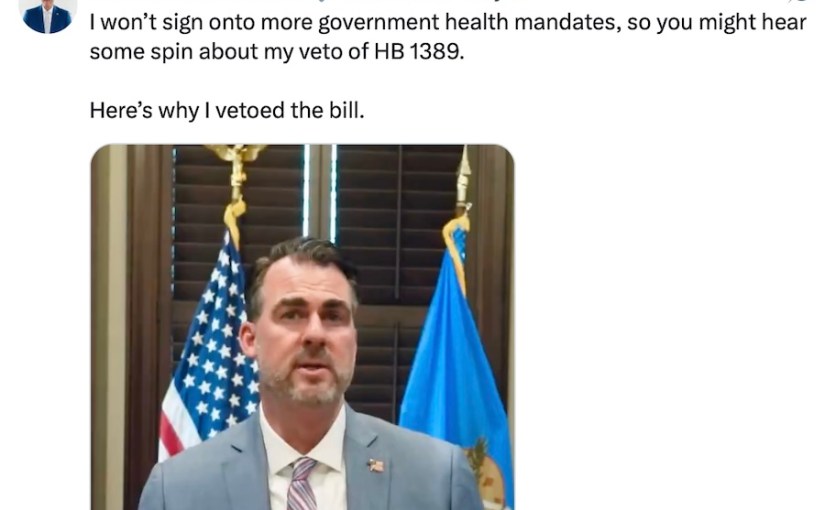
Gov. Kevin Stitt’s Twitter/X post about his veto.

I took a step this week that I’ve never taken before. I called my legislators urging them to help overturn Gov. Stitt’s veto of legislation that expands access for women to imaging technology that can detect breast cancer.

My wife, Paula, a breast cancer survivor, called our legislators, as well.

Another first.

HB 1389, passed by big margins in both houses, would require insurance plans to cover not only mammograms, but other diagnostics such as “enhanced mammogram, breast MRI, breast ultrasound or molecular breast imaging.”

Paula and I were surprised that Oklahoma’s Governor vetoed legislation that would undoubtedly save lives because, as he said in a statement, it would result in higher health insurance premiums across Oklahoma.

Here’s the Governor’s full statement on the veto:

“I am deeply sympathetic to the women across our state who have bravely fought breast cancer. While early detection and access to care are critical priorities, this legislation imposes new and costly insurance mandates on private health plans that will ultimately raise insurance premiums for working families and small businesses.”

Here’s what I take away from the Governor’s veto:

  • He values dollars over lives.
  • He devalues the lives of women.
  • He demonstrates a complete lack of empathy.
  • He’s obviously influenced by the insurance industry.

I’m pretty sure that the price of treating an advanced breast cancer would be far more than the cost of early detection.

I’ve seen a lot of outrage on social media at Stitt’s veto, much of it by women whose lives have been upended by breast cancer — thinking of you, Savannah.

In fact, one of the authors of HB 1389, was Melissa Provenzano, D-Tulsa, who is caught up in her own battle with breast cancer. Click here to read a story from the online news service, Oklahoma Voice, that details reactions to Stitt’s veto and efforts to override it.

Republicans and Democrats alike supported the legislation as it advanced through both legislative houses.

Of course, Stitt said on X/Twitter that he anticipates ‘spin’ on his veto.  It’s not spin Governor. It’s outrage.

So, I’m urging readers of this post to pick up the phone, call your legislators and urge them support the move to override the veto. Or email. Find your local legislators and contact info through this link. 

It will take a supporting vote by two-thirds of state legislators to overturn the veto, so it’s a high bar.

Remind them it’s about valuing lives of Oklahoma’s women over any added expense of diagnosing what often is a fatal disease if not detected early enough.

Take a stand.

A COVID protocol ‘Wall’ that prevents families from advocating for patients

My wife has always told me that every patient getting medical treatment needs an advocate to speak up on their behalf with health care professionals.

Paula has been a great advocate for me in the past when I had some major surgeries. 

However, we discovered on Christmas night that the COVID pandemic has thrown up walls that prevent people from advocating for a loved one.

Let me start at the beginning.

About 7 p.m. Christmas night, Paula received a phone call from some close friends of her mother in western Oklahoma.  Mother-in-law, as I will call her, was sitting down to eat Christmas dinner with her friends when she began having an apparent severe medical issue.

It might have been a heart issue or perhaps gall bladder or an infection of some sort.  A nurse who was at the dinner checked her vital signs and was concerned.

Ultimately, an ambulance was called and mother-in-law as transported to a hospital in Weatherford. 

After receiving the call, Paula immediately threw some clothes in a bag and drove to Weatherford.  She knows that her mother often is anxious and confused during a medical crisis, and unlikely to share critical information about meds she is taking or where she has traveled recently.

So, Paula arrived at the hospital and immediately went to the emergency room waiting area ready to share what she considered important information.  Her mother routinely takes several ongoing medications that might be an underlying cause to her distress.

The ER gatekeeper told her she could not go back to visit with health care staff because of  COVID protocols.  That was expected.

However, the anti-advocacy wall grew even higher and more unrelenting when Paula asked if a physician or nurse could come out to the lobby so she could share critical information. 

The answer was ‘no,’ because they were all too busy.

“I said  ‘I have information that you need that my mother is not going to tell you or give you,’ Paula told me as she recalled the confrontation.  ‘The (gatekeeper) said ‘oh, the doctor’s real good at knowing patients are holding things back.’ “

Paula’s pleas to advocate for her mom fell on deaf ears.  Eventually, she got in her car and drove back to Edmond.

Fast forward about five hours.  Paula was back at the Weatherford ER to pick up her mother after the hospital called and informed her that her mom was being dismissed.

As Paula walked in to the ER, the gatekeeper saw that she brought clothes for her mom to change into.

“She said, ‘come on back’ and opened the door,” Paula said. “I just stopped and said ‘you’ve got to be kidding me. You wouldn’t let me come back here when she was admitted to give you information, yet you want me to go back there now?   Am I all of a sudden not contagious?’ “

“We’re just following the COVID protocols.”

Paula translated the real meaning.

“The COVID protocol is ‘we don’t want you in the way when we have our patients back here, so we are using that to keep you out.’

“I didn’t have a problem in the world standing in the lobby and having a nurse come out and ask me ‘what do you want us to know that you think is important,’ and I would have been on my way and happy.”

Instead, a long night of frustration finally ended when Paula and her mom arrived at her family’s farm near Hammon about 4:15 am. 

As Paula reviewed the information the hospital printed out when her mom was dismissed, she read the section that lists medications patient is taking.

It said ‘none.’

The wall had done its job filtering out critical information.

OKC’s MedEncentive finds success in new partnership for its health care innovation

I first met Jeff Greene about 15 years ago when I was working at The Oklahoman as a business news reporter and he approached me about a concept that he considered to be the answer to runaway health care costs.

Jeff had sold his interest in one of the nation’s largest medical practice management firms and founded a company here in town called MedEncentive.

His idea was to use an incentive mechanism that rewards both doctors and patients for holding each other accountable for engaging in “information therapy,” a process that promotes health literacy and adherence to health behaviors and quality care.

Jeff’s idea was so innovative that it earned him three U.S. patents and a Canadian patent.  It has been proven in a myriad of independently validated studies to simultaneously improve health, improve healthcare, lower costs and provide doctor and patient fulfillment.

Jeff describes this combination of objectives as the “Triple/Quadruple/Quintuple Aim.”

Jeff and Jim Dempster, MedEncentive’s director of Business Development, have tirelessly promoted their innovation to health care providers, employers and insurers for well over a decade.

People are finally starting to see the “win-win-win” potential.

Earlier this month, Buck, one of the five largest HR consulting firms in the world, announced a partnership with MedEncentive, in which Buck will introduce the MedEncentive Mutual Accountability and Information Therapy (MAIT) Program to its clients, as well as adopt the Program for its own employees health plan.

It’s a big deal for MedEncentive, as well as for Buck and its employees and clients. And for Oklahoma.

Congratulations Jeff!

If you want to read more about the partnership, click here. And also visit the MedEncentive website for more info about the OKC-based company.