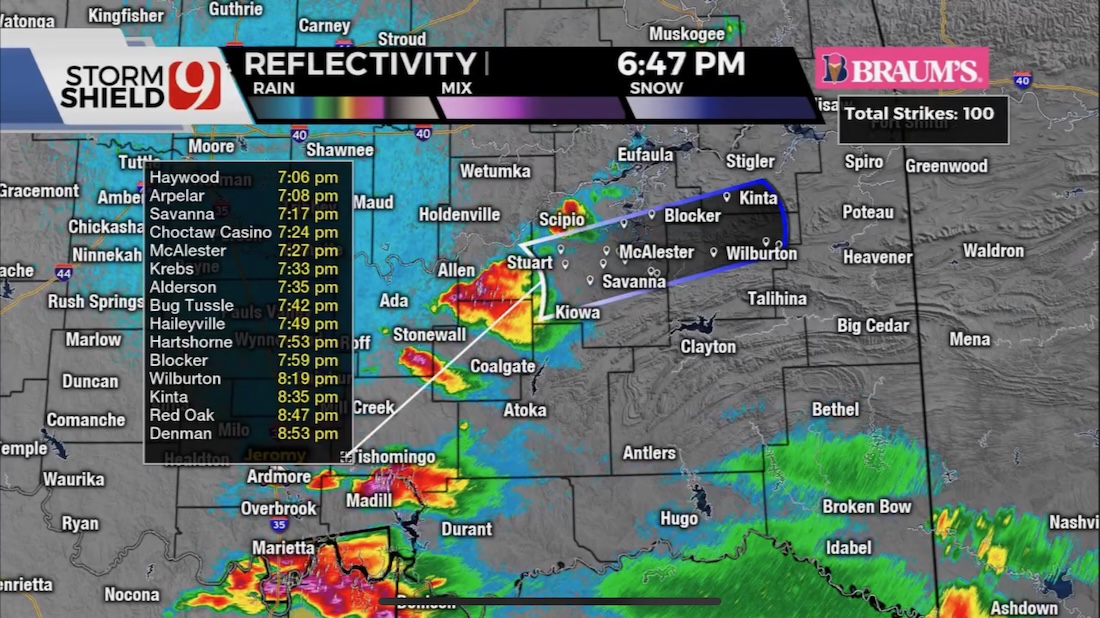
Whenever weather threatens OKC or western Oklahoma, our local TV stations abandon network programming and go with wall-to-wall weather coverage.
My family tunes in every time, and not just for potential life-saving information. We’re fascinated by the combination of theatrical performance, legitimate weather warnings and relentless self promotion.
“We’re declaring a News9 tornado warning for you folks in Custer County!” weatherman David Payne practically screams as he directs Val and Amy into the path of the storm.
No waiting on those slackers at the National Weather Service.
It’s like passing a car wreck on the Interstate, you can’t NOT look at it. Everyone has their favorite/least favorite TV meteorologist. Our go-to weather Drama Queens happen to be from Channel 9.
Anyway, it seems like programming has been interrupted every other night this Spring, but I would never suggest that it’s related to climate change, would I?
As we’ve watched the powerful color-coded radar scans and learned that we’re seeing details THAT NO OTHER STATION IN OUR MARKET CAN PROVIDE, the whole scenario got me thinking back to something I wrote about two decades ago.
Today, we’re in a digital world in which we can track incoming storms on color radar not only only our television screens, but on our phones, computers and tablets. That was all just emerging in 2004 when I was a Business News reporter at The Oklahoman who embraced the digital life.
Not all of my colleagues were ready to move on from their analog past, so I wrote the following column as an ode to the great digital divide:
It is autumn 2004, and a pair of coworkers are sitting in opposite cubicles facing each other. One has his back to the window. His name is “Digital.” His co-worker goes by the moniker “Analog.”
Digital: Hey, there’s a weather alert crawling across the bottom of my computer screen!
Analog: (looking out the window over Digital’s shoulder) It looks sunny to me. There’s a little cloud to the south.
Digital: Yeah, but the color-coded radar I’m looking at on my screen shows a major thunderstorm headed this way. It’s just north of Chickasha.
Analog: I trust my eyes. I’ll worry about the weather when I look out this window and see a big black cloud.
Digital: You are so 1990s. (picks up the phone to call his wife) Hello, honey, you better monitor the weather, it’s looking rough outside. Where are the kids? Outside playing? Well, bring them in. The radar on my computer screen is showing a big storm just north of Chickasha, and it’s headed this way.
Analog: I still only see blue sky out the window.
Digital: (still speaking into phone) I don’t care if it’s sunny out, I’m telling you my radar is showing a big storm brewing just south of here. I’ll call you with further updates. Bring the kids inside! Call my cell phone when you have them rounded up (hangs phone up).
Analog: I think you are scaring your family for no reason. You should trust your eyes. Look out the window! It’s sunny.
Digital: I don’t need a window! I’m wired into the weather service right here. I can zoom in on the screen and see within a half mile where the storm is, which way it’s moving and what the temperature is. See, it’s 62 degrees outside.
Analog: I can just walk outside and get a feel for the temperature.
Digital: Then I assume you aren’t concerned about your family’s welfare. They won’t be ready for this one when it blows through town.
Analog: We have a “safe room” in our garage.
Digital: (wireless telephone rings) Hello. You’ve got the kids? Good. Now, what’s your plan for when the storm hits?
Analog: My eyes are telling me it’s still sunny outside.
Digital: (still speaking into phone) Will you have time to drive to the community shelter? Yes, I know it’s still sunny outside, but the radar shows the storm has moved closer to the metro area. Herd the kids to the hall closet if you need to. OK, love you. Bye.
Analog: Hey, I’ve got to run out on an assignment. I’ll be back this afternoon.
Digital: Well, let me have your cell phone number so I can contact you in case there’s a weather emergency or something.
Analog: I don’t have a cell phone. Never had a need for one.
Digital: (head bangs against desk; heavy sigh) I give up.
Analog: (starts to walk out of the office) Later.
Digital: (jumps up and runs after Analog) Here, take my umbrella just in case.
That’s how we rolled in 2004. It was a different era. Pre-iPhone. Pre-News9 tornado warning.
Any resemblance to actual people is mere coincidence.
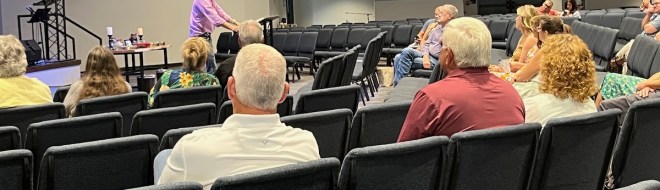
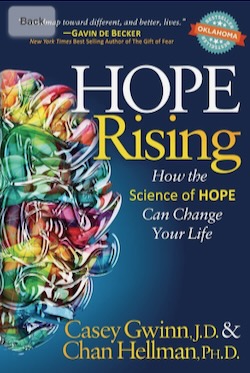 I was sitting in a Sunday morning class on the topic of ‘hope’ at our church a few weeks ago, listening to a lesson presented by Chad Hellman, Ph.D., a University of Oklahoma professor and co-author of the excellent book “Hope Rising: How the Science of Hope Can Change Your Life.”
 Jim Stafford's BlogOKC