My 2007 test drive with the original iPhone

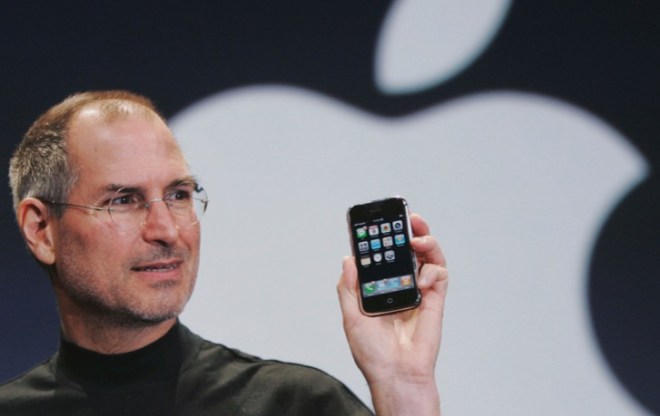
Steve Jobs holds an original iPhone at the Apple launch event in 2007.

Editor’s note:  In honor of Apple’s special product event today, I’m reprinting a column I wrote as technology reporter at The Oklahoman in 2007 after using the original iPhone for a week at the invitation of AT&T.  I’ve been an iPhone user now for almost a dozen years. However, in the months after the iPhone debuted in 2007, I had only a lowly flip-phone and some serious iPhone envy. 

I was seated prominently in a popular lunch spot along Western Avenue on Monday afternoon talking on the new iPhone that AT&T provided me for a one-week tryout.

I was there to show it off.

Parked at a table in the center of the busy restaurant, I whipped out the shiny new high-tech toy and proceeded to flaunt it for 45 minutes.

Important e-mails were read and sent, using the iPhone’s virtual keyboard that magically appears when any typing is needed. Web sites were accessed, appearing just as they do on a desktop or laptop computer. Tunes were cataloged on the device’s iPod. Photos were taken with the camera phone.

Nobody seemed to notice or even look my way.

Obviously, the crowd was suffering from a serious case of iPhone envy.  Their jealousy caused them to look the other way, even as I held it up to input an important appointment on the calendar.

So, I stepped it up a notch and took a very important phone call. I let the telephone ring several times before answering it. Loudly.

People continued their conversations at neighboring tables. I’m sure they were seething because they had no iPhone like the one that was providing me with such child-like wonder.

Meanwhile, I was seething at their ignorance. Or was it apathy?

Of course, they had no way of knowing that the very important phone call I took came from a coworker whom I had asked to call me at that time so I could make a show of taking a very important phone call.

I was engaged in animated conversation on the iPhone for several minutes when I looked around and noticed that the entire section of the restaurant was empty save for me.

I gave up, inserted the phone back into my shirt pocket and quietly walked to the car. Lunch was a bust.

When I walked back into the newsroom, my mood brightened. At least I had a captive audience who couldn’t run when I whipped the iPhone out. I could show off its many great features, from the easy YouTube access right on the main screen to the Google Maps button that let me see a great close-up satellite view of my house.

So, I walked into an editor’s office and pulled it out of my pocket. He was armed only with a Blackberry, which was suddenly relegated to old school technology status. The editor wanted to see the iPhone’s Web browser in action.

We had no WiFi network for the device to automatically find and use, so I called up a page using AT&T’s wireless network. We waited. And waited. Finally, we both had to go back to work.

“I’ll bring it back in when it’s feeling better,” I said, walking out.

On the way back to my desk I passed a co-worker I’ll call “Paul” and sprung the iPhone on him.

Just as I was about to list some bragging points of the device, he reached in his pocket and pulled out … an iPhone.

Paul had had it for a week and never told anyone until that moment. I almost quit on the spot.

Instead, I put the phone away and slinked back to my cubicle. An editor shouted some instructions from her desk.

“Write something about your experiences with the iPhone.”

Oh, great. Well, at least my wife liked the device until I told her about the $600 price tag. She made me put it in a drawer for safekeeping until I could give it back to AT&T.

iPhone, I hardly knew you.

Masked up and feeling smug during the pandemic

I’m a devout mask wearer. Throughout this pandemic I’ve read and listened to the scientists, who are a lot smarter and more educated on the topic than I am.

When I’m out, whether it’s picking up takeout at a restaurant or a prescription at the pharmacy, I’m masked up.

I’ve probably got the same smug look on my face beneath my mask as you see on Prius drivers. I’m sure you’ve seen them looking over at you in your big ol’ SUV wearing an expression that lets you know they are trying to save the planet while you are destroying it.

So, I found myself in northwest Arkansas over the Labor Day weekend, driving back from a couple days in my mom’s condo in Branson. We stopped for gas and food at a popular place outside of Huntsville, Ark., called King’s River Country Store.
My wife put on her mask and went in first to get some food and bring it out to the car. As she came out, I grabbed my mask and got out to go see what the place offered.

It was really crowded inside, but I was pleased to see most everyone followed the “mask required” sign on the door. I poked around for a few minutes, then picked out a sandwich and some cut watermelon.

The woman at the checkout counter could not have been nicer. I paid for my food and walked out.

Then I reached to take off my mask and was horrified to discover that I was not wearing a mask.

Nothing but stubble on my face.

But I saw it as I neared the car. There, on the pavement outside the car door lay my mask.

I felt about 1-inch tall as we pulled out of the parking lot and headed out of town, no longer wearing the smug look of a mask devotee.

OSU center pursues alternatives to Opioid pain medications

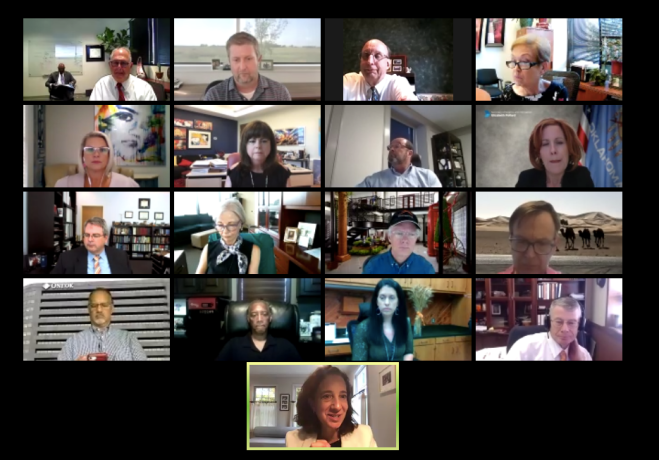
A screen shot of the August meeting of the board that oversees the Oklahoma Center for the Advancement of Science and Technology.

Editor’s Note: I recently sat in on the August virtual meeting of the board that oversees the Oklahoma Center for the Advancement of Science and Technology (OCAST), where a couple of scientists made some interesting presentations. First up was a presentation from OSU’s National Center for Wellness & Recovery, followed by Sean Bauman of Norman’s IMMY.  I wrote up this report on the presentations, a portion of which was published in the Oklahoma City Journal Record business newspaper.   (Subscription required)

Researchers at Oklahoma State University’s National Center for Wellness & Recovery (NCWR) are pursuing promising new molecules that could break the link between Opioid pain medications and the often-fatal side effects that accompany them, a scientist said this week.

During a presentation to the August meeting of the board that governs the Oklahoma Center for the Advancement of Science and Technology (OCAST), Don Kyle, Ph.D., said the Center has “unpublished research molecules” that show efficacy in pain relief without the common side effects of Opioids.

“New molecular approaches to treating pain outside the Opioid world, or using Opioid mechanisms in new ways are of premiere importance to develop Opioid-strength analgesics without the Opioid side-effect baggage,” said Kyle, an adjunct professor of Pharmacology and Physiology at OSU’s Center for Health Sciences in Tulsa.

Launched in 2017, the National Center for Wellness & Recovery is located on OSU’s Center for Health Sciences campus. A settlement announced last year between the State of Oklahoma and drug maker Purdue Pharma established a $200 million endowment for the Center to pursue research and treatment for Opioid addiction.

Kyle provided a historical perspective on Opioids for the OCAST board.

A graphic used in the presentation revealed that Opioids were first developed in the 1800s, but scientists didn’t discover the biological mechanisms by which they provide pain relief until the 1970s.

Efforts to develop side-effect free alternatives to Opioids have been largely unsuccessful, Kyle said.

“Look back over the past 25 or 30 years, FDA approval of new non-addictive pain medications has been disappointing,” he said. “It’s not because no one is trying.”

With discoveries of new molecules that show efficacy in pain reduction in pre-clinical trials, OSU’s National Center for Wellness & Recovery is pushing the science closer to a real alternative, he said.

“These molecules show analgesic efficacy that is comparable to morphine in animal models, but have reductions in the unwanted side effects,” Kyle said. “The bottom line is to end the Opioid crisis using scientific research.”

The OCAST board also heard a presentation from Sean Bauman, Ph.D., CEO of Norman-based IMMY, a developer and manufacturer of diagnostic tests for infectious diseases. Through a subsidiary called IMMYLabs, the company developed an FDA-approved test for COVID-19 in March to make testing more widely accessible across Oklahoma.

IMMY has since set up drive-through mobile test sites in nine communities, including Claremore, Edmond, McAlester, Midwest City, Moore, Norman, Sapulpa, Shawnee and Yukon.

“I can tell you, there is nothing else like this in the state of Oklahoma,” Bauman said. “You can make an appointment at IMMYLabs.com, pick a site, a day and an appointment time. All the data entry happens in advance of your appointment.”

The whole process takes less than 10 minutes, with diagnostic results available within two business days.

“We’re committed to fast turn-around,” Bauman said.


Stepping out of my comfort zone

Tools of the trade for 2020 Census enumerator

For years I’ve heard that a person doesn’t really experience life until they step out of their comfort zone. Well, I’m about to take a giant step (for me) out of the box.

I’m hitting the streets later this week as an enumerator for the U.S. Census Bureau.

For the next eight weeks, myself and a host of other enumerators in the OKC area will attempt to collect information from residents all across the metro who haven’t responded to the 2020 Census count. Enumerator is the word that describes a person who is employed to take a census of the population.

As a retired newspaper guy, I’m pretty busy in my own little freelance writing business. But there are periods of slack time, naturally.

So, when I saw a notice back in February advertising for Census 2020 enumerators, I signed up — and was accepted.

Then the pandemic hit and the local Census Bureau office shut down. I heard nothing for months until one day in May I got a call asking if I was still interested in the job. I said “yes,” so I went in to be fingerprinted and submit to a background check.

About a month later, I got another call asking if I was still interested. Yes, I responded. So, I was assigned to a team for training purposes, which met for in-person orientation in early July.

We took the oath of office, which made us official federal employees.

After about 11 hours of online training that dealt with everything from the history of the Census to various scenarios we might encounter in the field, I passed a final exam on Sunday.

We’re hitting the streets on Thursday of this week, I am told. I’m adding a big-brimmed straw hat to my wardrobe for the hot summer days and taking a cooler of bottled water on the road with me.

So, if you see me walking up to your front door carrying a U.S. Census brief case and a clipboard, be gentle. Just know that the answers you give will help our local community access its share of federal funding and Congressional representation.

And remember, I’ve definitely stepped out of my comfort zone.

Scenes from a park

OKC skyline seen from the footbridge across Scissortail Lake

I’m embarrassed to admit that Thursday was the first time I have visited OKC’s new Scissortail Park since it opened last year.

I had stepped on the grounds just a few weeks before it opened to shoot some photos of the new convention center under construction, but had not returned.

However, the park drew my son and me downtown late in the afternoon to shoot some photos of the OKC skyline and scenes around the park.

We arrived about 7:30 pm, and had no worries about social distancing. There were no crowds for us to negotiate, because we saw just a few families strolling on the grounds.

So, we parked in the boathouse area along Hudson Ave., and walked into the park.

Convention Center just east of the park

I noticed two things in what turned out to be a fairly brief visit.

First, the downtown skyline vistas are awesome. You have unobstructed views of skyscrapers immediately north of the park. And it’s spectacular.

Second, this is a great place to walk for exercise. There are sidewalk/trails around the lake and throughout the park that invite you to walk or even ride your bike. We saw quite a few families strolling in the late afternoon light, along with a few bikers. Plenty of dogs on leashes, too.

Our walk took us across Scissortail Lake on the footbridge and then around the south edge of the lake back to the boathouse.

Although the park is a good 16 miles south of our house, I plan to return ASAP and walk a lot more of the grounds.

Take me out to the ballpark — for graduation

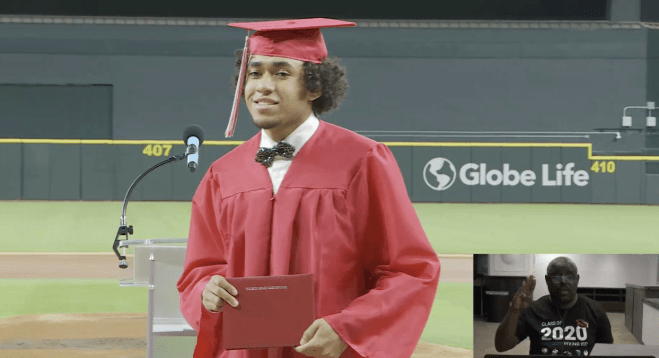
Zeke Brewer accepts his diploma in graduation ceremony at Globe Life Field in Arlington, new home of the Texas Rangers


We watched our friend Zeke Brewer – Reggie Ezekiel Brewer – cross the finish line Friday night when he received his high school diploma from Irving MacArthur High School.

Congratulations, Zeke!

What made the ceremony cool and unique is that it was held at Globe Life Field in Arlington, brand new home of the Texas Rangers Major League Baseball team.

Instead of having a virtual, “Zoom” graduation during this pandemic, Irving school district officials figured out a way to have graduation at a location that allowed plenty of social distancing for graduates and their families.

The ballpark seats approximately 40,000 people, so the 400 or so grads and the five guests they each were allowed to bring meant that roughly 2,500 people were in the stadium.

But the really cool factor was the live stream allowed us to watch the ceremony from our living room in Edmond, OK. We got to see and hear the commencement addresses by the various dignitaries and the student achievers in real time.

We got to watch a Zeke receive his diploma in an up-close-and-personal camera shot.

Thanks to Zeke’s Mom, Carmen Oliva, for sending us the link. We couldn’t be there, but we could.

And wouldn’t have missed it for anything.

One year ago, breaking news in Capitola: My grandson has arrived

My grandson, Solomon (above), has brightened our lives as a happy 1-year-old


One year ago today, I woke up about 7 am in Capitola, California, and picked up my phone. There was a text alert on the screen from Jane Loafman back in Edmond, OK. It said something on the order of “congratulations on Solomon’s birth.”

Wait, what?

Turns out that my daughter had given birth overnight, and I slept through her calls and text messages. So, I got the news from Jane, with whom I have attended church for many years at The Springs Church of Christ in Edmond.

While I was in California, Solomon Stafford was born 8 weeks premature on May 29, 2019.

Solomon’s mother, my daughter, Sarah, still won’t forgive me for not being present during the birth.

I had a great excuse for being 1,600 miles away.

My 86-year-old mother had suffered a heart attack and undergone emergency bypass surgery while visiting a friend in California about a week earlier.

So, I flew out to give her support from a familiar face while she recovered, first in the hospital, and then in a rehab center. She was unable to fly back to her home in Fort Smith, Ark., for about three weeks.

Papa holding Solomon soon after birth while he was still in the hospital

After staying with her for about 10 days, I flew back to OKC on a Sunday evening. My friend Ed picked me up at the airport and drove me straight to the hospital, where I met Solomon for the first time.

The timing of Solomon’s birth was a big surprise for all of us, because he was 8 weeks premature. He weighed only 3 pounds and change.

Sarah and my wife, Paula, urged me to hold him that first day, which I nervously did for just a few seconds.

I remained in Oklahoma for a week, then flew back to San Jose and Ubered down to Capitola to continue providing support for my mom until the doctor gave her permission to return home later that week. We flew back to Fort Smith together.

Now, a year later, my Mom is thriving as an 87-year-old widow who still lives on her own.

And Solomon has made tremendous progress, as well. He’s now a 20-pound, almost-toddler, crawling, climbing and bringing joy to our lives.

An unexpected gift and a flight to remember


Editor’s note: Back in 2005, I covered the annual Biotechnology Industry Organization convention in Boston as technology reporter for The Oklahoman. I was moved by an incident that happened on the flight back home and wrote about it in a column a week later. It’s short and not of anything of real consequence, but I’m proud of the message that it has. So, I’m sharing it in this blog.

I settled into my seat – row 24, seat D on the aisle – for a four-hour flight from Boston to Houston last week.

A woman occupied the window seat, and I was pleased to see the middle seat was empty.

Then I looked up and saw a really big man walking toward the back of the plane, and I knew where he was headed.

I mean “big” in the same way we envision Santa Claus as “big.” Rotund. My mom would be nice and say he was just big boned.

Anyway, I stood up and let the big guy into the middle seat. He spilled over into my seat and that of the poor woman in the window seat.

I resented every inch of his girth, but said nothing. I read my paper, listing toward the aisle.

I guess I couldn’t hide my discomfort because the flight attendant stopped and offered me another seat.  She said she had only middle seats available. I said I was fine and went back to my paper.

Meanwhile, the big guy folded his arms, leaned his head back against the seat and closed his eyes.

The plane took off and here we were, swapping the cotton off our shirts as our bellies rubbed against one another. He slept. I read and fumed.

There he was, standing by the rear emergency exit adjacent to the two bathrooms and the galley. He was nursing a cup of coffee. ‘So there you are,’ I said, not knowing really what to say. ‘I wanted to give you some space,’ he replied.

About an hour into the flight, the big guy said he wanted to get up and stretch his legs. I gladly stood and let him out.

He went toward the back of the plane and disappeared.

Now I really could enjoy the paper and the book I brought with me.

But time went by and I began to wonder where the big guy was. An hour ticked off, then two hours. I decided to wander back to the rear of the plane and see if I could find him.

There he was, standing by the rear emergency exit adjacent to the two bathrooms and the galley. He was nursing a cup of coffee.

“So there you are,” I said, not knowing really what to say.

“I wanted to give you some space,” he replied.

I went back to my seat.

About 45 minutes before we landed in Houston, the big guy reclaimed his middle seat.

I didn’t mind so much now.

“I really appreciate what you did,” I said to him. “You certainly didn’t have to do that.”

“You deserved it,” he said. “Is your mother still living?”

“Yes, she is.”

“Then do something nice for her on Mother’s Day.”

I felt about one-inch tall.

The plane landed, and we departed with no more words. I regretted that I didn’t ask his name or even introduce myself.

So, on Sunday I called Mom, wished her a happy Mother’s Day and told her this story. She told me it made her day.

Thank you for the present, big guy.


OKC’s technology community loses innovator in Phil Miller

Phil Miller as shown in July 14, 2004 article in The Oklahoman

I’ve hit the age milestone where the first thing I do when I open the daily newspaper is head straight to the obituaries. First of all, there are some great life stories told in the obits, as we called them when I worked at The Oklahoman back in the olden days.

Second, you never know whose passing you might stumble across. That happened to me in today’s edition of The Oklahoman.

As I was browsing the Sunday obits, I came across that of Phil Miller.

I was both surprised and crestfallen.

Phil was founder of OKC’s Long Wave, a high tech company that provided communications services for the U.S. Military, specifically for the big Navy jets that fly around the world and communicate via “long wave” radio frequency with the nation’s submarine force.

The Navy has a presence at Tinker Air Force Base, and Phil located Long Wave here to accommodate it. The cool thing about Long Wave is that it was located in a historic building down in Bricktown because that part of town was an opportunity zone that provided some financial benefits.

“With me, if I don’t make my quarter, I don’t care. It’s more important to do the right thing for the customer than to make the quarter. And, oh by the way, when you do that, you end up making more money.” — Phil Miller

Anyway, I got to know Phil by writing about his company on several occasions. He had an unassuming personality that seemed to welcome everybody who crossed his path. He accommodated me every time I called him out of the blue for a story, a quote or even to write a letter on behalf of another entrepreneur

Here’s a quote from a story about Long Wave’s recognition in the INC500/INC1500 for being one of the nation’s fastest growing companies:

“These awards include winning the INC500/INC5000 ten times (representing the fastest growing businesses in America). Long Wave was also an eight-time winner of the Inner City 100 for Oklahoma City. Phil was recognized by the U.S. Small Business Administration and the Governor of Oklahoma as Oklahoma’s Small Businessperson of The Year in 2006.”

You might also recognize Phil as one-time owner of the OKC Yard Dawgz Arena Football team.

OKC lost an innovator, entrepreneur and good person. Rest in peace, Phil.

Pandemic forces unexpected route to graduation for OCAST intern

OCAST interview with Ella Luttbeg, TU from OCAST on Vimeo.


Editor’s note: Along with Debbie Cox, my colleague from the Oklahoma Center for the Advancement of Science and Technology (OCAST), I recently interviewed Ella Luttbeg via the Zoom platform. Ella is a graduating senior at the University of Tulsa.

Ella Luttbeg was wrapping up some major projects as she prepared to graduate this spring as a mechanical engineering major from the University of Tulsa.

A senior capstone project neared its conclusion, as did an OCAST internship at Tulsa’s Triumph Aerostructures that she had held since October 2018.

A job at Boeing’s Oklahoma City operation awaited in June after her May graduation.

Then the COVID-19 pandemic threw some major roadblocks in her path. As the wave of Coronavirus infections washed over the nation in March, social distancing measures shuttered businesses, closed campuses and forced students like Luttbeg back to their homes to remotely complete the semester.

For Ella, home is Stillwater, where she graduated from high school before enrolling at TU as a freshman in 2016. Her parents are both biology professors at Oklahoma State University.

Luttbeg negotiated the roadblocks and finished out both the senior project and the OCAST internship.

“School wise, everything is remote, and our senior project kind of ended in a different fashion than we expected it to,” Ella told me in a recent interview over the Zoom platform. “So far, the pandemic hasn’t affected my job offer, which I’m grateful for.”

“I think something that really helps is seeing older college or professional women talking about their careers and getting excited about math and science and showing that it is a cool thing to be interested in. Having role models to look up to really helps people believe it’s something that they can achieve, as well.”
— Ella Luttbeg on inspiring more women to pursue STEM careers

During the OCAST internship, Luttbeg tackled a variety of engineering projects for Triumph Aerostructures related to fatigue and damage tolerance analysis in aircraft structures.

“I was lucky enough to be able to work from home for Triumph during the pandemic,” Ella said. “They were able to get me a laptop to remote in. It’s been different, but I’ve really been grateful to keep my internship.”

Luttbeg was one of two OCAST interns this academic year working at Triumph Aerostructures, a division of Triumph Group. Triumph is a publicly traded, global leader in manufacturing and overhauling aerospace structures, systems, and components.

“My time at Triumph Aerostructures has been super valuable to me, because it’s given me the opportunity to supplement my school studies with real world experience,” she said. “At Triumph, I worked with really smart engineers who taught me a lot about stress and fatigue and damage tolerance analysis. It exposed me to a whole different side of engineering.”

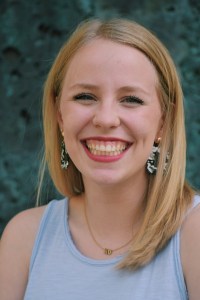
Ella Luttbeg

Luttbeg developed her interest in pursuing an education in STEM – science, technology, engineering and math – while still in high school. She credits Larry Hesler, a high school math teacher, for stoking that interest, and college professors John Henshaw, Ph.D., and Steve Tipton, Ph.D., for mentoring her through the engineering program.

“I’ve always been interested in math,” she said. “Both my parents are scientists, so I’ve always been kind of exposed to the STEM world. Then at TU, my classes have shown me what engineering is all about.”

She learned about the OCAST intern opportunity through an email that TU’s engineering department sent to its students. TU is a long-time participant in the OCAST Intern Partnership program, which places students in real world R&D settings on a cost-share basis.

“I would definitely tell future/current college students to be on the lookout for the OCAST internships because they are a great way to be able to work part time during the school year and over the summer,” Luttbeg said. “I’m so thankful to have this opportunity to have this OCAST internship. It’s meant a lot to me and supplemented my education.”