The first time I met Col. Pendleton Woods I was judging a high school history event at Oklahoma Christian University in the early 2000s. It was a crowded room, but Pendleton spotted me from a distance and walked over to introduce himself.
Born in 1923, Pen was almost 80 years old at the time. He knew of me because I had been a Business News reporter at The Oklahoman throughout the 1990s before taking a 3-year sabbatical at OC beginning in 2000.
Anyway, Pen introduced himself, and as I looked up from my seat I noticed he was wearing a plaid jacket. tie and a pair of slacks. There was one other detail that stood out.
His fly was open.
I later talked about meeting Pen with my friend Mike Osborne, who also worked at OC at the time. Mike had one question.
“Was his fly open?”
The knowing question made me laugh out loud, and I still smile at the memory today. But I grew to love Col. Pendleton Woods, and slowly came to know his story.
Turns out he was born and raised in Fort Smith, Ark., which is also my hometown. Pen graduated from the University of Arkansas with a journalism degree.
But that’s only the start. He was a military hero from The Greatest Generation.
Pen served in World War II with the 99th Infantry Division and was captured on a reconnaissance patrol on Dec. 10, 1944, during the German build-up to the Battle of the Bulge. He remained a prisoner until he and others escaped after Russian artillery shelled the compound shortly before the war in Europe ended on April 20, 1945.
Pen also served in the Korean War with the 45th Infantry Division of the Oklahoma National Guard. He was inducted into the Oklahoma Military Hall of Fame in 2002.
After his service in WWII, Pen settled in OKC and worked for Oklahoma Gas and Electric for years. He eventually joined the staff at Oklahoma Christian University and worked there until late in his life.
As a longtime OKC resident, Pen was an incredible community servant, volunteering for the Boy Scouts, helping bring the National Cowboy Hall of Fame to OKC, serving as executive director of the OKC Bicentennial Commission and many, many other endeavors. He authored 15 books.
After I returned to The Oklahoman in 2003, Pen would call me on a regular basis, either to pitch a story or just to catch up for a few moments.
Pen died on Dec. 1, 2014 and left a massive legacy in our local community and beyond. Read his obituary here.
I’ve written all of this about Col. Pendleton Woods because of something that happened this week. I was working on a special project for a friend at a busy local coffee shop when I happened to look down.
My fly was open.
Pen Woods was the first thought that ran across my mind after quickly closing the barn door.
As I was sitting in the stands at OKC’s All Sports Stadium in roughly 1987 watching the Big 8 baseball tournament with my Daily Oklahoman colleague, Tom Kensler, a lanky young man sat down with us.
Kensler, now deceased, was the paper’s OSU beat writer in 1987. He introduced me to the newcomer.
“Jim, I want you to meet the newest member of our Sports staff, Berry Tramel,” Tom told me as I shook Berry’s hand.
Although I had worked as a copy editor on the Sports desk at the Oklahoman since 1983, I didn’t know Tramel, who worked as a sports writer at the Norman Transcript.
Something happened, however, and Berry did not become a member of The Oklahoman’s Sports staff until 1991. Maybe the Transcript offered him a raise or he still had things to accomplish at the Norman paper.
But Berry eventually joined The Oklahoman staff and became our lead sports columnist. He quickly established himself as one of the top sports writers not only in Oklahoma but across the nation.
I don’t remember much of that first conversation with Berry at the ballpark, but eventually I found him to be warm, empathetic, approachable and the most prolific and hard-working writer I’ve ever known.
Berry writes in what I consider a folksy manner that carries the reader along. He has an incredible ability to uncover the critical issue that may be plaguing — or helping — a team, a coach, a school, a state, whatever. And he’s a walking encyclopedia of sports history.
Berry’s most influential article of them all may be the infamous “Taco Bell” column from the late 1990s when he compared OU’s hiring of John Blake to a company that put a management trainee in charge of the entire business.
Not everyone loves his style — ask my friend, Casey — but he’s attracted a huge following far and near over the years. Including me.
Berry was joined on The Oklahoman Sports staff in the late 1990s by Jenni Carlson, a Kansas native who brings a unique point of view to whatever she’s writing about. I’ve come to know Jenni, as well, and love reading her intriguing takes that often focus on people who have overcome long odds to become successful.
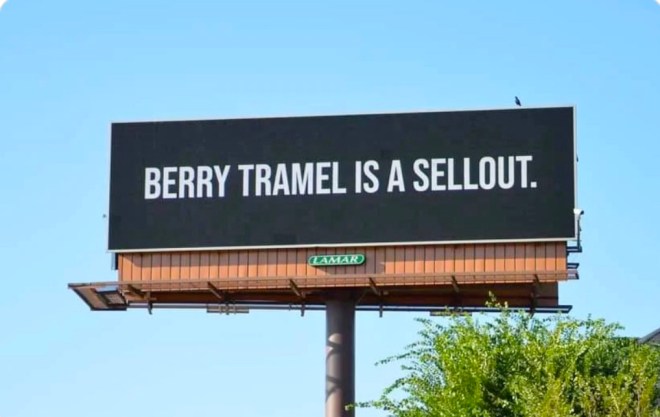
I’ve written all of this because, as most people know by now, both Berry and Jenni are leaving the paper. They’re joining a new online venture called The Sellout, Sellout Crowd, or something like that. It should debut later this month, from what I understand.
I got wind of Berry’s impending exit about three weeks ago and immediately sent him an email with the subject line “Say It Ain’t So.”
Berry responded and said it was so. He said it’s a good thing, not bad, because readers who follow him and Jenni will be able to read their work in a free online newsletter. He even wrote about his impending departure from the paper after billboards appeared saying “Berry Tramel is a Sellout.”
But I’m mourning for the newspaper because of the loss of such immense talent. I was part of that newsroom as a writer and editor for over two decades.
Although I’ve been gone from The Oklahoman for almost 15 years, I’m still a subscriber and a daily reader of the newspaper. I still pick it up off my driveway every morning (except Saturday).
We all know that the Internet has changed the way people consume news, sending the newspaper industry into a long decline, including The Oklahoman. In my opinion, the paper has done a great job of building its online enterprise while still keeping print alive.
For now.
But the loss of Berry and Jenni is a huge blow to readers like me who look forward to unfolding the paper every day (but Saturday) and seeing what one or both have written for us. Who can replace them?
So, what’s next? I’m anxiously watching as the leaves continue to fall from the tree and the newsroom branches become bare.
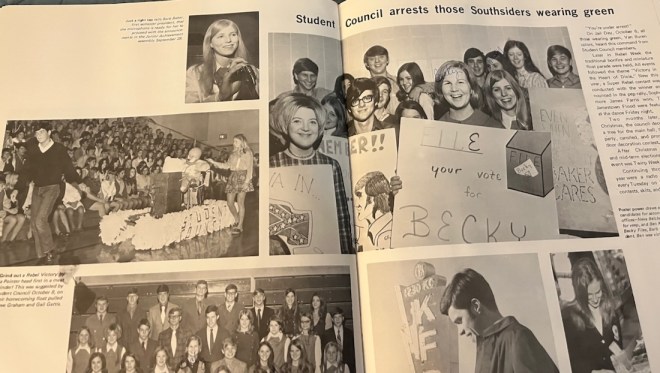
A page of the 1971 Southside High School yearbook, ‘Lifestyles’
I walked into Cattlemen’s Steakhouse a few weeks ago, made my way to a back booth and was greeted by someone I had not seen in 52 years. He was an old high school chum, so it was the ultimate class reunion.
Turns out, my friend, whom I will call “Will,” was driving from New Mexico to Fort Smith to visit our home town for a few days. So, he contacted me to see if I would be up for a reunion as he passed through.
Would I? Of course!
We spent a wonderful hour and a half at a back booth catching up on our lives, families and reminiscing about days long past.
The real story is how Will found me. He told me he stumbled across this blog as he was searching for some high school classmates he had not seen in years. After reading a few BlogOKC posts, he decided to reach out, although he has no social media presence at all.
So his wife looked me up and discovered my Twitter profile. She sent me a direct message asking if I would be interested in meeting Will when he was passing through OKC.
I’ve thought of Will often over the years. He was from a well established Fort Smith family and had gone to public schools there since first grade. I moved into the school district my sophomore year only because my dad was in the Army and his military assignments took us as a family around the world. We came to Fort Smith when Dad went to Vietnam in 1969.
Being a ‘move-in’ with no local history in an old Southern town like Fort Smith was a big challenge for me. Making friends, eating lunch in the cafeteria, having a social life after school.
For some reason, Will sort of took me in. We played basketball on his driveway and connected in classes. As I recall, he was a member of the National Honor Society, wrote a column for the student newspaper and was on the Student Council, among many other school activities.
By contrast, I was sort of the Invisible Man at Southside. I had only heard of the National Honor Society, but had a secret dream to become a newspaper reporter some day. So, we had that in common.
Anyway, Will showed kindness and attention to me. After high school, he went on to college, eventually earning a master’s degree, moving to a distant state and working for social change.
I wandered aimlessly for a few years before gaining some direction by attending Abilene Christian University and earning a journalism degree. My secret dream actually came true.
Since I have never attended a single high school class reunion, I lost touch with Will along with the rest of my senior classmates.
Then he called.
There’s a lot of space to fill and life to live in 52 years. But reconnecting with my old classmate was the feel good event of the summer for me.
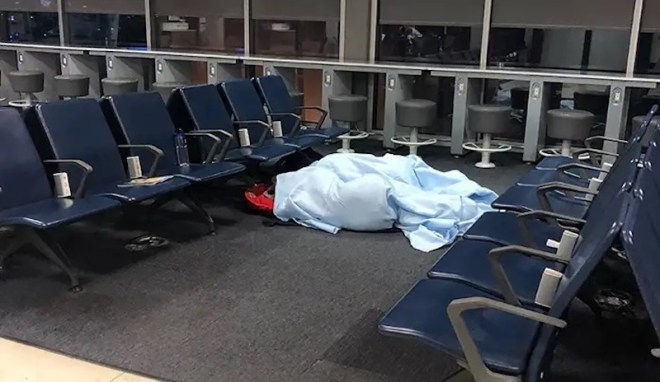
The floor is about the only place to stretch out at Chicago O’Hare International Airport.
Editor’s Note: Don Mecoy is a friend and former colleague at The Oklahoman who retired as the newspaper’s managing editor at the end of 2022. Don recently experienced the challenge of navigating the commercial airline system when multiple flights were cancelled as he attempted to return to Oklahoma City from Chicago’s O’Hare Airport. He shared his reaction to the experience in this blog post.
By Don Mecoy
I recently got a taste of homelessness. I wasn’t actually without a home, but I temporarily lacked access to some basic needs such as food and a place to sleep. It was a frustrating and instructional experience.
My situation was the same that millions of Americans find themselves in every year — my flight was cancelled and I was abandoned at a large metropolitan airport. My fellow passengers and I were shooed off our American Airlines plane at about 1 a.m. last Sunday — five hours after the planned departure — and told that we would not be flying from Chicago O’Hare International Airport to Oklahoma City anytime soon. The airline offered little to help us deal with the situation or to appeal to our better nature — $12 food vouchers (all the restaurants and stores were closed until 5 a.m.); no hotel vouchers (there were no rooms available within miles of the airport anyway), and no concrete information on when we might get back to good ol’ OKC.
After a lot of waiting in lines, hand-wringing and watching our flight’s self-designated Chad unload on the helpless, but genial gate attendant, we former passengers got down to the business of making the best of a bad situation.
About a dozen simply checked out, heading off to Ubers and Lyfts to whisk them away to someplace with food and blankets, or perhaps to rent a car and drive the 12 hours to Oklahoma City. I’m not sure; I never saw them again.
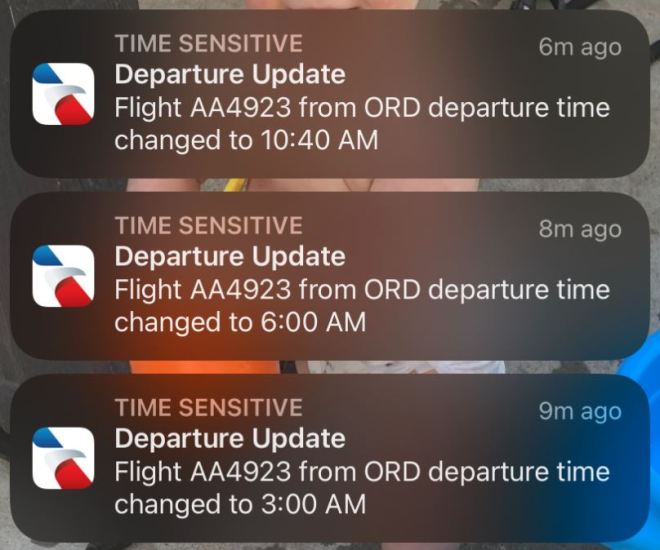
I could have done the same and returned to my son’s apartment in the West Loop area of downtown Chicago. But it hardly seemed worth it for a few hours of sleep and a very early return to O’Hare, particularly since I didn’t know what time our flight was. Within a few minutes of our flight being scratched, my American Airlines app showed the next departure for my flight changing from 12:30 a.m. to 3 a.m. to 6 a.m. to 10:40 a.m. The gracious gate attendant said she “hoped” that 10:40 time would hold. It didn’t.
The rest of us started cracking open suitcases and putting on more clothes. It was freezing in the cavernous, empty airport. I once interviewed a guy who helped run what is now called Paycom Center. He told me they crank up the air conditioning long before Thunder games or other big events to account for the body heat and activity of the 18,000 or so people who will fill the arena. Perhaps that’s what the airport folks were doing in anticipation for the next day’s crowds. But the A/C never stopped producing a chilling breeze that was unavoidable everywhere except in the middle of the concourse, and I wasn’t going to sleep on those tiled floors.
There are thousands of pieces of furniture in O’Hare, and just like at every airport, they are designed to be impossible to sleep on. You’ve seen them, essentially long couches, but with stainless steel arms demarcating where each individual should sit. They work fine when you’re waiting for a plane. But when seeking a place to lay your weary head, it makes you ponder why they don’t make those arms movable like the armrests on the planes. It’s needlessly cruel. Of course, cities do the same with park benches and walls to discourage those with no bed from making one in a public place. A bed is a very important thing when you don’t have one. And a blanket.
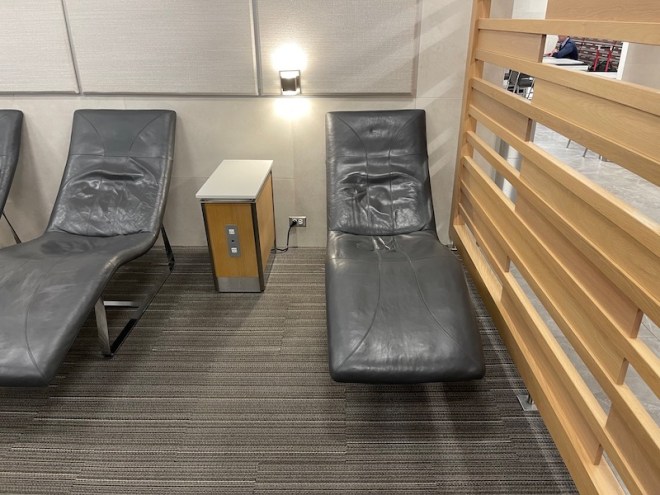
Meanwhile, directly across from the gate where we waited to secure our food vouchers was American Airline’s Admirals Club, an expansive area for the airline’s most lucrative customers that offers recliners, food and drink, showers and other amenities. I bet they even have blankets in there. It was closed. Here’s a suggestion, American: Give the beleaguered gate attendant a key so she can offer something to abandoned folks like us. What a waste.
Seating in the American Airlines Admirals Club at Chicago O’Hare International Airport.
And lest you think the powers that be at O’Hare are heartless. There is a yoga room in the airport. It closes at 10 p.m. I would have paid good money for one of those yoga mats. Instead, I swiped a floor mat from behind a ticket counter to soften the concrete floor covered with — like every airport I’ve ever been to — the thinnest grade of carpet known to man.
I took my pilfered floor mat and began to build a nest in a semi-isolated place. I draped most of the shirts in my suitcase atop the three shirts I was wearing, rolled up a pair of pants for a pillow and tried to nap. It was futile. After what felt like an hour of trying to get comfortable, I had to get up and move to warm up. I dragged the floor mat to a fellow passenger attempting to sleep on the bare carpet. She was grateful. She had a blanket. Man, a blanket. Luxury!
Another annoyance: At nearly every gate in O’Hare there is a TV. All those TVs play the same loop of programming that includes ads for stores and restaurants in the airport. It also features Conan O’Brien interviewing Kevin Bacon on how the star’s life was changed by the recent emergence of COVID. I looked it up: the interview was taped on April 9, 2020. It was impossible to turn off the TVs, or the sound broadcast through overhead speakers. Believe me, I tried.
So I was tired, hungry, bored, but not really upset. I wasn’t missing a wedding or funeral or graduation back home. I had the wherewithal to simply leave if my health or safety was a real concern. I learned that McDonald’s was going to open at 4 a.m., so I was an hour closer to food. My fellow passengers and I seemed to enjoy strategizing about our situation amid our shared misery.
Among our group was the tallest (6 foot 2), most mature 15-year-old I’ve ever met. He was traveling alone, was not allowed to leave the airport and nevertheless was handling the situation better than 90 percent of his fellow refugees. I met the gaze of another parent, and we shared a look that felt like a silent promise that this kid was going to get home. As the sun rose, I had a conversation with a lady from Moore about our favorite books we had read while on airplanes.
After climbing off the floor around 2:30 a.m. or so, I somehow was able to book an 8:30 a.m. flight on my American Airlines app. I hurried to tell some of my fellow passengers about the discovery, but no one was able to reproduce it. A dozen or more were placed on standby for that flight, and at least four of them — including the gangly 15-year-old — boarded along with me.
Our original flight finally took off at 1:11 p.m., roughly 17 hours after it was scheduled to depart. By that time, I was well fed and sound asleep in my bed. With my blanket.
All in all, it was not a terrible experience. And it drove home a couple of maxims that I long have believed true.
Be nice. It costs nothing, and you might make a friend; perhaps even ease someone’s pain. You don’t really know what struggles anyone is dealing with, so cut folks some slack.
If you see someone carrying a blanket or a piece of foam, or wearing layer upon layer of clothing, or trying to beg, borrow or steal some food, they’re just trying to make the best of a bad situation. Have a heart.
MORE READING: My daughter, Sarah Stafford, had a similar experience that I wrote about in this blog post back in January.


 As I was sitting in the stands at OKC’s All Sports Stadium in roughly 1987 watching the Big 8 baseball tournament with my Daily Oklahoman colleague, Tom Kensler, a lanky young man sat down with us.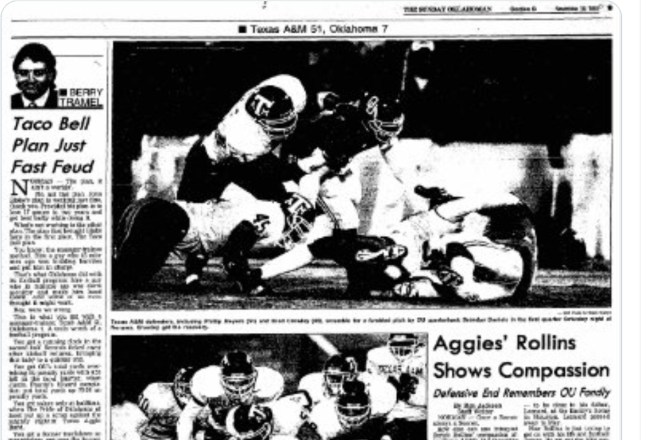
 Jim Stafford's BlogOKC