Editor’s note: My friend Ed Godfrey grew up in Eastern Oklahoma as a passionate St. Louis Cardinals fan, a devotion that began by listening to their games on his family’s big console radio. More than 50 years later, Ed remains a baseball fan and still follows the Cardinals with the same passion as he did as a 10-year-old Stigler Little Leaguer. I asked him to write about what sparked his fandom for the team from St. Louis, and he obliged with this essay.
By Ed Godfrey
When I was a kid, baseball was king. That gives you a clue to how old I am. Yes, I am old enough to draw Social Security.
I played Little League baseball, proudly donning the uniforms of King’s Tire Service, Guaranty Abstract and Davis Packing Company, some of the generous sponsors in Stigler who allowed the town’s pre-teen youth to live out their summer dreams on the ball diamond.
Like the Cardinals great utility man in the ’80s, Jose Oquendo, I would play everywhere on the field at some point. Dad nixed my playing days at catcher after just one game because he was afraid I would get hurt.
Center field was my best position, but I also took the bump a lot. I didn’t have Nuke LaLoosh stuff, but I could do what often none of my other teammates could do. Throw the ball over the plate.
Man, I loved baseball. Whenever I had a dime, I would ride my bicycle the six blocks from home to the Five & and Dime store in downtown Stigler and buy a pack of baseball cards.
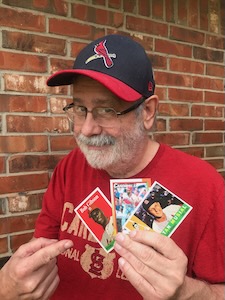
I was a pretty avid card collector in the early ’70s. And yeah, I stupidly put some of them on the spokes of my bike and glued others in a scrapbook, but most of my treasures are still intact. Thank you, mom, for not throwing away my baseball cards.
As you get older, I think the more you want to go back and be a kid again. That’s why I still buy baseball cards today. Nostalgia.
Back when I was a kid, I didn’t miss the major league game of the week on Saturday afternoons. Yeah, we got one baseball game on television each week. I also loved This Week in Baseball narrated by Mel Allen.
And I was a frequent listener of Major League Baseball games on the radio. This is how I became a St. Louis Cardinals fan.
First of all, the Cardinals were really good in the late ’60s. When I was 7, they won the ’67 World Series over the Red Sox. Then when I was 8, they lost the ’68 World Series to the Tigers.
(Don’t ask me about the ’85 World Series against the Royals, I am still ticked off about Game 6. Now, Game 6 of the 2011 World Series Game 6, that one was magical)
For many years, the Cardinals were the only major league team west of the Mississippi River and they developed a loyal following thanks to mighty KMOX-AM radio, which had a long reach throughout the South and Midwest.
KMOX helped turn countless families into Cardinals fans since 1926, including a kid in Stigler, Oklahoma.
When the Cardinals played on the West Coast and games started past my bedtime, I would sneak a transistor radio under my pillow so I could still listen to the broadcast without my parents knowing.
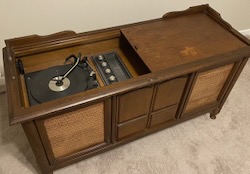 Otherwise, I would listen to games on our bulky old stereo-record combo that we had in our living room. In 1971, and I can still hear Jack Buck’s call of Bob Gibson striking out Willie Stargell to end the game for Gibby’s only no-hitter of his career.
“If you were here, it would have made you cry,” Buck proclaimed.
I wasn’t there but I felt like I was, thanks to one of the great baseball announcers in history.
When the Cardinals made the playoffs in the ’80s, every game, of course, was televised. But I turned the volume down on the TV and tuned in the radio for the play by play to listen to Buck.
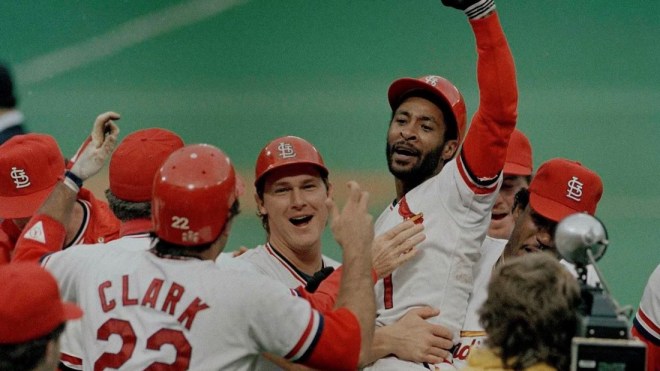
I got to hear his great “Go Crazy” call in the ’85 National League Championship Series against the Dodgers when Ozzie Smith unexpectedly hit the game-winning homer in Game 5.
I did “Go Crazy” in my apartment in Edmond, leaping from the sofa and landing on my knees in front of my TV in celebration.
A few years later I started dating my future wife. She tolerated my obsession with the Cardinals and actually enjoyed listening to Buck’s voice, even though she knew little about baseball.
Instead of going out on the town one Friday night, she drove from Norman to my apartment in Edmond and agreed to watch the Cardinals-Braves game with me on what was then Ted Turner’s superstation, TBS, which carried all the Braves games.
I promised we would go out for dinner after the game. It lasted 22 innings. My man Oquendo even came in and pitched when the Cardinals’ bullpen was depleted. (Told you he was a great utility player). He pitched several scoreless innings, but the Cards couldn’t get him a run and they lost.
Linda watched all 22 innings and never complained. Maybe she slept through an inning or two, I can’t remember for sure, but the point is she stayed until the end and then drove back home in the early morning hours. As Buck would say, “That’s a winner.”
I don’t listen to Cardinal games on the radio anymore because Buck and his broadcast partner, Mike Shannon, are no longer with us. Nothing against the new announcers, but it’s not the same for me.
This summer, I even stopped watching the Cardinals on TV because they stink this season. It’s been a long time since they have been this bad.
Well, the truth is I haven’t quit on them completely. I still sneak a peek once a while to see if the bullpen is going to blow another game and then I start cussing when they do.
It’s a lifelong addiction.
 Jim Stafford's BlogOKC