The old Double-Reverse Jinx does it again

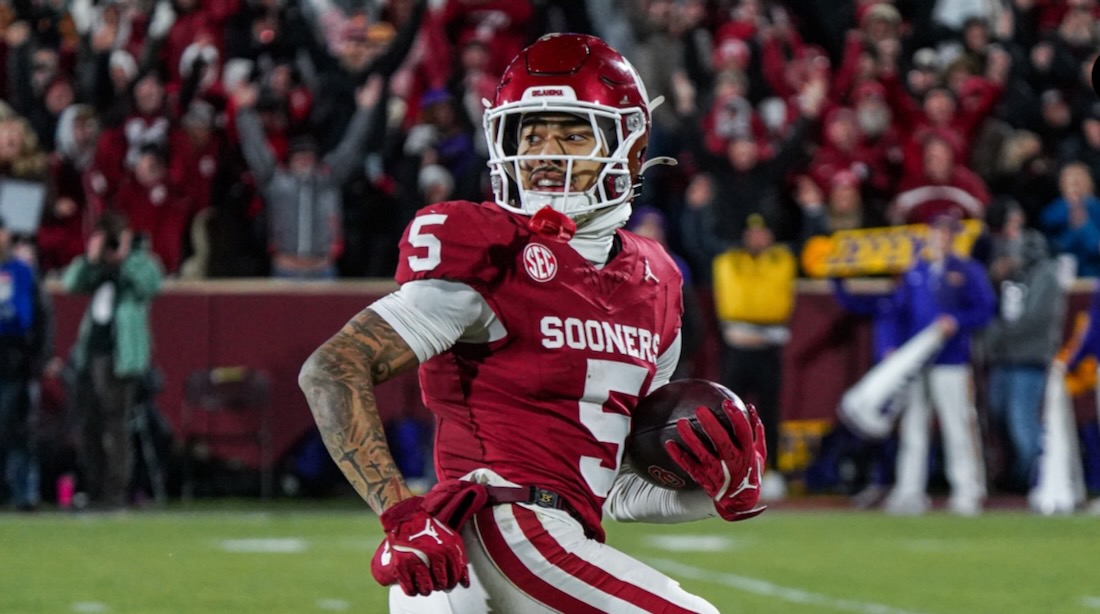
OU receiver Isaiah Sategna races toward goal line in victory over LSU.


When OU wide receiver Isaiah Sategna blew past LSU defensive backs in busted coverage last week to catch a game-sealing 58-yard TD pass, I missed the moment.

I could say that I was out back on our patio grilling or answering an unexpected knock at the door, but it would not be true.

The truth is that because it was late in a really tight game and I was invested in the outcome as someone who has bought into OU, I found something else to do at that moment.

Why?

Well, turning my back on a close game in which I have a rooting interest goes back many decades. I’m not even sure what to call it. Lack of courage? Can’t face reality?

Call it what you will, but I prefer to call it my double-reverse jinx.

As a pre-teen in the early 1960s, the Arkansas Razorbacks were my team. I lived and died with the Hogs. In those days, you mostly had only radio broadcasts on which to follow college football games.

So, when the Hogs were playing on an autumn afternoon I was tuned in — until I wasn’t. I specifically remember, when, in the second half of a really close game with the Razorbacks in a precarious position, I abandoned the radio, ran out into the back yard and started throwing a football around.

A few minutes later, I went back in and caught a couple minutes of the broadcast, but the outcome was still pending. I went back outside.

When the Hogs won that game with me not listening, I decided that all their success hinged on me not ever listening again when the outcome was on the line. Somehow, I controlled their fate.

My double-reverse jinx helped the Hogs have a great decade of success in the ’60s.

Fast forward to the late ’80s when I worked on the sports desk as a copy editor at The Daily Oklahoman. That meant that my daily working hours were from roughly 3-4 pm until midnight or 1 am.

Those working hours afforded the opportunity to drive out to the then-new Remington Park race track in the early afternoon on almost a daily basis to watch and wager on the horse races.

You know where this is going.

Yep, if I had $2 on a horse and it was among the leaders as they came off the final turn and into the stretch, I would turn my back and only listen to the track announcer’s call. One afternoon, I had maybe $5 on a horse and spent the entire race in the men’s room, safe from ruining the outcome by actually watching my horse.

I took a lot of grief from my newsroom colleagues for not being able to watch the outcome of races on which I had wagered. But that’s how I rolled.

Fast forward to 2025. It’s still how I roll when watching the Sooners, the Razorbacks, even the Thunder. When the game gets tough and the outcome precarious, I bail on the game.

And then it happens. Shai Gilgious-Alexander hits a game clinching 3. Isaiah Sategna makes a game winning catch.

The old double-reverse jinx does it again.

BONUS CONTENT: Don Mecoy, a friend and past contributor to BlogOKC, shared some of his own experience in not jinxing his favorite teams:

“Super Bowl V. Cowboys-Colts. I got on my bike during the game and rode and rode. Didn’t help.

“National Championship game in 2000. Sat in the same spot on the couch throughout the first and second half. Really had to pee by the end of the game. And I was hungry too. Literally didn’t get up once.”

Thanks for this perspective, Don. I am not alone!

A Golden memory on Super Bowl Sunday

A screenshot of The Gold Sheet taken from a Chicago Sun Times article.

Here’s a memory that goes back to the 1980s when I worked in the downtown OKC newsroom of The Daily Oklahoman.

Every Thursday afternoon during football season, I would walk about three blocks down to Taylor’s Newsstand from the paper’s Broadway & 6th Street headquarters.

You might remember Taylor’s Newsstand. It was located in the Century Center mall attached to the Sheraton Hotel. Taylor’s offered an awesome variety of magazines and newspapers from around the country. I fact, I bought a lot of Sunday papers from Denver, Kansas City and Dallas at Taylor’s over the years.

But that’s not what drew me to the newsstand on Thursdays in the fall. It was a publication that Taylor’s sold called The Gold Sheet.

Man, I loved to get my hands on The Gold Sheet each week.

If you are unfamiliar with it, The Gold Sheet was a football handicapping publication. A tout sheet. Still is, in digital form.

It was printed on heavy gold paper that unfolded into a large single sheet that contained predictions and analysis on every Division 1 and NFL football game for the coming weekend.

I’m pretty sure that my friend ‘David’ introduced me to The Gold Sheet, and I became a loyal reader.

I wasn’t much of a gambler, but coworkers at the newspaper in that mid-1980s era connected me to a bookie here in town who would would take my tiny wagers of $10 or $20.

So, The Gold Sheet became a big part of my weekly rhythm throughout the 1980s, when I was still single and willing to wager a few dollars on football.

Yes, I know it’s shocking that gambling on football (and other sports) occurred in OKC. But it did in the ’80s, and I’m certain you wouldn’t have to work too hard to find a bookie today who would take your wagering action.

A Bold Prediction: Oklahoma will have legal, online sports wagering within the next 5 years.

As for The Gold Sheet itself, it contained a prediction on the outcome of every game along with a couple of sentences that backed up each pick. It made for great reading, if nothing else.

Maybe because today is Super Bowl Sunday– by far the No. 1 day annually for sports wagering (sorry Final Four, Kentucky Derby et al) — I stumbled across a reference online this morning to The Gold Sheet.

And that got me to wondering what became of my favorite handicapping publication.

So, I did a little online research and discovered a Chicago Sun Times article from 2022 that revealed that it is now part of an online handicapping website called WagerTalk Media.

The article also outlined the history of The Gold Sheet, which was launched in Los Angeles by the late Mort Olshan in 1956. It remained a physical publication until the end of the 2019 football season, when it morphed into a digital publication.

A wave of nostalgia washed over me when I discovered the Chicago Sun Times article, which included a picture of The Gold Sheet from back in the day.

My weekly wagering days are long gone. But The Gold Sheet remains a fond memory of that time in my life.

BONUS CONTENT: Steve Lackmeyer, my friend and former colleague at The Oklahoman, wrote about the demise of Taylor’s Newsstand when it finally closed for good in 2009. Turns out The Gold Sheet outlasted the newsstand where I first discovered the publication.