‘London Homesick Blues’ puts me back in that place

‘Gotta put myself back in that place again’

Those are the first words in Jerry Jeff Walker’s live version of “London Homesick Blues,” which I consider as the soundtrack to my years on the campus of Abilene Christian University in the late 1970s.

Written by fellow Outlaw Country artist Gary P. Nunn, the song was recorded in Luckenbach, Texas, in 1974 as part of Jerry Jeff’s landmark “Viva Terlinqua!” album.

“London Homesick Blues” is one of the best examples of what became known as the Outlaw Country genre that emerged in Austin, Texas, in the 1970s. But it’s also a song about loneliness and longing for home when you are far removed from the place you love.

“Well, when you’re down on your luck and you ain’t got a buck
In London you’re a goner
Even London Bridge has fallen down
And moved to Arizona
Now I know why
And I’ll substantiate the rumor that the English sense of humor
Is drier than than the Texas sand
You can put up your dukes or you can bet your boots
That I’m leavin’ just as fast as I can”

So, why am I writing about a 52-year old outlaw country song in 2025?

Well, I was an aspiring journalist as an ACU student, and my campus life revolved around the student newspaper, The Optimist.  Several of my classmates who were also enrolled in ACU’s Journalism and Mass Communication department became lifelong friends.

Along the way on my ACU journey, the Optimist staff embraced “London Homesick Blues” as something of an anthem. A couple of guys played the guitar and we organized a faux band that played the song with gusto.

My role was only to stand with the band and sing the song’s famous chorus really loud and off key. Of course, that’s the only way I know to sing.

I fondly recall a party hosted by our beloved journalism professor, Dr. Charlie Marler, where we played and sang that song in his living room.

“I wanna go home with the armadillo
Good country music from Amarillo and Abilene
The friendliest people and the prettiest women you ever seen”

If you are a fan of the PBS show Austin City Limits, you know that chorus because it opened the show for 27 years.

Back to 2025. I’m not sure how or why, but I began listening to “London Homesick Blues” on replay over the course of the past couple of months.
A wave of nostalgia washes over me when I hear it, and it really does take me back to that place — the ACU campus and the people with whom I shared classes and The Optimist newsroom.

“Well, it’s cold over here, and I swear
I wish they’d turn the heat on
And where in the world is that English girl
I promised I would meet on the third floor?
And of the whole damn lot, the only friend I got
Is a smoke and a cheap guitar
My mind keeps roamin’, my heart keeps longin’
To be home in a Texas bar”

The song plays pretty much nonstop my head these days, and I really sense the longing and loneliness of the tune. It’s a pretty heavy message for an Outlaw Country song, and it’s come to mean so much to me.

So, I asked several former classmates their thoughts on “London Homesick Blues” nearly 50 years removed from our days together at ACU. Since it was a small campus and student body, we had many classes together.

Here are their responses:

Scott Kirk was Sports Editor of The Optimist and remains a close friend from our college days together:

“It is one of my all time favorites. Nancy and I are going to London for our anniversary this year ,and I’ve been singing this song when I walk the dogs. It does take me back to the Optimist, as does any Jerry Jeff Walker song.”

Karen Latham (now Everson) is one of the smartest people I’ve ever known and a great writer as The Optimist’s film critic and features editor.

“It makes me think of playing records in The Optimist office, y’all singing at Dr. Marler’s house, and when I would hear it while living in Arizona and then New York City, I would think of my Texas (which is not today’s Texas) and shed a tear.”

Michigan native Ron Hadfield was editor of The Optimist for two years and then built a 40-plus year career leading ACU’s marketing efforts. 

“Little did I know at the time, but in the late 1970s I was in the process of becoming a Naturalized Texan (I claim dual citizenship as a Michigander) in those years when the world was discovering Luckenbach and that genre of Texas country music, thanks to Willie Nelson and others whose music I came to enjoy.

Jerry Jeff Walker and Gary P. Nunn and Michael Martin Murphy were among the pioneers of that sound, perhaps even before Nelson, as I recall. I was fortunate to interview Murphy in between concerts at ACU one night in 1978, and remain a big fan of his.

Their music has always been imminently singable. And although I won’t be confused with a vocalist of note, and don’t drink or hang out in honky tonks, it represents the soulful sounds of this part of the world that have quietly become part of my DNA.

‘They will always be a part of me whenever I think of Texas memories,’ as Jerry Jeff sang in ‘Leavin’ Texas,’ a deeply introspective ballad I have come to love dearly and queued up on the 8-track tape as I drove east out of Texarkana for what I thought was the last time decades ago. It still makes my eyes water after all these years.

So I live these days in San Antonio, not far from the amazing Hill Country, and still get deep satisfaction out of listening to ‘London Homesick Blues’ and Jerry Jeff’s iconic ‘Viva Terlingua!’ album and any other number of songs that remind me of time spent with dear and friendly Native and Naturalized Texans from Amarillo and Abilene and elsewhere.

As James Earl Jones described so eloquently in a famous scene in the baseball movie, Field of Dreams, ‘those memories are so thick, I have to brush them from my face.’ The background music of my Texas life makes a world of difference.”

Thank you to Scott, Karen and Ron for sharing your perspectives on “London Homesick Blues” and the Outlaw Country flavor of Texas music.

When I hear that song, it really does put me back in that place again.

“Well, I decided that I’d get my cowboy hat
And go down to Marble Arch Station
‘Cause when a Texan fancies he’ll take his chances
Chances will be taken, that’s for sure
And them limey eyes, they were eyein’ the prize
That some people call manly footwear
And they said ‘You’re from down South and when you open your mouth
You always seem to put your foot there

I wanna go home with the armadillo
Good country music from Amarillo and Abilene
The friendliest people and the prettiest women you ever seen’
ACU Hall of Fame recognition for my friend Ron Hadfield … and a grand reunion

hadfield speaks
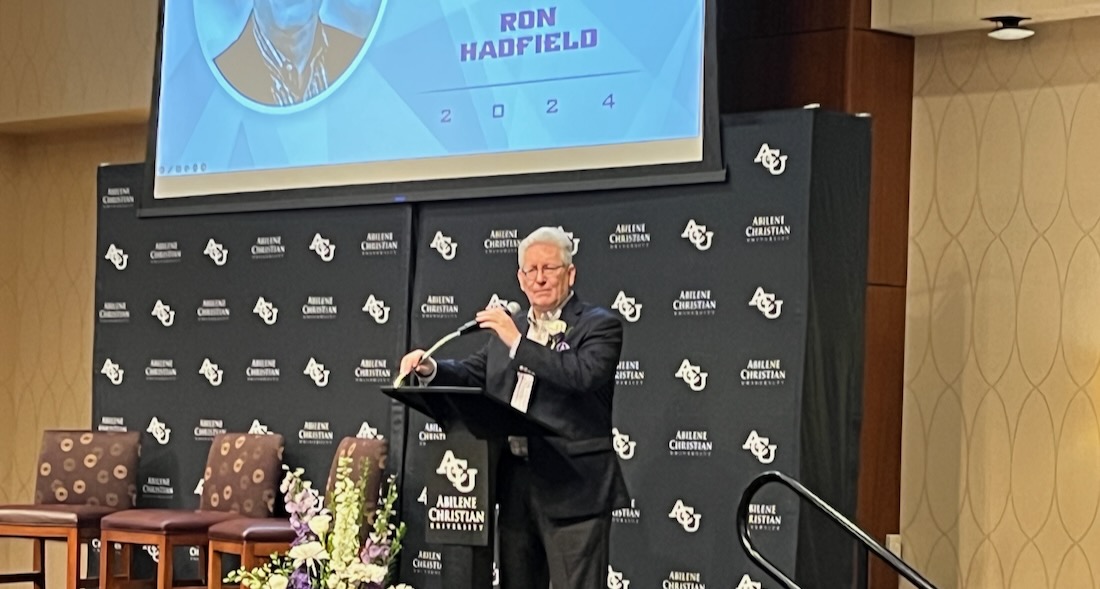
Ron Hadfield adjusts the mic as he speaks to the ACU Hall of Fame audience.

Ron Hadfield is a long-time friend who was my student editor on the Abilene Christian University newspaper, The Optimist, in 1977. Ron recently was recognized with a Lifetime Achievement Award at the ACU Athletic Hall of Fame ceremony that I was privileged to attend.

I showed up on ACU’s doorstep in 1976 as a transfer student with a dream to some day become a newspaper sportswriter, but with virtually no writing experience.

To say that I was a raw talent would be overstating my ability and potential. I didn’t have a clue.

Ron likes to tell the story that on the first assignment he sent me out on, I turned in some terrible copy and proudly showed him the quotes I made up.

I deny the accuracy of his memory.

But he was a patient editor who helped me begin to find my way as a writer.

I didn’t know the intricacies of sports — especially basketball — as well as I thought I did, and Ron helped me learn strategies such as the double high stack offense used by ACU men’s basketball coach Willard Tate.

As we shared both the Optimist newsroom and numerous ACU classes, Ron became a good friend. We each had a keen interest in sports, baseball in particular, and we traveled to Arlington, Texas, with our mutual friend, Scott Kirk, to catch Texas Rangers games on several occasions.

Ron and I even traveled to Kingsville, Texas, together to watch the 1977 ACU-Texas A&M-Kingsville game, spending the night on the North Padre Island beach.

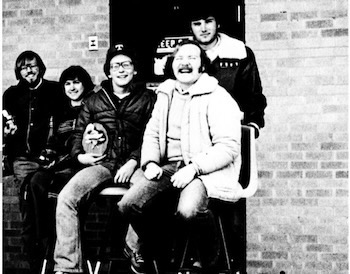
Our 1977-’78 Optimist staff of perhaps a dozen people became a team of close friends who spent late nights getting the paper out and often playing touch football well after midnight on the ACU campus. We were popular with campus security.

Optimist3
Me (front row, right) with colleagues from The Optimist in 1978

Optimist staff members were all regulars at the home of Dr. Charlie Marler, who led ACU’s Journalism and Mass Communications department for many years both as professor and chair. I completed a guided study sportswriting course one summer where we met at the Marler home instead of on campus. Dr. Marler passed away in 2022.

Anyway, I graduated in August of 1978, while Ron went on to serve a second year as editor of The Optimist before graduating in 1979. I’ve never let our friendship totally lapse, even if communication was only through occasional emails or texts.

After his graduation, Ron briefly worked in private industry back in his home state of Michigan, then returned to ACU to lead the university’s marketing efforts.

For the next 40-plus years, virtually every written word, advertisement, branding strategy and logo created on behalf of Abilene Christian University was either produced or led by Ron. He was founding editor of the university’s fabulous alumni publication, ACU Today, and led the school’s development of its online presence with the emergence of the Internet.

Ron wrote many cover stories for ACU Today, as well as blog posts and news releases that captured some of the school’s iconic moments over the past four decades.

The only person to be twice named the university’s Staff Member of the Year, Ron was named ACU editor emeritus, senior writer and university historian in 2022.

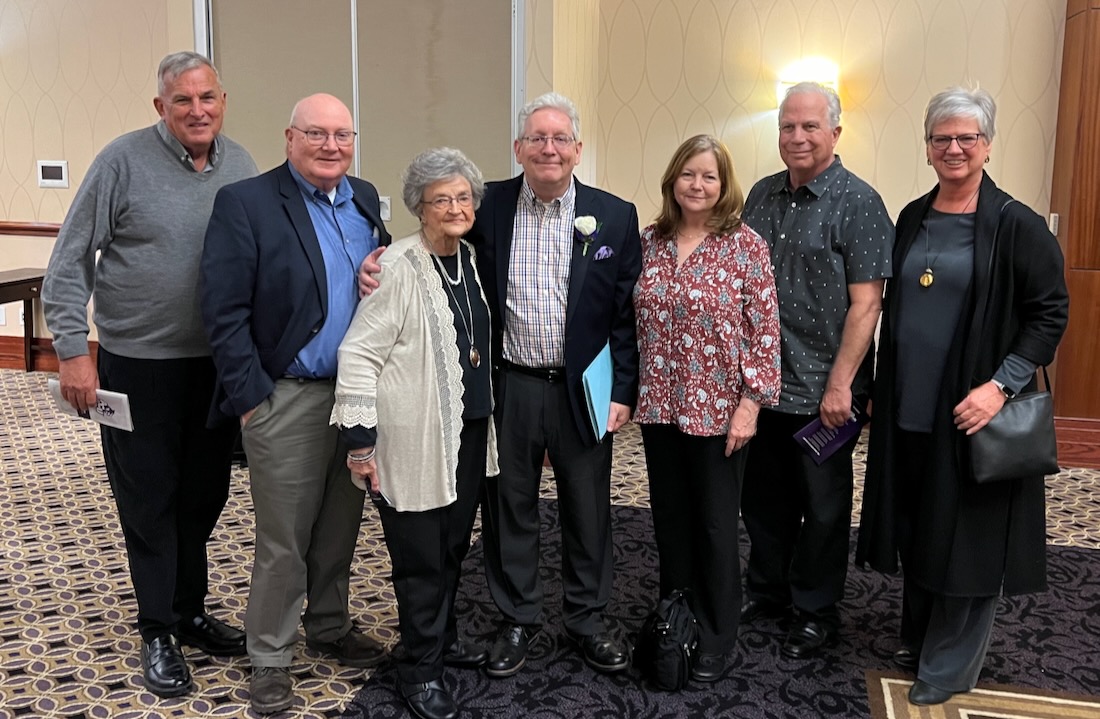
So, when Dr. Cheryl Mann Bacon invited me to sit at her table at the Hall of Fame induction ceremony, I didn’t hesitate to say ‘yes.’ Also at the table were fellow former Optimist staff members Scott Kirk (and his wife, Nancy) and Corliss Hudson Englert (along with her husband, Brad), as well as Peggy Marler, Dr. Marler’s wife of 67 years.

Dr. Bacon also was part of our Optimist group, although she was working on her master’s degree by the time I landed on campus.

acu group
From left, Scott Kirk, Jim Stafford, Peggy Marler, Ron Hadfield, Corliss Hudson Englert, Brad Englert, Cheryl Mann Bacon

It was an awesome evening in a banquet hall setting among about 200 or so ACU alums who watched as Ron was honored with the Lifetime Achievement Award, and five former athletes were inducted into the Athletic Hall of Fame.

Although I’ve never had the opportunity to experience any of ACU’s class reunions, this was the best of reunions for me.

Thanks for the invitation, Cheryl.

My college pal Scott Kirk brings baseball revival to Abilene

Scott Kirk Bison intro
Scott Kirk, president of the Abilene Flying Bison, introduces the new development league team on Dec. 14.

It’s funny how your memory can distort the facts over the years. When I first met Scott Kirk on the campus of Abilene Christian University in the fall of 1976, I was impressed because he had actually worked for a minor league baseball team in his hometown of Harlingen, Texas.

At least, that’s what I remembered from a distance of almost 50 years.

Scott recently corrected the historical record for me.

In reality, he actually worked as a sportswriter for the Valley Morning Star, covering the Rio Grande Valley WhiteWings baseball team that was based in Harlingen. He even took a year off from college to focus on the job as WhiteWings beat writer.

But I’m not letting the facts get in the way of my warm memory.

I remember Scott Kirk as a fellow student who was committed to sports journalism and loved the sport of baseball above all sports. He was and is one of my favorite writers both in college at the Optimist student newspaper and through a long career with the Abilene Reporter News after graduation. He closed out his career as a high school journalism teacher in Abilene.

By comparison, I was far behind Scott in my writing and reporting abilities when I landed on campus in 1976. But I loved baseball, and that sort of bonded us as members of the Optimist staff. We watched baseball on TV, talked baseball and drove to Arlington to watch the Texas Rangers play.

Scott and I have stayed in touch through the years, each of us playing a role in the other’s wedding, meeting in Dallas or Houston to watch baseball, and once playing a round of golf in 100+degree weather during a scorching Abilene summer.

Although he’s retired from roles as reporter and teacher, Scott continues to pursue his passion for baseball not only as a fan, but as someone working hard to bring a professional or semi-pro revival to Abilene. The west Texas city has been home to professional and independent baseball teams in both the distant and recent past.

pairie dogs logoblue sox logoBack in the 1940s and ’50s, it was home to a minor league team named the Abilene Blue Sox. There were two versions of the Abilene Prairie Dogs, one that played on the ACU campus from 1995-’99 and again for a one-year reprise in 2012.. Scott served as official scorer for the 1990s version of the Prairie Dogs.
Fast forward to Dec. 14, 2023. Scott’s vision for another Abilene baseball team became reality with the announcement that the Abilene Flying Bison developmental league team would begin play in May on the home field of McMurry University.

Turns out the person who made the announcement before about 150 people at a downtown Abilene events center was, wait for it, Scott Kirk, who is now President of the Abilene Flying Bison.

Scott’s wife, Nancy, posted a photo on Facebook of her husband making the announcement, so I called him to get the story of how it happened.

It begins with Scott connecting with George Lessmeister, a Kansas City resident who was scouting for a city to locate a team in a proposed developmental league, which would be unaffiliated with Major League Baseball.

“George Lessmeister’s involvement came through National Sports Services, which owns and operates several collegiate teams and also matches prospective owners with franchises,” Scott told me. “NSS and Ventura Sports Group are the co-founders of the Mid America League.”

It was a natural connection because of Scott’s long presence in the city of roughly 125,000 residents, and his past roles with previous teams.

AN ASIDE TO THE STORY: There’s an Oklahoma connection to all of this. Lessmeister previously considered locating the team in Edmond, where it would play on the UCO baseball field. But a deal could never be consummated.

So, now it’s the Abilene Flying Bison, instead.

Bison logoI asked Scott how the team was named. The Bison part is easy because of the city’s location in an area where the buffalo once roamed. The team added “Flying” as an homage to Dyess Air Force Base, Scott said. Dyess has a big local presence from its location on the west side of Abilene.
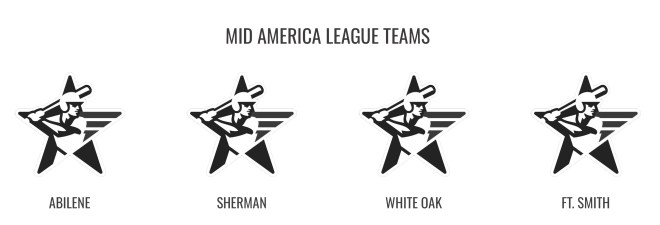


So, what about the league the Flying Bison will play in and where are the other teams located?

“We’re going to be playing in what is known as the Mid America League,” Scott told me. “It’s a developmental league with no Major League affiliation. The players are going to primarily be collegiate players. We can have guys who might have played pro ball for a couple years, and they can play for us. We just can’t pay them.”

Five cities have been identified for the six-team league, Scott said. In addition to Abilene, there are Sherman, Texarkana and White Oak, all in Texas, with the fifth team located in my home town of Fort Smith, Ark. Scott said the league is close to announcing the sixth location.

mid america citiers

Here’s what I found out about the league on the Mid America League website:

“The League will play a 68-game schedule to start in late May and run through early August, concluding with playoffs to determine the League champion. The League will also be contracting with Opendorse to implement a program offering Name, Image and Likeness opportunities for players.”

Wait. NIL for an independent baseball league?

“I know it sounds like pay for play, but those are the rules we live by,” Scott said. “There are literally dozens of collegiate baseball leagues across the country. I would say there are probably 200 collegiate teams. One league, the Northwoods League, has almost 40 teams.”

I looked up the Northwoods League, which plays in the upper Midwest, and its website showed 25 teams in two divisions.

OK, Mr. President, what’s the next step for the Flying Bison and the Mid America League?

“Get a season completed,” Scott said. “If you complete your first season, your chances of success are better.”

So, Scott Kirk’s baseball story has come full circle. He DID have an unofficial affiliation with the Rio Grande WhiteWings. And now he’s leading a long-sought baseball revival in Abilene.

“The motivation for bringing a team to Abilene has always been about doing something that contributes to a sense of community in the city,” Scott said. “The overarching goal has been to build a venue that could serve as the home for a sports team in the future, whether it’s the MAL team or another team. If there’s a place for the team to play, it increases the likelihood of baseball or another sport to continue to play in Abilene.”

Maybe my memory from long ago wasn’t so faulty after all. Facts is facts.

mid america screen

Dr. Charlie Marler & the divine coincidence

marler office
Portrait of Dr. Charlie Marler in his office/ACU photo

I was sitting in a pew in the next-to-last row at Oklahoma City’s Quail Springs Church of Christ one Sunday in 1991 when someone tapped me on the shoulder.

I glanced back and almost fell out of the pew.

Sitting directly behind me was Dr. Charlie Marler, my favorite professor from my days as a student at Abilene Christian University. Dr. Marler taught most of the journalism courses I took at ACU and led the university’s journalism and mass communications program for many years.

Turns out, Dr. Marler was traveling through the state that Sunday morning and randomly decided to attend the Quail service. Quail was a large church, but somehow he ended up sitting directly behind me.

I took it as divine coincidence.

I had only been attending at Quail for about a year and had begun dating the woman who would become my wife, Paula Bottom. She was sitting next to me at that service, so I introduced her to Dr. Marler.

“Oh, you need to stay away from this guy,” he said with a smile.

I was at Quail because of the influence of Dr. Charlie Marler. Not only did he help guide me and motivate me to stay the course to graduation at ACU, he also modeled a life of faith for me that led me to Quail Springs church decades later.

I grew up in a church tradition different but similar to the Church of Christ, and had always been a religion skeptic. I’m not a smart man, but I always wondered why there were no professionals — no doctors or lawyers or college professors — in our little church growing up.

We had plenty of blue collar people who worked with their hands, and we were proud of it.

Anyway, Dr. Marler showed me that you could be highly educated and still have faith in a God of the universe. Years later, I recalled Dr. Marler’s faith when a friend invited me to Quail.

I attended the church reluctantly, but slowly came to accept the faith myself.

Along the way, I met Paula, we married and have been members of the Quail Springs church — now known as The Springs Church of Christ — ever since.

So, when Dr. Marler passed away late in May, it was a very personal loss to me even though I saw him only on rare occasions over the last 40 years or so.

I’m writing this to share how one life was influenced by his academic guidance, gentle patience and faith.

My college career at ACU also was a divine coincidence, I guess.

I wasn’t recruited to ACU in the 1970s. I wasn’t recruited by any college. Poor academic record. Poor study habits. Little involvement in my high school community.

But I had a dream. I wanted to go to college and study journalism. I wanted to be a sportswriter. I aspired to be Blackie Sherrod of the Dallas Morning News.

Somehow, life’s circumstances led me to Abilene, Texas, in the Spring of 1976. So, I sort of turned up on ACU’s doorstep with 30 hours at community college to my credit.

That twist of fate brought me into Dr. Marler’s sphere of influence for the next two-and-a-half years. I recall his teaching style with fondness because he seemed to involve everyone in each class but never singled anyone out for embarrassment.

He was notorious for marking up papers I wrote and articles I attempted for ACU’s student newspaper, The Optimist, with his red editing pen. Every ACU journalism student was subjected to the red editing pen .

Optimist3
Me (front row, right) with colleagues from The Optimist in 1978

However, that red pen helped shape my writing style, and I slowly grew in confidence and ability.

And he talked about how Christians could — and should — work in newsrooms, keeping the faith while pursuing careers in a secular world.

It took years for the message to really sink in, but it finally hit home with the skeptic that I am.

Thanks to Dr. Marler, I had a 30-year newspaper career, and a decade-plus beyond that in the marketing office of a company.

Now, multiply the influence that Dr. Marler had on my life and career with thousands of other students over his 50-plus year academic career. That’s why he was a towering figure in journalism education and the Christian faith.

There is so much more to his story — read ACU’s wonderful tribute to him here — but this was the part of his life that touched mine.

The deal was finally sealed, you might say, when Dr. Marler tapped me on the shoulder at a random Sunday church service in Oklahoma City.

A divine coincidence.