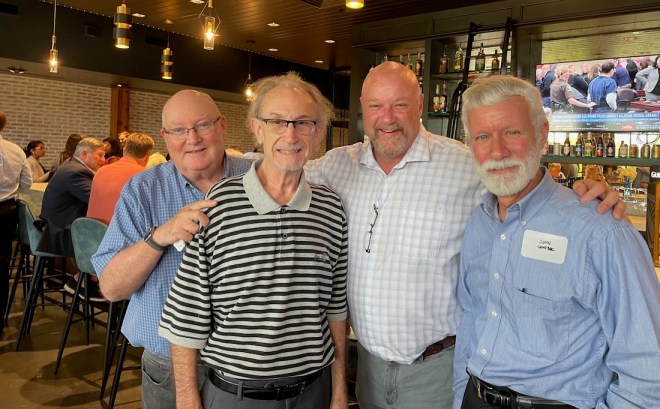
‘Family reunion’ for me at i2E anniversary celebration

i2E group
From left, Jim Stafford, David Daviee, Rick Rainey and John Campbell. Photo by Cindy Henson

There was no media coverage, but a milestone celebration occurred last week for i2E, an Oklahoma City-based not-for-profit corporation that has had a major impact on Oklahoma’s innovation economy since its debut in 1998.

Friends and employees — both current and past — celebrated i2E’s 25th anniversary at the City and State Event Center on NE 6th Street.

Roughly 75 of us gathered to catch up with old friends and hear some historical perspective from i2E President Rex Smitherman about the not-for-profit. i2E provides education, business advisory services and investment for Oklahoma’s tech-based entrepreneurs.

I’m a former i2E employee who worked in its marketing office both as full-time employee and contract worker from 2009 to 2022.

So, the anniversary celebration was a homecoming of sorts for me to see my former colleagues.

But first you should know a little more about i2E. It was created in 1998 as the Oklahoma Technology Commercialization Center by the Oklahoma Center for the Advancement of Science and Technology, which is the state agency that supports innovation and scientific research across the state.

That original name was unwieldy, so it soon became known as i2E — Innovation to Enterprise. The first CEO was Randy Goldsmith, followed by the late Greg Main, and then Tom Walker.

I entered the picture as an employee just after Tom became CEO and I retired as a newspaper reporter with The Oklahoman. I had become acquainted with Tom when he was i2E’s Chief Operating Officer in the early 2000s and I was the paper’s technology beat reporter.

After Tom moved to Columbus, Ohio, to lead a similar institution, Scott Meacham became CEO, continued to expanded the mission and retired from that position earlier this year. Scott remains Executive Chairman of the Board.

Today, Oklahoma boasts a growing number of venture capital firms and business accelerators, but back in 1998 there was virtually no organized investment capital for entrepreneurs.

That was the bleak landscape that i2E stepped into, thanks to the vision of Sheri Stickley and William Hagstrom. The pair —Stickley with OCAST and Hagstrom an Oklahoma entrepreneur — conceived of the idea of a private company, seeded with public dollars, that would provide assistance to businesses that were spun out of Oklahoma’s universities or the minds of local inventors.

Here’s more perspective on i2E’s history from a column authored by Meacham on the occasion of its 20th anniversary five years ago.

The headline described it was an “Oklahoma success story,” and that’s no exaggeration.
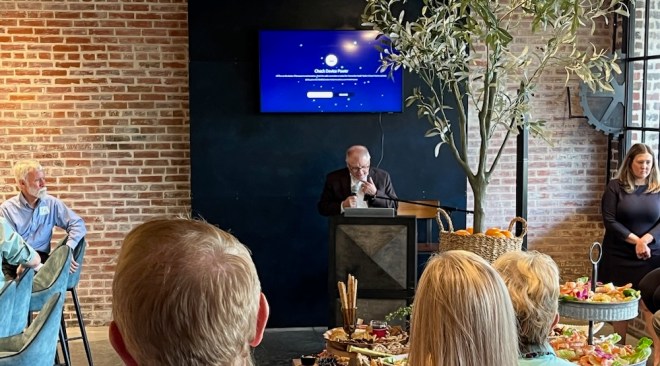
i2E Rex
Rex Smitherman addresses crowd at i2E 25th anniversary celebration

As Rex outlined in his presentation at the anniversary celebration, i2E has provided business advice or investment for over 800 fledgling companies across its history. It has provided more than $83 million of investment capital to Oklahoma ventures.

Here are a few of the high impact success stories for which i2E provided advisory services and investment: WeGoLook, Selexys Pharmaceuticals, Spiers New Technologies and Alkami Technology, a billion dollar public company that was founded in OKC in 2009 by Oklahoman Gary Nelson.

And i2E’s mission continues to expand. In fact, Rex devoted much of his presentation at the anniversary celebration to looking forward to i2E’s future impact through its new programs.

Today, i2E embraces a big educational mission, having launched and managed the statewide Love’s Entrepreneur’s Cup collegiate business plan competition that will celebrate its 20th anniversary in 2024. Now, i2E is launching a pilot high school business plan competition in a partnership with the MidAmerica Industrial Park in Pryor.

There’s more expansion news. i2E developed a popular workshop for new entrepreneurs called E3, which helps them determine whether their venture has a realistic opportunity for success. Joining E3 will be a second program called Bridge2, described as an 8-week ‘pre-accelerator’ that provides $50,000 in convertible debt funding for founders.

In addition, i2E created a subsidiary a few years ago known as Plains Ventures, which now handles virtually all of the investment activities for the company.

But enough of the history and impact of i2E.

For me, the anniversary celebration was a chance to catch up with old friends, even if just for a few moments. Folks like Rick Rainey, Cindy Henson, Mark Lauinger, Srijita Ghosh, Darcy Wilborn, John Campbell, Kevin Moore, Shaun O’Fair, Rex Smitherman and former OCAST executive director Michael Carolina.

I even had the opportunity to share a few moments with our former finance director, David Daviee. My only disappointment was that not all of my former i2E colleagues made it to the event. You know who you are.

Maybe for the next ‘family reunion.’

But life goes on. As i2E’s mission continues to expand, it’s been joined in the space by a host of new Oklahoma investment and accelerator partners, both here in OKC and in Tulsa.

While the investment outlook for new entrepreneurs and ventures in 2023 is far from bleak, the time was right for an i2E when it became a reality in 1998.

It really was an idea whose time had come.
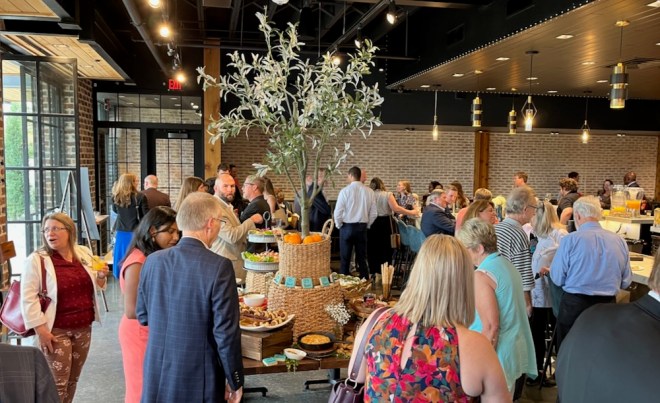
i2E crowd
Crowd shot during the i2E anniversary celebration

BONUS: I came across an old story by the Oklahoma Council of Public Affairs, a conservative research organization that generally attacks any new idea that uses public dollars to advance an innovative concept, no matter how many people benefit. Here’s a sample of the article:

“The Oklahoma Center for Science and Technology (OCAST) should no longer receive state funding for the Oklahoma Technology Commercialization Center (OTCC). This program directly competes with the private sector and existing market participants engaged in business formation and development.”

You get the drift.

My response:  Back in 1998 and for many years afterward, there was little private sector investment capital in Oklahoma competing with the i2E concept. Many new ventures likely would not even have been attempted had i2E not been in existence. Oklahoma’s innovation economy expanded because of i2E’s efforts, and now new private ventures are bringing new investment to the state.
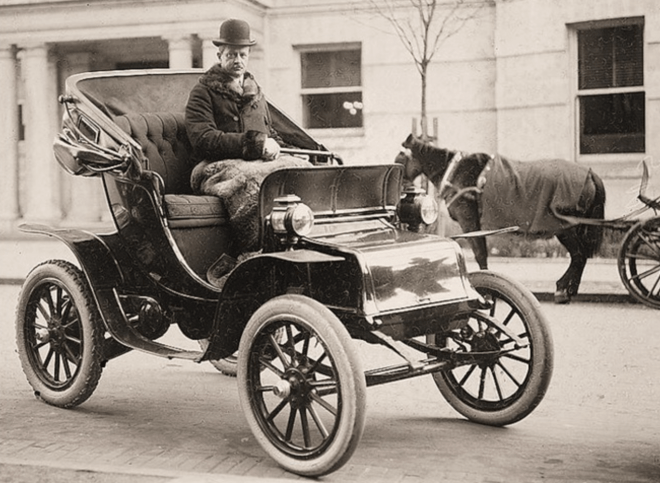
The horse is here to stay

horseless carriage
A turn of the 20th-Century horseless carriage.

‘The horse is here to stay, but the automobile is only a novelty — a fad.’ — American banker to potential investor in 1903

Even at the dawn of the 20th century, your crazy uncle was spouting off nonsense about things he didn’t know anything about.

I guess back in those days, social media rants took place at the local church, tavern or letter to the editor. New technologies have always brought out the doubters and naysayers, I guess.

One hundred years ago. Sarah T. Bushnell published a biography called “The Truth About Henry Ford” in which she told the story of the banker who advised the attorney that drew up incorporation papers in 1903 for Ford’s automotive company.

The attorney had been asked to invest in the Ford Motor Co., but was hesitant and sought out advice from his banker.

“My advice is not to buy the stock,” the banker said. “You might make money for a year or two, but in the end you would lose everything you put in. The horse is here to stay, but the automobile is only a novelty — a fad.”

We all know how that turned out.

Read more on the turn-of-the-20th-century opposition to the horseless carriage in “Get a Horse!”, an article written in the 1920s by one of the inventors of the automobile, Alexander Winton.

Fast forward 100 years.

We’re at the beginning of a revolutionary transition in which electric vehicles will replace gasoline and diesel powered vehicles. Auto manufacturers are building more EVs each year with commitments to make electric vehicles the vast majority of their production by the 2030s.

There seem to be an incredible number of Teslas already on Oklahoma roads.

Despite the upward trajectory and inevitable march of technology, I’m seeing rants against EVs every day on the social media platforms where I hang out. A lot of ‘crazy uncles’ are poo-pooing the potential of electric vehicles, along with alternative power generation from wind and solar energy.

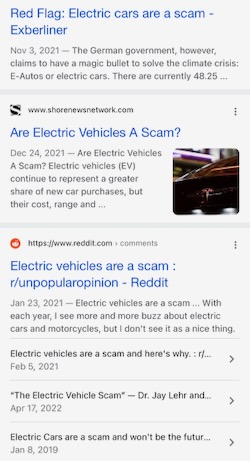
ev scamsI’ve seen photos and graphs and charts that allege that electric energy is just as harmful to the environment as fossil fuels because of the mining for minerals and the ultimate disposal of batteries.

If you Google “electric vehicles” and “scam,” you get dozens of articles showing that the world is being played.

I’m no expert, but I choose to believe that scientists and innovators have taken all of that into consideration.

So, I assume a lot of folks — especially Oklahomans — are feeling threatened by alternative power and transportation because of our long-standing ties to the oil and gas industry.

It’s sort of ironic that oil and gas-dominated Oklahoma is home to one of the world’s first large scale electric vehicle battery remanufacturing and recycling ventures, Spiers New Technologies.

Founded less than a decade ago by Dirk Spiers, the company has shown phenomenal growth, quickly outgrowing its original 23,000 square feet of manufacturing space to now occupying its current 200,000 square feet in its operations center along SE 89th Street just east of I-35.

Spiers also operates a European location and provides battery lifecycle services to virtually every automaker with the exception of Tesla. The company showed such potential that it was acquired in 2021 by Cox Automotive.

I’ve had the opportunity to interview Dirk on several occasions and hear his views on the future of electric vehicles. You can read an earlier post with Dirk here.

But I want to share some of his perspective again in this post, because I think it’s both worthy and accurate.

“In the next five years, the cost of an electric vehicle will be cheaper than a combustion engine,” Spiers said. “So, we are only at the beginning of where we are going.

“The Devon tower — and I think it is a great building — is now more than 50 percent empty. That shows you how they (and Oklahoma City) misread the future. And now the Devon tower stands there as a symbol of Oklahoma City prosperity, but it is half empty. A relic of an industry in decline.

“The good thing is that you know eventually that everyone will drive an electric car. Those cards have been played. So, we are on the right side of history” 

Although he added that the transition is not going to happen all at once, we’re watching Dirk’s predictions playing out every day.

Meanwhile, I’ll end this with the long-ago perspective of another futurist, former U.S. Supreme Court Justice H.B. Brown in a 1908 article entitled “The Horseless Carriage Means Trouble.”

“The automobile is doubtless a most useful vehicle, but one is not likely to lavish upon it the fond attention he bestows upon his horse or dog. A man may admire his own carriage, but his affections are reserved for the horse that draws it and the dog that follows it. Whatever the outcome may be, every true admirer of the horse will pray that it may not be the extinction or dethronement of the noblest of all domestic animals.”

Now there’s your crazy uncle.

negative screen]

Dirk Spiers and his passion for electric vehicles

Spiers New Technology founder Dirk Spiers in the foyer of his company’s OKC headquarters.

I was invited recently to tour the electric vehicle (EV) battery pack remanufacturing facilities of Oklahoma City’s Spiers New Technologies (SNT), a booming business that virtually created an industry niche.

You can read the story here. 

Founder Dirk Spiers was incredibly accommodating. He provided me and my colleague from the Oklahoma Center for the Advancement of Science & Technology (OCAST) an up-close look at the massive operation at SE 89th Street where Spiers remanufactures, repurposes or recycles as many as 2,000 EV batteries per month.

Dirk then patiently answered our questions about the business and why Oklahoma City works so well for a venture focused on electric vehicles when there are very few driven in Oklahoma. The short answer is that OKC is conveniently located geographically in the heart of the U.S., so shipping to and from SNT is less challenging than if it was located on either coast.

All of that is in the story I wrote for the Greater Oklahoma City Chamber. However, a few remarks from Dirk did not make the cut for the Chamber story, and I wanted to share them here because I think he’s an important alternative energy industry voice.

“We are the black sheep in Oklahoma. This is an oil and gas state. When people say ‘energy,’ they mean ‘oil and gas.’ And I think oil and gas was maybe good for Oklahoma for a while, but not anymore.”

Dirk speaks about alternative energy sources like solar, wind and vehicle electrification with an evangelistic fervor. Here are his comments in Q&A form.

Q. How do you describe your company’s reputation here in a state that has been dominated for decades by the oil and gas industry?

A: First of all, I think we are the black sheep in Oklahoma. This is an oil and gas state. When people say ‘energy,’ they mean ‘oil and gas.’ And I think oil and gas was maybe good for Oklahoma for a while, but not anymore.

The Devon tower — and I think it is a great building — is now more than 50 percent empty. That shows you how they (and Oklahoma City) misread the future. And now the Devon tower stands there as a symbol of Oklahoma City prosperity, but it is half empty. A relic of an industry in decline. In fact, I think the majority of office buildings here are empty.

The good thing is that you know eventually that everyone will drive an electric car. Those cards have been played. So, we are on the right side of history, it’s just a matter of navigating through a really difficult year because of COVID. Also, it will not all happen at once.

But look at oil and gas. It has been a particularly bad investment for investors lately. Big Oil is not so big anymore. Stranded assets are now becoming a real thing. Dividends are more difficult to sustain. What I find interesting is that the European oil companies are starting to pivot. In the U.S., they are still in denial.

Q: What can Oklahoma do to signal that it is ready for a future with electric vehicles and alternative energy sources like solar and wind?

A: First of all, you need to embrace electrification a lot more. Don’t come up every year with legislation for taxation that doesn’t make sense and is punitive. Do something that is fair and forward looking. But I can see some progress there. I am hopeful.

Solar and wind are important here in Oklahoma. but be more forward looking and don’t try to renegotiate an existing (wind) deal. Renegotiating an existing deal is never a good sign that you are trustworthy.

Solar is completely under-used in Oklahoma. I think it’s the fourth brightest state, and I don’t see many solar panels.

No. 2, allow Tesla to sell and service cars in the state. You can’t say with your right hand, come here, we’re the best state, and with the left hand say we don’t want you to sell your goods here. That’s hypocritical.

Q: Do you consider yourself an evangelist for alternative energy use?

I do believe and always believed in climate change. Climate change is real. It’s here and the effects are increasingly worrisome and easy to see. In the USA it became a political issue and people are still debating this. Only here. Climate change is here, so, deal with it and let’s not lose more time.

Not sure I am an evangelist. But read the newspapers, understand the trends. When you do you know that solar is going to become — if it not already is — the cheapest form of energy, that wind is going to become the cheapest form of energy. and that we are all eventually going to drive electric vehicles. It is not that difficult. Actually, it is good. Who wouldn’t benefit from cheaper and cleaner forms of energy? Who wouldn’t enjoy driving a much better car than what they drive now? We don’t watch black and white TV anymore either on big boxes.

In fact, when you buy the latest TV or smartphone, why would still choose antiquated technology when buying a car?