SEC Shorts means appointment viewing for me

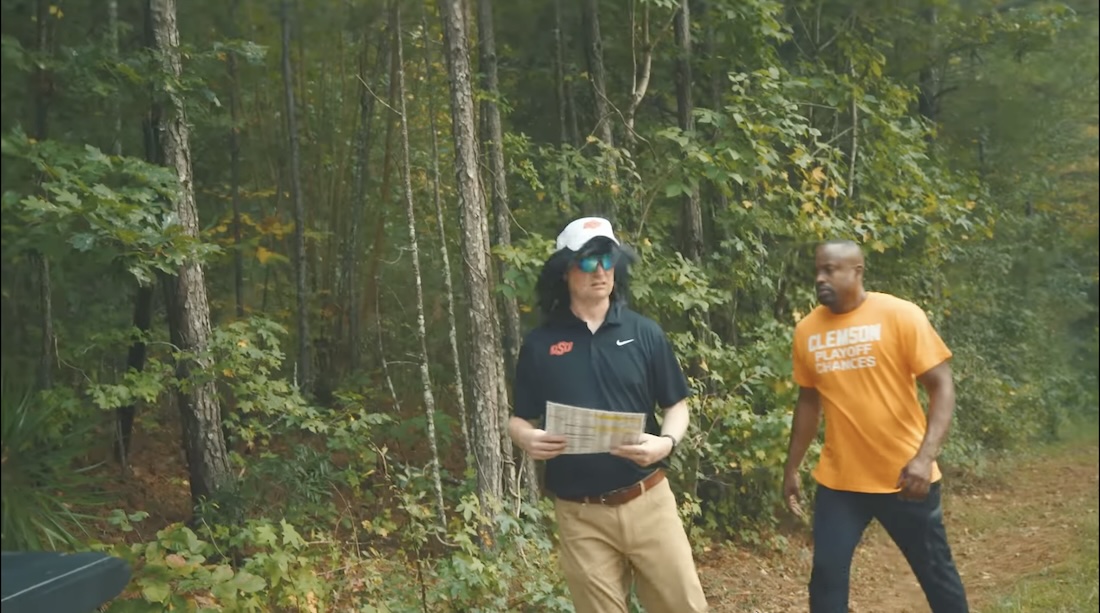
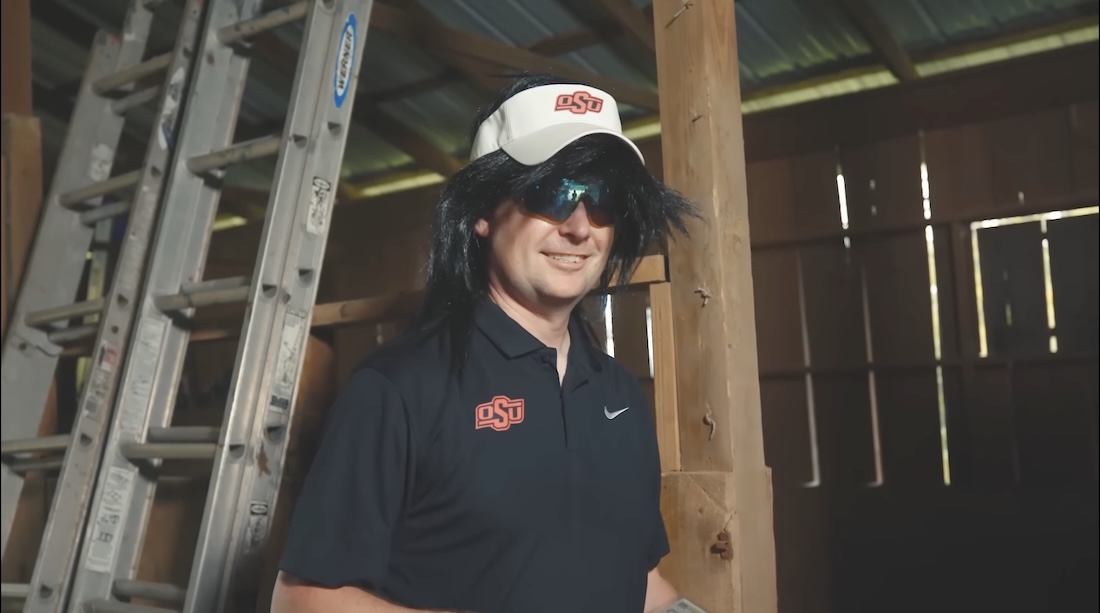
A Mike Gundy-like OSU character was welcomed to SEC Shorts this week.

There was a time in my life when watching Saturday Night Live was one of my most important weekly routines. Sadly, age and the long ago retirement of the Not Ready for Prime Time Players greatly diminished my SNL viewing.

Now I click on weekly SNL highlights posted on Twitter/X to watch individual skits. Saves me time and allows me to go to bed hours earlier on Saturday nights.

However, I’ve adopted a new viewing routine in 2025. It’s a weekly show posted online every Monday during football season called “SEC Shorts.”

You should be watching, too, if you are a college football fan.

SEC Shorts is a weekly, fast-paced 5 to 8-minute show that satirizes the immediate past weekend results from Southeast Conference football games. The writers/producers/actors are comic geniuses, in my view, because each episode is not only hilarious, but right on target with its send-ups.

I discovered SEC Shorts during the 2024 season, so I’ve only watched a dozen or so episodes from last year and into the start of this season. And in my limited view, this week’s episode towers over all the others.

Why? I’ll just say that this week’s short centers on a farmer and his “Going for Two Second Chance Farm.” No spoilers, except to say that OSU and Clemson are both welcomed into the SEC Shorts family.

You can watch the episode below.

My friend Ed Godfrey also watched the latest episode and declared it “Oscar worthy.” Another friend, Steve Buck, declared them “masters” after last week’s episode. Their videos attract millions of viewers, according to the SEC Shorts website.

Here’s something astounding about SEC Shorts.

College football games are played on Saturdays, and a fresh SEC Shorts episode is posted the following Monday morning. That means the SEC Shorts producers have to create the concept, write the script, access props and film the entire thing in one day.

Since I knew so little about SEC Shorts background or how it got started, I found its website to catch up on who these guys are.

Turns out, the show was created by a couple of Alabama guys — Robert Clay and Josh Snead — back in 2014. They filmed their first episode and submitted it to the Paul Finebaum simulcast radio/TV show in September of that year, and the rest is history, as their website says.

Today, there’s a cast of 5, including Robert and Josh, who write, act and film each episode, with additional support from a few others as needed. The website also offers a ‘behind the scenes’ photo gallery of some of their productions in progress.

Here’s the lead paragraph from the “Our Story” section of their website:

“Who doesn’t want to see themselves on TV? It was this noble motivation that launched SEC Shorts in the fall of 2014. Robert Clay and Josh Snead were wasting away in the basement of a medical publishing company, where they spent all day editing gross medical lectures that would make even the most seasoned surgeons gag. As they sat across from each other in the Inverness Dairy Queen, eating their fourth chocolate dip cone of the week, they realized there had to be a better way.”

It’s obvious they don’t take themselves too seriously, unlike, say, fans who hail from Alabama, Georgia or several other SEC destinations.

If you are tired of hearing “SEC! SEC!” chanted during broadcasts of SEC teams, remember there’s a small crew of comic geniuses just waiting to poke a little fun at their Saturday heroes when the games are over.

Watching a fresh SEC Shorts episode each week certainly brightens my Mondays. It should be on your schedule, too.

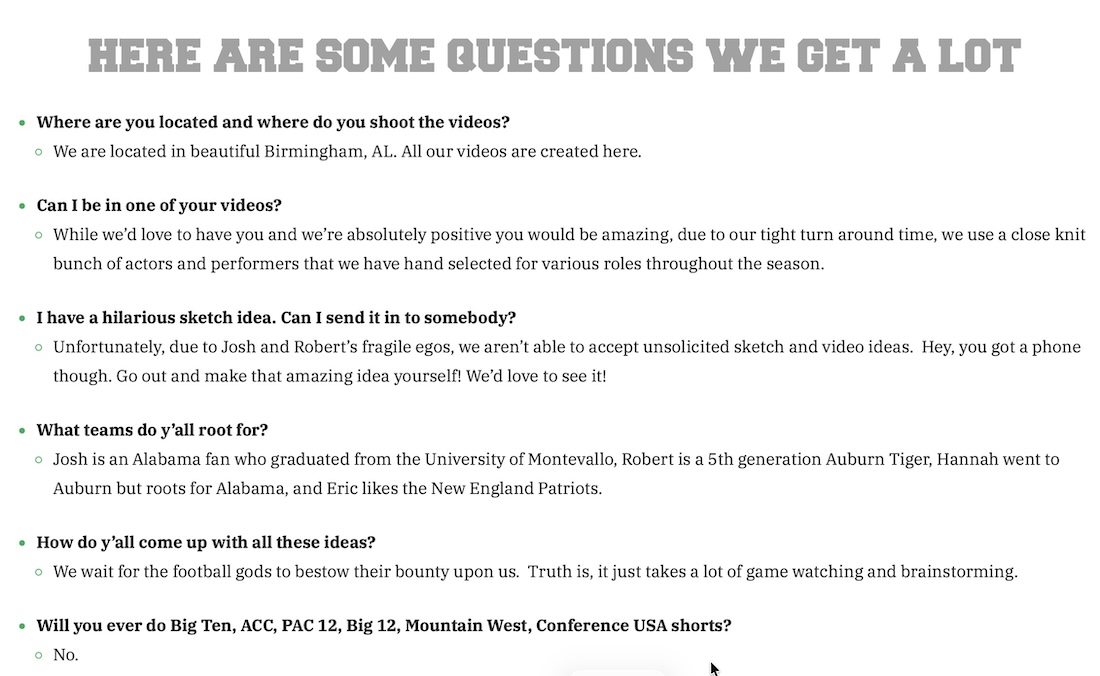
BONUS CONTENT: Read the Frequently Asked Questions section from the SEC Shorts website below.
Screenshot

34 years later, article stirs memories of Arkansas’ stunning exit from SWC

Fort Smith Etc. magazine cover from 1991

Almost 34 years ago, a friend and former coworker at the Southwest Times Record in Fort Smith, Ark., hit me up with a request.

Patti had left the paper to become editor of a new local magazine called Fort Smith Etc. She asked me to write an article on the University of Arkansas’ stunning move from the now late Southwest Conference to the the rival Southeast Conference.

Arkansas announced in August 1990 that it was switching conferences, and actually made the move the following year.

The unexpected conference divorce set off shockwaves among major conferences and ushered in what has become an era of constant realignment. By 1995, the SWC was no more, with most members welcomed into the Big Eight, now known as the Big 12.

Anyway, I wrote a pretty snarky — for me — 800-word piece for the magazine that listed all the things the Razorbacks would not miss from the SWC. It was published in the Nov./Dec. 1991 edition of Fort Smith Etc. magazine.

So, why am I writing about this now when I hadn’t given the article a thought for the last 30 years or so?

Turns out a high school friend of mine and Fort Smith native I’ll call ‘Will’ discovered he had digitized copy of the article on his personal computer. Will, who also had written for the magazine, emailed it to me. Thanks, Will!

After reading what I wrote more than three decades ago, I’m still proud of how it turned out and the fact that it is still relevant today in this era of conference reshuffling.

There are a couple of references to now departed venues like Barnhill and Reunion arenas (and  misplaced campus locations for the universities of Alabama and Mississippi), but it’s not too dated, I think.

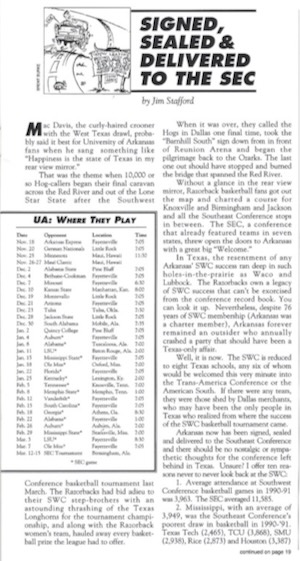
With all that said, I’m reprinting the article here in BlogOKC. Hope you enjoy this trip down memory lane.

Signed, sealed & delivered to the SEC

Mac Davis, the curly-haired crooner with the West Texas drawl, probably said it best for University of Arkansas fans when he sang something like “Happiness is the state of Texas in my rear view mirror.”

That was the theme when 10,000 or so Hog-callers began their final caravan across the Red River and out of the Lone State after the Southwest Conference basketball tournament last March. The Razorbacks had bid adieu to their SWC step-brothers with an astounding thrashing of the Texas Longhorns for the tournament championship, and along with the Razorback women’s team, hauled away every basketball prize the league had to offer.

When it was over, they called the Hogs in Dallas one final time, took the “Barnhill South” sign down from in front of Reunion Arena and began the pilgrimage back to the Ozarks. The last one out should have stopped and burned the bridge that spanned the Red River.

Without a glance in the rear view mirror, Razorback basketball fans got out the map and charted Knoxville and Birmingham and Jackson and all the Southeast Conference stops in between. The SEC, a conference that already featured teams in seven states, threw open the doors to Arkansas with a great big “Welcome.”

In Texas, the resentment of any Arkansas’ SWC success ran deep in such holes-in-the-prairie as Waco and Lubbock. The Razorbacks own a legacy of SWC success that can’t be exorcised from the conference record book. You can look it up.

Nevertheless, despite 76 years of SWC membership (Arkansas was a charter member), Arkansas forever remained an outsider who annually crashed a party that should have been a Texas-only affair.

Well, it is now. The SWC is reduced to eight Texas schools, any six of whom would be welcomed this very minute into the Trans-America Conference or the American South.

If there were any tears, they were those shed by Dallas merchants, who may have been the only people inTexas who realized from where the success of the SWC basketball tournament came.

Arkansas now has been signed, sealed and delivered to the Southeast Conference and there should be no nostalgic or sympathetic thoughts for the conference left behind in Texas.

Unsure? I offer ten reasons never to never look back at the SWC:

1. Average attendance at SouthwestConference basketball games in 1990-91 was 3,963. The SEC averaged 11,585.

2. Mississippi, with an average of 3,949, was the Southeast Conference’s poorest draw in basketball in 1990-’91. Texas Tech (2,465), TCU (3,868), SMU (2,938), Rice (2,873) and Houston (3,387) all had lower attendance averages.

3. Average attendance at Southwest Conference football games in 1990 was 39,382. The SEC averaged 63,870.

4. Southwest Conference teams were forced to play a limited football schedule for two seasons because one conference member, SMU, was given the “death penalty” by the NCAA; no SEC school has ever drawn the “death penalty.”

5. The Cotton Bowl is played in an open-air stadium, often in some of the most brutal weather Texas has to offer on New Year’s Day; the Sugar Bowl, played in the New Orleans SuperDome, is never threatened by the weather.

6. Southeast Conference football games are broadcast nationally over the Turner Broadcasting System cable network. SWC games are broadcast throughout Texas on something known as the “Raycom Sports Network.”

7. Arkansas will never have to face Southwest Conference officials when playing a Southeastern Conference game.

8. Texas A&M, a school full of traditions, features an all-male corps of cheerleaders.

9. There is no horror movie titled “The Tennessee Chainsaw Massacre”

10. Few natives from any Southeastern Conference state answer to the name of “Tex.”