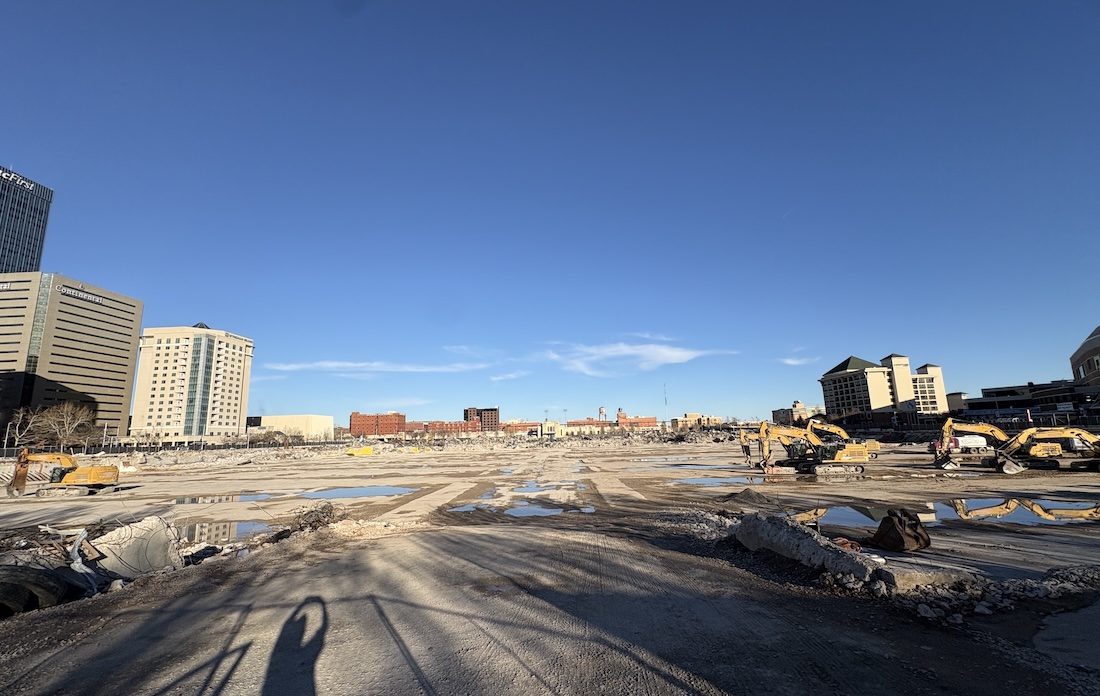
A few weeks ago, my friend Ed and I had an appointment in Midtown OKC when we decided to go take a look at the site of the Incomparable Myriad to see the progress made on its demolition.
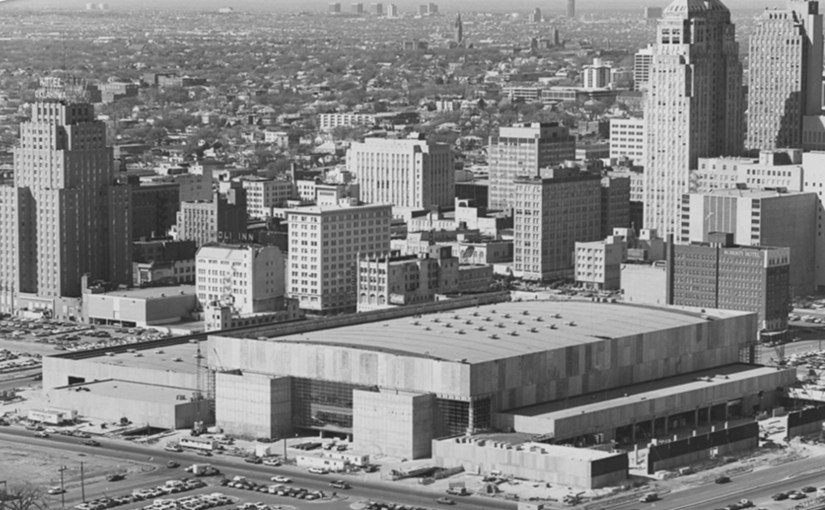
As you probably know, the gigantic concrete box that opened in 1972 as the Myriad Convention Center was demolished to make way for a new billion dollar arena built for the Oklahoma City Thunder. Along its 53-year journey, the name transitioned from the Myriad to the Cox Business Center and finally to the Prairie Surf Studios.
I admit I was surprised when we approached the 2-square block site of the Myriad and there was nothing but a gigantic empty lot. The site looked even larger to me than it actually is, because now it’s a sea of dirt stretching from E.K. Gaylord Blvd. to Robinson Ave.
Ed slowed down to let me jump out to take some photos while he drove around the block(s). When I got back into the car, we shared some of the experiences we had at the old arena.
Then Ed said, “you should write a blog post about your Myriad memories.”
So, that’s the purpose of this post. I’m sharing my favorite memories of the building that date back to the late ’70s. But I’ve also asked Ed and several other Oklahomans to share their Myriad memories.
I’ve got three memories that stand out to me.
My first visit to the Myriad took place in roughly 1979 or ’80 when I accompanied a group of folks from Fort Smith, Ark., to attend the National Finals Rodeo. I was a young sports writer at the Southwest Times Record and was sent on assignment with the Fort Smith Old Fort Days Rodeo committee to experience the NFR.
What stands out in my mind is the location from which I witnessed the rodeo. They stationed me on the actual arena dirt behind the protection of metal fencing. So you might say I had an up-close-and-personal look at the National Finals Rodeo.
My second Myriad memory is attending a John (Cougar) Mellencamp concert at the venue in February 1986. I’m not a big concert goer, but I was (and am) a fan of John Mellencamp’s music, so I enjoyed being part of a full house, both on the floor and in arena seats. I was struck by how awesome the violinist (fiddler?) was who accompanied him on several songs.
Finally, my favorite Myriad memory is that of New Years Eve 1990. I took my future wife, Paula, to see the Oklahoma City Cavalry on our first date. I know, I’m a real romantic. Turns out, Paula may be a bigger basketball fan than am I, and has seen far more OKC Thunder games at Paycom Center over the years than I have.
Now I’m turning this over to 10 Oklahomans who share diverse memories from their experiences at the Myriad over the decades.
First up is Oklahoma City Mayor David Holt, who is also Dean of the Oklahoma City University School of Law and author of the book: Big League City: Oklahoma City’s Rise to the NBA
If you get a little misty-eyed about the Myriad, it’s understandable. It may not have been much to look at, but it was the center of our community’s life in a unique way that will never happen here again.
The Myriad opened in 1972. Until the opening of the Ford Center in 2002, it was the city’s primary arena. Until the opening of the Oklahoma City Convention Center in 2021, it was also the city’s primary convention center. And until the city’s explosion in growth around the time of the Thunder’s arrival in 2008, the demand on the Myriad’s schedule was mostly for community events. All of this is worth noting, because it means that for about four decades, practically every major moment we experienced as a resident of this city was at the Myriad. The Myriad occupied an emotional place in Oklahoma City life that no venue will ever occupy again. In 2026, we utilize many venues to host that which was once held at the Myriad. And increased demand for national entertainment events and conventions means that community events once held at the Myriad are less likely to occur at its successor venues.
It is probably also worth noting that the prime decades for the Myriad were some of the worst decades in the city’s overall history. From a historical perspective, we can appreciate that. But within that narrative, we were living our lives. The milestones of our individual lives were largely unencumbered by the greater challenges facing our city. And those milestones occurred at the Myriad. Any OKC resident born between 1950 and 1985 is going to have a very long list of personal experiences tied to the Myriad. For me, it will always be the place I graduated high school, took the Bar exam and delivered my first two State of the City addresses. It was where I attended countless memorable athletic events and concerts. It was the focal point of our city’s shared experience. We’ll each carry those warm feelings forward as we experience the glorious new future destined for this site in the heart of our city.
Ed Godfrey is a now-retired longtime reporter at The Oklahoman who shares an unforgettable memory of the Myriad from 26 years ago.
Memories of the Myriad? There are many. I recall a great Whitney Houston concert there in 1987 and a tremendous Reba McEntire performance the following year.
But my most vivid memory came on March 13, 1998. I was the county courthouse reporter for The Oklahoman newspaper and covering a trial when the jury went out to deliberate that afternoon.
I left my pager number with someone in the judge’s office and asked to be paged when there was a verdict. With time to kill, I made the short walk to the Myriad to meet some colleagues from work and go to an NCAA basketball tournament game between 13th-seeded Valparaiso and 4th-seeded Ole Miss.
Thankfully, the jury didn’t reach a verdict before the end of the game, because it allowed me to witness one of the greatest buzzer beaters in NCAA history.
Valparaiso trailed 69-67 with 2.5 seconds left and had to inbound the ball from under its own basket and go the length of the court. I thought the game was over, as I’m sure everybody in the Myriad did.
I mean, how would Valparaiso even get a shot up, other than a Hail Mary, with just 2.5 seconds left? Ole Miss put a defender in front of Valparaiso’s Jaime Sykes, who was inbounding the ball.
Sykes heaved the ball over the halfcourt line to a leaping Bill Jenkins, who caught the pass and tossed it to Bryce Drew, who was streaking beside him, before Jenkins’ feet even hit the floor. Drew caught it and immediately fired up a 23-foot 3-point shot to win the game.
The Myriad erupted. No one could believe what they had just seen.
I don’t remember the verdict that day in the trial I was covering. I don’t even remember who was on trial or what it was about.
But I will always remember that shot and the noise in the arena at that moment
Don Mecoy had a long tenure at The Oklahoman as both a reporter and editor, closing out his career as the newspaper’s managing editor.
The Myriad, while incomparable in name only, was a happy place for me. I attended scores of events there over the decades, including graduation ceremonies, sporting events, business conferences and concerts.
I even worked there. As a reporter, I covered a 1991 appearance at the downtown arena by the Rev. Jesse Jackson. I was posted at a table along the front of the stage, with the 12,000 attendees at the National Baptist Conference seated behind me.
At one point, Jackson asked all the men in the arena to stand. I am a man, so I stood.
“Look at all these beautiful Black faces,” Jackson implored the crowd.
I am not Black, so I eventually sat back down.
But I digress. My favorite event that I ever attended at the Myriad was a Yes concert. I was a pretty big fan of the prog-rock band. But the performance, delivered from a rotating round stage in the middle of the arena floor, was much better than I had expected.
I even looked it up to make sure my memory hadn’t been faulty. It was indeed at the Myriad on June 5, 1979.
Coincidentally, that’s my wedding anniversary – just 14 years before the fact, and about six years before I even met my wife.
Scott Munn is also an alumnus of The Oklahoman, toiling for decades on the sports desk as both a reporter and an editor.
There were a few people who suggested that I keep a cot in a closet. For a few years in the early to mid-1990s, I was at the Myriad every night of the winter, covering either the Blazers hockey team or the Cavalry basketball team.
The Blazers would play Friday night, the Cavs on Saturday, etc. I was able to see Ryan Minor’s brief stay with the Cavalry before he went on the play baseball for the Baltimore Orioles and become the answer to a trivia question — who replaced Cal Ripken Jr., after he ended the consecutive games played record?
I witnessed Smokin’ Joe Burton develop from a rookie forward into the greatest player in Central Hockey League history. Fights. 10,000 people in the stands almost every game. The atmosphere made you feel like you were at an NHL game.
The Myriad had typical arena smells. Fried onion burgers, hot popcorn and Little Caeser’s Pizza. Even the parking garage under the arena had an odd, indescribable smell, which I think was a combination of automobile fuel and mold.
I really hated to see the Myriad go down. I saw a lot of games, stood for my share of national anthems — both American and Canadian (yes, I can sing “Oh Canada”). I tried to get one of those orange folding chairs from press row, just for memory-sake. But my “connection” never got back to me, so I figure those chairs went to the landfill like the rest of the grand old place.
Larry Newman is retired from a long career in the technology industry, but also worked part time on The Oklahoman’s sports desk while an OU student in the early 1980s.
My favorite memories of the Myriad involved time spent with my dad. We had season tickets to the Oklahoma City Blazers and Stars for about seven seasons in the late 1970s and early 1980s.
We rarely missed a game and enjoyed watching many great players when Oklahoma City was the farm club of the Calgary Flames and Minnesota North Stars.
Dad went to heaven three years ago, but the cherished memories remain vivid.
Steve Buck is a longtime friend, avid sports fan and public servant who worked for two governors and now is CEO of Care Providers Oklahoma.
Growing up in Altus, going to the Myriad was a magical treat. Even as I aged, I could never call it anything but “The Myriad” (sorry Cox). I experienced so many great events from hockey matches to CBA Hoops (Go Calvary!) and NCAA tournaments to State FFA conventions.
But the concerts are the events I remember the most. I saw some great ones, but by far the most historic was the May, 1991 event dubbed as “Farm Fest ’91”. One of my good friends helped organize the event to support our state’s farmers and the line-up of Oklahoma connected country superstars was unbelievable … Garth Brooks. Vince Gill. Restless Heart. Joe Diffie. Just an incredible night of music and an extraordinary reflection of the star power that calls our state home.
Marc Anderson and his wife, Michelle, served as Den Masters to my son’s Cub Scout Pack in the late 1990s.
I moved to OKC in 1991 and as I became entrenched in the community I would attend games at the Myriad with friends. Here are some core memories of the arena:
The May 1999 tornado and being evacuated to the parking garage during the game (Blazers?).
Also, graduations! My son, Reece, graduated in May 2014, daughter Quinn in 2016 and youngest son Beck in 2017, all at the Myriad.
There are some secondary memories, as well. Blazers hockey games, Oklahoma Calvary games and the arena’s final days as the Prairie Sky Studio, because my son, Beck, worked there for two years.
Kent Taylor is another longtime friend who is retired from a career in the oil and gas industry.
As an Okie who grew up watching football, baseball, and basketball, I was introduced to hockey at the Myriad Convention Center. An older couple from our church first invited my wife, Jamie, and me to our first game. Over the years, we attended a number of Blazer games.
I also recall attending the men’s gymnastics competition during the Olympic Festival in 1988 or maybe it was 1989. The Olympic Festival provided the opportunity for Oklahoma City to showcase itself to the country. Maybe the Olympic Festival was the springboard that birthed the renewal of downtown OKC.
Steve Hill served as Chief of Staff to two Oklahoma City mayors, Mick Cornett and David Holt, and before that was a renowned newspaper columnist and cartoonist.
I saw so many great shows at the Incomparable Myriad.
I saw Queen, twice. I also saw ELO, Neil Young, Thin Lizzy, and Whitney Houston. I think tickets were $12 for most of those shows.
I interviewed UB40 in the Green Room at the Myriad. By “interviewed,” I mean recording a conversation fueled by a ridiculous amount of Heinekens.
UB40 was opening for the Police. Mickey Virtue, the band’s keyboard player, told me to come sit on top of the on-stage speaker monitors during their opening set. So I did. Stayed there for the Police, eliciting a funny look from guitarist Andy Summers. Best seats ever.
I was friends with the Cavalry ownership group when the CBA came to OKC. I wound up selecting and playing the music during games.
OKC’s Steve Burtt was checking into a game. As he waited for the ref to motion him in, he told me he liked the baseball cap I was wearing.
“You want it?” I asked.
“Yeah!” He replied.
I tossed him the hat off my head. He grabbed it and ran back to the bench to stow it before checking in.
The CBA.
Best part of the Cavs experience was lunchtime pick-up games on the Myriad court with my buddies Mick Cornett, Dean Blevins, and other media guys.
I forget the OKC Barons played at the Myriad/Cox Convention Center in its latter years — that team was insane with future NHL stars Jordan Eberle, Ryan Nugent-Hopkins, Taylor Hall and Justin Shultz starting for the Barons. Loved going to Barons’ games.
Russ Florence is a longtime friend, music aficionado, writer and all-around renaissance man who also serves as OKC-based partner, President and CEO of the consulting and PR firm, Schnake Turnbo Frank.
Russ wrote a story for The Oklahoman last year about a 1977 concert experience he had at the Myriad as a 13-year old. Here are some key paragraphs and a link to the entire story on The Oklahoman’s website:
 Afterward, Gary and I walked out the north doors of the Myriad, into the downtown streets with thousands of long-haired fans. We were probably the only ones looking for our parents. Neither of us recalled instructions about where to meet them. Just, you know, “find us afterward, somewhere.”
Amidst the revelry and the traffic, we looked toward the corner of Sheridan and Robinson, and Gary pointed. “There they are,” he said. Indeed, there were his parents, idling in their giant Ford LTD, cigarette smoke rolling out of their windows. They didn’t have a care in the world. How did they know when the show would be over? How did they know we would find them? Where did they go while Gary and I were at the concert? I’m envisioning a couple of Crown and Cokes at a dark, wood-paneled restaurant on the city’s west side, or a little beer joint that played George Jones on the jukebox.
“How was she?” Gary’s dad asked.
“He,” Gary said. “Alice Cooper is a ‘he.’ He was good.”
Click here to read the entire story at The Oklahoman website.
Thanks to these fellow Oklahomans who shared their memories of the Myriad Convention Center built across decades of sports events, concerts, graduations and more. And thank you, Ed, for suggesting this post.
If you have your own memories of attending an event at the Myriad, please share them in comments below.

 “That really felt like an extension of the heyday of the blogosphere when so many people were blogging,” Dan told me. “I remember in those early days I would follow anyone from Oklahoma.

 Jim Stafford's BlogOKC