 When I graduated high school in 1971 — in the bottom half of my class academically — I plunged into my future thinking I pretty much knew everything I needed to know and could handle anything coming my way.
However, I didn’t know what I didn’t know.
It didn’t take long to realize that I had few skills or knowledge to navigate both life and a career. My confidence in myself took a steep dive.
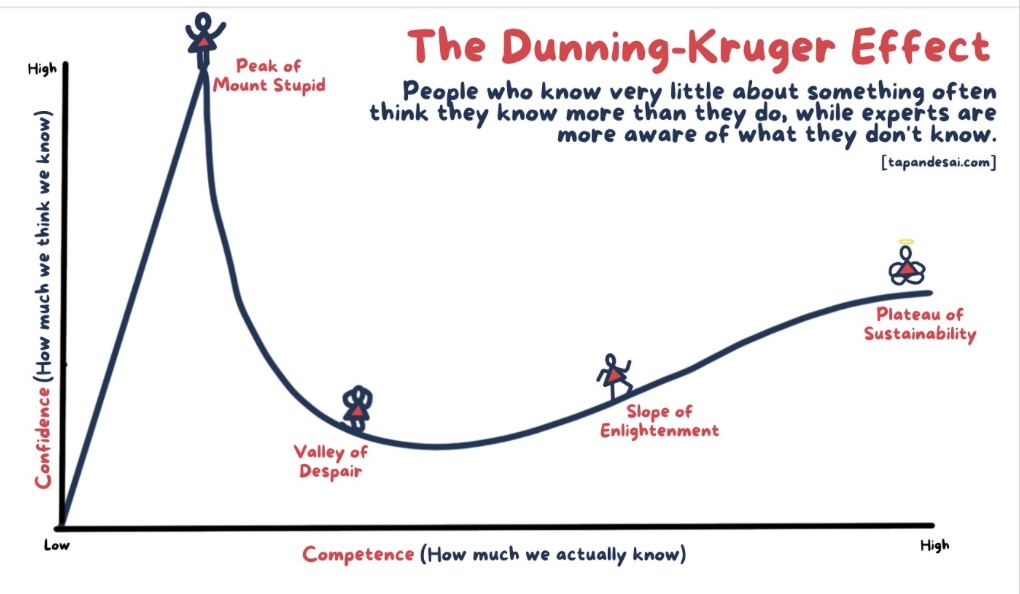
I’m writing about this because I saw a chart of what is known as the Dunning-Kruger Effect this week that perfectly described what I experienced. I’ve since found multiple versions of the chart online and posted one at the top of this column.
Developed by psychologists David Dunning and Justin Kruger in 1999, the Dunning-Kruger Effect describes what is called “unconscious incompetence,” when you truly don’t know what you don’t know and wrongly assume you know it all.
Many of the charts I’ve seen label the point at which a person has the most incorrect confidence in their knowledge or ability as “Mount Stupid.”
They certainly got it right in my case.
When I realized I didn’t know it all or possess any skills to actually have a successful career, my confidence hit bottom. Dunning-Kruger calls that the “Valley of Despair.”
Gradually, as you gain more knowledge and skill along the way, the Dunning-Kruger line begins to rise with the “Hope of Enlightenment” followed by the “Plateau of Sustainability.” No one knows it all, so even at the Plateau, there is still plenty to learn.
As I progressed in life, first in a retail job, then on to college and finally into a journalism career, I took tentative steps along the way, knowing I had a lot to learn.
Even at my current advanced post-retirement age, I realize there is so much I don’t know and struggle to sustain confidence.
So, where did I see the Dunning-Kruger Effect chart last week? It was projected onto the screen at the Sunday service at The Springs Church of Christ, a congregation of which I am a member.
Ryan Jones, a member of our church and a deep thinker, delivered the Sunday sermon as apart of our annual summer series when guests bring the message as a supplement to the work of our staff pastors.
I’m not sure he came right out and said it, but I’m pretty sure Ryan posted the Dunning-Kruger Effect because a lot of people in Christianity wrongly assume they have all knowledge when it comes to religion.
In other words, they don’t know what they don’t know.
Ryan’s sermon and the chart made me think not only of the younger me, but the hundreds of over-confident fellow Christians I’ve known over the years who assume that their corner of religion has it all down correctly and anyone who doesn’t do it their way is lost.
I’ve come to the conclusion that everyone’s faith journey is different. And that leads me to believe that I can’t condemn anyone whose journey arrives at a different spiritual perspective than me, or away from Christianity or to no religion at all.
Of course, my confidence level in all this is pretty low, because I’m still learning that I don’t know what I don’t know.
It’s a life-long lesson.
 Jim Stafford's BlogOKC