Homeless — and unwanted — in America

Screenshot
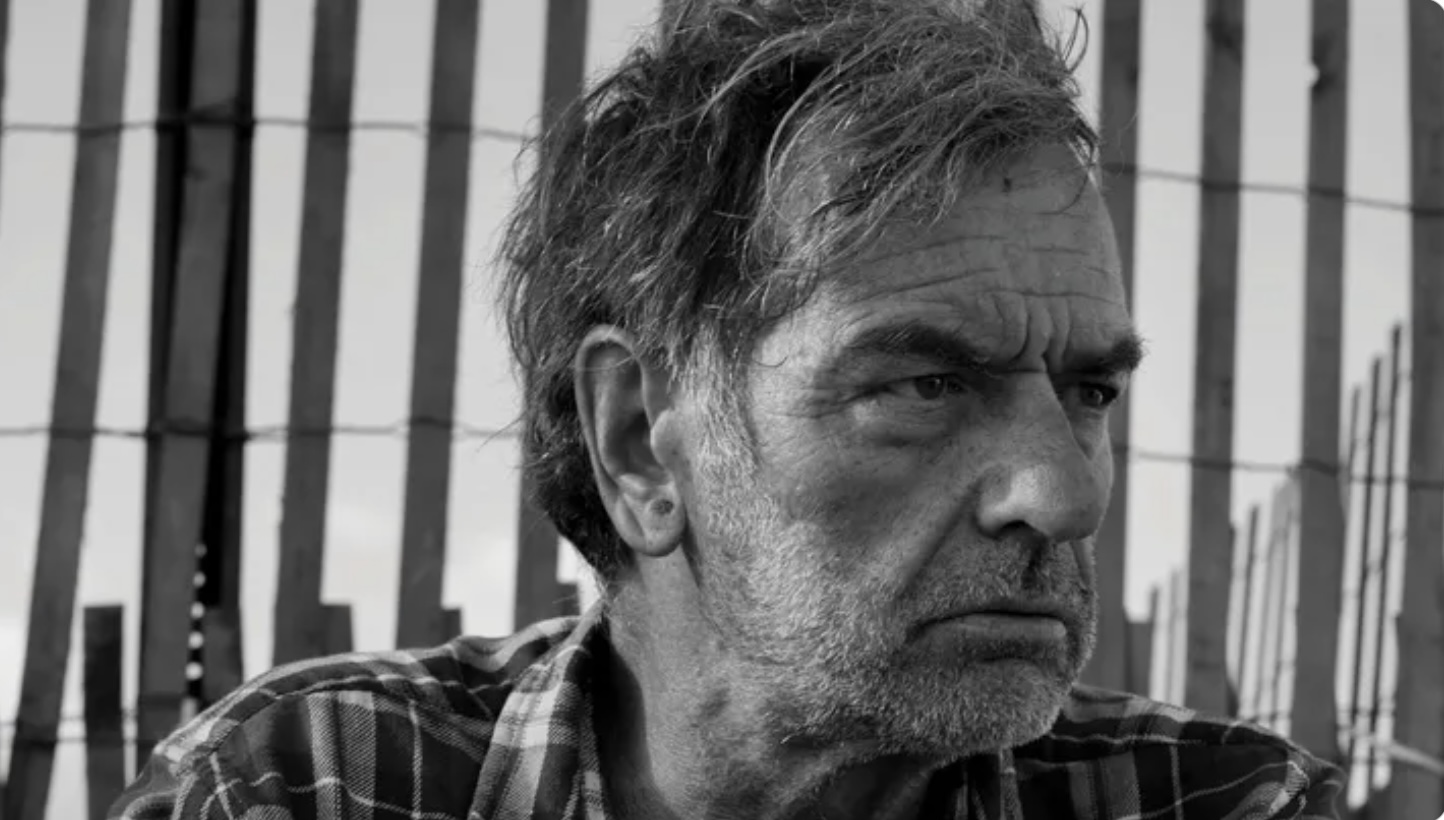
A portrait of Patrick Fealey, who wrote about his plight as a homeless person for Esquire magazine.

I’ve never been much of a social crusader like my friend and former high school classmate “Will,” about whom I wrote in a blog post last year.

Will was passing through town and asked if I would meet him for lunch, which I did. It was a great reunion after more than a half century of not seeing one another or even communicating.

Anyway, Will devoted much of his life to important work of helping lift the oppressed and bringing to justice the folks who actively sought to keep the “others” down.

Will, if you are reading this, I’m so awed and grateful for your efforts over the years.

Folks like Will make me realize that I’m more of an social activist wannabe who never really got up off the couch to help anyone, even those with whom I have great empathy.

That leads me to this disturbing Esquire magazine article my wife sent me last week. Entitled “The Invisible Man,” the article is a long, first-person account of a college educated, successful writer forced into living as a homeless person in his home state of Rhode Island.

Patrick Fealey found himself in this plight because of a mental illness that didn’t become apparent until he was a successful adult. Then his bipolar condition resulted in him being unable to hold a job, and the downward spiral began.

Read Fealey’s excellent account on the Esquire website.

For me, the most disturbing aspect of Fealey’s life is that no one really cared. He lived with his dog in an old car, but where ever he landed, he was constantly questioned by police, shunned by local citizens. The folks who operated shelters or housing programs offered little help, hope or sympathy.

Fealey was told to ‘move on’ a lot, even though one of the communities in which he stayed with the town in which he was raised. He was told by one policeman that if he didn’t move on he would be jailed or fined. People saw him as threatening or merely another drug addict.

(As an aside, some folks read about Fealey plight and started a Go Fund Me page that has received more than $169,000-and-counting to help him get into housing and deal with health issues.)

All of this sounds familiar, especially after reading recent newspaper articles about how the city of Shawnee has implemented ordinances that prevent the unhoused from sleeping or camping in public spaces or most any place outdoors within the city limits.

So, while the Shawnee citizens just want the homeless out of sight and out of mind — like most of us — what they are doing is turning homelessness into a crime.

That’s why I’m proud of the city of OKC for investing $55 million through MAPS4 to take on homelessness with its “housing first’ program that partners with innovative not-for-profits. And MAPs also is funding a new mental health crisis center, a restoration center and a transitional housing program that will make a difference.

It’s a start.

There are also several not-for-profits in our community like the SideXSide OKC program and Curbside Chronicle that are working to lift people up. Those are terrific initiatives that are making a difference.

As for myself, I have done nothing to brag about except for occasionally buying a Curbside Chronicle.

I’m not sure what my point in writing all of this is, but after reading Patrick Fealey’s story I think the point is that we have to do better.

Me. You. All of us. Do better.

A critique of the OKC Thunder ‘City’ edition uniforms through the years

Screenshot
OKC Thunder City edition uniforms through the years.

Together with my friends Steve Buck and Ed Godfrey, I cohost a podcast known as the 3 Old Geezers.

Steve and Ed are only pretend Geezers, while I am the real deal. Or as Ed says, I live in downtown Geezerville. That’s ageism, Ed!

Anyway, all of us are OKC Thunder fans, and much of our podcast discussion revolves around the team, the players and the potential for success as the season progresses.

We also share an interest in Thunder branding and the various uniform schemes the team uses. For instance, I’m a big fan of the team’s “Sunset” uniform, which might be seen as orange by some folks.

All of which brings me to the annual “City” edition uniform the Thunder unveils as each season begins. The 3 Old Geezers recently critiqued the 2024 City edition. on the podcast (LISTEN!)

Someone suggested that we rank the City edition uniforms from 2017-2024 by our personal preferences. So here are mine, ranked No. 8 to No. 1:

ScreenshotNo. 8 2020: I take issue with leaving the word “City” off of a uniform of the team known as the Oklahoma City Thunder. Makes no sense unless you think the folks in Tulsa or Elk City will buy into the team even more than they already do when they see “Oklahoma.”
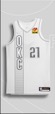
No. 7 2021: Not sure what statement a gray-on-white City edition uniform makes, except that it doesn’t stand out to me.
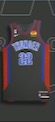
ScreenshotNo. 6 2022: I have nothing against this uniform, except the lettering looks too much like what we’ve already seen, And it uses “Thunder” instead of OKC or Oklahoma City.
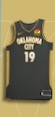
ScreenshotNo. 5 2019: White lettering on a gray uniform doesn’t do much for me. At least it says “Oklahoma City.”
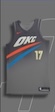
ScreenshotNo. 4 2017: I’m just not a fan of racing stripes on a gray background. But it gets extra credit because it says “OKC.”
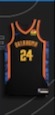
ScreenshotNo. 3 2024: I really like the color scheme but can’t rank this one higher because leaves off the word “City” AGAIN.
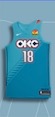
No. 2 2018: The lettering and the turquoise make this one of my favorite City edition unis. And I like that it reads “OKC.”
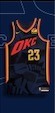
ScreenshotNo. 1  2023: I love this City edition version. It’s got orange and yellow trim on the navy jersey with bold orange “OKC”. That’s good enough for me.
Here are the takes from my fellow Geezers:

Steve Buck
Geezer Jim asked Geezer Ed and me to rank our team’s city jersey series. I am not a graphic artist so I’m sure my limited mind has missed some really cool elements that others love, but my rankings fell out pretty darn clearly.

ScreenshotNo. 8 2020: Just not much to like on this one. Looks like the packaging to a Hot Wheels car. Points deduction for reading “Oklahoma”

ScreenshotNo. 7 2017: I almost moved it higher because the year matched Poku’s number but common sense prevailed. I can’t find any connection to Oklahoma City and it just doesn’t look very sharp.

No. 6 2021: Not awful but not that attention grabbing either. The vertical look makes it somewhat unique but I prefer a bit of color in my uniforms and this is just too blah.

ScreenshotNo. 5 2019: Almost crept into my top half of rankings. Like ’21 there is jut not a pop in terms of color but the arched Oklahoma City is just fine with me.

ScreenshotNo. 4 2024: First too similar to ’23 so I had to provide some penalty for copying the prior year’s efforts. I like the colors and the detail on the sides are a nice nod to OKC. Speaking of…why didn’t it say Oklahoma City instead of simply using Oklahoma. Like the ’20 version, points deducted.

ScreenshotNo. 3 2022:  This one could’ve easily been my #2 choice. The blue and red pops against the dark gray. Just a super crisp look that was a wonderful look on the floor.

ScreenshotNo. 2 2023: I loved every element of this jersey. The dark blue with all the intricate details was so solid. The accent colors stand out beautifully. The diagonal in motion OKC is really on nice.

No. 1 2018: Yes, the color scheme has nothing to do with our current colors other than a few subtle uses in the accents but the design is fantastic and this jersey screams OKC like none other. It was unique in the league and a true reflection of honor and respect for our community and state. Bring these back. For my votes, this was the hands down winner.

Ed Godfrey
ScreenshotNo. 8 is the first city edition jersey to not include “City” in the name, the 2020-21 version. Again, they are the Oklahoma City Thunder, not the Oklahoma Thunder. I think the jersey is ugly.

ScreenshotNo. 7 is the first city edition jersey, the 2017-18 gray uniform. An orange and blue stripe with the OKC logo above it. Meh.

No. 6 is the simple all white city edition of 2021-22. I’m not a big fan of the all-white look with the OKC logo displayed vertically on the jersey, but it’s OK.

ScreenshotNo. 5 2024-25 is the latest city edition jersey. I love the look and the colors that pop. This jersey would rate higher if it had the word “City” on it and not just “Oklahoma.” A city edition jersey without the word city?

ScreenshotNo. 4 is the 2023-24 version. I like the vibrant colors of yellow and orange and the design is interesting and artistic.

ScreenshotNo. 3 is the 2022-23 City edition jersey. A simple, but solid look with “Thunder” emblazoned across the chest. The “Oklahoma Standard” badge is displayed on the jersey.

ScreenshotNo. 2 is the 2019-20 slate gray City edition tribute to the 25th anniversary of the bombing of the Alfred P. Murrah Federal Building. The gray uniforms with gold lettering and white accents are fantastic.

No. 1: My favorite City edition jersey is the 2018-19 turquoise version that paid tribute to Oklahoma’s Native American heritage. I love the color and the diamond influence in the OKC logo. It’s a sharp look.

So, what’s your favorite and least favorite among the Thunder’s City edition uniforms? Leave your thoughts on the City editions in the comments.

The Populous impact on OKC sports venues & my friend, Brady Spencer

Brady and John
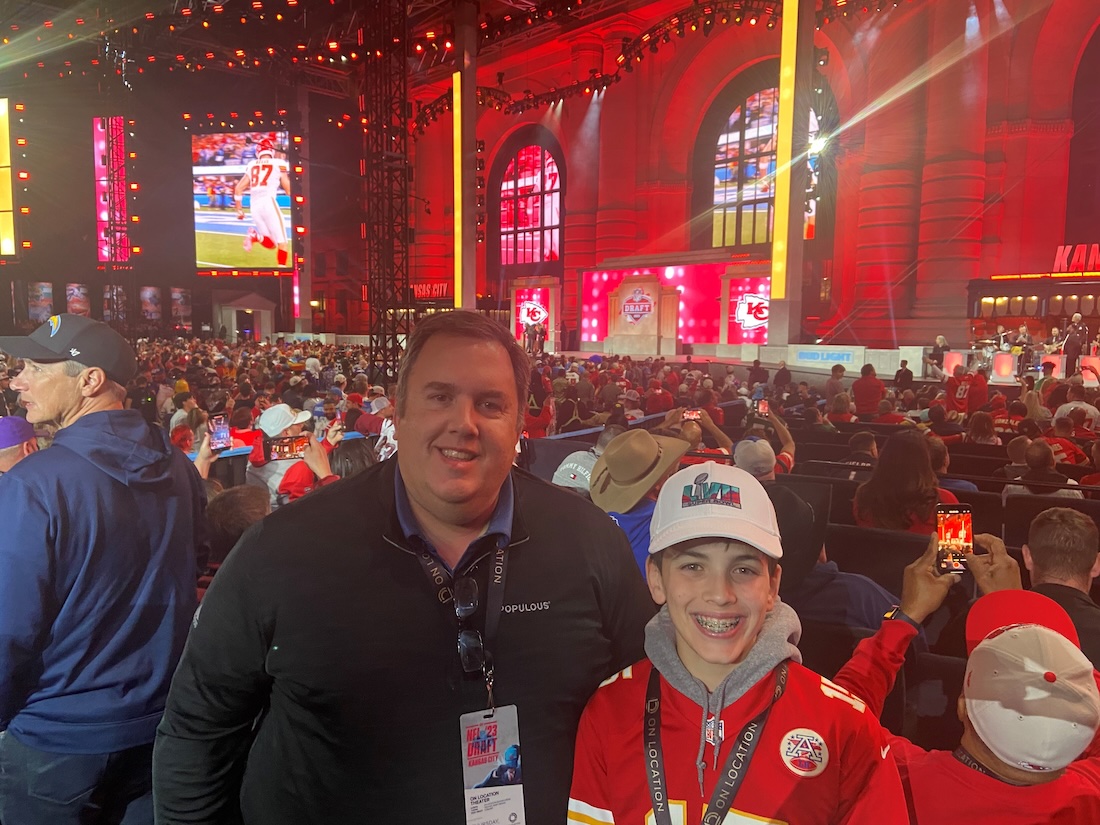
Brady Spencer with his son, John, outside Kansas City’s Union Station during the 2023 NFL draft.

A recent update in The Oklahoman newspaper on the new OG&E Coliseum under construction at the State Fairgrounds identified it as a venue designed by a firm named “Populous.

In an even more recent story, I learned that Populous has been hired to design the new $71 million soccer stadium just south of OKC’s Bricktown.

I think I’m noticing a trend.

There’s more.

I learned from other sources that Populous designed the fabulous OKC Convention Center, which opened in 2020. And Populous was hired to design Paycom Center’s upgrades in 2022.

Populous also is among the candidates to design OKC’s new $1 billion(ish) arena that will soon be built on the site of what was once known as The Myriad. It’s right across the street from Paycom Center.

So, what exactly is Populous?

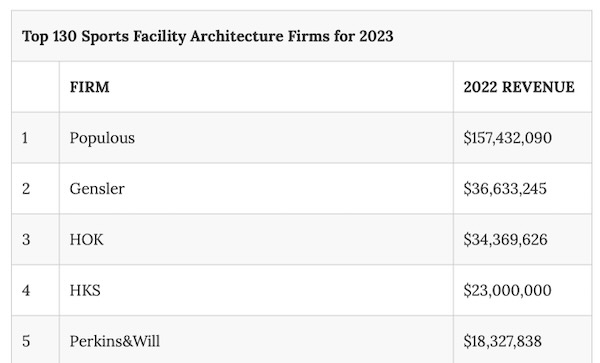
Turns out, it is an international architecture firm and the nation’s leading (by revenue) sports architecture company, based in Kansas City, Mo.

Screenshot

Populous has satellite offices around the world — including Norman, OK — and boasts a portfolio of more than 3,000 projects globally, including Wembley Stadium, T-Mobile Arena, Oriole Park at Camden Yards and many others.

Actually, Populous has been on my personal radar for quite some time because a close family friend named Brady Spencer is a Senior Principal/Senior Architect with the firm in its Kansas City office.

Some background:

I moved to Mena, Ark., in the summer of 1972, a year out of high school, and became acquainted with Greg and Lynelle Spencer.

At a banquet in the fall of 1972, they told me they were expecting their first child, who turned out to be Brady. They have another adult son, Matthew, who lives in Georgia.

The Spencers relocated to Springdale, Ark., when Brady was in the fourth grade, so most of his youth was spent in Northwest Arkansas. I stayed in touch with the Spencer family across the years.

So, after seeing the Populous-OKC link, I decided to call Brady and ask him about his career and role with Populous.

An avid fan of University of Arkansas sports as a child — “I remember going to Razorback football games with Dad” — Brady naturally enrolled at the Fayetteville school after high school.

Brady majored in architecture and graduated from the University of Arkansas School of Architecture in 1996. He told me that he began contemplating post-graduation employment and location in the fourth year of the five-year architectural program.

Brady settled on Kansas City and joined what was then known as HOK-Sports in 1996. He’s been with the firm ever since, although it evolved into Populous in 2009 when he and a group of fellow HOK architects spun out into their own company they called Populous.

“This last May was my 28th anniversary with the firm,” he told me.

Along the way, Brady married (Joanie), had a son (John), earned a Master of Architecture Management from the University of Kansas and has been on the design team for some of the nation’s most notable sports venues.

Among them have been NRG Stadium in Houston, State Farm Stadium in Phoenix, Arrowhead Stadium renovation in Kansas City, Raymond James Stadium in Tampa, Fla., and many others.

“I’ve focused on NFL stadiums and some college football,” Brady said. “I’ve worked with our Populous Event team that partners with the NFL on (venue oversight for) 21 Super Bowls. It’s most rewarding doing it in a stadium that I designed.”

Back in 2009, his alma mater came calling for renovations and updates on facilities across the University of Arkansas campus, including Razorback Stadium. Brady is not only an alum, but football season ticket holder.

“That one was near and dear to my heart, having grown up there and gone to school there,” he said. “I was just there yesterday (Sept. 14) when John and I went to the Razorback game. It’s fun to see the stadium every time I go back to a game.”

While Brady Spencer has not been directly involved in any of the OKC projects — the Fairgrounds Arena, the OKC Convention Center, the Paycom Center renovations, the upcoming soccer venue — he told me he’s aware of the Populous role in all of them.

“The thing about all our projects, it’s not ever just one person,” he said. “It always takes a team of us to complete.”

I’d call that 28 years of institutional knowledge.

Billy Carter and his 15 minutes of fame

Screenshot
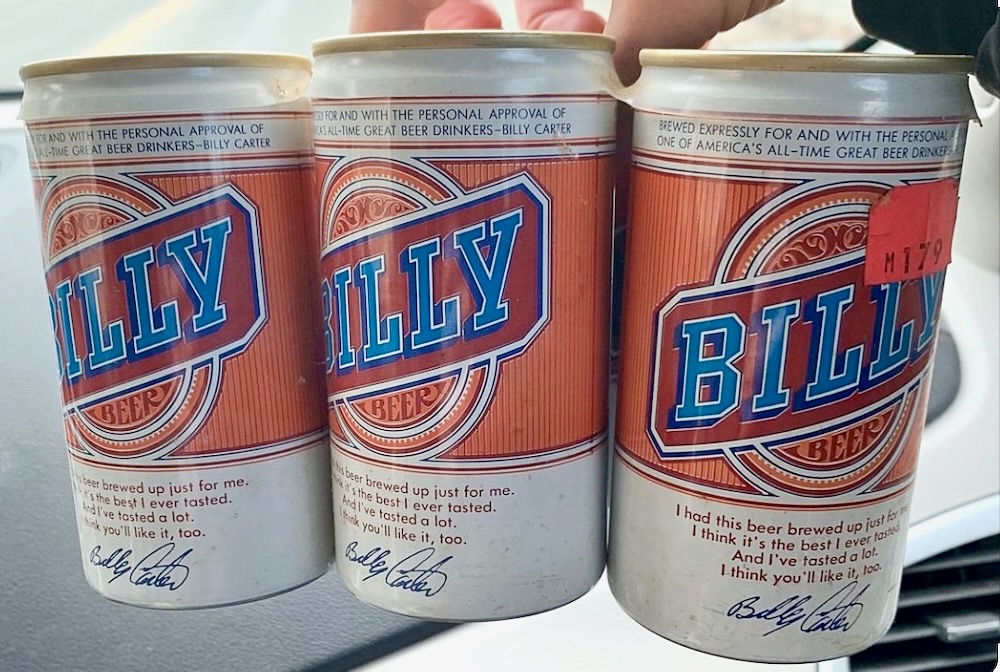
A six-pack of Billy Beer from 1977-’78

For a brief, shining moment back in 1977, the First Brother, Billy Carter, stole the spotlight from his brother, the President of the United States, Jimmy Carter.

While Jimmy Carter was a well educated, military veteran and successful peanut farmer, brother Billy was a good ole boy whose main avocation seemed to be drinking beer.

So, what happened?

A company called Falls City Brewing launched Billy Beer in 1977, and it took the nation by storm.

Billy Beer and brother Billy instantly gained the sort of notoriety that a Taylor Swift-Travis Kelce romance generated in 2023 (and continues today). There were volumes of newspaper articles about the beer and Billy.

Newsweek magazine even devoted a cover story to Billy and his beer. Songs were written about Billy Beer (I’m not kidding, read the story from a publication called Rate Your Music).

Despite all the hoopla surrounding Billy Beer, the brand folded up like a crushed can just one year later in 1978.  Billy Carter died in September 1978 of pancreatic cancer.
Turns out, folks didn’t like the taste of Billy Beer, despite Billy’s quotes printed on the cans themselves about the quality of his brew.

“I had this beer brewed up just for me. I think it’s the best I ever tasted. And I’ve tasted a lot. I think you’ll like it, too.” — Billy Carter

According to an article from the 1977 Milwaukee Journal, Billy admitted that he actually drank Pabst Blue Ribbon.

Here’s a quote from a publication called Collectors Weekly:

“There were MILLIONS of cases sold by 4 different breweries in the late 1970s. One estimate of the number of Billy Beer cans made is 2 BILLION. As a result, it is worth about 25 cents at most and then only if it is in very good shape, and if you can find a collector who actually needs one.”

A check on Billy Beer prices on eBay shows you can by an unopened (empty) six pack for a range from about $10 to $30.  So, Billy’s brew hasn’t appreciated much in value over time.

Sidenote: A North Carolina brewery has begun brewing a Billy Beer that plays off the name and look of the can, but has nothing to do with the brew from the 1970s.

As for me, I never tasted a Billy brew. I’m pretty sure its distribution didn’t reach Arkansas or Texas, although I could be mistaken. A friend of mine who lives in Mena, Ark., had an unopened six pack stashed on a shelf in the late ’70s for what I assume was investment purpose.

But I did come across a couple of guys on Youtube who did a Billy Beer taste test in modern days. Watch for yourself:

So, why am I writing about Billy Beer in 2024?

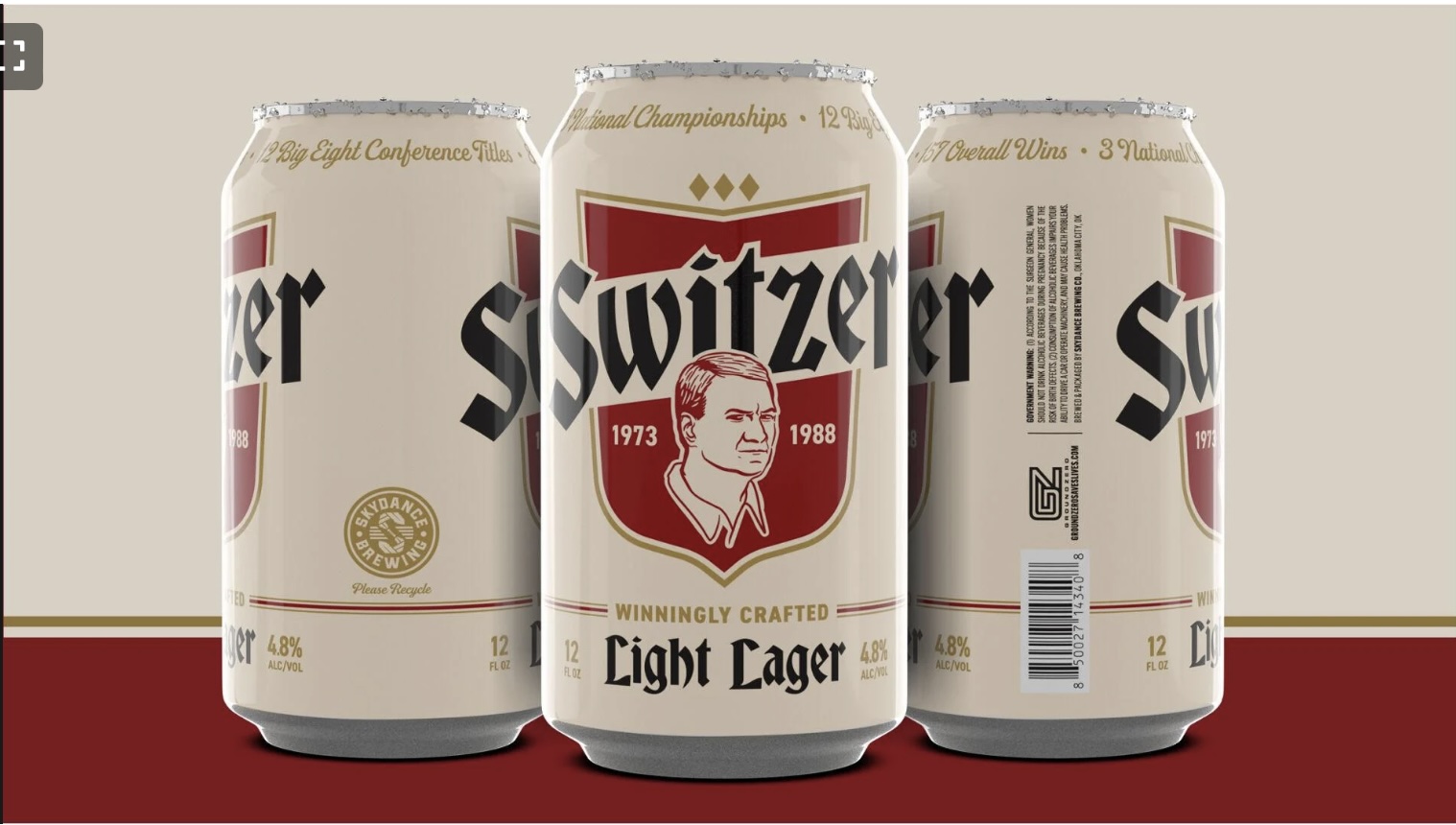
Well, OKC’s Sundance Brewing recently debuted a beer called “Switzer Light Lager.” It’s named after former OU football coach Barry Switzer, himself something of a good ole boy from Arkansas as well as one of the best football coaches in recorded history.

Tailgating may never be the same before OU games if Switzer beer has longevity. It has some promise, because it’s a craft beer brewed locally, and in Oklahoma Barry Switzer is still the king.

One other note. According to an article in the Norman Transcript, profits from Switzer beer will go to support the Ground Zero Training Center for search and rescue dogs.

From the Transcript:

“Ground Zero Emergency Training Center is a Non-Profit Organization in Oklahoma specializing in exceptionally trained urban search and rescue canines, educational opportunities, and a state-of-the-industry facility in which to hone their technical skills. Ground Zero was founded by Oklahomans, Barry & Becky Switzer in 2017 to meet the needs of a critical shortage in search-and-rescue canines.”

It sounds like a worthy cause. Now, we just have to crack open a cold Switzer Light Lager and determine if it’s a worthy brew or just another Billy Beer.

Screenshot

Show me the radar! A digital tale from 2004

Screenshot

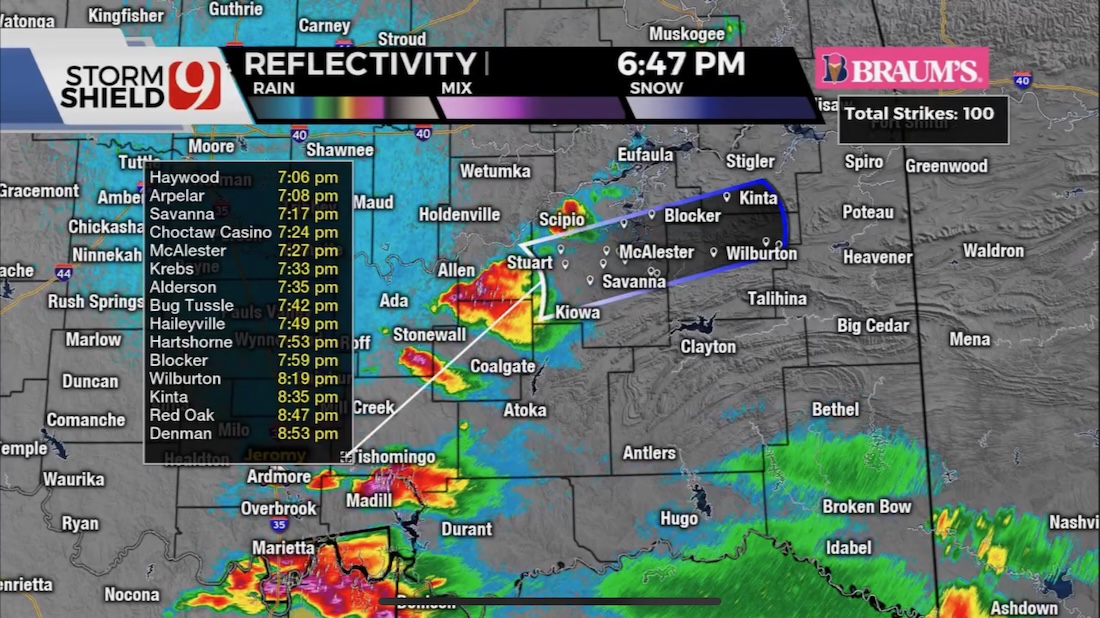
Whenever weather threatens OKC or western Oklahoma, our local TV stations abandon network programming and go with wall-to-wall weather coverage.

My family tunes in every time, and not just for potential life-saving information. We’re fascinated by the combination of theatrical performance, legitimate weather warnings and relentless self promotion.

“We’re declaring a News9 tornado warning for you folks in Custer County!” weatherman David Payne practically screams as he directs Val and Amy into the path of the storm.

No waiting on those slackers at the National Weather Service.

It’s like passing a car wreck on the Interstate, you can’t NOT look at it. Everyone has their favorite/least favorite TV meteorologist. Our go-to weather Drama Queens happen to be from Channel 9.

Anyway, it seems like programming has been interrupted every other night this Spring, but I would never suggest that it’s related to climate change, would I?

As we’ve watched the powerful color-coded radar scans and learned that we’re seeing details THAT NO OTHER STATION IN OUR MARKET CAN PROVIDE, the whole scenario got me thinking back to something I wrote about two decades ago.

Today, we’re in a digital world in which we can track incoming storms on color radar not only only our television screens, but on our phones, computers and tablets. That was all just emerging in 2004 when I was a Business News reporter at The Oklahoman who embraced the digital life.

Not all of my colleagues were ready to move on from their analog past, so I wrote the following column as an ode to the great digital divide:

It is autumn 2004, and a pair of coworkers are sitting in opposite cubicles facing each other. One has his back to the window. His name is “Digital.” His co-worker goes by the moniker “Analog.”

Digital: Hey, there’s a weather alert crawling across the bottom of my computer screen!

Analog: (looking out the window over Digital’s shoulder) It looks sunny to me. There’s a little cloud to the south.

Digital: Yeah, but the color-coded radar I’m looking at on my screen shows a major thunderstorm headed this way. It’s just north of Chickasha.

Analog: I trust my eyes. I’ll worry about the weather when I look out this window and see a big black cloud.

Digital: You are so 1990s. (picks up the phone to call his wife) Hello, honey, you better monitor the weather, it’s looking rough outside. Where are the kids? Outside playing? Well, bring them in. The radar on my computer screen is showing a big storm just north of Chickasha, and it’s headed this way.

Analog: I still only see blue sky out the window.

Digital: (still speaking into phone) I don’t care if it’s sunny out, I’m telling you my radar is showing a big storm brewing just south of here. I’ll call you with further updates. Bring the kids inside! Call my cell phone when you have them rounded up (hangs phone up).

Analog: I think you are scaring your family for no reason. You should trust your eyes. Look out the window! It’s sunny.

Digital: I don’t need a window! I’m wired into the weather service right here. I can zoom in on the screen and see within a half mile where the storm is, which way it’s moving and what the temperature is. See, it’s 62 degrees outside.

Analog: I can just walk outside and get a feel for the temperature.

Digital: Then I assume you aren’t concerned about your family’s welfare. They won’t be ready for this one when it blows through town.

Analog: We have a “safe room” in our garage.

Digital: (wireless telephone rings) Hello. You’ve got the kids? Good. Now, what’s your plan for when the storm hits?

Analog: My eyes are telling me it’s still sunny outside.

Digital: (still speaking into phone) Will you have time to drive to the community shelter? Yes, I know it’s still sunny outside, but the radar shows the storm has moved closer to the metro area. Herd the kids to the hall closet if you need to. OK, love you. Bye.

Analog: Hey, I’ve got to run out on an assignment. I’ll be back this afternoon.

Digital: Well, let me have your cell phone number so I can contact you in case there’s a weather emergency or something.

Analog: I don’t have a cell phone. Never had a need for one.

Digital: (head bangs against desk; heavy sigh) I give up.

Analog: (starts to walk out of the office) Later.

Digital: (jumps up and runs after Analog) Here, take my umbrella just in case.

That’s how we rolled in 2004. It was a different era. Pre-iPhone. Pre-News9 tornado warning.

Any resemblance to actual people is mere coincidence.

Confession: I was an Internet domain name squatter in 2006

Bennett Sonics
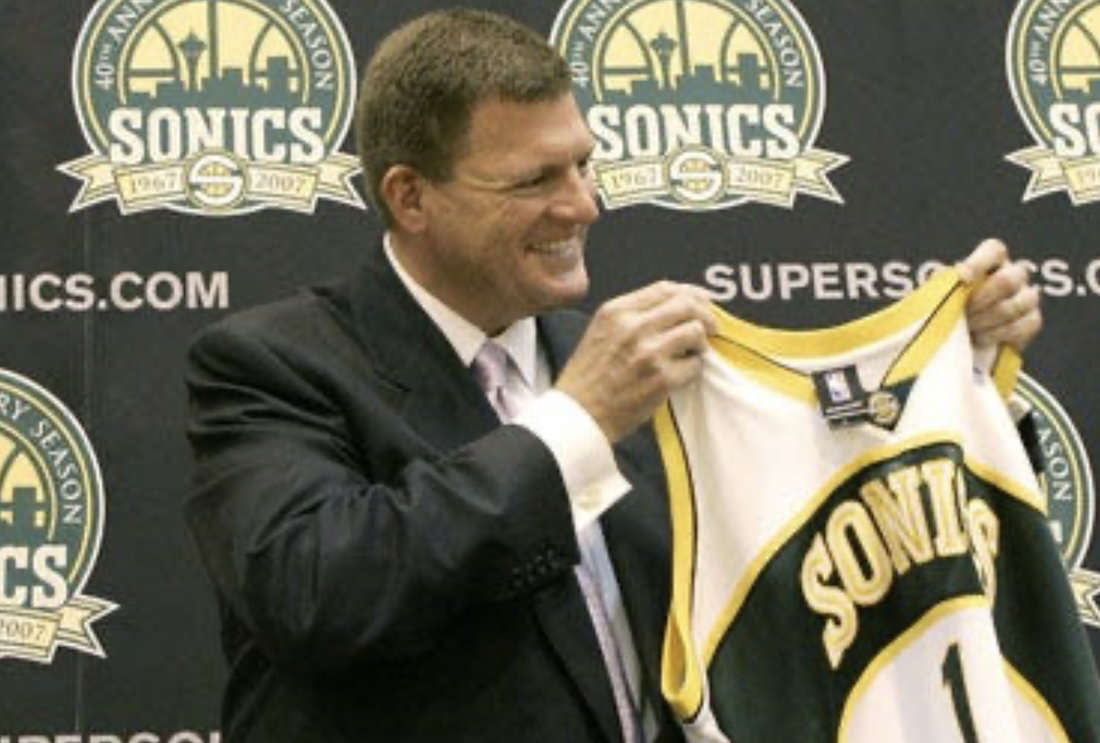
New Seattle Supersonics owner Clay Bennett showcases a Sonics jersey after purchasing the NBA franchise in 2006.

EDITOR’S NOTE: When it was announced in July 2006 that a group of investors from Oklahoma City had purchased the Seattle Supersonics NBA franchise, everyone in OKC knew what that meant. The team would relocate to Oklahoma City sooner or later. Probably sooner. That happened in 2008. Sorry Seattle. I was working in The Oklahoman newsroom at the time as a Business News reporter, and hit upon the idea of buying some potential Internet domain names that the future OKC Sonics (we thought) might want. Then I could sell the rights to that domain name to the team owners for a nice profit. Buy low, sell high. It didn’t work out, but I did get a nice story out of my brief tenure as an Internet domain name squatter. It was published as a column in The Oklahoman back in 2006. And that was the sole purpose of buying a domain name. This is that story.

By Jim Stafford

Like a tsunami traveling across hundreds of miles of ocean, it didn’t take long for ripples from last week’s $350 million acquisition of the Seattle SuperSonics to wash into Oklahoma.

A group of Oklahoma businessmen now own the Sonics, and less than a day after the deal was announced another group of enterprising Oklahomans spotted opportunity in a possible relocation of the team to the Sooner State.

We huddled in The Oklahoman newsroom.

A colleague I’ll call “Don” suggested that we research available Internet domain names using such words “Oklahoma, OKC, Sonics and Super-Sonics.” We could pool our resources and buy up the most promising real estate.

“I’m in,” I told him. The new team owners will need some prime Internet real estate if they relocate to Oklahoma, and we wanted to own it when they got here.

So began a race not unlike the Oklahoma Land Run of 1889, although the mode of transportation this time was a high-speed Internet connection. Using the domain broker GoDaddy.com, we did a search of virtually every combination of Oklahoma, OKC, Oklahoma City, Sonics and Super-Sonics.

Apparently, some Sooners had already anticipated the deal and staked out some virtual land before we got into the race. Names like oklahomasonics.com, okcsonics.com and sonicsokc.com were all gone. Even okiesonics.com was no longer available.

We settled on okc-sonics.com as the best of the unclaimed property. We formed a 50-50 partnership and sealed the deal through GoDaddy. Total investment: $9.40.

When word spread that a pair of Internet real estate moguls inhabited the newsroom, several of our colleagues began clamoring to join the investment group. They wanted in for $1 each, but Don and I decided the value already had risen beyond the original purchase price.

We decided to expand our investment empire the next day and claim another domain name. This time we went for sonics-okc.com. Another $9.40.

An editor who heard of our venture happened to wander by the business news desk. What were our intentions in owning these domain names, he inquired.

We’re not going to hold anybody up, we assured him. If the new owners of the Sonics want one of these domain names for the team’s Web site, we’ll demand nothing more than season tickets for each of us. And our spouses. On the floor. Plus parking.

The editor decided to play devil’s advocate. “Let me ask you this,” he said. “On whose computer and whose time did you make this deal?”

Gulp. The devil IS in the details.

Uh, we only took this move to assure the new Oklahoma owners that prime domain names will be available to them if they need it. Just kidding about the season tickets. HA! HA! We won’t really need to be on the floor anyway. And we can pay for our own parking.

Meanwhile, Don began looking for a possible exit strategy. He located the domain name auction site afternic.com where homesolutions.com recently brought a bid of $9,210. Therapy411.com reeled in a $2,000 bid.

Suddenly, new opportunities seem possible. We will wash our hands of this Sonics deal just as soon as our auction is over.

The auction won’t end until our reserve price is reached. We will set it just high enough to cover a pair of season tickets. Parking included.

I met my friend, Dr. Craig Shimasaki, at a conference 1,600 miles from OKC

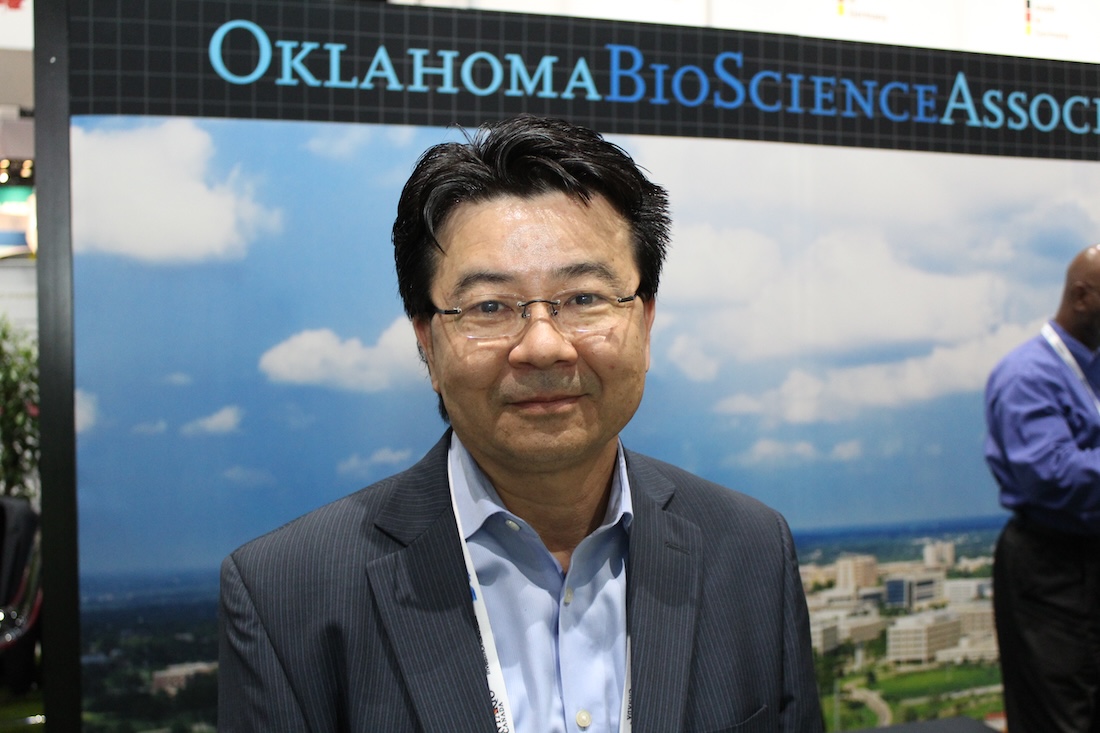
Dr. Craig Shimasaki at OKBio booth on the floor of a past Biotechnology Industry Organization conference.

Two decades ago, I was one of a group of more than 50 Oklahomans who represented Oklahoma’s life science community at the annual BIO — Biotechnology Innovation Organization — conference in San Francisco.

It was my first time to attend the BIO show and to travel as part of the group that identified itself as OKBio. The annual BIO show brings thousands of people — scientists, entrepreneurs, investors, economic development professionals and reporters — together for a week of networking and showcasing emerging life science technologies.

There was a joke that we had to travel 1,600 miles to get to know our neighbors.

Only it was not a joke, but, in fact, reality.

That 2004 BIO show was my first of what became more than a dozen trips with the OKBio group to pitch Oklahoma and our growing life sciences community in major cities like San Francisco, Chicago, San Diego, Washington, D.C., and more.

So, I met a lot of people on that first BIO trip who became important sources to me as a newspaper reporter for future articles about local startups or emerging research.

In fact, I specifically recall meeting Craig Shimasaki, MBA, Ph.D., on the floor of San Francisco’s Moscone Center. Dr. Shimasaki was stationed along with his wife in front of a display that showcased the OKC-based startup he was guiding at the time.

If you’re not familiar with Dr. Shimasaki, he’s a California native who emigrated from his home state to Oklahoma to help develop a technology that diagnosed the flu virus. Along the way, he also earned his MBA from Northwestern University, his Ph.D. in Molecular Biology and Biotechnology from the University of Tulsa, and never left the state.

Since that first introduction, I’ve become friends with Dr. Shimasaki and interviewed him probably a dozen times or more for newspaper articles on Oklahoma-based startups he founded or guided, groundbreaking research in which he was involved and books on entrepreneurship he wrote.

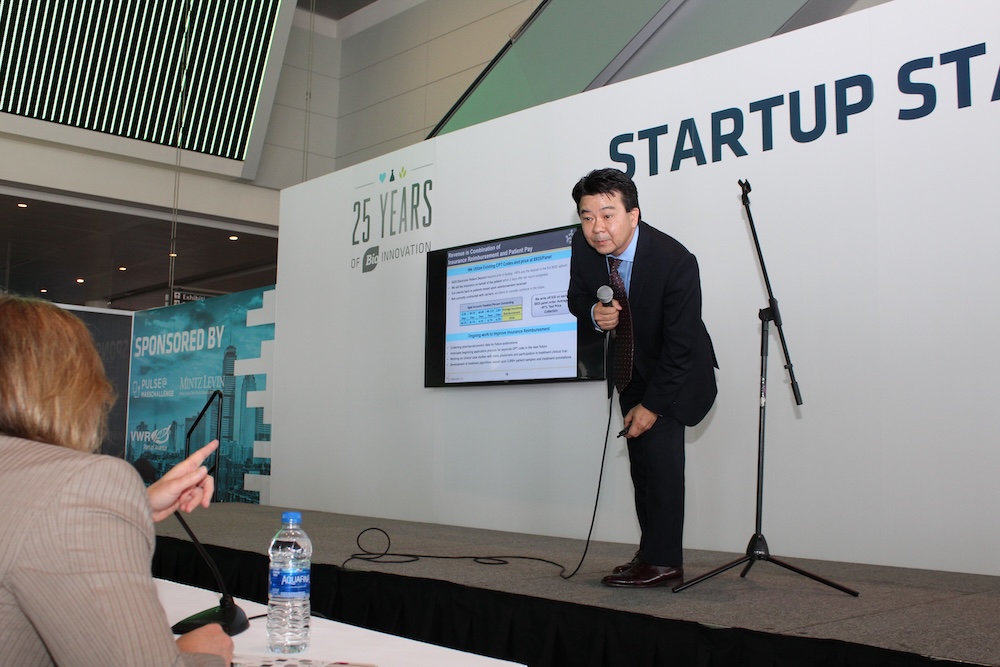
I’ve watched him participate in a panel discussion on ‘gut health’ at one BIO show and engage with potential investors in a Startup Stadium presentation at another. I’ve sat in on Love’s Entrepreneur’s Cup pitches by college teams for which he served as advisor. He’s led me on a tour of a world class laboratory that he oversees.

It was from Dr. Shimasaki as he discussed one of his books on biotech entrepreneurship years ago that I first encountered the term “you don’t know what you don’t know.”

And, you know, I don’t know.

Dr. Craig Shimasaki making a presentation at a past BIO show.

I’ve written all of this because of how life sometimes leads you back to where you began.

Recently, I reconnected with Dr. Shimasaki through Moleculera Labs,  the Oklahoma City-based company for which he co-founded and serves as CEO. Molecular Labs describes itself as “a precision medicine company focused on identifying the underlying immune-mediated root of neurologic, psychiatric, and behavioral disorders.”

The company has gained a lot of attention both local and nationally for its technology that can identify the underlying cause of apparent psychiatric and behavioral disorders that afflict both children and adults. Moleculera Labs has tested more than 15,000 patients since it began offering its test panel on a commercial basis about a decade ago.

So, when Dr. Shimasaki asked me to provide some assistance in crafting press releases for breaking news the company sought to share, I was all in.

Over the past two weeks, Molecular Labs announced the addition of a long-time life science industry veteran to its Board of Directors, and also revealed that it has been awarded a $500,000 grant from the Oklahoma Center for the Advancement of Science and Technology (OCAST) that will help it develop AI technology that will be integrated into its test panels.

Here’s a link to the announcement of Rodney Cotton as a new Moleculera Board member.

And here’s a link to the news release about OCAST Oklahoma Applied Research Support grant the company received.

There is even more breaking news from Moleculera Labs this month. The company announced this past week a strategic collaboration with Quest Diagnostics by which its offers patients of its neuropsychiatric autoantibody test services the option to provide blood specimens to any of Quest’s lab centers across the U.S.

Here’s a link to the Quest Diagnostics announcement.

It’s all big news not only for Moleculera Labs, but for the state’s entire life sciences community and all of Oklahoma.

For me, it’s the latest development in a relationship that began two decades ago on the floor of the BIO show 1,600 miles from OKC.

We’ve been good ‘neighbors’ ever since.

BONUS COMMENT FROM DR. SHIMASAKI:

“The BIO International Conferences allowed us to connect, and it’s been a wonderful relationship working with Jim Stafford over the many years as he has been actively covering the biotech and life science scene in Oklahoma,” Dr. Shimasaki said.  “Jim has an innovative way to tell audiences about the interesting stories in a way that inspires and informs,”

Thanks for the kind words, Dr. Shimasaki, but it’s innovators like you who have shown me the impact that your research can have — and is having — on human health worldwide.

The new BRT line is A-OK with me

BRT1
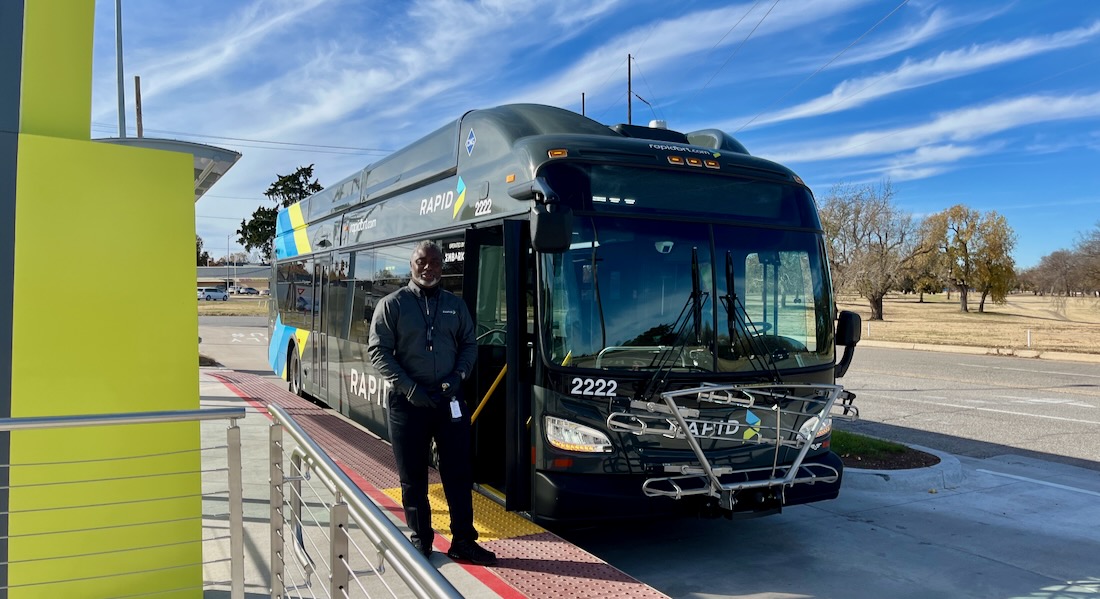
Our driver poses outside the BRT bus at the Lake Hefner park-and-ride stop along the Northwest Expressway.

My first brush with Oklahoma City’s new BRT — Bus Rapid Transit — didn’t start with promise.

A bus was waiting as I drove onto OKC EMBARK’s Lake Hefner park-and-ride lot along NW Expressway about 11:30 Monday morning. So, I parked, exited my car and started to walk about 30 yards to the platform only to watch as the bus pulled away.

I went back to my car.

My mission this morning was purely exploratory to see how efficiently Oklahoma City’s new BRT route that launched Sunday could move someone who parked and rode into downtown OKC.

I had read the waits for the next BRT buses were only 12 to 15 minutes, so I stuck around, and after about 10 minutes returned to the platform. The bus-tracker monitor said the next bus would arrive in 4 minutes.

The monitor was accurate, and the BRT bus pulled up as predicted.

The great thing about catching public transit — or a plane or a train for that matter — when the equipment is new is that you get that ‘brand-new car smell’ before it’s worn out by use. Or was I just imagining?

And the BRT cost is perfect all through December at the low, low price of free.   The City of OKC officially launched the BRT line with a special ceremony early Monday morning.

The Northwest line is one of at least three BRT routes planned by the city, with two others in the works for the south side and the Northeast corridor. MAPS 4 dollars are paying for the new BRT routes, according to this story from The Oklahoman.

Anyway, the bus was clean and new with about 5 people already aboard in the back seating area. I took a seat in the middle, and we headed toward downtown OKC.

We wound through the neighborhood just west of INTEGRIS Hospital, past the platforms outside the hospital and turned onto NW Expressway.

That’s when things got interesting. The bus began filling up.

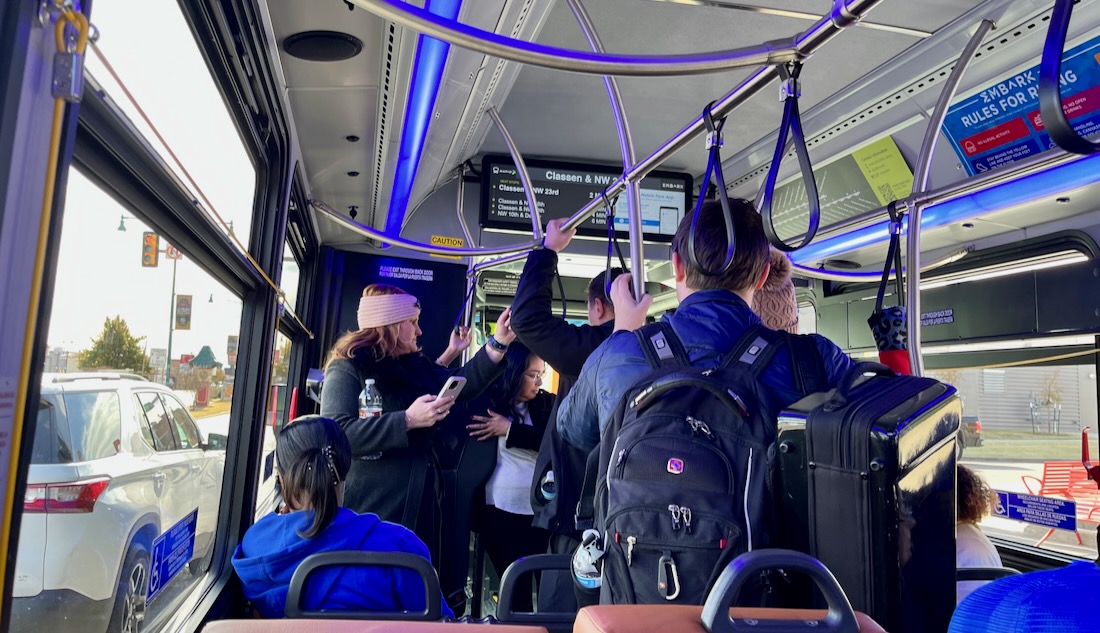
Each eastbound stop seemed to add four to six more people, and when we turned south on Classen Blvd. so many people climbed aboard at the first couple of stops that most new newcomers were forced to stand and hold on to the straps and poles.

BRT 2
Opening day strap hangers on OKC’s new BRT bus route.

By coincidence, my seatmate for a portion of the route was Cody Boyd, a friend of mine who actually works for EMBARK and was headed to a downtown restaurant for lunch.

I stayed aboard until we reached the Downtown Transit Center. Total time for the inbound stretch from Lake Hefner lot was 38 minutes. Not bad, considering how many people got on — and off — along NW Expressway and Classen Blvd.

After departing the bus, I walked a couple of blocks to my favorite OKC sandwich spot — Hobby’s Hoagies — where I ordered lunch and grabbed a table. After finishing my sandwich, I hiked back to the Transit Center where two BRT buses were waiting.

One bus pulled out before I got to the platform and headed south to complete the downtown loop. I boarded the northbound bus, and we were off on the return trip to the Lake Hefner stop.

On this trip the bus was less crowded, traffic was favorable and we arrived at the park-and-ride lot in 31 minutes. I thanked the driver and took his photo as he walked out of the bus onto the platform for a few seconds.

So, the BRT route gets a big thumbs up from me, even though it doesn’t lend itself to my daily transportation needs.  Here’s another first-day perspective, that of OKC Free Press founder/editor Brett Dickerson.

Monday was the second time I was a first-day rider of a new OKC public transportation route. I rode the OKC Streetcar on its first day in December 2018 and liked it, as well, although the Streetcar only takes a slow loop through downtown.

I wrote my thoughts on the Streetcar in this blog post a couple of years ago.

But the BRT line is more than a tourist ride and looks to fill the travel needs of a large number of people on OKC’s northwest side.

It’s a transportation route with a purpose.

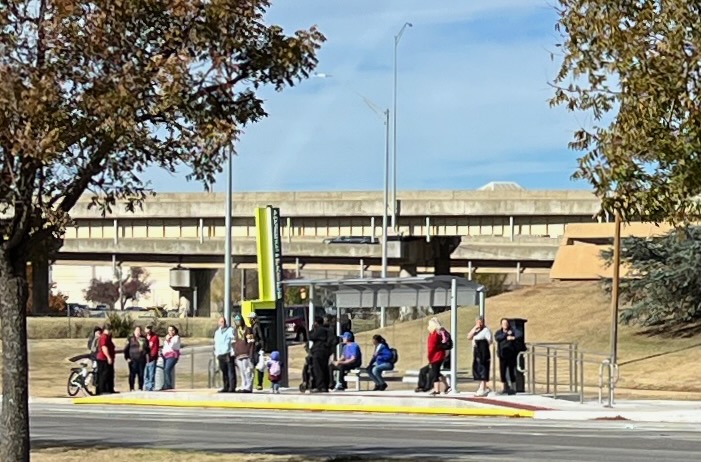
BRT 3
The crowd waiting at a west-bound BRT line stop along NW Expressway on Monday morning.

Damar Hamlin: ‘We don’t get to choose our calling’

Damar players
Players huddle in prayer for Buffalo Bills defensive back Damar Hamlin after he collapsed on the field in January. (New York Times photo)

We’ve all experienced moments in our lives that are burned into our memories, and we’ll always remember exactly where we were when we witnessed it or heard the news.

The Twin Towers. John Lennon’s death. The Kennedy Assassination.

On Jan. 2 of this year, millions of Americans watched as Buffalo Bills defensive back Damar Hamlin made a tackle in an NFL game vs. the Cincinnati Bengals, stood up, then collapsed on the field.

My wife and I were among those who witnessed it, watching from our living room.

Damar lay motionless on the field as trainers and emergency personnel rushed to his side. I was struck by the reaction of the players, many of whom turned away and appeared to be in grief or in prayer.

Team and security personnel surrounded Damar and blocked any views by intruding network cameras or even his own teammates. Players on both teams gathered in a big prayer circle.

We feared the worst as the minutes passed. My wife speculated that he already could be dead, even though we didn’t know what had happened. Here’s a recap from the New York Times written a few days later.

Damar Hamlin had had a massive heart attack, and his heart stopped. The emergency personnel and training staff used defibrillators and brought him back to life, more than once, apparently. After many minutes, he was loaded into an ambulance and taken to a Cincinnati hospital.

We were as anxious as anyone else and silently praying for his life. We weren’t optimistic.

But you probably know the rest of the story. Damar escaped more near misses with death on the way to — and in — the hospital. Still, he grew stronger by the day and was released nine days later.

He continued to improve, and under doctor’s supervision began working out again and was eventually cleared to rejoin the team this summer.

Damar is again on the Bills roster and played his first minutes of action this past weekend.

Then he flew to Oklahoma City on Tuesday to share his story with an audience of about 1,000 Oklahomans at the annual Champions of Health Awards Presentations at the OKC Convention Center.

Champ Damar1
Damar Hamlin shares the stage with News9’s Robin Marsh during a ‘fireside chat’ at the Champions of Health Awards Presentations.

I had the good fortune to be in that OKC audience as an employee of Care Providers Oklahoma, one of 11 health care related organizations that comprise the Champions of Health Coalition. All are working to improve health outcomes for Oklahomans, and the Champions of Health Awards recognize organizations or individuals that have devised innovative programs that could be replicated in other communities.

Anyway, the highlight of the night was Damar Hamlin’s presence and the perspective he shared in a “fireside chat” with News9 TV personality Robin Marsh.  Check out the video that my CPO colleague Tanecia Davis shot of Damar speaking during the chat.

Robin introduced Damar and told him that millions of Americans had prayed for him that night from their living rooms, just as his teammates did on the field.

Soft spoken, Damar didn’t go into details of the incident, but instead focused on his mission since. Today, he’s working to ensure that the technology that saved his life is available by every sports team nationwide and that people are trained in CPR.

I was struck by one comment in particular by Damar about this mission.

“It’s kind of like a calling, & we don’t get to choose our calling,” he told us.

Amen.

Robin asked Damar about his youth and how he progressed from high school to college to the NFL. He shared the story of his personal journey, and something else stood out.

“I found a mentor,” he said. “I found someone who was older than me and successful and worked with them.”

Amen again.

I’m a big believer in cultivating a mentor and then following their example and advice. Although I never had a formal mentor, I’ve had some folks in my life who provided sage advice along the way.

Like millions of my fellow Americans, I’m so glad that Damar Hamlin survived this near death experience. Survived and emerged with his new mission, his calling.

And we don’t get to choose our calling.

BONUS! Read my blog post over at Care Providers Oklahoma website that provides more details about the Champions of Health Awards Presentations and winners.

Bright blue skies — until next storm hits

The annual NAMI Walks Oklahoma event went off under a bright blue sky at Lower Scissortail Park

Living with a family member who suffers from mental illness reminds me of the weather. There are sunny, cloudless days when blue skies make you optimistic about a bright future. Then the clouds gather and an unexpected rain washes away your unrealistic hopes.

I had one of those blue-sky days on Saturday, literally.

I participated in the annual NAMI Walks Oklahoma event at Lower Scissortail Park on a beautiful, sunny and cloudless day.

Sponsored by NAMI Oklahoma, hundreds of people gathered to walk in support of NAMI’s mission to end the stigma of mental health. It was a great morning.

Although I’m a huge fan of OKC’s Scissortail Park, I had my doubts about how well the newly opened Lower Park would serve the NAMI Walks event.

Too isolated. Not enough parking. An unfamiliar venue south of I-40.

Not to worry. Folks found their way to the park with no problems. And while parking was at a premium, NAMI Oklahoma arranged for a shuttle bus that would take people from free parking areas across from the Paycom Center down to the lower park.

Better yet, the weather matched the festive mood. Bright blue skies and warming temperatures.

So, we had a great time as we listened to the beat of the music selected by the DJ, connected with old acquaintances and heard stories of overcoming anxiety and depression from speakers like Ashley Ehrhart. A former Miss Oklahoma USA and a member of the OKC Thunder Girl dance team, Ehrhart advocates for mental health from her own experience.

There was a Zumba exercise class that broke out, games for kids and ‘Mabel,’ the double-decker English bus from Junction Coffee that had a line of customers all morning.

Then at 10 am, the emcee counted it down and the actual Walk began on a 2 kilometer course over the Lower Scissortail walking trails. The sight of watching hundreds of people marching north toward the upper park and eventually back south on the west side was awesome. There were dogs, strollers, children and large groups wearing matching T-shirts.

I took scores of bad photos as I walked along the course on both the east and west sides.

Anyway, my reservations about the venue were totally unfounded. It teemed with life and enthusiasm. And the bright blue sky fueled my optimism that folks living with mental illness and their families can find that better place.

At least until the next storm hits.