A Toy Story 3 experience at Leonardo’s Children’s Museum

Entrance
Entrance to Enid’s Leonardo’s Children’s Museum

There’s a great scene in the Pixar flick “Toy Story 3” in which Andy’s toys find themselves in the “New Toy Room” at the Sunnyside Daycare center. The toys eagerly awaited the children to arrive so they could be played with once again.

Turned out, the New Toy Room was where the youngest, loudest and most rambunctious of the Sunnyside kids played.

So, when the door opened, dozens of rowdy youngsters raced in, screaming at the top of their lungs. Within a few seconds, every one of Andy’s toys were being slammed against the floor, pulled apart or otherwise abused.

You can watch that scene below:

I’ve written all of that because last week I got to live a real life version of the Toy Story 3 scene with my 4 year-old grandson Solomon.

We visited the Leonardo’s Children’s Museum in Enid on Friday as my wife, Paula, was engaged in a conference at a nearby Enid school. Opened in 1995, Leonardo’s is located on the fringes of downtown Enid and features two floors of interactive displays geared specifically for elementary-aged children.

Leonardo’s offers displays about potential careers like plumbing, construction, energy, medicine, finance and more. Each display features a hands-on experience for visitors. There also is a two-story indoor playground and a massive 3-story tall “Castle” playground across the street.

In addition, it has a huge Thomas the Train set that kept Solomon occupied for a good 45 minutes.

Anyway, Solomon and I arrived just before the museum’s opening at 10 am. As we were walking in, I noticed a group of children getting off a school bus and entering through a different entrance.

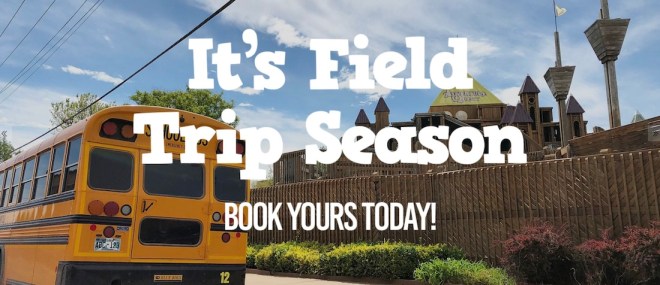
We didn’t realize it at the time, but it was field trip day at Leonardo’s. Elementary aged students — maybe kindergarten through third grade — were waiting in an adjacent room to enter the exhibit areas.
Screenshot

Solomon was playing with a Lego’s exhibit when the doors burst open. Dozens of kids raced in, screaming in excitement. Within 30 seconds or so they were climbing, turning handles, pounding displays that provided tools, all while babbling loudly.

It was like deja vu all over again, because all I could see was that scene out of Toy Story 3. The decibel level was incredible.

Solomon was a little intimidated because he’s only 4, but continued to play with the Legos before we moved on.
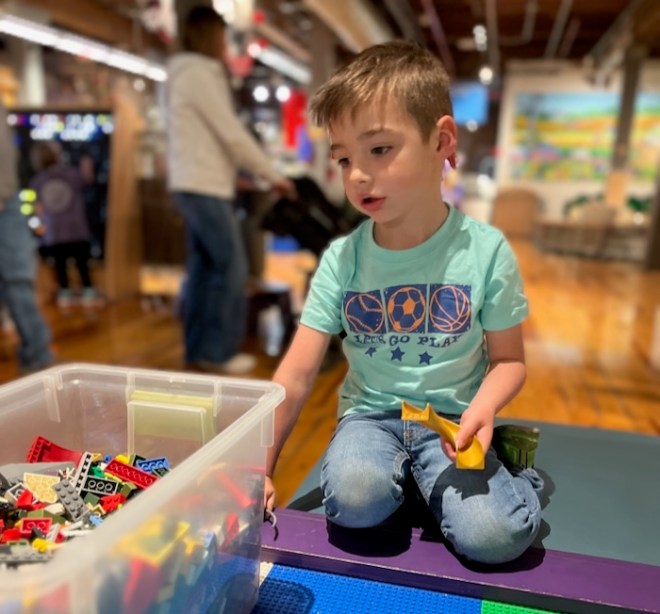
Legos

We toured exhibits that show how oil and gas is extracted from the ground (sponsored by Koch Industries), how crops are grown across Oklahoma and displays that let you crank a generator that turns a wind turbine and actually powers a light display. Solomon even piloted an airplane on a computer game-like display.

As we waited for the elevator to take us to the second floor displays, a docent told us a bit about the museum’s history. She said it was 29 years old now, and had more than doubled the exhibit space with a multimillion dollar expansion about eight years ago that was funded by Enid-area donors.

Here are more details about the founding of the museum. 
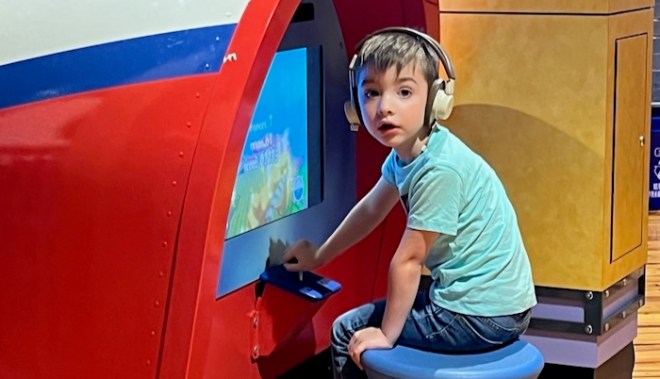
Simulator

After taking a lunch break around noon, Solomon and I returned so he could play on the outdoor playground. The young woman who served as playground gatekeeper told me that the museum staff is assisted by hundreds of volunteers who keep things going.

Solomon overcame some early playground hesitation and then joined dozens of other children climbing, sliding and exploring the upper floors of the massive Castle. When he discovered an area of the playground that featured a swimming pool-sized sandbox, it sealed the deal.

He never wanted to leave. Really.

But eventually, a teacher told the children that it was time to board the buses for the return trip to Okarche or Okeene or wherever their schools were located. Solomon was left with about a half dozen other kids, while I sat alone in the helicopter parent section.

That’s when I realized how abruptly the noise level dropped, too. So, I sat and enjoyed the quiet.

Toy Story 3 was over.

Sandbox

The horse is here to stay

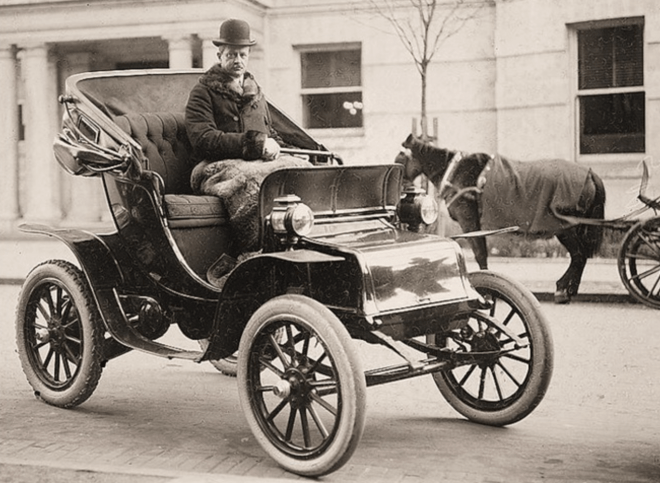
horseless carriage
A turn of the 20th-Century horseless carriage.

‘The horse is here to stay, but the automobile is only a novelty — a fad.’ — American banker to potential investor in 1903

Even at the dawn of the 20th century, your crazy uncle was spouting off nonsense about things he didn’t know anything about.

I guess back in those days, social media rants took place at the local church, tavern or letter to the editor. New technologies have always brought out the doubters and naysayers, I guess.

One hundred years ago. Sarah T. Bushnell published a biography called “The Truth About Henry Ford” in which she told the story of the banker who advised the attorney that drew up incorporation papers in 1903 for Ford’s automotive company.

The attorney had been asked to invest in the Ford Motor Co., but was hesitant and sought out advice from his banker.

“My advice is not to buy the stock,” the banker said. “You might make money for a year or two, but in the end you would lose everything you put in. The horse is here to stay, but the automobile is only a novelty — a fad.”

We all know how that turned out.

Read more on the turn-of-the-20th-century opposition to the horseless carriage in “Get a Horse!”, an article written in the 1920s by one of the inventors of the automobile, Alexander Winton.

Fast forward 100 years.

We’re at the beginning of a revolutionary transition in which electric vehicles will replace gasoline and diesel powered vehicles. Auto manufacturers are building more EVs each year with commitments to make electric vehicles the vast majority of their production by the 2030s.

There seem to be an incredible number of Teslas already on Oklahoma roads.

Despite the upward trajectory and inevitable march of technology, I’m seeing rants against EVs every day on the social media platforms where I hang out. A lot of ‘crazy uncles’ are poo-pooing the potential of electric vehicles, along with alternative power generation from wind and solar energy.

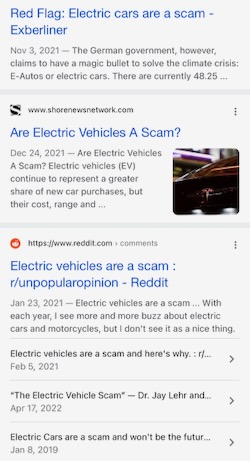
ev scamsI’ve seen photos and graphs and charts that allege that electric energy is just as harmful to the environment as fossil fuels because of the mining for minerals and the ultimate disposal of batteries.

If you Google “electric vehicles” and “scam,” you get dozens of articles showing that the world is being played.

I’m no expert, but I choose to believe that scientists and innovators have taken all of that into consideration.

So, I assume a lot of folks — especially Oklahomans — are feeling threatened by alternative power and transportation because of our long-standing ties to the oil and gas industry.

It’s sort of ironic that oil and gas-dominated Oklahoma is home to one of the world’s first large scale electric vehicle battery remanufacturing and recycling ventures, Spiers New Technologies.

Founded less than a decade ago by Dirk Spiers, the company has shown phenomenal growth, quickly outgrowing its original 23,000 square feet of manufacturing space to now occupying its current 200,000 square feet in its operations center along SE 89th Street just east of I-35.

Spiers also operates a European location and provides battery lifecycle services to virtually every automaker with the exception of Tesla. The company showed such potential that it was acquired in 2021 by Cox Automotive.

I’ve had the opportunity to interview Dirk on several occasions and hear his views on the future of electric vehicles. You can read an earlier post with Dirk here.

But I want to share some of his perspective again in this post, because I think it’s both worthy and accurate.

“In the next five years, the cost of an electric vehicle will be cheaper than a combustion engine,” Spiers said. “So, we are only at the beginning of where we are going.

“The Devon tower — and I think it is a great building — is now more than 50 percent empty. That shows you how they (and Oklahoma City) misread the future. And now the Devon tower stands there as a symbol of Oklahoma City prosperity, but it is half empty. A relic of an industry in decline.

“The good thing is that you know eventually that everyone will drive an electric car. Those cards have been played. So, we are on the right side of history” 

Although he added that the transition is not going to happen all at once, we’re watching Dirk’s predictions playing out every day.

Meanwhile, I’ll end this with the long-ago perspective of another futurist, former U.S. Supreme Court Justice H.B. Brown in a 1908 article entitled “The Horseless Carriage Means Trouble.”

“The automobile is doubtless a most useful vehicle, but one is not likely to lavish upon it the fond attention he bestows upon his horse or dog. A man may admire his own carriage, but his affections are reserved for the horse that draws it and the dog that follows it. Whatever the outcome may be, every true admirer of the horse will pray that it may not be the extinction or dethronement of the noblest of all domestic animals.”

Now there’s your crazy uncle.

negative screen]