OKC’s Golden Age of Tweetups & OpenBeta

Screenshot

I came across the obituary last week of Oklahoma City business leader Phil Scaramucci. I never met him, but his name was familiar. As I read further into his life story, I came across the name of his wife, Avis.

I don’t know Avis, either, but I know of her as the founder of the now departed Nonna’s Ristorante in Bricktown. That was in the obituary, as well.

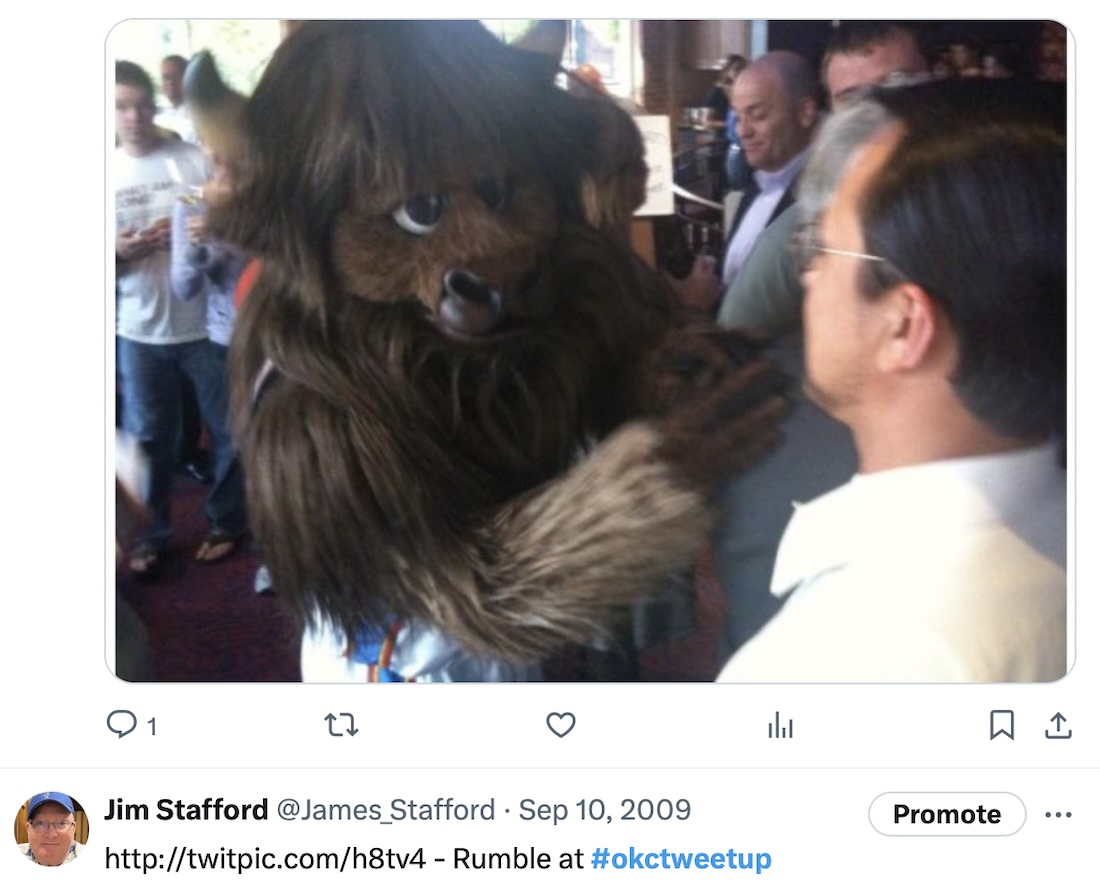
And THAT led me to recall an event I attended at Nonna’s in 2009. It was called a “Tweetup,” one among many such events that sprang up across OKC and elsewhere in that era, which provided the opportunity to meet my new Twitter friends in real life.

Screenshot

The Tweetup at Nonna’s was such fun. Probably well over 100 people attended, and, as I recall, there was free food and drink. I don’t know who paid for it. Great networking opportunities.

Tweetups became such a thing that I received an invitation to attend a Tweetup at the 2009 International BIO convention that I attended on behalf of i2E and the Greater OKC Chamber.

What set Tweetups apart — and what I call Early Twitter of the late 2000s — was how positive and upbeat everyone was. Folks were eager to lift one another up, and the concept of Twitter trolls had yet to appear to spoil the fun.

Social media was emerging in importance in that era. In fact, my friend Russ Florence, President and CEO of the Consulting and PR firm Schnake Turnbo Frank, recently told me that his firm was among the first to hire a social media and digital media specialist.

I found my way onto Twitter in the Spring of 2008 at Russ’s invitation. I worked as a Business News reporter at The Oklahoman, and discovered Twitter to be an incredible fountain of information and news.

So, I jumped into the deep end and have never left.

About that same time, another phenomenon occurred with the rise of co-working spaces. The first I recall was OKC CoCo — for Coworking Collaborative — created in downtown OKC by Derrick Parkhurst.

Derrick began hosting what he called “OpenBetas” on a semi-regular basis. OpenBetas were events where anyone could pitch their innovation or new business concept. There was food and drink and a festive upbeat atmosphere.

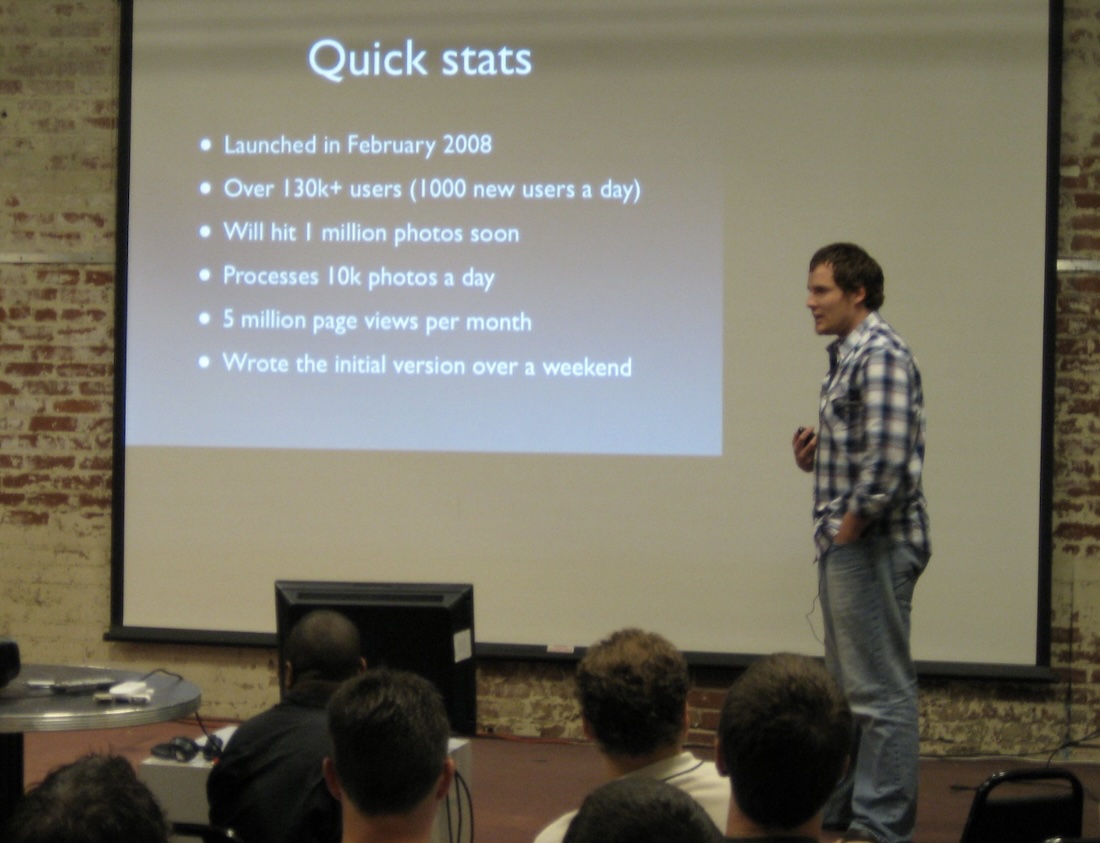
For example, Oklahoma native and entrepreneur Noah Everett shared details of his company called Twitpic at an OpenBeta event back in those days. Twitpic was huge in early Twitter as a way to post your photos.
Screenshot
Oklahoman and Twitpic founder Noah Everett discusses his venture at OpenBeta in 2009.

Another friend, Dan Lovejoy, today an Enterprise Architect Expert for OG&E, also fondly recalled the era of Tweetups and OpenBetas.
Screenshot“That really felt like an extension of the heyday of the blogosphere when so many people were blogging,” Dan told me. “I remember in those early days I would follow anyone from Oklahoma.

“I spoke at one of those (OpenBetas). They were fun.”

Fast forward to today’s Twitter, which is now known as “X” and owned by Elon Musk, who seems intent upon running into the ground. Many of my old Twitter friends have fled the site as the number of trolls increased exponentially and negativity is everywhere.

I’m still on Twitter (I refuse to call it “X”), if only because it remains a great source for breaking news, both local and beyond. I try my best to ignore the trolls, bots and MAGA acolytes.

But that’s where we are in 2024. Far removed from the naivety of Tweetups and OpenBetas.

So, I’m sorry for the loss of Phil Scaramucci, but I’m glad I got to read his life story in the paper. And how it reminded me of that 2009 Tweetup at Nonna’s.

Tweetups and Nonna’s are now only fond memories. Sadly, neither will ever be replaced.
Screenshot
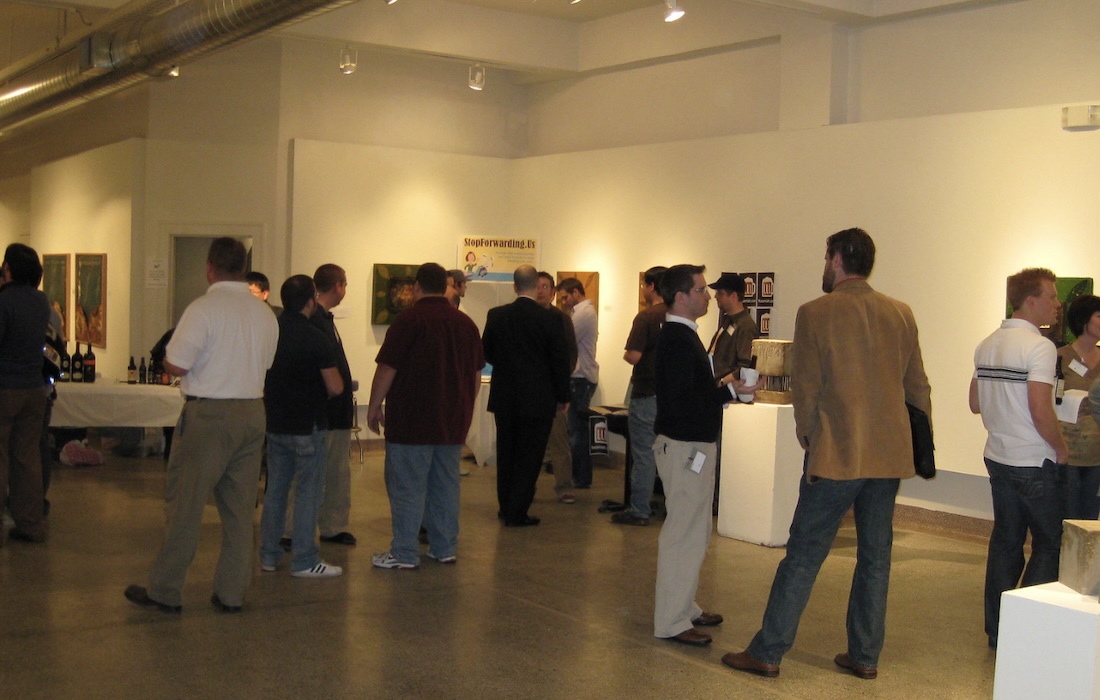
Networking at OpenBeta in roughly 2009.

Hometown hero and a smile

Pen Woods

The first time I met Col. Pendleton Woods I was judging a high school history event at Oklahoma Christian University in the early 2000s. It was a crowded room, but Pendleton spotted me from a distance and walked over to introduce himself.

Born in 1923, Pen was almost 80 years old at the time. He knew of me because I had been a Business News reporter at The Oklahoman throughout the 1990s before taking a 3-year sabbatical at OC beginning in 2000.

Anyway, Pen introduced himself, and as I looked up from my seat I noticed he was wearing a plaid jacket. tie and a pair of slacks. There was one other detail that stood out.

His fly was open.

I later talked about meeting Pen with my friend Mike Osborne, who also worked at OC at the time. Mike had one question.

“Was his fly open?”

The knowing question made me laugh out loud, and I still smile at the memory today. But I grew to love Col. Pendleton Woods, and slowly came to know his story.

Turns out he was born and raised in Fort Smith, Ark., which is also my hometown. Pen graduated from the University of Arkansas with a journalism degree.

But that’s only the start.  He was a military hero from The Greatest Generation.

Pen served in World War II with the 99th Infantry Division and was captured on a reconnaissance patrol on Dec. 10, 1944, during the German build-up to the Battle of the Bulge. He remained a prisoner until he and others escaped after Russian artillery shelled the compound shortly before the war in Europe ended on April 20, 1945.

Pen also served in the Korean War with the 45th Infantry Division of the Oklahoma National Guard. He was inducted into the Oklahoma Military Hall of Fame in 2002.

After his service in WWII, Pen settled in OKC and worked for Oklahoma Gas and Electric for years. He eventually joined the staff at Oklahoma Christian University and worked there until late in his life.

As a longtime OKC resident, Pen was an incredible community servant, volunteering for the Boy Scouts, helping bring the National Cowboy Hall of Fame to OKC, serving as executive director of the OKC Bicentennial Commission and many, many other endeavors. He authored 15 books.

After I returned to The Oklahoman in 2003, Pen would call me on a regular basis, either to pitch a story or just to catch up for a few moments.

Pen died on Dec. 1, 2014 and left a massive legacy in our local community and beyond. Read his obituary here. 

I’ve written all of this about Col. Pendleton Woods because of something that happened this week. I was working on a special project for a friend at a busy local coffee shop when I happened to look down.

My fly was open.

Pen Woods was the first thought that ran across my mind after quickly closing the barn door.

Then I smiled to myself at the memory.

Starbucks
The room where it happened.


What is Blockchain for Business? OKC conference provides some context

Alan Dickman, IBM Blockchain Architect, delivers a primer on Blockchain for Business to an audience of OKC business leaders.

Editor’s note: I was invited by my friends at OCAST to attend the recent Blockchain for Business conference here in OKC. This is what I wrote about the experience and what I learned from the event about a subject that I know very little about.

By Jim Stafford

There is a huge gulf between the emerging blockchain-for-business technology and the cryptocurrency world, a group of 150 Oklahoma business leaders learned at the recent Blockchain for Business conference at the Baker Hughes/GE Energy Innovation Center.

The blockchain primer delivered to the Oklahoma audience by Alan Dickman, IBM Blockchain Architect, contrasted the two computing networks that are often confused for one another.

“Blockchain is really just a shared, distributed ledger that helps record transactions,” Dickman said in his keynote presentation. “Blockchain facilitates business processes that are shared among a network that is using the same ledger.”

What blockchain-for-business is not is a giant, worldwide computing network that requires every member of the network, or peer, to update their blockchain file with each transaction, Dickman said.

“That sounds like Bitcoin, where there are lots and lots of peers around the world, and what you are doing is updating each ledger,” he said. “Only a small number of blockchains have that infrastructure.”

Blockchain-for-business can limit the number of peers, and requires that each participant be identified and invited to the network. Transactions are recorded as an “immutable” record that can never be altered.

In contrast, Cryptocurrency networks are known as “permission-less,” which means that participation is unlimited. Participants can remain anonymous. The “permission-less” networks can grow unwieldy and consume large amounts of energy as each transaction is updated.

“You can have permission blockchains where you put up your own private networks,” Dickman said. “So, it depends on the use case and depends on the technology and whether you are using a permission or permission-less blockchain.”

The Blockchain for Business conference was presented by OG&E and IBM, with support from the Greater Oklahoma City Chamber; the Oklahoma Department of Commerce; the Oklahoma City Innovation District; the Oklahoma Center for the Advancement of Science and Technology (OCAST); the Tom Love Innovation Hub at the University of Oklahoma; Baker Hughes, a GE Company, the Oklahoma Manufacturing Alliance; Zilker Technology LLC.; and the Energy Web Foundation.

“From OG&E’s perspective, the business purpose of this conference was two-fold,” said Richard Cornelison, economic development manager for OG&E. “We wanted to bring a better understanding of technology, and ways to communicate to the communities we serve and into the companies we serve.”

The conference featured breakout sessions for energy industry users, government, health care and supply chain, and oil and gas.

“Blockchain is one of those emerging, potentially enabling technologies that has the capability of impacting our economy,” said Mark Ballard, programs officer with OCAST. “We’re interested in this technology because it can give businesses another opportunity to compete more effectively in the economy.”

Jim Stafford writes about Oklahoma innovation and research and development topics on behalf of the Oklahoma Center for the Advancement of Science & Technology (OCAST).