Show me the radar! A digital tale from 2004

Screenshot

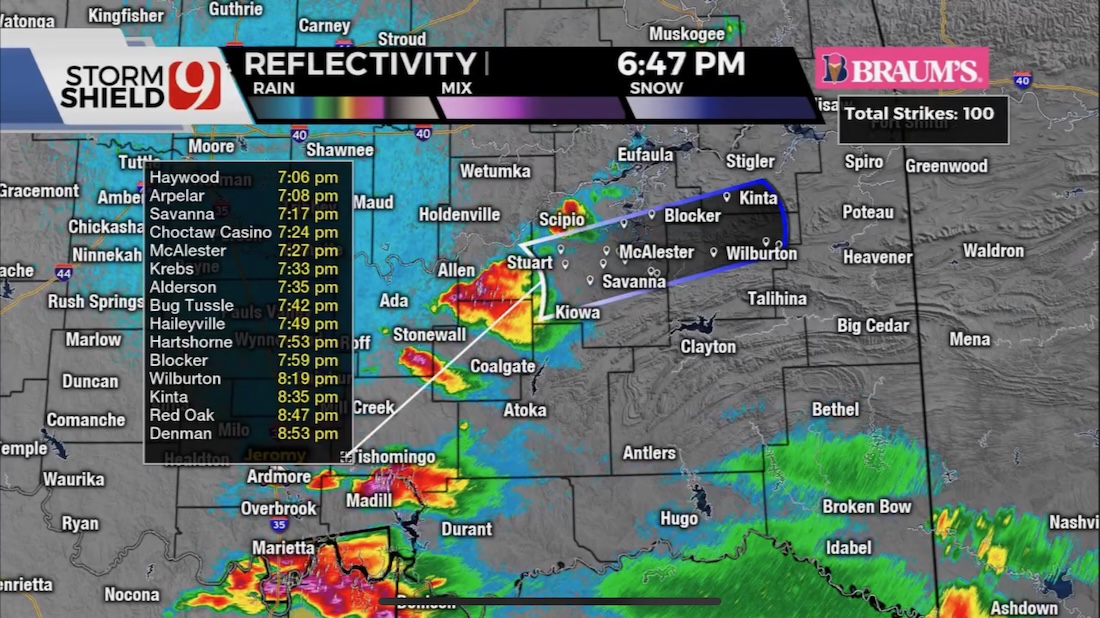
Whenever weather threatens OKC or western Oklahoma, our local TV stations abandon network programming and go with wall-to-wall weather coverage.

My family tunes in every time, and not just for potential life-saving information. We’re fascinated by the combination of theatrical performance, legitimate weather warnings and relentless self promotion.

“We’re declaring a News9 tornado warning for you folks in Custer County!” weatherman David Payne practically screams as he directs Val and Amy into the path of the storm.

No waiting on those slackers at the National Weather Service.

It’s like passing a car wreck on the Interstate, you can’t NOT look at it. Everyone has their favorite/least favorite TV meteorologist. Our go-to weather Drama Queens happen to be from Channel 9.

Anyway, it seems like programming has been interrupted every other night this Spring, but I would never suggest that it’s related to climate change, would I?

As we’ve watched the powerful color-coded radar scans and learned that we’re seeing details THAT NO OTHER STATION IN OUR MARKET CAN PROVIDE, the whole scenario got me thinking back to something I wrote about two decades ago.

Today, we’re in a digital world in which we can track incoming storms on color radar not only only our television screens, but on our phones, computers and tablets. That was all just emerging in 2004 when I was a Business News reporter at The Oklahoman who embraced the digital life.

Not all of my colleagues were ready to move on from their analog past, so I wrote the following column as an ode to the great digital divide:

It is autumn 2004, and a pair of coworkers are sitting in opposite cubicles facing each other. One has his back to the window. His name is “Digital.” His co-worker goes by the moniker “Analog.”

Digital: Hey, there’s a weather alert crawling across the bottom of my computer screen!

Analog: (looking out the window over Digital’s shoulder) It looks sunny to me. There’s a little cloud to the south.

Digital: Yeah, but the color-coded radar I’m looking at on my screen shows a major thunderstorm headed this way. It’s just north of Chickasha.

Analog: I trust my eyes. I’ll worry about the weather when I look out this window and see a big black cloud.

Digital: You are so 1990s. (picks up the phone to call his wife) Hello, honey, you better monitor the weather, it’s looking rough outside. Where are the kids? Outside playing? Well, bring them in. The radar on my computer screen is showing a big storm just north of Chickasha, and it’s headed this way.

Analog: I still only see blue sky out the window.

Digital: (still speaking into phone) I don’t care if it’s sunny out, I’m telling you my radar is showing a big storm brewing just south of here. I’ll call you with further updates. Bring the kids inside! Call my cell phone when you have them rounded up (hangs phone up).

Analog: I think you are scaring your family for no reason. You should trust your eyes. Look out the window! It’s sunny.

Digital: I don’t need a window! I’m wired into the weather service right here. I can zoom in on the screen and see within a half mile where the storm is, which way it’s moving and what the temperature is. See, it’s 62 degrees outside.

Analog: I can just walk outside and get a feel for the temperature.

Digital: Then I assume you aren’t concerned about your family’s welfare. They won’t be ready for this one when it blows through town.

Analog: We have a “safe room” in our garage.

Digital: (wireless telephone rings) Hello. You’ve got the kids? Good. Now, what’s your plan for when the storm hits?

Analog: My eyes are telling me it’s still sunny outside.

Digital: (still speaking into phone) Will you have time to drive to the community shelter? Yes, I know it’s still sunny outside, but the radar shows the storm has moved closer to the metro area. Herd the kids to the hall closet if you need to. OK, love you. Bye.

Analog: Hey, I’ve got to run out on an assignment. I’ll be back this afternoon.

Digital: Well, let me have your cell phone number so I can contact you in case there’s a weather emergency or something.

Analog: I don’t have a cell phone. Never had a need for one.

Digital: (head bangs against desk; heavy sigh) I give up.

Analog: (starts to walk out of the office) Later.

Digital: (jumps up and runs after Analog) Here, take my umbrella just in case.

That’s how we rolled in 2004. It was a different era. Pre-iPhone. Pre-News9 tornado warning.

Any resemblance to actual people is mere coincidence.
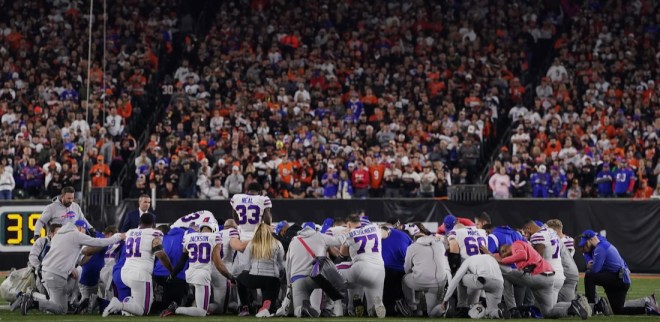
Damar Hamlin: ‘We don’t get to choose our calling’

Damar players
Players huddle in prayer for Buffalo Bills defensive back Damar Hamlin after he collapsed on the field in January. (New York Times photo)

We’ve all experienced moments in our lives that are burned into our memories, and we’ll always remember exactly where we were when we witnessed it or heard the news.

The Twin Towers. John Lennon’s death. The Kennedy Assassination.

On Jan. 2 of this year, millions of Americans watched as Buffalo Bills defensive back Damar Hamlin made a tackle in an NFL game vs. the Cincinnati Bengals, stood up, then collapsed on the field.

My wife and I were among those who witnessed it, watching from our living room.

Damar lay motionless on the field as trainers and emergency personnel rushed to his side. I was struck by the reaction of the players, many of whom turned away and appeared to be in grief or in prayer.

Team and security personnel surrounded Damar and blocked any views by intruding network cameras or even his own teammates. Players on both teams gathered in a big prayer circle.

We feared the worst as the minutes passed. My wife speculated that he already could be dead, even though we didn’t know what had happened. Here’s a recap from the New York Times written a few days later.

Damar Hamlin had had a massive heart attack, and his heart stopped. The emergency personnel and training staff used defibrillators and brought him back to life, more than once, apparently. After many minutes, he was loaded into an ambulance and taken to a Cincinnati hospital.

We were as anxious as anyone else and silently praying for his life. We weren’t optimistic.

But you probably know the rest of the story. Damar escaped more near misses with death on the way to — and in — the hospital. Still, he grew stronger by the day and was released nine days later.

He continued to improve, and under doctor’s supervision began working out again and was eventually cleared to rejoin the team this summer.

Damar is again on the Bills roster and played his first minutes of action this past weekend.

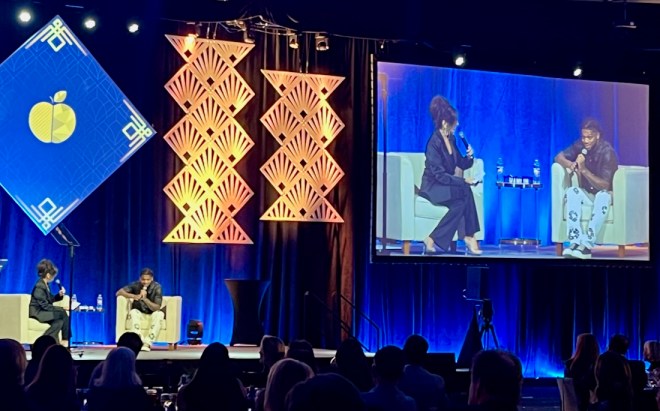
Then he flew to Oklahoma City on Tuesday to share his story with an audience of about 1,000 Oklahomans at the annual Champions of Health Awards Presentations at the OKC Convention Center.

Champ Damar1
Damar Hamlin shares the stage with News9’s Robin Marsh during a ‘fireside chat’ at the Champions of Health Awards Presentations.

I had the good fortune to be in that OKC audience as an employee of Care Providers Oklahoma, one of 11 health care related organizations that comprise the Champions of Health Coalition. All are working to improve health outcomes for Oklahomans, and the Champions of Health Awards recognize organizations or individuals that have devised innovative programs that could be replicated in other communities.

Anyway, the highlight of the night was Damar Hamlin’s presence and the perspective he shared in a “fireside chat” with News9 TV personality Robin Marsh.  Check out the video that my CPO colleague Tanecia Davis shot of Damar speaking during the chat.

Robin introduced Damar and told him that millions of Americans had prayed for him that night from their living rooms, just as his teammates did on the field.

Soft spoken, Damar didn’t go into details of the incident, but instead focused on his mission since. Today, he’s working to ensure that the technology that saved his life is available by every sports team nationwide and that people are trained in CPR.

I was struck by one comment in particular by Damar about this mission.

“It’s kind of like a calling, & we don’t get to choose our calling,” he told us.

Amen.

Robin asked Damar about his youth and how he progressed from high school to college to the NFL. He shared the story of his personal journey, and something else stood out.

“I found a mentor,” he said. “I found someone who was older than me and successful and worked with them.”

Amen again.

I’m a big believer in cultivating a mentor and then following their example and advice. Although I never had a formal mentor, I’ve had some folks in my life who provided sage advice along the way.

Like millions of my fellow Americans, I’m so glad that Damar Hamlin survived this near death experience. Survived and emerged with his new mission, his calling.

And we don’t get to choose our calling.

BONUS! Read my blog post over at Care Providers Oklahoma website that provides more details about the Champions of Health Awards Presentations and winners.

Don’t let your facts get in the way of my beliefs

encyclopedia2
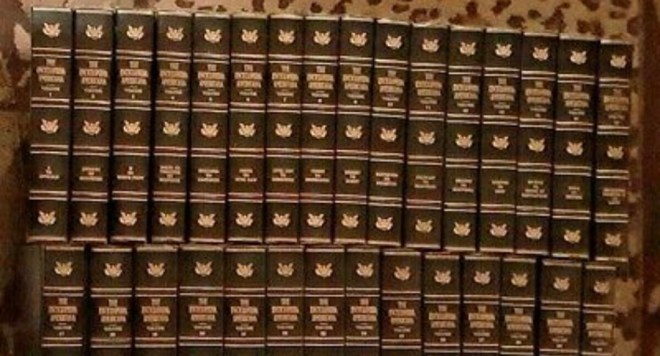
A set of Encyclopedia Americana from the 1960s.

When I was a kid, we had a big set of Encyclopedia Americana in our house that was my go-to Google-of-the-day for every bit of fact finding and trivia that drew my interest.

Once, when I was a teenager, my dad and I had a disagreement over some fact about a foreign country or its people, I can’t remember which.

However, my dad was spouting an opinion as fact that I was certain was wrong. So, I grabbed an encyclopedia, looked it up and read the part to him that proved that he was wrong.

“Now you’re taking it too far,” he said, clearly irritated.

Translation: don’t let your facts get in the way of my entrenched beliefs.

Anyway, I’m writing this because we’re seeing people in our society make up their minds and cling to ‘alternative facts’ when clearly there is no evidence to back them up. Or there’s evidence that shows that it is wrong and they still cling to their beliefs.

The dispute over vaccines, for instance. People would rather take their Uncle Jimmy Joe’s word that the COIVID-19 vaccines are making thousands of people sick or, worse yet, killing them, than accept statistics kept by health care professionals and scientists that show vaccines are incredibly safe and effective.

I’m pretty sure it’s really an issue motivated first and foremost by political beliefs. Red state. Blue state.

But we all stake out our territory on different issues and refuse to budge even when we’re smacked in the face by reality. I’m sure I’m guilty, as well.

And that leads me to an issue that really disturbed me this week. One of my neighbors whom I like and enjoy hanging out with in his driveway, stated as fact that a high-ranking OKC city official gets a cut from every concession sold at Scissortail Park because he made a donation to its construction.

I ask him to offer some proof. “They reported it on Channel 9,” he said.

If it had been reported on TV or in the newspaper, and there was evidence to support the allegation, the story would be huge and talked about by everyone in the city. The official would likely lose his job.

scissortail park1
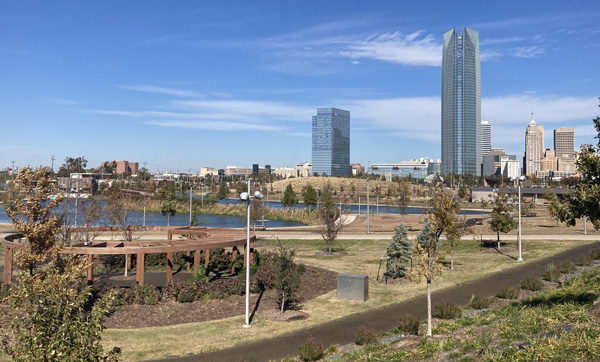
Scissortail Park in early November

Instead, it’s told as fact by a retired OKC resident who is skeptical about the whole MAPS program and Scissortail Park, as well. He doesn’t need actual proof, because he heard the story told as fact from others who share his point of view.

I even ran the allegation past a respected reporter for The Oklahoman that I trust and who told me that “none of it is true.” I’m taking his word for it, because, if true, it would have been a giant Page 1 headline.

The disturbing aspect is that my neighbor repeats the story to anyone who will listen, and in my far north OKC neighborhood there are a lot of takers.

I think some of it has to do with the fact that our neighborhood is so far out of the city’s core that people like my neighbor don’t see the benefit that MAPS and Scissortail Park have brought to our city.

As I walked back home after the encounter the other day, I couldn’t help but think of my dad and his long ago wrongly held opinion-as-fact. Even the Encyclopedia Americana couldn’t budge him off his belief.

Sad to say, that’s how it is with a lot of American society today.