I came across the obituary last week of Oklahoma City business leader Phil Scaramucci. I never met him, but his name was familiar. As I read further into his life story, I came across the name of his wife, Avis.
I don’t know Avis, either, but I know of her as the founder of the now departed Nonna’s Ristorante in Bricktown. That was in the obituary, as well.
And THAT led me to recall an event I attended at Nonna’s in 2009. It was called a “Tweetup,” one among many such events that sprang up across OKC and elsewhere in that era, which provided the opportunity to meet my new Twitter friends in real life.
The Tweetup at Nonna’s was such fun. Probably well over 100 people attended, and, as I recall, there was free food and drink. I don’t know who paid for it. Great networking opportunities.
Tweetups became such a thing that I received an invitation to attend a Tweetup at the 2009 International BIO convention that I attended on behalf of i2E and the Greater OKC Chamber.
What set Tweetups apart — and what I call Early Twitter of the late 2000s — was how positive and upbeat everyone was. Folks were eager to lift one another up, and the concept of Twitter trolls had yet to appear to spoil the fun.
Social media was emerging in importance in that era. In fact, my friend Russ Florence, President and CEO of the Consulting and PR firm Schnake Turnbo Frank, recently told me that his firm was among the first to hire a social media and digital media specialist.
I found my way onto Twitter in the Spring of 2008 at Russ’s invitation. I worked as a Business News reporter at The Oklahoman, and discovered Twitter to be an incredible fountain of information and news.
So, I jumped into the deep end and have never left.
About that same time, another phenomenon occurred with the rise of co-working spaces. The first I recall was OKC CoCo — for Coworking Collaborative — created in downtown OKC by Derrick Parkhurst.
Derrick began hosting what he called “OpenBetas” on a semi-regular basis. OpenBetas were events where anyone could pitch their innovation or new business concept. There was food and drink and a festive upbeat atmosphere.
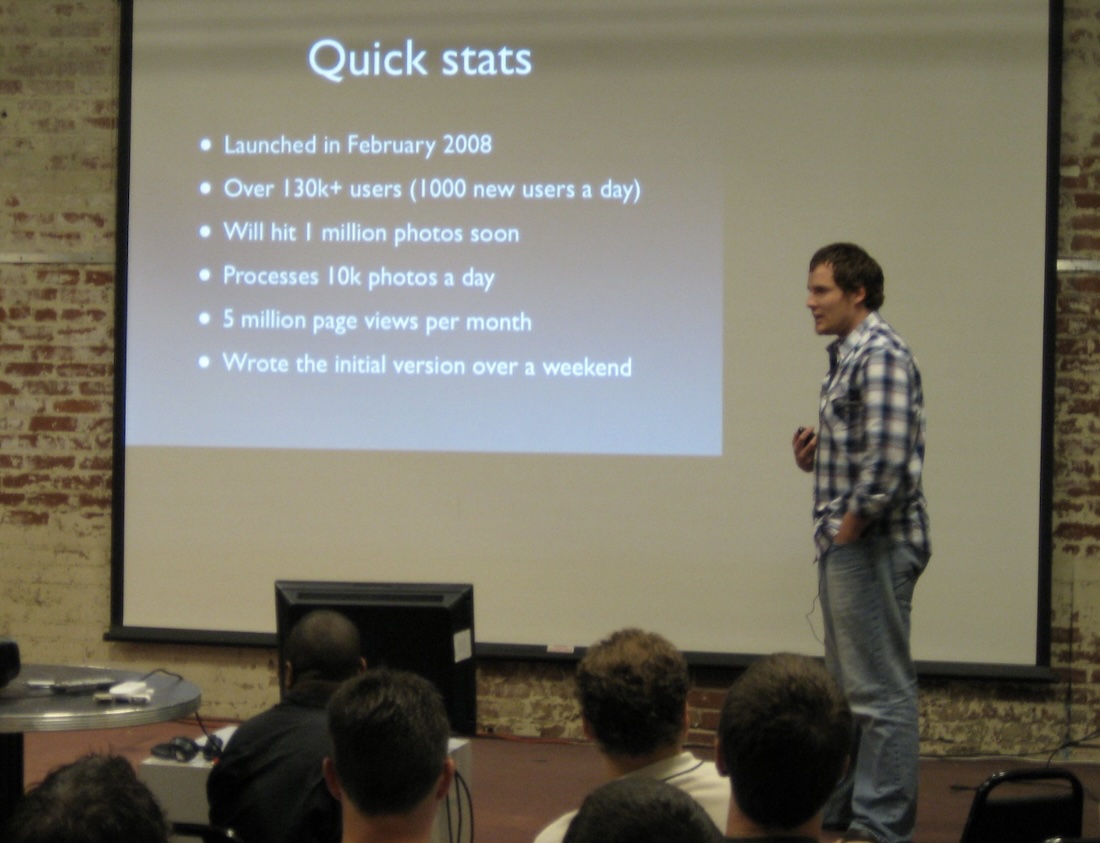
For example, Oklahoma native and entrepreneur Noah Everett shared details of his company called Twitpic at an OpenBeta event back in those days. Twitpic was huge in early Twitter as a way to post your photos.
Oklahoman and Twitpic founder Noah Everett discusses his venture at OpenBeta in 2009.
Another friend, Dan Lovejoy, today an Enterprise Architect Expert for OG&E, also fondly recalled the era of Tweetups and OpenBetas.
“That really felt like an extension of the heyday of the blogosphere when so many people were blogging,” Dan told me. “I remember in those early days I would follow anyone from Oklahoma.
“I spoke at one of those (OpenBetas). They were fun.”
Fast forward to today’s Twitter, which is now known as “X” and owned by Elon Musk, who seems intent upon running into the ground. Many of my old Twitter friends have fled the site as the number of trolls increased exponentially and negativity is everywhere.
I’m still on Twitter (I refuse to call it “X”), if only because it remains a great source for breaking news, both local and beyond. I try my best to ignore the trolls, bots and MAGA acolytes.
But that’s where we are in 2024. Far removed from the naivety of Tweetups and OpenBetas.
So, I’m sorry for the loss of Phil Scaramucci, but I’m glad I got to read his life story in the paper. And how it reminded me of that 2009 Tweetup at Nonna’s.
Tweetups and Nonna’s are now only fond memories. Sadly, neither will ever be replaced.
I’m here today to write about the new social media platform, Threads. But first I have to talk about Twitter, because without the bird app, I’m pretty sure there would not be a Threads.
Back in the Spring of 2008, my friend Russ Florence invited me to connect with him on Twitter, a social media platform that debuted in 2006. I was in the final year of my career as a reporter at The Oklahoman.
So, I signed up on the app and followed Russ as my lone Twitter connection.
As a Twitter newbie, I didn’t realize there was a big Twitter world out there with lots of potential accounts to follow. I loved following Russ and his personal tweets like the one from the day his dishwasher quit on him.
But one day I happened to look at Russ’s profile and saw he was following scores of other Twitter accounts. So I clicked on his follow list. It opened a new world to me because there were so many news and technology sources that I didn’t realize existed until that moment.
I followed a couple dozen right off the bat, and my interest in Twitter grew exponentially.
What I loved about it was being able to follow big national media sources like the New York Times and NPR, or more local sites like The Oklahoman and Tulsa World. Plus there were sports accounts like ESPN, and eventually MLB, NBA and NFL. I got instant alerts anytime there was breaking news or sports.
Plus there was a growing number of Oklahomans joining every day, providing local perspectives.
I enjoyed Twitter immensely, because, until Donald Trump started opining 30 times a day on Twitter on the run-up to the 2016 election, there were few of what I call the Crazy Uncles on Twitter that you frequently find on Facebook. It was upbeat and fun.
Fast forward to 2022.
Billionaire Elon Musk completed his purchase of Twitter in October, and it’s all been downhill from there. Musk encouraged less-than-objective news sources to begin posting on Twitter. He appealed to the type of voices like podcaster Joe Rogan, who broadcast and repeat misinformation. Trolls blossomed. New rules were imposed that limited the number of tweets a subscriber could view on a daily basis.
With all that roiling long-time Twitter subscribers, along comes Threads, owned by Meta and launched through Instagram. I heard about it and signed up on Day 2. By the end of the week (last week!) I read that 110 million individual accounts had opened.
Threads looks suspiciously like Twitter in that you can comment, like and repost items with or without your own commentary. In fact, Twitter has threatened to sue Meta over the copycat status of Threads.
The downside I’ve seen so far is that you can’t set up lists that contain just the accounts — Threaders? — or topics you want to see, and posts aren’t presented in chronological order. And there’s no Threads site set up for Mac or (I assume) Windows computer users — it’s all mobile based so far.
So, here’s my dilemma and that of millions of other long-time Twitter users. Many — including me — have made their living posting items on behalf of employers to Twitter accounts that are well established and have many followers. Many thought leaders still post regularly to Twitter, although you can find many of the same folks over on Threads.
Instead of just dropping my Twitter account, I’m hanging on, checking both Threads and my Twitter feed on a fairly regular basis.
Until further notice, I’ll be tweeting and threading simultaneously. I welcome followers on both.
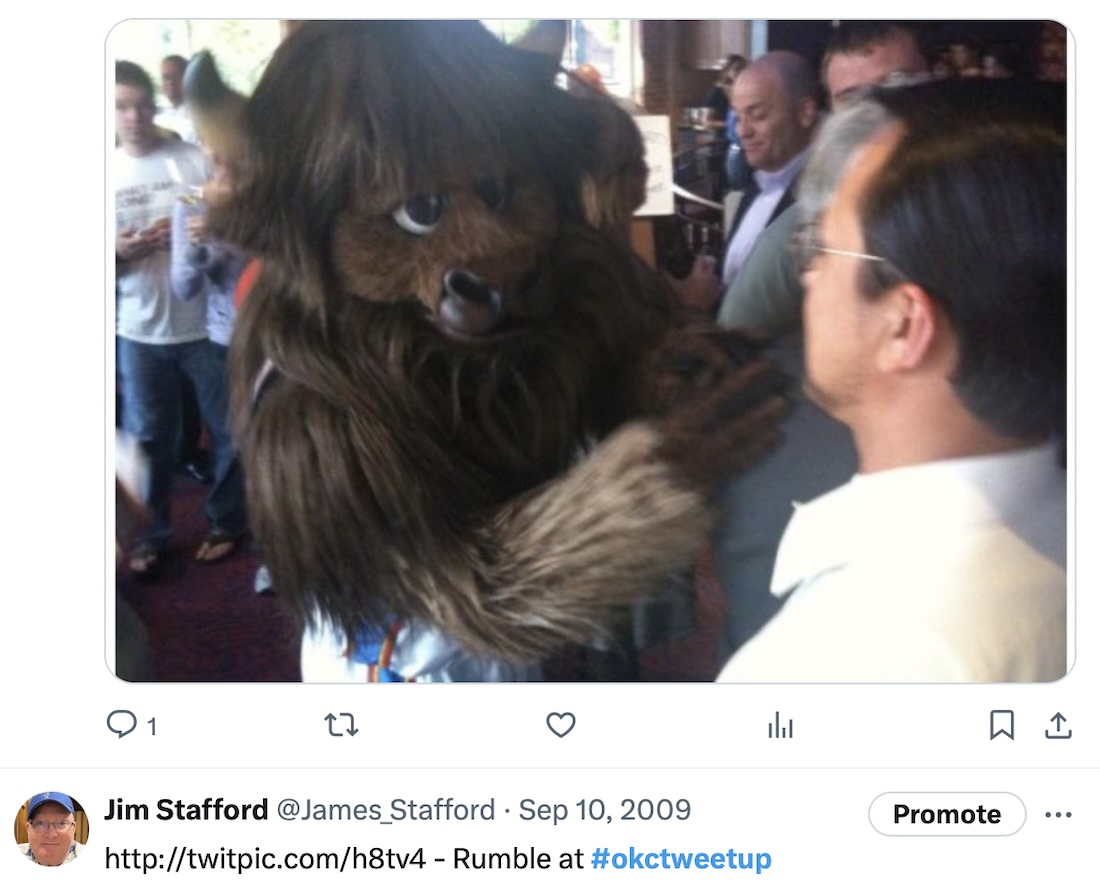
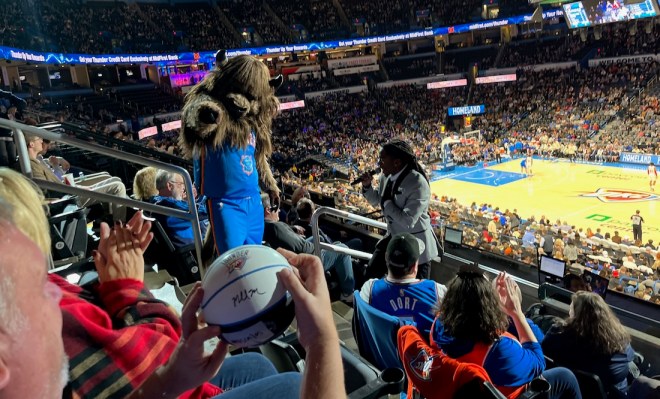
Thunder mascot Rumble makes an appearance in the stands at a recent OKC game.
I’ve heard a lot recently about this Artificial Intelligence app called ChatGPT, which allegedly will answer any question and write a report or an essay on any topic.
I figured that I owe BlogOKC readers an explanation of what ChatGPT is, so I went right to the source. Here’s what the Chatbot told me.
“ChatGPT is a large language model developed by OpenAI. It is trained on a dataset of internet text, which enables it to generate human-like responses to a wide range of text-based prompts. It can be used for tasks such as text completion, question answering, and conversation. It is based on the GPT (Generative Pre-training Transformer) architecture.”
A little long-winded, but there you have it.
So, I came up with a topic for my Chatbot to address to see how awesome it could be. Since much of my time seems to be focused on the Oklahoma City Thunder and my opposition to its tanking philosophy to rebuild for the future, I thought I would ask Chatbot for its take on the subject.
Here’s Chatbot’s take on why tanking is not the right philosophy for the Thunder:
“Tanking, or losing on purpose, is a controversial strategy that can have negative consequences for teams in the NBA. For the Oklahoma City Thunder, tanking may not be the best route to rebuild their team and become a contender in the league.
“One of the main reasons why tanking is a bad route for the Thunder is that it can have a negative impact on the team’s culture and morale. When a team is losing on purpose, it can be difficult for players and coaches to stay motivated and maintain a positive attitude. This can lead to a lack of effort and poor performance on the court, which can ultimately harm the team’s development. Additionally, it can also lead to a lack of fan support and engagement with the team, making it harder for the team to attract and retain fans.
“Another reason why tanking is a bad route for the Thunder is that it doesn’t guarantee success in the future. The NBA draft is not a sure thing and even the top draft picks do not always turn into star players. Therefore, tanking may not result in the Thunder getting the high-quality players they need to become a contender in the league. Additionally, even if they do get a high draft pick, it takes time for young players to develop and it’s not guaranteed that they will become the star player the team needs.
“Additionally, tanking can also lead to a lack of stability for the team. When a team is consistently losing, it can be difficult to keep coaches, players, and management in place. This can lead to frequent changes and a lack of continuity, which can make it difficult for the team to build a sustainable winning culture.
“Furthermore, tanking can also be detrimental to the league as a whole. When teams are not trying to win, it can lead to a lack of excitement and interest in the league, which can negatively impact the league’s reputation and overall revenue.
“In conclusion, while tanking may seem like a quick fix, it can have negative consequences for teams like the Oklahoma City Thunder. Tanking can lead to a negative team culture, lack of fan support, lack of stability, and lack of success, and it can also harm the league as a whole. Instead, the Thunder may be better served by taking a more gradual approach to rebuilding, focusing on player development and making strategic moves in the draft and free agency.”
Did you read that? “Detrimental to the league.” Chatbot went right to the heart of why tanking doesn’t fly for me, and I hope millions of other fans. If a lot of teams are playing to lose, the interest will wane everywhere.
I think Chatbot is dead on in its assessment of the impacts of tanking, including decrease in attendance and a loss of revenue.
All in all, I would grade this essay with an A+.
Chatbot, you’ve impressed me with this argument.
After I read this essay, I decided to have Chatbot argue the other side of the equation for balance. So I ask it to write 450 words on why tanking is good for the Thunder.
Here’s what it wrote in favor of tanking:
“Tanking, or losing on purpose, is a controversial strategy that teams in the NBA have used in order to rebuild their rosters and improve their chances of success in the long term. The Oklahoma City Thunder are currently in a position where tanking could be the best route to rebuild their team and become a contender in the league once again.
“One of the main reasons why tanking is the best route for the Thunder is that it would give them a better chance of getting a high draft pick. The NBA draft is the primary way for teams to acquire young, talented players who can help them improve in the future. The higher a team’s draft pick, the more likely they are to select a player who can make a significant impact on their team. By losing on purpose, the Thunder would increase their chances of getting a high draft pick and selecting a player who could be a cornerstone of their team for years to come.
“Another reason why tanking is the best route for the Thunder is that it would give them more financial flexibility. The NBA has a salary cap that limits how much teams can spend on player salaries. When a team is not competitive, they may not be able to attract top-tier free agents who can help them improve. By rebuilding through the draft and developing young players, the Thunder would have more financial flexibility to make moves in the future.
“In addition, tanking would give the Thunder a better chance of building a team that can contend for a championship in the future. Building a championship team is a difficult and time-consuming process that requires a combination of talented players, good coaching, and a solid organizational structure. By losing on purpose and getting high draft picks, the Thunder would be more likely to acquire the young, talented players they need to build a championship team.
“Furthermore, tanking would also give the Thunder a chance to give more playing time to their young players and prospects. This would be beneficial for their development and would also help the team to evaluate their potential.
“In conclusion, there are several reasons why tanking is the best route for the Oklahoma City Thunder to rebuild their team. The Thunder are currently not in a position to compete for a championship, and tanking would give them a better chance of getting a high draft pick, more financial flexibility, and a better chance of building a team that can contend for a championship in the future. Additionally, it would also give more playing time to the young players and prospects and help in their development. While tanking is a controversial strategy, it can be a necessary step for teams like the Thunder to rebuild and become a successful team again in the future.”
ChatBot presented some compelling arguments in favor of tanking for a rebuild. It hit on an argument that my friend, Steve Buck, often makes in favor of tanking: player development.
Chatbot wrote: “Furthermore, tanking would also give the Thunder a chance to give more playing time to their young players and prospects.”
Again, Chatbot wrote a compelling essay without an factual errors that I can detect. I give it an A+ on this assignment, as well.
However, I’ve still not moved an inch from anti-tanking stance.
Chatbot, when I finally found you at the OpenAI web page, you surprised me with some fine writing and compelling arguments.
Well done.
Editor’s note: My first attempt to have ChatGPT to write essays for and against tanking by the Oklahoma City Thunder was done via an app I downloaded to my iPhone from the Apple App Store. I’ve since discovered that app is ChatGPT filtered through a company hoping to make money by charging a weekly fee for the free, open-source app. So, I signed up on the OpenAI page and had the Chatbot write me new, much improved essays.

 “That really felt like an extension of the heyday of the blogosphere when so many people were blogging,” Dan told me. “I remember in those early days I would follow anyone from Oklahoma.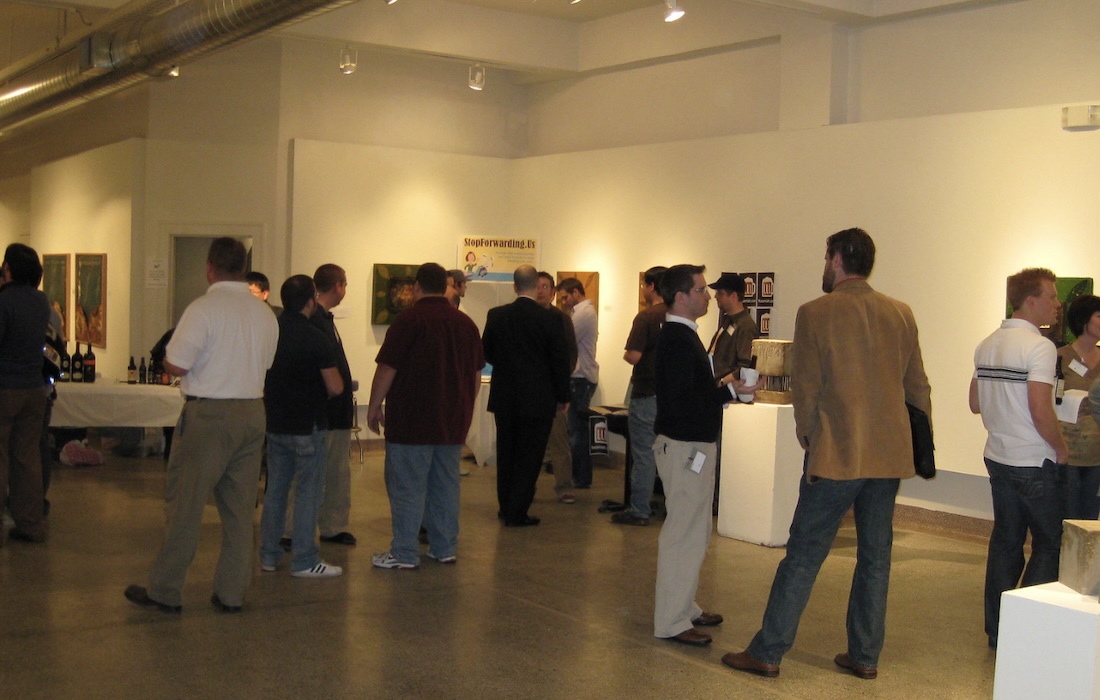
 I’m here today to write about the new social media platform, Threads. But first I have to talk about Twitter, because without the bird app, I’m pretty sure there would not be a Threads.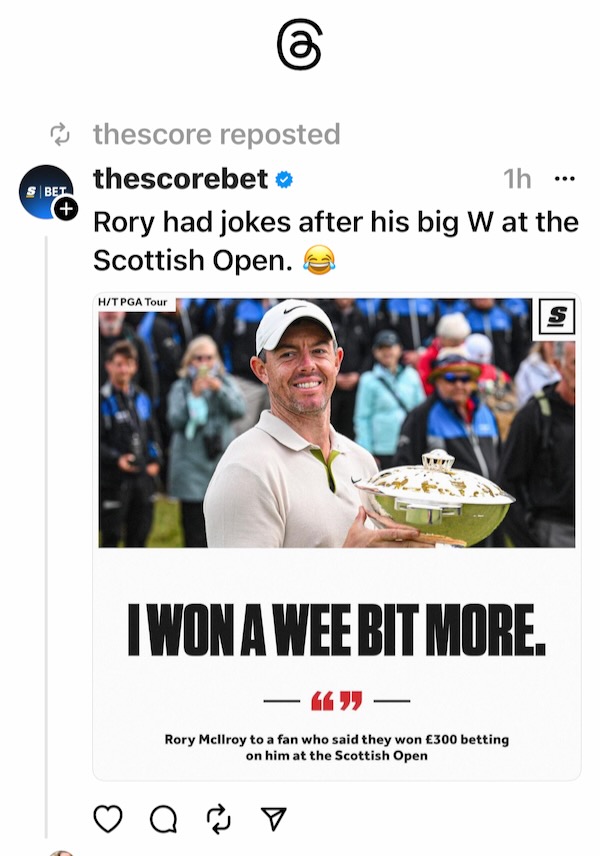
 Jim Stafford's BlogOKC