Walking tour showcases future impact of OKC’s Convergence project

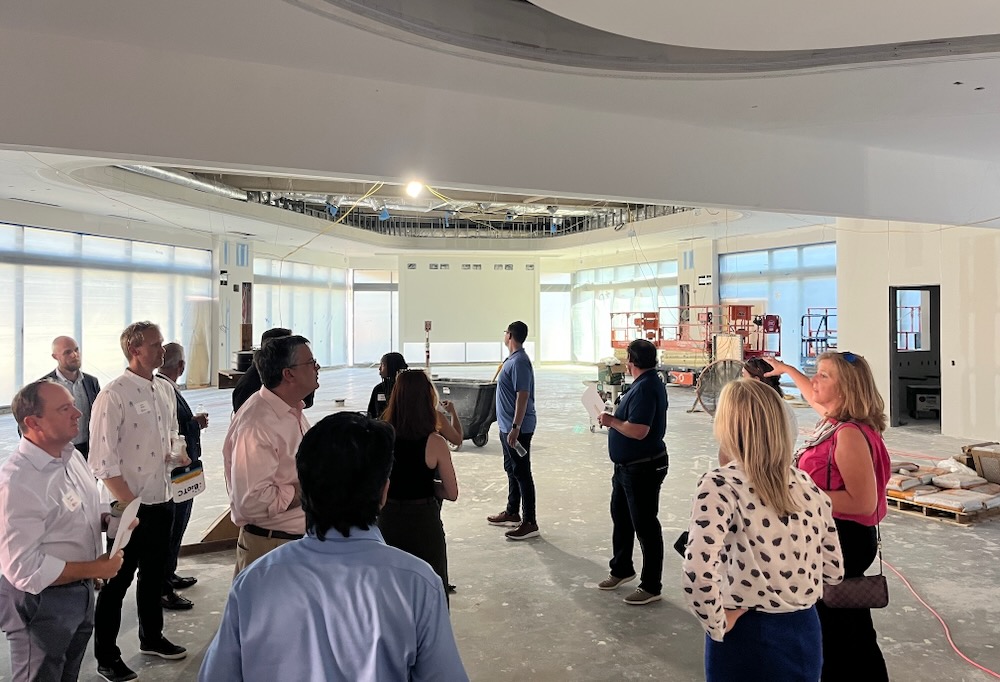
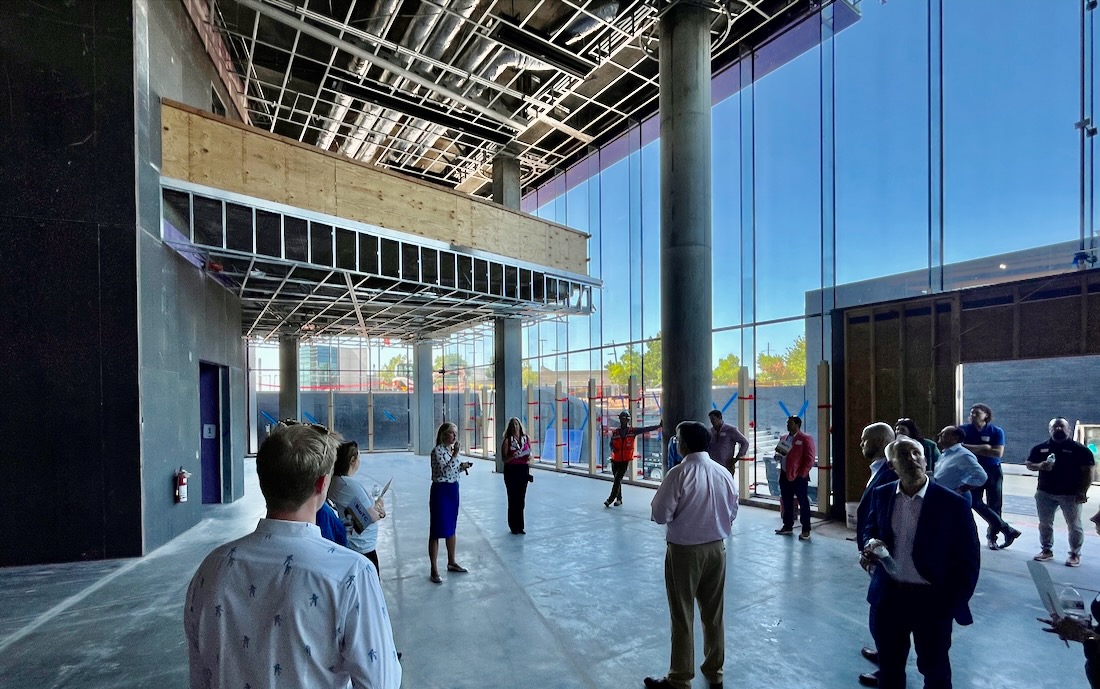
Convergence floor
Second floor of the Convergence tower under development in OKC’s Innovation District.

If you’re like me, you’ve been curious about the new Convergence tower rising from the ground the past couple of years along I-235 just east of downtown.

The eight-floor Convergence tower is a $200 million privately funded development in the heart of OKC’s Innovation District. The project includes the adjacent, MAPS funded Innovation Hall with a future hotel also planned for the site.

A pair of prominent OKC real estate investors/developers in Richard Tanenbaum, CEO of Tanenbaum Holdings, and Mark Beffort, CEO of Robinson Park Investments, have led the Convergence project.

Convergence sits on a pretty small plot of land — 5.5 acres — that surrounds the tiny Stiles Park and its Beacon of Hope, which shines a green light into the night sky like a giant flashlight. The project will have underground parking.
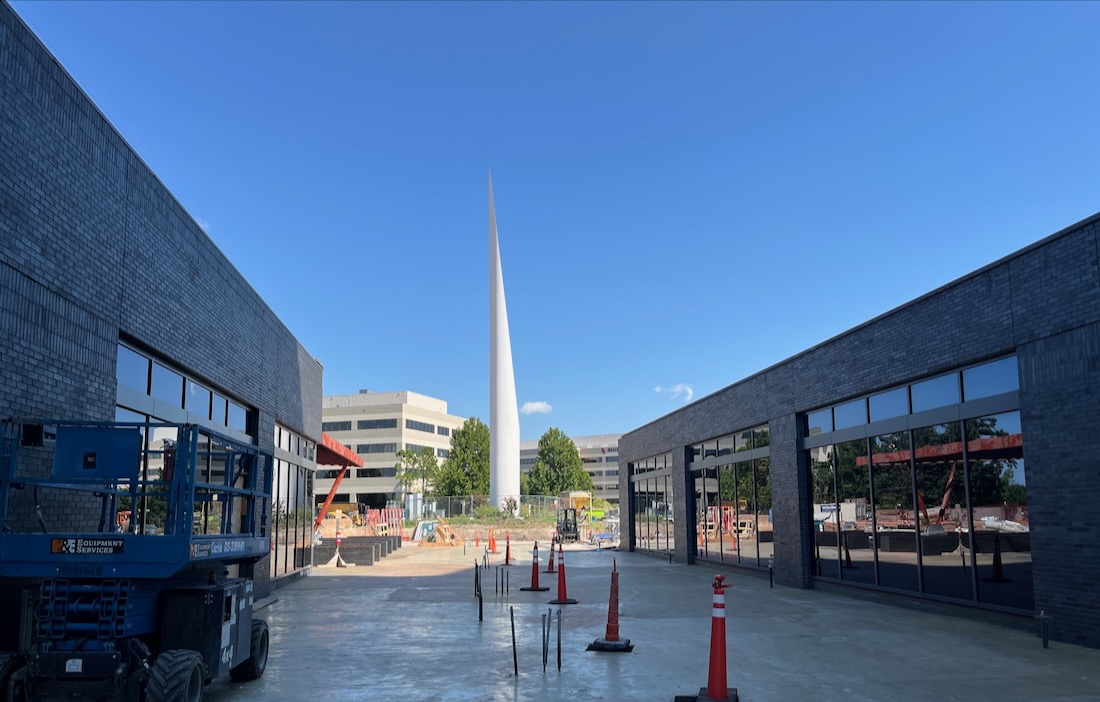
Stiles park
Stiles Park holds its ground as part of the Convergence project

The Convergence website descibes the project as an “ecosystem reshaping Oklahoma City’s economy through innovation, collaboration, diversity and advanced technology.”

The project is certainly reshaping OKC’s Innovation District.

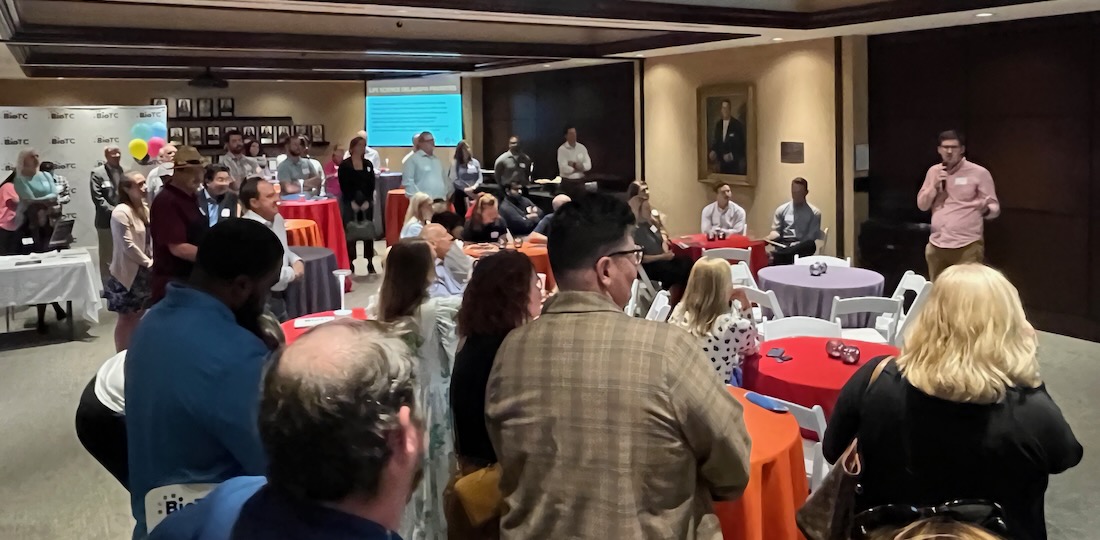
Anyway, I wrangled a ticket to attend the Greater OKC Chamber’s recent networking event and walking tour of the still-under-construction Convergence development.

My professional background includes many years of covering Oklahoma’s emerging biotech industry, first as a reporter for The Oklahoman newspaper and later as a writer and then freelancer for i2E, Inc., the not-for-profit that mentors and invests in many of the state’s entrepreneurial startups.

So, that led me to gather with about 75 folks at the Oklahoma  Our Blood Institute, which sits at the intersection of NE Eighth Street and Lincoln Blvd. It’s maybe a 50-yard walk from OBI to the new development.

Here’s what I learned that afternoon during the networking event and walking tour:

First, the Oklahoma Bioscience Association has been rebranded as Life Science Oklahoma, which made its debut at the annual BIO show in San Diego this past June. My friend, Dr. Craig Shimasaki, co-founder and CEO of OKC’s Moleculera Biosciences,  is co-chair of Life Sciences Oklahoma, along with Andrew Westmuckett, director of technology ventures at the Oklahoma Medical Research Foundation. 

Education will play a major role at the Innovation Hall, which features a Bio Pharmaceutical Workforce Training Center called BioTC.  We received a good explanation of how the space will accommodate aspiring biotech workers from Koey Keylon, BioTC’s, executive director. It will offer one-week, hands-on short courses in biotechnology manufacturing in which students will learn the biotech process and how to use sophisticated technology involved. It also offers an advanced two-week certification curriculum.
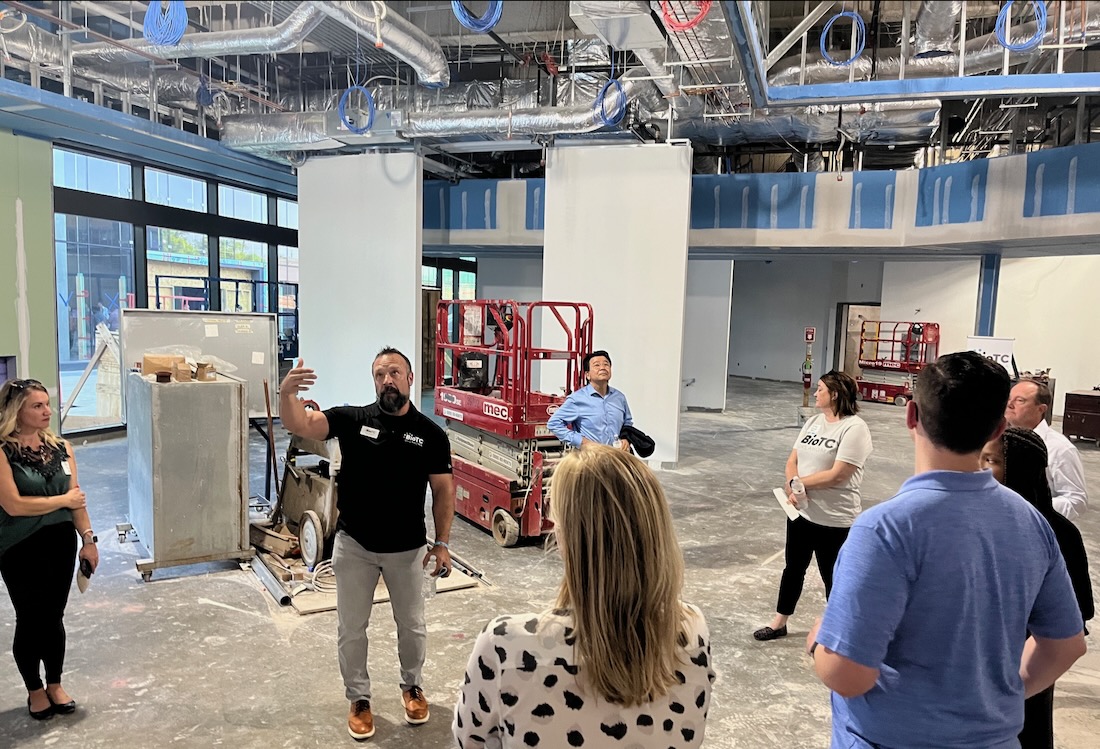
BioTC
Koey Keylon, executive director of BioTC, shows off the educational space in the Innovation Hall

Innovation Hall also includes a large Event Hall, a cafe and lounge open to the public, four conference rooms and two small “phone booth” size work/meeting spaces.

Innovation Hall is part of MAPS 4 Innovation District funding, which contributed $11 million to the development, with another $10 million or so from non-MAPS sources, according to the City of OKC.

After we toured the Innovation Hall, we entered the first floor of the Convergence tower. Much of the first floor will be occupied by Wheeler Bio,  an up-and-coming contract development and manufacturing organization in the life sciences space. Wheeler Bio also will have administrative offices on upper floors of the building.

CrossFirst Bank has been announced as a tenant, while the University of OklahomaTinker Air Force Base  and an unnamed aerospace partner will occupy the eighth floor.

All this was empty space as we toured it, but you could see the possibilities and envision the future.

By the way, I highly recommend you crossing over I-235 onto Eighth Street to drive slowly past the Convergence project for a closer view, then meander through the Innovation District that includes OSU’s Hamm Institute for American Energy adjacent to Convergence on the north side, University Research Park to the south and OU Health Sciences Center to the north and east.

In a year or maybe less, Convergence tower and Innovation Hall should be filled with bioscience research and manufacturing professionals. as well as students aspiring for a biotech career, while offering great meeting and hangout space in the Innovation Hall.

I can’t wait to see it all in action.
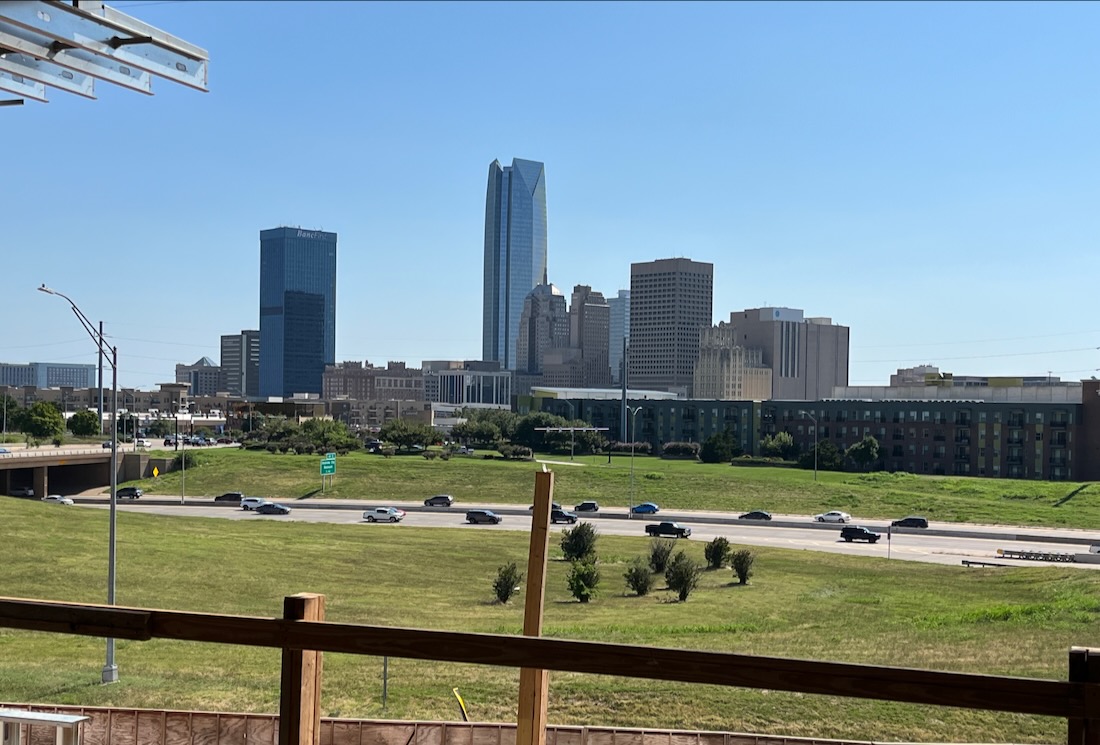
Downtown view
View of downtown OKC from second floor of the Convergence Tower
Innovation Events
Event space in the Innovation Hall
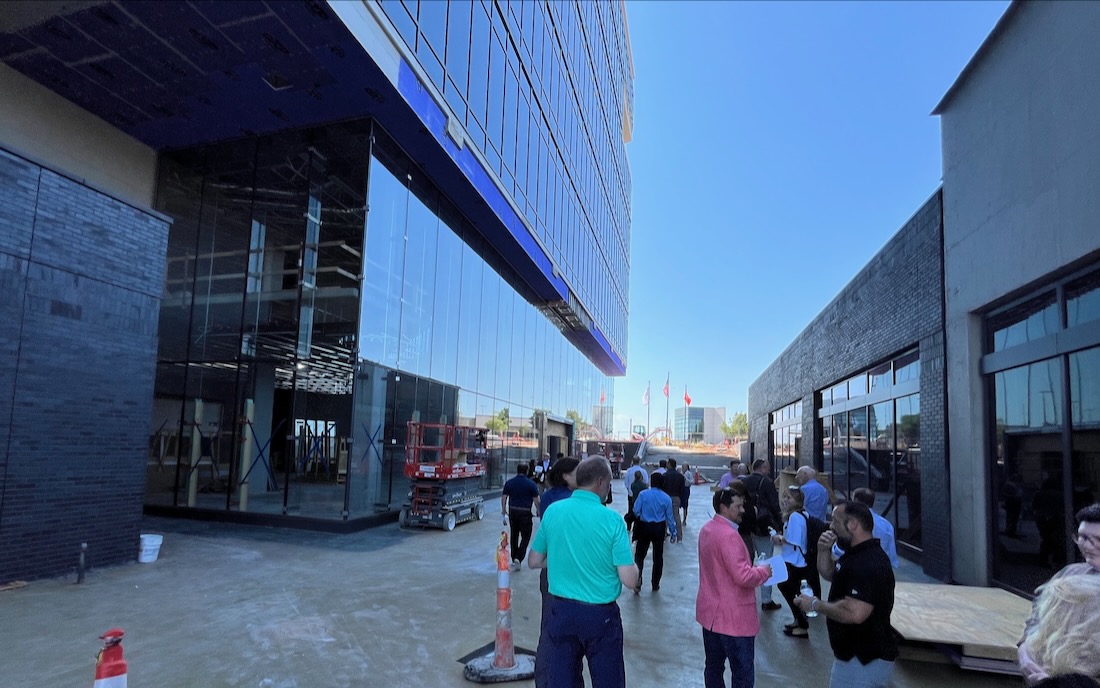
Buildings
Walking between buildings on a tour of the rising Convergence project in OKC.
Jeff Seymour
Jeff Seymour, executive vice president of the Greater OKC Chamber, welcomes guests to the recent networking event and Convergence project walking tour.

I met my friend, Dr. Craig Shimasaki, at a conference 1,600 miles from OKC

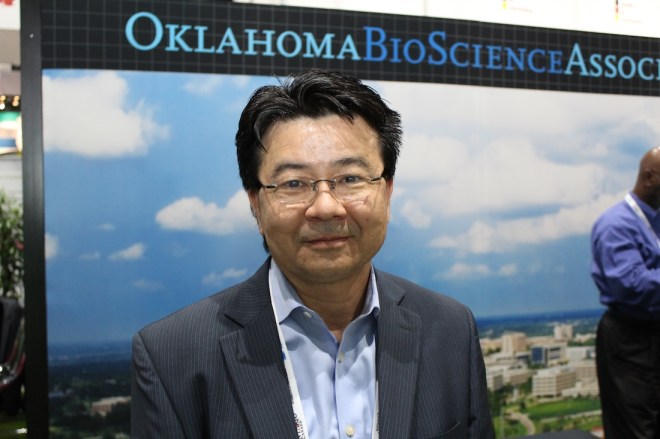
Dr. Craig Shimasaki at OKBio booth on the floor of a past Biotechnology Industry Organization conference.

Two decades ago, I was one of a group of more than 50 Oklahomans who represented Oklahoma’s life science community at the annual BIO — Biotechnology Innovation Organization — conference in San Francisco.

It was my first time to attend the BIO show and to travel as part of the group that identified itself as OKBio. The annual BIO show brings thousands of people — scientists, entrepreneurs, investors, economic development professionals and reporters — together for a week of networking and showcasing emerging life science technologies.

There was a joke that we had to travel 1,600 miles to get to know our neighbors.

Only it was not a joke, but, in fact, reality.

That 2004 BIO show was my first of what became more than a dozen trips with the OKBio group to pitch Oklahoma and our growing life sciences community in major cities like San Francisco, Chicago, San Diego, Washington, D.C., and more.

So, I met a lot of people on that first BIO trip who became important sources to me as a newspaper reporter for future articles about local startups or emerging research.

In fact, I specifically recall meeting Craig Shimasaki, MBA, Ph.D., on the floor of San Francisco’s Moscone Center. Dr. Shimasaki was stationed along with his wife in front of a display that showcased the OKC-based startup he was guiding at the time.

If you’re not familiar with Dr. Shimasaki, he’s a California native who emigrated from his home state to Oklahoma to help develop a technology that diagnosed the flu virus. Along the way, he also earned his MBA from Northwestern University, his Ph.D. in Molecular Biology and Biotechnology from the University of Tulsa, and never left the state.

Since that first introduction, I’ve become friends with Dr. Shimasaki and interviewed him probably a dozen times or more for newspaper articles on Oklahoma-based startups he founded or guided, groundbreaking research in which he was involved and books on entrepreneurship he wrote.

I’ve watched him participate in a panel discussion on ‘gut health’ at one BIO show and engage with potential investors in a Startup Stadium presentation at another. I’ve sat in on Love’s Entrepreneur’s Cup pitches by college teams for which he served as advisor. He’s led me on a tour of a world class laboratory that he oversees.

It was from Dr. Shimasaki as he discussed one of his books on biotech entrepreneurship years ago that I first encountered the term “you don’t know what you don’t know.”

And, you know, I don’t know.

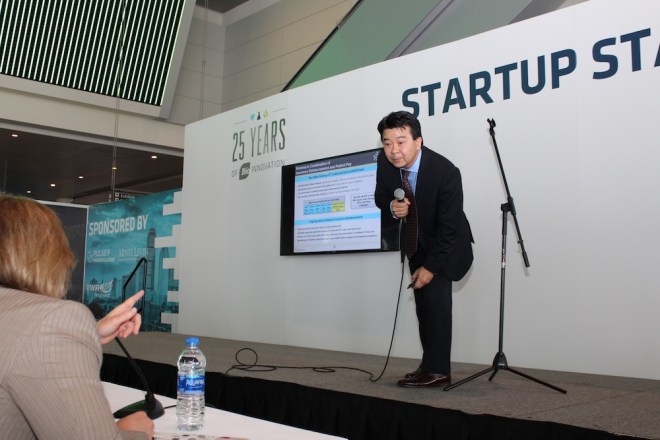
Dr. Craig Shimasaki making a presentation at a past BIO show.

I’ve written all of this because of how life sometimes leads you back to where you began.

Recently, I reconnected with Dr. Shimasaki through Moleculera Labs,  the Oklahoma City-based company for which he co-founded and serves as CEO. Molecular Labs describes itself as “a precision medicine company focused on identifying the underlying immune-mediated root of neurologic, psychiatric, and behavioral disorders.”

The company has gained a lot of attention both local and nationally for its technology that can identify the underlying cause of apparent psychiatric and behavioral disorders that afflict both children and adults. Moleculera Labs has tested more than 15,000 patients since it began offering its test panel on a commercial basis about a decade ago.

So, when Dr. Shimasaki asked me to provide some assistance in crafting press releases for breaking news the company sought to share, I was all in.

Over the past two weeks, Molecular Labs announced the addition of a long-time life science industry veteran to its Board of Directors, and also revealed that it has been awarded a $500,000 grant from the Oklahoma Center for the Advancement of Science and Technology (OCAST) that will help it develop AI technology that will be integrated into its test panels.

Here’s a link to the announcement of Rodney Cotton as a new Moleculera Board member.

And here’s a link to the news release about OCAST Oklahoma Applied Research Support grant the company received.

There is even more breaking news from Moleculera Labs this month. The company announced this past week a strategic collaboration with Quest Diagnostics by which its offers patients of its neuropsychiatric autoantibody test services the option to provide blood specimens to any of Quest’s lab centers across the U.S.

Here’s a link to the Quest Diagnostics announcement.

It’s all big news not only for Moleculera Labs, but for the state’s entire life sciences community and all of Oklahoma.

For me, it’s the latest development in a relationship that began two decades ago on the floor of the BIO show 1,600 miles from OKC.

We’ve been good ‘neighbors’ ever since.

BONUS COMMENT FROM DR. SHIMASAKI:

“The BIO International Conferences allowed us to connect, and it’s been a wonderful relationship working with Jim Stafford over the many years as he has been actively covering the biotech and life science scene in Oklahoma,” Dr. Shimasaki said.  “Jim has an innovative way to tell audiences about the interesting stories in a way that inspires and informs,”

Thanks for the kind words, Dr. Shimasaki, but it’s innovators like you who have shown me the impact that your research can have — and is having — on human health worldwide.