Gov. Stitt, let’s value lives over dollars

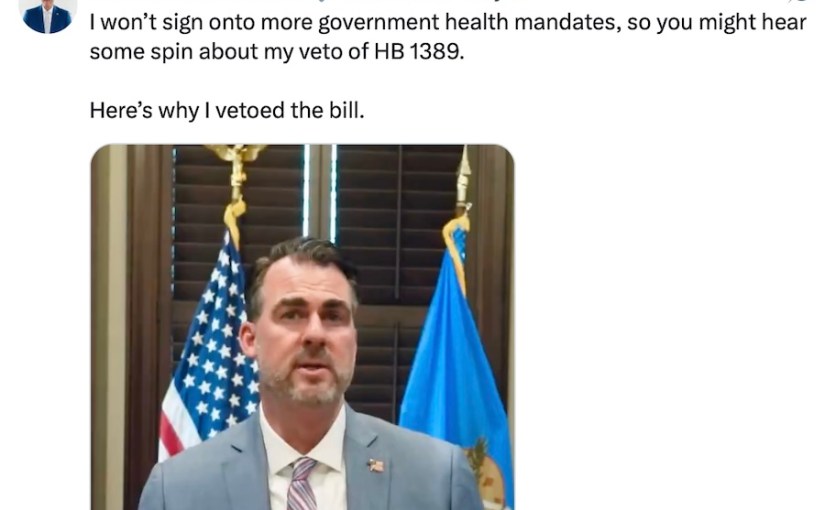
Gov. Kevin Stitt’s Twitter/X post about his veto.

I took a step this week that I’ve never taken before. I called my legislators urging them to help overturn Gov. Stitt’s veto of legislation that expands access for women to imaging technology that can detect breast cancer.

My wife, Paula, a breast cancer survivor, called our legislators, as well.

Another first.

HB 1389, passed by big margins in both houses, would require insurance plans to cover not only mammograms, but other diagnostics such as “enhanced mammogram, breast MRI, breast ultrasound or molecular breast imaging.”

Paula and I were surprised that Oklahoma’s Governor vetoed legislation that would undoubtedly save lives because, as he said in a statement, it would result in higher health insurance premiums across Oklahoma.

Here’s the Governor’s full statement on the veto:

“I am deeply sympathetic to the women across our state who have bravely fought breast cancer. While early detection and access to care are critical priorities, this legislation imposes new and costly insurance mandates on private health plans that will ultimately raise insurance premiums for working families and small businesses.”

Here’s what I take away from the Governor’s veto:

  • He values dollars over lives.
  • He devalues the lives of women.
  • He demonstrates a complete lack of empathy.
  • He’s obviously influenced by the insurance industry.

I’m pretty sure that the price of treating an advanced breast cancer would be far more than the cost of early detection.

I’ve seen a lot of outrage on social media at Stitt’s veto, much of it by women whose lives have been upended by breast cancer — thinking of you, Savannah.

In fact, one of the authors of HB 1389, was Melissa Provenzano, D-Tulsa, who is caught up in her own battle with breast cancer. Click here to read a story from the online news service, Oklahoma Voice, that details reactions to Stitt’s veto and efforts to override it.

Republicans and Democrats alike supported the legislation as it advanced through both legislative houses.

Of course, Stitt said on X/Twitter that he anticipates ‘spin’ on his veto.  It’s not spin Governor. It’s outrage.

So, I’m urging readers of this post to pick up the phone, call your legislators and urge them support the move to override the veto. Or email. Find your local legislators and contact info through this link. 

It will take a supporting vote by two-thirds of state legislators to overturn the veto, so it’s a high bar.

Remind them it’s about valuing lives of Oklahoma’s women over any added expense of diagnosing what often is a fatal disease if not detected early enough.

Take a stand.

OU showcases Stephenson Cancer Center at End2Cancer conference

A scientists presents his findings at the End2Cancer conference at the Samis Education Center on the OU Health Center campus

By Jim Stafford

The University of Oklahoma Health Sciences Center and the NCI-Designated Stephenson Cancer Center delivered an academic doubleheader for about 200 cancer research scientists at the recent 2019 END2Cancer conference at the Samis Education Center on the Health Center campus.

For the main event, scientists came to share their research or hear presentations given by counterparts from across the country who are pursuing breakthrough discoveries in the area of cancer treatment. At the two-day conference, the scientists focused on emerging nanotechnology and cancer drug delivery applications.

At the same time, OU showcased its renowned Stephenson Cancer Center on the Health Sciences Center campus, said Rajagopal Ramesh, Ph.D., conference chair and professor, Department of Pathology at the University of Oklahoma College of Medicine.

“The whole idea in organizing this conference for the third consecutive year – beyond the science – was to put Oklahoma on the map and have the Stephenson Cancer Center recognized for the great science that we do in the diagnosis and treatment of cancer,” Ramesh said. “We have eminent speakers coming in from all over the country, and the majority of them have never been to the state of Oklahoma or to the Stephenson Cancer Center.”

The NCI-Designated Stephenson Cancer Center ranks in the top 50 in the nation for cancer care in the 2019-2010 U.S. News & World Report ranking and currently ranks No. 1 among all cancer centers in the nation for the number of patients participating in clinical trials.

“They were highly impressed,” Ramesh said. “The first thing I hear when they come in is ‘Wow, I never knew such an outstanding cancer center with top-notch research infrastructure exists.’ We wanted them to come in and have the opportunity to go to the Stephenson Cancer Center and look at some of the cutting-edge clinical trials we are doing at the center.”

Ramesh pursues his own cutting-edge research at the Stephenson Cancer Center, developing nanoparticles that can deliver drugs specifically to tumors and minimize the toxicity that is often a cancer treatment side effect. He specializes in the diagnosis and treatment of lung cancer.

Ramesh recently received a grant from the U.S. Department of Defense to explore a means by which tumor cells may be avoiding immunotherapy in lung cancer. The study is unique in that it is being conducted on lung cancer patients in real time while they are on a clinical trial receiving an immunotherapy medication.

The Oklahoma Center for the Advancement of Science and Technology (OCAST) also supports Ramesh’s lung cancer research with a $135,000 Health Research grant.

“OCAST has been beneficial not only to my lab but across the entire state of Oklahoma,” Ramesh said. “The whole idea of OCAST is to bridge the transition from academic research to an industry setting in the state of Oklahoma. By receiving funds from OCAST, we are able to generate new ideas and test them first in the lab.”

Wei Chen, Ph.D., professor and dean of the College of Mathematics and Sciences at the University of Central Oklahoma, is another OCAST-supported scientist who moderated an END2Cancer panel discussion and presented findings from his own nanotech-based research at the conference.

“Ending cancer is everybody’s dream,” Chen said. “So everybody in this conference and many researchers around the world are contributing to the fight against cancer. We are making good inroads both in terms of nanotechnology and other methodologies. But cancer is a very tough enemy, as we know. Therefore, we still have a long way to go.”

Jim Stafford writes about Oklahoma innovation and research and development topics on behalf of the Oklahoma Center for the Advancement of Science & Technology (OCAST).